- 431 -
Introduction
Callistemon citrinus (Myrtaceae) is a shrub with a distinct citrus aroma (thus the common name is lemon bottlebrush).
Ethanolic leaf extracts of C. citrinus were shown to have a strong anti-Mycobacterium tuberculosis activity (Frame et al., 1998). In addition, a compound isolated as a component of the steam-volatile oils from C. citrinus, leptospermone, showed a moderately active herbicide and thus produced unique bleaching symptoms on susceptible weed species (Mitchell et al., 2001). The water-distilled essential oil from the leaves and flowers of C. citrinus contained the active components. The chemical composition was determined by GC, GC/MS and GC/FTIR, and identified as 1,8-cineole, α -pinene and -terpineol (Chane-Ming α et al., 1998).
In the course of study to search anticariogenic agents (Lee et al., 2002; Park et al., 2005), we found that the extracts from C. citrinus had antibacterial activity against Streptococcus mutans which is a bacterial species in oral flora and is associated with the initial development of enamel lesions and producing dental caries (Hamada and Slade, 1980; Loesche, 1986). Numerous chemicals and antibiotics are being used as antibacterial agents against S. mutans to reduce plaque-
mediated diseases including dental caries (Gjermo et al., 1973). However, many of these agents are known to have undesirable side effects such as teeth staining, vomiting and diarrhea (Chen et al., 1989). For this reason, great concern is focused on natural products including wood extractives as natural antifungal agent (Park et al., 2004). Moreover, many researches are reported on screening natural products including medicinal plants for anticariogenic agents (Skanaka et al., 1989; Bae et al., 1992).
Here, we report the isolation and identification of com- pound from the fruit of C. citrinus and also evaluated its anticariogenic activity.
Materials and Methods
Plant materials and extraction
The fruit of C. citrinus were collected from Jeju Province, Korea during June, 2002. A voucher specimen was deposited at the Korea Forest Research Institute, Suwon, Korea. Dried the fruit of C. citrinus was finely ground, extracted twice with ethanol (EtOH) and then evaporated to give the crude extract.
The crude extracts of the fruit was successively partitioned with various organic solvents in the order of n-hexane, methylene chloride (CH
2Cl
2) and ethyl acetate (EtOAc).
Anticariogenic activity of piceatannol isolated from Callistemon citrinus fruit against Streptococcus mutans
Youngki Park* and Moon-Ho Lee
Div. Special Purpose Tree, Korea Forest Research Institute, 44-3 Omokcheon, Suwon 441-350, Korea
Abstract - Dental caries is the destruction of the enamel of teeth by Streptoccus mutans. S. mutans has been isolated from human dental plaque and is associated with the initial development of enamel lesions. We have studied the antibacterial action of the fruit of Callistemon citrinus against a cariogenic bacterium, S. mutans. From the fruit of C. citrinus, piceatannol (3,3',4',5-tetrahydroxystilbene) was isolated by repeated column chromatography with SiO
2and Sephadex LH-20. Its structure was elucidated by instrumental analysis using 1D-NMR, 2D-NMR and EI-MS. This compound was isolated from the fruit of C. citrinus for the first time. The anticarcinogenic activity of this compound was determined by using agar well-diffusion method and minimal inhibition concentration (MIC).
Key words - Callistemon citrinus, Streptococcus mutans, piceatannol, anticariogenic activity
* Corresponding author. E-mail : [email protected]
Korean J. Plant Res. 21(6) : 431~434(2008)
Korean J. Plant Res. 21(6) : 431 ~ 434(2008)
- 432 -
Isolation of compound
The methylene chloride fraction was subjected to column chromatography on silica gel column eluted with CH
2Cl
2- MeOH (30:1, v/v) to yield 3 sets of fraction (CC1 CC3). ~ Fraction CC3 was rechromatographed on Sephadex LH-20 column with MeOH-H
2O (1:1, v/v) to give 3 subfractions (CC3-1 CC3-3). Compound was obtained from second ~ fraction (CC3-2) among three subfractions as brown amorphous powder.
EI-MS m/z : 244 (M
+, molecular ion) 173, 81, 63.
1H-NMR (500 MHz, CD
3OD) : 6.17 (1H, δ t, J = 2.3 Hz, H-4), 6.45 δ (2H, d, J = 2.5 Hz, H-2,6), 6.74 (1H, δ d, J = 8.5 Hz, H-5'), δ 6.75 (1H, d, J = 16 Hz, H-7), 6.84 (1H, δ dd, J = 2, 9 Hz, H-6'), 6.89 (1H, d, J = 16 Hz, H-8), 6.98 (1H, d, J = 2 Hz, H-2').
13
C-NMR (125 MHz, CD
3OD) : δ 159.6 (C-3,5), 146.5 (C-4'), 146.4 (C-3'), 141.3 (C-1), 131.1 (C-1'), 129.7 (C-8), 127.0 (C-7), 120.2 (C-6'), 116.4 (C-5'), 113.8 (C-2'), 105.7 (C-2, 6), 102.6 (C-4).
HMBC correlations : H-2,6 C-7, H-2' C-8/C-8, H-5' → → → C-1', H-8 C-1/ C-7/C-1'/C-2'. →
Instrument analysis
1
H and
13C NMR with TMS as internal standard. NMR spectra were obtained using a Varian UI 500 spectrometer at the operating frequency of 500 MHz (
1H) and 125 MHz (
13C) at Korea Basic Science Institute in Seoul. EI-MS: JEOL JMS-600W, direct inlet at 70 eV.
Anticariogenic acivity test
S. mutans (KCTC 3065) was used to measure antibacterial activity of the extracts by paper disc diffusion method. S.
mutans was cultured in BHI broth (Difco) at 37 ℃ for 48hr and ca. 1×10
6cell numbers of bacteria were mixed uniformly with BHI agar medium in petri dish. Paper discs soaked in the crude drug extract were carefully placed on the bacteria agar medium in petri dishes. The cultivation was carried out at 3 7 ℃ incubator for one day and the inhibition zone against S.
mutans was measured.
The minimal inhibition concentration (MIC) in the samples were measured according to the methods of Namba et al.
(1982) and Hwang et al. (2004). Samples (10 mg) were dissolved in ethanol (1 mL) and prepared in a series of diluted
solution. The solution (0.1 mL) was then added to 0.9 mL of sterile liquid BHI with 0.1 mL of a bacterial suspension (ca.
2×10
5colony forming units ((CFU)/mL) to each test tube.
The tube was mixed and incubated at 37 ℃ for 48hr. The MIC was defined as the lowest concentrations of a crude extract at which no visible growth of S. mutans was observed.
Results and Discussion
Identification of compound isolated from the fruit of C.
citrinus
The structure was elucidated by spectral data such as MS,
1
H- and
13C-NMR spectra and 2D-NMR spectra. Compound obtained from the methylene chloride soluble fraction of the ethanol extract of the fruit of C. citrinus was isolated as brown amorphous powder. The
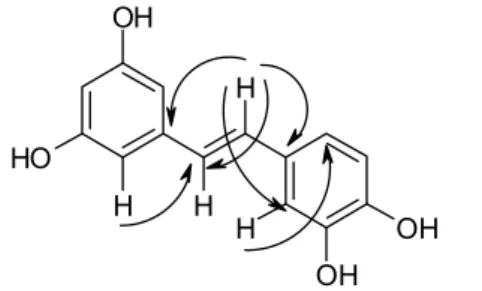
1H-NMR spectrum of compound showed signals assignable to one doublet representing two proton at δ 6.45 (2H, d, J = 2.5 Hz, H-2,6) and two trans olefinic protons at δ 6.75 (1H, d, J = 16 Hz, H-7) and 6.89 (1H, d, J = 16 Hz, H-8). A total of 12 carbons appeared in the
13
C-NMR spectrum, which induced three oxgenated-olefine tertiary carbon ( 159.6, 146.5, 146.4), two olefine tertiary δ carbon ( 141.3, 131.1) and seven olefine methine carbon ( δ δ 129.7, 127.0, 120.2, 116.4, 113.8, 105.7, 102.6). Carbons with protons and their protons were precisely matched by the HMQC experiment. In the HMBC spectrum (Figure 1), major correlations were observed between H-8 and C-1 (141.3), C-7 (127.0), C-1' (131.1), and C-2' (113.8). From the above evidence, the structure of compound was concluded to be 3,3',4',5-tetrahydroxystilbene, piceatannol (Figure 2) which isolated from the fruit of C. citrinus for the first time. All the spectral data of this compound were in good agreement with those of Oh et al. (2001) and Li et al. (2005).
OH OH OH
O H
H H
H H
Fig. 1. HMBC correlations for the compound isolated fromthe fruit
of C. citrinus.
Anticariogenic activity of piceatannol isolated from Callistemon citrinus fruit against Streptococcus mutans
- 433 -
Anticariogenic acivity
The anticariogenic activity of the fruit extracts, its CH
2Cl
2fraction, and piceatannol from the C. citrinus are shown in Table 1. The diameters of inhibition zone (mm) of fruit extracts its CH
2Cl
2fraction, and piceatannol were 19.1, 18.5 and 21.3 mm (at 5 mg/disk), respectively. The MIC values of the fruit extract and its CH
2Cl
2fraction and piceatannol are 31.3, 31.3 and 15.6 ug mL ・
-1, respectively, indicating that piceatannol had the highest anticariogenic activity. Piceatannol initially isolated from the heartwood of Vouacapoua species was previously identified as an antileukemic agent (Zheng and Ramirez, 1999). However, it is first time to report on the anticariogenic activity.
Compared with other researches, our results show that the C. citrinus plant has a strong inhibitory effect on the growth of S. mutans. Although the growth inhibition zones of baicalein and ganhuangenin (at 100 ㎍ /disc) isolated from Scutellaris baicalensis were 11.2 and 10.2 mm, respectively (Moon et al., 1997), the MIC value of piceatannol had two times higher than that of sanguinarine isolated from Sanguinaria canadensis, being used for the industrial mouthwash products (Southard et al., 1984). Methanol extracts from Coptis chinensis also showed inhibitory effects
on the growth of S. mutans with the MIC value of 130 ug mL ・
-1(Jang et al., 2000). From the results we suggest, the fruit extracts and isolated compound, piceatannol, from C. citrinus could be used to effectively control dental caries.
Literature Cited
Bae, K., W. Seo, T. Kwon, S. Baek, S. Lee and K. Jin. 1992.
Anticariogenic β -Carboline alkaloids from Commelina communis. Arch. Pharm. Res. 15: 220-223.
Chane-Ming, J.P.R.Vera and D. J. Fraisse. 1998. Chemical composition of essential oil of Callistemon citrinus (Curtis) Skeel from Reunion. J. Essent. Oil Res. 10: 429-431.
Chen, C.P., C.C. Lin and T. Namba. 1989. Screening of Taiwanese crude drugs for antibacterial activity against Streptoccus mutans. J. Ethnopharmacol. 27: 285-295.
Frame, A.D., E. Rios-Olivares, L. De Jesus, D. Ortiz, J. Pagan and S. Mendez. 1998. Plants from Puerto Rico with anti-Mycobacterium tuberculosis properties. P R Health Sci.
J. 17: 243-252.
Gjermo, P., G. Oloosa and L. Arskang. 1973. Effect on dental plaque formation and some in vitro properties of 12 bisbiguanides. J. Periodont. Res. 12: 81-88.
Hamada, S. and H.D. Slade. 1980. Biology, immunology and cariogenicity of Streptococcus mutans. Microbiol. Rev. 44:
331-384.
Hwang J.K., J.Y. Chung, N.I. Baek and J.H. Park. 2004.
Isopanduratin A from Kaepferia panduata as an active antibacterial agent against cariogenic Streptococcus mutans.
Int. J. Antimicrob. Ag. 23: 377-381.
Jang, G.H., B.Y. Ahn, S.H. Oh, D.S. Choi and Y.J. Kwon. 2000.
Anticariogenic effects of Coptis chinensis Franch extract.
Kor. J. Food Sci. Technol. 32: 1396-1402. (in Korea) Lee, W.Y., J.K. Ahn and Y.J. Kwon. 2002. The screening of
antibacterial activity against Streptococcus mutans and glucosyltransferase inhibitory activity from woody plants.
Table 1. Anticariogenic activities of crude extracts, methylene chloride fraction and piceatannol from C. citrinus against S. mutans.
Samples Diameter of inhibition zone (mm) MIC
(ug ・ mL
-1)
5
*3.75 2.5 1.25 0.62
Crude extracts 19.1 17.5 15.8 12.5 10.0 31.3
CH
2Cl
2fraction 18.5 16.3 15.2 13.1 9.8 31.3
Piceatannol 21.3 20.3 17.9 15.3 12.1 15.6
*
mg/disk
OH OH OH
O
H 1
4 2
1' 2'
5' 6'
7 8
Fig. 2. Chemical structure of the compound isolated from the fruit
of C. citrinus.
Korean J. Plant Res. 21(6) : 431 ~ 434(2008)
- 434 -