서 언
인간의 수명은 급격히 늘고 있지만, 현대사회에서 각종 스트 레스, 운동부족, 환경오염, 잘못된 식습관으로 인하여 노화, 암, 당뇨, 비만, 심장질환 등 각종 질환의 발병률이 증가되는 것으 로 밝혀지고 있다(Kim, 2010). 이를 위해 다양한 약용 식물들로 부터 건강 기능성 식품개발을 위한 성분분석, 항산화, 항균, 항 암, 항비만과 같은 효능의 연구가 활발하게 진행되고 있다(Kim, 2015; Kim and Cha, 2017). 최근 이와 같은 연구로서 와송의 추출 물을 이용한 연구들이 다양하게 진행되고 있다. 와송(Orostachys japonicus A. Berger)은 암송, 옥송, 작엽하초, 바위솔 등으로 불리는 돌나물과의 식물로, 가을에 추대되어 종자의 성숙과 함
께 고사하는 일년생 식물이다(Jeon et al., 2006). 현재까지 진 행된 와송의 효능들로는 인체 대장암 세포주에 와송 클로로포 름 분획물 100 ㎍/㎖ 농도로 24시간 처리 후 50.19% 세포 생존이 나타나는 결과가 보고되었고(Jung, 2011), 전립선암 세포주에 600 ㎍/㎖ 농도로 48시간 처리한 경우 10%의 세포 생존율과 apoptosis 유도가 보고되었다(Won et al., 2014). Oh et al. (2009) 은 와송추출물 실험에서 백혈병세포주의 apoptosis 유도단백 질의 합성을 촉진시켰다고 하였으며, Suk (2011)은 염증반응을 유도한 대식세포에 와송의 dichloro methane 추출물 처리한 경 우 nitric oxide (NO) 생성억제와 항염증 효과가 보고하였다. 또 한 식이성 고지혈증을 유발한 흰쥐에 와송 추출물의 경구투여 를 한 흰쥐는 정상식이를 한 흰쥐보다 체중이 감소하고, 중성지 질의 함량이 감소하는 결과를 보여 와송이 항비만과 고지혈증 에 대한 효과가 있다고 보고하였다(Kim et al., 2009). 이 외에
와송(Orostachys japonicus) 용매별 분획 추출물의 항산화, 항균 및 암세포 독성 비교
김승미, 박정훈, 부희옥, 송상기, 박현용*
조선대학교 자연과학대학 생명과학과
In vitro Comparision of Biological Activities of Solvent Fraction Extracts from Orostachys japonicus
Seung Mi Kim, Jeong Hun Park, Hee Ock Boo, Sang Gi Song and Hyeon Yong Park*
Department of Life Science, Chosun University, Gwangju 61452, Korea
Abstract - This study was conducted to evaluate the contents of total polyphenol and flavonoid, and the effect of antioxidant, antimicrobial activities and cytotoxicity in vitro by different solvent fractions from Orostachys japonicus. The ethylacetate fraction extract for O. japonicus contained 634.48 ㎍/g polyphenol and 205.20 ㎍/g flavonoid. The ABTS radical scavenging ability of ethylacetate fraction extract at 1 ㎎/㎖ was higher than 95% which is comparable to ascorbic acid of 97%. The APX enzymatic activity and CAT activity were 1125.89 μmol ascorbate oxidized/min/㎎ protein and 119.87 H2O2 decomposed/ min/ ㎎ protein, respectively. In disc agar plate diffusion assay, the extract gave rise to a larger inhibition circle with Listeria monocytogenes, Staphylococcus epidermidis, Staphylococcus aureus and Malassezia furfur strains compared with antibiotics kanamycin suggestive of high antibiotic activity. The cytotoxicity of extracts of O.
japonicus was significant differences between solvent fractions. That is, the cytotoxic effect against human cancer cell was higher in ethylacetate fraction extract than other fraction extracts. These results suggest that fraction extract of O. japonicus might be very effective and economical in developing natural antioxidant and antimicrobial.
Key words -
Orostachys japonicus, Total polyphenolics, Antioxidant, Antimicrobial, Cytotoxicity
*교신저자: [email protected] Tel. +82-62-230-6652
Original Research Article
도 와송의 효능에 대해서 건조방법 (Lee et al., 2008) 및 추출용 매에 따른 항암, 항산화, 항비만, 항염증 효과에 대한 연구들이 있다. 그러나 현재까지의 연구에서는 대부분 단일용매 추출물에 관한 연구에 국한되어 있다. 따라서 본 논문에서는 와송을 n-hexane, methylenechloride, ethylacetate, n-butylalcohol, water를 이용하여 5가지 용매로 분획 추출하였고, 각 분획 추 출물에 대해 여러 생리활성을 비교하였다. 즉, 분획별 총 폴리 페놀과 플라보노이드의 함량을 측정하였고, 천연 항산화제로 서의 이용 가능성을 알아보기 위하여 항산화능 및 항산화 효소 활성을 측정하였다. 또한, 다양한 균주들을 대상으로 와송 분 획 추출물의 항균력을 측정하여 식품첨가물이나 생활용품 개 발 등에 활용함으로써 식품산업 및 향장산업에서의 이용가치 를 검토하고자 하였다. 그리고 와송 분획 추출물별 폐암, 대장 암, 유방암 세포주의 세포독성을 조사함으로써 암 예방 및 치료 를 할 수 있는 건강 기능성 식품으로의 활용 가능성을 규명하고 자 하였다.
재료 및 방법
재료식물 및 시료의 추출
노지에서 재배된 와송(Orostachys japonicus)을 2014년 7월 채취하여 실험에 이용하였다. 와송을 -70℃ 이하 초저온 냉동 고(NIHON, Japan)에 5시간 이상 동결시킨 후, 동결된 재료를 0.05 ∼ 0.5 Torr (mmHg)로 -50℃ 이하에서 완전하게 진공 동 결건조(Ilshin, Korea)하여 시료로 이용하였다. 동결건조된 와 송 부피의 2배량(v/v)의 98% methanol에 48시간 이상 침지하 여 총 3회 반복 추출하였고, 이 추출액을 40∼45℃에서 감압 농 축(BUCHI, Switzerland)하였다. Methanol추출물을 분별 깔대 기에 담아 Fig. 1에서와 같이 각 용매별로 분획, 추출하였다. 즉, 분별 깔대기에 증류수 500 ㎖를 넣고, 극성이 낮은 n-hexane 500 ㎖를 첨가하여 24시간 이상 교반하여 분획, 추출하였고, 다 음으로 methylenechloride 500 ㎖, ethylacetate 500 ㎖, n-butyl alcohol 500 ㎖로 순차적으로 반복 추출하여 용매별 분획물을 획득하였다. 이 분획물을 감압 농축하여 완전히 건조시킨 후, 냉동 보관하면서 각 생리활성 실험에 사용하였다.
총 폴리페놀 함량 측정
Folin-Denis 방법(1912)에 따라 와송 분획 추출물에 대한 총 폴리페놀의 함량을 측정하였다. 분획 추출물은 98% methanol 에 1 ㎎/㎖로 용해하여 25 ㎕, 10배 희석한 folin- ciocalteu reagent 500 ㎕를 혼합하여 상온에서 5분간 반응시킨 후, 7.5% sodium carbonate (Na2CO3) 500 ㎕를 첨가하여 혼합하였다. 이 혼합액 을 water bath (BUCHI, Switzerland)에서 37℃로 60분간 반응 시켰다. Spectrophotometer (Mecasys, Korea)를 이용하여 750 ㎚ 에서 흡광도를 측정하였다. 폴리페놀 표준물질로 chlorogenic acid (Sigma, USA)를 이용하여 검량선을 작성하였으며, 이를 기준 으로 와송의 분획별 추출물의 총 폴리페놀 함량을 정량하였다.
총 플라보노이드 함량 측정
Jia와 Tang의 방법(1998)에 따라 와송 분획 추출물에 대한 총 플라보노이드 함량을 측정하였다. 분획 추출물을 98% 메탄올 에 1 ㎎/㎖농도로 용해하여 100 ㎕, diethylene glycol 1000 ㎕, 1N NaOH 10 ㎕를 넣어 잘 혼합한 후, water bath에서 37℃로 60분간 반응시켰다. Spectrophotometer를 이용하여 425 ㎚에서 흡광도를 측정하였다. 플라보노이드 표준물질로 naringin (Sigma, USA)을 이용하여 검량선을 작성하였으며, 이를 기준으로 와송의 분획별 추출물의 총 플라보노이드 함량을 정량하였다.
Fig. 1. Schemes of solvent fractionation from Orostachys japonicus.
항산화능 분석
DPPH radical 소거활성
Blois 방법(1958)에 따라 와송의 분획 추출물의 DPPH radical 소거 활성을 측정하였다. 분획 추출물을 98% 메탄올을 용매로 하여 희석시켜 실험에 이용하였다. 시료 100 ㎕와 100 ㎛의 DPPH 용액 900 ㎕를 혼합한 후, 암소에서 30분간 반응시켜주었다. Spect- rophotometer를 이용하여 517 ㎚에서 흡광도를 측정하여 radical의 감소를 정량하였다. 대조구에 대한 흡광도의 감소 정도 백분율 로 나타냈다.
ABTS radical 소거활성
Re et al.의 방법(1999)에 따라 와송의 분획 추출물의 ABTS (2,2'-azino-bis(3-ethylbenzothiazoline-6-sulfonicacid)di ammoniumsalt) radical 소거활성을 측정하였다. 와송 분획 추 출물을 메탄올을 용매로 하여 희석시켜 실험에 이용하였다.
ABTS∙+용액은 증류수에 2.45 mM potassium persulfate를 용 해하여 이 용액에 7 mM ABTS를 녹여 12∼17시간 이상 암소에 보관하여 ABTS cation radical을 형성 시킨 후, 이 용액을 734
㎚에서 흡광도 값이 0.900±0.002 이 되도록 methanol로 희석 하였다. 희석된 ABTS∙+용액 950 ㎕에 시료를 50 ㎕를 잘 혼합 한 후, 암소에서 5분간 반응시켰다. Spectrophotometer를 이용 하여 734 ㎚에서 흡광도를 측정하여 radical 감소를 정량하였 다. 대조구에 대한 흡광도의 감소 정도 백분율로 나타냈다.
아질산염 소거활성
와송 분획 추출물의 아질산염 소거활성 능력 측정은 Kato et al.
(1987)의 방법에 따라 0.1 N HCl 또는 0.2 M citrate buffer를 이용하여 반응액의 pH를 각 1.2, 4.0, 6.0으로 맞추어 반응의 차 이를 측정하였다. 분획 추출물(20 ㎎/㎖) 40 ㎕에 1 mM NaNO2
20 ㎕와 pH buffer 140 ㎕를 사용하였다. 이 반응액을 37℃에서 50분간 반응시킨 후, 2% acetic acid 1,000 ㎕, Griess reagant 80 ㎕를 첨가하여 혼합한 후, 빛을 차단한 암소에서 15분간 반응 시켰다. Spectrophotometer를 이용하여 520 ㎚에서 흡광도를 측정하여 아질산염 소거능을 백분율로 나타냈다.
항산화 효소 활성 분석 효소액의 조제
용매는 100 mM potassium phosphate buffer (pH 7.5) 48.5 ㎖ 에 2 mM EDTA 1 ㎖, PVP 0.5 g, 1 mM PMSF 500 ㎕로 준비하였 다. 항산화 효소 활성 측정은 용매 1000 ㎕에 와송 분획추출물
5 ㎎을 첨가하여 overnight시킨 후, 15,000 rpm으로 10분간 원 심분리한 후 상층액을 이용하였다. 각 분획 추출물 효소액의 단 백질은 Bradford 방법(1976)에 따라 BSA를 표준물질로 사용하 여 정량하였다.
Catalase(CAT) 활성의 측정
Catalase(CAT)활성은 Mishra et al. (1993)의 방법을 변형하 여 측정하였다. 효소액 100 ㎕와 100 mM potassium phosphate buffer (pH 7.0) 500 ㎕, 110 mM H2O2 400 ㎕를 혼합하였다. 소 거된 H2O2를 spectrophotometer를 이용하여 240 ㎚에서 1분간 흡광도를 측정하였다. 단백질 1 ㎎당 소거된 H2O2를 μmol로 표 기하였다.
Ascorbate peroxidase(APX) 활성의 측정
Ascorbate peroxidase (APX) 활성은 Chen과 Asada (1989) 방법에 따라 측정하였다. 효소액 100 ㎕와 200 mM potassium phosphate buffer (pH 7.5) 500 ㎕, 5 mM ascorbate 100 ㎕, 2 mM H2O2 10 ㎕를 혼합하였다. Ascorbate의 산화정도를 spect- rophotometer를 이용하여 290 ㎚에서 1분간 흡광도를 측정하 였다. 단백질 1 ㎎당 산화된 ascorbate를 μmol로 표기하였다.
Peroxidase(POX) 활성의 측정
Peroxidase (POX) 활성은 Chance와 Maehly (1995)의 방법 에 따라 측정하였다. 효소액 100 ㎕와 80 mM potassium phosphate buffer (pH6.9) 500 ㎕, 15 mM guaiacol 100 ㎕, 65 mM H2O2
100 ㎕를 혼합하였다. Tetra guaiacol 형성을 spectrophoto- meter를 이용하여 470 ㎚에서 흡광도 변화를 측정하였다. 단백 질 1 ㎎당 형성된 tetra guaiacol을 μmol로 표기하였다.
항균활성 분석
와송의 분획 추출물의 항균활성 효과를 측정하기위하여 한 천배지확산법(disc agar plate diffusion method)을 이용하였 다. 사용한 균주는 Listeria monocytogenes, Staphylococcus epidermidis, Staphylococcus aureus, Malassezia furfur, Es- cherichia coli와 Pseudomonas aeruginosa 등 총 6가지를 선발하 였으며, 위 균주들은 한국생명공학원구원 생물자원센터(KCTC)와 한국미생물보존센터(KCCM)로부터 구입하여 실험에 사용하였 다. 각 균주에 적합한 한천 배지(Table 1)를 petri dish에 분주, 응고시킨 다음 0.8% agar와 균주 100 ㎕를 혼합하여 준비한 top agar를 도말하였다. Top agar 표면에 멸균된 8 ㎜ paper disc
(Adventic, Japan)를 일정한 간격으로 올려놓고, 중앙의 paper disc에는 kanamycin (1 ㎎/㎖) 30 ㎕, 주변의 paper disc에는 각 분획추출물들을 30 ㎕씩 주입하였다. 이 때 각 분획물의 처리농 도는 10 ㎎/㎖로 하였다. 37℃에서 24시간 동안 배양하여 생성 되는 저해환을 측정하였다.
인체 암세포에 대한 세포독성
Hansen et al. (1989)의 방법에 따라 MTT assay법에 의해 와 송 추출물의 암세포 증식 억제 효과를 분석하였다. 실험에 사용 된 암세포주는 한국 세포주 은행에서 분양받은 인간 유래 폐암 세포주 Calu-6 (KCLB No.10002), 유방암 세포주 MCF-7 (KCLB No.30022), 대장암 세포주 HCT-116 (KCLB No.10247)를 실험 에 이용하였다. 각 세포주를 3×10⁴ cell/㎖ 밀도가 되도록 조정 하여 96 well microplate에 98 ㎕/well 씩 분주한 후, 37℃, 5%
CO2 습윤 세포 배양기에서 24시간 incubation하여 세포를 부착 시켰다. 각 well에 와송의 분획별 추출물을 2 ㎕씩 첨가하여 24 시간 동안 배양하였다. 그리고 각 well에 5 ㎎/㎖의 MTT solution (sigma, USA)을 10 ㎕씩 첨가하여, 4시간 동안 반응 시킨 후, 상층액을 제거하였다. 그리고 각 well에 100 ㎕의 DMSO를 첨 가하여 15분간 shaking 시켰다. Micro plate spectrophoto meter (BIO RAD, xMark, USA)를 사용하여 540 ㎚에서 흡광 도를 측정하였다. 각 세포의 추출물 무첨가군을 100%로 하여 암세포 증식 억제율을 구하였다.
통계처리
와송의 용매별 분획추출물의 생리활성에 대한 각 실험은 SAS software (SAS Institute, USA)을 이용하였다. ANOVA procedure을 실시하여 다중범위검정(Duncan's multiple range test)을 이용하여 0.05% 수준에서 유의성을 검정하였다. 와송 의 용매별 분획추출물의 생리활성에 대한 각 실험은 3회 실시하 였으며, 결과 값은 평균±표준오차로 표기하였다.
결과 및 고찰
총 폴리페놀 및 플라보노이드 함량
와송의 총 polyphenol 함량과 flavonoid 함량은 Table 2에 나 타냈다. 와송 분획추출물의 polyphenol 함량은 ethylacetate가 634.48 μg/mg로 가장 높았으며, 다음으로 n-butylalcohol 351.14 ㎍/㎎, n-hexane 148.37 ㎍/㎎, methylenechloride 124.38 ㎍/㎎, water 8.40 ㎍/㎎ 순으로 나타났다. 또한 총 flavonoid 함량은 polyphenol과 동일하게 ethylacetate 분획에 서 205.20 ㎍/㎎ 로 가장 높았으며, 다음으로 n-hexane 98.54
㎍/㎎, n-butylalcohol 97.85 ㎍/㎎, methylenechloride 74.63
㎍/㎎, water 5.67 ㎍/㎎ 순으로 나타났다. Kim et al. (2012)의 자생식물과 생약자원 추출물에 관한 연구에서 식물추출물의 폴 리페놀함량을 비수리 228.9 ㎎/g, 애엽 203.92 ㎎/g, 오이 171.94 ㎎/g, 참나무 겨우살이 46.76 ㎎/g 로 보고하였으며, 플 라보노이드 함량은 비수리 90.15 ㎎/g, 애엽 44.52 ㎎/g, 참나 무 겨우살이 57.02 ㎎/g, 질경이 48.06 ㎎/g, 울금 14.31 ㎎/g 등으로 보고하였다. 그리고 Hwang et al. (2014)은 안토시아닌 함량과 폴리페놀 함량이 높아 10대 슈퍼푸드로 선정되어 건강 기능성 식품으로 널리 이용되고 있는 아로니아 관련 연구에서, 열풍건조한 아로니아의 폴리페놀 함량은 757.6 ㎎/g로, 플라보 노이드 함량은 62.9 ㎎/g로 보고하였다. 이와 같은 결과와 비교 하여 볼 때, 와송의 ethylacetate 분획추출물의 polyphenol의 함량은 634.5 ㎍/㎎로 비수리 및 애엽 등의 3배 이상으로 매우 높은 함량을 확인할 수 있었으며, 플라보노이드 함량 또한 ethylacetate 분획추출물의 경우 비수리의 2배, 애엽, 참나무 겨우살이, 질경이의 5배 이상 높게 나타난 것을 확인하였다. 아 로니아의 폴리페놀 함량과 플라보노이드 함량과 비교할 때, 와 송 ethylacetate 분획추출물의 폴리페놀 함량은 0.16배 낮지만, 플라보노이드 함량은 와송 ethylacetate 분획추출물이 3.3배 높게 나타났다. 이와 같은 결과로 볼 때, 와송의 폴리페놀과 플 Table 1. List of strains and cultivation conditions used for the screening of antimicrobial activity
Strains Cultivation conditions
Staphylococcus epidermidis 37℃, Nutrient Agar Staphylococcus aureus 37℃, Nutrient Agar
Listeria monocytogenes 37℃, Brain Heart Infusion Agar Escherichia coli 37℃, Trypticase Soy Agar Pseudomonas aeruginosa 37℃, Nutrient Agar
Malassezia furfur 37℃, YM Agar+1% Oilve oil
라보노이드 함량은 상대적으로 높다는 것을 확인할 수 있었으 며, 이는 현재 피로회복과 심혈관 질환 예방으로 출시된 폴리페 놀 건강기능성 식품, 노화방지 화장품 등에 와송의 천연폴리페 놀을 활용할 수 있을 것으로 사료된다.
항산화 활성
DPPH radical 소거능
와송의 분획 추출물의 DPPH radical 소거활성은 Table 3에 나타냈다. 각 분획추출물의 radical 소거활성능은 10 ㎎/㎖에서 ethylacetate 98.17%, n-butylalcohol 94.84%, n-hexane 89.99%, methylenechloride 88.64%, water 40.34% 순으로 나 타났다. 특히 ethylacetate는 대조구로 이용한 ascorbic acid의 97.90%보다 높은 값을 보이며 매우 우수한 효과를 보이는 것으 로 나타났다. 또한 DPPH radical의 50%의 소거능을 나타내는 IC50 값은 ethylacetate 0.45 ㎎/㎖ n-butylalcohol 0.77 ㎎/㎖, n-hexane 1.47 ㎎/㎖, methylenechloride 1.96 ㎎/㎖ water 12.93 ㎎/㎖ 순으로 나타났다. Lee (2008)의 유자를 이용한 연 구에서 1 ㎎/㎖의 농도에서 유자과육은 50.93%, 과피는 93.12%
의 DPPH radical 소거능을 보고하였는데, water추출물을 제외
한 와송 분획추출물은 유자 과피에 비해 낮지만 5 ㎎/㎖ 이상의 농도에서 대부분 85% 이상의 DPPH radical 소거능을 나타내고 있으며, 건강기능성 식품으로 널리 이용되는 홍삼보다 2배의 DPPH radical 소거능이 확인된 바, 체내 항산화 기능성제품 제 조에 이용 할 수 있을 것으로 사료된다.
ABTS radical 소거활성
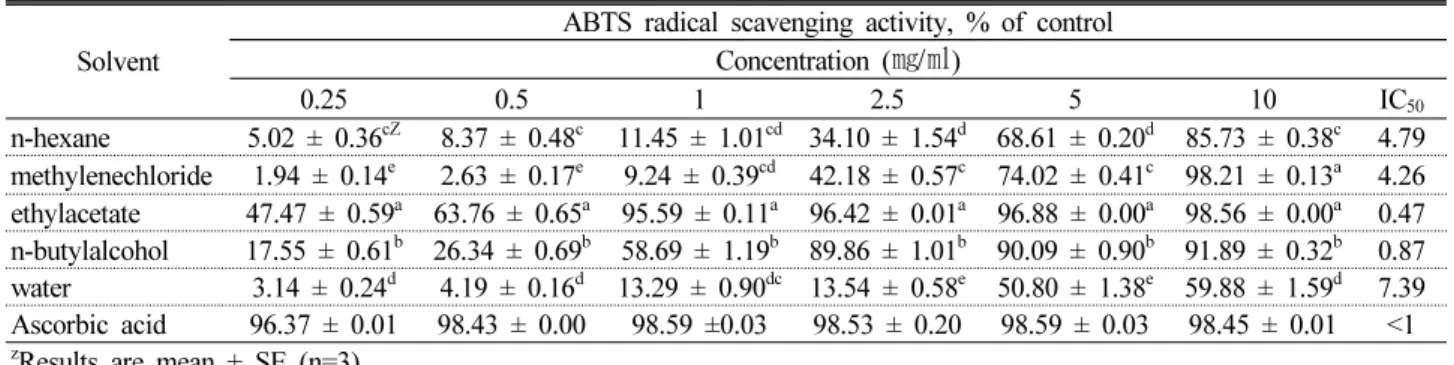
와송의 ABTS radical 소거활성은 Table 4에 나타냈다. 각 분 획추출물의 radical 소거활성은 10 ㎎/㎖에서 ethylacetate 98.56%, methylenechloride 98.21%, n-butylalcohol 91.98%, n-hexane 85.73%, water 59.88% 순으로 나타났다. 특히 ethy- lacetate는 1 ㎎/㎖에에서도 95.59%의 소거능을 보이며 대조구 로 이용한 ascorbic acid와 비슷하게 효과를 보이는 것으로 나타 났다. Ju et al. (2006)은 약용식물의 ABTS radical 소거활성 실 험에서 0.5 ㎎/㎖의 농도에서 갈근 62.49%, 쇠비름 30.31%, 참 빗살나무 52.58%, 합환피 43.43%, 감국 52.47%의 소거능을 나 타냈다고 보고하였다. 이는 와송의 ethylacetate 분획추출물이 0.5 ㎎/㎖ 농도에서 63.76%의 ABTS radical 소거활성을 보이는 값과 유사하거나 낮은 것으로 나타났다. 와송의 ethylacetate Table 2. Total polyphenol and flavonoid contents of solvent extracts from O. japonicus
Solvent Total polyphenol (㎍/㎎) Total flavonoid (㎍/㎎)
n-hexane 148.37 ± 2.26cZ 98.54±3.61b
methylenechloride 124.38 ± 2.78d 74.63±2.12c
ethylacetate 634.48 ± 4.34a 205.20±2.75a
n-butylalcohol 351.14 ± 3.71b 97.85±2.66b
water 8.40 ± 0.92e 5.67±1.16d
zResults are mean ± SE (n=3).
Table 3. DPPH radical scavenging activities of solvent extracts from O. japonicus
Solvent
DPPH radical scavenging activity, % of control Concentration ( ㎎/
㎖)
0.25 0.5 1 2.5 5 10 IC
50n-hexane 17.06 ± 0.99
cZ22.93 ± 1.50
c40.78 ± 1.23
c79.20 ± 0.35
b89.12 ± 0.97
c89.99 ± 1.68
c1.47 methylenechloride 15.24 ± 0.12
c20.32 ± 0.88
c41.81 ± 1.57
c71.09 ± 2.05
c85.37 ± 0.59
d88.64 ± 1.09
c1.96 ethylacetate 48.27 ± 0.39
a88.84 ± 0.35
a94.60 ± 0.45
a95.86 ± 0.40
a97.01 ± 0.13
a98.17 ± 0.31
a0.45 n-butylalcohol 32.71 ± 0.19
b48.91 ± 1.49
b74.72 ± 0.16
b92.75 ± 0.16
a93.22 ± 0.50
b94.84 ± 0.88
b0.77 water 6.41 ± 0.31
d9.90 ± 1.38
d11.77 ± 0.96
d19.32 ± 0.74
d25.16 ± 1.17
e40.34 ± 0.36
d12.93 Ascorbic acid 97.01 ± 0.02 97.36 ± 0.01 97.49 ± 0.04 97.56 ± 0.01 97.68 ± 0.02 97.90 ± 0.03 <0.1
z
Results are mean ± SE (n=3).
분획추출물은 1 ㎎/㎖의 농도에서 90% 이상의 소거능이 측정되 어 천연 항산화제로서 충분한 기능을 할 것으로 사료된다.
아질산염 소거활성
흔히 섭취하는 식품들에 발색, 풍미증진, 산패 방지 등을 위 하여 아질산염을 식품 첨가제로 널리 이용되고 있지만, 아질산 염을 섭취했을 경우 위 내에서 아민류와 반응하여 발암성 물질 인 nitrosamine을 생성하게 된다(Chow and Hong, 2002). 이러 한 nitrite의 소거능은 nitrosamine이라는 발암물질 의 생성억 제와 메트헤모글로빈증 등의 질병을 예방할 수 있는 것으로 보 고되었다(Boo et al., 2009). 와송의 분획추출물 10 ㎎/㎖을 아 질산나트륨 용액에 첨가하여 아질산염에 대한 소거능을 조사한 결과를 Table 5에 나타냈다. 아질산 소거능은 pH에 매우 농도의 존적으로 나타났으며, 즉 pH 1.2에서 n-hexane 25.13%, methy- lenechloride 36.67%, ethylacetate 81.68%, n-butylalcohol 74.00%, water 47.14%의 소거활성을 보였으며, ethylacetate 분획에서 가장 높은 아질산 소거활성을 나타냈다. 그리고 pH 4.2에서는 n-hexane 18.70%, methylenechloride 15.94%, ethylacetate 66.19%, n-butylalcohol 55.75%, water 17.44%
의 아질산염 소거활성을 보였다. pH 1.2에서와 마찬가지로 ethylacetate 분획추출물이 가장 높은 소거능을 확인하였다. 그 리고 pH 6.0에서는 ethylacetate 47.15%, n-butylalcohol 29.09%, water 7.99%의 아질산염 소거활성을 보였으며, n-hexane과 methylenechloride 분획에서는 활성이 나타나지 않았다.
Ethylacetate 추출물은 pH 농도가 증가해도 분획추출물 중 비 교적 높은 아질산염 소거능을 나타냈다. 이는 왕고들빼기의 메 탄올 추출물의 아질산 소거능을 연구한 Park(2014)의 결과와도 유사한 결과이다. 한국 재래약초의 항균 및 항산화성에 대해 연 구한 Park(2001)의 연구에서 약모밀, 소목, 마디풀, 육계나무의 아질산염 소거능이 높게 나타났는데, pH 1.2에서 가장 활성이 좋았으며, pH 4.2, pH 6.0으로 농도가 높아질수록 활성이 낮게 나타났다. pH 6.0에서 약모밀은 30%의 활성을 나타냈고, 소목, 마디풀, 육계나무 등은 10% 이상의 소거활성을 나타냈다고 보 고하였다. 이 식물들은 pH 1.2, pH 4.0에서 50% 이상의 아질산 염 소거활성을 나타냈다. 이와 같은 결과들로 비교하여 볼 때, 와송의 ethylacetate 분획추출물의 경우 pH 1.2, 4.0에서 81.68%, 66.19%로 높게 나타났으며, pH 6.0에서도 47.15%로 소목, 마디 풀 보다 30% 더 높은 아질산염 소거활성을 확인할 수 있었는데, Table 4. ABTS radical scavenging activities of solvent extracts from O. japonicus
Solvent
ABTS radical scavenging activity, % of control Concentration (
㎎/㎖)
0.25 0.5 1 2.5 5 10 IC
50n-hexane 5.02 ± 0.36
cZ8.37 ± 0.48
c11.45 ± 1.01
cd34.10 ± 1.54
d68.61 ± 0.20
d85.73 ± 0.38
c4.79 methylenechloride 1.94 ± 0.14
e2.63 ± 0.17
e9.24 ± 0.39
cd42.18 ± 0.57
c74.02 ± 0.41
c98.21 ± 0.13
a4.26 ethylacetate 47.47 ± 0.59
a63.76 ± 0.65
a95.59 ± 0.11
a96.42 ± 0.01
a96.88 ± 0.00
a98.56 ± 0.00
a0.47 n-butylalcohol 17.55 ± 0.61
b26.34 ± 0.69
b58.69 ± 1.19
b89.86 ± 1.01
b90.09 ± 0.90
b91.89 ± 0.32
b0.87 water 3.14 ± 0.24
d4.19 ± 0.16
d13.29 ± 0.90
dc13.54 ± 0.58
e50.80 ± 1.38
e59.88 ± 1.59
d7.39 Ascorbic acid 96.37 ± 0.01 98.43 ± 0.00 98.59 ±0.03 98.53 ± 0.20 98.59 ± 0.03 98.45 ± 0.01 <1
z
Results are mean ± SE (n=3).
Table 5. Nitrite scavenging activities of solvent extracts from O. japonicus
Solvent
Nitrite scavenging activity, % of control Concentration (㎎/㎖)
pH 1.2 pH 4.2 pH 6.0
n-hexane 25.13 ± 0.90eZ 18.70 ± 1.62c NDd
methylenechloride 36.67 ± 1.54d 15.94 ± 1.07c NDd
ethylacetate 81.68 ± 2.31a 66.19 ± 0.96a 47.15 ± 1.80a n-butylalcohol 74.00 ± 0.67b 55.75 ± 1.46b 29.09 ± 1.45b
water 47.14 ± 0.71c 17.44 ± 2.53c 7.99 ± 2.27c
zResults are mean ± SE (n=3).
이는 현재 육가공 식품에 품질 유지와 풍미를 위해 전반적으로 많이 쓰이고 있어 발암물질 논란이 되고 있는 아질산염의 소거 제로서 이용 가능성을 기대할 수 있다고 본다.
항산화 효소 활성
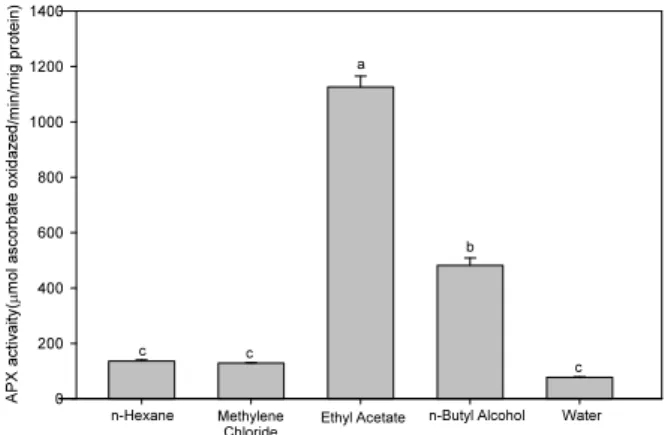
와송 분획 추출물에 있어서의 APX, CAT, POX 효소 활성에 대한 결과를 Figs. 2~4에 나타냈다. APX 효소 활성은 ethylacetate 가 1125.89 μmol ascorbate oxidized/min/㎎ protein으로 가장 높게 나타났다(Fig. 2). Ethylacetate는 Park (2014)의 왕고들 빼기 생리활성 연구에서 뿌리 660.76 μmol ascorbate oxidized/
min/㎎ protein보다 2배 가까이 높은 값을 보였다. CAT 효소활 성은 ethylacetate 119.87 mmol H2O2 decomposed/min/㎎
protein으로 가장 높게 나타났으며, n-butylalcohol 34.80 mmol H2O2 decomposed/min/㎎ protein 으로 측정되었다(Fig. 3).
Park (2014)의 연구에서 왕고들빼기의 catalase 효소활성은 13.88 mmol H2O2 decomposed/min/㎎ protein로 뿌리가 가장 높게 나타났는데, 와송의 ethylacetate추출물은 왕고들빼기 뿌 리의 9배 이상, n-butylalcohol은 2배 이상의 활성을 나타내 높 은 활성을 갖는 것으로 확인되었다. POX 효소활성은 n-butylalcohol 2.71, ethylacetate 2.35 mmol tetraguaiacol/
min/㎎ protein 순으로 나타났다(Fig. 4). Park (2014)의 연구 에서 왕고들빼기 줄기의 POX 효소활성은 7.04 mmol ascorbate oxidazed/min/㎎ protein으로 나타났으며, 꽃 5.73, 뿌리 3.91 mmol ascorbate oxidazed/min/㎎ protein로 나타났는데, 이 는 와송의 분획별 추출물보다 높은 수치를 보였다. 와송은 분획 별 추출물 중 ethylacetate 분획추출물에서의 APX, CAT 효소 활성이 1125.89 μmol ascorbate oxidized/min/㎎ protein, 119.87 mmol H2O2 decomposed/min/㎎ protein로 n-hexane 의 8배, n-butylalcohol의 2.33배 높았으며, POX효소활성은 n-butyl alcohol이 2.71 mmol tetraguaiacol/min/㎎ protein 로 ethylacetate 2.35 mmol tetraguaiacol/min/㎎ protein보 다 높게 나타났다. 이는 와송의 분획 추출 용매에 따라 효소 활 성에 많은 차이가 있음을 확인하였다. 높은 항산화 효소 활성을 보이는 ethylacetate, n-butylalcohol분획 추출물을 이용하여 anti-aging에 관련된 천연 화장품 개발이나 건강 기능성 식품 으로서의 활용 가능성이 높은 것으로 사료된다.
항균활성 효과
Agar diffusion assay를 이용하여 측정한 와송 분획별 추출 물의 항균활성에 대한 결과를 Fig. 5와 Table 6에 나타냈다. 공
APX activaity(µmol ascorbate oxidazed/min/mig protein)
0 200 400 600 800 1000 1200 1400
n-Hexane Methylene
Chloride Ethyl Acetate n-Butyl Alcohol Water a
b
c
c c
Fig. 2. APX activities of solvent extracts from O. japonicus.
Bar represent the standard error of the mean. Means separation was conducted with by Duncan's multiple range test (P=0.05).
Means followed by same letters are not significantly different.
CAT activaity(µmol H2O2 decomposed/min/mig protein) 0 20 40 60 80 100 120 140
n-Hexane methylenechloride ethylacetate n-butylalcohol water a
b
c c c
Fig. 3. CAT activities of solvent extracts from O. japonicus.
Bar represent the standard error of the mean. Means separation was conducted with by Duncan's multiple range test (P=0.05).
Means followed by same letters are not significantly different.
POX activaity (µmol tetraguaiacol formed/min/mg protein) 0.0 0.5 1.0 1.5 2.0 2.5 3.0
n-hexane methylenechloride ethylacetate n-butylalcohol water ab
a
c bc
bc
Fig. 4. POX activities of solvent extracts from O. japonicus.
Bar represent the standard error of the mean. Means separation was conducted with by Duncan's multiple range test (P=0.05).
Means followed by same letters are not significantly different.
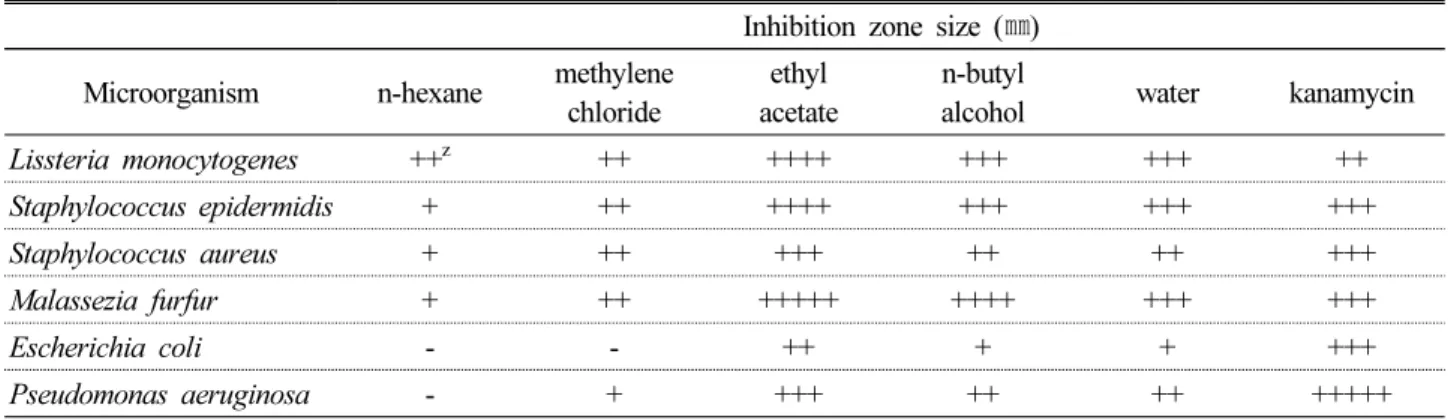
시한 6종의 균주(Listeria monocytogenes, Staphylococcus epi- dermidis, Staphylococcus aureus, Malassezia furfur, Esche- richia coli, Pseudomonas aeruginosa) 모두에서 항균활성이 있는 것으로 나타났으며, 특히 ethylacetate 분획추출물에서 향 균활성이 가장 높았고, n-butylalcohol, water 분획에서도 다 소 높은 활성을 확인할 수 있었다. 그러나 n-hexane 및 methy- lenechloride 분획추출물에서는 저해환이 거의 형성되지 않아 항균활성이 미미한 것으로 나타났다.
Sung (2004)의 은행잎 추출물, Kwon (2003)의 동백나무잎 추출물의 항균성 연구결과를 와송추출물의 결과와 비교하였을 때, 대부분 균주에서 와송추출물이 다른 식물추출물에 비해 높 은 항균활성을 나타냄을 알 수 있었다. 특히 ethylacetate 분획 추출물의 경우 공시한 대부분의 균주에서 큰 저해환을 형성하 여 높은 항균활성을 갖는 것으로 나타나 천연항균제, 천연보존 료 개발에 유익한 원료로서 활용될 수 있을 것으로 사료된다.
MTT assay에 의한 인체 암세포 생존율
MTT assay에 의한 와송의 용매분획별 추출물의 폐암, 유방 암, 대장암 세포주의 세포증식억제 효과에 대한 결과를 Figs. 6~8 에 나타냈으며, 세포 사멸율 50%의 추출물 농도를 나타내는 IC50값은 Table 7에 나타냈다. 와송 추출물농도 1000 ㎍/㎖에서 폐암 세포주(Calu-6)의 생존율은 n-hexane 33.11%, methylen- echloride 40.74%, ethylacetate 40.43%, n-butylalcohol 70.33%, water 87.33%로 나타났다. Chon et al. (2011)의 재배인삼의 연 령별 생리활성에 관한 연구에서는 1000 ㎍/㎖의 농도일 때 5년 생 인삼이 47.2%, 2년생 인삼이 59%, 나머지 3년, 4년, 6년생 인삼이 85%이상의 폐암 세포주 생존율을 보고하였는데, 이는 와송 분획별 추출물이 인삼보다 높은 세포증식 억제활성을 나 Table 6. Inhibition zone size against the microorganism by agar diffusion method of solvent extracts from O. japonicus
Inhibition zone size (㎜) Microorganism n-hexane methylene
chloride
ethyl acetate
n-butyl
alcohol water kanamycin
Lissteria monocytogenes ++z ++ ++++ +++ +++ ++
Staphylococcus epidermidis + ++ ++++ +++ +++ +++
Staphylococcus aureus + ++ +++ ++ ++ +++
Malassezia furfur + ++ +++++ ++++ +++ +++
Escherichia coli - - ++ + + +++
Pseudomonas aeruginosa - + +++ ++ ++ +++++
z+++++ : lager than 30 ㎜, ++++ : 25∼30 ㎜, +++ : 20∼25 ㎜, ++ : 10∼20 ㎜, + : smaller than 10 ㎜, - : not detected.
Fig. 5. Inhibition activity of the O. japonicus against the microorganism in paper disc diffusion assay.
1∼6 strains:(1) Listeria monocytogenes, (2) Staphylococcus epidermidis, (3) Staphylococcus aureus, (4) Malassezia furfur, (5) Escherichia coli, (6) Pseudomonas aeruginosa (A∼E;solvent extratcts from Orostachys japonicus.) (A) n-hexane, (B) methyle- nechloride, (C) ethylacetate, (D) n-butylalcohol, (E) water.
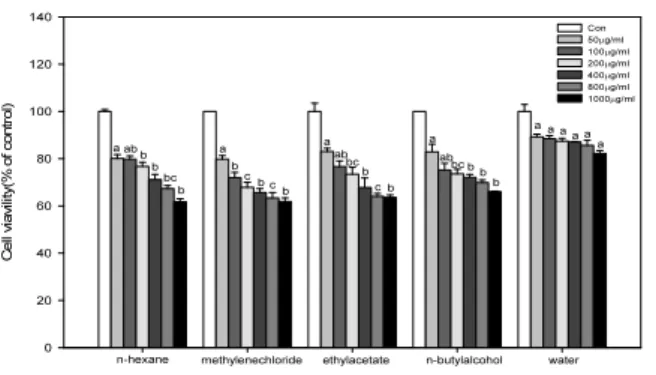
타냄을 알 수 있었다. 또한 유방암 세포주(MCF-7)의 경우를 보 면, n-hexane 50.63%, methylenechloride 60.80%, ethylacetate 60.15%, n-butylalcohol 44.77%, water 80.06%의 생존율을 보 였으며, water추출물을 제외한 대부분 추출물에서 세포증식 억 제효과를 나타냈다. Im et al. (2015)의 연구에서 황칠나무 추출 물을 50, 100 ㎍/㎖로 처리하였을 때 90% 이상 생존하였고, 500 ㎍/
㎖로 처리하였을 때 41.7%의 세포 생존율을 보고하였는데, 50
㎍/㎖ 및 100 ㎍/㎖ 농도에서는 와송 추출물이 낮은 세포생존율 을 보이지만 500 ㎍/㎖ 농도에서는 황칠나무 추출물에 비교하 여 세포생존율이 더 높게 나타나 와송 추출물은 높은 농도보다 낮은 농도에서 황칠나무 추출물에 비해 높은 세포증식억제 효 과를 나타냈다. 그리고 대장암 세포주(HCT-116)에서의 생존율 은 n-hexane 61.79%, methylenechloride 61.84%, ethylacetate 63.58%, n-butylalcohol 65.97%, water 82.17%로 나타났다.
Hong et al. (2014)의 길경추출물에 의한 대장암 세포주에 관한 연구에서는 1000 ㎍/㎖의 농도일 때 약 80%의 세포 생존율을 보 고하였는데, 와송의 분획별 추출물의 경우도 길경의 결과와 비 교하여 대장암 세포주에서 비슷한 암세포증식 억제활성을 갖는 것으로 사료된다. 와송 분획별 추출물은 특히 폐암 세포주(Calu-6) 에서 세포증식 억제 활성이 큰 것으로 나타났다. 또한 n-hexane 분획추출물의 경우 1000 ㎍/㎖의 농도에서 33%의 생존율을 보 여 높은 암세포증식억제활성을 보였다. 유방암 세포주(MCF-7) 의 경우 n-butylalcohol 분획추출물에서 높은 암세포증식 억제 활성을 나타냈다. 그러나 대장암 세포주(HCT-116)의 경우는 5 가지 분획추출물 1000 ㎍/㎖ 농도에서 60% 이상의 생존율을 보 여 폐암, 유방암 세포주보다 세포증식 억제활성이 낮은 것으로 나타났다. 와송의 경우 분획별 추출물에 따라 암세포 증식 억제 율에 차이가 있었으며, 암 세포주의 종류에 따라서도 추출물의 증식억제 효능에 편차가 있음을 확인하였다. 이와 같은 결과를
n-hexane methylenechloride ethylacetate n-butylalcohol water
Cell viavility(% of control)
0 20 40 60 80 100 120
140 Con
50µg/ml 100µg/ml 200µg/ml 400µg/ml 800µg/ml 1000µg/ml
d
c c
b a
e
d c
b
a
d
d
c
b
a
d
cd cd
b
a b
c
c
c
c
b b
a aa
Fig. 6. Effects of solvent extracts from O. japonicus on cell viability of Calu-6 cell. Bar represent the standard error of the mean. Means separation was conducted with by Duncan's multiple range test (P=0.05). Means followed by same letters are not significantly different.
n-hexane methylenechloride ethylacetate n-butylalcohol water
Cell viavility(% of control)
0 20 40 60 80 100 120
140 Con
50µg/ml 100µg/ml 200µg/ml 400µg/ml 800µg/ml 1000µg/ml
b
ab b
c
a
b b b
c
a
b
b b
c
a
c
b c
a
c
b b
c
a
c b b
b
a
Fig. 7. Effects of solvent extracts from O. japonicus on cell viability of MCF-7 cell. Bar represent the standard error of the mean. Means separation was conducted with by Duncan's multiple range test. (P=0.05). Means followed by same letters are not significantly different.
n-hexane methylenechloride ethylacetate n-butylalcohol water
Cell viavility(% of control)
0 20 40 60 80 100 120 140
Con 50µg/ml 100µg/ml 200µg/ml 400µg/ml 800µg/ml 1000µg/ml
a a a a a
ab
b ab ab
a b
c
bc bc
a
b
b b b
a
bcb cb cb bb
aa
Fig. 8. Effects of solvent extracts from O. japonicus on cell viability of HCT-116 cell. Bar represent the standard error of the mean. Means separation was conducted with by Duncan's multiple range test (P=0.05). Means followed by same letters are not significantly different.
Table 7. IC50 (㎍/㎖) of solvent extracts from O. japonicus on three human cancer cell lines
Cell line
IC
50z( ㎍/㎖) Solvent fractions n-hexane methylene
chloride ethylacetate n-butyl alcohol water Calu-6 419.03 678.45 686.40 >1000 >1000 MCF-7 997.44 >1000 >1000 328.82 >1000 HCT-116 >1000 >1000 >1000 >1000 >1000
z
Extract concentrations, which show 50% cell viability of solvent
extratcts from Orostachys japonicus.
종합하여 볼 때, 향후 와송을 이용하여 폐암이나 유방암 예방 및 치료 소재로서의 개발 가치가 있을 것으로 사료된다.6
적 요
와송 ethylacetate 분획추출물의 폴리페놀 함량은 634.48 ㎍/㎎, 플라보노이드 함량은 205.20 ㎍/㎎ 로 나타났다. 또한 항산화 활성을 보면, ethylacetate 분획추출물의 1 ㎎/㎖ 농도에서 DPPH radical, ABTS radical 소거능은 95% 이상으로, ascorbic acid 의 97%의 소거능과 거의 유사한 결과를 보여 높은 항산화능을 확인할 수 있었다. 항산화효소 활성의 경우, APX 및 CAT 효소 활성은 1125.89 μmol ascorbate oxidized/min/㎎ protein, 119.87 mmol H2O2 decomposed/min/㎎ protein 으로 높은 것으로 나 타났다. 항균활성은 Listeria monocytogenes, Staphylococcus epidermidis, Staphylococcus aureus, Malassezia furfur 균주 에서 항생제 kanamycin보다 큰 저해환을 형성하여 높은 항균 력이 확인되었다. 또한 와송의 용매분획별 추출물의 인체암 세 포주에 대한 세포증식억제 효과는 특히 ethylacetate 분획추출 물에서 폐암, 유방암에 대해 높은 효과를 나타냈다. 이와 같은 결과들을 종합하면 와송의 ethylacetate 분획추출물을 이용한 천연 항산화제와, 천연 항균제로서의 개발 가치가 높은 것으로 기대되어 경제성 있는 천연소재가 될 것으로 사료된다.
사 사
이 연구는 2016년도 조선대학교 학술연구비의 지원을 받아 수행되었음.
References
Blois, M.S. 1958. Antioxidant determination by the use of a stable free radical. Nature 26:1199-1200.
Boo, H.O., H.H. Lee, J.W. Lee, S.J. Hwang and S.U. Park.
2009. Different of total phenolics and flavonoids, radical scavenging activities and nitrite scavenging effects of Mom- ordica Charantia L. according to cultivars. Korean J. Medicinal Crop Sci. 17(1):15-20 (in Korean).
Bradford, M.M. 1976. A rapid and sensitive method for the quantification of microgram quantities of protein-dye binding.
Anal. Biochem. 72:248-254.
Chance, B. and A.C. Maehly. 1995. Assay of catalse and
peroxidase. Methods Enzymol. 2:764-775.
Chen, G.X. and K. Asada. 1989. Ascorbate peroxidase in tea leaves : Occurrence of two isozymes and the differences in their enzymatic and molecular properties. Plant Cell Physiol.
30:987-998.
Chon, S.U. and Y.M. Kim. 2011. Differential Physiogical Activity in Different Ages of Panax ginseng. Kor. J. Crop Sci. 56(1):80-87 (in Korean).
Chow, C.K. and C.B. Hong. 2002. Dietary vitamin E and selenium and toxicity of nitrite and nitrate. Toxicology 180:
195-207.
Folin, O. and W. Denis. 1912. On Phosphotungstic-phosphom- olybdic compounds as color reagents. J. Biol. Chem. 12:239- 243.
Hansen, M.B., S.E. Nielsen and K.Re. Berg. 1989. Examination and further development of a precise and rapid dye method for measuring cell growth/cell kill. J. Immunol. Methods 119:203-210.
Hong, S.H., C. Park, M.H. Han, J.H. Kim, M.H. Lee and Y.H.
Choi. 2014. Effects of Platycodon grandiflorum on the induc- tion of autophagy and apoptosis in HCT-116 human colon cancer cells. Journal of Life Science 24(11):1244-1251 (in Korean).
Hwang, E.S. and N.Do Thi. 2014. Antioxidant contents and antioxidant activities of hot-water extracts of aronia (Aoronia melancocarpa) with different drying methods. J.
Korean Food SCI. Technol. 46(3):303-308 (in Korean).
Im, K.J., S.B. Jang and D.Y. Yoo. 2015. Anti-cancer effects of Dendropanax morbifera extract in MCF-7 and MDA-MB-231 cells. J. Korean Obstet Gyncecol. 28(2):26-39 (in Korean).
Jeon, S.H., D.O. Hong, C.W. Lee, H.Y. Kim, S.C. Shin and J.H.
Kang. 2006. Growth and flowering of Orostachys japonicus A. Berger affected by transplanted seedling size. Korean J.
Medicinal Crop Sci. 14(3):153-157 (in Korean).
Jia, Z., M. Tang and J. Wu. 1998. The determination of flavonoid contents in mulberry and their scavenging effects on superoxide radicals. Food Chemistry 64(4):555-559.
Ju, J.C., J.H. Shin, S.J. Lee, H.S. Cho and N.J. Sung. 2006.
Antioxidative activity of hot water extracts from medicinal plants. J Korean Soc Food Sci Nutr. 35(1):7-14 (in Korean).
Jung, E.J. 2011. Orosotachys japonicus induces apoptosis through caspase-dependet on human colon cancer cells.
Department of Nutrients Education, MS Thesis, Sunchon Univ., Korea (in Korean).
Kato, H., I.E. Lee, N.V. Chuyen, S.B. Kim and F. Hayase.
1987. Inhibition of nitrosamine formation by nondialyzable melanoidins. Agric. Bio. Chem. 51:1333-1338.
Kim, E.J., J.Y. Choi, M.R. Yu, M. . Kim, S.H. Lee and B.H.
Lee. 2012. Total polyphenols, total flavonoid contents, and antioxidant activity of Korean natural and medicinal plants.
Korean J. Food Sci. Technol. 44(3):337-342 (in Korean).
Kim, E.S. 2015. Development of loquat leaf-derived anti-obesity product and establishment of loquat leaf mass production system. Jeonnam Agricultural Research & Extension Services (in Korean).
Kim, S.G., J.W. Choi, H.J. Park, S.M. Lee and H.J. Jung. 2009.
Anti-hyperlipidemic effects of the flavonoid-rich fraction from the methanol extract of Orostachys japonicus in Rat.
Kor. J. Pharmacogn. 40(1):51-58.
Kim, S.H. 2010. Effects of the combination of Umbilicaria esculenta extract and anticancer drugs on human cancer cells.
Department of Biological and Chemical Engineering, MS Thesis, Energy Korea Polytechnic Univ., Korea (in Korean).
Kim, S.S. and H.C. Cha. 2017. Comparison of the total phenolic and flavonoid contents and antioxidant activities of four kinds of sand dune plants living in Taean, Korea. Korean J.
Plant Res. 30(1):8-16 (in Korean).
Kwon, M.K. 2003. (A)study on the antimicrobial activities of the extract of Camellia japonica L. leaves. Department of Food Nutrition, MS Thesis, Sungshin Women's Univ., Korea (in Korean).
Lee, S.J., J.K. Seo, J.H. Shin, H.J. Lee and N.J. Sung. 2008.
Antioxidant activity of Wa-song (Orostachys japonicus A.
Berger) according to drying methods. J. Korean Soc Food &
Nutr. 37(5):605-611 (in Korean).
Mishra, N.P., R.K. Mishra and G.S. Singhal. 1993. Changes in the activities of anti-oxidant enzymes during exposure of intact wheat leaves to strong visible light at different temper- atures in the presence of protein synthesis inhibitors. Plant Physiol. 102:903-910.
Oh, C.H., J.B. Bae, N.S. Kim, H.Jeon, K.S. Han, M.J. Lee and J.
Kwon. 2009. Effect of Orostachys japonicus A. verger on apoptosis induction of human leukemia HL60 cells. Kor. J.
Pharmacogn. 40(2):118-122.
Park, J.H. 2014. A study on physiological activity of wild Lactuca indica. Department of Life Science, MS Thesis, Chosun Univ., Korea (in Korean).
Re, R., N. Pellegrini, A. Proteggente, A. Pannala, M. Yang and RE. Catherine. 1999. Antioxidant activity applying an improved ABTS radical cation decoloraztion assay. Free Radical Biol Med. 26:1231-1237.
Suk, D.H. 2011. Inhibitory effect of the extracts from Orostachys japonicus on inflammation. Department of Biomedical Labo- ratory Science, Ph.D. Thesis, Inje Univ., Korea (in Korean).
Sung, G.O. 2004. Antimicrobial activities of the extract of Gingo biloba L. leaves on the food-borne pathogens. Department of Food Nutrition, MS Thesis, Sungshin Women's Univ., Korea (in Korean).
Won, Y.S., J.H. Lee, S.J. Kwon, D.U. Ahn, D.Y. Shin and K.I.
Seo. 2014. Anticancer effects of cultivated Orostachys japonicus on human prostate cancer cell. J. Korean. Soc. Food Sci.
Nutr. 41(1):67-73 (in Korean).
(Received 18 January 2017 ; Revised 9 March 2017 ; Accepted 13 April 2017)