Technical Note
Trend Analysis on Korean and International
Management for Activated Material Waste from Medical Linear Accelerator
Na Hye Kwon
1, Young Jae Jang
2,4, Dong Wook Kim
1, Dong Oh Shin
3, Kum Bae Kim
4, Jin Sung Kim
1, Sang Hyoun Choi
41
Department of Radiation Oncology, Yonsei Cancer Center, Yonsei University College of Medicine, Seoul,
2Department of Accelerator Science, Korea University, Sejong,
3Department of Radiation Oncology, Kyung Hee University Hospital,
4Research Team of Radiological Physics & Engineering, Korea Institute of Radiological & Medical Sciences, Seoul, Korea
Received December 2 2020 Revised December 9 2020 Accepted December 14 2020
Corresponding author Sang Hyoun Choi ([email protected]) Tel: 82-2-970-1590 Fax: 82-2-970-2412
This study investigated and analyzed the Korean and international status of radioactive waste management for medical linear accelerators (linacs) and proceed prior research to suggest radiation safety regulations and guidelines for the safe use of radiation. We analyzed the number of linacs installed in the radiation oncology departments of 103 institutions. In addition, we analyzed the procedures and standards for disposal in Korea and foreign countries. For foreign countries, we analyzed the status based on reports from the United States, Japan, Europe, and Canada. A total of 182 linacs are installed in Korea and 95% of them use more than 10 MV of energy. In Korea, standards for managing radioactive waste from a linac, disposal procedures, and clearance criteria have yet to be established. Therefore, radioactive waste is disposed of in different ways depending on the hospitals where they originate. Japan, the US, and Canada have recommended clearance levels and procedures for linacs. Other countries have provided management guidelines for research or large-scale accelerators, but not for medical purposes. In this study, we investigated the management of radioactive waste from medical linacs in Korea and abroad. Several foreign countries have suggested a clearance level and criteria for disposing of waste storage drums. For the safe management of medical linacs, it is necessary to establish safety management regulations. In Korea, standards for disposal, such as radiation or dose limits, are required for medical linacs. A system for clearance when disposing at a medical institution should be created.
Keywords: Linear accelerator, Disposal, Radioactive waste, Management, Clearance
Copyright © 2020 Korean Society of Medical Physics
CC
This is an Open-Access article distributed under the terms of the Creative Commons Attribution Non-Commercial License (http://creativecommons.org/licenses/by- nc/4.0) which permits unrestricted non-commercial use, distribution, and reproduction in any medium, provided the original work is properly cited.
Introduction
The radiotherapy device industry is growing as part of the development of radiotherapy technology. In particular, radiation treatment technology that uses high-energy ra- diation of 6 to 15 MV or more is rapidly being incorporated by medical institutions; interest in the use of safe radia- tion therapy devices is also increasing while improving the
quality of life of patients treated with high-precision radia- tion. Currently, most institutions in Korea and abroad use an 8–15 MV high-energy linear accelerator (linac), so using technology based on preceding radiation safety regulations is crucial. In Korea, however, it is difficult to systematically manage radioactive waste because of the absence of guide- lines for disposal or replacement of linacs due to aging or failed parts.
Progress in Medical Physics 31(4), December 2020
https://doi.org/10.14316/pmp.2020.31.4.194
eISSN 2508-4453
NCRP (National Council on Radiation Protection and Measurement) 79 and IAEA (International Atomic Energy Agency) TECDOC 1183 outlined the need to manage ra- dioactive waste from internal components, such as a target, collimator, flattening filter, and ion chamber when disman- tling a linac. The IAEA TECDOC 1183 showed that a pos- sibility exists for the radiation of surrounding substances when using an accelerator of 10 MV or more and that the head parts are activated during the disassembly of an linac; therefore, an evaluation of the activation should be conducted [1]. According to NCRP 79, when energy of 10 MV or more is used, a radiation evaluation is required and activation occurs in the head parts, such as the target, col- limator, and flattening filter [2]. NCRP 151 states that when a high-energy accelerator of 10 MV or more is used, radio- nuclides may be generated by the radiation of neutrons and gamma rays from the components of linac, which may result in exposure to patients and staff [3].
According to data from the Workshop for Improving Safety Management in the Medical Field, a total of 11 lin- acs were replaced from 2013 to 2017 and a total of 17 linacs were discarded [4]. On average, two or more linacs are re- placed or discarded every year, although the relevant regu- lations and standards have yet to be established.
In accordance with the Nuclear Safety Commission No- tice No. 2017–65, standards and clearance levels are stipu- lated according to the allowable concentration of nuclides [5]. However, information on radionuclides generated
during the process of discarding a linac is limited and vari- ables, such as the number of patients, treatment methods, and treatment device models, change depending on the fa- cility. Due to a lack of standardized regulations for disposal or management, an urgent need exists for the development of a management plan for the disposal of radioactive waste.
The operational period of a linac is typically 10 to 15 years and linacs are replaced or discarded for various rea- sons, such as aging parts, failure of major parts, and the introduction of new treatment devices. When disposing of equipment, it is recommended to report this to the Korea Institute of Nuclear Safety (KINS) and dispose of or store waste when considering the activation. In addition, dis- carding the linac after measurements have been taken and clearance is possible is recommended, although standards and procedures (e.g., clearance and consignment disposal) have yet to be established. In this study, to establish a basis for safety management procedures and regulations when replacing or discarding a medical linac, we analyzed cur- rent practices for managing radioactive waste from medical linacs in Korea and other countries.
Status of Medical Linac Radioactive Waste Management in Korea
1. Status of medical linacs in Korea
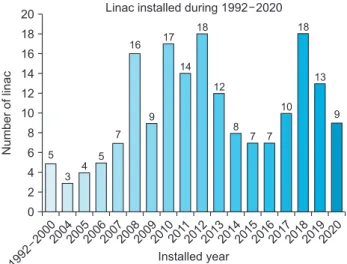
There are 103 hospitals using a linac in Korea, with a to- tal of 182 linacs installed. Fig. 1 shows the number of linacs
120
100
80
60
40
20
Number of linac
0
Number of linac per energy
6 MV 10 MV 15 MV
8
100
74
Fig. 2. Number of linear accelerators (linacs) by energy (1992–
2020).
1992 2000 20 18 16 14 12 10 8 6 4 2
Number of linac
Installed year 0
2004200520062007200820092010201 1
201220132014201520162017201820192020 Linac installed during 1992 2020
5 3
4 5
7 16
9 17
14 18
12
8 7 7
10 18
13
9
Fig. 1. Number of linear accelerators (linacs) installed dome-
stically (1992–2020).
according to the year they were installed from 1992 to 2020.
A total of 66 linacs were installed between 1992 and 2010.
Considering that the average life of a linac is 10 to 15 years, it is expected that their replacement or disposal owing to new installations will rapidly increase.
Fig. 2 shows an analysis of the energy used by installed linac equipment. Approximately 95% of linacs use more than 10–15 MV of energy and more than 95% of linacs use this energy to generate an activation product.
2. Current state of disposal of medical linacs in Korea
In Korea, no legally stipulated procedures or standards exist for linac disposal and thus disposal methods vary in different hospitals. The Nuclear Safety and Security Com- mission of Korea and the Korea Radioactive Waste Agency create regulations for the disposal of radioactive materials, such as radioisotopes.
Some hospitals store the entire head part of the radioac- tive linac in a radioactive waste storage facility at the hospi- tal after detachment. In addition, several parts are used as education-assistive tools or are collected by replacement companies without evaluation of the radioactive concen- tration/contamination when replaced.
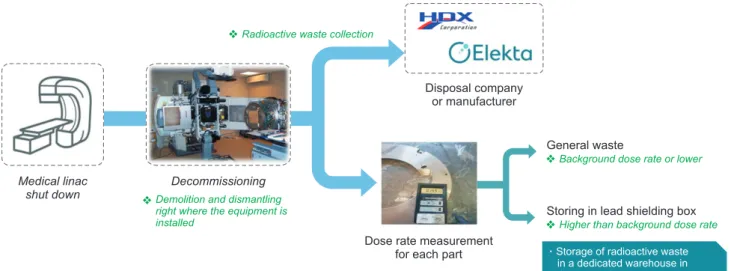
Some hospitals have applied a clearance or consignment disposal process by hiring a disposal company. The related
disposal procedures are shown in Fig. 3, which shows that after shutdown of a linac, the equipment should be dis- mantled immediately or within one to two months after shutdown. When the linac is disposed, the disposal com- pany measures the surface dose rate for each component by using a survey meter. When relocating or disposing of equipment through a company, these processes proceed without measuring the dose rate. Waste with a dose rate below the level of the background level of the dose rate (radiation) is disposed of as general waste and waste above the background is stored in the radioisotope waste storage facility of the hospital.
Currently, when disposing of a medical linac with a disposal company in Korea, a document on measures for disposing of a radiation-generating device is provided, as shown in Fig. 4. The document includes information on the disposal equipment, removal date, measures taken, results of the dose rate measurement, information on the detector used, and the calibration date. In addition, as shown on the Fig. 4b, the dose rate is measured using a survey meter for each component of the discarded linac. When dismantling, the surface dose is measured and recorded for each major component and reported to the KINS.
Medical linac shut down
Decommissioning
Demolition and dismantling right where the equipment is installedRadioactive waste collection
Disposal company or manufacturer
Dose rate measurement for each part
General waste
Background dose rate or lower
Storing in lead shielding box
Higher than background dose rateStorage of radioactive waste in a dedicated warehouse in the hospital
Fig. 3. Linear accelerator (linac) disposal and disposal procedure in Korea.
Radioactive Waste Management Status of Medical Linacs in Other Countries
1. Status of linac radioactive waste management in the United States
1) Management of radioactive waste
The US Department of Energy (DOE) published techni- cal standards in 2016 to support the control, clearance, and release of personal property (materials, equipment, and
items) from an accelerator, accelerator facilities, and mod- ules. In this report, based on DOE Directive Order 458.1 and ANSI N13.12-2013, regulations regarding the require- ments for radiological protection of the air and environ- ment are described [6–8]. The DOE report is based on large accelerators, such as the SLAC (Stanford Linear Accelerator Center), and suggests clearance standards, process knowl- edge, and measurement methodology.
The total effective dose limit is set at 0.01 mSv/y for the disposal of properties with residual radioactivity as stipu-
a b
Fig. 4. Documents for measuring the disposal of radiation-generating device (a) and measurement of dose rate by parts of medical linac (b).
Table 1. Contents of general program documents and documents related to clearance
General program documentation Additional documents for clearance
Related regulations and standards
Clearance and release/dismantling programs
Accelerator and facility parameters and operating history Surface and volume radioactivity evaluation
Procedures and records of radiation area classification, measurement method, and location
Criteria for clearance
A description of the concept and measurement of proxy radionuclides and difficult to measure nuclides
Clearance measurement procedure for proxy radionuclides Limits of detection for proxy radionuclides
Procedures and records for instrument calibration and testing Procedures and records of training and qualifications for conducting
measurements and using the device
Procedures and records for storage locations on site before release Plan for discussion with stakeholder
Additional process knowledge used in the measurement process during clearance (beam parameters and operating conditions, materials, etc.)
Records of past measurement of parts to be ejected Description of facility and component
Radiation irradiation report: measurement conditions and results,
including date and place of measurement, model and serial
number of the detector, calibration date, background dose rate,
inspection report, and measurement conditions and results
lated in O 458.1 and 10 CFR Part 835.1101. The DOE report presented the screening level and dose limit for surface and volumetric activity based on 0.01 mSv/y [9].
The DOE report recommends that process knowledge is used to determine whether radioactivity remains in the various parts of a linac during disposal. Process knowledge indicates whether a substance can be radiated or con- taminated and classified as general knowledge or specific knowledge. General process knowledge includes informa- tion that is equally applicable to most accelerator installa- tions with similar properties or operations, such as beam energy and particle types.
When disposing of a linac, a document should be pro- duced that contains the contents of its work history, proce- dures, and measurements, including process knowledge, as shown in Table 1.
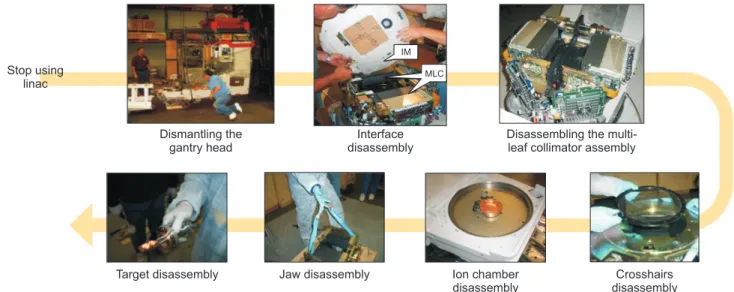
2) Linac decommissioning and disassembly procedure Fig. 5 shows the linac disposal process [10]. After the linac is turned off, the head part is detached and its multileaf col- limator (MLC), collimator head, gantry head, and bending magnet are discarded. Because the degree of activation var- ies according to the energy used in the linac, the parts must be disassembled and handled only after the recommended length of time. Components should not be removed until the dose rate is less than 50 μSv/h (5 mrem/h) at a distance of 1 ft (30 cm) from the surface of the linac.
• Accelerators using 10–14 MV X-ray energy: at least 1
hour after beam shutdown
• Accelerators operating above 15 MV X-ray energy: a longer attenuation period is recommended, typically 12–24 hours after beam shutdown
The list of hazardous substances and substances that should be removed from the linac gantry head, including non-radioactive parts, is as follows:
• Sealed components containing oil that may contain printed circuit boards (PCBs) (e.g., capacitors, trans- formers)
• PCBs with a surface area of 10 cm
2or larger
• Plastic containing brominated flame retardant
• External electric cable
• Ingredients containing radioactive substances
• Electrolytic capacitors containing substances of con- cern (height ≥25 mm, diameter ≥25 mm)
• Beryllium (bending magnet beam exit window)
• Radiation shielding lead (bending magnet, collimator, carousel) and lead solder
• Metal surfaces, sheet metal, and hardware surfaces
2. Status of linac radioactive waste management in Japan
Regulations for the dismantling and disposal of radioac- tive waste are outlined in the Act on the Regulation of Ra- dioactive Isotopes (Atomic Energy Regulatory Authority), the Medical Law/Medical Law Enforcement Rules (Ministry
IM MLC
Dismantling the gantry head
Interface disassembly
Disassembling the multi- leaf collimator assembly
Target disassembly Jaw disassembly Ion chamber
disassembly
Crosshairs disassembly Stop using
linac
Fig. 5. Medical linear accelator (linac) disassembly and disassembly procedure. IM, Interface Mount; MLC, multileaf collimator.
of Health, Labor, and Welfare), the Labor Safety and Sani- tation Act, and the Radio Law (Ministry of Internal Affairs and Communications). In Japan, regulations and facility standards, such as storage, disposal, incineration, and dis- posal of radioactive waste, are applied in the same manner as applied to waste contaminated by radioisotopes [11].
1) Procedure for replacement and abolition
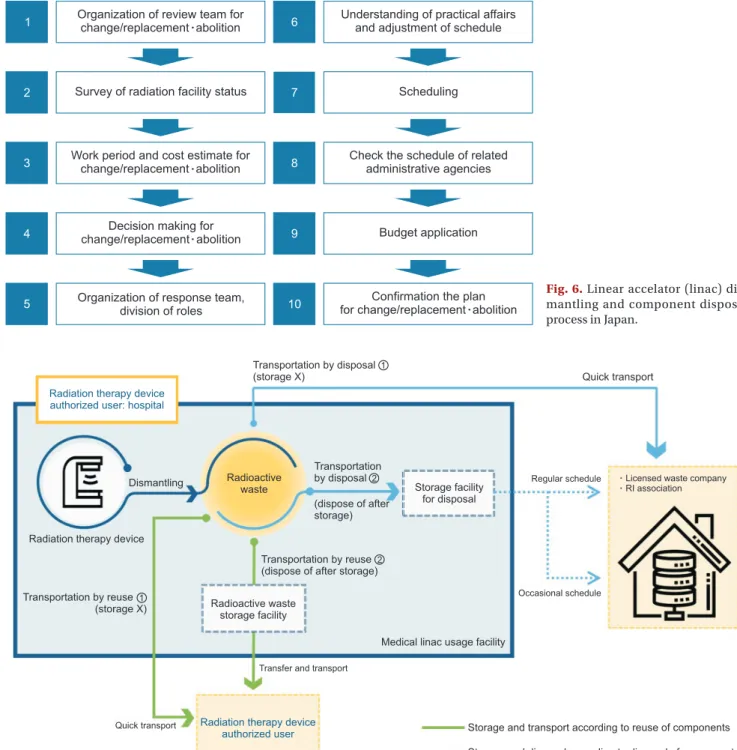
The procedures followed during the preparation stage for replacement of equipment or abolition of the facility is shown in Fig. 6. Japan recommends forming a dedicated group to replace equipment, as well as an additional re- view group within an institution that uses a linac. The institution that uses the linac investigates the status of the
1
2
3
4
5
6
7
8
9
10 Organization of review team for
change/replacement abolition
Survey of radiation facility status
Work period and cost estimate for change/replacement abolition
Decision making for change/replacement abolition
Organization of response team, division of roles
Understanding of practical affairs and adjustment of schedule
Scheduling
Check the schedule of related administrative agencies
Budget application
Confirmation the plan for change/replacement abolition
Fig. 6. Linear accelator (linac) dis- mantling and component disposal process in Japan.
Radiation therapy device authorized user: hospital
Transportation by disposal (storage X)
1
Quick transport
Dismantling
Radiation therapy device
Transportation by reuse (storage X)
1
Radioactive waste
storage facility
Storage facility for disposal
Transportation by reuse (dispose of after storage)
2
Transfer and transport
Quick transport Radiation therapy device
authorized user
Storage and transport according to reuse of components Storage and disposal according to disposal of components Transportation
by disposal
2(dispose of after storage)
Regular schedule
Occasional schedule
Medical linac usage facility
Licensed waste company RI association
Radioactive
waste
Fig. 7. Process of reuse and disposal of radioactive waste for radiation therapy device. Linac, linear accelator; RI, radiation isotope.
facility and conducts an overall estimate of the work to be performed and the cost. Next, a procedure for finalizing a disposal plan should be created by making decisions on institutional policies, the division of roles, scheduling, and budget.
When replacing or disposing of equipment, the user should classify and dismantle the radioactive components (regulated parts). In addition, the components are divided into those that can be reused and those to be disposed of, as shown in Fig. 7. Equipment to be reused is transported to a licensed user at another facility. Transportation imme- diately after dismantling or storage in a radioactive waste storage facility are optional. Equipment to be discarded is either immediately disposed of without first storing it in a storage disposal facility or it is stored similarly to equip- ment that is reused.
2) Measurement procedure for activation
The procedure for radiation measurement during disas- sembly of a linac is shown in Fig. 8. Radiation measure- ments related to the handling of radioactive waste should be conducted when disposing of regulated activation products, for products to be taken out of the radiation-con- trolled area, and for transport. The dose rate is measured at a distance of 1 cm from the equipment part by using a sur- vey meter and the dose rate is converted into Bq according to the conversion table used in Japan. After determining the reference dose of the radionuclides, the components are divided and stored in a drum.
In addition, if storage and disposal facilities are installed, periodic dose measurements are required. The types of measurements are divided into cases that the medical in- stitution directly conducts and cases that are entrusted to a professional contractor. In addition, the final evaluation should be conducted by the medical institution even in the case of consignment.
3. Status of linac radioactive waste management in Europe
The European Commission provides recommendations on the “Practical use of the concepts of clearance and exemption” in accordance with the Radiation Protection
Report 122 as published in 2000 [12]. In principle, waste should not be generated and resources should be reused;
however, radioactive materials are classified as exceptions and disposal is recommended.
In the case of radioactive waste, it is not necessary to re- port radioactive material with an activity concentration be- low the specific exemption for nuclides and prior approval for disposal is not required. The standard for clearance of radioactive waste is 10 μSv/y for individuals and 1 man-Sv/y for collective doses. The standards for clearance follow the IAEA Safety Series 89, but the Commission has difficulty linking dose standards for authorization and disposal with
Gantry
Couch Beam collimator