http://dx.doi.org/10.12925/jkocs.2018.35.4.1349
부생연료유(2호) 혼합에 따른 정제연료유(감압)의 물성 변화 특성 연구
도진우
1․임태윤
2․임의순
1․이정민
1․강형규
1,✝한국석유관리원 석유기술연구소1 현대오일뱅크 윤활유연구소2
(2018년 12월 3일 접수: 2018년 12월 23일 수정: 2018년 12월 25일 채택)
Study on Characteristics of Change of Physical/Chemical property of Refined Fuel Oil(Reduced-pressure) by Mixing with By-product Fuel Oil(No. 2)
Jin-woo Doe1․Tae-yun Lim2․Eui-soon Yim1․Joung-min Lee1․Hyung-kyu Kang1,✝
Research Institute of Petroleum Technology, Korea Petroleum Quality & Distribution Authority
1Hyundai Oil Bank Lubricant Research Institute
2(Received December 3, 2018; Revised December 23, 2018; Accepted December 25, 2018)
요 약 : 화석연료로부터 기인한 환경오염에 대한 대응과 더불어 신재생에너지 공급의무화제도의 시행은 재생연료유 등 신재생에너지의 활용도를 증대시켰다. 부생연료유(2호)와 정제연료유(감압)는 국내 법령으 로 엄격히 규제되고 있으며, 부생연료유(2호)를 혼합한 정제연료유(감압)의 물성변화를 시험하였다. 부생연 료유(2호)를 1 : 1로 혼합한 정제연료유(감압)의 물성분석 결과, 국내 폐기물관리법에서 규정하고 있는 품 질기준을 만족하였다. 다만, 연료와 관련한 추가항목 시험결과에서 높은 방향족 함량을 나타내었다. 연료 내 높은 방향족 함량은 사용기기의 고무류 파손이나 연소 시 그을음, 매연 등이 발생할 가능성이 높을 것으 로 보인다.
주제어 : 부생연료유(2호), 정제연료유(감압), 방향족 함량, 신재생에너지, 폐기물관리법
Abstract : In addition to responding to the environmental pollution caused by fossil fuels, the enforcement of Renewable Fuel Standard(RFS) system has increased the utilization of renewable energy such as refined fuels oil. The by-product fuel oil(No. 2) and the refined fuel oil(reduced-pressure) are strictly regulated by the domestic legislation and the chemical property changes of the refined fuel oil(reduced-pressure) mixed with the by-product fuel oil(No. 2) were analyzed. As a result of analyzing the physical properties of refined fuel oil(reduced pressure) obtained by mixing 1 : 1 of by-product fuel oil(No. 2), it satisfied the quality standards stipulated by the domestic Enforcement
✝
Corresponding author
(E-mail: [email protected])
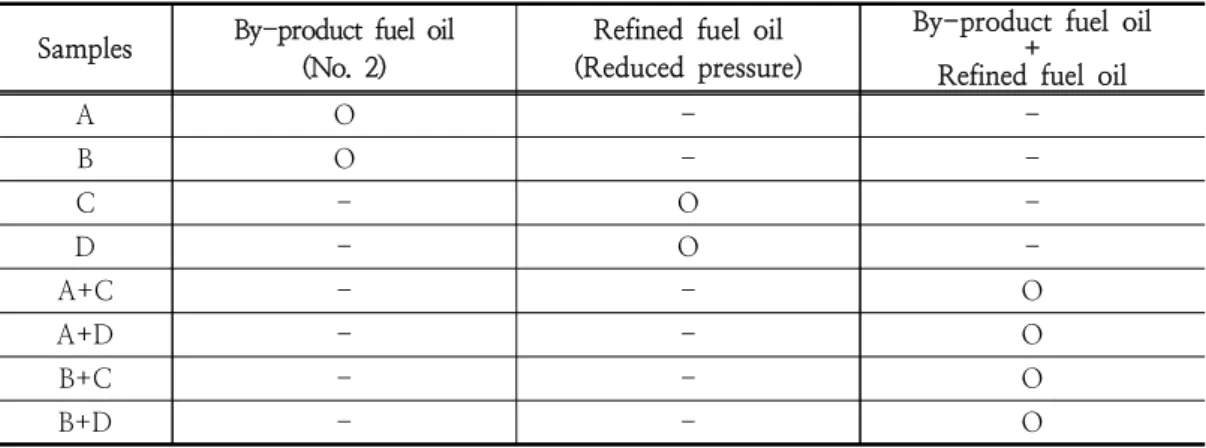
Samples By-product fuel oil (No. 2)
Refined fuel oil (Reduced pressure)
By-product fuel oil Refined fuel oil+
A O - -
B O - -
C - O -
D - O -
A+C - - O
A+D - - O
B+C - - O
B+D - - O
Table 1. Description of the samples analyzed in this study
Decree of the Wastes Control Act. However, the results of the additional tests related to the fuel showed a high aromatic content. The high content of aromatic in a fuel is likely to cause the soot and ehaust emission gas during the combustion of the used equipment.
Keywords : By-product fuel oil(No. 2), Refined fuel oil(Reduced pressure), Aromatic content, Renewable Fuel Standard, Enforcement decree of the wastes control act
1. 서 론
자동차용 윤활유를 교환할 때 발생하는 폐윤활 유 내에는 인체에 유해한 각종 유기첨가제를 비 롯하여 윤활작용 중 발생된 부산물, 외부 이물질 의 혼입으로 인해 일어나는 화학반응 생성물 및 엔진 내 마모성분 등 매우 다양한 오염물질이 포 함되어 있다[1-3]. 이러한 성상의 폐유가 적절한 회수, 재처리과정을 거치지 않고 무단 방류되거나 연료용으로 불법 유통될 경우 심각한 환경오염을 초래하게 된다. 이미 외국에서는 폐유로 인한 환 경오염 문제를 인식하여 폐유 내 오염물질을 제 거하고 자원의 재활용을 도모하고자 오래 전부터 상당한 연구가 수행되었으며 그 결과를 응용하여 다수의 정제공정이 실제 가동되고 있다[4-7]. 산, 백토 처리공정을 비롯하여 용매추출, 화학 처리, 여과 및 흡착, 열분해 그리고 감압증류 등으로 요약될 수 있는 외국의 정제공정들은 대부분이 폐유로부터 신유의 품질수준과 동등한 정제유를 얻고자 하는데 목적을 두고 있다[8]. 정제연료유 의 활용성은 날로 증대되고 있다. 또한 다양한 정제공정에 의해 여러 가지 정제연료유가 생산되
어 각 산업에 활용되고 있다. 더욱이 신재생에너 지 공급의무화제도(Renewable Fuel Standard, RFS)의 시행에 따라 재생에너지에 대한 수요가 증대되고 있다.
본 연구에서는 신재생에너지 공급의무화제도 시행에 따라 정제연료유(감압)에 부생연료유(2호) 의 혼합에 따른 물성변화 특성 분석을 위해 시험 을 실시하였다. 또한, 부생연료유(2호)를 혼합한 정제연료유(감압)를 연료로 사용하기 위한 추가항 목들에 대한 분석도 실시하여 비교⋅분석하였다.
2. 실 험
2.1. 실험대상국내에서 생산 및 사용되고 있는 부생연료유(2 호) 2종과 정제연료유(감압) 2종을 선택하여 해당 유종별 품질기준에 대한 물성분석을 실시하고, 두 유종을 1 : 1 로 혼합한 혼합정제유 시료를 제조 하였다(Table 1.).
Property Unit Analysis Method Test Instrument (Company)
Pour point ℃ KS M ISO 3016 MPC 602
(Tanaka)
Flash point ℃ KS M 2010 ATG-7
(Tanaka) Kinematic viscosity(40 ℃) mm2/s KS MS ISO 3104 CAV2100
(Cannon)
Distillation(90 ℃) ℃ KS M ISO 3405 OptiDist
(PAC) Copper strip corrosion(50 ℃) 3h KS M ISO 2160 K25339
(Koehler)
Water & Sediment vol% KS M 2115 -
Carbon residue on 10 % wt% KS M ISO 10370 ACR-M3 (Tanaka)
Carbon Residue wt% KS M ISO 10370 ACR-M3
(Tanaka)
Ash wt% KS MS ISO 6245 -
Sulfur content wt% KS M ISO 8754 SLFA-2800
(Horiba)
Density kg/m3 KS M ISO 12185 DMA5000
(Anton Paar)
Marker mg/L - UV/VIS Spectrometer
(JASCO)
Calorific value kcal/L KS M 2057 Parr 6000
(Anton Parr) Metal contents
(Cd, Cr, Pb, As, Na, K) mg/L - Optima 2100DV
(Perkin Elmer) Lubricity (60 ℃) HFRR
WSD, ㎛ KS R ISO 12156-1 HFRR (PSC)
Total Aromatic compounds wt% KS M 2456 HPLC
(Younglin) Table 2. Test method and equipment criteria for analyzing the petroleum product
2.2. 실험방법
부생연료유(2호)는 「석유 및 석유대체연료 사 업법」 및 「석유제품의 품질기준과 검사방법 및 수수료에 관한 고시」[9], 정제연료유(감압)는
「폐기물관리법」 및 「폐기물관리법 시행규칙 제14조의3 폐기물의 재활용 기준 및 준수사항 등」에서 규정하는 품질기준 및 분석방법을 적용 하여 분석하였다[10]. 각 유종의 항목별 품질기 준, 분석방법과 장비는 Table 2에 나타내었다 [11-23].
2.3. 부생연료유 품질기준
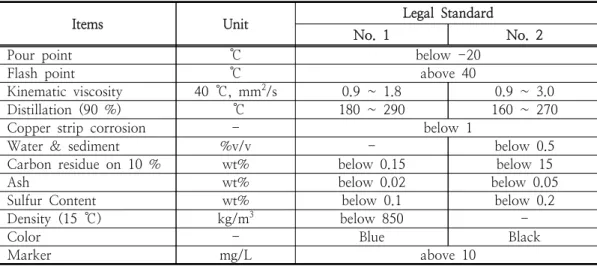
국내 「석유 및 석유대체연료 사업법」에서 규 정하는 부생연료유는 ‘보일러 또는 노(furnace)의 연료’로 정의되어 있으며, 2종류(등유형, 중유형) 로 구분된다[10]. 부생연료유(2호)는 주로 나프타 를 분해하여 생성되는 탄소수 9개 이상으로 구성 되고 기존의 보일러 등유, 벙커유 등 액체연료를 사용하는 열원 공급시설(산업용 보일러 등)에 대 체연료유로 사용한다. 연료유로 사용을 위해 고려 되는 항목들 중 연소성과 관련해서 10 % 잔류탄 소 및 방향족 함량은 매우 높은 경향을 보여 그
Items Unit Legal Standard
No. 1 No. 2
Pour point ℃ below -20
Flash point ℃ above 40
Kinematic viscosity 40 ℃, mm2/s 0.9 ~ 1.8 0.9 ~ 3.0
Distillation (90 %) ℃ 180 ~ 290 160 ~ 270
Copper strip corrosion - below 1
Water & sediment %v/v - below 0.5
Carbon residue on 10 % wt% below 0.15 below 15
Ash wt% below 0.02 below 0.05
Sulfur Content wt% below 0.1 below 0.2
Density (15 ℃) kg/m3 below 850 -
Color - Blue Black
Marker mg/L above 10
Table 3. Quality specification of by-product fuel oil in Korea
Items Unit Legal Standard
Flash point ℃ above 40
Water & sediment %v/v below 0.5
Carbon residue wt% below 0.15
Ash wt% below 0.05
Sulfur Content wt% below 0.2
Metal Contents
Cd mg/L below 1
Cr mg/L below 1
Pb mg/L below 1
As mg/L below 1
Table 4. Quality specification of refined fuel oil in Korea 을음 또는 배출가스의 일부 항목에서 허용기준을
초과할 수 있다. 또한 높은 방향족 함량은 연소 기기의 부품(연료공급호스, 오일필터 등의 고무, 플라스틱 재질 등)에 손상을 줄 수 있다. 부생연 료유(2호)에는 별도의 윤활성향상제와 같은 첨가 제가 들어가지 않아 동점도 및 윤활성능이 낮은 경향을 보인다. 다만 열량 측면에서는 다른 연료 유와 비교해서도 높은 열량을 가지고 있다.
Table 3은 국내 부생연료유의 품질기준을 나타내 었다.
2.3. 정제연료유(감압) 품질기준
정제연료유는 환경부의 「폐기물관리법 시행규 칙 별표 5의 2」 ‘폐기물의 재활용 기준 및 구체 적인 재활용 방법’ 에서 구체적인 제조방법과 품 질기준을 나타내고 있다. 정제연료유는 폐기물을
정제, 유화 등의 방법으로 에너지를 회수할 수 있는 상태로 만들어 재활용한 것으로, 폐유를 이 용하여 정제연료유를 재활용하는 경우에는 약품 정제, 감압증류, 열분해 등의 방법으로 생산한다.
또한, 생산된 정제연료유는 폐기물공정시험기준 또는 한국산업표준(KS), 대기오염공정시험기준 등 에서 정하고 있는 품질기준을 만족하여야한다 [11]. 감압증류는 폐윤활유의 열분해를 방지하기 위하여 진공상태에서 분리하는 기술로, 폐윤활유 의 분해에 따른 타르 생성, 악취 발생 등의 문제 점이 없다. 또한, 폐윤활유를 정제한 고점도 물질 로 높은 발열량을 가지고 있어 대체연료유로 많 이 활용된다. Table 4는 국내 정제연료유(감압)의 품질기준을 나타내었다.
Items Unit Legal Standard Company A Company B
Pour point ℃ below -20 -57 -57
Flash point ℃ above 40 53 48
Kinematic viscosity 40 ℃, mm2/s 0.9 ~ 3.0 1.3350 1.3800
Distillation (90 %) ℃ 160 ~ 270 202 210
Copper strip corrosion - below 1 1a 1a
Water & sediment %v/v below 0.5 0.0 0.0
Carbon residue on 10 % wt% below 15 0.0089 0.4365
Ash wt% below 0.05 0.0020 0.0894
Sulfur Content wt% below 0.2 0.0215 0.0010
Color - Black Black Black
Marker mg/L above 10 12 13
Table 5. Results of physical/chemical analysis in by-product fuel oil(No.2)
Items Unit Legal Standard Company C Company D
Flash point ℃ above 40 140 65
Water & sediment %v/v below 0.5 0.0052 0.0025
Carbon residue wt% below 0.15 0.0092 0.0095
Ash wt% below 0.05 0.0341 0.0014
Sulfur Content wt% below 0.2 0.1296 0.0827
Metal Contents Cd mg/L below 1 0.0670 0.0310
Cr mg/L below 1 0.1460 0.1580
Pb mg/L below 1 0.0960 0.2070
As mg/L below 1 0.0000 0.2030
Table 6. Results of physical/chemical analysis in refined fuel oil(Reduced pressure)
3. 결과 및 고찰
3.1. 부생연료유(2호) 및 정제연료유(감압)의 물성 분석
국내에서 생산된 부생연료유(2호)와 정제연료 유(감압)에 대해 해당 법령에서 규정하는 품질시 험 항목에 따라 시험분석을 실시하였다. Table 5는 시험분석 시료 2가지의 부생연료유(2호) 분 석결과를 나타내었다. 두 시료 모두 「석유 및 석유대체연료 사업법」상의 품질기준을 충족하고 있다. 다만, 일부 항목(10 % 잔류탄소 함량, 회 분, 황 함량)에서는 상이한 차이를 나타내었는데, 이는 각 생산업체별 공정 및 원료물질의 성상차 이에 따른 것으로 추정된다.
Table 6은 정제연료유(감압) 시료 2가지의 분 석결과를 나타내었다. 정제연료유(감압)의 경우에 도 부생연료유(2호)와 마찬가지로 두 시료 모두
「폐기물관리법」상의 품질기준을 충족하고 있다.
또한, 일부 항목(인화점, 회분)에서는 상이한 차 이를 보였으며, 이 역시 각 생산업체별 공정 및 원료물질의 성상차이에 따른 것으로 추정된다.
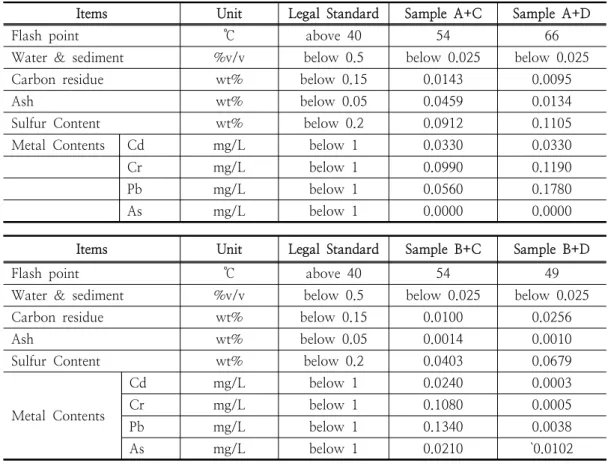
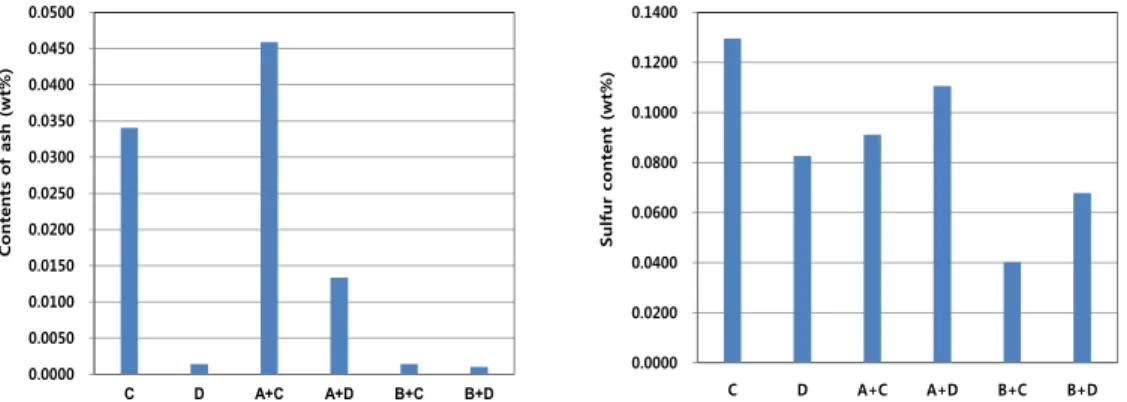
3.2. 부생연료유(2호) 혼합 정제연료유(감압)와 기존 정제연료유(감압)의 물성 비교 분석 부생연료유(2호) 및 정제연료유(감압) 각 2종을 1 : 1의 비율로 혼합하여 분석한 후, 「폐기물관 리법」상의 정제연료유(감압) 품질기준과 비교분 석을 실시하였다. Table 7, Fig. 1.과 Fig. 2.에서 보는 바와 같이, 부생연료유(2호)를 혼합한 정제 연료유(감압)의 물성도 정제연료유(감압) 품질기 준을 만족하는 것으로 나타났다. 시료(B+D)의 경 우(Fig. 1.), 부생연료유(2호)의 품질기준은 10 % 잔류탄소분을 측정하고 있지만 정제연료유(감압) 에서는 전체 잔류탄소분을 측정하는 차이점이 있 고, 제조사의 특성으로 다소 높은 탄소함량을 나 타낼 수도 있을 것으로 보인다. 또한, 중금속 함
Table 7. Results of physical/chemical analysis in refined fuel oil(Reduced pressure) mixed with the by-product fuel oil(No.2)
Items Unit Legal Standard Sample A+C Sample A+D
Flash point ℃ above 40 54 66
Water & sediment %v/v below 0.5 below 0.025 below 0.025
Carbon residue wt% below 0.15 0.0143 0.0095
Ash wt% below 0.05 0.0459 0.0134
Sulfur Content wt% below 0.2 0.0912 0.1105
Metal Contents Cd mg/L below 1 0.0330 0.0330
Cr mg/L below 1 0.0990 0.1190
Pb mg/L below 1 0.0560 0.1780
As mg/L below 1 0.0000 0.0000
Items Unit Legal Standard Sample B+C Sample B+D
Flash point ℃ above 40 54 49
Water & sediment %v/v below 0.5 below 0.025 below 0.025
Carbon residue wt% below 0.15 0.0100 0.0256
Ash wt% below 0.05 0.0014 0.0010
Sulfur Content wt% below 0.2 0.0403 0.0679
Metal Contents
Cd mg/L below 1 0.0240 0.0003
Cr mg/L below 1 0.1080 0.0005
Pb mg/L below 1 0.1340 0.0038
As mg/L below 1 0.0210 `0.0102
0 20 40 60 80 100 120 140 160
C D A+C A+D B+C B+D
Flash point (℃)
0.0000 0.0050 0.0100 0.0150 0.0200 0.0250 0.0300
C D A+C A+D B+C B+D
Carbon residue (wt%)
Fig. 1. Results of flash point and carbon residue analysis for comparing the refined fuel oil with the refined fuel oil(Reduced pressure)-mixed the by-product fuel oil(No.2).
0.0000 0.0050 0.0100 0.0150 0.0200 0.0250 0.0300 0.0350 0.0400 0.0450 0.0500
C D A+C A+D B+C B+D
Contents of ash (wt%)
0.0000 0.0200 0.0400 0.0600 0.0800 0.1000 0.1200 0.1400
C D A+C A+D B+C B+D
Sulfur content (wt%)
Fig. 2. Results of ash and sulfur content analysis for comparing the refined fuel oil(Reduced pressure) with the refined fuel oil-mixed the by-product fuel oil(No.2).
량도 정제연료유(감압)의 품질기준을 모두 만족하 였으며, 희석작용에 의해 더 낮아지는 경향을 보 였다.
0.0000 0.0500 0.1000 0.1500 0.2000 0.2500
Cd Cr Pb As
Concentration (mg/L)
A B C D A+C A+D B+C B+D
Fig. 3. Results of heavy metal content analysis for comparing the refined fuel oil(Reduced pressure) with the refined fuel oil-mixed the by-product fuel oil(No2).
3.3. 부생연료유(2호) 혼합 정제연료유(감압)의 추가 물성 분석
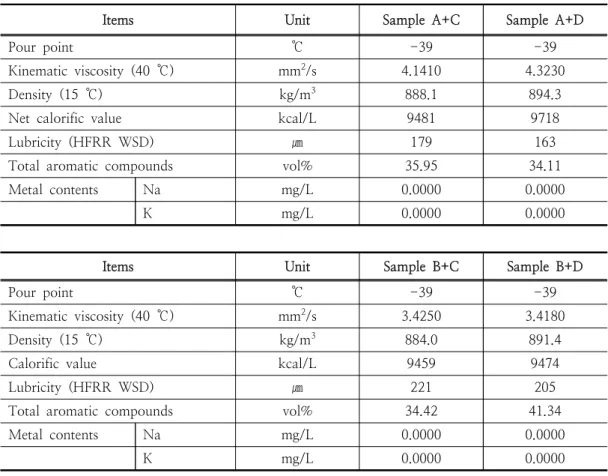
부생연료유(2호) 혼합 정제연료유(감압)의 사용 을 위해서는 기존 정제연료유(감압)의 품질기준 항목이외에도 연료로 사용을 위해 품질과 관련한 추가적인 항목들에 대한 분석을 통한 검토가 필 요하다. 따라서 폐기물관리법에서 규정하는 정제 연료유(감압)의 품질기준항목 이외에 연료의 특성 과 관련한 항목들에 대한 분석을 실시하였다.
Table. 8, Fig. 4. ~ 6.은 추가항목에 대한 분석 결과이다. 유동점은 연료의 저온성능과 관련되어 있으며, 동점도와 윤활성은 기기의 마모에 영향을
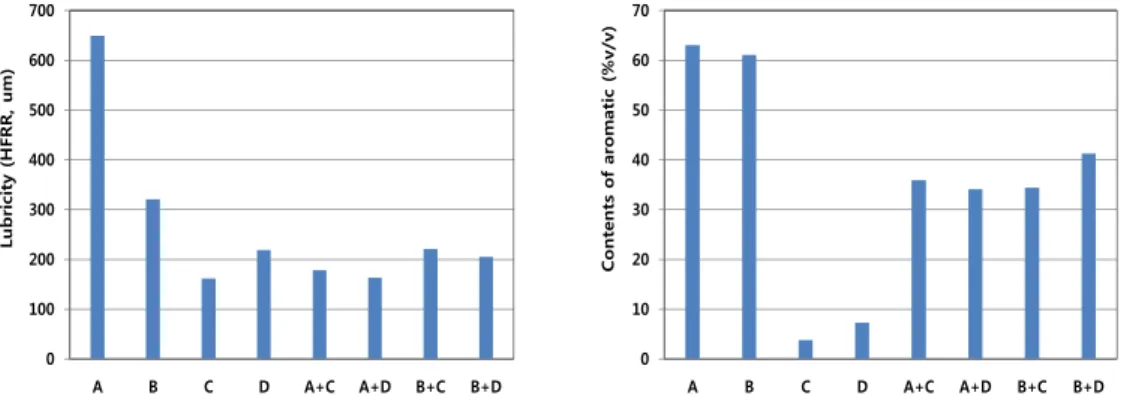
미칠 수 있다. 밀도와 저위발열량은 연료의 에너 지 특성을 나타내며, 중유(벙커C유)와 비슷한 열 량을 나타내었다. 다만, 방향족 함량은 기존의 부 생연료유(2호)가 높은 방향족 함량을 가지고 있 고 정제연료유는 매우 낮은 함량을 가지고 있어 부생연료유(2호)를 혼합한 정제연료유가 혼합 전 보다 높은 방향족 함량을 나타내었다. 이는 정제 연료유(감압)를 연료유로 사용 시 연료기기 계통 의 고무류나 플라스틱 부분에 파손 우려가 있고 불완전 연소에 의한 그을음 또는 매연의 발생이 증가할 것으로 예상된다.
4. 결 론
본 연구에서는 대체연료유로 사용되고 있는 정 제연료유(감압)에 부생연료유(2호)를 혼합하여 정 제연료유의 물성변화에 대한 분석 및 정제연료유 와의 품질비교를 실시하였다. 또한, 연료와 관련 된 추가적인 항목들에 대해서도 분석을 실시하였 다.
1. 부생연료유(2호)는 국내의 「석유 및 석유대 체연료 사업법」상의 품질기준을 모두 충분 히 만족하고 있고, 업체에 따라 항목별로 차 이를 나타내었다. 또한, 방향족 함량은 다소 높은 경향을 보였다. 정제연료유(감압)도
「폐기물관리법」에서 규정하는 품질기준을 모두 충분히 만족하였고 업체별로 항목에 따라 차이가 있는 항목도 있었다.
Table 8. Results of additional physical/chemical analysis in refined fuel oil(Reduced pressure) mixed with the by-product fuel oil(No.2)
Items Unit Sample A+C Sample A+D
Pour point ℃ -39 -39
Kinematic viscosity (40 ℃) mm2/s 4.1410 4.3230
Density (15 ℃) kg/m3 888.1 894.3
Net calorific value kcal/L 9481 9718
Lubricity (HFRR WSD) ㎛ 179 163
Total aromatic compounds vol% 35.95 34.11
Metal contents Na mg/L 0.0000 0.0000
K mg/L 0.0000 0.0000
Items Unit Sample B+C Sample B+D
Pour point ℃ -39 -39
Kinematic viscosity (40 ℃) mm2/s 3.4250 3.4180
Density (15 ℃) kg/m3 884.0 891.4
Calorific value kcal/L 9459 9474
Lubricity (HFRR WSD) ㎛ 221 205
Total aromatic compounds vol% 34.42 41.34
Metal contents Na mg/L 0.0000 0.0000
K mg/L 0.0000 0.0000
-60
-50
-40
-30
-20
-10
0
A B C D A+C A+D B+C B+D
Pour point (℃)
0 5 10 15 20 25 30
A B C D A+C A+D B+C B+D
Viscosity (mm2/s)
Fig. 4. Results of pour point and viscosity analysis for comparing the refined fuel oil(Reduced pressure) with the refined fuel oil-mixed the by-product fuel oil(No2).
780 800 820 840 860 880 900 920 940 960
A B C D A+C A+D B+C B+D
Density (kg/m3)
9000 9100 9200 9300 9400 9500 9600 9700 9800
A B C D A+C A+D B+C B+D
Net calorific value (kcal/L)
Fig. 5. Results of density and net calorific value analysis for comparing the refined fuel oil(Reduced pressure) with the refined fuel oil-mixed the by-product fuel oil(No2).
0 100 200 300 400 500 600 700
A B C D A+C A+D B+C B+D
Lubricity (HFRR, um)
0 10 20 30 40 50 60 70
A B C D A+C A+D B+C B+D
Contents of aromatic (%v/v)
Fig. 6. Results of lubricity and aromatic content analysis for comparing the refined fuel oil(Reduced pressure) with the refined fuel oil-mixed the by-product fuel oil(No2).
2. 부생연료유(2호)를 혼합(1:1)한 정제연료유 (감압)도 정제연료유(감압) 품질기준을 모두 만족하였다. 또한, 연료와 관련된 추가적인 분석에서는 부생연료유(2호)의 높은 방향족 함량에 의해 부생연료유(2호) 혼합 정제연료 유(감압)도 높은 방향족 함량을 나타내어 연 료로 사용에 주의가 필요할 것으로 보인다.
본 연구는 대체연료로 사용되는 정제연료유(감 압)에 부생연료유(2)호를 혼합하여 연료로서의 활 용에 대한 분석을 하였으나, 향후 보다 다양한 업체 및 많은 시료들과 여러 가지 혼합비율에 대 한 추가적인 검토가 필요할 것이다.
References
1. J. Hwang, H. Kim, and M. Kim, “Process Simulation and Vacuum Distillation of Petroleum Atmospheric Residuum with Waste Lube Oils”,
Journal of the Korean Institute of Chemical Engineers,
Vol.33, No.2, pp. 264-271, (1995).2. F. O. Cotton, M. L. Whisman, J. W.
Goetzinger and J. W. Reynolds, “Analysis of 30 used Motor Oils”,
Hydrocarbon
Processing,
Vol.56, No.9, pp. 131-140, (1977).3. J. W. Goetzinger, F. O. Cotton and M. L.
Whisman, “A Comparative Evaluation of New, Used, and Re-refined Lubricating Oils”,
The Oil and Gas Journal,
Vol.73, No.9, pp. 130-140, (1975).4. A. Sequeura, P. B. Sherman, J. U. Douciere and E. O. McBride, “MP Refining of Lubes”,
Hydrocarbon Processing,
Vol.58, No.9, pp. 155-160, (1979).5. T. Pyziak and D. W. Brinkman, “Recycling and re-refining used lubricating oils”,
Lubrication Engineering,
Vol.49, No.5, pp.339-346, (1993).
6. R. E. Linnard and L. M. Henton, “Re- refine waste oil with PROP”,
Hydrocarbon Processing,
Vol.58, No.9, pp. 148-154, (1979).7. M. L. Whisman, J. W. Reynolds, J. W.
Goetzinger, F. O. Cotton and D. W.
Brinkman, “Re-refining makes quality oils”,
Hydrocarbon Processing,
Vol.57, No.10, pp. 141-145, (1978).8. J. W. Reynolds, M. L. Whisman, and C.
J. Thompson, “Engine sequence testing of re-refined lubricating oils”,
SAE
(Society of Automotive Engineers) International,
Paper No. 770431, (1977).9. Petroleum and Petroleum Substitute Fuel Business Act, Republic of Korea, (2015).
10. Enforcement Decree of the Waste Control Act, Republic of Korea, (2014).
11. KS M ISO 3016, “Testing methods for pour point and cloud point of crude oil and petroleum products”,
Korea Standard,
(2008).12. KS M 2010, “Testing methods for flash point of crude oil and petroleum products”,
Korea Standard,
(2013).13. KS M ISO 3104, “Petroleum products – Transparent and opaque liquids – Determination of Kinematic viscosity and calculation of dynamic viscosity”,
Korea Standard,
(2013).14. KS M ISO 3405, “Petroleum products – Determination of distillation characteristics”,
Korea Standard,
(2012).15. KS M ISO 2160, “Petroleum products – Corrosiveness to copper – Copper strip test”,
Korea Standard,
(2012).16. KS M 2115, “Testing methods for water and sediment in distillate fuel by centrifuge”,
Korea Standard,
(2011).17. KS M ISO 10370, “Petroleum products – Determination of carbon residue – Micro method”,
Korea Standard,
(2011).18. KS M ISO 6245, “Petroleum products – Determination of ash”,
Korea Standard,
(2013).19. KS M ISO 8754, “Petroleum products – Determination of sulfur content – Energy- dispersive X-ray fluorescence method”,
Korea Standard,
(2008).20. KS M ISO 12185, “Crude petroleum and petroleum products – Determination of density – Oscillating U-tube method”,
Korea Standard,
(2013).21. KS M 2057, “Crude petroleum and petroleum products – Determination and estimation of heat of combustion”,
Korea Standard,
(2011).22. KS R ISO 12156-1, “Diesel fuel – Assessment of lubricity using the high- frequency reciprocating rig(HFRR) - Part 1: Test method”,
Korea Standard,
(2012).23. KS M 2456, “Petroleum products – Determination of aromatic hydrocarbon types in middle distillates – High performance liquid chromatography method with refractive index detection”,