• 검색 결과가 없습니다.

Effects of the BeHaS Program on Physical Factors and Self-esteem of Elderly Women in a Senior Center: A Pilot Study

N/A
N/A
Protected

Academic year: 2021

Share "Effects of the BeHaS Program on Physical Factors and Self-esteem of Elderly Women in a Senior Center: A Pilot Study"

Copied!
11
0
0

로드 중.... (전체 텍스트 보기)

전체 글

(1)

Effects of the BeHaS Program on Physical Factors and Self-esteem of Elderly Women in a Senior Center: A Pilot Study

Jong-Im Kim

1

, Jiyoung Kim

2*

, Eunok Park

3

, Ju-Ah Park

4

, Lina Lee

5

, Keumok Park

6

, Young-Hee Choi

7

1

Professor, College of Nursing, Chungnam National University

2

Instructor, College of nursing, Chungnam National University

3

Professor, College of Nursing, Jeju National University

4

Graduate Student, College of Nursing, Chungnam National University

5

Nurse, Chungnam National University Hospital

6

Professor, Nursing department, The college of Health and Welfare, Woosong University

7

Nurse, Seo-gu Daejeon Health Center

베하스(BeHaS) 프로그램이 경로당 여성 노인의 신체적 요인과 자아존중감에 미치는 효과: 예비연구

김종임

1

, 김지영

2*

, 박은옥

3

, 박주아

4

, 이리나

5

, 박금옥

6

, 최영희

7

1

충남대학교 간호대학 교수,

2

충남대학교 간호대학 강사,

3

제주대학교 간호대학 교수,

4

충남대학교 간호대학 대학원생,

5

충남대학교병원 간호사,

6

우송대학교 보건복지대학 간호학과 교수,

7

대전서구보건소 간호사

Abstract The purpose of this study was to investigate the effects of the BeHaS program on physical factors and self-esteem of the elderly women in a senior center. In this study, the BeHaS program for the elderly who had one or more risk factors for metabolic syndrome was conducted for 8 weeks, once a week, 1.5 hours a day. Data collection was measured 3 times at 8-week intervals. Physical factors were measured 3 times (Pretest1, Pretest2, posttest) and self-esteem were measured 2 times (Pretest2, posttest). Physical factors were analyzed using Repeated Measured ANOVA, and, self-esteem was analyzed using paired t-test. As the result of this study, it was confirmed that the BeHaS program is effective in managing obesity and blood glucose, reducing cholesterol, and improving self-esteem.

Therefore, it is suggested that additional research is needed to improve the community health with metabolic syndrome.

Key Words : Metabolic syndrome, Aged, Physical factors, Self-esteem, Senior centers

요 약 본 연구의 목적은 경로당 여성 노인의 신체적 요인과 자아존중감에 대한 베하스 프로그램의 효과를 알아보기 위함이다. 본 연구는 대사증후군 위험요인을 한 개 이상 가진 여성노인을 대상으로 베하스 프로그램을 8주간, 주 1회, 1일 1.5시간씩 실시하였다. 자료 수집은 8주 간격으로 총 3회 측정을 하였으며 신체적 요인은 3회(Pretest1, Pretest2, posttest), 자아존중감은 2회(Pretest2, posttest) 하였다. 신체적 요인은 Repeated Measured ANOVA, 자아존중감 은 paired t-test를 이용하여 분석하였다. 본 연구 결과 대상자의 복부둘레, 당화혈색소, 총콜레스테롤, 저밀도지단백 콜레스테롤, 자아존중감에서 유의한 차이를 보여, 베하스 프로그램이 비만 및 혈당 관리, 콜레스테롤 감소, 자아존중감 향상에 효과가 있음을 확인하였다. 이를 바탕으로 대사증후군이 있는 지역사회 주민의 건강향상을 위한 추가적인 연구 가 필요함을 제언한다.

주제어 : 대사증후군, 노인, 신체적 요인, 자아존중감, 경로당

*This research was supported by Basic Science Research Program through the National Research Foundation of Korea (NRF) funded by the Ministry of Education (No. 2017R1D1A1B03033785).

*Corresponding Author : Jiyoung Kim([email protected]) Received September 2, 2020

Accepted November 20, 2020 Revised October 5, 2020

Published November 28, 2020

(2)

1. Introduction 1.1 The need of research

Metabolic syndrome refers to a condition in which cardiovascular risk factors such as abdominal obesity, dyslipidemia, hypertension, and diabetes are clustered in one person [1] and has a high effect on chronic diseases, such as cardiovascular disease, in adults. According to Korea's 2016 Health Examination Statistical Yearbook, people with three to five of the risk factors for metabolic syndrome (abdominal obesity, high blood pressure, high blood glucose, hypertriglyceridemia, and low high-density lipoprotein (HDL) cholesterol) include 37.7%

individuals in their 60s, 45.3% in their 70s, and 45% in their 80s, and there appears to be an increase in such incidences with age [2].

Currently, the most commonly used diagnostic standard for metabolic syndrome is the National Cholesterol Education Program Adult Panel III (NCEP ATP III) standard, which has been published by the National Council for Cholesterol Education in the United States [1]. To reduce the risk factors for metabolic syndrome, it is essential to increase exercise and physical activity [3]. Further, it is also important to control one’s diet, health education, improve lifestyle [4] and self management [5].

Elderly population is growing worldwide faster than other population segment; one in eight people worldwide was aged 60 or over in 2017, and by 2050 there will be one in five people globally [6]. In the future, the increase in medical costs due to chronic diseases in the elderly population will become a social problem [7].

Since the health problems of the elderly are based on the active improvement of the existing unhealthy lifestyle [8], it is very important that the elderly who are at risk of metabolic syndrome also practice continuous health behavior. In particular, elderly women have poor or insufficient nutritional intake than elderly

men, health screening rates and cancer screening rates are low, and subjective health status is also perceived to be poor [9]. Therefore, elderly women need education for health behavior.

Self-esteem makes an individual feel valued;

the self-esteem of older adults is associated with their quality of life [10]. Moreover, self-esteem of older adults begins dropping at the age of 60 [11], or starts to decline at 50 [12]. Since self-esteem is closely correlated with health promotion behavior [13], efforts are needed to enhance self-esteem among elderly women living in senior center who have or are at risk of metabolic syndrome.

Most of the elderly in Korea use senior center to participate in activities, which has a great influence on elderly health care [14]. Also, the senior center is located in many places across the country, so it has a great advantage that it is highly accessible to elderly who have difficulty moving or moving around [14]. Therefore, if a health program for metabolic syndrome management is operated for many elderly people who use the senior center, the effect of metabolic syndrome prevention management can be enhanced.

At the time of development, the BeHaS (Be

Happy and Strong) program was developed to

educate arthritis and exercise, and promote

self-esteem to maintain and improve the health

of arthritis patients [15]. Since then, the BeHaS

program was applied to various participants

through various methods; elderly living in

facilities, pain patients, and breast cancer

patients, including education appropriate for

each disease [16-18]. Recently, it has developed

by changing into a complex program aimed at

improving not only exercise for the elderly, but

also disease management knowledge and

self-respect [19]. For example, some studies have

reported positive effects on psychological and

physical factors of the BeHaS programs in the

elderly with chronic diseases such as diabetes

(3)

One group (N=19)

󰀻 󰀻 󰀻 󰀻

Pretest 1 Pretest 2 Intervention

(8 weeks) Posttest

 Physical factors ➜

(8wks)

 Physical factors

 Self-esteem ➜ BeHaS program ➜  Physical factors

 Self-esteem Fig. 1. Flow-chart of the research design

[20] and hypertension [21]. Therefore, positive effects would be expected for the elderly with metabolic syndrome through BeHaS program.

At present, though education and research on metabolic syndrome management are increasing in Korea, the number of patients with metabolic syndrome continues to increase, especially among the elderly. Since the elderly may have difficulty in practicing and managing health behaviors[8], the BeHaS program, which includes metabolic syndrome management education, focuses on easily accessible places (senior centers) to increase metabolic syndrome management and self-esteem. Therefore, this study aims to examine the effects of an eight-week BeHaS program on physical factors and self-esteem of older adults with metabolic syndrome or risk factors in senior centers.

Further, this study is meaningful because it is the first to conduct an intensive program of this nature with women at risk of metabolic syndrome to examine the program’s effectiveness.

1.2 Purpose

The purpose of this study was to investigate the effects of the BeHaS program on the physical factors and self-esteem of the elderly in a senior center.

2. Method 2.1 Study design

This study is a one group repeated measures design to investigate the effects of the BeHaS program on the physical factors and self-esteem of older adults in a senior center.

The study design is shown in Fig. 1.

2.2 Participants

This study included participants aged 79.74±5.18 years who were registered in ‘A’

apartment senior center located in D City from August to September 2018, and who agreed to participate in the BeHaS program, including education for managing metabolic syndrome.

The selection criteria included presence of at least one risk factor for metabolic syndrome, no physical and mental dysfunction, and being able to communicate with each other.

The sample size required for the Repeated

Measured ANOVA was based on the effect size of

the total cholesterol in the BeHaS program for

the elderly with hypertension [21] and Cohen's

Power analysis. Therefore, when the significance

of .05, effect size =.4, power =.8 were calculated,

the sample generated was 12. In addition, the

sample size required for the paired t-test was

based on the effect size of the self-esteem in the

BeHaS program for the elderly [22] and Cohen's

Power analysis. Therefore, when the significance

of .05, effect size =.8, power =.8 were calculated,

the sample generated was 15. 20 participants

were selected considering the elimination rate, of

those 19 were included in the analysis, since one

participant dropped out of the study owing to

(4)

personal reasons.

2.3 Tools

2.3.1 Abdominal circumference

Participants were told to breathe lightly in a relaxed standing position and the most protruding part of the iliac crest was measured.

The tape was held parallel to the floor, and one investigator continuously measured using the same measuring tape (ROLLFIX®, hoechstmass®, West-Germany) to ensure that the tape was measured with uniform tension. To ensure high accuracy, the measurements were taken on the skin surface and not over the participants’

clothes.

2.3.2 Fasting blood glucose (FBS)

Blood was taken from peripheral blood vessels by stabbing the tip of the finger with a lancet after eight hours of fasting excluding water. It was measured using a blood glucose measuring device (Contour® Plus, Bayer Consumer Care AG, Switzerland) that has been verified for reliability and validity. The unit of measurement was mg/dL.

2.3.3 Glycated hemoglobin (HbA1c)

Blood was collected from peripheral blood vessels by stabbing the tip of fingers with a lancet and measured using a glycated hemoglobin measuring device (SD A1cCareTM System, SD Biosensor Co., Ltd., Chungbuk, Korea) that has been verified for reliability and validity.

The unit of measurement was mg/dL.

2.3.4 Blood pressure (BP)

The patients were instructed to rest for at least 5 to 10 minutes before blood pressure was measured. Blood pressure was assessed using an automatic blood pressure meter (AKESO TMB-986, Guangdong TRANSTEK Medical Electronics Co., LTD, China); its reliability and

validity were confirmed, and the unit of measurement was mmHg.

2.3.5 Triglyceride (TG), total cholesterol (TC), high density lipoprotein cholesterol (HDL-C), low density lipoprotein cholesterol (LDL-C) Blood was collected from peripheral blood vessels by puncturing the distal end, and measured using a cholesterol analyzer (Mission Cholesterol Meter, ACON Laboratories, Inc., San Diego, USA), which has been verified for reliability and validity. The unit of measurement was mg/dL.

2.3.6 Self-esteem

The Rosenberg Self Esteem Scale developed by Rosenberg [23] and translated by Jon [24], was used. This tool consists of a total of 10 questions, and is composed of a minimum of 10 to a maximum of 40 points on a Likert four-point scale, meaning that the higher the score, the higher the level of self-respect. At the time of measurement development, the reliability of the tool was Cronbach's α = .85, and in this study, Cronbach's α = .76.

2.4 Interventions

In this study, an intervention for the elderly who had one or more risk factors for metabolic syndrome was conducted for eight weeks, for 1.5 hours a day, from August to September 2018.

This study was conducted by three doctoral students and one master's student who are nurses, graduate students, and currently conducting related research. The researchers themselves developed the education materials by referring to research and books on metabolic syndrome.

In addition, three certified instructors who

were already researchers instructed the BeHaS

program. Further, a researcher trained in the

BeHaS program was an assistant instructor. After

(5)

Table 1. Contents of BeHaS Program including Metabolic Syndrome Management Education Wks Metabolic Syndrome Education

(20 min.) Self-esteem Promotion Strategy

(10~20 min.) Exercise

(20~30 min.) 1 What is metabolic syndrome?  Noticing each other

 Caring back massage

 I love myself

 Warm-up exercise Breathing Neck strengthening Arm stretching Shoulder stretching Weight shift movement Group walking

 Exercise

Upper limb exercise Lower limb exercise Foot exercise Light hit the body Light hit the sole

 Cooling-down exercise Breathing Neck strengthening Arm stretching Shoulder stretching 2 Abdominal obesity

 Health care

 Diet & Exercise

 Participating program

 Caring back massage

 I love myself 3 High blood pressure

 Health care

 Diet & Exercise

 Complementing each other

 Caring back massage

 I love myself

4 Diabetes

 Health care

 Diet & Exercise

 Hoping each other

 Caring back massage

 I love myself

5 hyperlipidemia

 Health care

 Diet & Exercise

 Greetings to each team member

 Companioning others

 Caring back massage

 I love myself 6 Explore nutritional facts

 Floating balloons in small groups

 Blessing each other

 Caring back massage

 I love myself 7 Low salt, Low fat and High protein diet

 Comforting each other

 Caring back massage

 I love myself 8 Presenting of personal experiences  Forgiving others

 Caring back massage

 I love myself

20 minutes of metabolic syndrome management education, the self-esteem promotion strategy was followed for about 10 to 20 minutes and exercise for about 20 to 30 minutes. The BeHaS was conducted once a week, but the program was designed to further enhance the effectiveness of the program by giving the participants a "joyful homework" based on what they learned every week. The details about the intervention are presented in Table 1.

In order to increase self-esteem, affirmations such as “I love myself,” “Caring back massage,”

“Greetings to each team member,” “Floating balloons in small groups,” and exercises such as

“Group walking” were used. Self-esteem building consists of programs that make one feel relaxed and using expressive motion therapy and various cognitive behavioral techniques. The BeHaS exercise component consists of three phases:

Warm-up exercise, Main exercise, and Cooling

down exercise. It consists of limb and body movements through folding and unfolding of body joints, including basic movements of traditional Korean martial arts.

2.5 Data collection

Before beginning this study, researchers obtained informed consent from the participants who were senior citizens registered in “A”

apartment senior center in Daejeon. Data were collected by five researchers licensed as nurses.

2.5.1 Pretest 1

First, 'pretest 1' was conducted for

participants' screening, and the measured

variables were physical factors (abdominal

circumference, FBS, HbA1c, BP, TG, TC, HDL-C,

and LDL-C). Through this, participants with more

than one risk factor for metabolic syndrome

(6)

Table 2. General Characteristics of the Participants (N=19)

Characteristics Categories n (%) or M±SD

Age 79.7±5.2

Marriage status

Have a spouse 4 (21.1)

Bereaved spouse 10 (52.6)

No marriage 5 (26.3)

Smoking No 19 (100)

Alcohol Yes 1 (5.3)

No 18 (94.7)

Lifestyle

Regular 1 (5.3)

Relatively regular 14 (73.6)

Irregular 4 (21.1)

Dietary attitude

Low salt 3 (15.8)

moderate salt 9 (47.4)

High salt 7 (36.8)

M=mean; SD=standard deviation

could be selected for this study. In addition, through the data of pretest 1, 2, and posttest were compared, more clearly compare the difference between when the BeHaS program, the intervention of this study, was not performed and when it was performed. However, self-esteem was not measured in pretest 1.

2.5.2 Pretest 2

Pretest 2 was measured 8 weeks after Pretest 1 and before the start of the BeHaS program.

Measurement variables were physical factors (abdominal circumference, FBS, HbA1c, BP, TG, TC, HDL-C, and LDL-C) and self-esteem.

2.5.3 Posttest

Posttest was conducted to confirm the effect after the 8 weeks BeHaS program was over.

Measured variables include physical factors (abdominal circumference, FBS, HbA1c, BP, TG, TC, HDL-C, and LDL-C) and self-esteem.

2.6 Data analysis

In this study, the collected data were analyzed using SPSS 24.0 version.

1) The general characteristics of the sample were calculated, including frequency, percentage, average, and standard deviation.

2) Physical factors of the sample were analyzed through a repeated measured ANOVA.

3) The self-esteem of the sample was analyzed using a paired t-test.

2.7 Ethical considerations

The Bioethics Review Committee of C University provided approval for the study (approved by 201806-SB-080-01). The researchers explained the purpose and method of the study, duration of participation, and risk factors of the study to the participants. In addition, participation in the study was voluntary and they could withdraw their consent at any

time during the research process, without any negative consequences.

3. Results

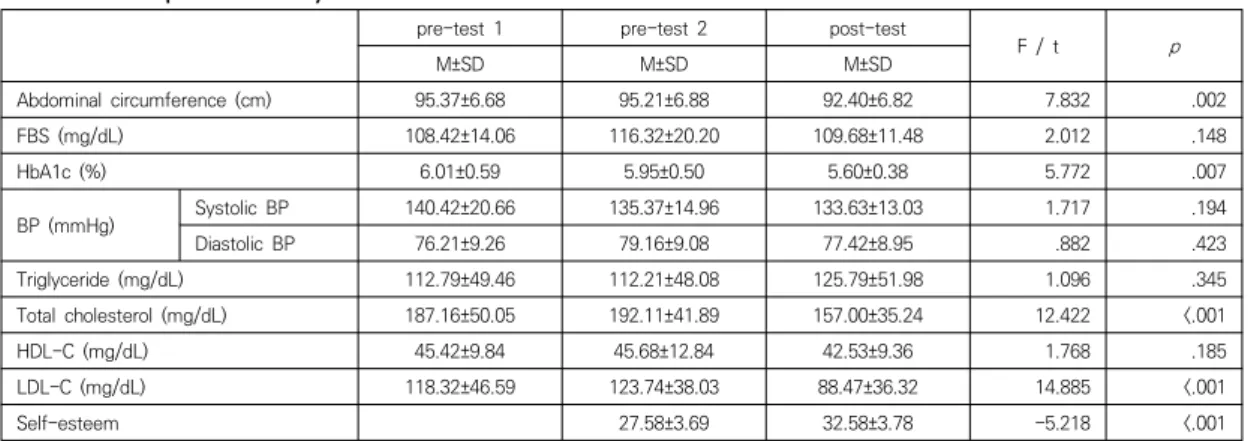
The general characteristics of the participants in this study are shown in Table 2. The study included 19 females, with an average age of 79.74±5.18 years. Of the sample, ten were widowed (52.6%), and five were unmarried (26.3%). None of the participants smoked, and 18 of them (94.7%) did not drink. In addition, 14 of them (73.6%) said that their healthy living habit was relatively regular, while 7 people (36.8%) ate salty food, 9 people ate normal food (47.4%), and 3 people ate bland food (15.8%).

The results showed significant differences in

the participants’ abdominal circumference

(F=7.83, p=.002), glycated hemoglobin (F=5.77,

p=.007), total cholesterol (F=12.42, p<.001),

low-density lipoprotein cholesterol (F=14.89,

p<.001) and self-esteem (t=-5.22, p<.001) after

(7)

Table 3. Comparison of Physical Factors and Self-esteem (N=19)

pre-test 1 pre-test 2 post-test

F / t p

M±SD M±SD M±SD

Abdominal circumference (cm) 95.37±6.68 95.21±6.88 92.40±6.82 7.832 .002

FBS (mg/dL) 108.42±14.06 116.32±20.20 109.68±11.48 2.012 .148

HbA1c (%) 6.01±0.59 5.95±0.50 5.60±0.38 5.772 .007

BP (mmHg) Systolic BP 140.42±20.66 135.37±14.96 133.63±13.03 1.717 .194

Diastolic BP 76.21±9.26 79.16±9.08 77.42±8.95 .882 .423

Triglyceride (mg/dL) 112.79±49.46 112.21±48.08 125.79±51.98 1.096 .345

Total cholesterol (mg/dL) 187.16±50.05 192.11±41.89 157.00±35.24 12.422 <.001

HDL-C (mg/dL) 45.42±9.84 45.68±12.84 42.53±9.36 1.768 .185

LDL-C (mg/dL) 118.32±46.59 123.74±38.03 88.47±36.32 14.885 <.001

Self-esteem 27.58±3.69 32.58±3.78 -5.218 <.001

FBS=Fasting blood glucose; BP=Blood pressure; HDL-C=High density lipoprotein cholesterol; LDL-C=Low density lipoprotein cholesterol

intervention when compared to the status before intervention (Table 3).

4. Discussion

This study was conducted to examine the effects of implementing the BeHaS program for managing metabolic syndrome for eight weeks on physical aspects like abdominal circumference, fasting blood glucose, glycated hemoglobin, blood pressure, triglycerides, total cholesterol, high-density lipoprotein cholesterol, low-density lipoprotein cholesterol, and self-esteem among females aged 70 years and older.

In the present study, three rounds of assessments (Pretest 1, Pretest 2, and Posttest) were conducted to examine the physical factors, and the results showed significant differences in abdominal circumference, glycated hemoglobin, total cholesterol, and low-density lipoprotein cholesterol after the intervention.

The reasons for significant decrease in abdominal circumference, one of the diagnostic criteria for metabolic syndrome, can be inferred as follows: The BeHaS program provides diet and nutrition education for 6 weeks during the 8 weeks intervention period, which showed similar result to the program including diet and exercise

for elderly people with metabolic syndrome for 12 weeks [25]. In addition, the exercise included in the BeHaS program was a low-intensity exercise, but the result was similar to the program including aerobic and resistance training program for 10 weeks [26]. Therefore, the eight-week BeHaS program, which includes diet education and exercise, is very effective in reducing abdominal circumference, so it is necessary to publicize the BeHaS program to the community for the elderly health.

Fasting blood glucose was not significantly different, but glycated hemoglobin showed a significant difference after the intervention. High fasting blood glucose is triggered by stress, sleep conditions, foods eaten before testing, and various environmental factors, while glycated hemoglobin shows an average value within the last three months [27]. Emphasis on nutrition and diet in the metabolic syndrome management education session, together with the BeHaS program, shows significant differences. The eight-week BeHaS program significantly reduced glycated hemoglobin, suggesting that it is effective in improving insulin resistance among those with risk factors of metabolic syndrome.

Further, diastolic blood pressure was higher in

the second round of assessment and slightly

lower in the third round of assessment, but not

(8)

significantly. However, systolic blood pressure had decreased steadily during the third round of assessment. The criterion of primary hypertension presented by the Seventh Report of the Joint National Committee on Prevention, Detection, Evaluation, and Treatment of High Blood Pressure [28] is more than 140mmHg systolic blood pressure or more than 90mmHg diastolic blood pressure. The participants’ blood pressure was not significantly higher than the criteria for hypertension. Therefore, there was no significant decrease.

In this study, there were significant changes in total cholesterol and low-density lipoprotein cholesterol, but no significant changes were seen in triglycerides and high-density lipoprotein cholesterol. Compared to other chronic diseases such as hypertension and diabetes, dyslipidemia is difficult to recognize, and is difficult to treat and control [29]. Triglyceride and high-density lipoprotein cholesterol are included in the diagnostic criteria for metabolic syndrome, but the 8 weeks BeHaS program, which includes low-intensity exercise, does not appear to affect blood lipids. This is consistent with a study that applied an 8 weeks aquatic exercise program to women at risk for metabolic syndrome [30].

Therefore, it can be seen that it is necessary to adjust the exercise intensity or consider the number of proceeding weeks in the composition of the program.

Since its development, The BeHaS program has included Susie Kim's interpersonal care techniques (Noticing, Participating, Complementing, Hoping, Companioning, Comforting, Forgiving, etc.) based on self-esteem [15]. While conducting this study, participants expressed that 'Caring back massage' made them feel valuable through physical contact with each other, and that they were able to receive attention and consideration for themselves. They also said that 'I love myself' was able to think that they were a being loved by themselves. Self-esteem decreases with age [31]

and women are relatively lower with men [32].

Thus, the Behas program is suitable for improving the self-esteem of elderly women, which can be confirmed in several previous studies [17, 21, 22].

5. Conclusion

This one-group pre and posttest repeated measure design study was conducted to identify the physical factors and self-esteem of metabolic syndrome management education and a BeHaS program on the elderly, in order to aid the development of proper nursing interventions for promoting health among the elderly living in the community. The results of this study suggest that metabolic syndrome management education and the BeHaS program are effective for obesity management, blood glucose management, reducing cholesterol, and improving self-esteem.

Therefore, they can be used effectively in preventing metabolic syndrome in the community.

The limitations of this study were that the participants were all women and that the study was conducted in a single group. Since the study included only female participants, findings may not be generalizable to men with metabolic syndrome risk factors. It was difficult to use a control group because the participants in that group did not have a health care program, so there was no motivation to come to the senior center. In addition, since self-esteem was only measured twice, a further study should be conducted to verify both physical and psychological factors, including various genders and more participants, in the study design section.

In the past, the BeHaS program has been

applied to a wide range of participants with

varied symptoms including osteoarthritis, breast

cancer, stroke, and diabetes, as well as

(9)

participants living in collective facilities, elderly college students, obese women, and middle-aged women. Previous studies using the BeHaS program have shown no significant difference in glycated hemoglobin levels. However, since the study showed significant results, the BeHaS program can be applied to patients who are in the pre-diabetes stage or diagnosed with diabetes.

REFERENCES

[1] National Cholesterol Education Program (NCEP) Expert Panel on Detection, Evaluation, and Treatment of High Blood Cholesterol in Adults (Adult Treatment Panel III). (2002). Third report of the National Cholesterol Education Program (NCEP) Expert Panel on Detection, Evaluation, and Treatment of High Blood Cholesterol in Adults (Adult Treatment Panel III) final report. Circulation, 106(25) , 3143-3421.

DOI : 10.1161/circ.106.25.3143

[2] National Health Insurance Service. (2018). 2018 National health screening statistical yearbook . Seoul : National Health Insurance Service.

[3] D. Martinez-Gomez et al. (2019). Physical activity and risk of metabolic phenotypes of obesity: a prospective Taiwanese cohort study in more than 200,000 adults.

Mayo Clinic Proceedings, 94(11) , 2209-2219.

DOI : 10.1016/j.mayocp.2019.04.042

[4] S. Zhu, M. P. St-Onge, S. Heshka & S. B. Heymsfield.

(2004). Lifestyle behaviors associated with lower risk of having the metabolic syndrome. Metabolism, 53(11) , 1503-1511.

DOI : 10.1016/j.metabol.2004.04.017

[5] R. Mangyo & T. Arai. (2020). Intervention using behavior modification techniques to improve the lifestyle of high-risk metabolic syndrome patients.

Journal of Physical Therapy Science, 32(2) , 156-160.

DOI : 10.1589/jpts.32.156

[6] Department of Economic and Social Affairs. (2017).

World population ageing 2017 – highlights [Online].

New York : United Nations.

www.un.org/en/development/desa/population/public ations/pdf/ageing/WPA2017_Highlights.pdf

[7] W. R. Yount. (2008). Transcendence and aging: the secular insights of Erikson and Maslow. Journal of Religion, Spiritual & Aging, 21(1-2) , 73-87.

DOI : 10.1080/15528030802265361

[8] Korea Institute for Health and Social Affair. (2014).

2014 survey of the elderly. Sejong : Korea Institute for Health and Social Affair.

[9] C. L. Joo, J. J. Park, A. Kim, N. L. Park, J. Lim & H. S.

Park. (2019). Health behaviors and lifestyle patterns of elderly living alone in Korea. Korean Journal of Family Practice, 9(3) , 247-253.

DOI : 10.21215/kjfp.2019.9.3.247

[10] D. M. S. Tavares, T. G. C. Matias, P. C. S. Ferreira, M.

S. Pegorari, J. S. Nascimento & M. M. Paiva. Quality of life and self-esteem among the elderly in the community. Cien Saude Colet, 21(11) , 3557-3564.

DOI : 10.1590/1413-812320152111.03032016 [11] U. Orth, K. H. Trzesniewski & R. W. Robins. (2010).

Self-esteem development from young adulthood to old age: a cohort-sequential longitudinal study.

Journal of Personality and Social Psychology, 98(4) , 645-658.

DOI : 10.1037/a0018769

[12] U. Orth & R. W. Robins. (2014). The development of self-esteem. Current Directions in Psychological Science, 23(5) , 381-387.

DOI : 10.1177/0963721414547414

[13] M. V. Auerbach, M. Lobel & D. T. Cannella. (2014).

Psychosocial correlates of health-promoting and health-impairing behaviors in pregnancy. Journal of Psychosomatic Obstetrics & Gynecology, 35(3) , 76-83.

DOI : 10.3109/0167482X.2014.943179

[14] E. H. Kim & J. H. Yang. (2018). An ethnography on the healthy life of the aged women participating the senior centers. Journal of Korean Academy of Nursing, 48(3) , 349-361.

DOI : 10.4040/jkan.2018.48.3.349

[15] J. I. Kim, S. A. Kim, J. H. Kim, H. Y. Song & Y. S.

Moon. (2006). Effects of a BeHaS (Be Happy and Strong) exercise program on pain, health status and weight in middle aged women with osteoarthritis of the knee. Journal of Korean Academy of Fundamentals of Nursing, 13(2) , 242-248.

[16] S. A. Kim. (2011). The effects of BeHaS exercise program on muscle strength and flexibility in institutionalized elders. Journal of Muscle and Joint Health, 18(1) , 93-102.

DOI : 10.5953/JMJH.2011.18.1.093

[17] J. I. Kim & S. K. Kim. (2015). Effects of the BeHaS exercise program on self-esteem, balance, and flexibility in community dwelling adults experiencing pain. Indian Journal of Science and Technology, 8(S7) , 624-629.

DOI : 10.17485/ijst/2015/v8iS7/70523

[18] K. S. Choi, M. S. Kim, I. J. Lee, S. Y. Han, J. A. Park

& J. Lee. (2011). Analysis of nursing intervention studies on patients with breast cancer in korea. Asian Oncology Nursing, 11(1) , 74-82.

DOI : 10.5388/jkon.2011.11.1.74

[19] J. I. Kim et al. (2020). Effects of BeHaS program on

health behvior, physiological Index and self-esteem of

the Elderly Living alone with metabolic syndrome

based on community based participatory research.

(10)

Journal of Korean Academy Nursing, 50(4) , 571-582.

DOI : 10.4040/jkan.19261

[20] K. O. Park. (2019). Development and evaluation of diabetes BeHaS program for older adults with diabetes . Doctoral dissertation. Chungnam National University, Daejeon.

[21] T. H. Kim. (2019). Effects of BeHaS program on physiological, psychological factor, self-efficacy, and self-care behavior in older adults with hypertension . Doctoral dissertation. Chungnam National University, Daejeon.

[22] J. I. Kim, H. J. Won, S. A. Kim & J. H. Lee. (2016). The effect of the BeHaS exercise program on closeness, self-esteem and the intention of exercise maintenance in elderly. Journal of Muscle and Joint Health, 23(3), 206-213.

DOI : 10.5953/JMJH.2016.23.3.206

[23] M. Rosenberg. (1965). Society and the adolescent self-image. New Jersey : Princeton University Press.

[24] B. J. Jon. (1974). Self-esteem: A test of its measurability . Yonsei Nonchong, 11(1), 107-130.

[25] Y. H. Lin, L. L. Chu, C. C. Kao, T. B. Chen, I. Lee &

H. C. Li. (2015). The effects of a diet and exercise program for older adults with metabolic syndrome.

J ournal of Nursing Research, 23(3) , 197-205.

DOI : 10.1097/jnr.0000000000000078

[26] Y. Shiotsu, Y. Watanabe, S. Tujii & M. Yanagita.

(2018). Effect of exercise order of combined aerobic and resistance training on arterial stiffness in older men. Experimental Gerontology, 111 , 27-34.

DOI : 10.1016/j.exger.2018.06.020

[27] J. R. Churilla & R. F. Zoeller. (2008). Physical activity:

physical activity and the metabolic syndrome: a review of the evidence. American Journal of Lifestyle Medicine, 2, 118-125.

DOI : 10.1177/1559827607311981

[28] A. V. Chobanian et al. (2003). The Seventh report of the joint national committee on prevention, detection, evaluation, and treatment of high blood pressure.

Hypertension, 42(6) , 1206-1252.

DOI : 10.1001/jama.289.19.2560

[29] H. W. Yun & S. J. Boo. (2019). Prevalence, Awareness, Treatment, and Control of Hypertension, Diabetes, and Dyslipidemia Among Patients with Rheumatoid Arthritis. Journal of Korean Public Health Nursing, 33(2) , 228-241.

DOI : 10.5932/JKPHN.2019.33.2.228

[30] J. Y. Kim & J. I. Kim. (2018). The effects of aquatic exercise program on risk factors of metabolic syndrome and stress in women. Journal of Muscle and Joint Health, 25(2) , 75-83.

DOI : 10.5953/JMJH.2018.25.2.75

[31] H. J. Jun. (2004). Providing Social Support to Others and Mental Health among Older Adults in USA.

Journal of Korean Gerontological Society, 24(1),

89-105.

[32] K. H. Suh & Y. S. Kim. (2003). Self-esteem and depression of the elderly people living alone. The korean journal of culture and social issues, 9(1) , 115-137.

김 종 임(Jong-Im Kim) [정회원]

․ 1990년 2월 : 서울대학교 간호대학 박사

․ 1990년 3월 ~ 현재 : 충남대학교 간호대학 교수

․ 관심분야 : 관절염 환자간호, 통증 및 운동간호

․ E-Mail : [email protected]

김 지 영(Jiyoung Kim) [정회원]

․ 2020년 8월 : 충남대학교 간호대학 박사

․ 2019년 3월 ~ 현재 : 충남대학교 간호대학 강사

․ 관심분야 : 만성질환관리, 노인간호, 간호교육

․ E-Mail : [email protected]

박 은 옥(Eunok Park) [정회원]

․ 1999년 2월 : 서울대학교 보건학 박사

․ 2000년 3월 ~ 현재 : 제주대학교 간호대학 교수

․ 2020년 9월 ~ 현재 : 제주대학교 건강과간호연구소 연구원

․ 관심분야 : 건강증진, 노인보건, 만성질환 관리

․ E-Mail : [email protected]

(11)

박 주 아(Ju-Ah Park) [정회원]

․ 2018년 3월 ~ 현재 : 충남대학교 간호대학 박사과정 재중

․ 관심분야 : 운동간호, 간호교육

․ E-Mail : [email protected]

이 리 나(Lina Lee) [정회원]

․ 2020년 2월 : 충남대학교 간호대학 석사

․ 2020년 6월 ~ 현재 : 충남대학교병 원 간호사

․ 관심분야 : 운동간호, 간호교육

․ E-Mail : [email protected]

박 금 옥(Keumok Park) [정회원]

․ 2019년 2월 : 충남대학교 간호대학 박사

․ 2019년 4월 ~ 현재 : 우송대학교 보건복지대학 간호학과 교수

․ 관심분야 : 만성질환간호, 노인간호, 당뇨병, 베하스

․ E-Mail : [email protected]

최 영 희(Young-Hee Choi) [정회원]

․ 2007년 1월 ~ 현재 : 대전광역시 서구보건소 건강증진과

․ 관심분야 : 대사증후군 관리 및 금연

․ E-Mail : [email protected]

수치

Table  1.  Contents  of  BeHaS  Program  including  Metabolic  Syndrome  Management  Education Wks Metabolic  Syndrome  Education
Table  2.  General  Characteristics  of  the  Participants (N=19) Characteristics Categories n  (%)  or  M±SD Age 79.7±5.2 Marriage  status Have  a  spouse 4 (21.1)Bereaved  spouse10 (52.6) No  marriage 5 (26.3) Smoking No 19 (100) Alcohol Yes 1 (5.3) No 1
Table  3.  Comparison  of  Physical  Factors  and  Self-esteem (N=19)

참조

관련 문서

The study analyzed differences in lifestyle, self-esteem, body satisfaction, physical self efficacy, self-confidence in fashion coordination between participants and