DOI:10.5229/JKES.2010.13.3.198
− 198 −
Physical Properties of Lithium Co-polyelectrolyte Based on Imidazolium and Ammonium-type Ionic Liquids
E.H. Cha*, S.A. Lim†, D.W. Kim††, J.K. Lee, and J.H. Park†††
College of liberal arts & Science, Hoseo Univ., Asan Choongnam, 336-795, Korea
†School of AIBN, Queensland University, Brisbane 6114, Australia h
††Dept of chemical Engineering HanYang Univ. Seungdonggu, Seoul, 133-791, Korea
†††Department of Chemistry, Korea University, Jochiwon 339-700, Korea
(Received July 30, 2010 : Accepted August 17, 2010)
Abstract : Lithium co-polyelectrolyte-ionic liquid systems, using poly (lithium 2-acrylamido-2- methyl propanesulfonate; PAMPSLi) and polyvinyl formamid (PVF) were prepared and their electrochemical and physical properties were measured. The conductivity of co-polymer sys- tems, PAMPSLi/PVF/N, N-dimethyl-N-propyl-N-butylammonium tricyanomethanide (PAMPSLi/
PVF/N1134TCM) and PAMPSLi/PVF/N, N-dimethyl-N-propyl-N-butylammonium dicyanamide (PAMPSLi/PVF/N1134DCA) exhibited low viscosity (N1134TCM:N1134DCA 28.6cP, 28.7cP) and higher conductivity (2.48×10⁻³Scm−1, 2.2×10⁻³Scm−1) than homopolymer system. The ionic conductivity PAMPSLi/PVF/1-ethyl-3-methyl imidazolium dicyanamide (PAMPSLi/PVF/emImDCA) exhibited 1.54×10⁻³Scm−1 and low viscosity (emImDCA: 28.09cP). High flexibility of imidazolium cation and dissociation of lithium cation from the co-polymer chains were affected by high con- ductivity and low viscosity.
Keywords : Conductivity, Imidazolium ionic liquid, Ammonium ionic liquids, Viscosity, thermal stability
1. Introduction
Ionic liquids have the properties of large stable liquid range, nonvolatile, hydrophobicity or hydrophilicity, fairly low viscosity, high conductivity, high thermal and electro- chemical stability.1-3) The physical properties of polyelec- trolyte based on ionic liquid have been studied for their application as electrolyte for batteries and capacitors,4-5) fuel cells, dye-sensitive solar cells and actuators. In most of these studies, N, N’ dialkyl-imidazolium salt, especially 1-ethyl-3-mehyl-imidazolium salt was focused on empiri- cally because of low viscosity and correspondingly high ionic conductivity.6) The substitution of the methyl group has shown increase in the electrochemical stability of the imidazolium by over 0,25 V.7-8) The dicyanoamide anion is a ligand having Lewis basic properties. It thus possesses the potential to provide ionic liquids which have powerful Lewis base donor solvent properties and therefore to have solvating properties for a range of metal ions that might
be insoluble.9)
Poly(2-arulamido-2-methylpropanesulfonic acid) has been widely used as a water-soluble polymer and as a proton-conducting polyelectrolyte, as well as a lithium- ion electrolyte when mixed with a lithium salt. In this paper, following my earlier report, the electrochemical properties of co-polyelectrolyte based on various ionic liquids are measured, that is conductivity, thermal analysis and stability, viscosity, NMR, TGA.
2. Experimental
The monomer, lithium 2-acrylamido-2-methyl-pro- panesulfonate (AMPSLi), was prepared by the reaction of 2 acrylamide-2-methyl propanesulfonic acid (Aldrich) with lithium carbonate (Aldrich) in a water solution placed in an ice bath. Poly (lithium-2-acrylamido-2- methyl-propanesulfonate (PAMPSLi)/poly(N-vinyl for- mamide) (PVF) was synthesized by polymerization of N-vinyl formamide(Aldrich) with AMPSLi at 80oC in presence of K2SO8 initiator (~1 wt%). The final polymer
*E-mail: [email protected]
product, PAMPSLi/PVF was dried under vacuum (~80 torr) at 65oC for at least 48 h. Co-polymer and ionic liquid (1 : 9) were mixed in ethanol and stirring over night. The transparent gel samples were obtained.12) emImTFSA, PAMPSLi/PVF/emImDCA PAMPSLi/
PVF/N1134 TCM, PAMPSLi/PVF/ N1134DCA were prepared. (Scheme 1).
Thermal analysis of samples was performed using a TA instruments differential scanning calorimeter (DSC Q100) at a scanning rate of 10oC/min over a temperature range of −150oC to 150oC.(But in this paper the data of DSC was displayed from −150oC to 0oC)
Impedance measurements were carried out in a small conductance cell. The samples were loaded and hermetically sealed in the cell using a SI1260 imped- ance/gain phase analyzer and Solatron 1296 with Sol- atron impedance measurement software (v.3.2.0). The cell constants were determined before and after measurements at room temperature using 0.01 M KCl solution. Mea- surements were taken at 10oC increments from 25 to 65oC using the Eurotherm 2240E. Viscosity of the ionic liquids was measured with an AMVn Automated Micro- viscometer at 25oC, 70oC and the ionic liquids were sealed in the sample tube under a nitrogen atmosphere.
A PerkinElmer thermo gravimetric Analyzer was used to test thermal stability of the ionic liquid and scan rate was 10.0oC/min from room temperature to 800oC.
1H and 13C NMR spectra were recorded on a Bruker DPX300 spectrometer for solutions in CDCL3. Peaks are noted below only if they were significantly resolved
from neighboring peaks and/or the baseline. Tetramethyl- silane was used as an internal standard. Positive and nega- tive ion electrospray mass spectra were recorded using a Micromass platform electrospray mass spectrometer on samples dissolved in methanol. NMR data of 5 sam- ples are as follow.
1. N,N-dimethyl-N-propyl-N-butylammonium Tricyanomethanide(N1134TCM);1Hnmr (CH2Cl2): δ 1.03 (m, 6H, CH3), 1.45 (m, 2H, CH2), 1.82 (m, 4H, CH2), 3.08 (s, 6H, CH2), 3.32 (d, 4H, CH2), 4.67 (s, CH2).
ES+ m/z 144.0 N1134+. ES− m/z 89.7 TCM−.
2. N, N-dimethyl-N-propyl-N-butylammonium dicyana- mide (N1134DCA) 1Hnmr (CH2Cl2): δ 1.05 (m, 6H, CH3), 1.47 (m, 2H, CH2), 1.82 (m, 4H, CH2), 3.11 (s, 6H, CH2), 3.35 (d, 4H, CH2), 4.67 (s, CH2). ES+ m/z 143.9 N1134+. ES− m/z 65.7 DCA−.
3. 1-ethyl-3-methylimidazolium bis (trifluoromethane sulfonyl Amide (emIm TFSA)
1Hnmr (400 MHZ, DMSO) δ 9.09 (s, 1H), 7.77- 7.68(m, 2H),4.19(q, 2H, J = 7.3 Hz), 3.84(s, 3H0, 1.42 (t,3H, J = 7.3 Hz)
4. 1-ethyl-3-methylimidazolium dicyanamide (emIm DCA) 1Hnmr (d6− DMSO): δ 1.42 (t, CH3), 3.84 (s, NCH3), 4.19(q, NCH2), 7.67 (s, CH), 7.76(s, CH), 9.10(s, NCHN). MS+ m/z 111emIm+. MS− m/z 66 N(CN)2−, 243emIm N(CN)2−.
3. Results and Discussion
Generally the melting point of dicyanamide(emIm- DCA: −21oC, N1134DCA; −99oC)is lower than those of the corresponding TFSA(emImTFSA; −15oC) and TCM(N1134TCM; 6.5oC)salts, perhaps an unexpected result since charge delocalization could be expected to be greater for TFSA than DCA, producing weaker ion-ion interaction. The trace for emImDCA shows a glass transition near −100oC followed by an exotherm associated with crystallization of the super cooled ionic liquid followed by melting.9) All polyelectrolyte samples except pure ionic liquids do not have a melting peak from −150oC to 0oC. This means that the presence of polymer in ionic liquids hinders the crystallization of the ionic liquid.12) Fig. 1 shows the thermal trace of (a) PAMPSLi/emImDCA (b) PAMPSLi/PVF/emImDCA (c) PAMPSLi/N1134TCM (d) PAMPSLi/PVF/N1134TCM (e) PAMPSLi/N1134DCA (f) PAMPSLi/PVF/N1134DCA.
The glass transition temperature (Tg) of pure ionic liq- uids emImTFSA is −85.49oC, emImDCA is −104oC, Scheme 1. (a) EmIm (b) N1134.
N1134TCM is −87.1oC, but N1134DCA can’t be measured.
The glass transition temperature (Tg) of emImTFSA exhibits −85.49oC. Because of emImTFSA is hydropho- bic and PAMPSLi is hydrophilic, they are immiscible. So the glass transition temperature (Tg) of PAMPSLi/PVF/
emImTFSA system could not be measured. The glass transition temperature (Tg) of PAMPSLi/ N1134TCM, PAMPSLi/N1134DCA and emImTFSA are very similar.
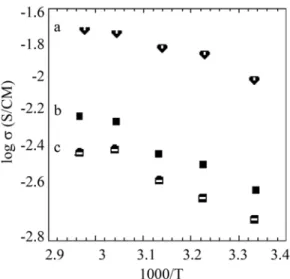
Fig. 1 shows the glass transition temperature of co-poly- mer electrolyte of PAMPSLi/PVF/ N1134TCM was also slightly lower than that of PAMPSLi/N1134TCM. These DSC results exhibited the Tg of copolymer- type polyelec- trolyte based on ionic liquid system is slightly lower than that of homopolymer type. These results are expected to show that ionic conductivity of copolymer system (Fig. 1b, d, f) is higher than that of homopolymer sys- tem(Fig. 1a, c, e). The magnitude of viscosity follows the order : emImTFSA (39 cP) > emImDCA (28.09 cP). This trend can be explained by the small size anion exhibits the lower viscosity. The viscosity of N1134TCM (28.6 cP) and N1134DCA (28.7 cP) also exhibit fairly low. An acceptable explanation concerning the ammonium ionic liquid indicates that electron donation from methyl group into cation center can decrease the positive charge on the nitrogen atom. Hence the electrostatic interaction between the cation and anion is weakened, which results in reduc- ing both the viscosities.12) Fig. 2 shows the conductivity of (a) N1134DCA (b) PAMPSLi/N1134DCA (c) PAMPSLi/
PVF/N1134DCA. As you can see copolymer system (PAMPSLi/PVF/N1134DCA exhibits the higher conductiv-
ity (2.2 × 10⁻³Scm−1) than that of homopolymer sys- tem(PAMPSLi/N1134DCA; 6.0 × 10⁻⁴Scm−1). As the temperature increases, the ionic conductivities are in- creased. The behavior of a higher conductivity co-poly- mer electrolyte-based on ionic liquid can be explained by free lithium cations dissociated from the polymer backbone and reducing the repulsion of anions. So intro- duction of vinyl formamide into copolymer system seem to be increased the dissociation if the lithium cations.
The copolymer system (PAMPSLi/PVF/N1134DCA, PAMPSLi/PVF/emImDCA) exhibits a higher conductiv- ity (2.2 × 10⁻³Scm−1, 1.54 × 10⁻³Scm−1) than that of homopolymer system(PAMPSLi/N1134DCA: 6.0 × 10⁻⁴Scm−1, 5.54 × 10⁻³Scm−1). Fig. 3 shows the con- ductivity of (a) emImDCA (b) PAMPSLi/PVF/emIm- DCA (c) PAMPSLi/emImDCA. This copolymer system (PAMPSLi/PVF/emImDCA) also exhibits the higher conductivity (1.54 × 10⁻³Scm−1) than that of homopoly- mer system (PAMPSLi/emImDCA; 5.54 × 10⁻³Scm−1).
High conductivity and low viscosity of PAMPSLi/PVF/
emImDCA system is due to high flexibility of imidazo- lium cation. But the ionic conductivity of N1134DCA is higher than that of emImDCA. Some quaternary ammo- nium cation contributed to increase the conductivity of the solution, while cyano-containing quaternary ammo- nium and lithium salts decreased the related to the intrin- sic miscibility of ionic liquid solutions.10) Although there was little difference between the glass transition tempera- tures(Tg).. The ionic conductivity of N1134TCM and vis- cosity provide the information on the mobility and Fig. 1. DSC traces of (a) PAMPSLi/emImDCA (b) PAMPSLi/
PVF/emImDCA (c) PAMPSLi/N1134TCM (d) PAMPSLi/PVF/
N1134TCM (e) PAMPSLi/N1134DCA (f) PAMPSLi/PVF/
N1134DCA.
Fig. 2. The conductivity of (a) N1134DCA (b) PAMPSLi/PVF/
N1134 DCA (c)PAMPSLi/ N1134DCA.
aggregation of ions and ion-pairing phenomenon. The conductivity of pure emImTFSA is 8.8 × 10⁻³Scm−1 and the viscosity is 39 cP(25oC). This conductivity value is not much higher than other imidazolium ionic liquid (emim- TCM; 2.0 × 10⁻²Scm−1; enImDCA; 2.2 × 10⁻²Scm−1).
The viscosity of the ionic liquid and its hydrophobicity are critical to achieving low conductivity. The conductiv- ity of the PAMPSLi/emImTFSA also could not be mea- sured, because of they are immiscible. Fig. 4 shows a thermogravimetric trace for (a) emImTFSA (b) emIm- DCA (c)N1134 TCM (d) N1134DCA. It was shown that the
quaternary ammonium salt is less stable than imidazolium salts. They decompose at 230oC,9) but theemImDCA decomposed around 275oC. EmImTFSA is thermally stable around 400oC indicating thermal stability differ- ences between anions. But imidazolium cation is some- what electrochemically unstable in the lithium battery system because the catholic limiting potential is ca.
+1.0 V vs Li/Li+[9].12) The alkali metal salts of dicyanide anion have much greater stability. Sodium dicyanide is known to cyclotrimetrise above 340oC. This suggests the decomposition of the DCA ionic liquids involves interaction between anion and cation.
4. Conclusions
The copolymer system (PAMPSLi/PVF/N1134DCA, PAMPSLi/PVF/emImDCA) exhibits higher conductivity (2.2 × 10⁻³Scm−1, 1.54 × 10⁻³Scm−1) than that of homo- polymer system(PAMPSLi/N1134DCA: 6.0 × 10⁻⁴Scm−1, 5.54 × 10⁻³Scm−1). The ionic conductivity of N1134DCA is higher than that of emImDCA. Some quaternary ammonium cation contributed to increase the conductivity of the solution, while cyano-containing quaternary ammo- nium and lithium salts decreased in relation to the intrinsic miscibility of ionic liquid solutions. The quaternary am- monium salt is less stable than imidazolium salts. The quaternary ammonium salt decomposed at 230oC,but the emImDCA decomposed around 275oC. EmImTFSA is thermally stable around 400oC indicating thermal sta- bility differences between anions.
Acknowledgements
This work supported by Hoseo University grant (2008-0169).
References
1. Wataru Ogihara, Satiko Washiro, Hiromitsu nakajima, Hiroyuki Ohno, Electro- chimica Acta, ‘Effect of cation structure on the electrochemical and thermal properties of ion conductive polymers obtained from polymerizable ionic liquids’ 51, 2614 (2006).
2. Qing Dai, David B.Menzies, D.R Macfarlane, Stuart R, Batten, Stewart Forsyth, Leone spiccia, Yi-Bing Cheng, Maria Forsyth, C.R. Chimie,’ Dye-sensitized nanocrystalline solar cells incorporating ethylmethylimidazolium-based ionic liquid electolytes’ 9, 617 (2006).
3. Hiroyuki Ohno, Masahiro Yoshizawa, Wataru Ogihara, Electrochimica Acta, ‘Develoment of new class of ion Fig. 3. The conductivity of (a) emImDCA (b) PAMPSLi/
PVF/emImDCA (c) PAMPSLi/emImDCA.
Fig. 4. Thermogravimetric trace for (a) emImTFSA (b) emImDCA (c) N1134 TCM (d) N1134DCA.
conductive polymers based on ionic liquids’ 50, 255 (2004).
4. Stewart A. Forsyth, Jennifer M. Pringle, and Douglas R.
MacFarlane, Aust, J. Chem., ‘Ionic Liquids based on Imidazolium and Pyrrolidinium Salts of the tricyanome- thanide anion’ 57, 113 (2004).
5. A. B. McEwen, H. L. Ngo, K. LeCompte and J. L.
Goldman, J. Electrochem Soc.’ Electrochemical Properties of imidazolium Salt Electrolyte for Electrochemical Capacitor Applications’ 146, 1687 (1999).
6. Kaori Ito, Naoko Nishina, hiroyuki Ohno, Electrochimica Acta, ’Enhanced ion conduction in imidazolium-type molten salts’ 45, 1295 (2000).
7. Thomas E. Sutto, Hugh C. De long, and Paul C. Trulove Z.
Naturforch.’ Physical Properties of Substituted Imidazolium Based Ionic Liquids Gel Electrolytes’ 57a, 839 (2002).
8. R. T. Carlin, J. Fuller, W. K. Kuhn, M. J. Lysaght, and P. C.
Trulove, J.Appl. Electrochem,’Electrochemistry of room-
temperature chloroaluminate molten salts at graphitic and nongraphitic electrode’ 26, 1147 (1996).
9. D. R. Macfarlane, S. A. Forsyth, J. Golding and B. Deacon, Greenchemistry, ‘Ionic liquids based on imidazolium, ammonium and pyrrolidinium salts of the dicyanamide anion’ 4, 444 (2002).
10. M. Forsyth, J. Sun, F. Zhou, D. R. MacFarlane, Electro- chimica Acta, ‘Enhancement of ion dissociation in polyelec- trolyte gels’ 48, 2129 (2003).
11. E. H. Cha, S. A. Lim, D. W. Kim, N. S. Choi, J. Korean Electrochemical Society, ‘Electrochemical Characterization of lithium polyelectrolyte based on ionic Liquid’ 12, No3, 271 (2009).
12. E. H. Cha, S. A. Lim, J. H. Park, D. W. Kim. D. R.
Macfarlane, J. Power Sources, ‘Ionic conductivity studies of gel polyelectrolyte based on ionic liquid’ 178, 779 (2008).