• 검색 결과가 없습니다.

Analysis of the Antioxidant Properties of 2,2-diphenyl-1 Picrylhydroazyl, Hydroxyl Radicals, and Nitric Oxide in Alaska Pollock Roe, with or without Natural Fermented Seasoned

N/A
N/A
Protected

Academic year: 2021

Share "Analysis of the Antioxidant Properties of 2,2-diphenyl-1 Picrylhydroazyl, Hydroxyl Radicals, and Nitric Oxide in Alaska Pollock Roe, with or without Natural Fermented Seasoned"

Copied!
8
0
0

로드 중.... (전체 텍스트 보기)

전체 글

(1)

Analysis of the Antioxidant Properties of 2,2-diphenyl-1 Picrylhydroazyl, Hydroxyl Radicals, and Nitric Oxide in Alaska Pollock Roe, with or without Natural

Fermented Seasoned

Ji-Young Hwang

1

, Jong-Soo Jang

1

and Man Kyu Huh

2

*

1

Research and Development Institute, Deok-Hwa Food, Busan 49277, Korea

2
Food Science and Technology Major, Dong-eui University, Busan 47340, Korea

Received February 26, 2019 /Revised March 19, 2019 /Accepted March 27, 2019

Alaska pollock (Gadus chalcogrammus) is a marine fish species belonging to the family Gadidae. In this study, whether the Alaska Polloack Roe have antioxidant properties, 2,2-diphenyl-1 picrylhydroazyl (DPPH), hydroxyl radical (OH) reducing activity, and nitric oxide radical (NO) scavenging activity were evaluated in distilled water extract (DWE) and ethanol extract (ETE) of raw Alaska pollock roe, Gochujang Pollock roe, and fermented seasoned Pollock roe. The DPPH scavenging activity of the DWE with Gochujang Pollock roe was 71.9% at a concentration of 1.0 mg/ml and that of the ETE was 73.7% at the same concentration. The DPPH scavenging activity of the DWE with fermented seas- oned Pollock roe was 78.0% at 1.0 mg/ml, whereas that of ETE was 78.4% at the same concentration.

The IC

50

values of the DWE and ETE of raw Pollock roe for DPPH were 11.65 µg/ml and 11.47 µg/ml, respectively. The OH scavenging activities of raw Pollock roe, Gochujang Pollock roe, and fermented seasoned Pollock roe ethanolic extracts at a concentration of 1.0 mg/ml were 70.9%, 79.0, and 80.6%, respectively. The IC

50

values of the DWE and EWE of raw Pollock roe for NO were 11.45 μg/ml and 11.41 μg/ml, respectively. The DPPH, OH, and NO scavenging abilities in DWEs and ETEs of Gochujang and fermented seasoned Pollock roe were higher than those of instant (no Gochujang or season treat- ment) treatment Pollock roe. Both the Gochujang and fermented seasoned Pollock roes have natural radical scavenging ability and may be useful potential antioxidant food supplements.

Key words : Alaska Pollock roe, DPPH, Gochujang, hydroxyl radical (OH), nitric oxide radical (NO)

*Corresponding author

*Tel : +82-51-890-1529, Fax : +82-0505-182-6864

*E-mail : [email protected]

This is an Open-Access article distributed under the terms of the Creative Commons Attribution Non-Commercial License (http://creativecommons.org/licenses/by-nc/3.0) which permits unrestricted non-commercial use, distribution, and reproduction in any medium, provided the original work is properly cited.

Journal of Life Science 2019 Vol. 29. No. 4. 428~435 DOI : https://doi.org/10.5352/JLS.2019.29.4.428

Introduction

The Alaska Pollock or walleye Pollock (Gadus chalcog- rammus) is a marine fish species of the cod family Gadidae [18]. It is a semipelagic schooling fish widely distributed in the North Pacific with largest concentrations found in the eastern Bering Sea. Alaska produces an estimated 1 billion pounds of fish heads per year and produced 1,528,196 ton of Alaska Pollock roe production on year 2016 [1]. Alaskan Pollock roe production was 32 percent on 2016. Japan is the primary market for Alaska roe products, although they are consumed in South Korea and other niche markets. Mean- while, South Korea has become a larger importer of frozen Pollock roe over the past decade. South Korea is an im-

portant location for cold storage and Pollock roe auctions.

A significant volume of Pollock roe is first exported to South Korea before going on to Japan. In Korea, the roe is called Myeongnan (literally “Alaska Pollock's roe”), and the salted roe is called Myeongnan-jeot (literally “Pollock roe Jeotgal”, Korean salted fish).

Oxygen is an indispensable element for cell activity in organisms. Oxidative property of oxygen plays a vital role in various biological phenomena; being essential for life, oxygen can also aggravate the damage within the cell by oxidative events. The recent growth in the knowledge of free radicals and reactive oxygen species (ROS) in biology is pro- ducing a medical revolution that promises a new age of health and disease management [2]. An antioxidant is a mol- ecule stable enough to donate an electron to a rampaging free radical and neutralize it, thus reducing its capacity to damage [14]. These antioxidants delay or inhibit cellular damage mainly through their free radical scavenging prop- erty [7].

2,2-diphenyl-1-picrylhydroazyl (DPPH) is a well-known

radical and a trap (scavenger) for other radicals. Therefore,

(2)

rate reduction of a chemical reaction upon addition of DPPH is used as an indicator of the radical nature of that reaction and most notably it is a common antioxidant assay [19].

Hydroxyl radicals (OH) generated in the human body may play an important role in tissue injury at sites of in- flammation in oxidative stress-originated diseases. The hy- droxyl radical (-OH) is the mostreactive product of ROS formed by successive 1-electronreductions of molecular oxy- gen (O

2

) in cell metabolism, and is primarily responsible for the cytotoxic effects observed in aerobic organisms extend- ing from bacteria to plants and animals [3].

Nitric oxide (NO) and reactive nitrogen species (RNS) are free radicals that are derived from the interaction of NO with oxygen or reactive oxygen species [21]. In vitro quenching of NO radical is one of the methods that can be used to determine antioxidant activity [17].

Many researches have been taken regarding anti-oxida- tive effect from fish and shellfish, as well as their by-prod- ucts [9, 11, 12]. However, little information regarding anti- oxidants of a Pollock roe and its application has been reported. The main objective of the study was to determine the antioxidant activity of Alaska Pollock roe extracts, Gochujang Pollock roe and fermented seasoning Pollock roe by DPPH, OH, and NO radical scavenging assay.

Materials and Methods

Sample extract

Raw Alaska Pollock roe, Gochujang Pollock roe, and fer- mented seasoning Pollock roe were obtained from Deok- Hwa Food Co., Busan-ci, Republic of Korea. Each roe of G.

chalcogrammus pulverized to a fine powder using a high- speed blender (HC-BL5000, Korea) and liquid nitrogen (-70

℃). Two solvents were used for the preparation of the ex- tracts, cold distilled water and 80% ethanol conc. The aque- ous extract was prepared by weighing out (100 g) of the milled powdered roes were soaked in 500 ml of cold water in a conical flask and stirring vigorously with a glass rod for proper extraction. For the ethanol extract, 100 g of the pulverized powdered roes and were soaked in 500 ml of ethanol for 24 hr also. The samples were treated with ultra- sound (5510, Branson, USA) at room temperature for one hr. The mixture was further stirred with a magnetic bar at 65℃ for 6 hr. They were squeezed out with the muslin cloth and filtered through Whatman filter paper No. 1. The sample was evaporated to remove solvent or excess water under

reduced pressure and controlled temperature (60℃) by us- ing rotary vacuum evaporator (N-1001S-W, Eyela, Tokyo, Japan). To get dry powder, samples placed in a low temper- ature vacuum chamber (HyperCool, HC3110, Gyrozen Co., LTD, Korea). The extract was dried, weighed (5.0 g) and stor- ed at -20℃ in storage vials for experimental use.

DPPH free radical

The hydrogen atoms or electrons donation ability of the corresponding extracts and some pure compounds were measured by bleaching the violet colored ethanoic solution of 2,2-diphenyl-1-picrylhydrazyl (DPPH) [6]. The effects of ethanoic extract on DPPH radicals were evaluated according to the method described by Brand-Williams et al. [4] with slight modifications. 1 ml of 0.1 mM DPPH solution in etha- nol was mixed with 1 ml of the ethanol extracts of various concentrations (0.1, 0.5, and 1.0 mg/ml). DPPH was added to the solutions prepared with sample extracts and standard antioxidant substances and stirred. A solution of DPPH was prepared by dissolving 5 mg DPPH in 2 ml of ethanol, and the solution was kept in the dark at 4℃. A stock solution of the compounds was prepared at 1 mg/ml in dimethyl sulfoxide (DMSO) were plated out in triplicate in a 96-well microtiter plate. Then, 5 μl of ethanol DPPH solution (final concentration 300 μM) was added to each well and ethanol was used for control of test samples. The plate was shaken to ensure thorough mixing for 2 minutes before being wrap- ped with aluminum foil and placed into the dark. The radi- cal scavenging reaction was carried out for 30 min at 37℃

in dark. The optical density (OD) of the solution was read using the Microplate Reader (VersaMax, Califonia, USA) at the wavelength 515 nm. Lower absorbance of the reaction mixture indicated higher free radical scavenging activity.

Corresponding blank sample was prepared and L-Ascorbic acid (1.0 μg/ml) was used as reference standard (positive control). Inhibition of free radical scavenging activity was calculated using the following equation. Relative inhibitor rate of treated groups and product samples for L-Ascorbic acid was calculated.

Hydroxyl radical assay

Hydroxyl radical (OH) scavenging activity was measured

by the ability of the different fractions of ethanol extract to

scavenge the hydroxyl radicals generated by the Fe

3+

-ascor-

bate-EDTA-H

2

O

2

system (Fenton reaction) [7]. The deoxy-

ribose method for determining the scavenging effect of the

(3)

sample extracts against hydroxyl radicals was performed ac- cording to a described procedure [7]. The reaction mixture in a final volume of 1.0 ml contained 100 μl of 2-deoxy-2- ribose (28 mM in 20 mM KH

2

PO

4

buffer, pH 7.4), 500 μl of the fractions at various concentrations (100-600 μg/ml) in buffer, 200 μl of 1.04 mM EDTA and 200 μM FeCl

3

(1:1, v/v), 100 μl of 1.0 mM hydrogen peroxide (H

2

O

2

) and 100 μl of 1.0 mM ascorbic acid. Test samples were kept at 37℃

for 1 hr. The free radical damage imposed on the substrate, deoxyribose was measured using the thiobarbituric acid test.

1 ml of 1% thiobarbituric acid (TBA) (w/v) and 1 ml of 2.8%

trichloroacetic acid (TCA) (w/v) were added to the test tubes and the mixture was heated in a water bath at 100℃ for 15 min. The absorbance of the resulting solution was meas- ured at 530 nm with Microplate Reader). This assay was also performed without ascorbic acid or EDTA, in order to check for pro-oxidant or metal chelation activities [22]. Relative in- hibitor rate of treated groups and product samples for H

2

O

2

and L-Ascorbic acid was calculated.

Nitric oxide (-NO) scavenging assay

Nitric oxide radical (NO˙)-scavenging activity was gen- erated from sodium nitroprusside and measured by the Greiss reaction. Sodium nitroprusside in aqueous solution at physiological pH spontaneously generates nitric oxide which interacts with oxygen to produce nitric ions that can be estimated by using Greiss reagent (1% sulphanilamide, 2% H

3

PO

4

and 0.1% napthylethylenediamine dihydro- chloride) [20]. Nitrite oxide scavenging activity was meas- ured by the method described by Kato et al. [10]. The ex- tracts were prepared from a 100.0 mg/ml ethanol crude extract. The reaction mixture contained 1 mM NaNO

2

120 μl, 0.1 N HCl 840 μl, and various concentrations of samples, making final volume 1.2 ml. After reacting for 1 hr at 37℃, 1 ml of the reaction mixture was mixed with 3 ml of 2%

acetic acid and 400 μl of Griess reagent, and the mixture was reacted at room temperature for 15 minutes. Absorbance was measured at 550 nm using the Microplate Reader and the amount of remaining nitrite was also measured. Gallic acid and L-Ascorbic acid solutions were used as the positive control and used to prepare a standard curve. The percent- age inhibition of the extract and standard was calculated as DPPH formula. Relative inhibitor rates of treated groups and product samples for Gallic acid and L-Ascorbic acid were calculated.

Statistical analysis

The samples were prepared in triplicate for each analysis and the mean value of absorbance was obtained. The results were expressed as the mean ± SD. Correlation co-efficient (R) to determine the relationship between two or more varia- bles among radical scavenging activity tests were calculated using the SPSS software (Release 21.0). The percent in- hibition was calculated as the decolourization percentage of the test sample using the following formula:

Inhibition % = (IA-As)/IA ×100

Where IA is the absorbance of the 100% initial and As is the absorbance of the sample. IA and As were the values which were subtracted the average absorbance of the blank wells.

Relative inhibitor rate of raw materials and product sam- ples for L-Ascorbic acid was calculated.

IC

50

is defined as the concentration of inhibitor necessary for 50% inhibition of the enzyme reaction of a maximum scavenging capacity. To determine the IC

50

value of the ac- tive component, the technique using 96-well microplates was employed [24]. Regression analysis by a dose response curve was plotted to determine the IC

50

values.

Results DPPH scavenging assay

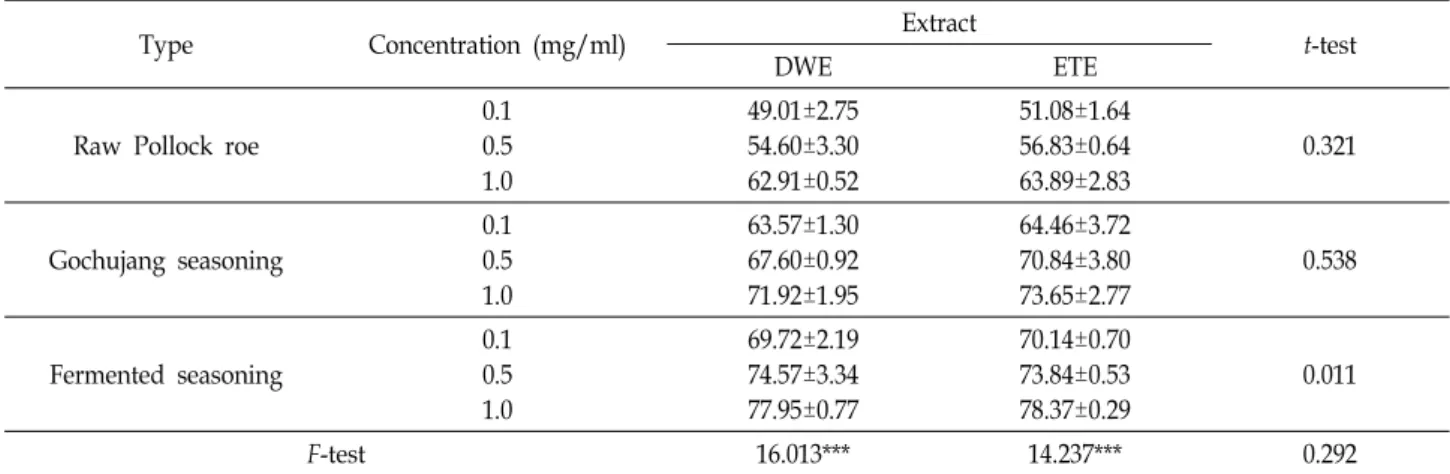
Table 1 was shown the antioxidant activities for DPPH radical of the Pollock roe. The DWE and ETE of Pollock roe demonstrated a concentration dependent scavenging activity by quenching DPPH radicals. DPPH scavenging activity of distilled water extracts of raw Pollock roe was evaluated 49.0% at 0.1 mg/ml, 54.6% at 0.5 mg/ml, and 62.9% at 1.0 mg/ml. DPPH scavenging activity of ethanol extracts of raw Pollock roe was evaluated 51.1% at 0.1 mg/ml, 56.8% at 0.5 mg/ml, and 63.9% at 1.0 mg/ml. The all values of DPPH scavenging activity of ETE for Pollock roe were higher than those of DWE for Pollock roe. However, the all did not show a statistically significant difference (p<0.05). DPPH scaveng- ing activity of DWE with Gochujang Pollock roe evaluated was 71.9% at 1.0 mg/ml and that of ETE was 73.7% at same concentration. DPPH scavenging activity of DWE with fer- mented seasoning Pollock roe evaluated was 78.0% at 1.0 mg/ml and that of ETE was 78.4% at same concentration.

The overall values of fermented seasoning Pollock roe were

showed higher inhibition activity of DPPH than other treat-

ed groups. There was shown a statistically significant differ-

(4)

Fig. 1. When L- Ascorbic acid was 100%, it showed relative in- hibitory effects (%) on DPPH by water and ethanol ex- tracts from various Pollock roes. Control is L-Ascorbic acid. DWE: distilled water extract, ETE: ethanol extract.

Raw: raw Pollock roe, Goc: Gochujang Pollock roe, Fer:

fermented seasoning Pollock roe.

Table 1. The degree of inhibition (%) of DPPH properties of premium Pollock roe with raw, Gochujang, and fermented seasoning at different concentrations

Type Concentration (mg/ml) Extract

t-test

DWE ETE

Raw Pollock roe

0.1 0.5 1.0

49.01±2.75 54.60±3.30 62.91±0.52

51.08±1.64 56.83±0.64 63.89±2.83

0.321

Gochujang seasoning

0.1 0.5 1.0

63.57±1.30 67.60±0.92 71.92±1.95

64.46±3.72 70.84±3.80 73.65±2.77

0.538

Fermented seasoning

0.1 0.5 1.0

69.72±2.19 74.57±3.34 77.95±0.77

70.14±0.70 73.84±0.53 78.37±0.29

0.011

F-test 16.013*** 14.237*** 0.292

Data represented the mean ± SD from three replicates. DWE: distilled water extract, ETE: ethanol extract. *** = p<0.001.

ence (p<0.001).

The IC

50

values of distilled water and ethanol extracts of raw Pollock roe on DPPH were 11.65 ug/ml and 11.47 ug/

ml, respectively (Table 4). The IC

50

values of distilled water and ethanol extracts of Gochujang Pollock roe were 10.64 ug/ml and 9.28 ug/ml, respectively. The IC

50

values of dis- tilled water and ethanol extracts of fermented seasoning Pollock roe on total phenolic content were 8.84 ug/ml and 8.81 ug/ml, respectively.

When the L-Ascorbic acid used as a control, relative DPPH scavenging activities of ethanol extracts raw Pollock roe, Gochujang Pollock roe, and fermented seasoning Pollock roe were 56.5%, 65.2%, and 67.8%, respectively (Fig. 1). The relative DPPH scavenging activities of distilled water ex- traction were 0.6 to 4.6% lower than those of the ethanol extract.

OH scavenging assay

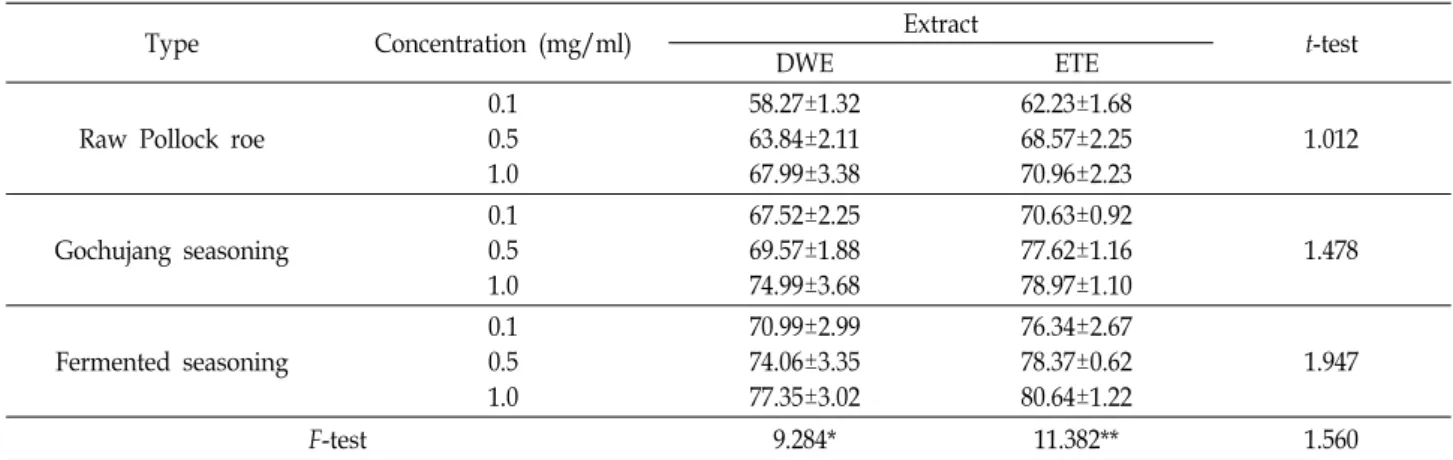
The effect of extracts on hydroxyl radicals was assayed by using the deoxyribose method (Table 2). The DWE of raw Pollock roe showed 68.0% inhibition of OH activity at 1.0 mg/ml that of ETE was 70.9% at same concentration.

OH scavenging activity of DWE with Gochujang Pollock roe evaluated was 74.9% at 1.0 mg/ml and that of ETE was 79.0% at same concentration. OH scavenging activity of DWE with fermented seasoning Pollock roe evaluated was 76.3%

at 1.0 mg/ml and that of ETE was 80.6% at same concen- tration. The highest OH activity was recorded in ETE with fermented seasoning Pollock roe among six groups (three samples x two solvents). The overall values of OH activity between Pollock roe with Gochujang and Pollock roe with fermented seasoning were show a statistically non-sig- nificant difference (p>0.05). However, there was shown a statistically significant difference among three groups (p<0.01).

When the H

2

O

2

and L-Ascorbic acid used as controls, rela- tive OH scavenging activities of raw Pollock roe, Gochujang Pollock roe, and fermented seasoning Pollock roe extracts were 63.4%, 70.5, and 72.0%, respectively (Fig. 2).

The IC

50

values of distilled water and ethanol extracts of

raw Pollock roe on OH were 10.78 ug/ml and 10.38 ug/ml,

respectively (Table 4). The IC

50

values of distilled water and

ethanol extracts of Gochujang Pollock roe were 10.04 ug/ml

and 9.56 ug/ml, respectively. The IC

50

values of distilled wa-

ter and ethanol extracts of fermented seasoning Pollock roe

on total phenolic content were 9.70 ug/ml and 9.28 ug/ml,

respectively.

(5)

Table 2. The degree of inhibition (%) of hydroxyl radical (OH) scavenging activity of premium Pollock roe with raw, Gochujang, and fermented seasoning at different concentrations

Type Concentration (mg/ml) Extract

t-test

DWE ETE

Raw Pollock roe

0.1 0.5 1.0

58.27±1.32 63.84±2.11 67.99±3.38

62.23±1.68 68.57±2.25 70.96±2.23

1.012

Gochujang seasoning

0.1 0.5 1.0

67.52±2.25 69.57±1.88 74.99±3.68

70.63±0.92 77.62±1.16 78.97±1.10

1.478

Fermented seasoning

0.1 0.5 1.0

70.99±2.99 74.06±3.35 77.35±3.02

76.34±2.67 78.37±0.62 80.64±1.22

1.947

F-test 9.284* 11.382** 1.560

Data represented the mean ± SD from three replicates. DWE: distilled water extract, ETE: ethanol extract. * = p<0.05, ** = p<0.01.

Table 3. The degree of inhibition (%) of nitric oxide radical (NO) scavenging activity of premium Pollock roe with raw, Gochujang, and fermented seasoning at different concentrations

Type Concentration (mg/ml) Extract

t-test

DWE ETE

Raw Pollock roe

0.1 0.5 1.0

47.90±1.14 53.33±1.42 58.69±1.58

49.19±1.85 53.74±2.61 57.86±1.17

0.072

Gochujang seasoning

0.1 0.5 1.0

56.83±1.46 63.63±1.83 69.47±0.44

58.64±1.90 65.62±0.52 71.98±0.24

0.395

Fermented seasoning

0.1 0.5 1.0

59.01±0.98 67.77±1.12 72.74±0.98

61.98±1.50 69.30±1.47 75.17±1.39

0.417

F-test 6.052* 8.940** 0.398

Data represented the mean ± SD from three replicates. DWE: distilled water extract, ETE: ethanol extract. * = p<0.05, ** = p<0.01.

Fig. 2. When H

2

O

2

and L- Ascorbic acid were 100%, it showed relative inhibitory effects on OH by water and ethanol extracts from various Pollock roes. Controls are H

2

O

2

and L-Ascorbic acid. DWE: distilled water extract, ETE:

ethanol extract. Abbreviations of Raw, Goc, and Fer are same as Fig. 1.

NO scavenging assay

Nitric oxide radical (NO)-scavenging activity was meas-

ured by the Greiss reagent. Among the analyzed extracts, those obtained from Alaska Pollock roe displayed high activ- ity (Table 3). NO scavenging activity of distilled water ex- tracts of raw Pollock roe was evaluated 47.9% at 0.1 mg/ml, 53.3% at 0.5 mg/ml, and 58.7% at1.0 mg/ml. NO scavenging activity of ethanol extracts of raw Pollock roe was evaluated 46.9% at 0.1 mg/ml,53.72% at 0.5 mg/ml, and 57.9% at 1.0 mg/ml. It is also observed that inhibition percentage values go on increasing with enhancements in concentration of re- search plant extracts in the assay mixture. The degree of NO inhibition activity of product samples was high. There was no significant difference between two solvents (p>0.05). NO scavenging activity of DWE of Gochujang Pollock roe was evaluated 69.5% at 1.0 mg/ml and that of ETE was 72.0%

at same concentration. NO scavenging activity of distilled

water extracts of fermented seasoning Pollock roe was eval-

uated 62.0% at 1.0 mg/ml and that of ETE was 75.2% at

(6)

Table 4. The 50% inhibition (IC

50

) of DPPH, OH, and NO of Alaska Pollock roe at different solvents (Unit is ng/ml)

Sample DPPH OH NO

DWE ETE DWE ETE DWE ETE

Raw Pollock roe Gochujang seasoning Fermented seasoning

11.652 10.643 8.835

11.466 9.277 8.811

10.775 10.037 9.700

10.382 9.555 9.281

11.449 9.946 9.580

11.408 9.716 9.353 DWE: distilled water extract, ETE: ethanol extract.

Fig. 3. When Gallic acid and L- Ascorbic acid were 100%, it showed relative inhibitory effects on NO by water and ethanol extracts from various Pollock roes. Controls are Gallic acid and L-Ascorbic acid. Abbreviations of Raw, Goc, and Fer are same as Fig. 1.

same concentration. The high antioxidant activity for NO- scavenging found on ethanol extracts of fermented season- ing Pollock roe. The values of NO scavenging activity of Gochujang and fermented seasoning Pollock roe were higher than those of raw materials, there was significant difference among the three experimental groups (p<0.05 for water ex- tracts, p<0.01 for ethanol extracts). When the Gallic acid and L-Ascorbic acid used as controls, relative NO scavenging ac- tivities of raw Pollock roe, Gochujang Pollock roe, and fer- mented seasoning Pollock roe extracts were 55.1%, 72.1, and 71.6%, respectively (Fig. 3).

The IC

50

values of distilled water and ethanol extracts of raw Pollock roe on NO were 11.45 ug/ml and 11.41 ug/ml, respectively (Table 4). The IC

50

values of distilled water and ethanol extracts of Gochujang Pollock roe were 9.95 ug/ml and 9.72 ug/ml, respectively. The IC

50

values of distilled wa- ter and ethanol extracts of fermented seasoning Pollock roe on NO were 9.58 ug/ml and 9.35 ug/ml, respectively.

Discussion

Natural antioxidants are widely distributed in food and medicinal plants as especially polyphenols and carotenoids, while they present at low concentrations in animals.

Jeotgal is a Korean traditional fermented seafood with a high concentration of salt and very small fish. The small fish are mostly Myeolchi (Engraulis japonicas, anchovy) or shrimps.

If it is a big fish, Jeotgal fermented with internal parts of fish products. Fermented fish products have been consumed as the fish itself, fish sauce, fish paste, and other types of food throughout the world. Some of the examples of fish sauces are Jeotkal in Korea [16].

The strong the antioxidant activity observed various sea- soning and fermented foods using fish products [15]. There were reported on the health function of fermented foods, 20 on Kochujang (Korean fermented red pepper paste) and four on Jeotgal as seasonings in Korean cuisine from 1995 to 2017 [16]. Supernatant of Lactobacillus plantarum NK181 from Jeotgal exhibited about 30% DPPH radical-scavenging activity [13]. Also, it has been suggested that the OH assay strongly depends on the nature of the compound being stud- ied [8]. However, they added many grains or soybeans and salt as an additive to fish Jeotgal to improve its functionality.

In the present study, although an overall antioxidant activity

of Pollock roe was presented at water and ethanol extracts,

it was not shown very high. DPPH scavenging activity of

ethanol extracts of raw Pollock roe was evaluated 63.9% at

1.0 mg/ml (Table 1). OH scavenging activity of ETE was

79.0% at 1.0 mg/ml (Table 2). NO scavenging activity of

ethanol extracts of raw Pollock roe was evaluated 57.9% at

1.0 mg/ml (Table 3). The all values of DPPH, OH, and NO

scavenging activity of DWE for Pollock roe were lower than

those of ETE for Pollock roe. Compared with the control

groups (L-Ascorbic acid for DPPH, H

2

O

2

for OH. and Gallic

acid and L-Ascorbic acid for NO), which has excellent anti-

oxidant function, the test substance has some antioxidant

function (Fig. 1, Fig. 2, Fig. 3). The antioxidant function was

not significantly improved by deducing only the unique an-

tioxidant function by the simultaneous analysis of Pollock

roe and seasoning added with Gochujang (Table 1, Table

2, Table 3). The higher DPPH, OH, and NO scavenging abil-

ities were shown in Gochujang and fermented seasoning

(7)

Pollock roe than instant Pollock roe. From the foregoing, it may be concluded that the ETE of Pollock roe with proper seasoning, Pollock roe demonstrated good antioxidant and free radical scavenging activities. Chiou et al. [5] reported that raw Alaska Pollock roe contained 71.8% moisture, and on a dry basis 78.7% protein, 6.7% lipid, and 8.2% ash.

Gochujang and fermented seasoning Pollock roes may be useful natural radical scavenging and potential supplement for the food. The analysis of the various antioxidant changes was first reported in this study when the instant Pollock roe and additives were added. However, it is necessary to study whether the spice has additional antioxidant ability or different antioxidant ability to the unique antioxidant function of eggs. The optimization of the ingredient ratios in the manufacturing of Kochujang sauce was investigated using central composite design and response surface meth- odology [23]. In the future, it is necessary to investigate the ratio of these materials to improve the antioxidant function because Kochujang sauce is a mixture of various ingredients.

The half maximal inhibitory concentration (IC

50

) is a measure of the potency of a substance in inhibiting a specific bio- logical or biochemical function. Many different equations can be used to derive an IC

50

. In addition, there was no com- parison between the IC values ​ ​ for Pollock roe and it could not be discussed.

The all values of DPPH, OH, and NO scavenging activity of ethanol extract for Alaska Pollock roe were higher than those of distilled water extracts. DPPH, OH, and NO scav- enging activity of Gochujang and fermented seasoning Pollock roe were higher than those of raw materials.

Acknowledgement

This research was supported by the Fisheries Industry Investment Support Project (2018) of BUSAN TECHNOPARK.

We would like to express our sincere gratitude to the BUSAN TECHNOPARK.

References

1. Alaska Seafood Marketing Institute. 2007. Analyses of Specialty Alaska Seafood Products, pp. 1-104. McDowell Group: Alaska, USA.

2. Aruoma, O. I. 2003. Methodological consideration for char- acterization for potential antioxidant actions of bioactive components in plants foods. Mutat. Res. 532, 9-20.

3. Bektasoglu, B., Celik, S. E., Ozyurek, M., Guclu, K. and Apak, R. 2006. Novel hydroxyl radical scavenging anti-

oxidant activity assay for water-soluble antioxidants using a modified CUPRAC method. Biochem. Biophys. Res. Commun.

345, 1194-1200.

4. Brand-Williams, W., Cuvelier, M. E. and Berset, C. 1995. Use of free radical method to evaluate antioxidant activity. Food Sci. Technol. 28, 25-30.

5. Chiou, T. K., Matsui, T. and Konosu, S. 1988. Purification and properties of an aminopeptidase from Mullet, Mugil- Cephalus, roe. Agric. Biol. Chem. 52, 235-242.

6. Cornish, M. L. and Garbary, D. J. 2010. Antioxidants from macroalgae: Potential applications in human health and nutrition. Algae 25, 155-171.

7. Halliwell, B. 1995. How to characterize an antioxidant- An update. Biochem. Soc. Symp. 61, 73-101.

8. Halliwell, B., Gutteridge, J. M. C. and Arouma, O. I. 1987.

The deoxyribose method: a simple test tube assay for the determination of rate constants for reactions of hydroxyl radicals. Anal. Biochem. 165, 21-29.

9. Harada, K., Maeda, T., Hasegawa, Y., Tokunaga, T., Tamura, Y. and Koizumi, T. 2010. Antioxidant activity of fish sauces including puffer (Lagocephalus wheeleri) fish sauce measured by the oxygen radical absorbance capacity method. Mol.

Med. Rep. 3, 663-668.

10. Kato, H., Lee, I. E,, Chuyen, N. V., Kim, S. B. and Hayase, F. 1987. Inhibition of nitrosamine formation by nondialyz- able melanoidins. Agric. Biol. Chem. 51, 1333-1338.

11. Kim, J. S., Moon, G. S., Lee, K. H. and Lee, Y. S. 2006. Studies on quality changes and antioxidant activity during the fer- mentation of the salt fermented whangseoke. J. Kor. Soc.

Food Sci. Nutr. 35, 171-176.

12. Kim, S. M. 2003. The functionality of anchovy sauce. Food Industry Nutr. 8, 9-17.

13. Lee, N. K., Kim, H. W., Chang, H. I., Yun, C. W., Kim, S.

W., Kang, C. W. and Paik, H. D. 2006. Probiotic properties of Lactobacillus plantarum NK181 isolated from Jeotgal, a Korean fermented food. Food Sci. Biotechnol. 15, 227-231.

14. Lobo, L., Patil, A., Phatak, A. and Chandra, N. 2010. Free radicals, antioxidants and functional foods: Impact on hu- man health. Pharmacogn Rev. 4, 118-126.

15. Mheen, T. 1993. Microbiology of salted-fermented fishery products in Korea, pp. 231-247. In: Lee, C. H., Steinkraus, K. H. and Alan Reilly, P. J. (eds.), Fish Fermentation Technol- ogy, United Nation University Press: Tokyo, Japan.

16. Mun, E. G., Kim, B., Kim, E. Y., Lee, H. J., Kim, Y., Park, Y. and Cha, Y. S. 2018. Research trend in traditional fer- mented foods focused on health functional evaluation. J.

Kor. Soc. Food Sci. Nutr. 47, 373-386.

17. Nagmoti, D. M., Khatri, D. K., Juvekar, P. R. and Juvekar, A. R. 2011. Antioxidant activity and free radical-scavenging potential of Pithecellobium dulce Benth seed extracts. Free Rad.

Antiox. 2, 37-43.

18. NOAA Fisheries. 2015. Walleye Pollock Research. Alaska Fish- eries Science Center: Alaska, USA.

19. Sharma, O. P. and Bhat, T. K. 2009. DPPH antioxidant assay revisited. Food Chem. 113, 1202-1205.

20. Sumanont, Y., Murakami, Y., Tohda, M., Vajragupta, O.,

(8)

초록:알래스카 명란의 DPPH, OH, NO의 항산화 특성 분석 황지영

1

․장종수

1

․허만규

2

*

(

1

덕화푸드㈜,

2

동의대학교 식품공학과)

알래스카 산 대구(Gadus chalcogrammus)는 대구과(family Gadidae)의 해산어종이다. 알래스카 명란 원료, 고추 장 명란, 발효 명란을 증류수와 에탄올로 추출하여 2, 2- diphenyl - 1- picrylhydroazyl (DPPH), 하이드록시 라디 칼(OH), 산화질소(NO)의 항산화 소거능을 평가하였다. 철 이온 환원력(FRAP)을 조사하였다. ABTS+ 소거능은 Brand-Williams 등의 방법에 따랐다. 고추장 명란의 증류수 추출물의 DPPH 소거능은 1.0 mg/ml 농도에서 71.9%

였으며 에탄올 추출물에서 소거능은 73.7%였다. 발효 명란의 증류수 추출물의 DPPH 소거능은 1.0 mg/ml 농도에 서 78.0%였고 에탄올 추출물에서 소거능은 78.4%였다. 명란 원료의 증류수 추출물과 에탄올 추출물의 DPPH에 대한 최소 저해 농도 값(IC

50

)은 각각 11.65 ug/ml과 11.47 ug/ml이었다. 명란 원료, 고추장 명란, 발효 명란의 에탄올 추출물의 OH 소거능은 1.0 mg/ml 농도에서 70.9%, 79.0, and 80.6%였다. 명란 원료의 증류수 추출물과 에탄올 추출물의 NO의 최소 저해 농도 값은 11.45 ug/ml과 11.41 ug/ml였다. 본 연구 결과, 고추장 명란과 발효 명란은 원료 명란 보다 높은 DPPH, OH, NO 소거능을 나타내었다. 고추장 명란과 발효 명란은 자연 라디칼 소거 능이 있어 식품으로써 항산화 보충제가 될 수 있을 것이다.

Matsumoto, K. and Watanabe, H. 2007. Evaluation of the nitric oxide radical scavenging activity of manganese com- plexes of curcumin and its derivative. Biol. Pharm. Bull. 27, 170-173.

21. Tsai, P. J., Tsai, T. H., Yu, C. H. and Ho, S. C. 2007. Evalu- ation of NO suppressing activity of several Mediterranean culinary spices. Food Chem. Toxicol. 45, 440-447.

22. Valentão, P., Fernandes, E., Carvalho, F., Andrade, P. B., Seabra, R. M. and Bastos, M. L. 2003. Hydroxyl radical and hypochlorous acid scavenging activity of small Centaury (Centaurium erythraea) infusion: a comparative study with

green tea (Camellia sinensis). Phytomedicine 10, 517-522.

23. Yang, J. W., Kim, S. S., Choi, S. Y., Choi, I. S. and Lee, Y.

S. 2012. Proportion optimization for manufacture Kochujang sauce supplemented with tonic herbal extract and beef using response surface methodology. Korea J. Food Cookery Sci. 28, 133-141.

24. Zubia, M., Fabre, M. S., Kerjean, V., Le Lann, K., Stiger-

Pouvreau, V., Fauchon, M. and Deslandes, E. 2009. Antiox-

idant and antitumor activities of some Phaeophyta from

Brittany Coasts. Food Chem. 116, 693-701.

수치

Fig.  1.  When  L-  Ascorbic  acid  was  100%,  it  showed  relative  in- in-hibitory  effects  (%)  on  DPPH  by  water  and  ethanol   ex-tracts  from  various  Pollock  roes
Table  2.  The  degree  of  inhibition  (%)  of  hydroxyl  radical  (OH)  scavenging  activity  of  premium  Pollock  roe  with  raw,  Gochujang,  and  fermented  seasoning  at  different  concentrations
Fig.  3.  When  Gallic  acid  and  L-  Ascorbic  acid  were  100%,  it  showed  relative  inhibitory  effects  on  NO  by  water  and  ethanol  extracts  from  various  Pollock  roes

참조

관련 문서