Kor J Fish Aquat Sci 47(6),719-725,2014
한수지 47(6), 719-725, 2014Original Article
719
Copyright © 2014 The Korean Society of Fisheries and Aquatic Science pISSN:0374-8111, eISSN:2287-8815
서 론
남해안을중심으로어획되는멸치
(Engraulis japonica)
는칼 슘을다량함유하고양질의아미노산과n-3
계열의고도불포화 지방산,
각종비타민,
정미성분등을함유하여영양적으로우수 하며,
가공처리방법에따라서기호성을부여해줄수있는수산 가공품의공급원원료로서의잠재력을갖고있다(Shim et al.,
2001).
하지만다른어종에비해부패속도가빠르기때문에어획량의
90%
이상이자건품,
염신품(
젓갈및액젓)
의원료로사용되고있으며
,
주로반찬류,
조미료및김치의조미용부재료로 널리사용되어왔다(Cho et al., 2000).
우리나라젓갈연도별생산량은
2009
년41,134 M/T (Metric/
Ton), 2010
년35,315 M/T, 2011
년27,228 M/T, 2012
년35,193 M/T
으로젓갈의생산량이감소하다가다시증가하는추세이 다.
특히2012
년멸치젓은젓갈총생산량의약33%
인11,664 M/T
이 생산되었다(Korean Statistical Information Service, 2013).
멸치젓갈에관한연구로는멸치젓갈추출물이돌연변이유
토마토페이스트소스첨가 멸치(Engraulis japonica) 육젓필레통조림의 제조 및 특성
권순재ㆍ이재동ㆍ윤문주ㆍ박진효ㆍ제해수ㆍ공청식ㆍ노윤이ㆍ김정균*
경상대학교 해양식품공학과/농업생명과학연구원
Processing and Characteristics of Canned Salt-fermented Anchovy Engraulis japonica Fillet using Tomato Paste Sauce
Soon-Jae Kwon, Jae-Dong Lee, Moon-Joo Yoon, Jin-Hyo Park, Hae-Soo Je, Cheung-Sik Kong, Yuni Noh and Jeong-Gyun Kim*
Department of Seafood Science and Technology/Institute of Agriculture and Life Science, Gyeongsang National University, Tongyeong 660-701, Korea
This study was investigated for the purpose of obtaining basic data for application to the canning process of salt-fer- mented anchovy Engraulis japonica fillet using tomato paste. The salt fermented anchovy fillet was prepared by fer- menting anchovy fillet with salt 15% at 5℃ for 15 days and then cold air drying the salt-fermented anchovy fillet for 1 h at 16±1℃. The dried salt-fermented anchovy fillet 85 g was filled with 60 g of tomato paste sauce (tomato paste 42%, gum guar 1.0%, salt 2.0%, starch syrup 2.0%, cooking wine 1%, water 52%) and seamed by vacuum seamer in 301-3 can, then sterilized at Fo 9 and 11 min in a steam system retort at 121℃, respectively. The factors such as chemical composition, pH, total volatile basic nitrogen (TVB-N), amino-N, color value (L, a, b), texture profile, thio- barbituric acid (TBA) value, sensory evaluation and viable bacterial count of the canned salt-fermented anchovy fillet were measured. Texture value of the product sterilized at Fo 11 min was higher than at Fo 9 min condition. In both sterilized cans, the viable bacterial counts were not detected. There was no remarkable difference in physicochemical between sterilization conditions. As a result of sensory evaluation, most sensory evaluation inspector judged that it was difficult to distinguish the sensory difference of both products sterilized at Fo 9 min and at 11 min. The results showed that sterilization of Fo 9 min was more desirable than that of Fo 11 min to prepare canned salt-fermented anchovy fillet using tomato paste sauce, because this condition is more economical.
Key words : Sterilization, Anchovy fillet, Fo value, Tomato paste sauce, Engraulis japonica
This is an Open Access article distributed under the terms of the Creative Commons Attribution Non-Commercial Licens (http://creativecommons.org/licenses/by-nc/3.0/)which permits unrestricted non-commercial use, distribution, and reproduction in any medium, provided the original work is properly cited.
http://dx.doi.org/10.5657/KFAS.2014.0719 Kor J Fish Aquat Sci 47(6) 719-725, December 2014
Received 16 October 2014; Revised 17 November 2014; Accepted 27 November 2014
*Corresponding author: Tel: +82. 55. 772. 9141 Fax: +82. 55. 772. 9149
E-mail address: [email protected]
권순재
ㆍ
이재동ㆍ
윤문주ㆍ
박진효ㆍ
제해수ㆍ
공청식ㆍ
노윤이ㆍ
김정균720
발에미치는영향
(Jung et al., 2000),
초고압처리에의한저염 멸치젓의품질변화(Lim et al., 2000),
시판젓갈류의지방산조 성(Lee et al., 1986),
젓갈류의유통기한연장을위한연구(Cho et al., 2002),
효소분해법에의한페이스트형속성멸치젓의제 조및품질에관한연구(Han et al., 1997),
한국산멸치젓의휘 발성향기성분에관한연구(Cha, 1992),
젓갈의숙성및저온 저장이미생물균수및균총에미치는영향(Hong et al., 2000)
등많은연구가보고되고있으나,
멸치육젓을이용하여통조림 제품의제조에관하여보고한것은Kwon et al. (2014)
의멸치 육젓필레기름담금통조림의제조및특성, Yook (2003)
의an- chovy fillet
제품의가공조건최적화에관한연구이외에는찾 아보기힘들다.
우루과이라운드협상과자유무역협정체결국 가의증가로수산물의수출입이자유화됨으로써전통수산발효 식품인젓갈류도고품질및안정성을겸한제품으로개발되지 않는다면동남아시아지역에서생산되는값싼어장유(魚醬油)
에의하여우리는식탁이수입품목으로뒤바뀌어질지도모르는 상황에처할것이다(Cha et al., 1999).
본연구에서는수입되고있는멸치육젓필레통조림보다덜 짜고조직감이단단하며토마토페이스트소스에의해향미를증 대시킨멸치육젓필레통조림의제조를시도하였다
.
즉,
원료멸 치를먼저fillet
작업하여육을분리하였으며,
식염15%
를첨가 한후5℃
에서숙성공정을거치고16℃
에서냉풍건조시킨반 건조멸치육젓필레에토마토페이스트소스를첨가하여멸치육 젓필레통조림을제조하였고,
아울러이화학적및관능적특성 에대하여조사하였다.
재료 및 방법
실험재료
본실험에서사용한원료멸치
(Engraulis japonica)
는2012
년5
월부산광역시기장군에서어획된체장10.0-12.2 cm (
평균10.5 cm),
체중8.94-11.85 g (
평균9.36 g)
의크기인멸치를구입하여
ice box
에넣어실험실로운반하여실험에사용하였다.
토마토페이스트는
C
사의통조림제품을,
식염,
물엿,
맛술및구 아검은대형마트에서구입하여사용하였다.
토마토페이스트소 스는Noe et al. (2011a)
의방법에따라토마토페이스트42%,
식염2%,
구아검1%,
물52%,
물엿2%,
맛술1%
의비율로배 합하여사용하였다.
토마토페이스트소스첨가 멸치육젓필레통조림의 제조
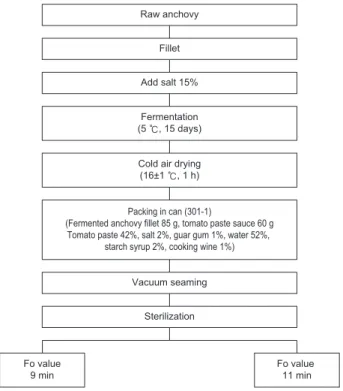
토마토페이스트소스첨가멸치육젓필레통조림의제조공정은Fig. 1
과같다.
원료멸치의비가식부(
머리,
내장,
중골)
를제거 하고fillet
작업을한후식염15%
를첨가하여혼합하였다.
그 리고5℃
에서15
일간숙성시킨후16±1℃
에서1
시간냉풍건 조시켰다.
반건조된멸치육젓필레85 g
을통조림관(301-3
호 관)
에살쟁임하고토마토페이스트소스60 mL
를넣은후이중밀봉기로 밀봉하였다
.
이어서소형증기식레토르트(ISUZU, ISUZU Seisaku Shoco., Japan)
를 이용하여 예비실험에서121.1℃
에서Z
값이10℃
인경우의가열치사시간(Fo
값)
측정 실험결과를토대로가열살균하였으며,
살균시간의차이에따 른품질을비교하기위해Fo
값을9
및11
분의두조건으로가 열살균하였다.
토마토페이스트소스첨가멸치육젓통조림의
Fo
값측정은무 선형열측정logger (EBI 125A, Ebro Co., Germany)
를사용 하였으며,
무선형열측정logger
를301-3
호관의기하학적중심 에위치하도록멸치육젓필레와함께충전하여Fo
값을측정하 였다.
실험에사용한시료는통조림을개봉한후, 10
분간액을 탈수시킨후육질부분만을취하여믹서기(PT-MR 2100, KI- NEMATICA co., Switzerland)
로갈아서실험에사용하였다. 생균수
생균수는고온가열살균한토마토페이스트소스첨가멸치육 젓통조림을
37±1℃
와55±1℃
에서각각30
일간씩가온한것을개관후
A.P.H.A (1970)
법의표준한천평판배양법에따라35±0.5℃
에서24-48
시간배양하여나타난집락수를계측하였다
.
일반성분, pH 및 휘발성염기질소
일반성분은
AOAC (1995)
법에 따라,
수분은상압가열건조 법,
조지방은soxhlet
법,
회분은건식회화법,
조단백질은semi-
Fig. 1. Flowsheet of processing of various canned salt-fermented anchovy Engraulis japonica fillet using tomato paste sauce.
0.09a 0.10a
0.00 0.03 0.06 0.09 0.12
9 11
Fo value (min)
176.6a 170.4a
100 125 150 175 200
9 11
Fo value (min)
10.9a 11.1a
6 8 10 12 14
9 11
Fo value (min)
685.6b
467.1a
0 200 400 600 800
9 11
Fo value (min) TBA-value (O.D) Amino-N (mg/100 g) Salinity (%) Hardness (g/cm
2)
Raw anchovy Fillet Add salt 15%
Fermentation (5 ℃, 15 days)
Cold air drying (16±1 ℃, 1 h)
Packing in can (301-1)
(Fermented anchovy fillet 85 g, tomato paste sauce 60 g Tomato paste 42%, salt 2%, guar gum 1%, water 52%,
starch syrup 2%, cooking wine 1%) Vacuum seaming
Sterilization
Fo value
9 min Fo value
11 min
토마토페이스트소스첨가 멸치 육젓필레통조림의 제조 및 특성
721
micro Kjeldahl
법으로분석하였다. pH
는시료육에10
배량의 증류수를가하여균질화한후pH meter (Euteoh instruments pH-1500, Euteoh Co., USA)
로측정하였다.
휘발성염기질소 함량은conway unit
를사용하는미량확산법(Ministry of So- cial Welfare of Japan, 1960)
으로측정하였다.
Thiobarbituric acid (TBA) 값, 아미노질소 및 염도
토마토페이스트소스첨가멸치육젓필레통조림의지질산패도 를나타내는TBA
값은시료를정평한후Tarladgis et al. (1960)
의수증기증류법으로측정하였고,
아미노질소함량은Formol
적정법(Kohara, 1982)
으로 측정하였으며,
염도는Morh
법(AOAC, 1995)
으로측정하였다.
색조
토마토페이스트소스첨가 멸치육젓필레통조림 시료의 표면 색조에대한
L
값(lightness,
명도), a
값(redness,
적색도), b
값(yellowness,
황색도)
및ΔE
값(color difference,
색차)
을직시 색차계(ZE-2000, Nippon Denshoku, Japan)
로써측정하였고,
이때표준백판(standard plate)
의L
값은95.73, a
값은-0.48, b
값은0.52
이었다.
조직감
가열살균처리에 따른 토마토페이스트소스첨가 멸치육젓필 레통조림의조직감은레오메터
(Rheometer Compac-100, Sun Scientific Co., Japan)
를사용하여 절단시험으로고형물의질 김도를측정하였다.
즉,
토마토페이스트소스첨가멸치육젓통 조림의고형물은최대한균일한것으로시료를선정하여레오 메터로써절단하는데소요되는힘으로나타내었다.
이때max force
값의계산은rheology data system ver. 2.01
에의해처리 하였다.
관능검사
관능검사는
10
인의관능검사원을구성하여토마토페이스트 소스첨가멸치육젓통조림의냄새,
맛,
조직감및색조등관능 적기호도의척도가되는항목에대하여5
단계평점법(5:
아주 좋음, 4:
좋음, 3:
보통, 2:
싫음, 1:
아주싫음)
으로평가하여,
평 균값으로결과를나타내었다.
통계처리
데이터통계처리는
ANOVA test
를이용하여분산분석한후, Duncan
의다중범위검정(Steel and Torrie, 1980)
으로최소유 의차검정(P<0.05)
을실시하였다.
결과 및 고찰
생균수
토마토페이스트소스첨가 멸치육젓필레통조림을 제조하여
외관검사와 생균수를 측정한 결과를
Table 1
에 나타내었다. 121℃
에서Fo
값이9
및11
분이 되게 열처리한 검체 모두37±1℃
와55±1℃
에서각각30
일간씩가온한것을개관후생균수를측정한결과잔존미생물이검출되지않았으며외관 도정상이었다
. Park et al. (2013)
은토마토페이스트첨가과메 기통조림의경우, 121℃
에서Fo
값8, 10
및12
분으로살균할 경우균이검출되지않았고,
외관도정상이라고보고하여본실 험의결과와일치하였으며,
또한토마토페이스트첨가홍합통 조림(Noe et al., 2011a),
조미홍합통조림(Noe et al., 2011b),
조미과메기통조림(Yoon et al., 2011)
및보일드과메기통조림(Park et al., 2012a)
의경우Fo
값8, 10
및12
분이되도록각각 살균한후생균수를측정한결과음성으로나타났다고보고하 여본실험의결과와일치하였다.
따라서본실험의경우토마 토페이스트소스첨가멸치육젓필레통조림을121℃
에서Fo
값9
및11
분이되게살균할경우미생물학적으로는안전성이확 보된다고판단되었다.
일반성분 조성, pH 및 휘발성염기질소함량
Fo
값9
및11
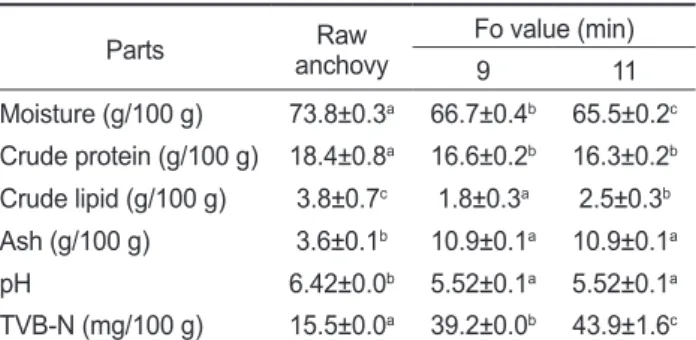
분으로가열살균처리하여만든토마토페이스트 소스첨가멸치육젓필레통조림의일반성분조성, pH
및휘발성 염기질소의변화를측정한결과는Table 2
와같다.
수분함량은원료멸치가
73.8%
였으나토마토페이스트소스첨가멸치육젓필레통조림의경우
65.5-66.7%
로낮아졌는데이 것은냉풍건조시멸치육젓필레의수분함량이줄어들었고,
가 열살균중단백질의가열변성에따른보수력의저하및육중 의수분의일부가유리수형태로제거되었기때문이라판단되 었다.
또한Fo
값이높게살균된시료일수록수분함량은더감 소하는경향이었다.
조단백질함량은원료멸치(18.4%)
에비해 토마토페이스트소스첨가멸치육젓필레통조림(16.3-16.6%)
의 그함량이낮았는데,
이것은회분함량의증가에의해상대적으 로조단백질의함량이감소하였기때문으로생각되었다.
그리 고Fo
값의차이에따른조단백질의함량차이는거의없었다.
조지방은원료멸치
(3.8%)
보다토마토페이스트소스첨가멸치육젓필레통조림
(1.8-2.5%)
의그값이감소하였는데,
이는fillet
Table 1. Viable cell counts (CFU/g) and external appearance test of canned salt-fermented anchovy Engraulis japonica fillet using tomato paste sauce incubated at 37±1℃ and 55±1℃ for 30 days after sterilization at various Fo values
value Fo (min)
Incubation temperature
37±1℃ 55±1℃
Viable cell
counts External
appearance Viable cell
counts External appearance
9 ND1 Normal ND Normal
11 ND Normal ND Normal
1ND: not detected.
권순재
ㆍ
이재동ㆍ
윤문주ㆍ
박진효ㆍ
제해수ㆍ
공청식ㆍ
노윤이ㆍ
김정균722
공정중조지방의함량이상대적으로많은부위인피하조직
,
장 간막,
간장,
췌장및소화기관등의부위를제거하여그함량이 감소한것으로판단되었다(Konozu, 1994).
회분함량은원료 의경우5.8%
이었으나통조림제조후10.9%
로증가하였는데 이것은멸치육젓필레제조시첨가된식염이육질내부로침투 하였기때문이라판단되었다.
그리고Fo
값의차이에따른회분 함량의차이는거의없었다.
Noe et al. (2011a)
및Park et al. (2013)
은토마토페이스트첨 가홍합통조림및토마토페이스트소스첨가과메기통조림의경 우Fo
값이높게살균할수록수분함량은감소하고조지방함량 은증가하였으며,
조단백질및회분함량은거의차이가없었다 고보고하여본실험의결과와일치하였다.
원료멸치의
pH
는6.4
이었으나토마토페이스트소스첨가멸 치육젓필레통조림의pH
는5.5
로그값이줄어들었는데,
그이 유는토마토에함유되어있는citric acid, malic acid
등의유기 산때문으로판단되었으며(Kim et al., 2014),
살균조건에따른pH
값의차이는거의보이지않았다.
휘발성염기질소함량은원료멸치의경우
15.5 mg/100 g
이었으나토마토페이스트소스첨가멸치육젓필레통조림의경우
39.1-43.9 mg/100 g
으로 증가하였다.
그리고Fo
값이높게살균된제품일수록휘발성염 기질소함량이더많았다.
정어리통조림및레토르트파우치제품의품질비교
(Ahn et
al., 1986),
레토르트살균처리가적색육및백색육어류의성분변화에미치는영향
(Oh et al., 1991),
복어통조림제조및저 장안정성(Kim et al., 2000),
가열살균처리가굴보일드통조림 의품질특성에미치는영향(Kong et al., 2009),
연어frame
통 조림의제조및특성(Park et al., 2010)
의연구에서고온가열살 균처리한제품의Fo
값이증가할수록휘발성염기질소함량이 증가한다고각각보고하여본실험의결과와일치하였다.
한편Park et al. (2013)
은과메기통조림의경우원료과메기를Fo
8, 10
및12
분으로살균하였을때휘발성염기질소함량은각각14.0, 14.2, 14.9 mg/100 g
으로본실험의결과와마찬가지로 미미하게증가하였는데,
그원인은인지질산화에의해생성되 는trimethylamine (TMA)
나통조림제조시생성되는암모니 아가조금씩제품에침투하였기때문으로생각하였다. TBA 값, 아미노질소 함량 및 염도
토마토페이스트소스첨가멸치육젓필레통조림의고온가열처
리정도에따른지질의산화정도를알수있는
TBA
값의변화는
Fig. 2
에나타내었다. TBA
값은원료멸치의경우0.105
이 었으나,
살균후0.090-0.100
으로살균전후의값의차이가거의없었으며
, Fo
값의차이에따른값의차이도거의보이지않았다
. Oh et al. (1991)
은고등어육을가열살균할경우TBA
값은열처리전보다열처리후그값이높았으며
, Fo
값이증가할수록
TBA
값은감소하였다고보고하여본실험의결과와차이가있었다
.
그러나Noe et al. (2011a; 2011b)
은토마토페이스트 첨가홍합통조림및조미홍합통조림의경우Fo
값의차이에따른
TBA
값의차이가거의없었다고보고하여본실험의결과와일치하였다
.
토마토페이스트소스첨가멸치육젓필레통조림의아미노질소 함량은
Fig. 3
에나타내었다.
아미노질소함량은Fo 9
및11
분 으로살균할경우각각170.4
및176.6 mg/100 g
으로Fo
값이 증가함에따라고온가열분해에의해그값이증가하였다. Noe et al. (2011a), Park et al. (2012b), Noe et al. (2011b), Yoon et al. (2011), Park et al. (2012a)
및Cho et al. (1996)
은토마토페 이스트첨가홍합통조림,
조미홍합통조림,
레토르트파우치조 미홍합,
조미과메기통조림,
보일드과메기통조림및햄통조림 을각각살균할경우Fo
값이증가할수록아미노질소량이증가 한다고보고하여본실험의결과와일치하였다.
토마토페이스트소스첨가멸치육젓필레통조림의염도는
Fig.
4
와같다. Fo 9
및11
분으로살균할경우각각11.1
및10.9%
로Fig. 2. Thiobarbituric acid (TBA) value of canned salt-fermented anchovy Engraulis japonica fillet using tomato paste sauce steril- ized at various Fo values.
Means within each line followed by the same letter are not signifi- cantly different (P<0.05).
Table 2. Proximate composition, pH and total volatile basic nitro- gen (TVB-N) of the raw anchovy Engraulis japonica and canned salt-fermented anchovy fillet using tomato paste sauce sterilized at various Fo values
Parts Raw
anchovy Fo value (min)
9 11
Moisture (g/100 g) 73.8±0.3a 66.7±0.4b 65.5±0.2c Crude protein (g/100 g) 18.4±0.8a 16.6±0.2b 16.3±0.2b Crude lipid (g/100 g) 3.8±0.7c 1.8±0.3a 2.5±0.3b Ash (g/100 g) 3.6±0.1b 10.9±0.1a 10.9±0.1a
pH 6.42±0.0b 5.52±0.1a 5.52±0.1a
TVB-N (mg/100 g) 15.5±0.0a 39.2±0.0b 43.9±1.6c Values are the means ±standard deviation of three determinations.
Means within each line followed by the same letter are not signifi- cantly different (P<0.05).
0.09a 0.10a
0.00 0.03 0.06 0.09 0.12
9 11
Fo value (min)
176.6a 170.4a
100 125 150 175 200
9 11
Fo value (min)
10.9a 11.1a
6 8 10 12 14
9 11
Fo value (min)
685.6b
467.1a
0 200 400 600 800
9 11
Fo value (min) TBA-value (O.D) Amino-N (mg/100 g) Salinity (%) Hardness (g/cm
2)
Raw anchovy Fillet Add salt 15%
Fermentation (5 ℃, 15 days)
Cold air drying (16±1 ℃, 1 h)
Packing in can (301-1)
(Fermented anchovy fillet 85 g, tomato paste sauce 60 g Tomato paste 42%, salt 2%, guar gum 1%, water 52%,
starch syrup 2%, cooking wine 1%) Vacuum seaming
Sterilization
Fo value
9 min Fo value
11 min
토마토페이스트소스첨가 멸치 육젓필레통조림의 제조 및 특성
723
고온가열처리정도에따른차이는거의없었다
. 색조
토마토페이스트소스첨가멸치육젓필레통조림의색조를측정 한결과는
Table 3
에나타내었다.
원료멸치의L
값, a
값, b
값 및⊿E
값은각각34.5, 3.0, 8.7
및62.9
이었으나,
토마토페이스 트소스첨가멸치육젓통조림의경우각각33.9-34.3, 10.3-10.8, 14.8-14.8, 65.0-65.5
으로변화되어,
적색도(a
값),
황색도(b
값)
및색차(⊿E
값)
는증가하였으나,
명도(L
값)
는차이가없었다.
그리고Fo
값이증가함에따라명도(L
값),
적색도(a
값),
황색도(b
값)
및색차(⊿E
값)
모두거의차이가없었다.
Kwon et al. (2014)
은멸치육젓필레기름담금통조림의경우원료멸치에비해명도
,
적색도및황색도는증가하였으나색차는감소하였다고보고하였으며
, Park et al. (2013)
은토마토페 이스트소스첨가과메기통조림의색조를측정한결과,
명도(L
값, 32.8-29.2)
의경우Fo
값이증가할수록점차감소하였고,
적 색도(a
값)
및황색도(b
값)
는가열살균조건에따른값의차이 가거의없었으며,
색차(⊿E
값, 67.5-71.3)
는Fo
값이증가할 수록점차증가하였다고보고하였고, Kong (2011)
은굴보일 드통조림및죽염굴보일드통조림의경우Fo
값이증가함에 따라명도는증가하고적색도및황색도는큰차이가없었다고 보고하였다.
조직감
토마토페이스트소스첨가멸치육젓통조림의조직감을측정하 기위해멸치육젓필레를
5 mm
두께로슬라이스한다음이를 절단하는데필요한hardness
값으로나타낸것은Fig. 5
와같 다.
토마토페이스트소스첨가멸치육젓필레통조림을121℃
로 살균할경우, Fo 9 (467.1 g/cm
2)
및Fo 11 (685.6 g/cm
2)
은, Fo
값이증가할수록경도는증가하였는데,
이것은가열살균시고 Table 3. Color value of the raw anchovy and canned salt-fermented anchovy Engraulis japonica fillet using tomato paste sauce steril- ized at various Fo valuesColor value Raw anchovy Fo value (min)
9 11
L 34.5±0.30a 34.3±0.40a 33.9±0.40a a 3.0±0.40a 10.3±0.40b 10.8±0.30b b 8.7±0.30a 14.8±0.50b 14.8±0.10b
⊿E 62.9±0.20a 65.0±0.50b 65.5±0.40b Values are the means± standard deviation of three determination.
Means within each line followed by the same letter are not signifi- cantly different (P<0.05).
Fig. 3. Amino-N contents of canned salt-fermented anchovy En- graulis japonica fillet using tomato paste sauce sterilized at various Fo values.
Means within each line followed by the same letter are not signifi- cantly different (P<0.05).
0.09a 0.10a
0.00 0.03 0.06 0.09 0.12
9 11
Fo value (min)
176.6a 170.4a
100 125 150 175 200
9 11
Fo value (min)
10.9a 11.1a
6 8 10 12 14
9 11
Fo value (min)
685.6b
467.1a
0 200 400 600 800
9 11
Fo value (min) TBA-value (O.D) Amino-N (mg/100 g) Salinity (%) Hardness (g/cm
2)
Raw anchovy Fillet Add salt 15%
Fermentation (5 ℃, 15 days)
Cold air drying (16±1 ℃, 1 h)
Packing in can (301-1)
(Fermented anchovy fillet 85 g, tomato paste sauce 60 g Tomato paste 42%, salt 2%, guar gum 1%, water 52%,
starch syrup 2%, cooking wine 1%) Vacuum seaming
Sterilization
Fo value
9 min Fo value
11 min
Fig. 4. Salinity of canned salt-fermented anchovy Engraulis japon- ica fillet using tomato paste sauce sterilized at various Fo values.
Means within each line followed by the same letter are not signifi- cantly different (P<0.05).
0.09a 0.10a
0.00 0.03 0.06 0.09 0.12
9 11
Fo value (min)
176.6a 170.4a
100 125 150 175 200
9 11
Fo value (min)
10.9a 11.1a
6 8 10 12 14
9 11
Fo value (min)
685.6b
467.1a
0 200 400 600 800
9 11
Fo value (min) TBA-value (O.D) Amino-N (mg/100 g) Salinity (%) Hardness (g/cm
2)
Raw anchovy Fillet Add salt 15%
Fermentation (5 ℃, 15 days)
Cold air drying (16±1 ℃, 1 h)
Packing in can (301-1)
(Fermented anchovy fillet 85 g, tomato paste sauce 60 g Tomato paste 42%, salt 2%, guar gum 1%, water 52%,
starch syrup 2%, cooking wine 1%) Vacuum seaming
Sterilization
Fo value
9 min Fo value
11 min
Fig. 5. Hardness value of canned salt-fermented anchovy Engrau- lis japonica fillet using tomato paste sauce sterilized at various Fo values.
Means within each line followed by the same letter are not signifi- cantly different (P<0.05).
0.09a 0.10a
0.00 0.03 0.06 0.09 0.12
9 11
Fo value (min)
176.6a 170.4a
100 125 150 175 200
9 11
Fo value (min)
10.9a 11.1a
6 8 10 12 14
9 11
Fo value (min)
685.6b
467.1a
0 200 400 600 800
9 11
Fo value (min) TBA-value (O.D) Amino-N (mg/100 g) Salinity (%) Hardness (g/cm
2)
Raw anchovy Fillet Add salt 15%
Fermentation (5 ℃, 15 days)
Cold air drying (16±1 ℃, 1 h)
Packing in can (301-1)
(Fermented anchovy fillet 85 g, tomato paste sauce 60 g Tomato paste 42%, salt 2%, guar gum 1%, water 52%,
starch syrup 2%, cooking wine 1%) Vacuum seaming
Sterilization
Fo value
9 min Fo value
11 min
권순재
ㆍ
이재동ㆍ
윤문주ㆍ
박진효ㆍ
제해수ㆍ
공청식ㆍ
노윤이ㆍ
김정균724
온에서의열처리로인한조직의연화보다는멸치육젓필레육질 내부의수분이외부로확산되고
,
외부의guar gum
이함유된토 마토페이스트소스가멸치육젓필레내부로침투하여오히려단 단해졌기때문으로생각되었다.
Noe et al. (2011b)
은조미홍합통조림의경도를측정한결과, Fo 8, 10
및12
분으로살균할경우,
각각111.9, 112.8
및114.6 g/cm
2으로Fo
값이증가할수록hardness
값이증가하였다고보 고하였으며,
굴보일드통조림,
토마토페이스트첨가홍합통조 림,
레토르트파우치조미홍합,
조미 과메기통조림및 보일드 과메기통조림의경우Fo
값이증가할수록hardness
값이증가 하였다고보고하여본실험의결과와일치하였다(Kong et al., 2009; Noe et al., 2011a; Yoon et al., 2011; Park et al., 2012b;
Park et al., 2012a).
관능적 특성
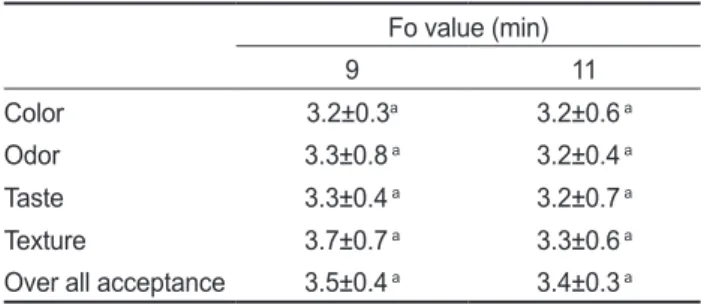
토마토페이스트소스첨가멸치육젓필레통조림의관능적기호 도를살펴보기위해색조
,
냄새,
맛및조직감등관능적특성에 대하여10
명의관능검사원을구성하여5
단계평점법으로관 능검사를실시한결과는Table 4
와같다. Fo
값이9
및11
분이 되도록각각살균한후개관하여관찰한결과,
색조,
냄새,
맛,
조직감및종합평가의차이를거의느낄수가없었다.
관능검 사표와같이종합평가도그점수가거의비슷하였으며,
관능 검사원들도관능적차이를구별하기가힘들다는견해가지배 적이었다.
따라서상업적살균조건에도맞고살균원가가가장 싼Fo
값9
분의조건으로제품을살균하는것이바람직하리라 생각되었다.
사 사
"
이논문은2012
년기장멸치젓갈명품화육성사업단의지원 에의하여연구되었음"
References
Ahn CB, Lee EH, Lee TH and Oh KS. 1986. Quality compari- son of canned and retort pouched sardine. Bull Korean Fish Soc 19, 187-194.
AOAC. 1995. Official Methods of Analysis. 16th ed. Asso- ciation of Official Analytical Chemists, Washington DC, U.S.A., 69-74.
APHA (American Public Health Association). 1970. Recom- mended Procedures for the Bacteriological Examination of Sea Water and Shellfish. 3rd ed. American Public Health As- sociation, Inc., New York, U.S.A., 17-24.
Cha YJ. 1992. Volatile flavor components in korean salt-fer- mented anchovy. J Korean Soc Food Nutr 21, 719-724.
Cha YJ, Kim H, Jang SM and Park JY. 1999. Identification of aroma-active compounds in Korean salt-fermented fishes by aroma extract dilution analysis. 1. Aroma-active com- ponents in salt-fermented anchovy on the market. J Korean Soc Food Sci Nutr 28, 312-318.
Cho HR, Park UY and Chang DS. 2002. Studies on the shelf-life extension of jeotkal, salted and fermented seafood. Korean J Food Sci Techonol 34, 652-660.
Cho YB, Kim SH, Lim JY and Han BH. 1996. Optimal steril- izing condition for canned ham. J Korean Soc Food Nutr 25, 301-309.
Cho YJ, Im YS, Park HY and Choi YJ. 2000. Changes of com- ponents in salt-fermented anchovy, engraulis japonicas sauce during fermentation. J Korean Fish Soc 33, 9-15.
Han BH, Kim SH, Cho HD, Cho MG and Bae TJ. 1997. A study on the rapid processing of hydrolyzed anchovy paste and lts quality stability. J Korean Fish Soc 30, 79-87.
Hong Y, Kim JH, Ahn BH and Cha SK. 2000. The effects of low temperature storage and aging of jeot-kal on the micro- bial counts and microflora. Korean J Food Sci Techonol 32, 1341-1349.
Jung KO, Kang KS and Park KY. 2000. Effect of fermented anchovy extracts on the N-methyl-N'-nitro-N-nitrosoguani- dine induced mutagenicities. Korean J Food Sci Technol 32, 1426-1432.
Kim DS, Cho MR, Ahn H and Kim HD. 2000. The preparation of canned pufferfish and its keeping stability. Korean J Food Nutr 13, 181-186.
Kim KH, Kim YS, Koh JH, Hong Ms and Yook HS. 2014. Qual- ity characteristics of yanggaeng added with tomato powder.
J Korean Soc Food Sci Nutr 43, 1042-1047. http://dx.doi.
org/10.3746/jkfn.2014.43.7.1042
Kong CS. 2011. Commercial sterilization condition of canned oyster and quality characteristics of canned boiled oyster in bamboo salt. Ph.D. Thesis, Gyeongsang National Univer- sity, Tongyeong, Korea.
Kohara T. 1982. Handbook of food analysis. Kenpakusha, To- kyo, Japan, 51-55.
Table 4. Sensory evaluation of canned salt-fermented anchovy En- graulis japonica fillet using tomato paste sauce sterilized at various Fo values
Fo value (min)
9 11
Color 3.2±0.3a 3.2±0.6 a
Odor 3.3±0.8 a 3.2±0.4 a
Taste 3.3±0.4 a 3.2±0.7 a
Texture 3.7±0.7 a 3.3±0.6 a
Over all acceptance 3.5±0.4 a 3.4±0.3 a 1, very poor; 2, poor; 3, acceptable; 4, good; 5, very good.
Values are the means± standard deviation of three determination.
Means within each line followed by the same letter are not signifi- cantly different (P<0.05).
토마토페이스트소스첨가 멸치 육젓필레통조림의 제조 및 특성
725
Kong CS, Yun JU, Oh DH, Park JY, Kang JY and Oh KS. 2009.
Effects of high temperature sterilization on qualities char- acteristics of the canned boiled oyster. J Agric Life Sci 43, 85-93.
Konozu S. 1994. Marine food chemistry. Soohaksa, Seuol, Ko- rea, 82.
Korean Statistical Information Service. 2013. Fisheries informa- tion sevice. Retrieved from http://kosis.kr. on Sep 17.
Kwon SJ, Lee JD, Yoon MJ, Jung JH, Je HS, Kong CS and Kim JG. 2014. Processing and characteristics of canned salt-fermented anchovy fillet in olive oil. J Fish Mar Sci Edu 26, 1175-1184. http://dx.doi.org/10.13000/
jfmse.2014.26.5.1175.
Lee EH, Oh KS, Lee TH, Ahn CB and Cha YJ. 1986. Fatty acid composition of salted and fermented sea food on the market.
Korean J Food Sci Techonol 18, 42-47.
Lim SB, Yang MS, Kim SH, Mok CK and Woo GJ. 2000.
Changes in quality of low salt fermented anchovy by high hydrostatic pressure treatment. Korean J Food Sci Techonol 32, 111-116.
Ministry of Social Welfare of Japan. 1960. Guide to experiment of sanitary insfection. III. Volatile basic nitrogen. Kenpaku- sha, Tokyo, Japan, 30-32
Noe YN, Kong CS, Yoon HD, Lee SB, Nam DB, Park TH, Kwon DG and Kim JG. 2011a. Preparation and keeping quality of canned sea mussel using tomato paste. J Fish Mar Sci Edu 23, 410-424.
Noe YN, Yoon HD, Kong CS, Nam DB, Park TH and Kim JG.
2011b. Preparation of retort pouched seasoned sea mussel and its quality stability during storage. J Fish Mar Sci Edu 23, 710-723.
Oh KS, Kim JG, Kim IS and Lee EH. 1991. Changes in food components of dark, white-fleshed fishes by retort steriliza- tion processing. 2. Changes in lipid components. Bull Ko- rean Fish Soc 24, 130-136.
Park KH, Yoon MS, Kim JG, Kim HJ, Shin JH, Lee JS, No YI, Heu MS and Kim JS. 2010. Preparation and characterization of canned salmon frame. Kor J Fish Aquat Sci 43, 93-99.
http://dx.doi.org/10.5657/kfas.2010.43.2.093.
Park TH, Kwon SJ, Lee IS, Lee JD, Yoon MJ, Back KH, Noe YN, Kong CS and Kim JG. 2013. Processing and charac- teristics of canned kwamaegi 3. processing and character- istics of canned kwamaegi using tomato paste sauce. J Fish Mar Sci Edu 25, 1348-1359. http://dx.doi.org/10.13000/
jfmse.2013.25.6.1348.
Park TH, Noe YN, Lee IS, Kwon SJ, Yoon HD, Kong CS, Oh KS, Choi JD and Kim JG. 2012a. Processing and character- istics of canned kwamaegi. 2. Processing and characteristics of canned boiled kwamaegi. J Fish Mar Sci Edu 24, 833- 844.
Park TH, Noe YN, Lee IS, Kwon SJ, Yoon HD, Kong CS, Nam DB, Oh KS and Kim JG. 2012b. Processing and character-
istics of canned seasoned sea mussel. J Fish Mar Sci Edu 24, 820-832.
Shim KB, Kim TJ, Ju JM and Cho YJ. 2001. Establishment of processing conditions of salted anchovy. 1. change of chem- ical compositions during fermentation of salted anchovy by salting methods. J Korean Fish Soc 34, 98-102.
Steel RGD and Torrie JH. 1980. Principle and procedures of statistics, 1st ed. McGraw-Hill Kogakusha. Tokyo, Japan, 187-221.
Tarladgis BG, Watts MM and Younathan MJ. 1960. A distilla- tion method for quantitative determination of malonalde- hyde in rancid food. J Am Oil Chem Soc 37, 44-48.
Yoon HD, Shim KB, Noh YN, Kong CS, Nam DB, Park TH and Kim JG. 2011. Preparation and characterization of canned kwamaegi. (1) Preparation and characterization of canned seasoned kwamaegi. J Fish Mar Sci Edu 23, 663-673.
Yook JH. 2003. Studies on the optimization of processing condi- tion of anchovy fillet products. Ph.D. Thesis, Pukyong Na- tional University, Busan, Korea.