Korean J Biol Psychiatry 2011;18:210-216
서 론
현재 우울증을 정의할 때 주로 정신장애의 진단 및 통계 편 람 4판(Diagnostic and Statistical Manual of Mental Disor- ders, 이하 DSM-IV)1)의 주요우울장애의 진단기준을 이용한 다. 그러나 실제로 임상현장과 지역사회에서 더 쉽게 만날 수 있는 우울증 환자는 DSM-IV의 엄격한 주요우울장애의 진 단기준을 만족하지 못하는 경우가 더 많다.2) 그러나, 주요우울 장애 수준에 못 미치는 이러한 우울증이라도 일상생활 기능 과 삶의 질을 저하시키고 자살 또는 기타 원인의 사망의 위험 인자로 작용하여 임상적으로 중요하다.3)4)
초기의 정신장애의 진단 및 통계 편람(DSM-I~DSM-III)에 서는 엄격하게 우울증상의 개수, 기간에 기초하여 주요우울 장애를 진단하였지만, 이런 엄격한 진단 기준은 임상가와 연 구자가 임상현장과 지역사회에서 우울증을 진단하는데 적당하 지 않았다. 그래서 연구자들은 DSM-III 진단기준이 요구하는 증상의 개수, 기간을 만족시키지는 않지만, 심각한 사회적 기능 장애를 일으키는 우울증을 가리켜 “역치하 우울 상태(sub- threhold depressive state)”라고 명명하였다. 이에 대한 임상 특징, 인구학적 특징, 심리사회 및 직업적 기능저하에 대한 많 은 연구들이 이뤄졌고,5)6) 이를 통해 역치하 우울상태에 대한 임상적 중요성이 밝혀졌다. 위의 결과가 DSM 진단기준에 반
아증후군적우울증
제주대학교 의학전문대학원 제주대학교병원 정신건강의학교실,1 서울대학교 의과대학 분당서울대학교병원 정신건강의학교실2
박 준 혁1 ·김 기 웅2
Subsyndromal Depression
Joon Hyuk Park, MD,1 Ki Woong Kim, MD2
1Department of Psychiatry, Jeju National University Hospital, School of Medicine, Jeju National University, Jeju, Korea
2Department of Psychiatry, Seoul National University Bundang Hospital, College of Medicine, Seoul National University, Seongnam, Korea
Subsyndromal depression (SSD) is found to be more prevalent than major depressive disorder (MDD) and minor depressive disorder (MnDD). SSD is also associated with adverse clinical outcomes, increased risk of suicide, increased social dysfunction and disability, in- creased risk for future mood disorders, and increased uses of medical and mental health services. DSM-IV diagnostic criteria are not suitable for capturing SSD. Although there is no agreement on gold standard to define SSD so far, three definitions of SSD are available.
First, SSD is defined as having two or more current depressive symptoms without core depressive symptoms (depressive mood or loss of interest) and with time threshold (most of the day and nearly every day over at least two weeks). Second, SSD is defined as having two or more current depressive symptoms with core depressive symptoms and without time threshold. Third, SSD is defined by using cutoff points of depression rating scales. SSD may represent a prodromal, residual, or interepisode symptomatic state in the course of MDD and MnDD. More than a half of SSD patients became any type of depressive disorders (SSD, MnDD and MDD) at 1 year. SSD may rep- resent a discrete category of its own, without prior or consequent episodes of MDD. Considering clinical significance of SSD such as its high prevalence, significant psychosocial impairment and chronicity and serious outcomes, researchers and clinicians should be more vigilant in capturing and caring for patients with SSD.
Key WordsZZSubsyndromal depression ㆍDefinition ㆍOutcome ㆍCourse.
Received: September 16, 2011 / Revised: November 1, 2011 / Accepted: November 3, 2011 Address for correspondence: Ki Woong Kim, MD
Department of Neuropsychiatry, Seoul National University Bundang Hospital, College of Medicine, Seoul National University, 166 Gumi-ro, Bundang- gu, Seongnam 463-707, Korea
Tel: +82-31-787-7432, Fax: +82-31-787-4058, E-mail: [email protected]
영되어, DSM-III-R에 기분부전장애(dysthymic disorder)가, DSM-IV에는 경도우울장애와 반복성 단기 우울장애가 포함 되었다. 그러나 사회적 기능저하를 일으키는 역치하 우울상태 의 2/3에서 3/4은 새로 추가된 세 가지 진단기준에 여전히 포함 되지 않았다.7)8) DSM-IV 경도우울장애 진단기준은 우울 증상 의 숫자를 2~4개(우울한 기분 또는 흥미상실 두 증상 중 하나 는 반드시 존재)로 줄였지만, 시간의 기준은 주요우울장애의 진 단과 동일하여, “하루의 대부분 시간 동안”, “2주 이상 거의 매 일”의 증상의 연속성과 지속 기간을 엄격하게 요구하고 있기 때 문에, 지역사회 또는 일차 진료기관에서 우울증 환자를 발견하 는데 사용되는 진단기준으로는 여전히 부적절하였다.9)10) 특히 노년기 우울증의 경우에는 특징적으로 우울증상이 일정기간 동안에 지속적으로 나타나기보다는 하루 중과 주 중에도 많 은 변동을 보이기 때문에 기존 DSM-IV의 경도우울장애의 진 단기준으로는 노년기 우울증의 아증후군적 증상을 찾아내기 는 어렵다.10)11)
이러한 배경에서 1990년대 중반부터 DSM-IV의 주요우울 장애와 경도우울장애의 진단적 역치에는 미치지 못하지만 임 상적으로 중요한 우울증을 정의할 새로운 진단기준의 필요성 이 제기되었고,8)10-13) 경도우울장애와 구분하여 그보다 낮은 수 준의 우울증으로 아증후군적 우울증(subsyndromal depres- sion)8)이라는 새로운 정의가 제시되었다. 초기의 연구에는 아 증후군적 우울증에 경도우울장애를 포함하는 경우도 있었 지만,14) 최근의 연구에서는 대부분 경도우울장애와 구분하여 그보다 낮은 수준의 우울증을 아증후군적 우울증이란 용어 로 통칭한다.11)12)
진단기준
현재 아증후군적 우울증의 통일된 진단기준은 존재하지 않 는다. 아증후군적 우울증의 연구결과들을 비교, 분석, 통합하 려면 무엇보다도 아증후군적 우울증의 통일된 진단기준이 필 요하다. 현재의 대표적인 아증후군적 우울증의 진단기준의 다음과 같다(Table 1). 세 기준 모두 주요우울장애와 경도우
울장애에 해당되지 않을 때만 아증후군적 우울증을 진단할 수 있다.
첫 번째 기준(SSD-1)은 DSM-IV의 9개의 우울증상 중에 서 우울감 또는 흥미 상실의 핵심증상 없이 최소 2개 이상의 증상이 최소 2주 동안에 대부분 또는 모든 시간 동안에 존재 하는 하는 경우이다.7)8)15-17) 이 기준은 주요우울장애, 경도우 울장애, 기분부전장애에 속하지 않으면서 우울증의 핵심증상 이 없이 다른 2개 이상의 우울증상이 있는 군들도 여러 영역 에서 의미있는 심리사회적 기능저하를 일으킨다는 연구에 기반한다.8) 대부분의 Judd 그룹의 연구는 이 진단기준을 사용 하였다. 그러나, 이 기준에서는 우울증상 중 핵심증상에 대한 기준이 없기 때문에, 우울증의 정서적, 인지적인 증상이 없으면 서 신체증상, 신경식물증상(neurovegetative symptom)만 있는 경우에도 아증후군적 우울증 환자로 진단할 수 있어 진단의 특이도(specificity)가 떨어지는 단점이 있다.
두 번째 기준(SSD-2)은 DSM-IV 9개의 우울증상 중에서 최 소 2개 이상의 증상이 있고 그 중에 우울감 또는 흥미와 즐거 움의 상실의 핵심증상 한가지는 꼭 포함해야 하지만, 증상의 지속기간, 연속성에 대한 시간에 대한 기준을 요구하지 않는
다.18-20) 이 기준은 엄격한 시간 진단기준을 만족하지 못하는 다
양한 심각도의 우울증 환자를 진단할 수 있지만, 한편으로는 진단의 역치를 너무 낮추어서 증상이 매우 경하거나 일시적인 경우에도 우울증이 과도하게 진단될 수 있는 단점이 있다.
세번째 기준(SSD-3)은 특정 우울척도 점수의 절단점(cutoff point)을 기준으로 아증후군적 우울증을 진단하는 것이다.11)21)22) 앞의 두 진단기준이 DSM-IV의 진단기준을 변형하여 우울증 을 핵심우울증상의 유무, 우울증상의 개수, 지속기간에 따라 범주적으로 아증후군적 우울증을 진단하는 것이라면, 이 기 준은 우울척도 점수의 절단점(cutoff point)을 기준으로 아증 후군적 우울증을 진단하는 것이다. Lyness 등23)은 24문항 해 밀턴 우울척도24)를 이용하여, 주요우울장애, 경도우울장애가 아니면서 척도점수가 11점 이상인 우울증상(depressive symp- toms)군을 아증후군적 우울증이라고 정의하였다. 그러나 연 구자 마다 사용하는 우울척도가 다르고, 같은 우울척도라고 Table 1. Provisional diagnostic criteria of subsyndromal depression
SSD-1 SSD-2 SSD-3
No. of depressive symptoms 2 ≥ depressive symptoms 2 ≥ depressive symptoms Cutoff scores of depression rating scales (e.g. Ham-D >10) Core depressive symptoms
(depressive mood or loss of interest)
- At least one core
depressive symptoms -
Time threshold Most of day and nearly every day over at least 2 weeks
- -
Researchers Judd et al. 19948)
Judd et al. 199727) Goldney et al. 200417)
Lyness et al. 200619)
McAvay et al. 200418) Lyness et al. 199923) Chopra et al. 200511) da Silva Lima et al. 200722) HAM-D : Hamilton Depression Rating Scale, SSD : Subsyndromal depression
하더라도 설문문항 자체가 문화적인 영향을 많이 받고,25)26) 인 종, 지역에 따라서 각각의 다른 절단점이 사용되기 때문에 진 단이 불안정하고, 진단의 특이도도 낮다.
유병률
아증후군적 우울증에 대한 통일된 진단 기준이 존재하지 않기 때문에 진단기준이 다른 연구 간의 비교가 어려울 뿐 아 니라, 현재까지 아증후군적 우울증의 유병률의 연구는 매우 소수에 불과하다. 향후 인종, 문화, 국가 간의 유병률 비교를 위 해서 아증후군적 우울증의 통일된 진단기준이 필요하다. Judd 등8)의 진단 기준을 이용한 유병률은 미국의 1년 유병률은 8.4%
였고, 1개월 유병률은 3.9%였다.16) 호주의 연구에서는 시점 유 병률이 미국의 1개월 유병률보다 높은 12.9%였다.17) Judd 등 의 연구에서 아증후군적 우울증의 1개월 유병률은 3.9%로 주 요우울장애의 2.3%, 경도우울장애 1.5%와 비교하여 상대적으 로 높은 유병률을 보였다.27) Lyness 등12)은 662명의 일차진료 환자를 대상으로 3가지 아증후군적 우울증 진단기준을 적용 하여서 진단기준 간의 유병률을 비교하였다. SSD-1 기준에서 는 16.2%, SSD-2 기준에서는 28.1%, 해밀턴 우울척도 절단점 11점을 이용한 SSD-3에서는 20.4%였다. 엄격한 시간에 대한 기준이 없는 SSD-2에서 가장 높은 유병률을 보였다(Table 2).
임상적인특징
아증후군적 우울증은 남성보다 여성에서 많았고,8)12) 무직, 독신자, 낮은 사회경제적 수준에서 유병률이 높아,5) 아증후군 적 우울증의 인구학적 특징은 주요우울장애, 경도우울장애 와 비슷하였다. 그러나 노인에서는 주요우울장애의 경우 나 이에 따른 유병률의 변화가 뚜렷하지 않거나 나이가 증가할 수록 유병률이 줄어들지만,28-30) 아증후군적 우울증의 포함한 주요우울장애의 아닌 우울장애의 경우는 나이에 증가함에 따라서 유병률도 증가하였다.31)32) 아증후군적 우울증군에서 이전의 주요우울장애의 과거력은 정상인보다 높다는 연구27)
도 있지만, 정상인과 차이가 없다는 결과11)19)도 있어 향후 추 후 연구를 통한 확인이 필요하다.
SSD-1 기준에 의한 아증후군적 우울증의 가장 흔한 증상 으로는 불면증, 피곤, 죽음에 대한 반복적인 생각, 집중력 저 하였고,8) 이는 우울증상의 핵심증상을 제외하고는 주요우울 장애와 비슷하였다. 그러나 다른 연구에서는 주요우울장애군 과 비교해서 아증후군적 우울증군에서 자살사고, 죄책감이 특 징적으로 적어서, 아증후군적 우울증은 주요우울장애와는 증 상의 양적으로나 질적으로도 다른 우울장애라는 주장도 제기 되었다.10) 아증후군적 우울증은 일반인에 비해서 자살의 위험은 높았지만, 경도우울장애, 주요우울장애군보다는 낮았다. Judd 등8)은 아증후군적 우울증과 경도우울장애와 우울증상의 차 이를 비교하였는데, 아증후군적 우울증군에서 체중증가, 느려 진 사고, 과다수면은 많고 식욕저하는 적었다. 이를 근거로 아증 후군적 우울증이 우울증의 비전형적 양상과 연관될 수 있음 을 제시하였다.
다른 우울장애군과 마찬가지로 아증후군적 우울증에서 정 상군에 비해 급속안구운동(rapid eye movement sleep, 이하 REM) 수면 잠복기가 짧았다. 비록 REM 수면 잠복기 감소가 우울증에만 특이적이지는 않지만, 아증후군적 우울증이 다 른 우울장애와 신경생리학적으로 연관됨을 시사해준다.33)
경 과
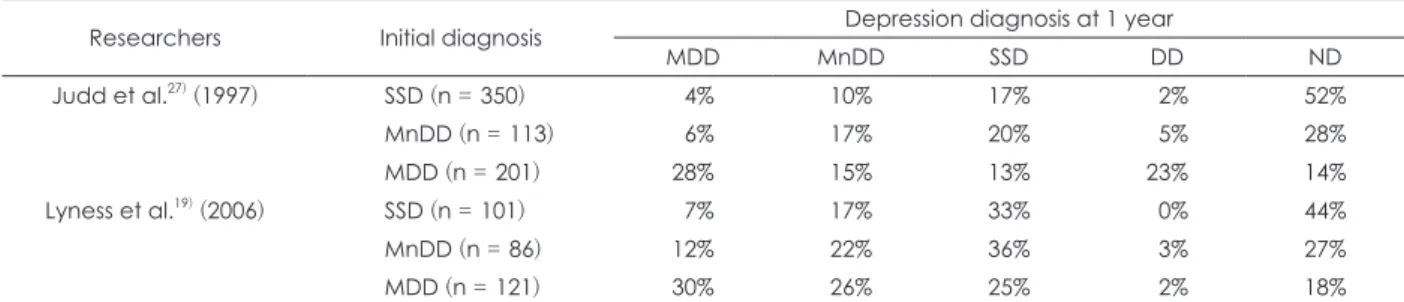
주요우울장애와 역치하 범주에 속하는 우울장애의 경과 및 우울장애 간의 역동적인 상호작용에 관한 몇몇 전향적 연구들 이 있다.5)16)19)27)34-37) 주요우울장애가 일정기간이 지난 후에 아 증후군적 우울증 범주에 속하게 되거나, 아증후군적 우울증이 나중에 발생하는 주요우울장애의 위험인자로 작용하였다. 우 울장애에 대한 대표적인 전향적인 두 연구19)27)에서 각각 SSD-1 과 SSD-2를 기준으로 아증후군적 우울증을 정의하였는데, 아 증후군적 우울증군에서 1년 후 4%와 7%의 주요우울장애가 발병하였다(Table 3). 이는 비우울중군에서 주요우울장애 발 병률보다 의미있게 높은 비율로 아증후군적 우울증이 주요
Table 2. Prevalence rates of subsyndromal depression
Investigator Year Country Number Age (years) Sample Criteria Prevalence
Judd et al.8) 1994 USA 09,160 General population Community SSD-1* 8.4% (1-year) Judd et al.27) 1997 USA 10,526 General population Community SSD-1* 3.9% (1-month) Goldney et al.17) 2004 Australia 03,010 General population Community SSD-1* 12.9%
Lyness et al.12) 2007 USA 00,662 ≥ 65 Primary care patients SSD-1* 16.2%
Lyness et al.12) 2007 USA 00,662 ≥ 65 Primary care patients SSD-2† 28.1%
Lyness et al.12) 2007 USA 00,662 ≥ 65 Primary care patients Ham-D >10 20.4%
* : more than 2 depressive symptoms without core depressive symptoms and with time threshold, † : more than 2 depressive symp- toms with core depressive symptoms and without time threshold. HAM-D : Hamilton Depression Rating Scale
우울장애의 전구체(precursor)이라는 가능성을 보여주었다.
또한 주요우울장애의 13%와 25%가 1년 후에 아증후군적 우 울증의 형태로 남아 있었고,19)27) 아증후군적 우울증 경우에는 이전 주요우울장애의 과거력이 5%로 비우울증군의 2%보다 유의하게 높았다. 이들의 결과는 아증후군적 우울증이 주요 우울장애의 잔류(residual) 증상일 가능성도 제시해주었다. 그 리고 아증후군적 우울증은 1년 후의 추적관찰에서, 48%, 56%
가 여전히 한가지의 우울장애를 앓고 있는 만성적인 경과를 보 여주었다.19)27)
그러나, 다른 연구에서는 아증후군적 우울증군에서 주요 우울장애 과거력과의 연관성은 비우울장애군과 차이가 없었
고,11)19) 실제로 지역사회에서 주요우울장애의 과거력이 없이
독립적으로 발생하는 아증후군적 우울증이 대부분이었다. 아 증후군적 우울증군은 5%만 주요우울장애의 과거력이 있었 고 이는 주요우울장애군의 83%에서 주요우울장애 과거력이 있다는 사실과 비교할 때 매우 낮은 비율이다.27) 주요우울장 애의 과거력이 있는 아증후군적 우울증군에서 그렇지 않은 군 보다 심리적인 장애가 더 심하고, 향후 더 심한 우울증으로 진 행될 가능성이 훨씬 높았다.11)
아증후군적우울증으로인한장애
아증후군적 우울증으로 인한 기능저하는 크게 아증후군적 우울증의 직접적인 영향으로 인한 다양한 건강서비스 이용횟 수의 증가, 자살시도, 작업의 생산성 저하 등과 같은 기능저하 와 향후 주요우울장애의 발병 위험의 증가로 인한 간접적인 기능저하로 구분할 수 있다.
Broadhead 등5)은 침대에서 보낸 날, 일을 하지 못한 날, 병 으로 인한 일상생활이 제한된 시간 등 다양한 척도를 이용하 여 장애의 정도를 측정하였는데 아증후군적 우울장애로 인 한 생기는 장애일수(disability day)는 전체 장애일수의 16%
를 차지하여, 경도우울장애의 8.5% 주요우울장애의 5.6%보 다 높았다. 비록 아증후군적 우울증의 증상은 덜 심하지만, 높
은 유병률로 인해서 훨씬 다른 우울장애보다 장애일수에 더 큰 영향을 주었다. Johnson 등38)은 장애의 정도를 나타내는 척도 로 의학적 서비스 이용, 정신과 약물복용, 자기보고 건강상태, 1주일간 일을 못함, 자살시도 등을 이용하여 우울증상 군에서 장애의 정도를 평가하였는데, 정상군보다 우울증상 군에서 유 의미하게 장애가 심했다. Judd 등7)은 심리사회적 장애의 척도로 신체장애수당(disability benefits), 복지수당, 내과, 정신과 또는 다른 외래치료 이용, 정신과 입원, 응급실 방문, 자살사고, 자 살시도 등을 이용하였는데, 9개 중 8개 영역에서 아증후군적 우 울증군에서 정상군보다 더 기능저하를 보였고 증상의 심각도 가 심할수록 기능저하는 심했다.
진단기준에 따른 아증후군적 우울증의 장애를 보면 세가지 기준(SSD-1, SSD-2, SSD-3) 모두에서 비우울증군보다 기능 저하가 심했고, SSD-1, SSD-3로 진단한 아증후군적 우울증 군이 SSD-2로 진단한 군보다 기능저하가 더 심했다.12) 1년 후 결과를 보면, 세 가지의 다른 진단기준을 이용한 아증후군적 우 울증군 모두에서 정상군보다 정신과적 증상과 기능적 측면 에서 더 나쁜 결과를 보였고, 경도우울장애, 주요우울장애와 비 교해서는 그 차이가 유의하지 않았다. 세 가지 진단기준에 따 른 1년 후 결과 비교에서는 SSD-3로 정의한 아증후군적 우울 증에서 가장 나쁜 예후를 보였고, 그 다음은 SSD-2, SSD-1 순 이었다.39)
아증후군적 우울증은 주요우울장애와의 관계에서 주요우 울장애의 전구증상으로서뿐만 아니라, 주요우울장애의 불완 전한 회복시 잔존증상으로 존재하여 나쁜 예후의 인자와 주 요우울장애 재발의 위험요소로 작용하였다.15)
치 료
아증후군적 우울증 치료에 관한 연구는 소수에 불과하고, 그 치료 효과에 대한 증거도 제한적이다.40-42) 심리사회적 치료 로는 인지행동치료43-45)와 대인치료(interpersonal therapy)45)46) 가 가장 많이 사용되었고, 이 치료를 통해서 우울증상의 호전
Table 3. Outcomes at 1 year by baseline depression diagnosis
Researchers Initial diagnosis Depression diagnosis at 1 year
MDD MnDD SSD DD ND
Judd et al.27) (1997) SSD (n = 350) 04% 10% 17% 02% 52%
MnDD (n = 113) 06% 17% 20% 05% 28%
MDD (n = 201) 28% 15% 13% 23% 14%
Lyness et al.19) (2006) SSD (n = 101) 07% 17% 33% 00% 44%
MnDD (n = 86) 12% 22% 36% 03% 27%
MDD (n = 121) 30% 26% 25% 02% 18%
MDD : major depressive disorder, MnDD : minor depressive disorder, SSD : subsyndromal depression, DD : dysthymic disorder, ND : no depression
을 보여주었지만, 위의 연구들은 현재의 아증후군적 우울증 의 진단기준을 이용한 진단이 아닌 우울증상군을 기준으로 하였다.
Rapport와 Judd47)는 처음으로 15명의 아증후군적 우울증과 경도우울장애 환자를 대상으로 한 open label 약물 연구를 시 행하였다. 처음 8주간의 fluvoxamine 약물치료 후에 임상증상 과 심리사회적 기능이 향상되었고, 그 이후 2주간 약물을 서서 히 끊었더니 다시 우울증상이 악화되었다. 그러나 위의 연구는 대상자 수가 너무 적고, open label이면서 대조군이 없는 등 제 한점이 많은 임상시험이기 때문에 그 결과를 일반화하는데 무 리가 있다. 향후 다양한 항우울제에 대한 전향적 이중맹검 위 약 대조군 임상시험을 통해, 아증후군적 우울증군에서 항우울 제의 치료적 유용성을 판단해야 한다. 최근의 한 연구에서 경 도우울장애 또는 아증후군적 우울증 환자의 치료에서 초기 반 응이 향후 치료 경과를 예측하는 중요한 인자였다.48)
단극성우울증에서 아증후군적우울증의역할
단극성 우울증은 DSM-IV 진단기준 역치, 기간, 증상의 개 수를 만족할 때만 임상적으로 의미 있고, 개념적으로 급성으 로 발병하는 고립된(isolated) 질환으로 여겨졌다. 그러나, 아증 후군적 우울증이 심각한 심리사회적 장애를 일으키고, 주요 우울장애와의 연관성이 밝혀지면서 단극성 우울증의 개념에 도 변화가 있었다.
첫째, 우울증은 일종의 스펙트럼 질환(spectrum disease)으로 정상부터 주요우울장애의 다양한 심각도가 연속선상에 존재 하고, 아증후군적 우울증은 두 군을 연결시켜 주는 다리역할을 한다는 것이다. 아증후군적 우울증의 우울증상 심각도, 개수, 기간은 향후 발생하는 주요우울장애의 중요한 예측인자로서, 우울증상의 심각도가 클수록 숫자가 많을수록 향후 우울장애 가 발병할 위험은 높아졌다.11) 주요우울장애도 경계가 명확한 분리된 질환이기보다는 다양한 증상, 기간, 심각도를 갖는 우 울증상군의 연속선상에 있는 진단적 합의 중 하나인 것이다.49) Judd 등16)의 연구에서, 주요우울장애를 12개월 동안 추적 평가하였는데, 우울장애는 만성질환의 경과를 보였고 그 경 과도 다양하였다. 주요우울장애 환자들은 추적기간의 41.5%
동안만 증상이 없었고, 나머지 기간에는 우울장애의 한 아형 에서 다른 아형으로 지속적으로 변하였다. 이러한 결과는 결 론적으로 단극성 우울장애는 다양한 심각성이 존재하는 스펙 트럼 질환(spectrum disease)이라는 가설을 지지해 준다.
둘째는, 아증후군적 우울증은 주요우울장애의 효과적인 치 료를 위한 방향을 제시해 주었다. 주요우울장애의 발병 이전
에 대부분 아증후군적 우울증이 선행하고, 치료 후에도 재발 과 연관성이 높은 아증후군적 우울증이 뒤따른다. 그러므로 치료의 목표가 주요우울장애를 아증후군적 우울증 상태로 변화시키는 증상의 완화가 아닌, 무증상 상태에 이르게 하는 것이 되어야 한다.50) 즉 질환을 없애고 건강을 완전히 회복하 는 것이 목표가 되어야 하는 것이다.
결 론
5개 미만의 우울증상, 2주 미만의 우울증상들도 심리사회적 기능을 저하시키고, 향후 부정적인 결과와 예후를 초래한다.
DSM-IV의 진단기준에는 이미 세 가지의 역치하 우울증(반 복성 단기 우울증, 경도우울장애, 기분부전장애)이 있지만, 아 증후군적 우울증은 포함되어 있지 않다. 현재 아증후군적 우 울증은 크게 3가지의 기준(SSD-1, SSD-2, SSD-3)으로 진 단되고 있고, 어떤 기준을 이용하더라도 아증후군적 우울증 은 사회심리적, 직업적 기능 저하에 영향을 미치고 향후 자살과 주요우울장애와 연관성을 갖는다. 우울증은 경한 상태에서도, 우울감과 흥미상실의 핵심증상이 빠진 우울증상 군들에서도 심각한 기능장애를 일으킨다. 향후 아증후군적 우울증에 대 한 연구들 간의 결과를 비교, 분석, 통합하기 위해서는 통일된 단일한 진단기준이 요구된다. 단극성 우울증은 우울증상의 연 속된 범주에서 다양한 심각도의 우울증상이 나타나는 질환으 로 개념화되고 있다. 아증후군적 우울증은 주요우울장애의 전 구증상, 잔존증상, 삽화 간에도 나타나고, 한편으로는 주요우 울장애의 전구증상 및 잔류증상과 관계없이 독립적으로 나 타나기도 한다. 향후 두 종류의 아증후군적 우울증에 대한 임 상적 특징, 경과, 예후, 치료 등을 밝히는 연구가 필요하다. 현 재 아증후군적 우울증의 치료에 대한 연구는 매우 부족한 실 정이다. 심리사회적 치료가 아증후군적 우울증 치료로 충분한 지, 어떤 역치의 우울장애부터 약물치료를 해야 되는지, 주요 우울장애로 진행되는 아증후군적 우울증을 더 적극적으로 치 료를 해야 되는지, 주요우울장애에 과거력이 있는 아증후군적 우울장애를 더 적극적으로 치료해야 되는지 등의 다양한 질문 에 답을 할 수 있는 종적 연구들이 필요하다. 아증후군적 우울 증은 유병률이 높고, 의미있는 심리사회적, 경제적인 장애를 일 으키고, 만성적인 경과를 거치고, 부정적인 예후를 초래하는 임 상적으로 중요한 질환으로, 임상가와 연구자는 아증후군증 우 울증의 발견, 진단, 치료에 더 많은 주의를 기울여야 한다.
중심 단어:아증후군적 우울증·정의·결과·경과.
Conflicts of interest
The authors have no financial conflicts of interest.
REFERENCES
1) American Psychiatric Association. Diagnostic and statistical manu- al of mental disorders: DSM-IV-TR. 4th ed. Washington DC: Ameri- can Psychiatric Association;2000.
2) Henderson AS, Jorm AF, MacKinnon A, Christensen H, Scott LR, Korten AE, et al. The prevalence of depressive disorders and the dis- tribution of depressive symptoms in later life: a survey using Draft ICD-10 and DSM-III-R. Psychol Med 1993;23:719-729.
3) Lebowitz BD, Pearson JL, Schneider LS, Reynolds CF 3rd, Alexo- poulos GS, Bruce ML, et al. Diagnosis and treatment of depression in late life. Consensus statement update. JAMA 1997;278:1186-1190.
4) Hybels CF, Blazer DG, Pieper CF. Toward a threshold for subthresh- old depression: an analysis of correlates of depression by severity of symptoms using data from an elderly community sample. Gerontol- ogist 2001;41:357-365.
5) Broadhead WE, Blazer DG, George LK, Tse CK. Depression, disabil- ity days, and days lost from work in a prospective epidemiologic sur- vey. JAMA 1990;264:2524-2528.
6) Wagner HR, Burns BJ, Broadhead WE, Yarnall KS, Sigmon A, Gaynes BN. Minor depression in family practice: functional morbidi- ty, co-morbidity, service utilization and outcomes. Psychol Med 2000;
30:1377-1390.
7) Judd LL. Pleomorphic expressions of unipolar depressive disease:
summary of the 1996 CINP President’s Workshop. J Affect Disord 1997;45:109-116.
8) Judd LL, Rapaport MH, Paulus MP, Brown JL. Subsyndromal symp- tomatic depression: a new mood disorder? J Clin Psychiatry 1994;
55 Suppl:18-28.
9) Flint AJ. The complexity and challenge of non-major depression in late life. Am J Geriatr Psychiatry 2002;10:229-232.
10) Geiselmann B, Bauer M. Subthreshold depression in the elderly:
qualitative or quantitative distinction? Compr Psychiatry 2000;41:
32-38.
11) Chopra MP, Zubritsky C, Knott K, Have TT, Hadley T, Coyne JC, et al. Importance of subsyndromal symptoms of depression in elderly patients. Am J Geriatr Psychiatry 2005;13:597-606.
12) Lyness JM, Kim J, Tang W, Tu X, Conwell Y, King DA, et al. The clinical significance of subsyndromal depression in older primary care patients. Am J Geriatr Psychiatry 2007;15:214-223.
13) Sherbourne CD, Wells KB, Hays RD, Rogers W, Burnam MA, Judd LL. Subthreshold depression and depressive disorder: clinical char- acteristics of general medical and mental health specialty outpa- tients. Am J Psychiatry 1994;151:1777-1784.
14) Lavretsky H, Kumar A. Clinically significant non-major depres- sion: old concepts, new insights. Am J Geriatr Psychiatry 2002;10:
239-255.
15) Judd LL, Akiskal HS, Maser JD, Zeller PJ, Endicott J, Coryell W, et al. Major depressive disorder: a prospective study of residual sub- threshold depressive symptoms as predictor of rapid relapse. J Af- fect Disord 1998;50:97-108.
16) Judd LL, Akiskal HS, Maser JD, Zeller PJ, Endicott J, Coryell W, et al. A prospective 12-year study of subsyndromal and syndromal de- pressive symptoms in unipolar major depressive disorders. Arch Gen Psychiatry 1998;55:694-700.
17) Goldney RD, Fisher LJ, Dal Grande E, Taylor AW. Subsyndromal depression: prevalence, use of health services and quality of life in an Australian population. Soc Psychiatry Psychiatr Epidemiol 2004;
39:293-298.
18) McAvay GJ, Bruce ML, Raue PJ, Brown EL. Depression in elderly homecare patients: patient versus informant reports. Psychol Med 2004;34:1507-1517.
19) Lyness JM, Heo M, Datto CJ, Ten Have TR, Katz IR, Drayer R, et al.
Outcomes of minor and subsyndromal depression among elderly patients in primary care settings. Ann Intern Med 2006;144:496-
20) Bruce ML, Ten Have TR, Reynolds CF 3rd, Katz II, Schulberg HC, 504.
Mulsant BH, et al. Reducing suicidal ideation and depressive symp- toms in depressed older primary care patients: a randomized con- trolled trial. JAMA 2004;291:1081-1091.
21) Lyness JM, King DA, Cox C, Yoediono Z, Caine ED. The impor- tance of subsyndromal depression in older primary care patients:
prevalence and associated functional disability. J Am Geriatr Soc 1999;47:647-652.
22) da Silva Lima AF, Fleck M, Pechansky F, de Boni R, Sukop P. Psy- chometric properties of the World Health Organization quality of life instrument (WHOQoL-BREF) in alcoholic males: a pilot study.
Qual Life Res 2005;14:473-478.
23) Lyness JM, Caine ED, King DA, Cox C, Yoediono Z. Psychiatric dis- orders in older primary care patients. J Gen Intern Med 1999;14:
249-254.
24) Williams JB. A structured interview guide for the Hamilton De- pression Rating Scale. Arch Gen Psychiatry 1988;45:742-747.
25) Chang SM, Hahm BJ, Lee JY, Shin MS, Jeon HJ, Hong JP, et al.
Cross-national difference in the prevalence of depression caused by the diagnostic threshold. J Affect Disord 2008;106:159-167.
26) Noh S, Speechley M, Kaspar V, Wu Z. Depression in Korean immi- grants in Canada. I. Method of the study and prevalence of depres- sion. J Nerv Ment Dis 1992;180:573-577.
27) Judd LL, Akiskal HS, Paulus MP. The role and clinical significance of subsyndromal depressive symptoms (SSD) in unipolar major de- pressive disorder. J Affect Disord 1997;45:5-17; discussion 17-8.
28) Blazer D, Williams CD. Epidemiology of dysphoria and depression in an elderly population. Am J Psychiatry 1980;137:439-444.
29) Ernst C, Angst J. Depression in old age. Is there a real decrease in prevalence? A review. Eur Arch Psychiatry Clin Neurosci 1995;245:
272-287.
30) Mulsant BH, Ganguli M. Epidemiology and diagnosis of depression in late life. J Clin Psychiatry 1999;60 Suppl 20:9-15.
31) Lavretsky H, Kumar A. Practical geriatrics: clinically significant nonmajor geriatric depression. Psychiatr Serv 2003;54:297-299.
32) Tannock C, Katona C. Minor depression in the aged. Concepts, prev- alence and optimal management. Drugs Aging 1995;6:278-292.
33) Akiskal HS, Judd LL, Gillin JC, Lemmi H. Subthreshold depres- sions: clinical and polysomnographic validation of dysthymic, re- sidual and masked forms. J Affect Disord 1997;45:53-63.
34) Angst J. Recurrent brief depression. A new concept of depression.
Pharmacopsychiatry 1990;23:63-66.
35) Horwath E, Johnson J, Klerman GL, Weissman MM. Depressive symptoms as relative and attributable risk factors for first-onset ma- jor depression. Arch Gen Psychiatry 1992;49:817-823.
36) Maier W, Gänsicke M, Weiffenbach O. The relationship between ma- jor and subthreshold variants of unipolar depression. J Affect Disord 1997;45:41-51.
37) Lyness JM, Chapman BP, McGriff J, Drayer R, Duberstein PR. One- year outcomes of minor and subsyndromal depression in older pri- mary care patients. Int Psychogeriatr 2009;21:60-68.
38) Johnson J, Weissman MM, Klerman GL. Service utilization and so- cial morbidity associated with depressive symptoms in the commu- nity. JAMA 1992;267:1478-1483.
39) Grabovich A, Lu N, Tang W, Tu X, Lyness JM. Outcomes of subsyn- dromal depression in older primary care patients. Am J Geriatr Psy- chiatry 2010;18:227-235.
40) Pinquart M, Duberstein PR, Lyness JM. Treatments for later-life de- pressive conditions: a meta-analytic comparison of pharmacotherapy and psychotherapy. Am J Psychiatry 2006;163:1493-1501.
41) Oxman TE, Sengupta A. Treatment of minor depression. Am J Geri- atr Psychiatry 2002;10:256-264.
42) Lyness JM. Treatment of depressive conditions in later life: real-world
light for dark (or dim) tunnels. JAMA 2004;291:1626-1628.
43) Miranda J, Muñoz R. Intervention for minor depression in primary care patients. Psychosom Med 1994;56:136-141.
44) Fava GA, Rafanelli C, Grandi S, Conti S, Belluardo P. Prevention of recurrent depression with cognitive behavioral therapy: preliminary findings. Arch Gen Psychiatry 1998;55:816-820.
45) Barkham M, Shapiro DA, Hardy GE, Rees A. Psychotherapy in two-plus-one sessions: outcomes of a randomized controlled trial of cognitive-behavioral and psychodynamic-interpersonal therapy for subsyndromal depression. J Consult Clin Psychol 1999;67:201- 46) Klerman GL, Weissmann MM. Interpersonal psychotherapy (IPT) 211.
and drugs in the treatment of depression. Pharmacopsychiatry 1987;
20:3-7.
47) Rapaport MH, Judd LL. Minor depressive disorder and subsyndro- mal depressive symptoms: functional impairment and response to treatment. J Affect Disord 1998;48:227-232.
48) Tadić A, Helmreich I, Mergl R, Hautzinger M, Kohnen R, Henkel V, et al. Early improvement is a predictor of treatment outcome in pa- tients with mild major, minor or subsyndromal depression. J Affect Disord 2010;120:86-93.
49) Kendler KS, Gardner CO Jr. Boundaries of major depression: an evaluation of DSM-IV criteria. Am J Psychiatry 1998;155:172-177.
50) Judd LL, Paulus MP, Zeller P. The role of residual subthreshold de- pressive symptoms in early episode relapse in unipolar major de- pressive disorder. Arch Gen Psychiatry 1999;56:764-765.