ⓒ 2015, The Microbiological Society of Korea
보 문
Pseudoalteromonas donghaensis HJ51의 체외 단백질 분해효소 특성과 생산 조건
오지성 ・ 최윤수 ・ 노동현*
충북대학교 자연과학대학 미생물학과
Characterization and optimum production condition of extracellular protease from Pseudoalteromonas donghaensis HJ51
Ji-Sung Oh, Yoon-Soo Choi, and Dong-Hyun Roh*
Department of Microbiology, Chungbuk National University, Cheongju 362-763, Republic of Korea
(Received March 10, 2015; Accepted March 18, 2015)
ABSTRACT: Pseudoalteromonas donghaensis HJ51, isolated from the East Sea, has been reported as a novel strain to produce extracellular protease. Crude supernatant was used to determine optimal activity and optimal production conditions for the enzyme. It was found that the optimal temperature and pH of the protease were 40°C and pH 7.5–10.5, respectively. The enzyme activity was kept to 88% at the pH 11. In metal requirement analysis, the enzyme exhibited the highest activity when 10 mM Fe3+ was supplied. While supplementation of additional carbon sources used in study showed no positive effect on cell growth and enzyme activity, the addition of beef extract, tryptone, or casamino acids instead of peptone of PY-ASW containing 1% glucose increased enzyme production to 21, 7, 4%, respectively. Taken together these properties, the enzyme produced from P. donghaensis HJ51 can be applied to the industries that require protease activity under alkaline pH and low temperature.
Key words: Pseudoalteromonas donghaensis HJ51, optimal condition, protease production
*For correspondence. E-mail: [email protected];
Tel.: +82-43-261-3368; Fax: +82-43-264-9600
단백질 분해효소는 단백질의 구성성분인 아미노산 간 펩타 이드 결합의 가수분해를 촉매 하는 효소이며, 생명체 내외에 서 중요한 생리적 역할과 기능을 수행하는 효소로 알려져 있 다. 이러한 단백질 분해효소는 산업적인 관점에서 화학적 방 법을 대체하여 사용할 수 있는 고부가가치 자원으로 주목을 받고 있으며, 식품공업, 제약산업, 피혁가공업 및 세제공업 등 의 다양한 산업에 응용되어 세계 공업효소 판매량의 60%를 차 지하는 것으로 추정되고 있다(Rao et al., 1998).
단백질 분해효소는 동물 및 식물, 세균, 곰팡이, 효모 등 다 양한 생물에서 생산되고 있으나, 산업적 측면의 수요 충당을 위해 미생물 유래 효소가 많이 사용되고 있으며, 이들 대부분 은 Bacillus 속 세균으로부터 생산되는 효소들이다(Gupta et al., 2002). 단백질 분해효소의 다양한 산업적 응용을 위해 활
성이 높고 안정된 성질을 갖는 새로운 미생물 선별에 많은 노 력을 기울인 결과, Bacillus 속 이외에도 Alcaligenes (Thangam and Rajkumar, 2002), Chryseobacterium (Wang et al., 2008b;
Lee et al., 2012), Micrococcus (Fernández et al., 1996; Cha et al., 2009), Pseudoalteromonas (Cha et al., 2007), Pseudomonas (Zeng et al., 2003), Pseudoxanthomonas (Cho et al., 2010), Serratia (Kwon et al., 1993), Shewanella (Kulakova et al., 1999), Vibrio (Denkin and Nelson, 1999) 속 등의 세균들로부 터 단백질 분해효소의 생산이 보고되었다.
해양 세균으로 알려진 Pseudoalteromonas 속 미생물들은 다양한 생물학적 활성 분자 및 체외 분비 효소들을 생산함으 로써 해양 서식처에 중요 상호작용 역할을 수행하는 것으로 알려져 있다(Holmström and Kjelleberg, 1999; Bowman, 2007). 특히 이들 미생물에 의해 생산된 단백질 분해효소들은 저온 또는 고염 등의 극한 환경에서 높은 활성을 보유하거나,
76
∙ Oh et al.
해양 미세 조류 성장의 억제 등 다양한 특성을 지니는 것으로 알려져 있다(Lee et al., 2000; He et al., 2004; Yan et al., 2009).
본 연구에서는 동해 해양 환경으로부터 분리되어 신종 미생물 로 보고된 P. donghaensis HJ51이 생산하는 체외분비 단백질 분해효소의 특성 및 생산에 대해 보고하는 바이다.
재료 및 방법
사용된 균주, 배지 및 배양 조건
실험에 사용된 균주는 동해 해양 환경으로부터 분리된 P.
donghaensis HJ51을 사용하였다(Oh et al., 2011). 이 균주가 생산하는 체외분비 단백질 분해효소의 특성을 알아보기 위해 서 PY-ASW (peptone 5.0 g, yeast extract 1.0 g/L artificial seawater) 배지를 사용하였다. Artificial seawater는 1 L 증류 수에 NaCl 24.0 g, MgCl2·6H2O 10.6 g, Na2SO4 4.0 g, CaCl2· 2H2O 1.47 g, KCl 0.7 g, NaHCO3 0.2 g, KBr 0.1 g, H3BO3 0.027 g, SrCl2·6H2O 0.04 g, NaF 0.003 g을 첨가하여 제조하였 다(Lyman and Fleming, 1940). 균주의 체외분비 단백질 분해 효소의 특성을 알아보기 위한 종배양은 5 ml PY-ASW 배지에 균주를 접종하여 2일 동안 25°C에서 150 rpm으로 진탕 배양 시켰고, 본배양은 2 ml 종배양액을 500 ml 플라스크에 준비한 200 ml PY-ASW 배지에 접종하여 24시간 동안 25°C에서 150 rpm으로 진탕배양시켰다.
체외분비 단백질 분해효소의 활성측정
체외분비 단백질 분해효소의 활성 측정은 배양된 균의 상등 액을 이용하여 Windle과 Kelleher의 방법(1997)을 변형하여 다음과 같이 실시하였다. 24시간 동안 배양된 균주의 배양액을 4°C, 14,000 rpm (Micro 17R, Hanil)에서 10분간 원심 분리하 여 균체를 제거한 crude supernatant를 사용하였다. 이들 crude supernatant 50 μl에 100 mM sodium phosphate buffer (pH 7.0) 에 녹인 0.5% (w/v) azocasein을 150 μl를 첨가하여 잘 혼합한 후에 30°C 항온수조에서 30분 동안 반응시켰다. 반응 정지를 위해 10% trichloroacetic acid (TCA) 400 μl를 가하여 2분 동안 정치하였고, 이를 4°C, 14,000 rpm에서 10분간 원심 분리하여 상등액 500 μl에 525 mM NaOH 700 μl를 가하여 혼합한 후 혼 합액 1 ml을 흡광도 432 nm에서 측정하였다. 효소의 활성단위 는 30°C에서 30분 동안 432 nm에서의 흡광도 0.01 증가를 1 unit/ml (EU/ml)로 정하였다(Secades and Guijarro, 1990). 모든 체외분비 단백질 분해효소의 활성 측정은 3회 반복하였다.
체외분비 단백질 분해효소의 최적 온도, pH 및 금속이온에 따른 특성
균주가 생산하는 체외분비 단백질 분해효소의 최적 활성 온 도를 알아보기 위해서 100 mM sodium phosphate buffer (pH 7.0)에 녹인 0.5% (w/v) azocasein을 기질로 사용하였으며, 반 응 온도는 4°C 및 10°C부터 60°C까지 5°C 간격으로 조정하여 효소활성을 측정하였다. 효소의 최적 pH를 알아보기 위해서 pH 5.0부터 pH 6.0까지는 100 mM citrate buffer를 사용하였고, pH 6.0부터 pH 8.0까지는 100 mM sodium phosphate buffer, pH 8.0부터 pH 9.0까지는 100 mM Tris-HCl buffer, pH 9.0부터 pH 11.0까지는 100 mM Glycine-NaOH buffer를 사용하였으며, 이때 효소의 반응 온도는 30°C에서 수행하였다. 효소의 활성 에 미치는 금속이온의 영향을 알아보기 위해 100 mM sodium phosphate buffer (pH 7.0)에 녹인 0.5% (w/v) azocasein을 기질 로 사용하고 반응 온도는 30°C로 수행하였으며, MgCl2, CaCl2, NaCl, KCl, CuSO4, FeCl3, AlCl3, AgNO3, MnSO4를 각각 최종 농도가 1 mM과 10 mM이 되도록 첨가하여 반응하였다.
탄소원과 질소원에 따른 체외 단백질 분해효소 생산의 영향 탄소원 또는 질소원에 따른 단백질 분해효소 생산의 영향 을 조사하기 위해 탄소원은 PY-ASW 배지에 부가적인 탄소원 으로 glucose, sucrose, maltose, mannose를 각각 1%로 첨가하 였고, 질소원은 glucose를 1%로 첨가한 PY-ASW 배지에 peptone을 대신하여 tryptone, beef extract, malt extract, skim milk, casamino acid, KNO3, (NH4)2SO4, NaNO3, NH4Cl을 각 각 0.5%로 첨가하였다. 균주의 배양은 25°C에서 24시간 동안 150 rpm으로 진탕배양 하였다. 균주는 종배양을 위해 5 ml PY-ASW 배지에 접종하여 2일 동안 25°C에서 150 rpm으로 진탕 배양하였고, 본배양은 0.5 ml 종배양액을 250 ml 플라스 크에 준비한 50 ml PY-ASW 배지에 접종하여 24시간 동안 25°C에서 150 rpm으로 진탕배양 하였다.
결과 및 고찰
체외분비 단백질 분해효소의 최적 온도
일반적으로 저온성 효소들의 고유 활성도는 30–50°C 사이 의 온도에서 최적의 활성을 보이는 것으로 알려져 있다(Huston et al., 2000). P. donghaensis HJ51로부터 생산된 체외분비 단 백질 분해 효소가 저온성 효소의 특성을 가지는지 알아보기 위하여 반응온도에 대한 효소의 활성을 조사한 결과 Fig. 1과
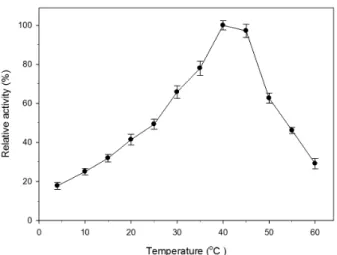
Fig. 1. Effect of temperature on the protease activity of P. donghaensis HJ51. The cells were incubated at 25°C by shaking at 150 rpm in the PY-ASW medium and enzyme activity was determined for 30 min at pH 7 and each temperature. Relative activity is expressed as a percentage of the highest activity at 40°C. Standard deviations from the mean of three independent assays are indicated by error bars.
Fig. 2. Effect of pH on the protease activity of P. donghaensis HJ51. All conditions were the same as Fig. 1 except the pH range and reaction temperature at 30°C. Relative activity is expressed as a percentage of the highest activity at pH 9.5. Standard deviations from the mean of three independent assays are indicated by error bars. ( ●), 100 mM citrate buffer; ( ○), 100 mM sodium phosphate buffer; (▼), 100 mM Tris-HCl buffer; ( △), 100 mM glycine-NaOH buffer.
같았다. 반응온도에 대한 효소의 활성은 4°C부터 점진적으로 증가하여 40°C에서 약 1,409 unit/ml의 최적 활성을 나타내었 다. 최적온도 이후 활성이 서서히 감소하여 45°C에서 약 97%
의 활성을 보였으며, 그 후 50°C에서 활성이 급격하게 감소하 여 약 63%의 활성을 나타내었다.
유사한 환경으로부터 분리된 Pseudoalteromonas sp. HJ47의 체외분비 단백질 분해효소와 비교해 볼 때 최적온도는 5°C 높았 으며, 최적온도 이후 효소 활성이 감소하여 45°C부터 55°C까지 범위에서 HJ47의 효소는 약 60% 정도의 활성이 유지된 것과 달 리 P. donghaensis HJ51의 효소는 최적 온도 이후 온도가 상승함 에 따라 활성이 지속적으로 감소하는 차이를 보였다(Cha et al., 2007). Pseudoalteromonas sp. SM9913의 단백질 분해효소는 Pseudoalteromonas sp. HJ47 효소와 최적온도가 같았지만, 최 적온도 이후의 효소활성 감소 양상은 P. donghaensis HJ51 효소 와 유사 하였다(He et al., 2004). 이와 같이 해양에서 분리된 Pseudoalteromonas 속 세균들은 저온성 단백질 분해효소 특성 을 가졌으며(He et al., 2004; Wang et al., 2008a) P. donghaensis HJ51의 단백질 분해효소는 저온성 효소로 분류할 수 있었다.
체외분비 단백질 분해효소의 최적 pH
P. donghaensis HJ51이 생산하는 효소의 최적 pH를 알아보 기 위하여 네 가지 완충용액에 기질을 녹여 pH를 5.0부터 pH 11.0까지 0.5 단위로 변화시키면서 crude supernatant와 반응 하여 조사한 결과 Fig. 2와 같았다. 효소의 활성은 pH의 증가에 따라 비례적으로 증가하여 pH 7.5부터 pH 10.5까지 범위에서
최적 활성을 나타내었으며, 이후 활성이 감소하여 pH 11.0에 서는 약 88%의 활성을 보였다.
Pseudoalteromonas sp. HJ47 (Cha et al., 2007)과 Pseudoal- teromonas sp. NJ276 (Wang et al., 2008a)의 단백질 분해효소 들은 pH 8.0에서 최적활성을 보여 유사하였으나, pH 9.0 이상 의 알칼리성 pH 범위에서는 약 20% 이상 활성이 감소하는 차 이를 보였다. 알칼리성 pH 범위에서 높은 상대 활성을 유지하 는 특성은 Bacillus pumilus D-6로부터 생산된 알칼리성 단백 질 분해 효소와 유사하였으며(Bajaj and Jamwal, 2013), P.
donghaensis HJ51이 생산하는 단백질 분해효소도 알카리성 단백질 분해효소임을 알 수 있었다.
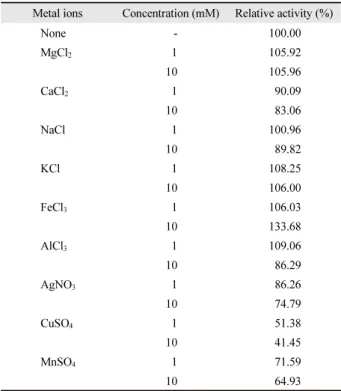
금속이온에 따른 체외분비 단백질 분해효소의 활성 효소의 활성은 다양한 금속이온에 의해 영향을 받는다고 알 려져 있다. P. donghaensis HJ51의 체외분비 단백질 분해효소 를 이용하여 다양한 금속이온들에 의한 효과를 알아 본 결과 Table 1과 같았다. Mg2+와 K+를 첨가하였을 때 10% 미만의 활 성 증가를 보였으며, 특히 Fe3+를 10 mM 첨가하였을 때 약 34%
증가하여 가장 높은 효소 활성을 나타내었다. Al3+는 1 mM로 첨가하였을 때 약 9% 정도 효소 활성이 증가하였으나, 10 mM 로 첨가하였을 때 약 14% 정도 활성이 감소하는 특성을 보였 다. 그 외의 Ca2+, Na+, Ag+, Cu2+, Mn2+첨가는 농도가 증가함 에 따라 효소의 활성이 감소되었다.
Pseudoalteromonas sp. NJ276에서 생산된 체외분비 단백
78
∙ Oh et al.
Table 1. Effect of metal ions on the protease activity of P. donghaensis HJ51
Metal ions Concentration (mM) Relative activity (%)
None - 100.00
MgCl
21 105.92
10 105.96
CaCl
21 90.09
10 83.06
NaCl 1 100.96
10 89.82
KCl 1 108.25
10 106.00
FeCl
31 106.03
10 133.68
AlCl
31 109.06
10 86.29
AgNO
31 86.26
10 74.79
CuSO
41 51.38
10 41.45
MnSO
41 71.59
10 64.93
Table 2. Effect of carbon source on the cell growth and protease activity of P. donghaensis HJ51
Carbon source Cell growth (OD 600 nm)
aProtease (U/ml) Protease production (U/ml)/
OD 600 nm Caseinolytic activity (%)
bNone 3.07±0.14 1148.96±44.50 374.21±14.49 100.00
Glucose 2.76±0.35 938.22±63.76 339.48±23.07 90.72
Sucrose 2.07±0.11 472.96±65.70 228.22±31.70 60.99
Maltose 1.80±0.26 404.96±61.36 225.42±34.16 60.24
Mannose 2.86±0.15 696.15±42.11 243.76±14.74 65.14
a
For nutrient studies cells was grown in PY-ASW medium supplemented with 1.0% indicated carbon source at 25°C for 24 h with shaking of 150 rpm. Values are means±SD for three independent experiments.
b
Percent caseinolytic activity in each medium was expressed as a relative activity to none (100%).
질 분해효소와 비교해 볼 때 Ca2+, Cu2+, Mn2+첨가 시 효소활성 이 감소하는 특성은 같았으나, Mg2+, Fe2+ 및 Na+ (1 M)를 첨가 하였을 때는 P. donghaensis HJ51의 결과와 상반된 특성을 보 였다(Wang et al., 2008a). 또한 Pseudoalteromonas sp. CP76 의 체외분비 단백질 분해효소도 Ca2+와 Mn2+뿐만 아니라 Mg2+의 농도가 높아짐에 따라 효소의 활성이 감소하는 특성 을 보였다(Sánchez-porro et al., 2003).
탄소원과 질소원에 따른 체외 단백질 분해효소 생산 일반적으로 배지에 부가적인 영양분의 첨가는 세포의 성장 (cell growth)과 효소 생산(protease production)에 영향을 미친
다고 알려져 있다. 탄소원에 대한 세포 성장 및 효소 생산의 영 향을 알아보기 위해 P. donghaensis HJ51이 동화할 수 있는 glucose, sucrose, maltose 또는 mannose를 각각 첨가하여 진행 한 결과 Table 2와 같았다. 당이 희박한 해양에서 분리된 P.
donghaensis HJ51은 이용 가능한 탄소원의 첨가시 세포 성장 이 낮아졌고, 효소 생산도 약 9–40% 정도 감소하였다.
Pseudoalteromonas sp. CP76 (Sánchez-porro et al., 2003) 의 경우도 탄소원 첨가로 인한 세포의 성장 정도 변화가 거의 없었다. 하지만 sucrose 첨가로 인하여 효소 활성과 생산이 증 가하였고, glucose의 첨가는 효소 활성(protease)이 증가한 반 면 생산이 감소하였으며, maltose를 첨가하였을 때 효소 활성 과 생산이 약 90% 이상 급격히 감소하는 특성을 보였다. Bacillus sp. SMIA-2 (Nascimento and Martins, 2004)의 경우에도 기본 배지의 trisodium citrate를 대신해서 sucrose, maltose, glucose 또는 mannose를 각각 첨가한 결과 세포 성장 및 효소 활성이 감소하는 유사한 특성을 보였다.
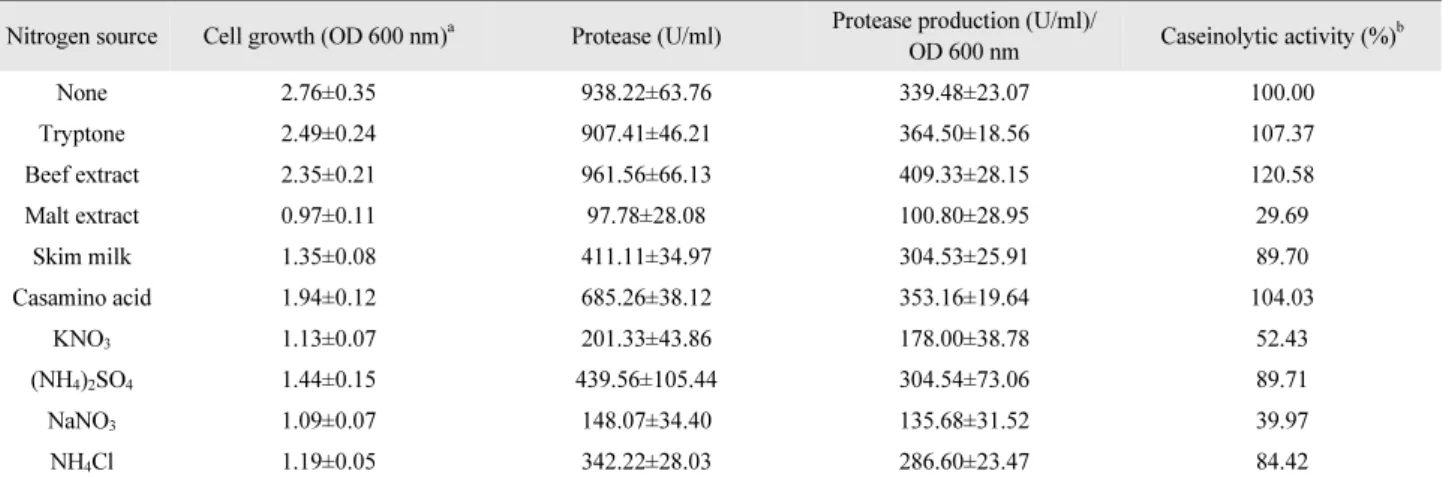
질소원에 대한 세포 성장 및 효소 생산의 영향은 Table 3과 같았다. Peptone을 대신하여 각각의 다양한 질소원들을 첨가 한 결과 세포 성장은 낮아졌으며, malt extract를 제외한 유기 질소원들이 무기 질소원들보다 높은 세포 성장 및 효소 활성 을 가졌다. 효소 활성은 beef extract를 첨가하였을 때 가장 높 았으며, malt extract를 첨가하였을 때 가장 낮은 효소 활성을 보였다. 효소 생산은 beef extract, tryptone 또는 casamino acid 를 첨가하였을 때 peptone 첨가에 비해 약 4–20% 정도 증가하 였으며, 그 외 질소원의 경우 감소하였다.
Pseudoalteromonas sp. CP76 (Sánchez-porro et al., 2003) 은 casamino acid와 NH4Cl을 첨가하였을 때 peptone보다 세포 성장이 감소하는 양상은 같았으나, 효소 생산은 증가하는 차 이를 보였다. 유사한 환경으로부터 분리된 Micrococcus sp.
HJ19 (Cha et al., 2009)는 malt extract를 첨가하였을 때 세포 성장이 감소하여 유사하였으나 효소 생산은 증가하는 차이를 보였으며, casamino acid를 제외한 모든 질소원들이 peptone
Table 3. Effect of nitrogen source on the cell growth and protease activity of P. donghaensis HJ51
Nitrogen source Cell growth (OD 600 nm)
aProtease (U/ml) Protease production (U/ml)/
OD 600 nm Caseinolytic activity (%)
bNone 2.76±0.35 938.22±63.76 339.48±23.07 100.00
Tryptone 2.49±0.24 907.41±46.21 364.50±18.56 107.37
Beef extract 2.35±0.21 961.56±66.13 409.33±28.15 120.58
Malt extract 0.97±0.11 97.78±28.08 100.80±28.95 29.69
Skim milk 1.35±0.08 411.11±34.97 304.53±25.91 89.70
Casamino acid 1.94±0.12 685.26±38.12 353.16±19.64 104.03
KNO
31.13±0.07 201.33±43.86 178.00±38.78 52.43
(NH
4)
2SO
41.44±0.15 439.56±105.44 304.54±73.06 89.71
NaNO
31.09±0.07 148.07±34.40 135.68±31.52 39.97
NH
4Cl 1.19±0.05 342.22±28.03 286.60±23.47 84.42
a
For nutrient studies cells was grown in PY-ASW medium supplemented with 1% glucose and 0.5% indicated nitrogen source in place of peptone at 25°C for 24 h with shaking of 150 rpm. Values are means±SD for three independent experiments.
b
Percent caseinolytic activity in each medium was expressed as a relative activity to none (100%).
을 제공한 경우보다 높거나 비슷한 효소 생산을 보였다. 무기 질소원에 한하여 암모니아 질소원의 첨가가 상대적으로 높은 효소 활성 및 생산을 보이는 현상은 Chryseobacterium sp. JK1 과 유사하였다(Lee et al., 2012). Bacillus licheniformis N-2 (Nadeem et al., 2008)의 경우 유기질소원들이 무기질소원보 다 높은 세포 성장 및 효소 활성을 유도하여 유사한 특성을 보 였다.
본 연구에서 분석된 P. donghaensis HJ51의 체외분비 단백 질 분해효소는 저온 환경에서 식품 단백질 가수분해를 수행하 는 식품산업 및 알칼리성 pH 환경을 요구하는 특수 산업으로 의 응용이 가능할 것으로 생각되며, 산업적 이용 가능성을 위 해 효소 정제, 유전자 클로닝 및 과발현 시스템 개발 등의 추가 적인 연구가 필요할 것으로 사료된다.
적 요
동해에서 분리된 Pseudoalteromonas donghaensis HJ51는 체외분비 단백질 분해효소를 생산하는 신종 미생물로 보고되 었다. 체외 단백질 분해효소의 특성과 최적 생산 조건을 결정 하기 위해 crude supernatant을 사용하여 단백질 분해효소의 최적 활성 온도와 pH를 조사한 결과 40°C와 pH 7.5–10.5이었 으며, pH 11에서도 88%의 높은 상대적인 효소 활성을 나타내 었다. 효소의 금속 요구성을 조사한 결과, Fe3+를 10 mM로 첨 가하였을 때 최대 효소활성 증가를 보였다. 최대의 효소생산 조건을 탐색한 결과, 기본배지인 PY-ASW (peptone 0.5%, yeast extract 1.0%, artificial seawater)에 탄소원을 첨가하지 않는 것
이 가장 높았으며, 질소원으로는 peptone 보다 beef extract, tryptone, casmino acids을 각각 첨가했을 때 활성이 21, 7, 4%
증가하였다. 이러한 결과를 종합해 볼 때 P. donghaensis HJ51 이 생산하는 효소는 알칼리성 pH 환경 및 저온환경에서 활성 이 필요한 분야에 응용이 가능할 것으로 사료된다.
감사의 말
이 논문은 2013년도 충북대학교 학술연구지원사업의 연구 비 지원에 의하여 연구되었습니다(This work was supported by the research grant of the Chungbuk National University in 2013).
References
Bajaj, B.K. and Jamwal, G. 2013. Thermostable alkaline protease production from Bacillus pumilus D-6 by using agro-residues as substrates. Adv. Enzyme Res. 1, 30 –36.
Bowman, J.P. 2007. Bioactive compound synthetic capacity and ecological significance of marine bacterial genus Pseudoal- teromonas. Mar. Drugs 5, 220 –241.
Cha, I.T., Lim, H.J., and Roh, D.H. 2007. Isolation of Pseudoalteromonas sp. HJ47 from deep sea water of East Sea and characterization of its extracellular protease. Kor. J. Life Sci.
17, 272 –278.
Cha, I.T., Oh, Y.S., Cho, W.D., Lim, C.S., Lee, J.K., Lee, O.S., and
Roh, D.H. 2009. Production condition and characterization of
extracellular protease from Micrococcus sp. HJ19. Kor. J.
80