유한 요소법에 의한 300 메쉬 콩 가루 분쇄기의 진동 해석 Vibration Analysis of 300 mesh Soy Bean Crusher
Based on Finite Element Method
프라타마 판두 산디1, 수페노 데스티아니2, 변재영2,우지희2, 이은숙2, 남미경2, 황현지2,
키프 디마스 하리스 신2, 이강삼2, 최원식2*
Pandu Sandi Pratama1, Destiani Supeno2, Jae-Yeong Byun2, Ji-Hee Woo2, En-Suk Lee2, Mi-kyung Nam2, Hyun-Ji Hwang2, Keefe Dimas Harris Sean2,
Kang-Sam Lee2, Won-Sik Choi2*
<Abstract>
A machine such as bean crusher machine is subjected to different loads and vibration. Due to this vibration there will be certain deformations which affect the performance of the machine in adverse manner. This paper proposed a vibration analysis of bean crusher machine using ANSYS. The Finite Element Method (FEM) analysis is carried out to study the effect of vibration on the structure in order to ensure the safety. This work helps the machine developer make a better product at the early design stage with lower cost and faster development time. To do this, firstly, using Inventor, a CAD model is prepared. Secondly, the analysis is to be carried out using ANSYS 15. The modal analysis and random vibration analysis of the structure was conducted. The analysis shows that the proposed design was successfully shows the minimum deformation when the vibration was applied in normal condition.
Keywords : vibration analysis, Soy bean crusher, Finite Element Method
1 산디, 생명산업융합연구원, 부산대학교 경상남도 밀양시 삼랑진읍 삼랑진로 1268-50 우편번호 50463
E-mail: [email protected] Tel:+82-55-350-5422 2* 최원식, 부산대학교 바이오산업기계공학과 교수
경상남도 밀양시 삼랑진읍 삼랑진로 1268-50 우편번호 50463
E-mail : [email protected], Tel: +82-55-350-5425
1 Post doc, Live and Industry Convergence Research Inst., Pusan Natl. Univ Gyeongsangnam-do Miryang-si Sangnamjin-eub
Sangnamjin-ro 1268-50, 50463 REPUBLIC OF KOREA 2* Corresponding Author, Professor, Dept. of
Bio-Industrial Machinery Eng.,Pusan Natl. Univ Gyeongsangnam-do Miryang-si Sangnamjin-eub Sangnamjin-ro 1268-50, 50463 REPUBLIC OF KOREA
1. Introduction
Nowadays, soybean can be said to be a plant increasingly important for agriculture, because it is one of the main food sources in human and animal nutrition. It is a food source which contains high quality protein and does not contain cholesterol and saturated fatty acids. Tofu is one of the most important food products made from soybean protein. Tofu making procedure includes soaking of beans, grinding, filtering, boiling, coagulating and moulding [1]. The flavour, quality and the texture of tofu produced is significantly influenced by its processing parameters. During Tofu making process, insoluble residue after filtration of soymilk called okara is remained. In common, every pound of dry beans makes into soymilk or tofu generates about 1.1 pounds of okara with around 80% moisture. It contains high content of fiber and appreciable amounts of oil and protein with high quality. However, okara is generally used as feed or fertilizer.
With the growing awareness of the importance of dietary fiber in human health, there is an increasing interest in the utilization of whole beans as an alternative solution [2]. Moreover, more than 90% of the water used during tofu making is wasted [3].
This water including coagulant recently has caused serious environmental issues. Some of the issues that could be caused by wastewater from tofu production are ecosystem damage, extinction of certain
organisms, decreased quality of water, and many others. Therefore wasted coagulant should be avoided. To produce whole beans tofu, the bean powder size should be less than 300 mesh. Conventional soybean pulverizer can only produce bean powder more than 100 mesh. Liquefied nitrogen is used to prevent the generation of oil in the pulverizer soybean during the pulverization.
The surface hardening causes the wear of the pulverizer blade and the durability of the pulverizer.
In this research a bean crusher machine to produce the bean powder with size less than 300 mesh, and kept the temperature at 40
°C or less without discharging the beverage.
A bean crusher machine is a mill used to grind hard, small food products between two revolving abrasive surfaces separated by a distance. When the two surfaces are set far apart, the resulting ground material is coarser, and when the two surfaces are set closer together, the resulting ground material is finer and smaller. According to the market demand, in this research a high speed bean crusher machine was developed. The structural analysis is one of important step in the development process such as in [4].
During operation, uneven load inside the crushing machine will lead the machine to the forced vibration. If the excitation vibration frequency and the resonance natural frequency of the frame structure is closed, the mechanical structure will produce local resonance and deformation [5]. Therefore, the
simulation related to the vibration analysis is needed in development process.
2. System Design
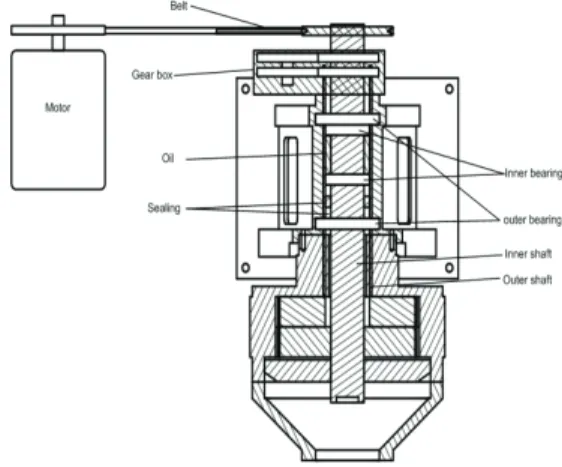
The developed bean crusher machine is shown in Figure 1. The dimension of the machine was calculated optimally to maximize the capacity and the material strength. This machine powered by 220V 3.75KW induction motor. The nominal angular velocity of the crusher machine is 3000 rpm. Power transfer box transfer the energy generated by motor to the crush box through belt system. The belt conversion ratio is 1:2. The crush box is the most important part of bean crusher. It was made of steel. Three Nano inner crush tool inside the crush box rotate in different direction to crush the bean. The hopper was used as inlet for the crusher machine. Powder box was used to collect the bean powder
processed by crush tool. The suction pipe then transports the bean powder to collector tank. Figure 2 shows the horizontal cut off schematics of the crusher machine. Since it consist of inner shaft and outer shaft, the Nano crush tool can rotate in two directions at the same time. In order to reduce the noise, vibration proof rubber was attached to the base of each corner. To prevent degeneration of soybean grains with high oil content, a special cooling system was developed to maintain a low temperature of 40 degrees or less.
3. Simulation Method
In this research the stress and modal analysis was done to evaluate the reduction gear performance. Stress analysis was done to clarify the design of reduction gear can withstand a specified load, using the specified amount of material or that satisfies some
Fig. 1 Developed system Fig. 2 Schematics diagram of soy bean crusher
other optimality criterion. Modal analysis is a kind of linear analysis technology, used to determine the structure of the natural frequency and vibration mode.
The procedure of static analysis and modal analysis includes following steps. Firstly, the 3D model of important component was created. In this research focused on the crush box since this part affected by the operation condition. Secondly, the model was simplified to obtained geometry model.
Thirdly, the mesh of the model was generated. Fourthly, the materials properties were defined. In this research the crush box is made of steel. Fifthly, the boundary condition was defined. Finally, solve the problem, visualized and read the results. In
this research the 3D model was build using inventor software.
The stress analysis was done using EDEM 2017 and modal analysis was done using ANSYS 15.
3. Result and Discussion
The calculation result of modal analysis is shown in figure 4. Modal analysis results in Table 1 shows that the frames of 1∼6 orders modal natural frequency are 338.55∼1437.1 Hz range. Figure 4a∼e shows the deformation effect on the frame when the natural frequency occurred. The scale is 1.
a. F = 236 Hz b. F = 251 Hz c. F = 477 Hz
d. F = 547 Hz e. F = 1055 Hz f. F = 1080 Hz Fig. 3 Modal analysis of bean crusher machine
No Frequency
[Hz] Characteristics of vibration 1 236 Vertical along Z axis on the front side 2 251 Horizontal along X axis on the front side 3 477 Vertical along Z axis on the front side 4 547 Horizontal along X axis on the top side 5 1055 Horizontal along X axis on the top side 6 1080 Vertical along X axis on the top side Table 1. Natural frequency and vibration mode
The bean crusher analysis based on discrete element method (DEM) using EDEM software is shown in figure 5. This figure shows the bean flow through the crusher machine at 1500 rpm motor speed. In this simulation the bean diameter size is 5 mm.
4. Conclusion
In this research, natural frequency analysis and random vibration analysis was done to the bean crusher machine. The simulation result show that the natural frequency value of the first order and second order frame are among sensitive frequency value ranges which can be obtained from modal analysis. Modal analysis results show that the machine 1∼6 orders modal natural frequencies range are 338.55∼1437.1 Hz. This should be the key consideration to avoid produce resonance. The behaviour of beans inside the bean crusher machine was investigated using discrete
a. t = 0 s b. t = 0.01 s c. t = 0.02 s
d. t = 0.0712 s e. t = 0.0812 s f. t = 0.1132 s Fig. 4 Analysis of bean crusher machine based on discrete element method
element method. The simulation shows that the bean flow the hopper inlet to the crush box.
Acknowledgments
This work was supported by Ministry of Agriculture, Food and Rural Affairs of Republic of Korea (2017 320 90001).
References
[1] Rekha C R and Vijayalakshmi G 2013 Influence of processing parameters on the quality of soycurd (tofu) J. Food Sci. Technol. 50(1) p 176.
[2] Kao F-J, Su N-W and Lee M-H. Development and Quality of Tofu Analogue Prepared from Whole Soybeans. Chemistry, Texture, and Flavor of Soy. ACS Symposium Series. 1059:
American Chemical Society; 2010. p. 277.
[3] Faisal M, Gani A, Mulana F and Daimon H 2016 Effect of Organic Loading on Production of Methane Biogas From Tofu Wastewater Treated by Thermophilic Strirred Anaerob Reactor Rasayan Journal Chemical 9(2) p 133.
[4] Choi W S, Pratama P S, Supeno D, Woo J H, Lee E S and Park C S 2017 Dynamic vibration characteristics of electric agricultural vehicle based on finite element method Glob. J. Eng.
Sci. Res. 4 p 27.
[5] Wang W, Cheng S, Luo M and Zou J, editors.
Experimental Modal Test for Structure Refinement of an Automotive Chassis. 2010 International Conference on Measuring Technology and Mechatronics Automation; 2010 13-14 March 2010.
[6] Wang G.S., Si J.P., Chen Y.Y., Guo L.N., and Zhao Y.N., "Structural Stability Analysis of Dump Truck Body Based on ANSYS", Advanced Materials Research, Vol. 588, pp.
217-221, 2012.
[7] Si F.J.P., Wang G.S., and Ding X.L., "Analysis of Dump Truck Unloading Condition Based on ANSYS", Advanced Materials Research, Vol.
548, pp. 724-729, 2012.
(접수: 2017.10.20. 수정: 2017.11.21. 게재확정: 2017.11.27.)