Combined Effects of L-Carnitine Supplementation and Exercise on the Body Composition, Serum Lipids and Adiponectin in the High School Obese Female Students
Won-Bae Shin, Dae-Yun Seo and Yeong-Ho Baek*
Department of Physical Education, Pusan National University, Busan 609-735, Korea
Received September 4, 2009 /Accepted October 2, 2009The purpose of this study was to investgate combined effects of L-carnitine supplementation and ex- ercise on body composition, serum lipids and adiponectin in obese high school female students.
Eighteen female students with 35% fat in body weight participated in the study. Students were ran- domly divided into the following three groups; exercise and L-carnitine supplementation group (ELG:
n=5), exercise group (EG: n=6) and control group (CG: n=7), each with seven students. They under- went 10 weeks of exercise (50 min/day, 5 times/wk, 10 wk, RPE 11~16). ELG was given L-carnitine (1 g/day), EG and CG were given placebos. Before and after this period, body composition, serum lipids and adiponectin in plasma were measured. The results of the study in the three groups were as follows: Fat mass and %BF were significantly decreased in ELG. On the other hand, free fat mass was significantly increased in ELG, however, other groups showed no changes. Total cholesterol was significantly increased in the control group. High density lipoprotein cholesterol and low density lip- oprotein cholesterol were not different in the three groups. Triglyceride was significantly decreased in ELG. Adiponectin was significantly increased in ELG. This study demonstrated that exercise and carnitine supplementation have a positive effect on fat mass, %BF, free fat mass and adiponetin. Thus, we can improve proper dietary and training programs for obese students.
Key words : L-carnitine intake, exercise, obesity, adiponetcin
*Corresponding author
*Tel:+82-51-510-1647, Fax:+82-51-515-1991
*E-mail : [email protected]
서 론
청소년의 비만은 지난 3년에 비하여 두 배로 증가하였고 [49], 미국의 국민건강영양조사(NHANES)에 의하면 2003- 2004년 청소년의 17.1%가 비만을 가지고 있다[45]. 그리고 비 만청소년은 인슐린 저항성, Type 2 당뇨병, 고혈압, 이상 지질 혈증, 수면무호흡증, 심리적 스트레스 등을 유발할 가능성이 있다[48].
비만치료의 기본적인 방법으로는 식사요법과 운동요법을 병행하여 실시하는 것이 가장 효과적이라 할 수 있으며[57], 이러한 비만을 해소하기 위하여 운동과 식이요법을 병행한 연구들이 활발히 진행되고 있다[4,15].
지방과 관련된 호르몬 중 아디포넥틴은 지방조직에서 특이 하게 발현되는 단백질로 체내에서 발견되는 호르몬들 중 농도 가 높고 기능이 다양한 아디포사이토카인으로 국내에서도 최 근 5년간 집중연구 되어져 왔다. 아디포넥틴은 간과 근육에서 지방산의 산화를 촉진하여 인슐린 감수성을 개선시키고[31], 혈관 내피세포에서 사이토카인의 분비를 억제하여 항 염증작 용을 나타낸다[2]. 그리고 혈관 평활근 세포에서는 혈소판유래
성장인자(platelet derived growth factor)에 의한 세포증식과 이주를 억제함으로써 항 동맥경화작용을 하는 것으로 알려져 있다[5,58]. 아디포넥틴에 관한 선행연구에서는 인종, 성별, 연 령, 체중뿐만이 아니라 같은 집단 내에서도 차이가 많다고 보 고되고 있는데 이런 이유는 개인의 병력, 성별, 연령, 생리적 스트레스 수준 등에 의해 영향을 받는다고 한다[25,36,39,50,53].
규칙적인 운동은 체중감소와 함께 아디포넥틴의 농도를 증 가시키고[6,44], 인슐린 저항성을 개선시키며 염증반응인자를 감소시킨다고 한다[18]. 그리고 식이제한과 운동을 병행한 연 구에서도 체중이 감소되면서 아디포넥틴의 농도는 증가한다 고 하였다[10]. 숙련된 runner를 대상으로 최대산소섭취량 60
〜75%로 27분간 운동[37], 카누선수를 대상으로 24주간 저강 도의 운동[28], 당뇨환자를 대상으로 하루 20분 3주간 실시 [44], 정상인을 대상으로 60분간 4주 운동은 아디포넥틴의 농 도를 유의하게 증가시키며[6], 반대로, 일반인을 대상으로 최 대산소섭취량 60%의 강도로 1회 60분간 운동[20], 비만인을 대상으로 12주간의 운동[43]. 당뇨병 환자를 대상으로 하루 45 분 8주간의 운동[7]은 아디포넥틴의 변화가 없다고 하였다. 따 라서 규칙적인 운동의 기간과 운동대상에 따른 연구들의 결과 들이 서로 다른 양상을 보이고 있다.
한편, 카르니틴은 지방대사의 과정에서 중요한 carnitine
acyl transferase I (CAT1)과 carnitine acyl transferase Ⅱ
(CATⅡ)를 구성하여, 활성화된 긴-사슬 지방산(long-chain fatty acid)의 미토콘드리아(mitochondria) 내·외막 통과를 용 이하게 함으로써 베타-산화(β-oxidation)를 촉진하는 중요한 역할을 하고 있다[22]. 또한, 카르니틴은 인체 내 지방분해와 에너지 생성에 관여하는 것으로 밝혀지면서, 서구사회에서는 20년 이상 식이 보조제로 사용되어 오고 있다. 카르니틴은 간 이나 신장에서 리신(lysine)과 메티오닌(methionine)이 결합 되어 합성되며, 영양섭취가 정상일 때는 카르니틴 부족이 없 다. 그러나 운동이 장시간 수행이 될 경우 지방 동원이 활발하 게 되면서 카르니틴이 부족하게 된다. 따라서 체내에서 합성 되는 내인성 카르니틴은 장시간 운동 중의 지방산화를 촉진하 기에는 부족하다는 문제가 제기 되면서 여러 학자들에 의해 연구가 진행되어왔다[8,16,23,55].
이와 같이 유산소운동에 대한 연구와 카르니틴 섭취를 통하 여 지방산화를 촉진시킨 연구들이 많이 진행되어 왔다. 그러 나 대부분의 선행연구가 유산소운동을 위주로 실시를 하였고 복합운동을 실시한 연구는 미흡한 실정이다.
따라서 본 연구는 비만여고생을 대상으로 10주간 카르니틴 섭취와 복합운동을 병행하여 신체조성, 혈중지질, 아디포넥틴 에 미치는 영향을 규명하여 비만을 극복할 수 있는 효율적인 방안을 제시하는데 도움을 주고자 본 연구를 시도하였다.
재료 및 방법
연구 대상
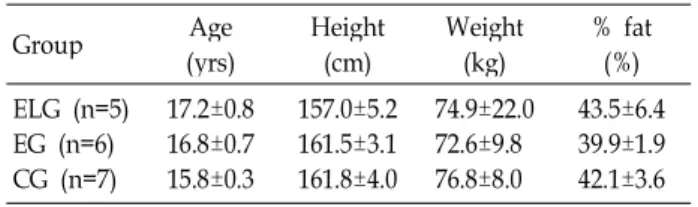
본 연구는 B광역시 S고등학교 1, 2학년 학생 중 체지방률이 35% 이상인 비만 여학생들에게 본 연구의 취지와 목적을 설명 한 후 본인의 동의를 얻은 총 21명의 대상자를 무작위추출법 에 의해 운동과 카르니틴 섭취군 7명, 운동군 7명, 일상생활을 그대로 유지하는 대조군 7명으로 나누었다. 그러나 실험기간 중 개인적인 사정에 의하여 운동과 카르니틴 섭취군 2명, 운동 군 1명, 총 3명이 중도 탈락하였다. 그리고 실험 시작 전 비만 관련 합병증으로 치료를 받고 있는 학생은 제외하였으며, 대 상자의 신체적 특징은 Table 1과 같다.
연구 방법
본 연구의 실험절차는 피험자 18명을 선정하고 피험자의
Table 1. Characteristics of the subjects
Group Age
(yrs) Height
(cm) Weight
(kg) % fat
(%) ELG (n=5)
EG (n=6) CG (n=7)
17.2±0.8 16.8±0.7 15.8±0.3
157.0±5.2 161.5±3.1 161.8±4.0
74.9±22.0 72.6±9.8 76.8±8.0
43.5±6.4 39.9±1.9 42.1±3.6 ELG: exercise and L-carnitine intake group, EG: exercise group, CG: control group
신체적 특성을 측정하였다. 무선추출법에 의해 각 그룹에 따 른 유산소운동과 카르니틴섭취를 각각 10주간 실시하였다. 카 르니틴(L-carnitine 100%, GNC, USA)은 알약형태로 1일 1 g, 주 3회, 운동 3시간 전 섭취하였고[52], 대조군은 위약효과를 위하여 빈 캡슐을 섭취시켰다. 트레이닝 전․후 신체조성과 2회의 채혈을 통해 혈중지질, 아디포넥틴을 측정하였다.
측정항목 및 분석방법
측정항목은 신체조성과 관련되는 체지방량(fat mass), 체지 방률(% Fat), 제지방량(FFM), 혈중지질 항목으로 총콜레스테 롤(T-C), 고밀도지단백콜레스테롤(HDL-C), 저밀도지단백콜 레스테롤(LDL-C), 중성지방(TG), 그리고 아디포넥틴으로 하 였다.
신체조성은 최대한 간편한 복장으로 다주파수 생체전기 임 피던스 분석원리를 적용한 국내 Bio Space사 In Body 720을 이용하여 측정하였다.
혈액분석은 12시간 공복상태를 유지하도록 하여 오전 10시 에 앉은 자세에서 10 ml를 채취하여 사전 분석하였고, 사후에 도 동일한 조건과 방법으로 실험이 끝나는 다음 날 실시하였 다. 혈액성분 분석은 S임상검사센터에 의뢰하여 분석하였다.
트레이닝 방법
본 운동프로그램을 정확하게 수행하기 위하여 프로그램 시 작 1주일 전 사전교육을 충분히 하였으며, 준비운동 5분, 본 운동 40분, 정리운동 5분으로 총 50분 실시하였다. 본 운동은 걷기, 줄넘기, 스텝박스, 스쿼트, 팔굽혀펴기 운동으로 하였으 며, 프로그램은 주 3회(월, 수, 금) 총 10주를 실시하였다[27].
운동 강도는 Borg's scale에 따라 1∼2주는 RPE 11∼12, 3∼6주 는 RPE 13∼14, 7∼10주는 15∼16로 점진적으로 증가시켰다.
통계처리
본 실험의 자료는 SPSS Ver 14.0 (statistical package for social science) 통계package를 이용하였으며, 각 변인들 간에 평균 및 표준편차를 산출한 후 집단 내 변화는 paired t-test를 이용하였고, 각 항목별 집단 및 실험전․후간의 평균의 차이 를 비교하기 위해 반복측정 이원량분석(two-way ANONA re- peated measure)을 실시하였으며, 사후 검증은 Tukey방법으 로 유의수준은 α=0.05로 설정하였다.
결 과
신체조성
신체조성의 변화는 Table 2와 같다. 체중은 집단 내 운동과
카르니틴 섭취군에서 유의하게(p<0.01) 감소하였으며, 집단
간 유의한 차이는 없었다. 또한 운동과 카르니틴 섭취군이 체
지방량과 체지방률 변화에서 집단 내 유의하게(p<0.01) 감소
Table 2. Changes of body composition and total energy intake
Content Time ELG (n=5) EG (n=6) CG (n=7) F Tukey
Weight (kg) Before After T-value
74.9±22.0 74.1±22.1 7.364**
72.6±9.8 73.3±7.4 0.325
76.8±8.0 75.4±10.4
0.837 0.88 NS
% BF (%) Before After T-value
43.5±6.4 41.7±7.1 4.793**
39.9±1.9 40.4±3.0 0.277
42.1±3.6 41.5±3.7
0.447 34.068 NS
FM (kg) Before
After T-value
33.7±15.5 32.0±15.6 7.291**
29.1±5.2 29.6±4.0 0.259
32.5±5.3 31.5±6.8
0.558 0.232 NS
FFM (kg) Before After T-value
22.5±4.1 23.0±3.9 4.894**
23.9±2.7 23.9±2.7 0.142
24.2±2.5 24.0±2.4
1.038 0.308 NS
Mean±SD, ELG: exercise and L-carnitine intake group, EG: exercise group, CG: Control group
a: ELG, b: EG, c: CG, FM: fat mass, FFM: free fat mass, % BF: percentage body fat,*: p<0.05,**: p<0.01, ***: p<0.001 and NS:
not significant
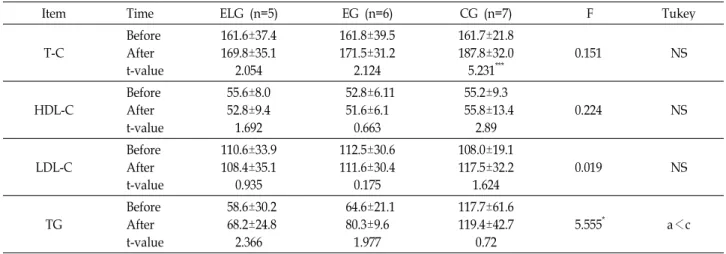
Table 3. Changes of T-C, TG, HDL-C, LDL-C in pre and post test for 10 weeks exercise and L- carnitine intake groups (mg/dl)
Item Time ELG (n=5) EG (n=6) CG (n=7) F Tukey
T-C Before
After t-value
161.6±37.4 169.8±35.1
2.054
161.8±39.5 171.5±31.2
2.124
161.7±21.8 187.8±32.0
5.231*** 0.151 NS
HDL-C Before
After t-value
55.6±8.0 52.8±9.4 1.692
52.8±6.11 51.6±6.1
0.663
55.2±9.3 55.8±13.4
2.89 0.224 NS
LDL-C Before
After t-value
110.6±33.9 108.4±35.1
0.935
112.5±30.6 111.6±30.4
0.175
108.0±19.1 117.5±32.2
1.624 0.019 NS
TG Before
After t-value
58.6±30.2 68.2±24.8
2.366
64.6±21.1 80.3±9.6
1.977
117.7±61.6 119.4±42.7
0.72 5.555* a<c
ELG: exercise and L-carnitine intake group, EG: exercise group, CG: Control group a: ELG, b: EG, c: CG,*: p<0.05, **: p<0.01, ***: p<0.001, and NS: not significant
하였으며, 집단 간 유의한 차이가 없었다. 제지방량의 변화에
서는 운동과 카르니틴 섭취군에서 집단 내 유의하게(p<0.01) 증가하였으며, 집단 간 유의한 차이는 없었다.
혈중지질
혈중지질의 변화는 Table 3에 나타난 바와 같이 집단 내 T-C변화에서 대조군이 유의하게(p<0.001) 증가하였으며, 집 단 간 유의한 차이는 나타나지 않았다. 집단 간 TG의 변화에서 는 운동과 카르니틴 섭취군이 대조군에 비하여 유의하게(p<
0.05) 감소하였다.
아디포넥틴
아디포넥틴의 변화는 Table 3에 나타난 바와 같이 집단 내
변화에서 대조군이 유의하게(p<0.001) 높게 나타났으며, 집 단 간 변화에서 운동과 카르니틴 섭취군이 다른 군에 비하여 유의하게 높게(p<0.01) 나타났다.
고 찰
일반적으로 체지방 감소를 위해서는 혈중 유리 지방산의
이용을 증가시키는 운동과 식이조절이 필요하다. 운동을 통한
미토콘드리아에서 β산화과정은 심장과 골격근에 필요한 에너
지를 공급하는데 중요한 역할을 하는 대사과정이며, 체지방률
을 줄이기 위해서 지방 산화율의 증가는 매우 필요한 과정이
다. 카르니틴은 지방산 산화에 있어 필수불가결한 요소이기
때문에 카르니틴 투여는 지방을 연소시켜 체지방을 감소시키
Table 4. Changes of Adiponectin in pre and post test for 10 weeks exercise and L- carnitine intake groups
Item Time ELG (n=5) EG (n=6) CG (n=7) F Tukey
Adiponectin (μg/ml)
Before After T-value
7.1±2.1 10.1±4.3 1.801
4.2±8.3 4.9±2.1 0.745
4.6±1.6 5.9±1.7
7.749*** 6.661** a>b, c
ELG: exercise and L-carnitine intake group, EG: exercise group, CG: Control group a: ELG, b: EG, c: CG,*: p<0.05, **: p<0.01, ***: p<0.001, and NS: not significant
는 역할을 한다[21,26].
신체 조성 변화에서 본 연구는 운동과 카르니틴 섭취군에서 체중, 체지방률이 유의하게 감소하였으나, 운동군에서는 유의 한 변화가 없었다. 이러한 결과는 운동의 효과로 체지방을 개 선했다는 것 보다 카르니틴이 지방산화를 촉진시켜 체지방을 감소시킨 것으로 생각되며, 제지방량의 증가는 복합운동프로 그램에 저항운동이 편성되어 근육량을 증대시킨데 도움을 준 것으로 생각되어진다.
카르니틴 섭취에 따른 선행연구에 의하면 고지혈증 유발쥐 에 체중 1 kg 당 500 mg의 carnitine을 1회 투여한 결과 T-C와 TG가 유의하게 감소하고[40], 4주간의 carnitine 섭취는 T-C, TG 및 LDL-C의 농도는 유의하게 감소한다고 하였다[13]. 8주 간 과체중 여성을 대상으로 카르니틴 복합제제 섭취실험에서 TG가 유의하게 감소한다고 하였다[12,14]. 그러나 본 연구는 장기간 카르니틴을 섭취시켰음에도 불구하고 TG에서만 다른 군에 비해 유의하게 감소한 것으로 나타난 것은 카르니틴을 섭취시킨 기간이 선행연구와 차이가 있고, 대부분의 연구들은 유산소운동을 시킨 것과는 달리 본 연구에서는 복합운동을 시킴으로서 카르니틴의 효과가 다르게 나타난 것으로 사료되 며, 후속 연구에서는 카르니틴만 섭취한 군을 추가하여, 실험 기간 동안 식사기록일지를 작성하여 분석한다면 명확한 카르 니틴의 효과를 기대할 수 있을 것으로 판단되어진다.
혈액성분의 변화에 있어서 복합운동에 따른 선행연구에 의 하면 20대 비만여성을 대상으로 12주간 주 4회 복합운동프로 그램 실시한 후 T-C변화가 유의하게 감소한다고 하였고[42], 또한, 비만여중생 30명을 대상으로 10주간 달리기운동과 덤벨 체조를 적용시켜 T-C가 유의하게 감소한다고 하였다[33]. 일 반적으로 T-C는 체중과 체지방의 감량 및 지방 섭취량의 감소 와 유산소 트레이닝을 실시한 경우에 감소한다고 하였다[30].
반면에 T-C는 트레이닝에 의해 잘 감소되지 않으며, 운동 기간 에도 영향을 받지 않는다고 하였고[16], 비만중년여성을 대상 으로 12주간 복합운동을 실시한 결과 T-C의 변화가 없다고 하였다[54]. 그리고 TG에 관한 선행연구에서 비만 여성을 대 상으로 복합운동프로그램을 실시한 결과 TG가 유의한 감소하 였고[32], 16주 동안 60%의 최대심박수와 최대근력의 60%로 30분간 복합운동을 병행한 경우 TG는 감소하고[47], 중년여성 들의 경우 9종목의 서킷트레이닝을 실시한 결과 TG가 유의하 게 감소되었다는 보고가 있다[51]. 또한 40대 이상의 중년여성
과 남학생을 대상으로 복합운동을 실시한 결과 HDL-C는 유 의한 증가를 보였고[13], 체지방률이 28% 이상인 비만 여대생 을 대상으로 복합 트레이닝을 실시한 결과 혈중지질의 변화에 서 LDL-C에서 유의하게 감소하는 것으로 나타났다[46]. 비만 여중생을 8주간 저강도의 복합운동을 한 결과 LDL-C이 유의 하게 감소하였다[42]. 그리고 비만 여중생을 대상으로 8주간 저강도의 복합운동을 실시한 결과 LDL-C가 유의하게 감소하 였다고 하였다[38].
본 연구결과에서는 HDL-C, LDL-C은 유의한 차가 나타나 지 않으므로 위의 선행연구들과 상반된다. 하지만 반대로 복 합운동 실시 후 HDL-C, LDL-C은 통계적으로 유의한 변화가 없었다고 하였으며[27], 좌업여성을 대상으로 주 5회씩 12주 동안 실시한 유산소성 운동에서 HDL-C 농도가 유의한 차이 를 보이지 않았고[11], 중년 여성을 대상으로 12주간 에어로빅 댄스를 최대산소섭취량의 60〜80% 강도로 12주 동안 실시한 결과 유의한 변화가 없었다고 하였다[3]. 이러한 결과의 차이 는 골격근이나 지단백 분해효소의 활성화 차이, 체지방 축적 정도, 운동형태, 강도 및 빈도에 의해 비롯된 것으로 사료된다.
아디포넥틴과 사람의 지방량 사이에 명백한 상호관련성이 있다. 사람의 경우 전체 아디포넥틴은 혈장 단백질의 0.01%를 차지하며 혈중 농도는 2〜25 μg/ml로 비교적 높은 농도로 존 재한다[1]. 아디포넥틴 농도는 비만인에게 낮게 나타나는데 [29], 평균 혈장 아디포넥틴 농도가 비만하지 않는 대상자에서 평균 8.9 mg/ml이었던 반면에 비만 환자집단에서는 3.7 mg/
ml이었다고 보고하였다. 즉 아디포넥틴은 지방조직에 의해 조 절되며 오직 지방에서 발현되는 특이적인 단백질이다[46]. 본 연구결과에서 집단 내 대조군에서 아디포넥틴 농도가 유의하 게 증가하였으며, 다른 군에서는 유의한 차가 나타나지 않았 지만, 운동과 카르니틴 섭취군이 다른 군보다 유의하게 증가 하였다.
아디포넥틴에 대한 선행 연구에 의하면 비만 중년여성을
대상으로 식이조절과 유산소운동을 2년 실시한 결과 체중감
소와 함께 아디포넥틴 농도가 유의하게 증가되었다고 하였으
며[18], 체지방률 30% 이상인 중년비만여성을 대상으로 8주간
복합운동집단과 수중운동 병행집단에서 모두 아디포넥틴의
농도가 유의하게 증가되었다고 하였다[35]. 반면, 19세의 비만
자를 대상으로 8주간 복합운동 실시하여 아디포넥틴 농도 변
화가 없었다고 하였으며[24], 비만 여중생을 대상으로 12주간
생활양식변화 프로그램을 실시한 결과 아디포넥틴 농도는 유 의한 차이가 없었다고 보고하였다[34]. 운동에 의한 아디포넥 틴의 변화는 훈련 효과와 무관한 반응의 결과와 체지방량의 감소 현상과 더불어 아디포넥틴 농도가 증가한다는 결과[19]
와 대조적으로 체중의 변화와는 무관하다는 연구결과[9,20,24]
를 고려해 볼 때 아직 논쟁의 여지가 남겨져 있다고 생각된다.
그러나 본 연구에서는 운동과 카르니틴 섭취군이 체지방량, 체지방률 감소와 아디포넥틴 농도는 증가한 것으로 보아 운동 으로 인한 효과보다 카르니틴 섭취가 체지방량 감소와 함께 아디포넥틴 농도를 증가시킨 것으로 사료되며, 이를 뒷받침하 기 위한 inflamatory marker들의 signaling pathway인자(IL-6, TNF-α)를 측정한다면 좀 더 명확한 기전을 밝혀 낼 수 있으리 라 사료된다.
References
1. Arita, Y., S. Kihara, M. Takahashi, K. Meada, J. Miyagawa, K. Hotta, I. Shimomura, T. Nakamura, K. Miyaoka, H.
Kuriyama, T. Nishida, and Y. Matsuzawa. 1999. Paradoxical decrease of an adipose-specific protein, adiponctin, in obesity.
Biochem. Biophysio. Res. Commun.
257, 79-83.2. Auntuna, P., B. Feve, S. Fallahi, and J. P. Bastard. 2008.
Adipokines: the missing link between insulin resistance and obesity.
Diabetes metabolism
34,
2-11.3. Baek, W. D. 1998. The analysis on comparison of blood lipid components after maximal exercise intensity in athletic players.
Res. Sport Sci.
9, 189-202.4. Bennett, B. M. and S. Sothern. 2009. Diet, exercise, behav ior: the promise and limits of lifestyle change.
J. Seminars in Pedatric Surgery
18, 152-158.5. Berg, A. H., T. P. Combs, and P. E. Scherer. 2002.
ACRP30/adiponectin an adipokine regulating glucose and lipid metabolism.
Treand Endocrin. Metab.
13, 84-89.6. Bluher, M., J. J Bullen, and J. H. Lee. 2006. Circulating adi- ponectin and expression of adiponectin receptors in human skeletal muscle: associations with metabolic parameters and insulin resistance and regulation by physical training.
J.
Clin. Endocrinol. Metab.
91, 2310-2316.7. Boudou, P., E. Sobngwi, F. Mauvais-Jarvis, P. Vexiau, and J. F. Gautier. 2003. Absence of exercise-induced variations in adiponectin levels despite decreased abdominal adiposity and improved insulin sensitivity in type 2 diabetic men.
Eur. J. Endocrionol.
149, 421-424.8. Brass, E. P. and W. R. Hiatt. 1994. Carnitine metabolism during exercise.
J. Life Science
54, 1386-1393.9. Bronsky, J., J. Nedvidkova, H. Zamrazilova, M. Pechova, M. Chada, K. Kotaska, J. Nevoral, and R. Prusa. Dynamic changes of orexin A and leptin in obese children during body weight reduction.
Physio. Res.
56, 89-96.10. Bruun, J. M., B. Richelsen, and B. Stallknecht. 2006. Diet and exercise reduce low-grade inflammation and marcro- phage infiltration in adipose tissue but not in skeletal mus-
cle in severely obese subjects.
Am. J. Physiol. Endocrinol, Metab.
290, 961-967.11. Cardoso, W. V., M. C. Williams, S. A. Mitsiallis, and M.
Joyce-Brady. 1995. Retinoic acid induces changes in the pat- tern of airway branching and alters epithelial cell differ- entiation in the developing lung
in vitro
.Am. J. Respir. Cell.
Mol. Biol.
12, 464-476.12. Cha, B. R., J. S. Che, J. H. Lee, Y. S. Jang, J. H. Lee, and J. O. Son. 2003. The effect of a potential antiobesity supple- ment on weight loss and visceral fat accumulation in over- weight women.
The Korean J. Nutr.
36, 483-490.13. Choi, J. G. and Y. S. Lee. 2004. The effects aerobic combined with resistance exercise on the changes of blood lipid pro- files, serum leptin and insulin in obese middle school stu- dents boys.
The Korean J. Physio. Edu
. 43, 579-588.14. Choi, J. H., J. H. Yang, and J. P. Han. 2006. A comparative analysis of body composition and blood lipid profile during exercise and detraining in exercise type in the middle aged obese women.
The Korean J. Physio. Edu
. 45, 525-536.15. Cooper, J. A., A. C Adams, and D. A. Schoeller. 2009. Effects of dietary fatty acid compositon on 24-h energy expenditure and chronic disease risk factors in men.
Am. J. ClinL. Nutr.
89, 1350-1356.
16. Decombaz, J., O. Deriaz, and K. Acheson. 1993. Effect of L-carnitine on submaximal exercise metabolism after deple- tion of muscle glycogen.
Med. Sci. Sport Exer.
25, 733-740.17. Durstine, J. L. and P. Thmpson 2001. Exercise in the treat- ment of lipid disorder.
Cardio. Clinic
19, 471-488.18. Esposito, K., A. Pontillo, and C. D. Palo. 2003 Effect of weight loss and lifesytle changes on vascular inflammatory markers in obese women: a randomized trial.
J. A. .M. A.
289, 1799-1804.
19. Esposito, K., F. Nappo, F. Giugliano, C. D. Palo, M. Ciotola, M. Barbieri, G, Paolisso, and D. Giugliano. 2003. Meal mod- ulation of circulating intereukin 18 and adiponectin concen- trations in healthy subjects and patients with type 2 diabetes mellitus.
Am
.J. Clinic Nutr.
78, 1135-1140.20. Ferguson, M. A., L. J. White, S. McCoy, H. W. Kim, T. Petty, and J. Wilsey. 2004. Plasma adiponectin response to acute exercise in healthy subjects.
Euro. J. Appl. Physio.
91, 324-329.21. Grunewald, K. K. and R. S. Bailey. 1993. Commercially mar- keted supplements for bodybuilding athletes.
Sport Med.
15, 90-103.22. Guarnieri, G., R. Situlin, and G. Biolo. 2001. Carnitine me- tabolism in uremia.
Am. J. Kidney. Dis
. 38, 63-67.23. Hara, T., H. Fujiwara, H. Nakao, T. Mimura, T. Yoshikawa, and S. Fujimoto. 2005. Body composition is related to in- crease in plasma adiponectin levels rather than training in young obese men.
Euro. J. Appl. Physio.
94, 5-6.24. Heinonen, O. J., J. Takala, and M. H. Kvist. 1992. Effect car- nitine loading on long-chain fatty acid oxidation, maximal exercise capacity, and nitrogen blance.
Euro. J. Appl. Physio.
Occup. Physio.
65, 13-17.25. Hulver, M. W., O. Saleh, K. G. McDonald, W. J. Pories, and H. A. Barakat. 2004.
Metabolism.
53, 1-3.26. Ian, J., T. K. Peter, and R. Robert. 2004. Duration of over-
weight and metabolic health risk in american men and women.
Ann. Epidemol
. 14, 585-591.27. Jeong, S. R. and B. R. Kim. 2003. The effects of aerobic and muscular combined exercise for 12 weeks on the physical strength, body composition, blood lipid profiles in the mid- dle aged obese women.
The Korean J. Physio. Edu
. 42, 649-658.28. Jurimae, J., P. Purge, and T. Jurimae. 2006. Adiponectin and stress hormone responses to maximal sculling after vol- ume-extended training season in elite rowers.
Metabolism
55, 13-19.29. Kanatani, Y., I. Usui, K. Bukhari, S. Fujisaka, M. Urakaze, T. Haruta, T. Kishimoto, T. Naka, and M. Kobayashi. 2007.
Effect of pioglitazone on suppressor of cytoline signaling 3 expression: potential mechanisms for its effects on insulin sensitivity and adiponectin expression.
Diabetes
56, 795-803 30. Katzmarzyk, P. T., I. Janssen, and C. I. Ardern. 2003.Physical inactivity excess adiposity and premature mortality.
Obesity Reviews
4, 257-290.31. Kazunori, S., M. Tetsuro, and D. Hiroyuki. 2004.
Adiponectin and atherosclerotic disease.
Clinic Chimica.
Acta.
344, 1-12.32. Kim, D. H., J. S. Beak, S. I. JO, and H. Y. Lee. 2006. The effect of combined exercise on HOMA index and ghrelin in abdominal obesity women.
The Korean J. Grow. Develop.
14, 1-12.
33. Kim, S. H. 2001. Effect of hypothalamic pituitary adrenal axis on running and dumbbell exercise for 10 weeks in obe- sity girl students.
The Korean J. Physio. Edu
. 40, 591-600.34. Kim, T. U. 2005. Effect of lifestyle change programs adop- tion on metabolic syndrome related factors and adiponectin in obese adolescent girls.
The Korean J. Exer. Nutr.
9, 281-289.35. Kim, Y. S., Y. K. Kim, C. S. Lee, and Y. J. Lee. 2005. The effect of complex exercise and aquatic exercise combined with physical therapy on visceral fat, adiponectin and re- sistin in middle aged obese women.
The Korean J. Physio.
Edu
. 44, 417-428.36. Kotani, Y., I. Yokota, S. Kitamura, J. Matsuda, E. Naito, and Y. Kuroda. 2004. Plasma adiponectin levels in newborns are higher than those in adults and positively correlated with birth weight.
Chem. Endocrin.
61, 418-423.37. Kraemer, R. R., K. S. Aboudehen, and A. K. Carruth. 2003.
Adiponectin responses to continuous and progressively in- tense intermittent exercise.
Med. Sci. Sports Exerc. 35,
1320-1325.38. Lee, S. K. and S. I. Oh. 1998. Effect of aerobic exercise on the body composition, blood lipid and cardiorespiratory function for obese middle school girls.
Res. Bullet. Res. Ins.
Physi. Edu. Sport Sci. Kangwon Univ.
22, 329-348.39. Liu, Y. M., J. M. Lacorte, N. Viguerie, C. Poitou, V. Pelloux, B. Guy-Grand, C. Coussieu, D. Langin, A. Basdevant, and K. Clement. 2003. Adiponectine gene expression in subcuta- neous adipose tissue of obese woman in reponse to short-term very low calorie diet and refeeding.
J. Clinic Endocrin. Meta.
88, 5881-5886.40. Marcari, M. 1984. Food intake and thermic effect of feeding
in thyroid-defecient pigs.
Physio. Behav.
32, 245-251.41. Na, J. C. and H. G. Seo. 2003. The effect of combined run- ning and resistance training for 12weeks on serum lipid, lipoprotein and apolipoprotein metabolism in obese women in their twenties.
J. Sport Leis. Stu.
20, 1105-1113.42. Na, S. H. 2006. Effects of band fitness on menopausal wom- en’s bone density and blood lipid and basic physical strength.
Korean J. Sport Sci.
15, 617-626.43. Nassis, G. P., K. Papantakou, and K. Skenderi. 2005. Aerobic exercise training inproves insulin sensitivity without changes in body weight, body fat, adiponectin, and in- flammatory markers in overweight and obese girls.
Metabolism
54, 1472-1479.44. Oberbach, A., A. Tonjes, and N. Kloting. 2006. Effect of a 4 week physical training program on plasma concentrations of inflammatory markers in patients with abnormal glucose tolerance.
Eur. J. Endocrinol.
154, 577-585.45. Ogden, C. L., M. D. Carroll, L. R. Curtin, M. A. Mcdowell, C. J. Tabak, and K. M. Flegal. 2006. Prevalence of over- weight and obesity in the United States, 1999-2004.
J. A.
M. A.
295, 1549-1555.46. Park, I. J. and J. O. Yang. 2007. The effects of squash exercise on health related physical fitness and serum lipid of female college students.
Ins. Natur. Sci. Silla Univ.
16, 41-49.47. Park, J. H. and S. G. Park. 2004. The effects of combined exercise in adiponectin concentration in obse middle aged women.
Korea Sport Res.
16, 107-116.48. Reilly, J. J., E. Methven, Z. C. Mcdowell, B. Hacking, D.
Alexander, and L. Stewart. 2003. Health consequences of obesity.
Archives Diseases in Childhood
88, 748-752.49. Rocchini, A. P. 2002. Childhood obesity and a diabetes epidemic.
The New England Journal of Medicine
14, 854-845.50. Ryo, M., T. Nakamura, S. Kihara, M. Kumada, S. Shibazaki, M. Takahashi, M. Nagai, Y. Matsuzawa, and T. Funahashi.
2004. Adiponectin as a biomarker of the metabolic syndrome.
Circulation Journal:
J. Jap. Cir. Society
68, 975-981.51. Seo, H. G., S. W. Lee, J. C. Na, S. B. Kang, S. K. Kim, and J. M. Kim. 2000. The effects of circuit training on body com- position, serum lipids and lipoproteins in middle aged women.
The Korean J. Sport Med.
18, 66-73.52. Stuessi, C., P. Hofer, C. Meier, and U. Boutellier. 2005.
L-Carnitine and the recovery from exhaustive endurance exercise: a randomised, double-blind, placebo-controlled trial.
Eur. J. Appl. Physio.
95, 431-435.53. Vikram, N, K., R. M. Misra, R. M. Pandey, and L. Luthra.
2004. Adiponectin, insulin, resistance, and C-Reactive pro- tein in postpubertal asian indian adolescent.
Meta. Clinic Experi.
53, 1336-1341.54. Wang, S. W. 2004. The effects of 12weeks training depend- ing on existing or non-existing obese genes to metabolic reg- ulatory hormones, blood lipids and body compositions.
The Korean J. Physio. Edu
. 43, 699-711.55. Wyzz, V., G. P. Ganzit, and A. Rienzi. 1990. Effect of L-car- nitine administration on Vo2max and the aerobic-anaerobic threshold.
J. Appl. Physio.
60, 1-6.56. Yatagai, T., Y. Nishida, and S. Nafasaka. 2003. Relationship
between exercise training-indued increase in insulin sensi- tivity and adiponectinemia in healthy men.
J. Endocrinol.
50, 233-238.57. Zelasko, C. J. 1995. Exercise for weight loss: what are the
facts?.
J. Am. Diet. Assoc.
95, 1414-1417.58. Zofia, D. 2003. Decreased plasma concentration of a novel anti-inflammatory protein-adoponectine-in hypertensive men with coronary artery disease.