1. 서 론
라미네미션은 대상이 되는 물체를 기준으로 1겹 이 상의 레이어를 적층하여 표면을 보호하고 강도와 안전 성을 높이는 기술이며, 얇은 재료를 필요로 하는 태양
a. Corresponding author; [email protected] Copyright ©2017 KIEEME. All rights reserved.
This is an Open-Access article distributed under the terms of the Creative Commons Attribution Non-Commercial License (http://creativecommons.org/licenses/by-nc/3.0) which permits unrestricted non-commercial use, distribution, and reproduction in any medium, provided the original work is properly cited.
전지, 디스플레이, 2차전지, 그래핀 등의 첨단산업에 활용되고 있다 [1]. 라미네미션은 hot type과 cold type으로 구분되며, hot type은 수십 μm 두께의 필름 을 히팅롤러의 열과 회전 접촉으로 부착한다. 부착된 필 름은 내부의 기포발생이 없고 부착상태도 평탄해야 한다.
이에 따라 태양전지 모듈의 내구수명을 위한 라미네이션 공정의 가열판, 디스플레이 부품의 FPCB (flexible printed circuit board) 절연을 위한 coverlay 공정의 hot press, 폴리머 배터리의 전극제조를 위한 히팅롤러 등에서 열 분포 해석, 온도 분포 균일화, 온도 제어 개선
라미네이션을 위한 히팅롤러 모니터링 시스템 개발
오재준1, 최운식2, 최성주3,a
1 한국기술교육대학교 메카트로닉스공학과
2 세한대학교 기술교육과
3 한국기술교육대학교 기계공학부
Development of Heating Roller Monitoring System for Lamination
Jae-Jun Oh
1, Woon-Shik Choi
2, and Seong-Ju Choi
3,a1 Department of Mechatronics Engineering, Korea University of Technology and Education (KOREATECH), Cheonan 31253, Korea
2 Department of Technology Education, Sehan University, Youngam 58447, Korea
3 Department of Mechanical Engineering, Korea University of Technology and Education (KOREATECH), Cheonan 31253, Korea
(Received August 29, 2017; Revised September 3, 2017; Accepted September 5, 2017)
Abstract: Lamination is used extensively in various industries. The type of lamination applied to the material depends on the precision level required, which varies for materials needed for everyday use, materials used in high-tech industries, and processes employed to fabricate finished products. Especially in hot lamination, the distribution of the surface temperature of the heating roller is very important to avoid the generation of internal bubbles and ensure flatness of the attached materials, and thus maintain a good standard of quality and productivity. In this study, we have developed a system to monitor the surface temperature of the heating rollerby applying a heterogeneous controller and a non - contact temperature sensor. This monitoring system accurately measures the surface temperature of the heating roller and applies the RS485 MODBUS communication method for easy expansion. Using this system, a laminated prototype was fabricated, and its efficacy for non-contact temperature sensor calibration, Ethernet IP communication, stoppage of the heating roller, and determination of temperature distribution with rotation was examined for its potential usage in industries.
Keywords: Lamination, Heating roller, Temperature calibration, Ethernet IP, Monitoring
ISSN 1226-7945(Print), 2288-3258(Online)
을 위하여 다양한 산업분야에서 연구가 이루어지고 있다 [2-9]. 이는 히팅롤러의 온도 분포가 생산성과 품질에 중 요한 인자임을 확인할 수 있다. 특히, 대량생산을 위해서 는 면적이 넓은 제품을 라미네이션하여 생산성을 높여야 한다. 하지만, 히팅롤러 표면온도를 정밀하게 측정하고 모니터링에 관한 연구는 전무한 실정이다.
따라서 본 논문에서는 다양한 산업분야에 적용되는 라미네이션을 위하여 비접촉식 온도센서와 이기종 컨 트롤러를 적용하여 구역별 온도를 측정하고, 생산조건 에 따른 트렌드 관리와 알람 확인 및 확장성이 용이한 모니터링 시스템을 개발하고자 한다.
2. 실험 방법
2.1 히팅롤러 분류 및 선정
라미네이션의 hot type은 히팅롤러를 사용하여 그림 1 과 같이 1겹 이상으로 적층한다. 또한, 히팅롤러는 오
일순환방식, 히터삽입방식, 유도가열방식 등으로 그림 2와 같이 분류된다. 본 논문에서는 히팅롤러 표면온도 에 대한 모니터링과 이벤트 발생을 고려하여 오일순환 방식으로 선정하였다 [10].
2.2 라미네이션 제작
본 논문에서는 라미네이션 히팅롤러 모니터링시스템 을 개발 후 검증을 위해 프로토 타입을 제작하였다.
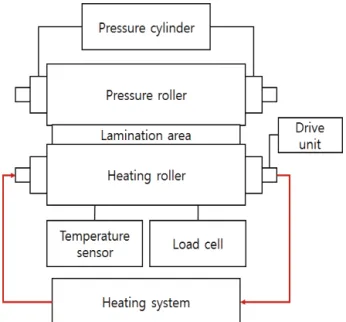
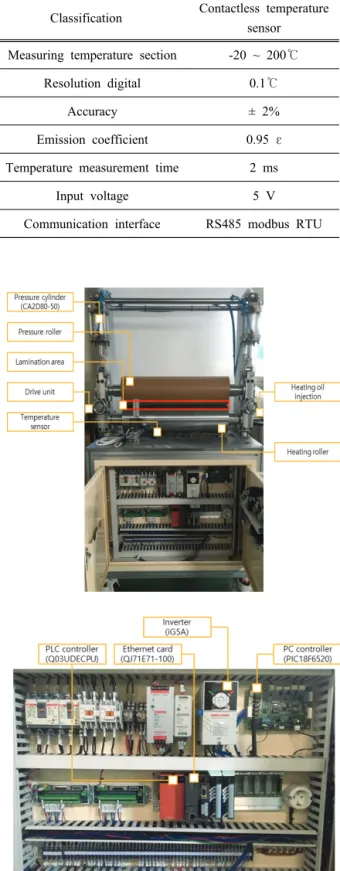
프로토 타입의 전체크기는 1,260×655×1,560 mm이며, 기구부는 그림 3과 같이 히팅롤러 회전을 위한 구동 부, 오일 가열과 순환을 위한 히팅시스템, 가압을 위한 가압 실린더, 온도와 압력을 측정하기 위한 온도센서와 로드 셀 등으로 구성하였다. 이에 따른 주요부품의 사 양은 표 1과 같다.
또한, 히팅롤러 표면온도를 측정하기 위한 온도센서 는 비접촉식 센서로 선정하였다. 특히, 히팅롤러 표면 온도를 구역별로 정밀하게 측정하기 위해 신호 확장이 용이한 RS485 modbus 통신을 적용하였다. 선정된 비 접촉식 온도센서의 특징은 표 2와 같다. 그리고 비접 촉식 온도센서의 아날로그 신호처리를 위한 회로 설계 는 그림 4와 같이 구성하여 제작하였고, 라미네이션 환경 계측을 위한 다양한 센서 사용이 가능하도록 하 였다. 그림 5는 제작된 라미네미션의 프로토 타입과 제어 패널의 외형이다.
Fig. 3. Configuration of the mechanical part of the prototype.
Fig. 1. Lamination operating principle.
(a)
(b)
(c)
Fig. 2. Classification of heating roller. (a) An oil circulation system, (b) a heater insertion system, and (c) an induction heating system.
Component Model Characteristic Heating
roller Making Size φ160×1,078 mm
Heating
system HTBC-2320AT Working
temperature 45~255℃ Contactless
temperature sensor
DTPML-485
Measuring temperature
section
-20~200℃
Contact temperature
sensor
TPK-04
Measuring temperature
section
-50~500℃
Pressure
cylinder CA2D80-50 Bore size φ80
Load cell MNC-1K Rated capacity 500 kgf Motor
reducer M2135 RPM
(reduction ratio) 1,800 (1/60)
Inverter iG5A Frequency 0~400 Hz
Ethernet card QJ71E71-100 Data transfer rate 100 Mbps Table 1. Main specifications of the prototype.
(a)
(b)
(c)
Fig. 4. Analog signal processing circuit. (a) Differential analog
& load cell input section, (b) digital analog converter section, and (c) expandable temperature sensor section.
Classification Contactless temperature sensor
Measuring temperature section -20 ~ 200℃
Resolution digital 0.1℃
Accuracy ± 2%
Emission coefficient 0.95 ε
Temperature measurement time 2 ms
Input voltage 5 V
Communication interface RS485 modbus RTU Table 2. Specification of contactless temperature sensor.
(a)
(b)
Fig. 5. Lamination prototype. (a) Outline of prototype and (b) outline of control panel.
2.3 라미네이션 제어 프로그램과 ethernet IP 통신
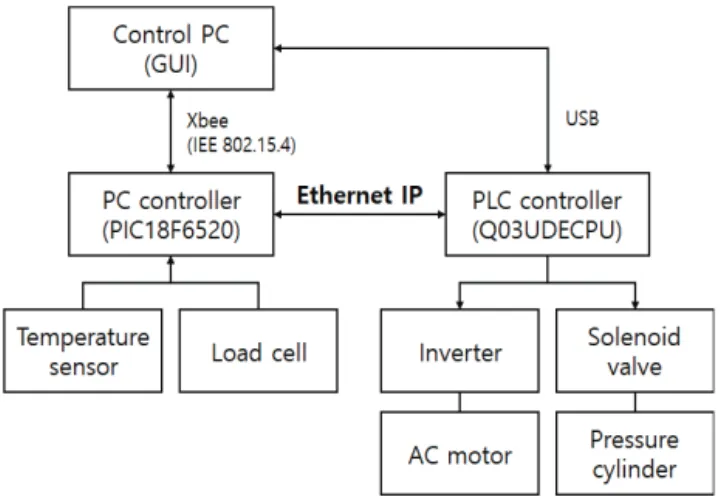
라미네이션 제어를 위한 컨트롤러와 개발환경은 이기종 으로 구성하였다. 히팅롤러 표면온도의 구역별 정밀한 측 정을 위한 확장성과 이에 따른 데이터베이스 생성 및 트 렌드 관리의 용이성을 고려하여 PC (personal computer) 기반 제어의 C++로 GUI (graphical user interface)를 구성하였다. 그리고 구동부와 연계된 히팅롤러의 속도제 어와 운영 프로그램은 PLC (programmable logic controller) 기반의 개발환경을 적용하여 제어프로그램 을 작성하였다. 구성된 컨트롤러는 그림 6과 같으며, 컨트롤러 간 ethernet IP 통신을 적용하였다.
Fig. 6. Controller configuration of the prototype.
3. 결과 및 고찰
3.1 히팅롤러 표면 온도 측정
히팅롤러 표면온도 측정은 비접촉식 온도센서(DTPML- 485)를 사용하였다. 히팅롤러 표면온도의 정밀한 측정을 위해 작업영역 570 mm 중 센터 기준 520 mm를 65 mm 간격으로 측정영역을 8등분하였다. 그리고 비접촉식 온도센서를 히팅롤러 표면으로부터 11.8 mm 위치에 그 림 7과 같이 구성하였다. 측정결과 히팅시스템(HTBC- 2320AT)의 온도와 히팅롤러 표면의 온도 차이가 발생하 였다. 이와 같은 발생 원인은 비접촉식 온도센서가 방사 율을 활용하여 측정하기 때문에 재료와 표면 광택 등에 따라서 약간의 오차가 있음을 알 수 있었다. 본 논문에 서는 히팅롤러 재료로 강(KS D 3517)을 사용하였다. 강
의 방사율은 흑체를 기준으로 0.6이기 때문에 이에 따른 온도 보정이 요구된다. 이를 위해 접촉식 온도센서(TPK- 04)를 추가로 적용하였다. 그리고 히팅시스템을 기준으로 30~75°C까지 5°C 간격으로 접촉식 온도센서와 비접촉식 온도센서에서 온도를 측정하였다. 측정결과 그림 8과 같 이 선형적인 오차를 확인하고 보정하였다.
3.2 PC와 PLC의 ethernet IP 통신 시험
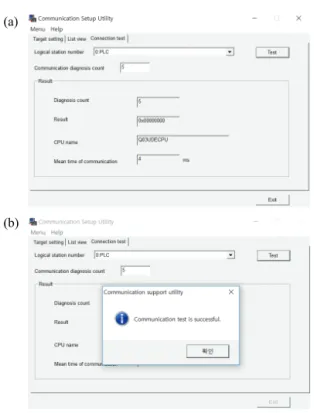
라미네이션의 이기종 컨트롤러가 데이터 읽기와 쓰 기가 가능하도록 ethernet IP 통신을 그림 9와 같이 설정하였다. 그리고 mitsubishi에서 제공하는 MX component를 사용하여 그림 10과 같이 시뮬레이션 한 결과 통신이 원활히 진행됨을 확인하였다. 또한, PC 기반 제어에서 측정한 비접촉식 온도센서의 측정 데이터를 PLC에서 읽어 local에서 활용할 수 있도록 래더를 작성하고 PLC에서 모니터링한 결과 그림 11과 같이 정상적으로 수신됨을 확인하였다.
Fig. 7. Non-contact temperature sensor configuration for measuring the surface temperature of the heating roller.
Fig. 8. Results of surface temperature measurement of lamination heating roller.
3.3 히팅롤러 표면온도 모니터링 시험
라미네미션의 히팅롤러 모니터링을 위해 디지털 입·
출력 신호에 대한 제어와 모니터링, 히팅롤러 표면온도 측정에 대한 그래프, PC기반 제어 컨트롤러와 PLC 컨 트롤러와의 통신 설정과 모니터링 등을 포함하여 GUI 를 구성하였다. 그리고 히팅롤러의 구역별 표면온도 평 균 데이터를 기준으로 사용자가 설정한 온도에 따라 히팅롤러가 저속, 중속, 고속 등으로 자동 변속하여 회 전할 수 있도록 구성하였다. 제작한 프로토 타입에서는 최저 67℃, 최고 73℃로 설정하여 시험하였다.
시험결과 히팅시스템을 통해 가열된 히팅롤러 표면 온도는 총 9개의 비접촉식 온도센서에서 측정되었다.
정지 상태의 히팅롤러에서는 ±1℃ 범위에서 온도가 확인되었다. 하지만, 히팅롤러가 설정된 회전속도로 회 전하면 각 구역별 온도가 최대 12℃ 차이가 발생하였 다. 이는 히팅롤러가 정지 상태에서는 전도에 의한 열 확산이 발생하지만, 회전 시에는 열 확산보다 회전에 따른 대류효과가 강하게 발생하여 히팅롤러의 구조에 따른 열전도 및 열손실 때문으로 사료된다 [2].
또한, 설정한 최저 및 최대값에 따라 알람 이벤트의 활성화 여부를 시험한 결과 그림 12와 같이 정상적으 로 동작하였으며, 알람 데이터는 구역별, 시간별로 엑 셀에 저장하여 트렌드를 확인할 수 있도록 하였다.
Fig. 9. Set up ethernet IP of the prototype.
(a)
(b)
Fig. 10. Ethernet IP communication of PC-PLC. (a) MX component communication setting and (b) ethernet IP communication succeeded.
Fig. 11. PLC readout for PC based data.
(a)
(b)
Fig. 12. Alarms on the heating roller. (a) Lowest temperature alarm and (b) highest temperature alarm.
4. 결 론
본 논문에서는 라미네이션을 위한 히팅롤러 모니터 링시스템을 개발하였다. 모니터링시스템은 PC와 PLC 컨트롤러의 장점을 연계하여 히팅롤러 작업영역의 구 역별 표면온도와 주변 환경에 대한 정확하고 정밀한 측정을 위하여 이기종 컨트롤러로 구현하였다. 이기종 컨트롤러의 데이터 송수신은 ethernet IP로 설정하였 다. 그리고 히팅롤러 표면온도를 중심으로 모니터링 및 제어를 위해 GUI를 구현하고 시험하였다. 히팅롤러가 회전할 경우에는 히팅롤러의 구조와 열전달 방식 및 열손실 등에 따라 구역별 최대 12℃ 차이가 발생하였 다. 또한 개발된 히팅롤러 모니터링시스템은 RS485 modbus 통신방식을 적용하여 온도센서 확장과 알람 발생 및 트렌드 관리가 용이하였다.
향후 라미네이션 생산현장 적용에 따른 효과성과 히 팅롤러의 열 분포를 최소화하기 위한 다양한 연구가 요구된다.
REFERENCES
[1] Wikipedia, Lamination, https://ko.wikipedia.org/wiki/ (2016).
[2] K. O. Lim and K. S. Lee, J. Mech. Sci. Technol., 25, 975 (2001).
[3] H. J. Shin, H. G. Kim, L. G. Kwac, S. H. Ko, W. Han, and H. W. Kim, Proc. Proceedings of the International Conference of Manufacturing Technology Engineers (ICMTE) 2012 (KSMTE The Korean Society of Manufacturing Technology Engineers, Jeju, 2012) p. 197.
[4] G. H. Hwang, W. G. Kim, and B. S. Lee, Proc. KIIEE Annual Conference 2012 (The Korean Institute of Illuminating and Electrical Installation Engineers, Seoul, 2012) p. 227.
[5] G. H. Hwang, W. G. Kim, Y. M. Yun, C. J. Paik, J. B. Yun, I. H. Moon, C. S. Shin, B. S. Kim, and B. S. Lee, Proc.
KIIEE Annual Conference (The Korean Institute of Illuminating and Electrical Installation Engineers, Hoengseong, 2010) p. 326.
[6] J. W. An, Y. S. So, and J. H. Lee, Proc. KISA Annual Conference (Korea Industry Convergence Association, Gumi, 2007) p. 5.
[7] K. J. Chun, J. H. Kim, and H. J. Lee, Journal of the Korean Society for Precision Engineering, 22, 155 (2005).
[8] C. Kim, D. S. Jang, and S. J. Yu, J. Mech. Sci. Technol., 31, 833 (2007).
[9] B. Bahadur, J. D. Sampica, J. Tchon, and A. Butterfield, Proc. Conference Record of International Display Research Conference (Society for Information Display, Sao Paulo, Brazil, 2010) p. 191.
[10] H. C. Park and Y. S. Son, State of the Art Report, 13, 33 (2001).