352
Copyright © 2017 The Korean Society of Fisheries and Aquatic Science pISSN:0374-8111, eISSN:2287-8815
서 론
우리나라의
1
인당연간수산물소비량은2010
년51.3 kg, 2012
년54.9 kg
그리고2014
년에는58.9 kg
으로계속적으로증가하 고있다(Statistics Korea, 2017).
특히, 2013
년-2015
년기준으 로1
인당연간수산물소비량58.4 kg
은주요국중1
위에해당 한다.
우리나라뿐만아니라전세계적으로수산물의소비량이증가하고있는상황이며
, 1
인당연간수산물소비량은1960
년9.9 kg
에서꾸준히증가하여최근3
년간평균20.2 kg
으로나타났다
(FAO, 2016).
우리나라는세계상위권의패류생산국으로
2015
년패류생산량은약411
천톤으로총수산물생산량의12.3%
를차지하고있으며품종별로는굴이287
천톤으로70%,
바지락이25
천톤으로6.1%
를차지하고있다(MOF, 2016).
패류는연안의육상과인접한곳에서서식하며이동성이거의없 고여과섭이를통해먹이를섭취한다
.
이로인해하천등의배수 유역에서유입되는오염물질의영향을받기쉬우며,
해수중에부유하는세균들을체내에쉽게축적하게된다
(Grimes, 1991;
Feldhusen, 2000).
또한기후변화로인해발생하는잦은폭우 와태풍등에인한다량의강우로패류생산해역에분변계오염 물질이대량으로유입되어병원성세균및바이러스에의해쉽 게오염될수있다(Park et al., 2011; Park et al., 2012).
이러한 이유때문에생굴과같이가열조리과정을거치지않는오염된 패류의섭취는식중독발병의원인이될수있어여러국가에서 는생산단계에서부터패류에대한안전관리를강화하고있다(Kim and Lee, 2016).
한편
,
패류의위생안전을위한연구로는Song et al. (2008)
단순가공 패류의 수산물의 가공 공정 중 미생물학적 및 이화학적 위해요소 분석
권기언·류대규·정민철·강은혜·신일식
1·김영목*
부경대학교 식품공학과, 1강릉원주대학교 해양식품공학과
Microbiological and Physicochemical Hazard Analysis in Processing Process of Simple-Processed Shellfish Products
Kion Kwon, Dae-Gyu Ryu, Min-Chul Jeong, Eun-Hye Kang, Il-Shik Shin1 and Young-Mog Kim*
Department of Food Science and Technology, Pukyong National University, Busan 48513, Korea
1Department of Marine Food Science and Technology, Gangneung-Wonju National University, Gangneung 25457, Korea
The object of this study is to assess physicochemical and microbiological hazards involved during the processing of shellfish products such as oysters, clam, and mussels. Samples including raw materials, intermediates, and final products in the processing process were collected from seven simple-processed shellfish facilities. In the samples obtained from the facilities, viable cell count and coliform group were detected less than that of the Korean Govern- ment guidelines. In addition, the high-risk bacterial pathogens such as Escherichia coli O157:H7 , Salmonella sp., and Listeria monocytogenes were not identified in raw materials and final products. However, the low-risk pathogens, Staphylococcus aureus and Vibrio parahaemolyticus , were detected in some final products. The level of heavy metal content in the final products tested in this study meets the recommendations by the Korean Government standard guidelines. No foreign materials in the final products were also observed. Considering these results, it was concluded that no significant food hazards exists in the processing process of simple-processed shellfish products. However, it is essential to improve the food safety control in the shellfish processing facilities since S. aureus , a personal sanitary indicative bacterium, was continuously detected over seven simple-processed shellfish facilities.
Key words: Food safety, Hazard analysis, Simple-processed product, Shellfish
This is an Open Access article distributed under the terms of the Creative Commons Attribution Non-Commercial Licens (http://creativecommons.org/licenses/by-nc/3.0/) which permits unrestricted non-commercial use, distribution, and reproduction in any medium, provided the original work is properly cited.
https://doi.org/10.5657/KFAS.2017.0352
Korean J Fish Aquat Sci 50(4) 352-358, August 2017
Received 21 July 2017; Revised 31 July 2017; Accepted 2 August 2017
*Corresponding author: Tel: +82. 51. 629. 5832 Fax: +82. 51. 629. 5824
E-mail address: [email protected]
의충남태안패류생산해역에서의세균학적위생안전성평가
, Kim et al. (2015)
의어패류에오염된Vibrio parahaemolyticus
에대한차아염소산수의살균효과, Choi et al. (1998)
의자란만 의해수및굴의세균학적연구, Kang et al. (2016)
의HACCP
구축을위한굴가공공장의위해평가그리고Yoo et al. (2010)
의남해창선해역의해수및진주담치의위생학적안전성평가 에관한연구등이있다.
하지만대부분의연구가주로패류생 산해역의수질과수확전의패류등에대한연구이며,
냉동패 류,
냉장패류등의단순가공패류수산물가공공장에서의미생 물학적안전성과관련된연구는부족한실정이다.
이에본연구 에서패류중생산및유통비중이상대적으로높은굴,
바지락 및진주담치의3
종을대상으로이들패류가공공장에서가공공 정중시료를채취하였다(MOF, 2016).
이러한패류수산물의 안전한생산을위한패류가공공장의미생물학적위해요소의기 초자료확보를위해패류수산물의가공공정중의미생물학적 위해요소들에대해분석하였다.
재료 및 방법
가공업체 및 검체
굴
(Pacific oyster Crassostrea gigas)
가공품중봉지굴과냉 동굴은2016
년4
월에경상남도통영시소재의가공업체(A, B)
와거제시의C
업체에서채취하였으며,
자숙굴은2016
년5
월에경상남도통영시의 가공업체(A, D)
와거제시의E
업체에서채취하였다
.
바지락(Shortnek clam Tapes philippinarum)
가공품인냉장바지락과냉동바지락은
2016
년4
월에경상남도사천시소재의
F
업체와창원시의G
업체에서채취하였다.
진주담치(Mussel Mytilus edulis)
가공품중냉장및냉동진주담치는
2016
년4
월에경상남도창원시의G
업체에서채취하였다
.
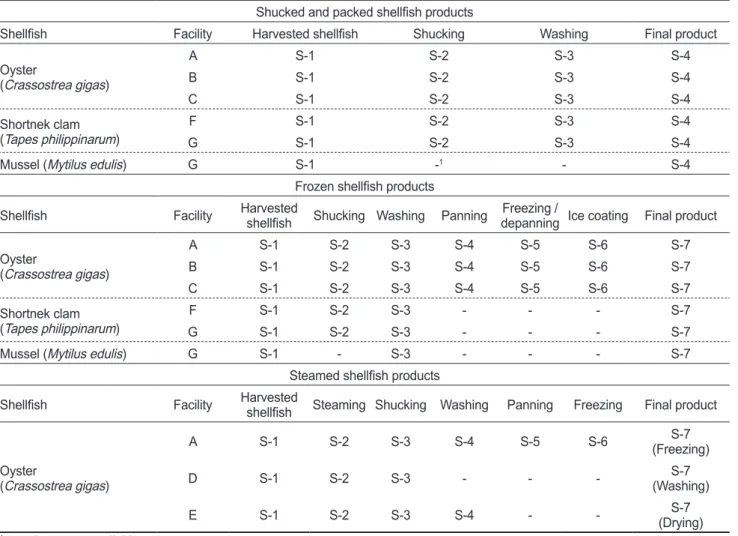
단순가공패류수산물의가공공정및시료를채취한공정 은Table 1
에나타내었다.
시료는멸균된시료팩(Whirl-Pak®
bags; Nasco, USA)
에채취하였다.
가공에사용되는용수는멸 균된채수병을이용하여채취하였고제조공정중의식품접촉 기구의표면은Swab kit (3M Piptette Swab Plus; 3M, USA)
Table 1. Processing process of simple-processed shellfish products and sampling scheme Shucked and packed shellfish products
Shellfish Facility Harvested shellfish Shucking Washing Final product
Oyster
(Crassostrea gigas)
A S-1 S-2 S-3 S-4
B S-1 S-2 S-3 S-4
C S-1 S-2 S-3 S-4
Shortnek clam
(Tapes philippinarum) F S-1 S-2 S-3 S-4
G S-1 S-2 S-3 S-4
Mussel (Mytilus edulis) G S-1 -1 - S-4
Frozen shellfish products
Shellfish Facility Harvested
shellfish Shucking Washing Panning Freezing / depanning Ice coating Final product Oyster
(Crassostrea gigas)
A S-1 S-2 S-3 S-4 S-5 S-6 S-7
B S-1 S-2 S-3 S-4 S-5 S-6 S-7
C S-1 S-2 S-3 S-4 S-5 S-6 S-7
Shortnek clam
(Tapes philippinarum) F S-1 S-2 S-3 - - - S-7
G S-1 S-2 S-3 - - - S-7
Mussel (Mytilus edulis) G S-1 - S-3 - - - S-7
Steamed shellfish products
Shellfish Facility Harvested
shellfish Steaming Shucking Washing Panning Freezing Final product
Oyster
(Crassostrea gigas)
A S-1 S-2 S-3 S-4 S-5 S-6 S-7
(Freezing)
D S-1 S-2 S-3 - - - S-7
(Washing)
E S-1 S-2 S-3 S-4 - - S-7
(Drying)
1Sample was not available.
를사용하여채취하였다
(APHA, 2001).
이후,
모든시료는냉 장온도(4℃
이하)
에서보관,
운반하여12
시간이내에실험을 진행하였다.
일반세균수, 대장균군 및 대장균 분석
일반세균수
,
대장균군및대장균의분석은식품공전(MFDS,
2016a)
의일반실험법중미생물시험법에준하는방법으로진행하였다
.
채취된단순가공패류수산물의각가공공정의시 료(25 g)
에0.85%
멸균된생리식염수225 mL
로10
배희석한 후, 30
초간stomacher (BagMixer 400VW; Interscience, Saint
Nom, France)
를이용하여균질화하였다.
일반세균수는균질액1 mL
를취하여0.85%
멸균생리식염수9 mL
에단계별로희석 한다.
각단계희석액을Plate Count Agar (PCA; Difco, USA)
에분주하여접종한후
, 35±1℃
에48±2
시간동안배양한후생성된집락수를측정하였다
.
대장균군및대장균은최확수법 으로진행하였으며,
추정시험의경우LST (lauryl sulfate tryp- tose),
확정시험의경우BGLB (brilliant green lactose bile 2%
broth)
를사용하여35±1℃, 24-48
시간배양하였다.
대장균은EC broth
를사용하여44.5±1℃, 24
시간배양하였으며,
대장균군과대장균에사용된
BGLB, EC
배지가혼탁해지거나발효관
(durham tube)
에가스가발생한것을양성으로판정하고,
이 를최확수(most probable number, MPN/100g)
로나타내었다. 식중독 세균 분석
병원성미생물중주요식중독원인균인
Staphylococcus au- reus, V. parahaemolyticus, Escherichia coli O157:H7, Salmo- nella sp.
그리고Listeria monocytogenes
등총5
종에대한분 석을진행하였으며,
식품공전(MFDS, 2016a)
의시험법에따라 실험을진행하였다. S. aureus
와V. parahaemolyticus
는정량실 험을진행하였고E. coli O157:H7, Salmonella sp.
그리고L.
monocytogenes
는정성실험을진행하였다. 이화학적 위해요소 분석
중금속은 단순가공 패류수산물의완제품에 한하여실시되 었으며
,
가식부위의수은(Hg),
납(Pb)
과카드뮴(Cd)
의함량에 대해분석하였다.
중금속분석은부경대학교부경푸드바이오 센터에의뢰하여유도플라스마질량분석기(Optima 3300XL;
PerkinElmer, Waltham, USA)
를이용하여분석을진행하였다.
이물은육안검사를통하여최종제품에서연질및경질이물을 검사하였다.
결과 및 고찰
단순 패류 가공제품의 가공 공정 중의 일반세균 및 위 생지표세균 위해요소 분석
패류 가공품 중 냉장 유통되는 제품
(
봉지 굴,
냉장 바지락 및냉장진주담치)
의 원료부터최종완제품생산까지의 공정별일반세균수
,
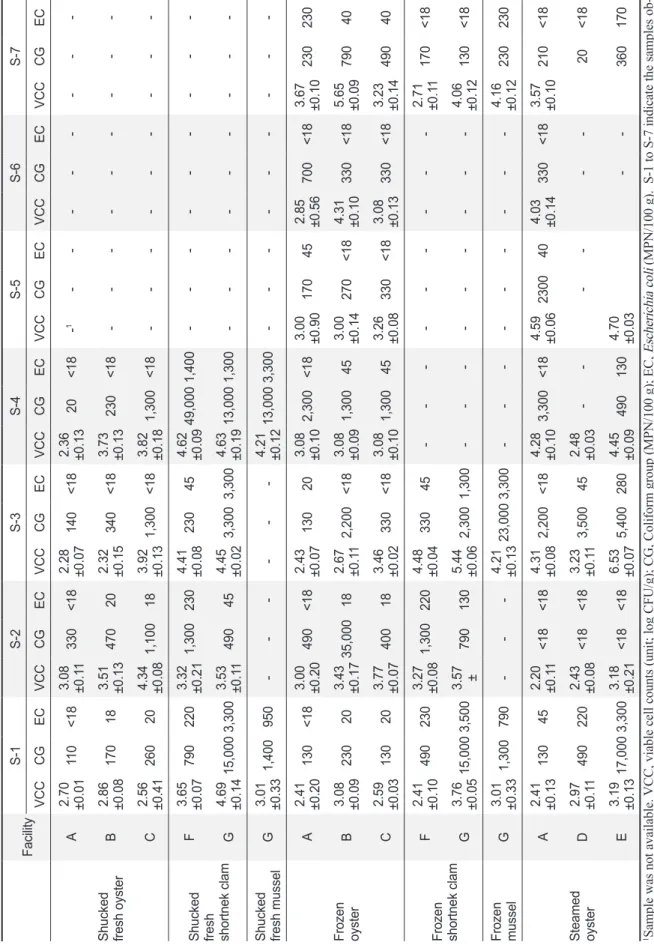
대장균군및대장균을분석하였다(Table 2).
냉 장유통되는제품에서일반세균수는2.28-4.69 log CFU/g,
대 장균군은20-49,000 MPN/100 g
였으며대장균은<18-3,300 MPN/100 g
으로나타났다.
이중봉지굴의경우,
최종완제품 의일반세균수는2.28-4.34 log CFU/g
으로나타나선도가아 주양호하다고판단되었고,
원료부터최종완제품까지의공정 별시료분석결과모든시료가<18-20 MPN/100 g
으로식품공전상생굴의대장균기준인
230 MPN/100 g
이하로분석되어식품위생학적으로큰우려가없는것으로나타났다
(MFDS, 2016a).
단순가공패류제품중냉동패류(
냉동굴,
냉동바지 락 및 냉동진주담치)
의 공정별일반세균수는2.41-5.65 log CFU/g,
대장균군은130-35,000 MPN/100 g
그리고대장균은<18-23,000 MPN/100 g
으로나타났다.
단순가공패류제품중 자숙굴최종제품의일반세균수는2.48-4.70 log CFU/g,
대장 균군은20-360 MPN/100 g,
대장균은<18-170 MPN/100 g
으 로다소높게검출되었다. Bae et al. (2003)
은쥐어채와오징어 채등의단순가공수산가공품의경우데치기등의가열처리 에의해일반세균수와대장균군이1-3 log CFU/g
이상감소한 다고보고하였으며,
이와같이자숙공정(S-2)
후미생물오염 도가감소하지만그이후공정에서미생물오염도가점진적으 로증가하였다.
이는자숙이후공정에서위생안전관리의미흡 이주된원인으로판단되며향후자숙후공정에서의위생안전 관리에대한적극적인대처가필요하다고판단된다.
단순 패류 가공제품의 가공 공정 중의 식중독 세균 위 해요소 분석
단순가공패류수산물의원물과최종제품에대한주요식중 독세균
(S. aureus, V. parahaemolyticus, E. coli O157:H7, Sal- monella sp., L. monocytogenes)
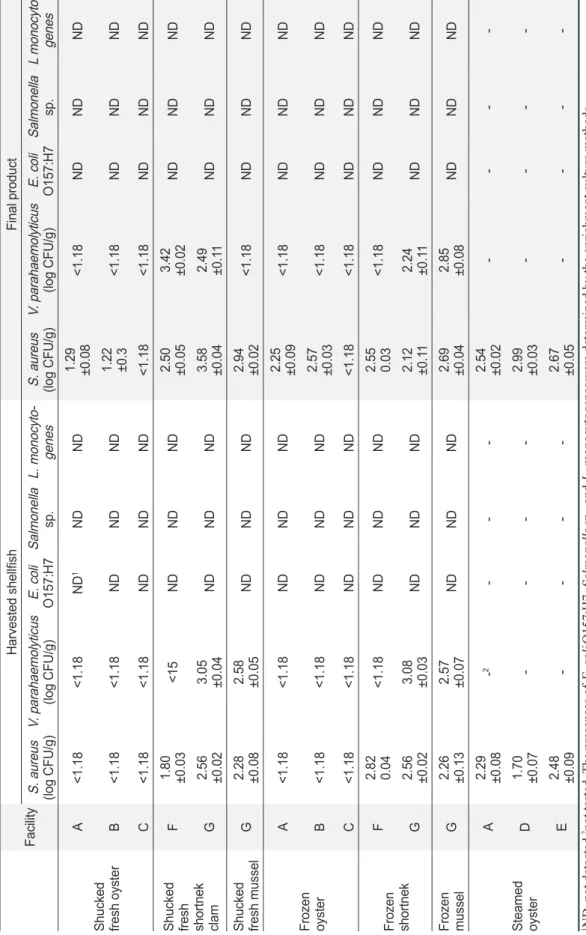
의분석결과는Table 3
에나타냈다
. S. aureus
는모든단순가공패류수산물의완제품에서<1.18-3.58 log CFU/g, V. parahaemolyticus
는<1.18-3.42 log
CFU/g
그리고나머지병원성미생물은모두검출되지않았다.
특히생식으로섭취하는비중이높은봉지굴제품의경우
, S.
aureus
는<1.18-1.29 log CFU/g, V. parahaemolyticus
는<1.18 log CFU/g, E. coli O157:H7, Salmonella sp.
그리고L. mono-
cytogenes
는검출되지않아이전의연구결과인봉지굴제품에서식중독세균이불검출된결과와일치하였다
(Kang et al.,
2016).
또한,
이러한결과는식품공전중의즉석섭취ㆍ
편의식품류의기준규격을충족하고있어식품위생학적으로문제가없
는것으로나타났다
(MFDS, 2016a).
이는생식용비중이높은봉지굴공정중에는다른가공품과달리좀더개인위생관리가 철저하고
,
전처리실과포장실등가공공정분리등상대적으로 식품위생안전관리가잘되어있기때문인것으로판단된다.
하 지만,
냉동굴과자숙굴등가열조리비중이높은제품의경우S. aureus
가<1.18-2.99 log CFU/g
로검출되어공정중의식품 위생안전관리강화가필요한것으로판단된다.
Table 2. Bacteriological levels on intermediates and final produc ts obtained in the processing process of simple-processed shell fish products Facility S-1 S-2 S-3 S-4 S-5 S-6 S-7 VCC CG EC VCC CG EC VCC CG EC VCC CG EC VCC CG EC VCC CG EC VCC CG EC
Shucked fresh oyster
A
2.70 ±0.01
11 0 <18
3.08 ±0.1
1 330 <18
2.28 ±0.07
140 <18
2.36 ±0.13
20 <18 -
1- - - - - - - - B
2.86 ±0.08
170 18
3.51 ±0.13
470 20
2.32 ±0.15
340 <18
3.73 ±0.13
230 <18 - - - - - - - - - C
2.56 ±0.41
260 20
4.34 ±0.08
1,100 18
3.92 ±0.13
1,300 <18
3.82 ±0.18
1,300 <18 - - - - - - - - -
Shucked fresh shortnek clam
F
3.65 ±0.07
790 220
3.32 ±0.21
1,300 230
4.41 ±0.08
230 45
4.62 ±0.09
49,000 1,400 - - - - - - - - - G
4.69 ±0.14
15,000 3,300
3.53 ±0.1
1 490 45
4.45 ±0.02
3,300 3,300
4.63 ±0.19
13,000 1,300 - - - - - - - - -
Shucked fresh mussel
G
3.01 ±0.33
1,400 950 - - - - - -
4.21 ±0.12
13,000 3,300 - - - - - - - - - Frozen oyster
A
2.41 ±0.20
130 <18
3.00 ±0.20
490 <18
2.43 ±0.07
130 20
3.08 ±0.10
2,300 <18
3.00 ±0.90
170 45
2.85 ±0.56
700 <18
3.67 ±0.10
230 230 B
3.08 ±0.09
230 20
3.43 ±0.17
35,000 18
2.67 ±0.1
1 2,200 <18
3.08 ±0.09
1,300 45
3.00 ±0.14
270 <18
4.31 ±0.10
330 <18
5.65 ±0.09
790 40 C
2.59 ±0.03
130 20
3.77 ±0.07
400 18
3.46 ±0.02
330 <18
3.08 ±0.10
1,300 45
3.26 ±0.08
330 <18
3.08 ±0.13
330 <18
3.23 ±0.14
490 40
Frozen shortnek clam
F
2.41 ±0.10
490 230
3.27 ±0.08
1,300 220
4.48 ±0.04
330 45 - - - - - - - - -
2.71 ±0.1
1 170 <18 G
3.76 ±0.05
15,000 3,500
3.57 ±
790 130
5.44 ±0.06
2,300 1,300 - - - - - - - - -
4.06 ±0.12
130 <18 Frozen mussel G
3.01 ±0.33
1,300 790 - - -
4.21 ±0.13
23,000 3,300 - - - - - - - - -
4.16 ±0.12
230 230
Steamed oyster
A
2.41 ±0.13
130 45
2.20 ±0.1
1 <18 <18
4.31 ±0.08
2,200 <18
4.28 ±0.10
3,300 <18
4.59 ±0.06
2300 40
4.03 ±0.14
330 <18
3.57 ±0.10
210 <18 D
2.97 ±0.1
1 490 220
2.43 ±0.08
<18 <18
3.23 ±0.1
1 3,500 45
2.48 ±0.03
- - - - - - 20 <18 E
3.19 ±0.13
17,000 3,300
3.18 ±0.21
<18 <18
6.53 ±0.07
5,400 280
4.45 ±0.09
490 130
4.70 ±0.03
- - 360 170
1Sample was not available. VCC, viable cell counts (unit; log CFU/g); CG, Coliform group (MPN/100 g); EC, Escherichia coli (MPN/100 g) . S-1 to S-7 indicate the samples ob - tained in in the processing process of simple-processed shellfis h facilities as described in Table 1.
Table 3. Pathogenic bacteria level on harvested shellfish and fini shed products obtained in simple-processed shellfish products Facility Harvested shellfish Final product S. aureus (log CFU/g)
V. parahaemolyticus (log CFU/g) E. coli O157:H7 Salmonella sp. L. monocyto - genes
S. aureus (log CFU/g)
V. parahaemolyticus (log CFU/g) E. coli O157:H7 Salmonella sp. L monocyto - genes
Shucked fresh oyster A <1.18 <1.18 ND
1ND ND 1.29 ±0.08
<1.18 ND ND ND B <1.18 <1.18 ND ND ND
1.22 ±0.3
<1.18 ND ND ND C <1.18 <1.18 ND ND ND <1.18 <1.18 ND ND ND
Shucked fresh shortnek clam
F
1.80 ±0.03
<15 ND ND ND
2.50 ±0.05 3.42 ±0.02
ND ND ND G
2.56 ±0.02 3.05 ±0.04
ND ND ND
3.58 ±0.04 2.49 ±0.1
1 ND ND ND
Shucked fresh mussel
G
2.28 ±0.08 2.58 ±0.05
ND ND ND
2.94 ±0.02
<1.18 ND ND ND Frozen oyster
A <1.18 <1.18 ND ND ND
2.25 ±0.09
<1.18 ND ND ND B <1.18 <1.18 ND ND ND
2.57 ±0.03
<1.18 ND ND ND C <1.18 <1.18 ND ND ND <1.18 <1.18 ND ND ND Frozen shortnek F
2.82 0.04
<1.18 ND ND ND
2.55 0.03
<1.18 ND ND ND G
2.56 ±0.02 3.08 ±0.03
ND ND ND
2.12 ±0.1
1
2.24 ±0.1
1 ND ND ND Frozen mussel G
2.26 ±0.13 2.57 ±0.07
ND ND ND
2.69 ±0.04 2.85 ±0.08
ND ND ND Steamed oyster
A
2.29 ±0.08
-
2- - -
2.54 ±0.02
- - - - D
1.70 ±0.07
- - - -
2.99 ±0.03
- - - - E
2.48 ±0.09
- - - -
2.67 ±0.05
- - - -
1ND, not detected.
2not tested. The presences of E. coli O157:H7, Salmonella sp., and L. monocytogenes were determined by the enrichment culture methods.
진주담치및바지락가공품의경우
S. aureus
와V. parahae- molyticus
가굴가공품에비해높게나타났다. Yu et al. (2014)
은수하식으로양식하는굴(72.5%)
보다갯벌에서양식하는바 지락(97.5%)
이V. parahaemolyticus
의검출율이높다고보고 하였으며,
이는바지락과진주담치가양식되는환경적특성에 의해미생물학적오염도가높은것이주된원인중의하나로판 단된다.
이상의냉장,
냉동및자숙패류등의단순패류가공제 품생산을위한가공공정중의미생물학적위해요소분석결과,
공통적으로탈각공정에서다소일반세균수,
대장균군및대장 균이증가하였다.
하지만,
세척공정에서균의오염도가감소하 는경향이나타났으나그후가공공정이진행됨에따라증가하 였다.
이와같은결과는봉지굴공정중세척공정에서균이감 소하지만이후공정에서증가한다는Kang et al. (2016)
의연구 결과와동일하게나타났다.
또한,
최종완제품에서봉지굴제품 을제외한다른패류가공품에서S. aureus
과V. parahaemolyti- cus
의검출빈도가높았으며, S. aureus
이V. parahaemolyticus
보다빈번하게검출되었는데Cho et al. (2009)
은어류수산물 가공품인생선초밥에서V. parahaemolyticus
보다S. aureus
의 오염도가보다높은것으로보고하고있다.
또한, Bae (2006)
은 가열조리된닭볶음탕,
잡채,
비빔밥,
콩나물무침에서S. aureus
가검출되었다고보고하였다.
이러한결과들은종업원의손,
재 료를손질한도마등에의한것으로판단되며,
탈각공정을필히 거치게되는단순가공패류수산물또한가공특성상탈각종사 자들의손과탈각대등에의해오염이발생할가능성이높다고 생각된다.
이상의결과를종합해보면,
봉지굴을제외한냉장 패류,
냉동패류및자숙패류에서S. aureus
와V. parahaemo-
lyticus
는검출되지만오염도가높지않고이들제품들이일반적으로가열조리하여섭취되기때문에큰문제는없을것으로 생각된다
.
하지만,
적극적인종업원의위생교육과가공공정중 의기구및설비의세척소독등의가공공정중의위생관리를 철저히한다면더욱안전한단순가공패류수산물을생산할수 있을것으로사료된다.
단순가공 패류 수산물의 가공에 사용되는 용수에 대한 일 반세균수및대장균군분석결과
,
모두15 CFU/mL
이하, 1.8 MPN/100 mL
이하로분석되었으며(
결과미제시)
이는봉지굴 가공공정중사용되는용수중일반세균수및대장균군이검출 되지않았다는Kang et al. (2016)
의연구결과와동일하며용수 에의한오염은거의없는것으로판단되었다.
단순 패류 가공제품의 제조 공정중의 이화학적 요소 분석
단순가공패류수산물의최종완제품에서의중금속함량을분 석하기위하여납
,
카드뮴그리고총수은함량에대하여분석하 였다.
모든단순가공패류수산물에서납은ND(
불검출)-0.289 mg/kg,
카드뮴은0.485-1.017 mg/kg,
그리고총수은은0.008- 0.056 mg/kg
으로분석되어식품공전(MFDS, 2016a)
중패류의중금속기준
(
납2 mg
이하/kg;
카드뮴2 mg
이하/kg;
총수은0.5 mg
이하/kg)
을초과하는시료는없었다.
이러한결과는우리나라연안에서식하는패류의중금속함량을분석한
Kim et
al. (2003)
의연구결과와유사하였다.
또한최종완제품중의이 물또한검출되지않았다.
이처럼단순가공패류수산물의최종 완제품중기준치를초과하는시료는없었지만,
중금속의경우 제조공정중제어가불가능하기때문에원료입고단계에서보 다철저한원료관리가필요한것으로판단된다.
본연구에서는단순가공패류수산물의종류별및가공유형 별식품위생안전성확보를위해원료에서부터최종완제품가 공공정전반에걸쳐일반세균수
,
대장균군,
식중독세균,
중금 속이물등의미생물학적ㆍ
이화학적위해요소를분석하였다.
이를위해주요패류가공품인굴,
바지락및진주담치가공업 체7
곳을방문하고각가공공정별시료,
가공용수및환경분 석시료를채취하였으며,
각공정별로식품위해요소를분석하 였다.
일반세균수등의미생물학적오염도는제품별로다소차 이가있는것으로분석되었다.
주요식중독세균중저위해성인S. aureus
와V. parahaemolyticus
는낮은수준으로검출되었으 며,
고위해성인E. coli O157:H7, Salmonella sp., L. monocyto- genes
은모든패류시료에서검출되지않았다(MFDS, 2016b).
그외에중금속등의이화학적위해요소의경우모든단순가공 패류수산물이식품공전의식품기준및규격을충족하는것으 로나타났다
(MFDS, 2016a).
하지만,
종업원및가공공정중의 교차오염으로추정되는S. aureus
가높은빈도로많은단순가 공패류수산물최종제품에서검출되고있다.
이와같은단순가 공패류수산물의미생물학적위해요소를줄이기위해서는보 다적극적인종업원의위생교육과가공공정중의기구및설비 의세척및소독관리가필요하다고판단된다.
사 사
이논문은
2016
년도식품의약품안전처에서시행한용역연구개발과제의연구개발비지원
(16162
수산물601)
에의해수행되 었습니다.
References
American public health association (APHA). 2001. Compendi- um of methods for the microbiological examination of foods (4th Ed), American public health association, Washington DC, U.S.A., 26-35.
Bae HJ, Lee Jh and Oh SI. 2003. Effect of applying pretreatment methods before cooking for decreasing the microbiological hazard of cooked dried fish in foodservice establishments.
Korean J Soc Food Cookery Sci 19, 231-240.
Bae HJ. 2006. Analysis of contamination of bacteria from raw materials, utensils and workers’ hands to prepared foods in foodservice operations. Korean Soc Food Sci Nutr 35, 655-
660. https://doi.org/10.3746/jkfn.2006.35.5.655.
Cho SK, Moon BY and Park JH. 2009. Microbial contamination analysis to assess the safety of marketplace shshi. Korean J Food Scl Technol. 41, 334-338.
Choi JD, Jeong WG and Kim PH. 1998. Bacteriological study of sea water and oyster in Charan bay, Korea. J Korean Fish Soc 31, 429-436.
Emswiler BS, MD Pierson and SP Shoemaker. 1976. Sublethal heat stress of Vibrio parahaemolyticus. Appl Environ Mi- crobiol 32, 792-798.
Feldhusen F. 2000. The role of seafood in bacterial foodborne disease. Microbes Infect 2, 1651-1660.
Food and Agriculture Organization of the United Nations (FAO). 2016. The state of world fisheries and aquaculture 2016. FAO, 171-182. Retrieved from http://www.fao.org/
publications/sofia/2016/en/?platform= on Jun 2, 2017.
Grimes DJ. 1991. Ecology of estuarine bacteria capable of caus- ing human disease: A review. Estuaries 14, 345-360. https://
doi.org/10.2307/1352260.
Kang KT, Kim MJ, Park SY, Choi JD, Heu MS and Kim JS. 2016.
Risk assessment of oyster crassostrea gigas processing site for an HACCP system model. Korean J Fish Aquat Sci 49, 533-540. http://dx.doi.org/10.5657/KFAS.2016.0533.
Kim HY, Choi JK and Shin IS. 2015. Bactericidal effects of hypochlorous acid water against Vibrio parahaemolyti-
cus contaminated on raw fish and shellfish. Korean J Fish
Aquat Sci 47, 719-724. http://dx.doi.org/10.9721/KJFST.2015.47.6.719.
Kim JH, Im CW, Kim PJ and Park JH. 2003. Heavy metals in shellfishes around the south coast of Korea. J Food Hyg Saf 18, 125-132.
Kim YM and Lee TS. 2016. International status of sanitary con- trols system in marine shellfish growing area. Safe Food 11, 37-49.
Park K, Jo MR, Lee HJ, Kwon JY, Son KT and Lee TS. 2011.
Evaluation of the effect of the discharged water from Bong stream after events on the bacteriological water quality in Gangjinman, Korea. Korean J Fish Aquat Sci 44, 622-629.
http://dx.doi.org/10.5657/KFAS.2011.0622.
Park K, Jo MR, Kim YK, Lee HJ, Kwon JY, Son KT and Lee TS. 2012. Evaluation of the effects of the inland pollution sources after rainfall events on the bacteriological water quality in Narodo area, Korea. Korean J Fish Aquat Sci 45, 414-422. http://dx.doi.org/10.5657/KFAS.2012.0414.
Son KT, Thea Lach, Jung Y, Kang SK, Eom SH, Lee DS, Lee MS and Kim YM. 2014. Food hazard analysis during dried- laver processing. Fish Aquat Sci 17, 197-201. https://doi.
org/10.5657/fas.2014.0197.
Song KC, Lee DS, Shim KB, Lim CW, Mog JS, Byun HS, Park YJ and Cho KC. 2008. Evaluation of bacteriological safety for the shellfish growing waters in Taean area, Korea. Kore- an J Fish Aquat Sci 41, 155-162. http://dx.doi.org/10.5657/
kfas.2008.41.3.155.
Statistics Korea. 2017. Seafood Consumption, The Fishery Pro- duction Statistics. Retrieverd from http://www.index.go.kr/
potal/main/EachDtlPageDetail.do?idx_cd=1317 on Jun 3, 2017.
Ministry of Food and Drug Safety (MFDS). 2016a. Korean Food Standards Codex. Retrieved from http://www.food- safetykorea.go.kr/foodcode/01_01.jsp on Jun 17, 2017.
Ministry of Food and Drug Safety (MFDS). 2016b. Principle and application for establishing food standards. The Korean Governmental Publication Registration, Cheongju, Korea, 75-85.
Ministry of Oceans and Fisheries (MOF). 2016. Statistical Year- book of Fisheries Production. Retrieved from http://www.fips.
go.kr/jsp/sf/ss/ss_kind_law_list.jsp?menuDepth=070104 on Jun 1, 2017.
UK Health Protection Agency. 2009. Guidelines for assessing the microbiological safety of ready-to-eat foods placed on the market. Health Protection Agency, London, UK
Yoo HD, Ha KS, Shim KB, Kang JY, Lee TS and Kim JH.
2010. Microbiological quality of the shellfish-growing waters and mussels in Changseon, Namhae, Korea. Ko- rean J Fish Aquat Sci 43, 298-306. https://doi.org/10.5657/
kfas.2010.43.4.298.
Yu HS, Oh EG, Shin SB, Park YS, Lee HJ, Kim JH and Song KC. 2014. Distribution and antimicrobial resistance of Vib-
rio parahaemolyticus isolated from Korean shellfish. Kore-
an J Fish Aquat Sci 57, 508-515. http://dx.doi.org/10.5657/KFAS.2014.0508.