Introduction
Zostera marina (eelgrass) is the most common seagrass species in temperate coastal areas and increases habitat complexity and provides living space and shelter for marine animals (Klumpp et al., 1989; Rozas and Minello, 1998). Many fish species including many economically important fishes use eelgrass meadows as feeding and nursery grounds (Edgar and Shaw, 1995; Huh and Kwak, 1997; Guidetti and Bussotti, 2000).
Recent studies on eelgrass beds in Korea have reported seasonal variations in species compos- tition and abundance of fishes in Kwangyang Bay, Hamduck around Cheju Island and Angol Bay (Huh and Kwak 1997; Go and Cho 1997; Lee et al., 2000) and feeding habits of some fish species (Acanthogobius flavimanus, Platycephalus indicus, Liparis tanakai and Limanda yoko- hamae) in the southern sea, Korea (Huh and
Kwak, 1999; Kwak and Huh, 2002, 2003a,b) In Myoungjuri of Jindong Bay, eelgrass mead- ows provide a habitat for a variety of inverte- brates and small fish, which in turn are the po- tential food of large fishes. However, environ- mental disturbances such as red tide and jelly- fish blooms have occurred in these eelgrass beds every year due to industrial complex around coa- stal areas since 1980’s (Kang et al., 1996; Kim et al., 2001). To date the study on the eelgrass bed in Jindong Bay has been confined to the fish community itself (Im, 2004) and feeding habits of common fish species (Stephanolepis cirrhifer, Rudarius ercodes and Sillago japonicus) (Kwak et al., 2003; Kwak and Huh, 2004; Kwak et al., 2004) in Daguri close to Myoungjuri of Jindong Bay, but the fish community of these eelgrass beds has not been studied relating to the envi- ronmental variations.
The objective of this study was to examine the seasonal variation in species composition and abundance of fishes inhabiting in an eelgrass bed
Seasonal Variations in Abundance and Species Composition of Fishes in an Eelgrass Bed
in Myoungjuri of Jindong Bay
Gun Wook Baeck, Seok Nam Kwak* and Sung-Hoi Huh
1 Korea Inter-university Institutes of Ocean Science and1Department of Oceanography, Pukyong National University, Pusan 608-737, Korea
A total of 33 fish species were collected by a small beam trawl from an eelgrass bed in Myoungjuri of Jindong Bay, Korea. The dominant fish species were Hexagrammos
otakii, Pholis fangi, Repomucenus valenciennei, Pseudoblennus cottoides, Pholis nebulosa, Rudarius ercodes, Syngnathus schlegeli, and Sebastes schlegeli. These 8fish species accounted for 79.5% of the total number of individuals collected. The fishes collected in the study area were primarily small fish species or juveniles of large fish species. Seasonal variations in both species composition and abundance were large; higher numbers of fish occurred from April to June 2002, while biomass was the highest in September 2001 and 2002. Seasonal changes in fish abundance corresponded with eelgrass biomass and abundance of food organisms.
Key words : Fish, seasonal variation, species composition, eelgrass bed, eelgrass biomass
*Corresponding author: [email protected]
─
─ 8 ──
in Myoungjuri of Jindong Bay and to determine the relationships between environmental factors and fish abundance.
Materials and Methods
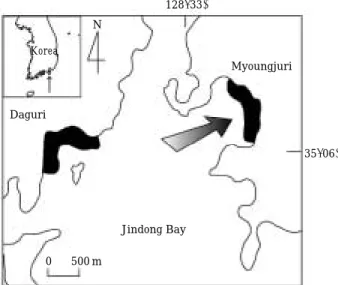
The study area was located in Myoungjuri of Jindong Bay (Fig. 1). The area supports a luxu- riant eelgrass, Zostera marina, bed which is forming subtidal bands (500~700 m wide) in the shallow waters (⁄3 m). The eelgrass bed extend- ed in patches for about 4 km along the shore.
Fish samples were collected monthly by a 5-m beam trawl (1.9-cm mesh wing and body, 0.6-cm mesh liner). Four 6-minute tows in each sampl- ing time were carried out during the day in the eelgrass bed from August 2001 to July 2003.
Specimens were preserved immediately in 10%
formalin after capture and later transferred to 70% isopropanol. These samples were identified according to Masuda et al. (1984) and Yoon (2002), and weighed to the nearest gram in wet weight and their standard length measured to the near- est millimeter in the laboratory.
Water temperature and salinity were measur- ed at each sampling location. Eelgrass biomass was estimated by removal of all plant matter in a 0.01 m
2within each station. The plants were sep- arated into the above-and below-ground parts, dried at 80� C for 24h then weighed to the nearest gram.
The fish data were analysed to obtain the fol- lowing community variables. Diversity H′ (Shan- non and Weaver 1949) was calculated as:
H ′ = - ∑ (ni/N) log (ni/N),
where n is the number of individuals of each i species in a sample and N is the total number of individuals. Similarity between fish species, Pianka’s index, Aij (Pianka, 1973) was calculated as:
A
ij= [ ∑ p
ihp
jh] / [ ∑ p
2ihΣ p
2jh]
where A
ijis the similarity of species j on spec- ies i; p
ihis the proportion of individuals of a fish species i in a particular month h; p
jhis the proportion of individuals of a fish species j in a particular month h. Values for the similarity index may vary between 0, if no similarity occurs, and 1 for complete similarity. The Pianka’s index was subjected to an average linkage cluster ana- lysis.
A one-way ANOVA with orthogonal design was used to analyse variations in fish abundance and environmental factors with season and year.
Log transformed data were used to satisfy the equal variance assumption of the model. The
0 50 100 150 200 250 300 350 0 5 10 15 20 25 30
0 5 10 15 20 25 30 35 40
Temperatu Salinity
A O D F A J A O D F A J 2001 2002 2003
Salinity (‰)
Month (2001~2003) Temperature (�C)Eeagrass biomass(g DW/m2) 400
re
Fig. 2. Monthly variations of temperature, salinity and eelgrass biomass in an eelgrass bed in Myoungjuri of Jindong Bay.
Fig. 1. Location of the study area (The black area is an eelgrass bed).
128�33′
Daguri
Jindong Bay N
Korea
0 500 m
Myoungjuri
35�06′
relationships between fish abundance and eel- grass biomass were analysed using Pearson’s correlation coefficient.
Results
Temperature, salinity, eelgrass biomass Temperature at the study site ranged from 6.7
� C to 27.7� C and varied significantly with season (ANOVA, p⁄0.05), but no marked annual varia- tion was observed. The peak of temperature occurred around July 2002, a decline to mini- mum in February 2003 (Fig. 2). Salinity ranged from 19.5‰ to 34.2‰ and did not vary signifi-
cantly between years (ANOVA, p¤0.05) with display a similar pattern except in July, August and September when it dropped markedly (about 20‰) (Fig. 2). This decline occurred soon after heavy rain, which affected the region during summer. The average eelgrass biomass ranged from 21.8 g DW/m
2to 378.7 g DW/m
2and varied significantly with season and year (ANOVA, p⁄
0.05). The peak of eelgrass occurred around May 2002, and a sharp decline from June 2002 to January 2003, and then increased to May 2003 gradually (Fig. 2).
Species Composition
A total of 3,570 fish belonging to 33 species
Table 1. Total number of individuals and biomass of fishes collected in an eelgrass bed in Myoungjuri of Jindong Bay
Scientific name Total Standard length
N % W % range (cm)
Hexagrammos otakii 632 17.7 12,518.3 61.3 4.5~16.3
Pholis fangi 543 15.2 1,694.8 8.3 3.7~15.8
Repomucenus valenciennei 496 13.9 855.6 4.2 2.6~9.8
Pseudoblennius cottoides 406 11.4 489.8 2.4 2.3~7.2
Pholis nebulosa 295 8.3 1,948.6 9.5 4.1~18.6
Rudaris ercodes 168 4.7 246.6 1.2 2.2~5.3
Syngnathus schlegeli 164 4.6 214.1 1.0 9.5~21.3
Sebastes schlegeli 134 3.8 72.9 0.4 1.5~5.6
Hippocampus japonica 118 3.3 61.0 0.3 1.2~7.6
Pseudoblennius percoides 112 3.1 194.6 1.0 3.6~7.1
Sebastes longispinis 99 2.8 245.5 1.2 1.5~4.5
Acanthogobius flavimanus 91 2.5 350.2 1.7 4.2~13.1
Leiognathus nuchalis 66 1.8 315.1 1.5 2.5~6.9
Acentrogobius pflaumi 59 1.7 105.0 0.5 2.2~5.9
Sebastes inermis 43 1.2 201.0 1.0 1.6~4.9
Takifugu niphobles 28 0.8 141.1 0.7 6.2~10.3
Hypodytes rubrippinis 24 0.7 41.5 0.2 2.3~4.2
Acanthopagrus schlegeli 23 0.6 127.7 0.6 2.9~10.2
Upeneus japonicus 11 0.3 40.0 0.2 4.6~7.2
Lateolabrax japonicus 9 0.3 147.4 0.7 2.1~11.1
Chaenogobius heptacanthus 9 0.3 20.7 0.1 3.1~5.7
Sillago japonicus 9 0.3 58.9 0.3 3.7~10.6
Pholis crassispina 7 0.2 31.9 0.2 6.9~13.5
Trachurus japonicus 6 0.2 28.6 0.1 4.8~6.3
Limanda yokohamae 5 0.1 17.4 0.1 6.8~9.7
Conger myriaster 5 0.1 71.0 0.3 15.3~21.7
Siganus fuscescens 2 0.1 1.1 0.0 5.9~6.7
Muraenesox cienrerus 1 0.0 57.9 0.3 23.1
Tridentiger trigonocephalus 1 0.0 0.7 0.0 4.3
Ditrema temmincki 1 0.0 31.2 0.2 8.6
Ernogrammus hexagrammus 1 0.0 7.5 0.0 6.3
Mugil cephalus 1 0.0 77.5 0.4 21.3
Pterogobius elapoides 1 0.0 1.2 0.0 3.8
Total 3,570 100 20,416.4 100
N: Number of individuals, W: Biomass (g).
were collected from the eelgrass bed in Myoung- juri of Jindong Bay (Table 1). Numerically domi- nant fish were Hexagrammos otakii (17.7%), Pholis fangi (15.2%), Repomucenus valenciennei (13.9%), Pseudoblennius cottoides (11.4%), Pholis nebulosa (8.3%), Rudarius ercodes (4.7%), Syngan- thus schlegeli (4.6%) and Sebastes schlegeli (3.8%).
These 8 fish species accounted for 79.5% of total number of indivals individuals collected during the study period. The numerically dominant fish species made up 88.4% of biomass because of the presence of large H. otakii (61.3% of biomass) which were high in biomass. These were primar- ily small fish species or early juveniles of large fish species. Only about 10% exceeded 8 cm stan- dard length.
Seasonal Variation in Fish Abundance The number of fish species (7~17 species) vari-
ed with season (ANOVA, p⁄0.05), but there was no marked annual variation (Fig. 3-a). High nu- mber of fish species occurred in September 2001 and 2002. Number of individuals varied signifi- cantly with both season and year (ANOVA, p⁄
0.05, Fig. 3-b). Higher number of fish indivi- duals occurred from April to June 2002 which were dominated P. fangi, Sebastes schlegeli, P.
nebulosa. P. ercoides, and P. cottoides, and lowest numbers occurred in January 2003 (Appendix).
The fish biomass differed substantially between different seasons and years (ANOVA, p⁄0.05, Fig. 3-c). Highest biomass occurred September 2001 and 2002 when a few relatively large H.
otakii, P. cottoides, R. valenciennei, Lateolabrax japonicus were present (Appendix). Significant seasonal difference was observed for the diver- sity index (ANOVA, p⁄0.05, Fig. 3-d), but ann- ual difference was not significant. The range of index were 0.86~3.62, and higher value occurr- ed in September 2001, and from May to July 2002. The similar values of diversity, in general, suggesting that the number and relative abun- dances of fishes were similar over the study peri- od.
The dendrogram shows four clusters which identify the fish species groups regardless of year
1
Rudaris ercodes
Acanthogobius flavimanus
Acentrogobius pflaumi Hypodytes rubrippinis Upeneus bensasi Acanthopagrus schlegeli Leiognathus nuchalis Hippocampus japonica
Takifugu niphobles Sebastes inermis Sebastes longispinis Sebastes schlegeli Syngnathus schlegeli
0.5
Hexagrammos otakii
Pseudoblennius cottoides
Pseudoblennius percoides Pholis nebulosa
Pholis fangi
Repomucenus valenciennei
0
Group 1
Group 2
Group 3
Group 4
Fig. 4. Dendrogram illustrating the species associations of common fishes in an eelgrass bed in Myoungjuri of Jindong Bay.
0 5 10 15 20
0 50 100 150 200 250 300
0 500 1000 1500 2000
0.0 1.0 2.0 3.0 4.0
Number of speciesBiomass (g)Diversity index (H′)
A O D F A J A O D F A J 2001 2002 2003
Month / Year
Number of individuals
A
B
C
D
Fig. 3. Monthly variations in (A) number of species, (B) number of individuals, (C) biomass, and (D) diver- sity index of fish species in an eelgrass bed in Myoungjuri of Jindong Bay.
(Fig. 4). The first group was composed of H.
otakii, P. fangi, R. valenciennei, P. cottoides, and P. nebulosa with occurring predominantly over study periods. This group can be further divided into two sub-groups: subgroup A contains P.
fangi and P. nebulosa with high occurrence from March to May when high eelgrass biomass was shown in the study area, while subgroup B was composed of H. otakii, R. valenciennei, and P.
cottoides with peak numbers from June to Au- gust. The second group was composed of S.
schlegeli, Sebastes schlegeli, P. percodes, S. long- ispinis, and S. inermis. This group showed high numbers from May to July, however, few individ- uals in other periods. The third group was com- posed of R. ercode, H. japonicus, A. flavimanus, L.
nuchalis, A. schlegeli, and U. bensasi which show- ed peak numbers from September to November.
This periods coincide with low eelgrass biomass.
The fourth group was consisted of T. niphobles, H.
rubripinnis, and A. pflaumi with high numbers from December to February.
Eelgrass biomass variation corresponded close- ly with seasonal variation of the abundance of fishes over the study period (Fig. 5). Numbers of individuals of fish species (r
2= 0.68, p⁄0.05) were strongly correlated with eelgrass biomass.
Discussion
A total of 33 fish species were collected from an eelgrass bed in Myoungjuri of Jindong Bay, and among these H. otakii, P. fangi, R. valenciennei, P.
cottoides, P. nebulosa, R. erodes, Syngnathus schlegeli and Sebastes schlegeli were numerically dominant. H. otakii, Pholis nebulosa and Sebastes schlegeli were the commercially important fishes in Korean waters (Kim and Kang, 1993; Yoon, 2002). Broad scale surveys of fish communities in the eelgrass beds from other regions of Korea suggest a similar community structure. H. otakii, P. fangi, P. cottoides, Syngnathus schlgeli and P.
nebulosa also dominated the fish community from Daguri of Jindong Bay (Im, 2004) and Kwangyang Bay (Huh and Kwak, 1997), Syngnathus schlgeli, P. nebulosa in Angol Bay (Lee et al., 2000), and R. ercodes, Syngnathus schlegeli, P. nebulosa in Hamduck around Cheju Island (Go and Cho, 1997). On the other hand, the genera Pseudobl- ennius, Rudarius, Syngnathus were important groups in the Japanese eelgrass beds (Kikuchi, 1966, 1974; Horinouchi et al., 1998).
Although species composition of fish species in the eelgrass bed in Myoungjuri of Jindong Bay did not varied with year, abundance of L. nu- chalis increased with year was remarkable char- acteristics. Recent studies have demonstrated that the number of individuals of small sized L.
nuchalis has been increased in southern coastal areas such as Kwangyang, Namhae Island and Nakdong River Estuary (Huh and Kwak, 1998;
Huh and An, 2000; Kwak and Huh, 2003c) Lee et al. (1997) reported that the variation in abun- dance of L. nuchalis was due to occurrence of environmental disturbances in Chonsu Bay.
Fish collected from the eelgrass bed in the study area appeared to be dominated by small fish species and juveniles of most species. This indicated that the eelgrass bed in Myoungjuri of Jindong Bay functions as nursery areas. Such conclusions are in general agreement with other studies of eelgrass beds (Huh and Kwak, 1997;
Rozas and Minello, 1998; Lee et al., 2000; Im, 2004; Kwak and Klumpp, 2004). A significantly greater abundance of fish juveniles than that of adults in this study site in Myoungjuri of Jin- dong Bay confirmed that these species were like- ly to be dependent on eelagrass beds for shelter and survival during the early life cycle stages (Brook, 1977; Bell et al., 1989; Edgar and Shaw, 1995).
Fish abundance in seagrass meadows are often correlated with eelgrass biomass (Klumpp et al., 1989). The temporal pattern of fish abundance in the eelgrass bed at Myoungjuri of Jindong Bay correlated with temporal variations in eelgrass
R2 = 0.68, p<0.05 1
1.2 1.4 1.6 1.8 2 2.2 2.4 2.6 2.8
1.4 1.6 1.8 2 2.2 2.4 2.6
Log number of individuals of fishes
Log eelgrass biomass (g DW/m2)
Fig. 5. Relationships between number of individuals of fishes and eelgrass biomass in an eelgrass bed in Myoungjuri of Jindong Bay.
biomass. From the data available it is not possi- ble to determine whether variation in eelgrass biomass, directly or indirectly, determined these changes in fish abundance in the study area or whether faunal activities had an affect on the eelgrass biomass. However, there is evidence for both types of interaction occurring in the sea- grass beds (Adams, 1976; Baelde, 1990; Blaber et al., 1992; Williams and Heck, 2001; Kwak and Klumpp, 2004).
Eelgrass biomass in Jindong Bay reached a peak in May 2002 when light and water temper- ature are increasing, and then decreased rapidly to a minimum in the period from November 2002 to January 2003. This decrease in eelgrass bio- mass was assumed by the complex functions such as annual variation, the occurrence of red tide and high jellyfish abundance due to environ- mental disturbance (Kwak, personal observation).
The interactions between these factors and eel- grass biomass were no examined in this study and need further examination. Numbers of fish- es, in particular small sized individuals, in Myo- ungjuri of Jindong Bay, were high during periods when eelgrass biomass was high. The high shoot density and length produced by Zostera marina in Myoungjuri of Jindong Bay would seem to provide fishes with an effective refuge from predators. Indeed, a positive correlation between fish richness and abundance and the above- ground biomass of seagrass beds has been sug- gested (Bell and Pollard, 1989; Connolly et al., 1999; Guidetti and Bussotti, 2000). Other studies have shown similar patterns of variable faunal abundance in fish communities of eelgrass beds, Korea. For example, the fish abundance increas- ed with increasing eelgrass biomass and temper- ature in Angol Bay (Lee et al., 2000), and simi- larly in Hamduck off Jeju Island (Go and Cho, 1997). Huh (1986) have demonstrated that sea- sonal variation of fish abundance in Hansilpo, Chungmu was correlated positively with temper- ature.
While eelgrass biomass in Jindong Bay seems to be an important factor influencing abundance of the fish community, prey availability may also directly or indirectly control fish abundance.
High eelgrass biomass provides good shelters and food resources for small organisms such as epiphytic fauna (amphipods, isopods, tanaids etc.). Small fishes such as dominant fish species in Jindong Bay fed mainly on small amphipods and isopods. The temporal abundance of epiphyt-
ic fauna coincided with these groups of domi- nant fishes during the study period. These com- mon fish species changed diets from gammarid amphipods and copepods to decapods such as caridean shrimps and crabs as they increased in size (Kwak et al., 2003; Kwak and Huh, 2004;
Kwak et al., 2004). Huh and Kwak (1997) demon- strated that the abundance of dominant fishes in an eelgrass bed of Kwangyang Bay was positive- ly correlated with seagrass biomass and prey availability. Hence we suggest that the high abundance of epiphytic fauna were responsible for the maintenance of fish abundance through predator-prey interactions in these eelgrass bed.
Acknowledgement
We are grateful to Seong Oh Im and Hyun Gi Choo, Department of Oceanography, Pukyong National University for assistance with sampling and data analysis. We also thank Dr. David W Klumpp (AIMS) for his constructive comments in structure of English. This work supported by the Ministry of Maritime Affairs and Fisheries, Korea.
References
Adams, S.M. 1976. The ecology of eelgrass, Zostera marina (L.), fish communities. I. Structural analysis. J. Exp.
Mar. Biol. Ecol., 22 : 269~291.
Baelde, P. 1990. Differences in the structures of fish assemblages in Thalassia testudinum beds in Gua- deloupe, French West Indices, and their ecological significance. Mar. Biol. 105 : 163~173.
Bell, J.D. and D.A. Pollard. 1989. Ecology of fish assem- blages and fisheries associated with seagrasses. In:
Larkum, A.W.D., A.J. McComb and S.D. Shepherd (ed.), Biology of seagrasses: A treatise on the biology of seagrasses with special reference to the Australian region. Elsevier Science Publishers. B.V., New York/
Amsterdam, pp. 565~597.
Blaber, S.J.M., D.T. Brewer, J.P. Salini, J.D. Kerr and C.
Conacher. 1992. Species composition and biomasses of fishes in tropical seagrasses at Groote Eylandt, Northe- rn Australia. Estuarine Coast. Shelf Sci., 35 : 605~620.
Brook, I.M. 1977. Trophic relationships in a seagrass community (Thalassia testudinum) in Card Sound, Fl- orida : Fish diets in relation to macrobenthic and cryptic faunal abundance. Trans. Am. Fish. Soc., 106; 219~229.
Connolly, R., G. Jenkins and N. Loneragan. 1999. Seagrass dynamics and fisheries sustainability. In: Butler, A.
and P. Jernakoff (ed.), Seagrass in Australia: Strategic review and development of an R & D plan. CSIRO Publishers, Collingwood, pp. 24~64.
Edgar, G.J. and C. Shaw. 1995. The production and trophic ecology of shallow-water fish assemblages in southern Australia. I. Species richness, size-structure and production of fishes in Western Port Bay, Victoria. J.
Exp. Mar. Biol. Ecol., 194 : 53~82
Go, Y.B. and S.H. Cho. 1997. Study on the fish community in the seagrass belt around Cheju Island I. Species composition and seasonal variations of fish community.
Korean J. Ichthyol., 9(1) : 48~60. (in Korean)
Guidetti, P. and S. Bussotti. 2000. Fish fauna of a mixed meadow composed by the seagrasses Cymodocea nodosa and Zostera noltii in the Western Mediterranean.
Ocean. Acta., 23 : 759~770.
Horinouchi, M., M. Sano, T. Taniguchi and M. Shimizu.
1998. Food and microhabitat resource use by Rudarius ercodes and Ditremma temmincki coexisting in a Zostera beds at Aburatsubo, Central Japan. Fish. Sci.
64(4) : 563~568.
Huh, S.H. 1986. Species composition and seasonal varia- tion in abundnace of fishes in eelgrass meadows. Bull.
Kor. Fish. Soc., 19(5) : 509~517. (in Korean)
Huh, S.H. and S.N. Kwak. 1997. Species composition and seasonal variations of fishes in eelgrass (Zostera mari- na) bed in Kwangyang Bay. Korean J. Ichthyol., 9(2) : 202~220. (in Korean)
Huh, S.H. and S.N. Kwak. 1998. Seasonal variations in species composition and abundance of fishes collected by an otter trawl in the coastal water off Namhae Island. Korean J. Ichthyol., 10(1) : 11~23. (in Korean) Huh, S.H. and S.N. Kwak. 1999. Feeding habits of Aca-
nthogobius flavimanus in the eelgrass (Zostera marina) bed in Kwanyang Bay. J. Fish. Sci. Soc., 32(1) : 10~17.
(in Korean)
Huh, S.H. and Y.R. An. 2000. Species composition and seasonal variation of fish assemblage in the coastal water off Gadeok-do, Korea. 1. Fishes collected by a small otter trawl. J. Kor. Fish. Soc., 33(4) : 288~301.
(in Korean)
Im, S.O. 2004. Species composition and seasonal variations of fishes in eelgrass (Zostera marina) bed in Jindong Bay. M.S. Thesis, Pukyong Nat’l Univ. Pusan. 72pp.
Kang, Y.S., J.S. Park, S.S. Lee, H.G. Kim and P.Y. Lee.
1996. Zooplankton community and distribution of cope- pods in relation to eutrophic evaluation in Chinhae Bay. J. Kor. Fish. Soc., 29(4) : 415~430. (in Korean) Kikuchi, T. 1966. An ecological study on animal com-
munities of the Zostera marina belt in Tomioka Bay, Amakusa, Kyushu. Publ. Amakusa Mar. Biol. Lab., 1 : 1~106.
Kikuchi, T. 1974. Japanese contributions on consumer ecology in eelgrass (Zostera marina L.) beds, with special reference to trophic relationships and resources in inshore fisheries. Aquaculture, 4 : 145~160.
Kim, D.S., K.D. Cho and C.K. Park. 2001. The oceanic environmental property in the Jindong Bay of the red- tide appearance area. J. Kor. Env. Sci. Soc., 10(2) : 159~166. (in Korean)
Kim, I.S. and Y.J. Kang. 1993. Coloured Fishes of Korea.
Academy Publishing Co, Seoul. 478 pp.
Klumpp, D.W., R.K. Howard and D.A. Pollard. 1989.
Trophodynamics and nutritional ecology of seagrass co- mmunities. In: Larkum, A.W.D., A.J. McComb and S.D.
Shepherd (ed.), Biology of seagrasses: A treatise on the biology of seagrasses with special reference to the Australian region. Elsevier Science Publishers. B.V., New York/Amsterdam, pp. 394~437.
Kwak S.N. and D.W. Klumpp. 2004. Temporal variation in species composition and abundance of fish and dec- apods in Cockle Bay, North Queensland, Australia.
Aquat. Bot., 78 : 119~134.
Kwak, S.N. and S.H. Huh. 2002. Feeding habits of Pla- tycephalus indicus in eelgrass (Zostera marina) beds in Kwangyang Bay. Korean J. Ichthyol., 14(1) : 29~35. (in Korean)
Kwak, S.N. and S.H. Huh. 2003a. Feeding habits of juve- nile Liparis tanakai in eelgrass (Zostera marina) beds in Kwangyang Bay. J. Kor. Fish Soc., 36(4) : 372~377.
(in Korean)
Kwak, S.N. and S.H. Huh. 2003b. Feeding habits of Lim- anda yokohamae in the eelgrass (Zostera marina) bed in Kwangyang Bay. J. Kor. Fish. Soc., 36(5) : 522~527.
(in Korean)
Kwak, S.N. and S.H. Huh. 2003c. Changes in species com- position of fishes in the Nakdong River Estuary. J. Kor.
Fish. Soc., 36(2) : 129~135. (in Korean)
Kwak, S.N. and S.H. Huh. 2004. Feeding habits of Rud- arius ercodes in a Zostera marina bed. J. Fish. Sci.
Tech., 7(1) : 46~50.
Kwak, S.N., G.W. Baeck and S.H. Huh. 2003. Feeding habits of Stephanolepis cirrhifer in a Zostera marina bed. Korean J. Ichthyol., 15(4) : 219~223.
Kwak, S.N., G.W. Baeck and S. H. Huh. 2004. Feeding habits of Sillago japonica in an eelgrass (Zostera maina) bed. J. Fish. Sci. Tech., 7(2) : 84~89.
Lee, T.W., H.T. Moon and S.S. Choi. 1997. Changes in species composition of fish in Chonsu Bay (II) Surf zone fish. Korean J. Ichthyol., 9(1) : 79~90. (in Korean) Lee, T.W., H.T. Moon, H.B. Hwang, S.H. Huh and D.J.
Kim. 2000. Seasonal variation in species composition of fishes in the eelgrass beds in Angol Bay of the Sout- hern Coast of Korea. J. Kor. Fish. Soc., 33(5) : 439~447.
(in Korean)
Masuda, H., K. Amaoka, C. Arago, T. Ueno and T. Yoshino.
1984. The Fishes of the Japanese Archipelago. Text and Plates. 437 pp ±370 plates.
Rozas, L.P. and T.J. Minello. 1998. Nekton use of salt marsh, seagrass, and nonvegetated habitats in a South Texas (USA) Estuary. Bull. Mar. Sci. 63(3) : 481~501.
Shannon, C.E. and W. Weaver. 1949. The Mathematical Theory of Communication. Illinois Univ. Press, Urba- na, 117pp.
Williams S.L., and K.L. Heck. 2001. Seagrass community ecology. In: Bertness, M.D., S.D. Gaines and M.E. Hay (ed.). Marine Community Ecology. Sinauer Assoc Inc., Sunderland, MA USA., pp. 317~337.
Yoon, C.H. 2002. Fishes of Korea with Pictorial Key and Systematic List. Academy Publ. Co. Seoul., 747 pp.
Received: October 15, 2004 Accepted: January 5, 2005
진동만 명주리 잘피밭에 서식하는 어류의 종조성 및 계절변동 백 근 욱∙곽 석 남*∙허 성 회
부경대학교 해양과학공동연구소 및 해양학과
진동만 명주리 잘피밭에 서식하는 어류의 종조성 및 계절변동을 조사하기 위해서
2001년
8월
부터
2003년
7월까지 소형 비임트롤을 이용하여 어류를 매월 채집하였다
.조사기간 동안 어류는
총
33종이 채집되었다
.쥐노래미
,흰베도라치
,실양태
,가시망둑
,베도라치
,그물코쥐치
,실고기
,그
리고 조피볼락이 많이 채집되었는데
,이들은 채집된 총 개체수의
79.5%를 차지하였다
.본 조사해
역에서 채집된 어류는 대부분이 평균
15 cm이하의 소형 어종이거나 대형 어종의 유어들로 구성
되어 있었다
.잘피밭 어류군집은 뚜렷한 계절변동을 보였는데
,채집 개체수는
2002년
4월에서
6월사이에 아주 높았으나
,생체량은
2001년과
2002년
9월에 각각 가장 높은 수치를 나타내었다
.대체적으로 겨울철에서는 채집 개체수 및 생체량이 모두 낮았다
.어류 군집의 계절변동은 잘피의
현존량 및 먹이생물의 양적변동과 관계가 있었다
.Hexagrammos otakii37906.5 391,072.5 31883.5 26741.1 35997.5 28434.1 522.5 15112.5 Pholis fangi67.9 2521.5 1213.9 2441.1 56391.4 Repomucenus valenciennei136267.9 15113.4 819.6 2453.5 40.7 40.6 922.7 Pseudoblennius cottoides2262.5 24145.2 738.6 71.4 612.9 30.1 93.3 Pholis nebulosa29218.1 1174.5 748.4 1178.3 21170.9 Rudaris ercodes54.9 314.7 45140.9 4444.9 66.9 46.3 Syngnathus schlegeli33.2 1112.2 2615.1 Sebastes schlegeli Hippocampus japonica222.2 212.5 41.7 Pseudoblennius percoides Sebastes longispinis11.0 2111.9 821.1 Acanthogobius flavimanus747.5 268.1 1696.8 1162.9 424.9 Leiognathus nuchalis28.2 512.8 50.6 75.8 Acentrogobius pflaumi66.9 214.9 94.8 52.6 30.7 95.1 Sebastes inermis1728.7 Takifugu niphobles950.4 110.8 1240.1 Hypodytes rubrippinis11.4 711.6 47.1 45.7 Acanthopagrus schlegeli839.8 18.9 Upeneus japonicus623.1 27.7 Lateolabrax japonicus489.6 Chaenogobius heptacanthus30.4 11.1 15.3 Sillago japonicus20.9 41.7 Pholis crassispina Trachurus japonicus Limanda yokohamae13.1 22.9 12.5 Conger myriaster340.2 230.8 Siganus fuscescens21.1 Muraenesox cienrerus Tridentiger trigonocephalus Ditrema temmincki Ernogrammus hexagrammus17.5 Mugil cephalus Pterogobius elapoides Total2211,311.8 2181,612.2 1721,161.8 1541,152.6 1391,275.3 71549.2 53180.5 136739.7 N : number of individuals, B : biomass in grams Appendix.Monthly variation in number of individuals and biomass of fishes collected in an eelgrass bed in Myoungjuri of Jindong Bay from August 2001 to July 2003 SpeciesAug.(2001)Sep.Oct.Nov.Dec.Jan. (2002)Feb.Mar. N WN WNWN WNWNWNWNW
Hexagrammos otakii26247.1 42609.1 11181.5 521,014.1 351,088.6 37851.9 21556.5 24660.1 Pholis fangi119486.7 2266.9 1858.6 3127.6 1620.8 Repomucenus valenciennei216.8 23.1 414.2 4714.1 10086.9 53115.7 2720.8 1211.4 Pseudoblennius cottoides226.8 4931.9 7132.1 287.1 224.4 1669.3 316.5 21.1 Pholis nebulosa46434.7 32220.2 28161.6 814.2 Rudaris ercodes64.8 914.8 27.1 122.2 Syngnathus schlegeli914.5 3237.7 774.0 2223.3 34.6 55.8 Sebastes schlegeli114.5 7132.1 1111.6 Hippocampus japonica86.1 115.1 2125.8 910.1 11.4 20.2 Pseudoblennius percoides4267.2 1525.1 2238.1 Sebastes longispinis25.2 39.4 1859.4 2171.6 10.5 Acanthogobius flavimanus519.5 1449.1 12.5 424.4 Leiognathus nuchalis646.7 432.4 20165.4 430.9 10.8 Acentrogobius pflaumi20.4 10.4 20.9 20.9 31.3 258.8 21.6 Sebastes inermis477.5 72.2 413.5 27.6 Takifugu niphobles211.6 18.8 Hypodytes rubrippinis12.4 12.3 13.1 Acanthopagrus schlegeli11.1 34.3 972.5 Upeneus japonicus25.7 13.5 Lateolabrax japonicus333.7 224.1 Chaenogobius heptacanthus15.3 14.6 13.9 Sillago japonicus254.0 12.3 Pholis crassispina Trachurus japonicus Limanda yokohamae18.9 Conger myriaster Siganus fuscescens Muraenesox cienrerus157.9 Tridentiger trigonocephalus Ditrema temmincki131.2 Ernogrammus hexagrammus Mugil cephalus Pterogobius elapoides11.2 Total2421,303.5 2551,058.9 272685.7 2251,253.3 1841,280.5 1701,580.7 101685.8 82745.4 Appendix.Continued SpeciesApr.MayJun.Jul.Aug.Sep. Oct.Nov. N WNWNWNWN WN WNWNW
Hexagrammos otakii15397.5 13175.5 724.5 22121.1 19123.5 34391.1 17229.5 41676.5 Pholis fangi1032.7 915.6 184.7 52208.5 71229.3 3812.9 1654.7 Repomucenus valenciennei850.7 50.9 30.5 612.7 318.4 24.2 226.8 Pseudoblennius cottoides25.1 30.1 62.2 236.1 3715.2 4127.1 30.8 Pholis nebulosa519.2 11.8 916.1 1130.3 26171.1 28234.6 2254.6 Rudaris ercodes37.6 11.5 Syngnathus schlegeli34.6 2613.1 63.8 112.2 Sebastes schlegeli910.1 2513.1 71.5 Hippocampus japonica21.6 21.1 81.4 40.9 30.9 Pseudoblennius percoides1218.1 1230.7 915.4 Sebastes longispinis410.1 12.4 12.7 926.6 923.6 Acanthogobius flavimanus15.5 14.5 14.5 Leiognathus nuchalis98.1 33.4 Acentrogobius pflaumi21.1 10.4 31.6 10.6 10.4 21.2 10.4 Sebastes inermis329.3 323.3 213.6 15.3 Takifugu niphobles213.6 15.8 Hypodytes rubrippinis23.6 34.3 Acanthopagrus schlegeli11.1 Upeneus japonicus Lateolabrax japonicus Chaenogobius heptacanthus10.1 Sillago japonicus Pholis crassispina416.5 315.4 Trachurus japonicus628.6 Limanda yokohamae Conger myriaster Siganus fuscescens Muraenesox cienrerus Tridentiger trigonocephalus10.7 Ditrema temmincki Ernogrammus hexagrammus Mugil cephalus177.5 Pterogobius elapoides Total48533.0 32200.3 4350.2 110469.9 156602.9 202742.5 172497.0 112743.7 Appendix. Continued SpeciesDec.Jan.(2003)Feb.Mar.Apr.MayJun.Jul. N WN WNWN WNWNWNWNW