Print ISSN: 1738-3110 / Online ISSN 2093-7717 JDS website: http://kodisa.jams.or.kr/
http://dx.doi.org/10.15722/jds.18.8.202008.5
Relationship between Airline's Distribution Services SNS Content and Customer Satisfaction
Eunji YOO1, Soyeon PARK2
Received: July 14, 2020. Revised: July 19, 2020. Accepted: August 05, 2020
Abstract
This study aims to examine the impact of characteristics of SNS content provided by airlines on customer satisfaction and to explore the effect of the personal characteristics of the customers which have a modulating effect on the relationship between content characteristics of SNS and customer satisfaction. The data were collected over a period of April 21. 2019. to July 21. 2019. for three months from the people who have experience using SNS provided by airlines. 225 samples were selected and used as final samples from a collection rate of 93.4 percent. Findings suggest that the characteristics of airline's SNS content which include a promotion, information, and communication showed a positive impact on customer satisfaction. The analysis of a modulating effect of individual characteristics on the relationship between the airline's SNS content characteristics showed that diversity pursuit propensity, innovation propensity, and information-seeking propensity control the relationship between characteristics of airline's SNS content which are publicity, information and customer satisfaction. And it was found that all three personal characteristics do not control the relationship between communication and customer satisfaction. Thus, airlines should use SNS more effectively to generate customer satisfaction and present marketing measures to help generate profits through consumer purchasing behavior. It is expected that the findings of this study will help airlines to utilize marketing implications for effective and practical marketing methods.
Keywords: Airline's Distribution Services, SNS Content, Personal Characteristics, Customer Satisfaction, JEL Classification Code: D3, L86, L93, M12, M31.
1. Introduction
12According to the Korea Media Panel Survey, an annual sample tracking survey conducted by the Media Statistics Portal (KISDISTAT) since 2010, Out of the total 9,426 individual respondents surveyed, 4,546 said they were using SNS, and 48.2% which is an increase of 2.4% compared to
1 Marketing Department, University of Finance – Marketing, 2 / 4 Tran Xuan Soan Street, Tan Thuan Tay Ward, District 7, Ho Chi Minh City, 72910, Vietnam.
Email: [email protected]
2 Dean of Marketing Department, University of Finance – Marketing, 2/4 Tran Xuan Soan Street, Tan Thuan Tay Ward, District 7, Ho Chi Minh City, 72910, Vietnam. Email: [email protected]
ⓒ Copyright: The Author(s)
This is an Open Access article distributed under the terms of the Creative Commons Attribution Non-Commercial License (http://Creativecommons.org/licenses/by-nc/4.0/) which permits unrestricted noncommercial use, distribution, and reproduction in any medium, provided the original work is properly cited.
the previous year, was using SNS. As the result shows, the rate of SNS usage continues to increase, and as of 2019, one out of two respondents is found to use SNS., Also, SNS usage has continued to grow among middle-aged people in their 30s and 60s since 2014.
Purchasing airline’s products and service through travel agencies used to be a general way for existing airlines, but recently, due to the generalization of mobile devices and the development of IT networks, consumers are purchasing directly through applications. In the past, travelers have used package tour to avoid any hassles from planning an itinerary,
airline tickets, accommodation, and tours. But nowadays, there is an increasing number of independent travelers who are willing to make reservations and purchase their airline tickets, accommodation and make their itinerary.
Obar and Wildman (2015) defined SNS as a computer technology that can share and express various forms of information, ideas and interests with other SNS users using
virtual communities and networks. Airlines also provide relevant information, such as route information and ticket promotions to consumers through SNS, affecting the decision-making process of consumers' willingness to buy (Dolan & Shahbaznezhad, 2017).
This study seeks to find out how content characteristics of SNS used by airlines as a marketing tool affect customer satisfaction and focus on how personal characteristics control the relationship between SNS content characteristics and customer satisfaction.
Based on this study, we would also like to present airlines with better SNS marketing directions that can improve SNS content quality and drive customer satisfaction control the relationship between SNS content characteristics and customer satisfaction.
Based on this study, we would also like to present airlines with better SNS marketing directions that can improve SNS content quality and drive customer satisfaction.
2. Theoretical Background
2.1. SNS (Social Network Service) Content Characteristics
Muntinga, Moorman and Smit (2011) and Villanueva, Yoo and Hanssens (2008) argued that SNS content approach consumers more strongly than traditional facilitated mixes such as advertising. Kim, Spiller and Hettche (2015) defined three types of SNS content. First, public relations content aimed at generating profits for the company, second, information content that provides information about the products or service the company produces, and lastly communication content that the company needs to interact with consumers.
Cvijikj and Michahelles (2013) classified the types of SNS content into information and interest to compare how users react and by using images such as photographs. The results revealed that the use of images has a positive effect on users.
Low cost carriers with low cost, high efficiency management principles are also paying attention to SNS marketing as it can have a huge impact on marketing at low- cost.
SNS has become an essential tool for consumers to participate online, and a growing number of companies are using SNS as a marketing tool (Dipietro, Crews, Gustafson
& Strick, 2012).
As new airlines continue to emerge, consumers are taking the initiative in choosing the airlines. The changes show that price competition, which was the only marketing tool for early airlines, will not give them a market edge (Park & Park, 2017). This study comprised the components
of SNS content characteristics in promotion, information and communication based on prior studies by Cvijikj and Michhaeles (2013) and Kim, Spiller and Hettche (2015).
2.2. Customer Satisfaction
Franke and Piller (2003) classified and explained the causes of customer satisfaction in two forms. Customer satisfaction is determined, the moment when a product or service is purchased then used and during the process of obtaining a product or experiencing service. Verhoef et. all (2009) defined that customer satisfaction is the level of enjoyment consumers experience from the services to meet their needs and expectations. Customer satisfaction can lead to consumer purchase intentions and purchase intentions have a direct impact on purchase behavior. And if the degree of purchase intention is high, the probability of actual purchase behaviour increases, so a company that aims to pursue profits will need to do continuous research and make efforts to draw customer satisfaction.
2.3. Personal Characteristics
Devaraj, Easley and Crant (2008) defined personal characteristics as a whole of a sustained and consistent attribute that characterizes an individual and is a generic concept that refers to the non-environmental factors that determine an individual's attitudes, beliefs, cognition, and behaviour.
Based on the Prior research of Yang and Woo (2013), this study consisted of four personal characteristics elements:
diversity pursuit propensity, innovation propensity, information seeking propensity, and self-fulfilling propensity.
Diversity pursuit tendency is a consumer's tendency to use a variety of products or brands to be stimulated by changes rather than selecting only specific products or brands when selecting products or brands.
Innovation propensity refers to an individual who is more open-minded to try new experiences or stimuli than others. They are not reluctant to accept new information or technology and make innovative decisions with their own subjective opinions, regardless of others' opinions (Oakey, 2013).
The higher the direction of information seeking propensity, the more active it is to exchange information with others, and actively try to acquire various information quickly by using SNS. (Kim, Sin & Tasi, 2014).
A self-fulfilling propensity is to find something that you think have greater desires or interest than others, such as social service, sports activities, painting, and literature creation activities. It is the desire to become a person you want to be.
3. Hypothesis
3.1. Relationship between Airline SNS Content Characteristics and Customer Satisfaction
A study by Niu and Lee (2018) on the impact of e- service quality on satisfaction at an online travel agency site showed that reliability, informality, and satisfaction were affected. Jeong, Bae and Yoon (2014), analyzed the impact of relationship between SNS marketing characteristics and purchasing intent, found that the higher the accessibility, interaction, and usefulness of SNS marketing, the higher the intention and reliability of use, and that the intention of continuous use has a positive relationship to purchasing intent. Wang, Lee and Kim (2014) studied that usefulness, interdependence and intimacy among the characteristics of SNS have a positive effect on tourism information dependence and said that the positive impact on reliance has a positive effect on tourism preferences.
Based on these prior studies, the following hypothesis 1 is proposed.
H1: Airline’s SNS content characteristics will have apositive impact on customer satisfaction.
H1-1: Promotion will have a positive impact on customer satisfaction.
H1-2: Information will have a positive impact on customer satisfaction.
H1-3: Communication will have a positive impact on customer satisfaction.
H1: Airline SNS content characteristics will have a positive impact on customer satisfaction.
H1-1: Promotion will have a positive impact on customer satisfaction.
H1-2: Information will have a positive impact on customer satisfaction.
H1-3: Communication will have a positive impact on customer satisfaction.
3.2. Relationship between Personal Characteristics and Customer Satisfaction
Consumers with positive personality traits are formed through various experiences with the business, which will affect the satisfaction of the consumer toward the company (Vazquez & Foxall, 2006).
Yang and Woo (2013) studied the effect of the individual characteristics of consumers using SNS on customer behavior, saying that the interaction, individual innovation and perceived enjoyment have a positive effect on customer behavior.
Based on these prior studies, H2 was established.
H2: Personal characteristics will control the relationship between Airline SNS content characteristics and customer satisfaction.
H2-1: Diversity pursuit propensity will control the relationship between promotion and customer satisfaction.
H2-2: Diversity pursuit propensity will control the relationship between information and customer satisfaction.
H2-3: Diversity pursuit propensity will control the relationship between communication and customer satisfaction.
H2-4: Innovation propensity will control the relationship between promotion and customer satisfaction.
H2-5: Innovation propensity will control the relationship between information and customer satisfaction.
H2-6: Innovation propensity will control the relationship between communication and customer satisfaction.
H2-7: Innovation propensity will control the relationship between promotion and customer satisfaction.
H2-8: Information seeking propensity will control the relationship between information and customer satisfaction.
H2-9: Information seeking propensity will control the relationship between communication and customer satisfaction.
H2-10: Self-fulfilling propensity will control the relationship between promotion and customer satisfaction.
H2-11: Self-fulfilling propensity will control the relationship between information and customer satisfaction.
H2-12: Self-fulfilling propensity will control the relationship between communication and customer satisfaction.
The data were collected over a period of April 21. 2019.
to July 21. 2019. for three months from the people who have experience using SNS provided by airlines. A total of 241 copies of the samples were distributed, excluding surveys that were checked as having no experience using SNS and unreliable data, 225 samples were selected and used as final samples from a collection rate of 93.4 percent. In this study, statistical programs SPSS 22.0 and AMOS 18.0 were used after data coding to derive the statistical values of the collected samples.
4. Results
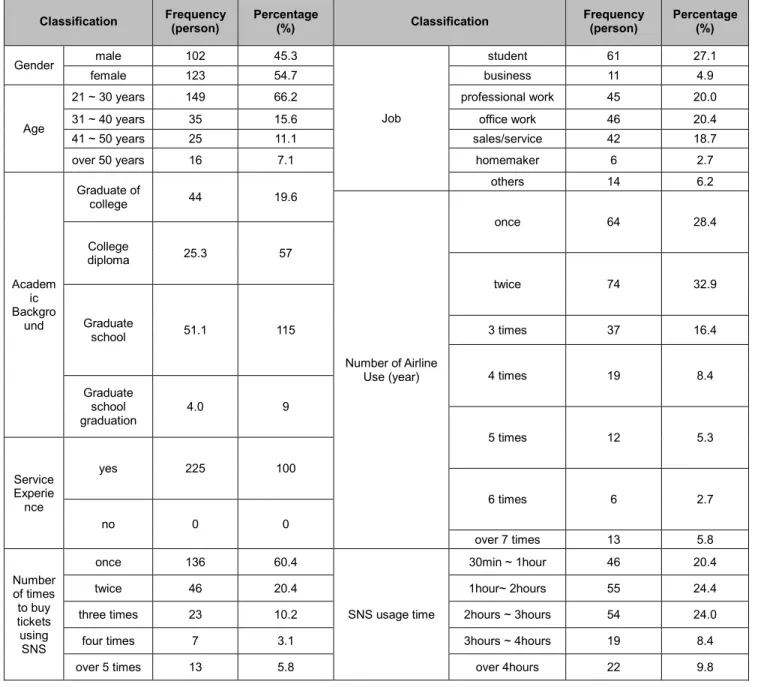
Table 1 presents the results of an analysis of the statistical characteristics of the respondents.
Table 1: Demographic Characteristics of the Respondents Classification Frequency
(person)
Percentage
(%) Classification Frequency
(person)
Percentage (%)
Gender male 102 45.3
Job
student 61 27.1
female 123 54.7 business 11 4.9
Age
21 ~ 30 years 149 66.2 professional work 45 20.0
31 ~ 40 years 35 15.6 office work 46 20.4
41 ~ 50 years 25 11.1 sales/service 42 18.7
over 50 years 16 7.1 homemaker 6 2.7
Academ ic Backgro
und
Graduate of
college 44 19.6
others 14 6.2
Number of Airline Use (year)
once 64 28.4
College
diploma 25.3 57
twice 74 32.9
Graduate
school 51.1 115 3 times 37 16.4
4 times 19 8.4
Graduate school graduation
4.0 9
5 times 12 5.3
Service Experie nce
yes 225 100
6 times 6 2.7
no 0 0
over 7 times 13 5.8
Number of times to buy tickets using SNS
once 136 60.4
SNS usage time
30min ~ 1hour 46 20.4
twice 46 20.4 1hour~ 2hours 55 24.4
three times 23 10.2 2hours ~ 3hours 54 24.0
four times 7 3.1 3hours ~ 4hours 19 8.4
over 5 times 13 5.8 over 4hours 22 9.8
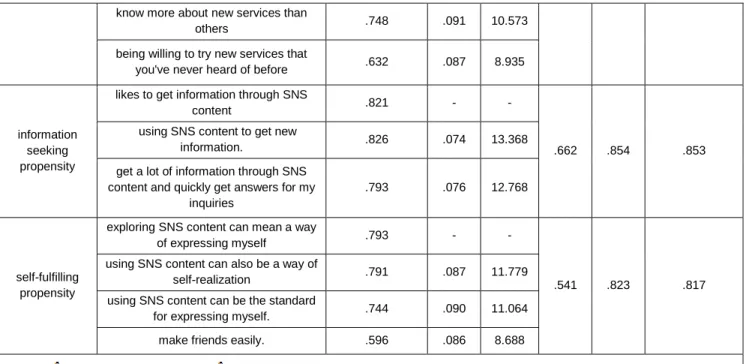
In this study, a positive factor analysis was conducted to verify the validity of concentration for the construction of a structural equation model.
In this study, correlation analysis between each potential variable was conducted and shown in Table 3.
Table 2: Verification Factor Analysis
Factor Measurement
standardization Factor Loading Value
S.E. C.R. AVE CCR Cronbach’s α
promotion
content conveys persuasive messages and images to promote airlines or
tickets
.798 - - .600 .857 .852
content conveys the purpose of announcing new products and services
or events
.816 .070 13.032
contents deliver messages such as free
services, discounts, special tickets .763 .081 12.044 contents are well communicated with
the purpose of generating profits .717 .084 11.165
information
contents deliver information, news and
stories related to airlines well .898 - -
.734 .917 .914
contents deliver information, news, and
stories related to tickets well .896 .052 19.94 contents are currently delivering events,
campaigns, and programs well .858 .054 18.165 contents deliver videos and photos of
flight attendants, airport service staff. .768 .062 14.715
communication
content uploads stories from airline
users .762 - -
.593 .910 .910
content includes celebrating a special
day or event or a specific person .748 .085 11.606 contents communicate opinions on
social topics and issues .821 .093 12.938
contents talk about season and weather .692 .092 10.617 contents are sending messages
requesting 'comments', 'share' and 'like' .796 .090 12.479 content is asking for participation such
as asking for feedback, voting, and making an implementation
.825 .087 13.015
photos and videos of customers using the airlines and event participants are being delivered to the airline's SNS contents
.736 .078 11.38
customer satisfaction
overall satisfaction with the information
gained from SNS content .821 - -
.680 .895 .894
satisfied with receiving more information
through SNS content .798 .071 13.678
content meets my expectations. .825 .072 14.314 satisfied with the value of SNS content .854 .068 15.041
diversity pursuit propensity
a lot of interest in various airlines and
ticket products. .769 - -
.528 .770 .768
comparing various airlines. .706 .082 9.466
purchase ticket products from various
airlines. .703 .090 9.432
innovation propensity
tend to try new services faster than
others .743 - -
.548 .828 .825
try to learn how to use the new service .825 .091 11.539
know more about new services than
others .748 .091 10.573
being willing to try new services that
you've never heard of before .632 .087 8.935
information seeking propensity
likes to get information through SNS
content .821 - -
.662 .854 .853
using SNS content to get new
information. .826 .074 13.368
get a lot of information through SNS content and quickly get answers for my
inquiries
.793 .076 12.768
self-fulfilling propensity
exploring SNS content can mean a way
of expressing myself .793 - -
.541 .823 .817
using SNS content can also be a way of
self-realization .791 .087 11.779
using SNS content can be the standard
for expressing myself. .744 .090 11.064
make friends easily. .596 .086 8.688
=849.443(df=558, p=.000), /df=1.522, RMR=.046, GFI=.877, AGFI=.844, NFI=.903, TLI=.966, CFI=.974, RMSEA=.048
***: p<.001
Table 3: Correlation Analysis
Factor Men S.D Pro- motion
Infor- mation
communic ation
Customers atisfaction
diversity pursuit propensity
innovation propensity
information seeking propensity
self-fulfilling propensity
promotion 3.986 .669 .600a .475b .428b .472b .138b .124b .160b .181b
information 3.731 .824 .689 .734a .402b .445b .109b .175b .129b .169b
communica
tion 3.347 .869 .654 .634 .593a .370b .108b .203b .081b .224b
customer
satisfaction 3.606 .778 .687 .667 .608 .680a .226b .235b .329b .407b
diversity pursuit propensity
3.853 .793 .371 .330 .328 .475 .528a .364b .327b .145b
innovation
propensity 4.682 1.09
7 .352 .418 .450 .485 .603 .548a .331b .264b
information seeking propensity
3.793 .786 .400 .359 .284 .574 .572 .575 .662a .389b
self-fulfilling
propensity 3.429 .818 .426 .411 .473 .638 .381 .514 .624 .541a
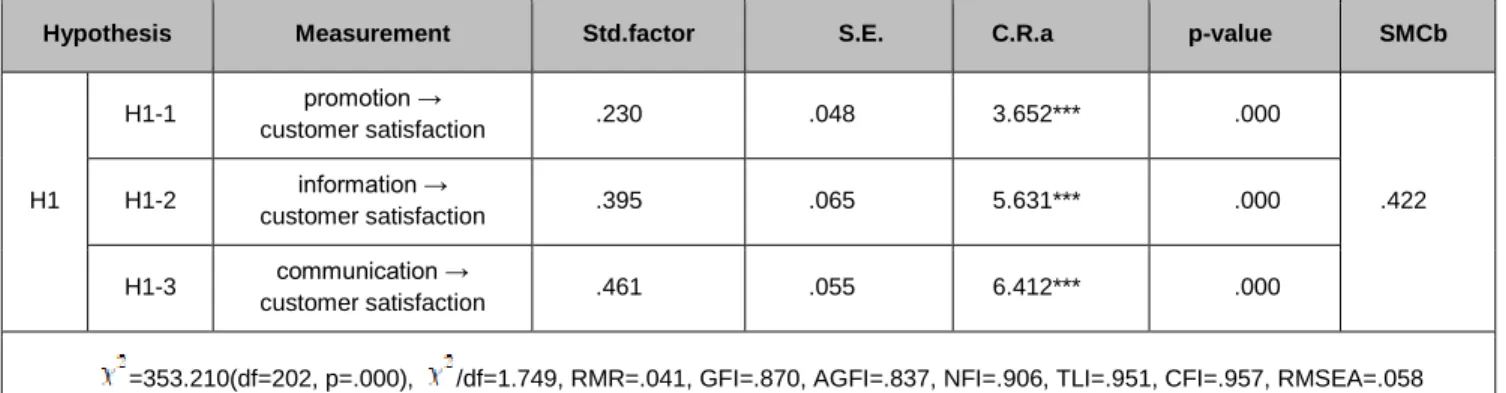
Verification of the detailed theory of H1 of Airline's SNS content characteristics will have a significant impact on customer satisfaction was shown in Table 4.
The effect of promotion on customer satisfaction was shown to be 2.30, and H1-1 was adopted.
The effect of information on customer satisfaction was shown as .395, so H1-2 was adopted. The effect of communication on customer satisfaction was shown as .461, so H1-3 was adopted.
Table 4: Impact of Airline SNS Content Characteristics on Customer Satisfaction
Hypothesis Measurement Std.factor S.E. C.R.a p-value SMCb
H1
H1-1 promotion →
customer satisfaction .230 .048 3.652*** .000
.422
H1-2 information →
customer satisfaction .395 .065 5.631*** .000
H1-3 communication →
customer satisfaction .461 .055 6.412*** .000
=353.210(df=202, p=.000), /df=1.749, RMR=.041, GFI=.870, AGFI=.837, NFI=.906, TLI=.951, CFI=.957, RMSEA=.058
*** : p<.001, a : Critical Ratio, b : Squared Multiple Correlations First, to verify the effect of adjusting the personal characteristics in the customer satisfaction relationship of the Airline's SNS content characteristics with a hypothesis 2, based on the mean of diversity pursuit propensity, innovation propensity, information seeking propensity, and self-fulfilling propensity, the sub-factors of personal
characteristics, the adjustment effect was verified by comparing with non-pharmaceutical models after dividing them into high and low groups and limiting their respective paths.
The results of the diversity pursuit propensity adjustment verification are shown in Table 4.
Table 5: Adjustment Effect of Diversity Pursuit Propensity
Path Non. Std.
factor Std.errr C.R. p-value ∆χ2 (df)
diversity pursuit propensity (H) promotion → customer satisfaction
.377 .092 4.072*** .000
4.066(1) > 3.84
diversity pursuit propensity (L) .290 .083 3.478*** .000
diversity pursuit propensity (H) information → customer satisfaction
.276 .076 3.626*** .000
7.735(1) > 3.84
diversity pursuit propensity (L) .067 .057 1.181 .238
diversity pursuit propensity (H) communication → customer satisfaction
.331 .070 4.712*** .000
3.118(1) < 3.84
diversity pursuit propensity (L) .321 .097 3.319*** .000
H2-1 and H2-2 were adopted, as diversity pursuit propensity was shown to control the influence relationship between promotion and customer satisfaction and information and customer satisfaction.
H2-3 was rejected because there was no significant difference in the effect of communication on customer satisfaction.
Second, the results of the innovative adjustment effect validation were shown in Table 6.
H2-4 and H2-5 were adopted as it showed that publicity controls the relationship between customer satisfaction and information and customer satisfaction. However, H2-6 was
rejected as it showed that the relationship of communication's impact on customer satisfaction was not adjusted.
Third, the results of the adjustment effect verification for information propensity were shown in Table 7.
H2-7 and H2-8 were adopted as information seeking propensity are shown to control the relationship between public relations and informality's impact on customer satisfaction.
However, H2-9 was rejected as it was shown that the relationship of communication's impact on customer satisfaction was not regulated.
Table 6: Adjustment Effect of Innovation Propensity
Path Non. Std.
factor Std. error C.R. p-
value ∆χ2 (df) innovation propensity (H) promotion →
customer satisfaction
.400 .089 4.499*** .000
3.996(1) > 3.84
innovation propensity (L) .297 .110 2.695** .007
innovation propensity (H) information → customer satisfaction
.326 .082 3.965*** .000
6.187(1) > 3.84
innovation propensity (L) .067 .063 1.064 .287
innovation propensity (H) communication → customer satisfaction
.304 .071 4.273*** .000
3.225(1) < 3.84
innovation propensity (L) .300 .083 3.595*** .000
Table 7: Adjustment Effect of Information Seeking Propensity
Path Non. Std.
factor Std. error C.R. p-value ∆χ2 (df) informationseekingpropensity (H) promotion
→ customer satisfaction
.333 .090 3.696*** .000
4.188(1) > 3.84
informationseeking propensity (L) .282 .087 3.247* .001
informationseeking propensity (H) information
→ customer satisfaction
.179 .077 2.332* .020
6.485(1) > 3.84
informationseeking propensity (L) .093 .055 1.694 .090
Information seeking propensity (H) communication
→ customer satisfaction
.409 .076 5.410*** .000
2.155(1) < 3.84
information seeking propensity (L) .328 .081 4.046*** .000
Table 8: Adjustment Effect of Self-Fulfilling Propensity
Path Non. Std.
factor Std. error C.R. p-value ∆χ2 (df) self-
fulfilling propensity (H) promotion
→ customer satisfaction
.382 .101 3.778*** .000
2.314(1) < 3.84 self-
fulfilling propensity (L) .282 .091 3.104** .002
self-
fulfilling propensity (H) information
→ customer satisfaction
.226 .061 3.715*** .000
2.301(1) > 3.84 self-
fulfilling propensity (L) .310 .094 3.300*** .000
self-
fulfilling propensity (H) communication
→ customer satisfaction
.263 .080 3.288** .001
3.992(1) > 3.84 self-
fulfilling propensity (L) .146 .060 2.449* .014
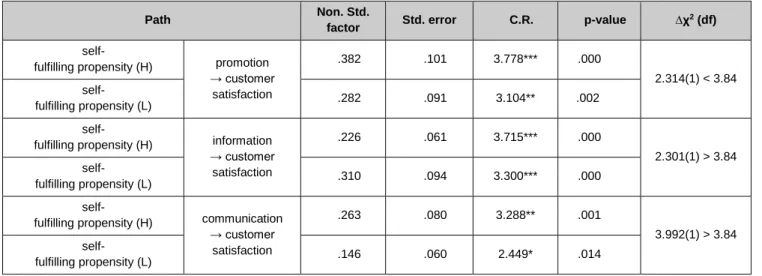
Finally, the results of the self- fulfilling propensity control verification among the sub-factors of personal characteristics were shown in Table 8
H2-10 and H2-11 were rejected as sub-factors of the airline's SNS content characteristics showed that self- fulfilling propensity had no moderating effect in the
relationship between public relations and informality on customer satisfaction.
H2-12 was adopted as the self- fulfilling propensity is shown to play a controlling role in the relationship of communication's impact on customer satisfaction.
5. Conclusion
The empirical results of this study can be summarized as follows. First, analysis of the impact of airline's SNS content characteristics on customer satisfaction shows similar results to those of Kim, Spiller, and Hettche (2015), a component of airline's SNS content characteristics, and the impact between information and customer satisfaction is similar to those of Cvijikj and Michhelles (2013). Second, analysis of whether individual characteristics control the relationship between the airline’s SNS content characteristics and customer satisfaction showed that diversity and innovation and information seeking propensity control the relationship between public relations, information and customer satisfaction, but the relationship between communication and customer satisfaction was not effected, and hypotheses 2-3, hypothesis 2-6, and hypothesis 2-9. Hypothesis 2-10 and 2-11 were rejected, as it appeared that only controls the relationship between communication and customer satisfaction.
In this study, several practical implications are presented to provide marketing strategies that can help airlines to use SNS more effectively to derive customer satisfaction and to help them to make profits through consumer purchasing behavior. First, the results of H1 show that public relations, information and communication, which are components of the airline's SNS content characteristics, all have positive effects on customer satisfaction. Airlines can drive customer satisfaction through content that includes information about special-price tickets they wish to promote, information about destinations, information about airlines, photos of airlines, etc. and improve the quality of content that communicates with consumers, such as encouraging participation, asking for feedback and responding inquiries.
In order communicate with customers the airline uploaded contents such as the videos of where the flight attendants personally experienced, recommended restaurants, tourist sites, how the crew grooms, destination information and actual videos of the passengers experiencing the airline and it had an enormous number of views and were able to see their positive response. Therefore, airline marketing practitioners will have to strive to create content that can attract consumers' attention by enhancing the quality of promotional, informative and communicative content and making it interesting and diverse to elicit customer satisfaction using SNS.
Second, the results of H2 show that diversity, innovation and information pursuit prosperity among the components of personal characteristics control the relationship between public relations and information performance, which are characteristics of airline SNS content, but not the relationship between communication and customer satisfaction. These results indicate that consumers who have
a diversity pursuit prosperity to pursue a variety of brands or products and services, innovative consumers who are more willing to try to use new technologies or buy new products and services than others, will obtain a variety of information, feel satisfied through content that is promotional and informative. Thus airlines need to make the composition of promotional content that includes discounts, special-price ticket information, events, new services or product promotions, and information-based content that includes various information about airlines or services or campaigns sponsored by airlines more quickly and more interesting rather than communicating with them through communicative content. Among individual characteristics, self-fulfilling propensity only controls the relationship between communication and customer satisfaction.
Therefore, consumers who want to fulfil their potential are satisfied with the promotional content and the interactive content that allows them to communicate more easily with airlines rather than the informational content that provides a variety of information. Therefore, it is important to create and provide more opportunities for communication, such as exchanging opinions through comments in real time using interactive features, which are characteristic of SNS, or checking responses using functions such as "like" and
"sharing."
The limitations of this study and directional suggestions for subsequent research are as follows. Since this study has been conducted by integrating without selecting specific SNS channel, it has limitations in presenting specific marketing strategies according to SNS channels. However, several variables may exist, such as Instagram, YouTube, Facebook, Twitter, and Kakao Story, have different characteristics and types of information sharing methods.
Proceeding with research by specifically classifying various SNS channels, each with its own characteristics it will be able to provide effective implications for establishing detailed marketing methods with differences according to the unique characteristics of various SNS channels that airlines use as marketing tools.
References
Blackwell, R. D., Miniard, P. W., & Engel, J. F. (2006). Consumer Behavior (4th ed,). Chicago: Dryden Press.
Cha, S. S., & Seo, B. K. (2019). The effect of brand trust of home meal replacement on repurchasing in online shopping. Journal of Business, Economics and Environmental Studies, 9(3), 21- 26.
Cho, B. D., Potluri, R. M., & Youn, M.K. (2020). A Study on the effect of product recommendation system on customer satisfaction: focused on the online shopping mall. Journal of Asian Finance, Economics and Business, 7(1), 217-228.
Choi, Y. K., Chu, K. H., & Choi, E. J. (2019). Social network
services addiction in the workplace. Journal of Asian Finance, Economics and Business, 6(1), 249-259.
Cvijikj, I. P., & Michahelles, F. (2013). Online engagement factors on Facebook brand pages. Social Network Analysis and Mining, 3(4), 843-861.
Devaraj, S., Easley, R. F., & Crant, J. M. (2008). Research note- how does personality matter? Relating the five-factor model to technology acceptance and use. Information Systems Research, 19(1), 93-105.
Dipietro, R. B., Crews, T. B., Gustafson, C., & Strick, S. (2012).
The use of social networking sites in the restaurant industry:
Best practices. Journal of Foodservice Business Research, 15(3), 265-284.
Dolan, R., & Shahbaznezhad, H. (2017). Social media strategy in services: The effect of airline brand posts on engagement.
Social Science Research Network, 13(1), 1-3.
Franke, N., & Piller, F. (2003). Key research issues in user interaction with configuration toolkits in a mass customization system, International Journal of Technology Management, 26, 578-599.
Jung, M. H., Bae, D. I., & Yun, J. C. (2014). The effects of SNS characteristics on purchase intention. The Journal of Business, Economics, and Environment Studies, 4(3), 19-25.
Kim, D. H., Spiller, L., & Hettche, M. (2015). Analyzing media types and content orientations in Facebook for global brands.
Journal of Research in Interactive Marketing, 9(1), 4-30.
Kim, K., Sin, S. J., & Tasi, T. (2014). Individual differences in social media use for information seeking. The Journal of Academic Librarianship, 40(2), 171-178.
Kim, M. H. (2016). A study of the effect of purchasing factors on customer satisfaction and repurchasing intention of Chinese residents in Korea buying through Internet shopping malls.
Journal of Distribution Science, 14(11), 139-147.
Kim, Y. K. (2019). The effects of attractiveness of service employees on interpersonal trust, satisfaction and loyalty.
International Journal of Industrial Distribution & Business, 10(10), 23-34.
Lee, J. H., W, R., & Fan, L. (2017). Influence on the use intention of user’s traits in china market. The Journal of Business, Economics, and Environment Studies, 7(2), 21-29.
Lee, J. W., & Cormier, J. F. (2010). Effects of consumers’
demographic profile on mobile commerce Adoption. Journal of Distribution Science, 8(1), 5-11.
Martenson, R. (2007). Corporate brand image, satisfaction and store loyalty: A study of the store as a brand. International Journal of Retail & Distribution Management, 35(7), 544-555.
Muntinga, D. G., Moorman, M., & Smit, E. G. (2011). Introducing COBRAs: Exploring motivations for brand-related social media use. International Journal of Advertising, 30(1), 13-46.
Niu, L. X., & Lee, J. H. (2018). The intention of repurchase on e- service quality by online travel agency site. International
Journal of Industrial Distribution & Business, 9(7), 61-70.
Oakey, R. P. (2013). Open innovation and its relevance to industrial research and development: The case of high- technology Small Firms. International Small Business Journal, 31(3), 319-336.
Obar, J. A., & Wildman, S. (2015). Social media definition and the governance challenge: An introduction to the special issue.
Telecommunications Policy, 39(9), 745-750.
Park, H. Y., & Park, S. Y. (2017). The influence of service quality factors on reuse intention. Journal of Distribution Science, 15(4), 59-67.
Park, H. Y., & Park S. Y. (2019). The effect of emotional image on customer attitude. Journal of Asian Finance, Economics and Business, 6(3), 259-268.
Steenkamp, J. E. M., & Baumgartner, H. (1992). The role of optimum stimulation level in exploratory consumer behavior.
Journal of Consumer Research, 19(DEC), 434-448.
Vazquez-Carrasco, R., & Foxall, G. R. (2006). Influence of personality traits on satisfaction, perception of relational benefits, and loyalty in a personal service context. Journal of Retailing and Consumer Service, 13(3), 205-219.
Verhoef, P. C., Lemon, K. N., Parasuraman, A., Roggeveen, A., Tsiros, M., Schlesinger, L. A., & Schlessinger, L. L. (2009).
Customer experience creation: determinants, dynamics and management strategies. Journal of Retailing, 85(1), 31-41.
Villanueva, J., Yoo, S., & Hanssens, D. M. (2008). The impact of marketing-induced versus word-of-mouth customer acquisition on customer equity growth. Journal of Marketing Research, 45(1), 48-59.
Wang, Y., Lee, J. H., & Kim, H. K. (2014). The influence of SNS characteristics on tourist attractions preference: Focus on China. Journal of Distribution Science, 12(9), 53-63.
Weqian, D., & Lee, J. H. (2018). Effects of website characteristics and delivery service quality on repurchase intention.
International Journal of Industrial Distribution & Business, 9(5), 17-24.
Yang, H. C., & Woo, M. S. (2013). The effect of consumers’
personal characteristics on attitude toward social commerce:
Focused on the theory of reasoned action. Journal of Distribution Science, 11(11), 71-76.
Youn, M. K., Kim, Y. O., Lee, M. K., & Namkung, S. (2006).
Domestic restrictions on the opening of retail stores. Journal of Distribution Science, 6(2), 121-160.
Yu, W., Lee, J. H., & Kim, H. K. (2014). The influence of SNS characteristics on tourist attractions preference: Focus on China. Journal of Distribution Science, 12(9), 53-63.
Zhang, J., & Lee, H. Y. (2015). Factors influencing Chinese customers’ selection of health care service countries: Focusing on word-of-mouth moderating effects. Journal of Distribution Science, 13(12), 41-52.