• 검색 결과가 없습니다.

Design and Implementation of Key Frame Sharing Application in Android Using Chord Protocol

N/A
N/A
Protected

Academic year: 2021

Share "Design and Implementation of Key Frame Sharing Application in Android Using Chord Protocol"

Copied!
8
0
0

로드 중.... (전체 텍스트 보기)

전체 글

(1)

Design and Implementation of Key Frame Sharing Application in Android Using Chord Protocol

K.W. Kim

ABSTRACT

Due to the popularity of mobile phones, Peer-to-Peer (P2P) content sharing in mobile phones is highly desirable, especially in a mobile data connection. In addition, there has been an increasing demand for content sharing applications for P2P communication in Android-based smartphones as ubiquitous mobile devices. However, due to wireless network limits, unstable characteristic and restricted storage space, mobile users confront challenges in establishing connections and sharing video frames with other users.

To solve this issue, we propose an architectural design and implementation of key frame sharing applica- tion that uses Chord, a distributed lookup protocol to establish a content sharing platform for mobile devices, combined with the Chord SDK based on Android. Our proposed system enables users easily to share key information on video data in real-time over a wireless network without manual processing of devices which join or leave the group and cost associated with the 3G/4G network.

Key words: Key Frame, Chord Protocol, Android, Sharing

※ Corresponding Author : Kang Wook Kim, Address : (445-855) 148-901, Lotte Castle Apt., Seoku-dong, Hwa- seong-si, Gyeonggi-do, Korea, TEL : +82-10-2678-2501, E-mail : [email protected]

Receipt date : Jan. 28, 2014 , Revision date : Feb. 25, 2014 Approval date : Mar. 14, 2014

Samsung Electronics Co., Ltd

1. INTRODUCTION

With the high growth of mobile technology, Android-based smartphones and tablets have ad- vanced rapidly in recent years. The number of smartphone users has also increased sharply be- cause they are powerful multimedia devices which are equipped with a low power high performance processor and high resolution touch screen with cameras and sensors. Already, mobile devices are not just used for making a call or sending an SMS.

They can provide us with the multimedia function- alities such as taking pictures, recording video, playing games, and searching the Internet. Wireless networks will be more popular both at work and home in the near future and the convergence of mobile or wireless devices significantly change

people’s everyday lifestyle and become the main

means of communication. In addition, a lot of users

are still deeply interested in sharing their multi-

media content. For instance, with the development

of smartphones with high-quality cameras, there

is an intention of users to share their own content

such as photos or videos with nearby smartphones

or tablet devices. However, such users still face the

problem related to high costs when using the mo-

bile data networks such as 3G/4G and uploading

data to a certain server. Therefore, it is common

that most of users are normally subjected to mobile

data plans with limited usage. It is a matter of fact

that the design of P2P protocol in a mobile environ-

ment mainly depends on the underlying wireless

technology such as Wi-Fi and Bluetooth. One of

the main advantages of wireless mobile P2P net-

work is sharing resources in a mobile environment,

and it also has many other advantages such as high

scalability, full decentralization, highly dynamic,

self-organizing in mobile environment, and con-

venience of establishing network [1]. There has

been a wide use of many P2P applications in the

(2)

wired network environment in the last few years.

However, there is no efficient adaptation of these new technologies to a wireless mobile environment [2]. Currently, smartphones and tablets have be- come multimedia devices with high capability in the mobile environment. In addition, the intro- duction of Wi-Fi Direct protocol enable users to make good use of the P2P communication with mobile devices anytime and anywhere in a direct manner without any interface router or access point (AP) [3].

Typically, P2P communication systems are div- ided mainly into unstructured P2P system and structured P2P system or distributed hash table (DHT), such as Chord [4]. Structured P2P net- works became popular for its advantages of high scalability and good performance. The main ad- vantage of DHT-based systems is that data place- ment and search procedures generate less traffic.

Among the DHT-based approaches, Chord is one of the most popular systems. As structured P2P networks, Chord protocol, which is the most repre- sentative network architecture protocol has not only simple design ideas, but also good distribution, scalability, stability and load balancing. For de- signing the P2P applications for different devices, it only depends on the operating systems (OS) run- ning on these devices. In our research, we have a definite reason for choosing the Android-based mobile devices including the Google Android plat- form where the entire OS is open and accessible to developers and application programming is easi- ly supported by software development kit (SDK).

Therefore, in this paper, we propose an architec- tural design and implementation of key frame sharing application that uses Chord, a distributed lookup protocol to establish a content sharing plat- form for mobile devices, combined with the Chord SDK based on Android.

The remainder of this paper is organized as fol- lows: In section 2, we introduce our proposed key frame extraction system and its block diagram.

Then, in section 3, we briefly review standard Chord protocol, and device connection mechanism via a Chord channel. Section 4 gives details about the architectural design and implementation of the key frame sharing application in Android, demon- strating the Chord SDK, class view and user inter- face of the proposed system. Compatibility test re- sults for Android OS versions and various video sequences are presented in Section 5. Finally, sec- tion 6 concludes the paper.

2. KEY FRAME EXTRACTION

The use of key frames to represent the content of a video has been previously discussed in many research papers as an efficient way of preserving the temporal information of sequence based on a small amount of data [5,6]. The underlying as- sumption is that if these frames are extracted using an appropriate video sampling method, the visual content of each segment of the sequence can be easily understood by looking at given samples.

Accordingly, such compact video representation can be suitable for the purpose of video browsing.

Furthermore, for query processes involving the search for video parts containing specific objects, the concept of key frames can also be useful. In our application, we adapted a three-step key frame extraction method [6] for efficient video content representation, which was proposed in 2012.

3. CHORD PROTOCOL

3.1 Description of Chord Protocol

In this section we briefly describe the standard Chord mechanism. For a more detailed description, we are referred to [4]. The Chord protocol is one solution for connecting the peers of a P2P network.

Chord can simplify the design of P2P and applica-

tions based on it by solving the touch issues such

as load balancing, decentralization, scalability and

flexibility. Chord will be an essential component for

(3)

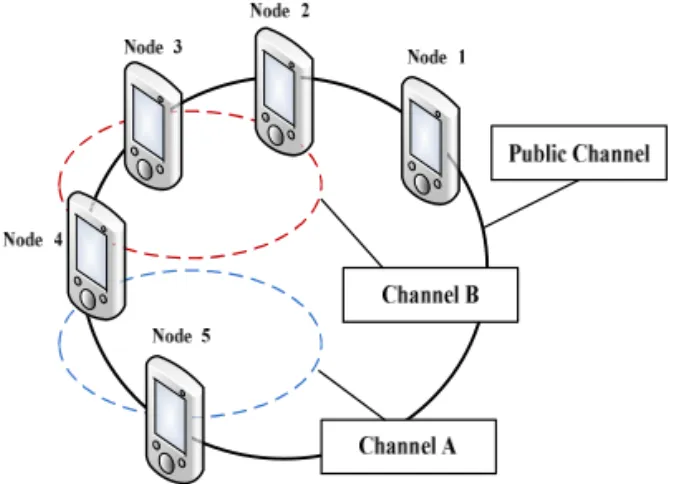
Fig. 1. Example scenario of device connection via a Chord channel.

P2P and large-scale distributed applications.

Excellent features of Chord include its simplicity, correctness, and good performance even in the case of concurrent node arrivals and departures.

Among the DHT-based approaches, Chord is one of the most popular systems. As structured P2P networks, Chord protocol which is the most representative network architecture protocol has not only a simple design idea, but also good dis- tribution, scalability, stability and load balancing.

There is a lot of research and improvement on Chord needed to meet the actual demand [7,8]. For this reason, Chord has been recently adopted as mandatory by the IETF P2PSIP (Peer-to-Peer SIP) working group [9].

3.2 Mobile device connection via Chord channel

Chord allows you to easily develop local in- formation-sharing applications. Devices running Chord-based applications find the position of each other using UDP-broadcast-based discovery, and then use a TCP/IP-based protocol stack to create a reliable, local, P2P communications network.

Chord-based applications use this network to share data, including text messages, binary mes- sages and files, with selected members of the network. We can use the Chord to discover de-

vices, join or leave private channels and share in- formation by sending and receiving data and files.

Fig. 1 shows the system architecture of node ar- chitecture of and illustrates the scenarios of de- vices connected via a Chord channel. A node is a device that is connected to other devices through the Chord protocol. The Chord public channel in- cludes all the nodes in the local Chord network, while individual applications on nodes use private channels to interact with each other. A node is al- ways a member of the public channel, and can also be a member of multiple private channels. Devices running Chord-based applications join the Chord public channel automatically and become nodes.

However, the Chord public channel is not visible to users. This means that users must use private channels to share data, conversations, and files. A private channel only includes nodes that are run- ning the same application. Fig. 1 shows five de- vices connected through a Chord public channel.

Nodes 2, 3, and 4 are also connected to each other in a private channel (Channel B) while nodes 4 and 5 are connected through another private channel (Channel A). Note that node 4 is connected to both Channel A and Channel B, and that node 1 is not connected to any private channels.

4. DESIGN AND IMPLEMENTATION OF PROPOSED APPLICATION

4.1 Design of Key Frame Extraction Engine

The functions packaged in the form of library

(DLL, SO) or executable file, such as Assembly,

C and C++ can be called on Java layer through JNI

(Java Native Interface) in Android. JNI comes from

the following reasons: First, the application has to

use the system-related functions, while Java does

not support or is hard to implement. Second, there

are many useful libraries written in other lan-

guages. Java programs can reuse them. Third, for

higher performance issues, the developer has to

use assembly or C/C++ code to implement some

(4)

Fig. 2. Structure of Android key frame extraction module.

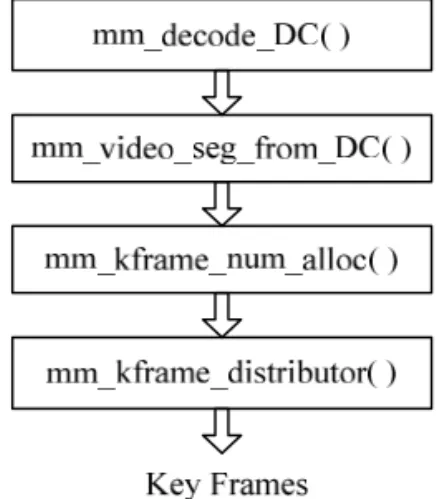
Fig. 3. The flow chart of key frame extraction functions.

specific program modules [10,11]. For these re- quirements, Android platform supports the JNI method. In this paper, we use JNI because of the second reason, for reusing already implemented C codes for key frame extraction as explained in sec- tion 2. JNI layer is exchanging the key frame data between Application UI and MPEG decoder library. Meanwhile, it provides the interface for controlling the DC images decoding.

Normally, native C code executes faster than Java code [11]. In view of the efficiency require- ments of key frame extraction application, and the characteristics of Android hierarchy, the DC image extraction engine is located between Linux kernel layer and applications layer and realized by C/C++

programming language. In the DC image ex- traction engine, the function of Linux kernel and libraries are called to decode DC image from video stream and calculate the differences between DC images. Functions in Android application layer call the service provided by DC image extraction en- gine using JNI interface. The architecture of key frame extraction is designed into four layers as shown in Fig. 2. In Android, applications are devel- oped with Java programming language based on Android SDK, but key frame extraction engine is based on C programming language.

In this paper, we develop dynamic linked library based C programming language (.so) by JNI, and

then pack the “.so” file and the Java application as a “.apk” file by Android NDK. The advantage of this approach is we can upgrade and reuse each layer because only changing the common library allows us to develop new applications. Combining hierarchical and modular design, the key frame ex- traction engine consists of mainly four layers, in- cluding the user interface, scene change detection, key frame allocation, and key frame distribution.

This type of design approach can simplify video information processing. It is useful to develop and maintain video processing application using the key frame extraction engine. It is also easy to add a new functionality to our proposed design scheme.

There is a mapping table between native functions and Android Java functions, which is registered to Dalvik VM.

The user interface layer is the interface of key frame extraction engine, and it is a JNI interface package of key frame extraction engine. Java ap- plications can call the corresponding key frame ex- traction engine functions through JNI interface.

The layer controls the flow of command from one

layer to another. Related APIs implement the con-

trol of key frame number, widow size setting for

scene change detection, and view options for dis-

play on screen. The main flow of the functional

call is shown in Fig. 3. Every step’s function is

(5)

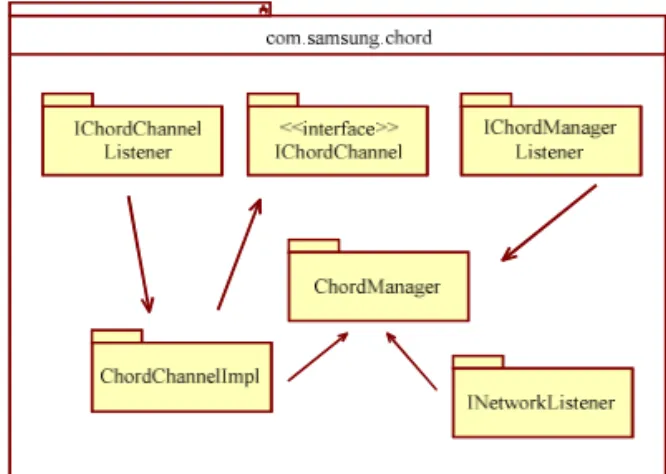
Fig. 4. Chord classes and interfaces.

as follows:

• mm_decode_DC( ) : Decode DC image from compressed video

• mm_video_seg_from_DC( ) : Segment video into shots using extracted DC images

• mm_kframe_num_alloc( ) : Allocate the num- ber of key frames to a shot

• mm_kframe_distributor( ) : Distribute key frames over a shot

4.2 Chord SDK on Android platform

The Samsung Chord [12] is a very effective way to share content and user events in real-time be- tween devices. Samsung is fully committed to making Chord the useful sharing protocol for ap- plication developers. Chord is supported by Android 4.0 (Ice Cream Sandwich), API level 14 or above. Chord enables simple real-time sharing without the cloud. The Samsung Chord SDK al- lows application developers to develop local in- formation-sharing applications without a detailed knowledge of networking. For this reason, we have concluded that he Samsung Chord SDK is the most efficient way to implement the prototype applica- tion for key frame sharing. We are able to imple- ment a large variety of features with the Chord SDK. The Chord SDK is a network framework that makes it easy for users without professional net- working skills to discover many devices connected to the same subnet. It helps them group the devices through Chord channels, and exchange files and data between the devices. There is the difference between Chord and other shot-distance network connections such as Wi-Fi direct and Bluetooth.

In general, Wi-Fi Direct and Bluetooth refer to a physical network interface connection. Chord is a top layer messaging protocol that uses the TCP/IP network. Fig. 4 shows the Chord classes and inter- faces that we can utilize in our application. The Chord classes and interfaces are described as fol- lows:

• ChordManager : Creates a node and man- ages the node's connection to channels.

• IChordManagerListener : Listens for the connection status of the node.

• INetworkListener : Listens for the status of network, even if Chord has not started.

• IChordChannel : Manages node names and IP addresses, and data and file transfers.

• ChordChannelImpl : Access the channel in- stance by using IChordChannel.

• IChordChannelListener : Listens for nodes joining and leaving channels, and data trans- fers.

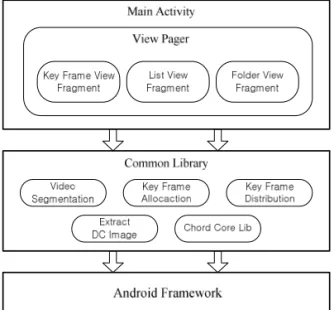
4.3 Implementation of User Interface We need to use a fragment structure for appli- cation UI which is provided by Android 3.0 APIs as shown in Fig. 5 because we can easily compose different functionality for each layout in activity.

An activity in Android OS represents a single screen with a user interface. In a multiple activities application, generally, an activity is defined as the

"main" activity, which is presented to the user when user first executes the application program.

A main activity of key frame list view is an object

of activity type and it provides interface to users

and communicates with the common library. View

pager contains content providers provided by sys-

tem to get key frame information from the common

(6)

Fig. 5. Fragment structure for key frame sharing application UI.

Fig. 6. Relationship of the classes and context view structure.

library. These components need to cooperate with each other in order to extract and show key frames on Android platform.

To extract and share key frames, the video common library should collect key frames then display them after decoding DC image, scene change detection, key frame allocation and dis- tribution. According to the four steps, this paper designs the key frame extraction application based on this hierarchy. In the Java layer of key frame sharing application, the relationship of function classes and context view structure is shown in Fig.

6. Besides the Chord classes for implementation of the key frame sharing module, we are required to make use of the Media Libraries provided in the Android SDK. It involves extending the Surface- View class, creating a SurfaceHolder class and a MediaRecorder class, and implementing a Surface- Holder callback function. The SurfaceView class provides a dedicated drawing surface for the pic- ture captured, which can be displayed on the LCD screen. SurfaceHolder provides the user with the interface to control the surface size and format, to edit the pixels in the surface, and to monitor changes to the surface. SurfaceHolder callback will be called if there is any change to the surface.

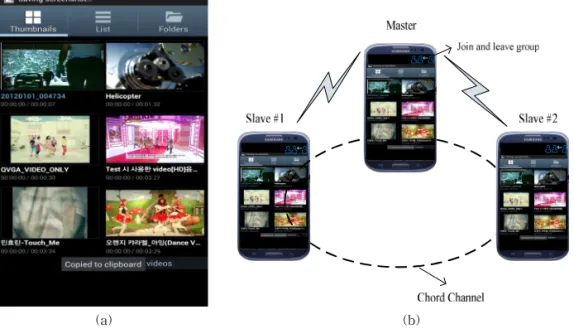
We installed the application on each of these phones. User interface is shown in Fig. 7. Fig. 7(a) shows a screen shot of the user interface of the application and its menu tabs. It has a simple and clear user interface with three tap buttons in the view layout. When we touch the key frame, video is played from the position of corresponding key frame. Fig. 7(b) shows the example scenario of the application for devices connected with each other.

we can support the status icon on the top right side of UI layout to conveniently check if mobile devices join and leave the group.

Key frames are delivered from a master device to a slave via HTTP server-client mechanism.

Considering the bandwidth of Wi-Fi, a maximum 10 devices are connected at the same time through the wireless AP and are sharing key frames in re- al-time. Our key frame sharing application is based on P2P communication between mobile phones, i.e.

without the use of video processing servers or net- work infrastructure.

5. SOFTWARE COMPATIBILITY TEST

Since there are various formats of video files,

our system need to parse most of universal video

formats. The formats we support are as list in table

1. So, we modify the original media player in

(7)

(a) (b)

Fig. 7. Implemented Android key frame sharing application. (a) Screen shot of key frame display on Android phone, (b) Example service scenario of key frame sharing application

Table 1. Supported video file formats

supported video files

video/mp4 video/3gp video/3gpp video/3gpp2

video/x-ms-asf video/x-ms-wmv video/x-ms-wma video/divx

video/avi video/flv video/mkv -

Android to support various kinds of video files list- ed in table 1 and then use Android API to run media scanner service, which reads meta-data from the file and adds the file to the media content provider.

We tested our system using various kinds of smartphones with different video formats, audio format and resolution. There are hundreds of de- vices with Android system. It is not easy to test application compatibility for all of the devices. So we choose several phones of major Android mobile phone manufacturers such as Samsung, HTC, and Google, which have different systems and hardware. We verified our application for various video formats and resolution to see if there are per- formance or compatibility issues using several Android phones. Test results showed that our pro- posed application is fully compatible for android 3.0, android 4.0 and android 4.1 and later versions.

Due to the use of the standard Android develop-

ment kits, the application can be easily built on all of these mobile phones without modifications to the engine source code. So far, section 4 and 5 have illustrated all the design, implementation, and testing. Application test results on target devices confirm the validity, availability and usefulness of the proposed method. In addition, the proposed key frame sharing framework demonstrates it can pro- vide a sufficient software platform for many Android-based P2P applications.

6. CONCLUSIONS

This paper described a prototype application in

Android for sharing key frames in real-time using

the Chord SDK. Using our prototype application,

users are capable of creating, consuming and shar-

ing rich media on mobile devices without compli-

cated settings for discovering, joining and leaving

(8)

the network.

REFERENCES

[ 1 ] Erlend Larsen, TCP in MANET: Challenges and Solutions, Research Report: FFI-rapport 2012/01289, 2012.

[ 2 ] S. Kirsimäe, U. Norbisrath, G. Singer, S.

Narayana Srirama, and A. Lind, “Extending Friend-to-Friend Computing to Mobile Environments,” P roceeding of International Conference on Mobile Services, Resources, and Users, pp. 75-80, 2011.

[ 3 ] N. Ishikawa, H. Sumino, T. Kato, J. Hjelm, S.

Murakami, K. Kitagawa, and N. Saito,

“Peer-to-Peer Networking Platform and Its Applications for Mobile Phones,” Mobile P eer-to- Peer Computing for Next Generation Distributed Environment, pp.

374-396, 2009.

[ 4 ] I. Stoica, R. Morris, D.L. Nowell, D.R. Karger, M.F. Kaashoek, F. Dalek et al., “Chord: A Scalable Peer-to-Peer Lookup Protocol for Internet Applications,” IEEE/ ACM Trans.

on Networking, Vol. 11, No. 1, pp. 17-32, 2003.

[ 5 ] G. Liu and J. Zhao, “Key Frame Extraction from MPEG Video Stream,” P roceeding of International Symposium on Information P rocessing, pp. 423-427, 2010.

[ 6 ] K.W. Kim and S.G. Kwon, "New Framework for Automated Extraction of Key Frames from Compressed Video," Journal of Korea Multimedia Society, Vol. 15, No. 6, pp. 1109- 1116, 2012.

[ 7 ] Z.L. Kis and R. Szabo, “Chord-Zip: A Chord- Ring Merger Algorithm,” IEEE Communica- tions Letters, Vol. 12, No. 8, pp. 605-607, 2008.

[ 8 ] G.N. Hoang, H.N. Chan, K.N. Van, T.L. Xuan, T.N. Manh, and V.V. Thanh, “Performance Improvement of Chord Distributed Hash Table under High Churn Rate,” Proceeding of International Conference on Advanced Tech- nologies for Communications, pp. 191-196, 2009.

[ 9 ] C. Jennings, B. Lowekamp, E. Rescorla, S.A.

Baset, and H. Schulzrinne, REsource LOcation And Discovery (RELOAD) Base Protocol

<draft-ietf-p2psip-base-22>, 2012.

[10] Developer Resources for Google Android, http://developer.android.com/, 2014.

[11] D. Gavalas and D. Economou, “Development Platforms for Mobile Applications,” IEEE Software, Vol. 28, No. 1, pp. 77-86, 2011.

[12] Samsung Mobile SDK, http://developer.

samsung.com/chord, 2014.

Kang-Wook Kim

He received the B.S., M.S,. and Ph. D. degrees in Electronics Engineering from Kyungpook National University, Korea in 1996, 1998 and 2002 respectively.

He is currently a principal en-

gineer in R&D Group, Mobile

Communication Division, Samsung Electronics Co.,

Ltd. His research interests include visual communica-

tion, mobile embeded system, and Android application.

수치

Fig. 1. Example scenario of device connection via a Chord channel.
Fig. 2. Structure of Android key frame extraction module.
Fig. 4. Chord classes and interfaces.
Fig. 5. Fragment structure for key frame sharing application UI.
+2

참조

관련 문서

To this end, prior studies of the type of value, design paradigm and design value were considered, and three types of design value (practical value,

This paper is written to find answers of the research question that the 'Meeting First, Key-issue Agreement Later&#34; approach of the US and South Korea

Fiscal transparency should lead to better-informed public debate about the design and results of fiscal policy, make governments more accountable for the implementation

The purpose of this study is to establish and design the characteristics of summer resorts according to the design manual, develop cultural products using

Application of TMDs to attenuate floor vibration by Steel Structures and Seismic

In wireless sensor networks (WSNs), a transport protocol plays an important role of reliable transmission and congestion control.. The efficient design of

The key procedure of seismic design is consisted of decision of design earthquake, dynamic seismic response analysis, seismic design of structures and equipment,

One possible way of solving these equations is to write the blade equations in the fixed reference frame using Fourier coordinate transformation, and then solve