J. Korea Inst. Build. Constr. Vol. 18, No. 1 : 033-040 / Feb, 2018
https://doi.org/10.5345/JKIBC.2018.18.1.033 www.jkibc.org
양생방법 변화가 혼화재 다량치환 고강도 모르타르의 압축강도 및 수축변화에 미치는 영향
Influence of Curing Methods on Compressive Strength and Shrinkage of High Strength Mortar with High Volume SCMs
한 천 구11) 백 철*
Han, Cheon-Goo Baek, Cheol*
Department of Architectural Engineering, Cheong ju University, 298 Daesung-Ro, Cheongju, 28503, Korea
Abstract
Currently, in South Korea, because of reducing the construction period or treating wasted water, there are some cases of missing wet curing for concrete structure even though for high strength concrete. This air curing conditions is considered to cause increased possibility of compressive strength decrease , and increasing drying or autogenous shrinkages. As a solution of shrinkage of concrete, The authors’ research team conducted the research on improving durability of concrete with decreasing autogenous shrinkage by adding the oil or fat to induce the saponification. Therefore, in this research, the influence of curing method on compressive strength, shrinkage on evaporation rate of high strength mortar including high volume supplementary cementitious materials (SCMs) was evaluated depending on various curing methods such as air curing, drying after painting emulsified refined cooking oil (ERCO), and drying after 7 and 28 days’
wet curing. The experimental result showed the air curing method caused approximately 50% of decreased compressive strength and 1.9 times of increased shrinkage rather than the 28-day-wet curing method, thus it was known that the wet curing significantly influences on performance of high strength mortar using high volume SCMs. However, the ERCO painting curing caused decreased performance of concrete rather than drying after 7 days curing while it caused improved performance of concrete than entire period air curing.
Keywords : curing method, high volume SCMs, high strength mortar, compressive strength, shrinkage
1. 서 론
콘크리트의 양생이란 강도 및 내구성 등 소요품질을 확보 하기 위해 타설한 콘크리트를 적당한 온도와 습윤상태를 유 지하고, 유해한 작용으로부터 보호하는 것을 말한다[1]. 이 러한 콘크리트의 양생방법 종류로는 습윤양생, 증기양생, 전기양생, 피막양생 등이 있는데, 콘크리트 표준시방서에서
Received : September 25, 2017 Revision received : November 29, 2017 Accepted : December 29, 2017
* Corresponding author : Baek, Cheol
[Tel: 82-43-229-8480, E-mail: [email protected]]
ⓒ2018 The Korea Institute of Building Construction, All rights reserved.
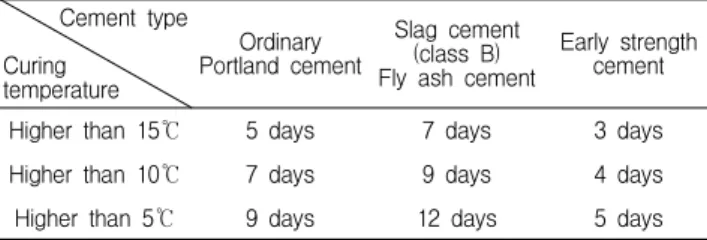
는 콘크리트 타설 후 습윤상태를 Table 1과 같이 유지하도록 명시되어 있다[2].
Table 1. Various curing conditions (temperature and period) Cement type
Curing temperature
Ordinary Portland cement
Slag cement (class B) Fly ash cement
Early strength cement
Higher than 15℃ 5 days 7 days 3 days
Higher than 10℃ 7 days 9 days 4 days
Higher than 5℃ 9 days 12 days 5 days
하지만 현재 우리나라의 많은 건축공사현장에서는 건축물 이 고층화 되면서, 공기단축 및 물의 처리곤란 등의 이유로 고강도 콘크리트일지라도 습윤양생을 실시하지 않고 공사를
Influence of Curing Methods on Compressive Strength and Shrinkage of High Strength Mortar with High Volume SCMs
진행하는 경우도 존재한다. 이와 같이 건조상태로 양생하게 되면 특히 혼화재를 다량 치환한 고강도 콘크리트의 경우에 는 압축강도가 감소하고, 건조수축ㆍ자기수축 등 수축변화 가 크게 증가할 것으로 예상된다.
또한, 본 연구팀에서는 기존의 연구로서 콘크리트 수화물 중 알칼리 성분인 수산화칼슘(Ca(OH)2)과 유화처리정제식 용유(Emulsified Refined Cooking Oil 이하 ERCO)의 주 성분인 글리세린 에스테르(RCOOH)와의 비누화 반응을 이 용하여 콘크리트의 모세관 공극을 충전함으로써 고강도 콘 크리트의 자기수축 저감[3] 및 내구성 향상[4]에 대한 효과 를 연구한바 있다. 따라서 이번에는 이와 같은 ERCO의 활용 방안으로 양생 중 피막양생의 관점으로 콘크리트 표면에 ERCO를 도포하게 되면 콘크리트 표면 모세관 공극의 수산 화칼슘과 유지의 글리세린 에스테르가 비누화 반응되어 표 면층 모세관 공극을 충전함에 따라 공극내부에 있는 수분의 증발을 막으므로서 양생효과로 강도증진 및 수축저감에 효 과적일 것으로 추측된다.
그러므로 본 연구에서는 비양생 건조, ERCO를 모르타르 표면에 도포, 7일 수중양생 후 건조 및 28일 수중양생 등 양생방법변화에 따른 보통포틀랜드시멘트(이하 OPC), 고로 슬래그 미분말(이하 BS) 및 플라이애시(이하 FA) 등 혼화재 다량치환 시멘트 모르타르의 압축강도특성, 수분증발에 따 른 수축변화 특성에 대하여 분석하여 ERCO 도포의 양생효 과 및 양생의 중요성을 확인하고자 한다.
2. 실험계획 및 방법
2.1 실험계획
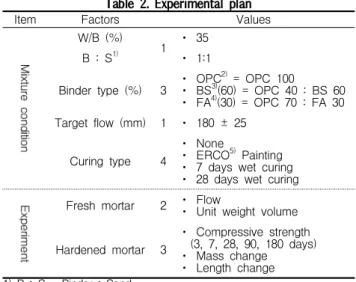
본 실험에서의 실험계획 및 배합사항은 Table 2 및 3과 같다. 즉, 실험요인으로 물결합재비(이하 W/B)는 35%에 모르타르 배합비(B:S)는 1:1로 고정하고, 결합재로는 OPC 만을 사용하는 배합, OPC에 BS를 60%치환한 배합 및 OPC에 FA를 30% 치환한 배합의 3수준으로 계획하였다.
이때 목표 플로는 OPC 100%의 경우 180±25mm로 배합 설계한 다음 여타의 배합에도 동일하게 적용하였다.
양생방법으로는 탈형 후 계속 건조, 탈형 후 ERCO 도포 후 건조, 7일 수중양생 후 건조 및 28일 수중 후 91일 까지 건조시키는 것으로 계획하였다. ERCO의 도포 방법으로는 1회 붓칠로 0.4ℓ/m2를 도포하는 것으로 계획하였다.
실험사항으로 굳지 않은 모르타르의 특성은 플로, 단위용
적질량을 측정하고, 경화 모르타르의 특성으로는 각 양생방 법 및 재령별 압축강도, 질량변화율 및 길이변화율을 측정하 는 것으로 계획 하였다.
Table 2. Experimental plan
Item Factors Values
W/B (%)
1 ㆍ 35
B : S1) ㆍ 1:1
Binder type (%) 3 ㆍ OPC2) = OPC 100
ㆍ BS3)(60) = OPC 40 : BS 60 ㆍ FA4)(30) = OPC 70 : FA 30 Target flow (mm) 1 ㆍ 180 ± 25
Curing type 4
ㆍ None
ㆍ ERCO5) Painting ㆍ 7 days wet curing ㆍ 28 days wet curing Fresh mortar 2 ㆍ Flowㆍ Unit weight volume
Hardened mortar 3
ㆍ Compressive strength (3, 7, 28, 90, 180 days) ㆍ Mass change ㆍ Length change 1) B : S = Binder : Sand
2) Ordinary portland cement 3) Blast furnace slag powder 4) Fly ash
5) ERCO(emulsified refined cooking oil)
Table 3. Mix proportions of mortar Type B : S W/B(%)1)
Unit mass(kg/m3)
W OPC BS FA S
OPC
1:1 35
331 947 0 0 947
BS(60) 326 373 559 0 931
FA(30) 320 640 0 274 914
1) W/B = Water/ Binder
2.2 사용재료
본 실험에 사용한 모든 재료는 국내산을 사용하였다. 즉, 결합재의 경우 OPC는 KS L 5201의 1종을, 고로슬래그 미 분말은 KS F 2563의 3종 및 플라이 애시는 KS L 5105의 2종을 사용하였고, 잔골재는 석산의 부순 잔골재를 사용하 였다. 이때 각 사용재료의 물리ㆍ화학적 특성은 Table 4∼7 과 같다.
Table 4. Physical properties of cement
Density
(g/cm3) Blaine (cm2/g)
Loss on ignition
(%)
Setting time
(min) Compressive strength(MPa)
Initial Final 3 days 7
days 28 days
3.15 3 450 2 275 325 28.4 39.5 52.3
Cement Aggre-+
gate → mixingDry Water+ →
Mortar (Water absorp-
tion) → Mortar → Dis- charge
30 sec 30 sec 90 sec 60 sec
Figure 1. Mixing protocol for mortar slag powder
Density
(g/cm3) Blaine (cm2/g)
Loss on ignition
(%)
Chemical composition (%)
SiO2 Al2O3 Fe2O3 CaO MgO
2.89 4 520 1.5 34.2 14.6 0.32 42.3 6.40
Table 6. Physical and chemical properties of fly ash Density
(g/cm3)
Blaine (cm2/g)
Loss on ignition
(%)
Moisture content
(%)
SiO2
(%)
2.27 3 850 2.50 0.10 51.3
Table 7. Physical properties of crushed fine aggregate Density
(g/cm3) Absorption ratio
(%) Fineness modulus
2.64 2.1 2.75
Table 8. Physical properties of emulsified redined cooking oil Density
(g/cm3)
main ingredient(%)
Viscosity (Pa.s) Saturated
acid multi unsaturated
acid Omega-3
acids
0.98 15 54 8 0.2
2.3 실험방법
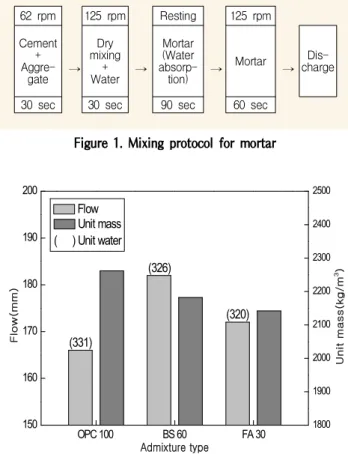
본 연구의 실험방법으로 먼저, 모르타르의 혼합은 Figure 1과 같이 모르타르 믹서를 사용하여 KS L 5109의 방법에 의거 진행하였다.
굳지 않은 모르타르의 특성으로 플로는 KS L 5111, 단위 용적질량은 KS F 2409에 의거 측정하였고, 경화 모르타르 의 특성으로 압축강도는 KS L 5105에 의거하여 측정하였 다. 양생요인의 평가로 수분증발량인 질량변화율은 시멘트 모르타르의 시간경과에 따른 질량변화량을 처음의 질량으로 나누어 백분율로 구하였고. 길이변화율은 KS F 2424에 의 거하여 콘택트 게이지로 측정하였다.
3. 실험결과 및 분석
3.1 굳지 않은 모르타르의 특성
본 실험에 적용한 모르타르의 특성으로, 결합재 종류에 따른 굳지 않은 모르타르의 플로 및 단위용적질량은 Table
150 160 170 180 190 200
( ) Unit water
(320) (326)
(331)
Flow(mm)
Admixture type Flow
BS 60
OPC 100 FA 30 1800
1900 2000 2100 2200 2300 2400 2500
Unit mass(kg/m3)
Unit mass
Figure 2. Influence of mixture type on flow and unit mass
Table 9. Flow and unit weight volume with mortar type
Type B : S Flow
(mm) Unit mass
(kg/m3) OPC
1:3
166 2 262
BS(60) 182 2 182
FA(30) 172 2 142
9 및 Figure 2와 같다.
먼저, 플로는 목표 값인 180±25mm를 모두 만족하였는 데, OPC 100%를 치환 사용한 배합 대비 혼화재를 치환 사 용한 경우 단위수량이 감소하였음에도 불구하고 플로 값이 증가하는 것으로 나타났다. 이는 BS(60)을 치환한 경우는 OPC와 달리 BS 내부로의 물 흡수량이 적기 때문에 사용수 가 효율적으로 유동성에 작용하여 플로가 증가한 것으로 판 단되고, FA(30)을 치환한 경우는 Ball bearing효과에 기인 한 것과 고체입자의 충전밀도를 향상시켜 유동성이 향상된 것으로 판단된다[5]. 단위용적질량은 2,200kg/m3 전후로 나타나는데, OPC가 가장 크고, BS(60), FA(30)의 순으로 혼화재 치환 모르타르에서 단위용적질량이 작게 나타났다.
Influence of Curing Methods on Compressive Strength and Shrinkage of High Strength Mortar with High Volume SCMs
이는 혼화재의 밀도가 작은 것과 혼화재 치환율 및 공기량의 영향 등 복합에 기인한 것으로 판단된다.
3.2 경화 모르타르의 특성
3.2.1 압축강도
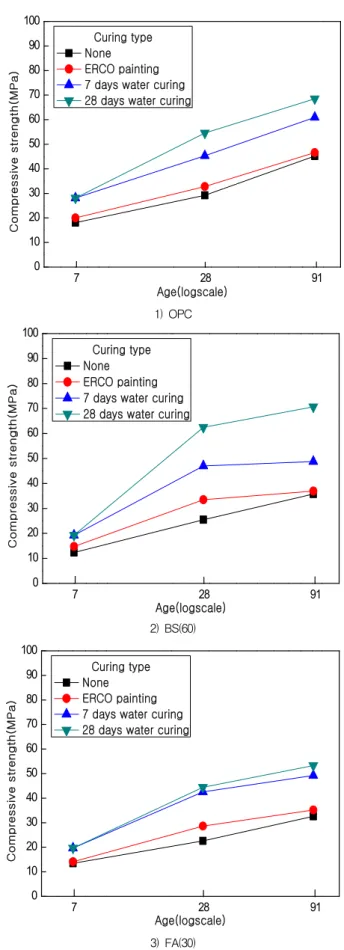
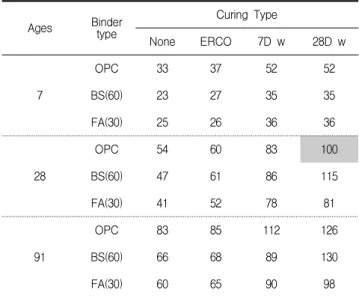
경화모르타르의 특성 분성으로, Figure 3은 결합재 종류 및 양생조건 변화별 재령경과에 따른 압축강도를 나타낸 것 이고, Table 10은 OPC의 수중양생을 기준으로 각 재령 결 합재 종류 및 양생방법별 압축강도 발현율을 나타낸 것이며, Table 11은 OPC 28일 수중양생을 기준으로 각 재령 결합재 종류 및 양생방법별 압축강도의 발현율을 나타낸 것이다.
당연한 결과이겠지만 양생조건변화에 따라 약간의 차이는 있을지라도 전반적으로는 재령의 log 함수에 비례하여 증가 하는 경향을 나타내었다.
Table 10. Influence of powder type and curing method on compressive strength (Ratio to the compressive strength of
wet cured OPC)
(unit : %)
Ages Binder
type
Curing Type
None ERCO1) 7D w2) 28D w3)
7
OPC4) 64 71 100 100
BS5)(60) 44 53 69 69
FA6)(30) 48 51 78 78
28
OPC 64 77 83 100
BS(60) 47 61 86 115
FA(30) 41 52 78 81
91
OPC 68 72 89 100
BS(60) 52 54 71 103
FA(30) 48 51 72 78
* The result of the curing method is expressed as a percentage based on 28 days of underwater curing of OPC
1) Emulsified refined cooking oil 2) 7 days wet curing
3) 28 days wet curing 4) Ordinary portland cement 5) Blast furnace slag powder 6) Fly ash
상세분석으로 먼저 결합재 종류별에 따라서는 재령 7일의 경우 OPC에 비해 양생조건을 평균할 때 BS(60) 및 FA(30) 의 경우 대략 20∼30%의 강도저하를 나타내었고, 28일 및 91일의 경우 수중양생 특히 BS 60의 경우는 양호한 강도를 발휘하였지만, FA(30)은 80%정도의 강도를 발휘한 반면,
0 10 20 30 40 50 60 70 80 90 100
28 7
Curing type None ERCO painting 7 days water curing 28 days water curing
Compressive strength(MPa)
Age(logscale)
91 1) OPC
0 10 20 30 40 50 60 70 80 90 100
Curing type None ERCO painting 7 days water curing 28 days water curing
Compressive strength(MPa)
Age(logscale)28
7 91
2) BS(60)
0 10 20 30 40 50 60 70 80 90 100
Curing type None ERCO painting 7 days water curing 28 days water curing
Compressive strength(MPa)
Age(logscale) 28
7 91
3) FA(30)
Figure 3. Influence of curing method on compressive strength depending on age
50% 정도밖에 발휘되지 않았다. 따라서 BS 및 FA와 같은 혼화재를 다량치환할 경우에는 잠재수경성반응 및 포졸란 반응이 일어날때까지의 재령에서는 초기강도가 작게 발휘 됨에 유의할 필요가 있고, 또한 후기 강도에 있어서도 충 분한 습윤양생이 이루어지지 않으면 목표한 강도가 발휘 되지 못함을 알 수 있었다.
Table 11. Influence of powder type and curing method on compressive strength (Ratio to the compressive strength of 28
days wet cured OPC)
(unit : %)
Ages Binder
type
Curing Type
None ERCO 7D w 28D w
7
OPC 33 37 52 52
BS(60) 23 27 35 35
FA(30) 25 26 36 36
28
OPC 54 60 83 100
BS(60) 47 61 86 115
FA(30) 41 52 78 81
91
OPC 83 85 112 126
BS(60) 66 68 89 130
FA(30) 60 65 90 98
양생방법에 따른 영향으로는 당연한 결과이겠지만 수중양 생일 경우 가장 크게, 건조시킬 경우 가장 작으며, 탈형 즉시 ERCO를 도포한 경우는 건조시킨 경우보다는 양호하나 7일 수중양생 후 건조시킨 경우보다는 저하하게 나타났다. ERCO 를 도포할 경우 건조시킨 것보다 양호한 강도발현의 원인은 콘크리트 중 시멘트 수화생성물인 Ca(OH2)와 ERCO의 유지 류 성분이 비누화 반응하여 모르타르 표면의 모세관 공극을 충전함으로서 모세관 공극속의 수분증발을 억제하여 양생효 과를 증진 시키므로서 얻어진 결과로 사료된다.
또한 7일 수중양생 후 건조한 경우 일시적으로 강도가 증가하여 지속적인 수중양생보다 증가한다는 보고[6]도 있 지만, 본 연구에서는 시험체 사이즈가 기존 연구보다 작음에 따라 수화반응에 장애를 받아 작아진 것으로 분석된다.
종합적으로 혼화재 다량치환 고강도 모르타르에서 양생방 법별 강도 발현율은 Table 11과 같이 28일 수중 양생한 OPC에 비해 BS(60)수중양생은 115%를 발휘하여 양호한
-0.08 -0.06 -0.04 -0.02 0.00 0.02 0.04
0.06 None
ERCO painting 7 days water curing 28 days water curing
Age(days)
Mass change(Ratio)
150 180
120 90 60 28 0
1) OPC
-0.08 -0.06 -0.04 -0.02 0.00 0.02 0.04 0.06 0.08
Curing type None ERCO painting 7 days water curing 28 days water curing
150 180
120 90 60 28 0
Mass change(Ratio)
Age(days) 2) BS(60)
-0.08 -0.06 -0.04 -0.02 0.00 0.02 0.04 0.06 0.08
Curing type None ERCO painting 7 days water curing 28 days water curing
150 180
120 90 60 0 28
Mass change(Ratio)
Age(days) 3) FA(30)
Figure 4. Influence of curing method of mass change depending on age
Influence of Curing Methods on Compressive Strength and Shrinkage of High Strength Mortar with High Volume SCMs
반면 여타의 양생은 41∼86%로 표준강도보다 크게 미달되 는 경향을 나타내었고, 91일까지 연장하여도 60∼112%로 강도증진은 있지만 특히 혼화재를 다량치환한 경우일수록 강도저하가 큼에 유의할 필요가 있는 것으로 분석되었다.
3.2.2 질량변화율 및 길이변화율
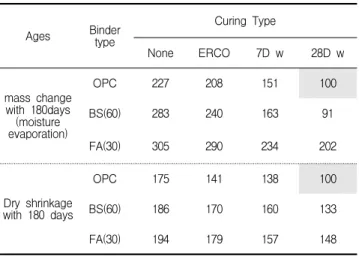
콘크리트 및 시멘트 모르타르가 건조 환경에 놓이게 되면 수분증발에 의한 질량감소와 아울러 수축에 의한 길이변화 로 나타나게 된다. Figure 4는 결합재 종류 및 양생조건 변화별 180일까지의 재령경과에 따른 질량변화율을 나타낸 것이고, Figure 5는 동일 요령으로 길이변화율을 나타낸
Table 12. Influence of powder type and curing method on evaporation rate at 180 days and shrinkage (Ratio to the 28
days wet cured OPC)
(unit : %)
Ages Binder
type
Curing Type
None ERCO 7D w 28D w
mass change with 180days (moisture evaporation)
OPC 227 208 151 100
BS(60) 283 240 163 91
FA(30) 305 290 234 202
Dry shrinkage with 180 days
OPC 175 141 138 100
BS(60) 186 170 160 133
FA(30) 194 179 157 148
것이다. 또한 Table 12는 OPC 28일 양생 후 180일까지 건조시킨 질량변화율 및 건조수축변화율을 기준으로 각 결 합재종류 및 양생방법별에 따른 변화율을 백분율로 나타낸 것이다.
먼저, 전반적인 경향으로 질량변화율은 수중양생기간 중 에는 질량이 약간 증가하였지만 기중양생기간 초기에는 급 격히 감소하고 후기에는 완만히 감소하였다. 반면 길이변화 율의 경우는 수중양생기간에는 자기수축의 영향으로 미소하 게 수축하고, 건조 환경에서는 28일이내의 초기에는 급격히 수축하고, 이후에는 완만히 수축하는 경향을 나타내었다.
세부적으로 먼저, 결합재 종류별에 따라서는 OPC보다 혼 화재를 다량 치환할 경우, 특히 FA(30)이 BS(60)보다 질량 감소율이 크게 나타난 반면 길이변화율은 거의 유사하게 나
-1200 -1000 -800 -600 -400 -200 0
Age(days) Length change(X106)
150 180
120 90 60 28 0
Curing type None ERCO painting 7 days water curing 28 days water curing
1) OPC
-1200 -1000 -800 -600 -400 -200 0
Length change(X106)
Age(days)
150 180
120 90 60 28 0
Curing type None ERCO painting 7 days water curing 28 days water curing
2) BS(60)
-1200 -1000 -800 -600 -400 -200 0
Age(days) Length change(X106)
150 180
120 90 60 28 0
Curing type None ERCO painting 7 days water curing 28 days water curing
3) FA(30)
Figure 5. Influence of curing method of length change depending on age
수중양생보다 건조 환경에 놓일 경우 크게 질량감소 및 수축 길이변화율을 나타내었다. 단, 탈형 즉시 ERCO를 도포한 경우는 압축강도와 유사하게 건조시킨 경우보다는 작게 나 타났으나 7일 수중양생 후 건조시킨 경우보다는 크게 나타났 다. ERCO를 도포한 경우가 양생 없이 건조시킨 것보다 양호 한 원인은 압축강도에서 분석한 것과 같이 모세관 공극 속에 서의 비누화 반응에 기인한 수분증발 억제의 영향으로 분석 된다.
종합적으로 고강도 모르타르에 있어 수분증발에 의한 질 량변화율 및 수축 길이변화율은 OPC 대비 혼화재 다량치환 인 경우 특히 건조 환경일수록 심각하여 28일 수중양생 후 91일 까지 건조한 경우대비 1.5∼3배의 큰 질량변화율과 수축 길이변화율이 나타남을 알 수 있었다.
4. 결 론
본 연구에서는 ERCO 도포를 포함하는 양생방법변화에 따른 혼화재 다량치환 시멘트 모르타르의 압축강도특성, 수 분증발 및 수축변화 특성을 분석하였는데, 본 연구의 범위 내에서 다음과 같은 결론을 얻었다.
1) 굳지 않은 모르타르의 유동성인 플로는 OPC 대비 혼화재를 치환한 모르타르의 배합에서 증가하는 경 향을 보인 반면, 단위용적질량의 경우는 OPC 대비 혼화재 치환한 모르타르 배합에서 감소하는 것으로 나타났다.
2) 고강도 모르타르의 강도 발현율은 OPC에 비해 BS(60) 의 수중양생은 115%로 양호하게 발휘되었지만 여타의 양생에서는 41∼86%로 표준강도보다 미달되는 경향 을 보였으며 91일까지 연장하여도 60∼112%로 강도 증진은 있었지만 혼화재를 다량 치환한 경우에서 강도 저하가 크게 나타남을 알 수 있었다.
3) 질량변화율은 전반적으로 수중양생기간 중에는 질량이 약간 증가한 반면 기중양생기간에는 초기에는 급격히 감소하고 후기에는 완만히 감소하였다. 반면 길이변화 율은 수중양생기간에는 자기수축의 영향으로 미소하 게 수축하며, 건조 환경에서는 28일이내의 초기에 급 격히 수축하고, 이후에는 완만히 수축하는 경향을 나타 내었다.
내 부의 알칼리와 비누화 반응으로 어느정도 수분증발 이 방지되어 노출보다는 강도증진 및 수축이 감소되었 지만 7일 수중양생 후 건조보다는 강도가 저하하고 수 축이 크게 되는 경향이었다.
이상을 종합하면 혼화재 다량치환 고강도 모르타르에 비 양생 건조를 실시하게 되면 28일 수중양생을 실시하였을 경 우보다 약 50% 전후의 강도저하와 1.9배의 길이변화율 증가 로 나타나 가능한 습윤양생 조건의 확보는 매우 중요한 사항 이 됨을 확인할 수 있었다. 단, ERCO 도포의 경우는 비양생 보다는 효과적이지만 여타의 수중양생 후 건조보다는 부족 함을 알 수 있었다.
요 약
우리나라의 많은 건설 공사에서는 건축물이 고층화 되면 서, 공기단축 및 물의 처리 곤란 등의 이유로 고강도 콘크리 트일지라도 습윤양생을 실시하지 않고 공사를 진행하는 경 우가 존재한다. 이와 같이 건조 상태로 양생하게 되면 압축 강도 감소, 건조수축 및 자기수축 등 수축변화가 크게 증가 할 것으로 예상된다. 또한 본 연구팀에서는 기존의 연구로 서 유지류를 콘크리트에 혼합할 경우 비누화 반응을 이용하 여 콘크리트의 자기수축 저감 및 내구성 향상에 대한 연구 를 진행한바 있다. 그러므로 본 연구에서는 양생방법을 비 양생 건조, 유화처리정제식용유(ERCO) 도포 후 건조, 7일 수중양생 후 건조 및 28일 수중양생 후 건조 등 양생 방법 변화에 따른 혼화재 다량치환 모르타르의 압축강도 특성, 수분증발에 따른 수축변화 특성에 대하여 분석하였다. 실 험결과는 양생방법으로 비양생 건조를 실시하게 되면 28일 수중양생을 실시하였을 경우보다 약 50% 전후의 강도저하 와 1.9배의 수축 길이변화율 증가로 나타나, 혼화재 다량 치환 고강도 모르타르에 있어 습윤양생이 매우 중요하게 영향을 미치는 것을 알 수 있었다. 단, ERCO 도포의 경우 는 강도 및 수축변화측면에서 무양생인 건조보다는 우수하 지만 7일 수중양생 후 건조보다는 성능이 저하하는 것으로 나타났다.
키워드 : 양생방법, 혼화재 다량치환, 고강도 모르타르, 압 축강도, 수축변화
Influence of Curing Methods on Compressive Strength and Shrinkage of High Strength Mortar with High Volume SCMs
Acknowledgement
This research was partially supported by the Cheongju University Research Scholarship Grants in 2017.
References
1. Choisin concrete gonghak [The newest Concrete Engineering].
Seoul(Korea): Kimoondang; 2011. p. 233-4.
2. Concrete pyojun sibangseo haeseol [Concrete Standard Specification]. Seoul(Korea): Kimoondang; 2009. p. 145-7 p.
3. Jo MK, Han CG. Effects of different types of oil based shrinkage reducing admixture on the fundamental properties and autogenous shrinkage of high strength concrete. Journal of the Architecture Institute of Korean Structure & Construction.
2016 Oct;32(10):39-46.
4. Han MC, Woo DH. Effects of waste cooking oil on durability of high volume mineral admixture concrete. Journal of the Korean Recycled Construction Resources Institute. 2013 Oct;1(3):173-180.
5. Hukaya. Tsuchiyuki. cementconcretejairyokagaku[Cement Concrete Material]. Tokyo(Japan): Technical Institute; 2003.
88 p. Japanese.
6. Neville AM. Properties of concrete Fourth and Final Edition.
1st ed. Tokyo(Japan): GihodoBooks; 2004. 406 p. Japanese.
7. Park JS. Characteristics of strength development of ultra-high performance concrete according to curing condition. Journal of the Concrete Institute of Korea. 2013 Jun;25(3):295-304.
8. Park JW, Lee GC. Effect of compressive strength and curing condition on the direct tensile strength properties of ultra high performance concrete. Journal of the Korea Institute of Building Construction. 2017 Apr;17(2):175-81.
9. Kim TC. Reduction of autogenous shrinkage of high strength concrete using emulsified refined cooking oil [dissertation], [Cheong-Ju(Korea)]: Cheong-Ju University; 2013.
10. Jo SJ, Han CG. Fundamental properties and reduction of autogenous shrinkage of HPFRCC depending on various fiber contents and ERCO dosages. Journal of the Korea Institute of Building Construction. 2017 Feb;17(1):1-8.
11. Lee JG, Han CG. Plastic and drying shrinkage cracking reduction by the bubble sheet curing. Journal of the Korea Institute of Building Construction. 2017 Jun;16(3):211-7.
12. Park JW, Chu YS, Jeong JH. Physical properties of calcium
silicate inorganic insulation depending on curing time. Journal of the Korea Institute of Building Construction. 2016 Dec;16(6):529-34.