• 검색 결과가 없습니다.

A Study on Problem Development of Management subject for BPBL in a Mongolian University.

N/A
N/A
Protected

Academic year: 2021

Share "A Study on Problem Development of Management subject for BPBL in a Mongolian University."

Copied!
6
0
0

로드 중.... (전체 텍스트 보기)

전체 글

(1)

Vol. 19, No. 6 pp. 683-688, 2018

1. Introduction

1.1 Research needs and objectives

Within the past few years, internet and mobile

technologies have become more affordable and widespread. Even though there are progresses, the quality in all levels of educational sector in Mongolia could still be further improved [1]. Blended learning,

A Study on Problem Development of Management subject for BPBL in a Mongolian University.

Natsagdorj Bayarmaa, Keunsoo Lee

*

Dept. of Computer Science and Engineering / Computer System Institute Hankyong National University

몽골 대학에서 BPBL을 위한 관리 교과목 문제 개발 연구

바야르마, 이근수*

한경대학교 컴퓨터공학과 / 컴퓨터 시스템 연구소

Abstract In the 21stcentury, teachers must welcome new technology to ensure the best learning in virtual classrooms, aside from the physical classroom. Google Classroom provides a vital chance to promote blended learning and professional development. The purpose of this study is to specify the procedures in problem design when employing blended problem-based learning (BPBL) and to design problems for learning the contents of the subject. The design of problems is crucial for effective BPBL. The underlying theory of BPBL is that learning is most effectively initiated and facilitated by posing and solving real-life problems that interest the learner, because working on such problems makes learning meaningful and motivates students. Ineffective problem-based learning (PBL) could affect students when acquiring sufficient domain knowledge, activating appropriate prior knowledge, and properly directing their own learning. The procedures for designing good problems are composed of the selection of educational content, figuring out the learner's characteristics, finding problems, setting up roles and situations, and writing down problems. Using these procedures, we designed five integration problems covering the contents of management subjects. Planned management subjects based on BPBL in a Mongolian university focuses on the process of designing problems.

요 약 21세기에 교사는 물리적 수업 외에 가상 수업에서 최상의 학습을 보장하기 위해 어떤 새로운 기술에도 환영해야 한다. 구글 크레스룸은 브랜디드 학습과 전문 개발을 촉진하기 위한 중요한 기회를 제공한다. 본 연구는 브랜디드 문제중심학 습을 위한 문제 설계를 제시하는 데 그 목적이 있다. BPBL의 기본적인 특징은 학습자들이 흥미를 갖게 하는 실생활의 문제 들을 포즈를 취하고 해결함으로써 학습이 가장 효과적으로 시작되고 촉진된다는 것이다. 비구조된 PBL(문제중심 학습 )문제 는 충분한 도메인 지식을 획득하는 학생들에게 영향을 미칠 수 있고, 적절한 사전 지식을 활성화하고, 그들 자신의 학습을 적절하게 지도할 수 있다. 좋은 문제를 설계하는 절차는 교육적 콘텐츠의 선택, 학습자의 특성 파악, 문제 발견, 역할과 상황 설정, 문제 기록으로 구성된다. 이러한 절차를 사용하여, 관리 과목의 내용을 포괄하는 5가지 통합 문제를 설계하였다. 몽골

대학의 BPBL에 기반하여 계획된 관리 과목 문제를 해결하는 과정에 시점을 두었다.

Keywords : BPBL, Google Classroom, ill-structured problems, Management, problem design

*
Corresponding Author : Keunsoo Lee(Hankyong National Univ. / Computer System Institute) Tel: +82-31-670-5161 email: [email protected]

Received May 15, 2018 Revised May 29, 2018

Accepted June 1, 2018 Published June 30, 2018

(2)

as the name suggests, consists of a blend of at least two pedagogical approaches: within the context of this research, blended learning is the integration of the PBL and face-to-face learning in a classroom with e-learning. For example, the classroom is used by the PBL group to discuss critical concepts, and the discussion boards and synchronous chat room in an online environment such as Google Classroom, is used to encourage participant's dialogue around the concept [2]. Mongolian Universities are being challenged by technology, and need to adapt in a world where online courses are becoming increasingly popular. Therefore, Mongolian Education Ministry defined long-term strategies and basic policies for the educational development [3]. This paper presents process and procedures of problem developments for BPBL in Mongolian Universities. The aim of the module is to develop the problems required for BPBL based on a Management curriculum. This paper contains Research needs and objectives, Instructional design of BPBL, Learning Environment for BPBL, Problem development of the BPBL, Extraction and Procedures of BPBL Problem Development and Conclusion[16-18].

2. The main body

2.1 Instructional design of BPBL

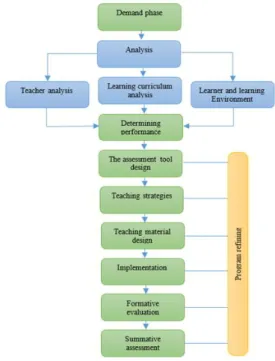
The proposed BPBL instructional design model (Fig.1) is made up of demand, analysis, performance objectives determining, assessment tool designing, teaching strategies development, teaching materials preparing, implementation, formative implement assessment, final evaluation and formative evaluation[4].

(1) Demand phase

Phase to determine gaps of Mongolian University changes in teaching and distance learning conditions.

Fig. 1. procedures design for BPBL

(2) In the analysis phase, characteristics of learners and teachers, the learning environment and learning processes will be analyzed.

(3) Determining performance objectives. Determining the expected outcomes of the study. Learning objectives should be defined before choosing appropriate courses for BPBL.

(4) Develop assessment tools and items that can determine whether the learners achieve learning objectives.

Assessment is done to acquire learning objective and close relation assessment standard and object are based on BPBL objective [5].

(5) Teaching strategies. Teaching method should be determined and various materials that are used during class should be prepared. Instructional method conditions are required to execute the learning objective. It is also called as teaching methods, teaching forms and teaching tactics [6].

(6) Teaching material design. When establishing a plan

for BPBL, all materials should be prepared for

before learning. The materials needed for class

(3)

refer to all tools of learning and media data to be used for classroom activities. Teaching materials must be prepared in accordance with the steps and procedures necessary data for lesson progress [7].

(7) Implementation. Execution of BPBL in Mongolian University. In the implementation phase, a learner gains knowledge by self-direct choosing aside from seeing and listening.

(8) Formative evaluations. The program is evaluated by the following steps, one to one evaluation, small group evaluation and on-site evaluation.

One-to-one evaluation is evaluation of learning progress, advantage of participation, occurring trouble of individual students compared to one individual student to prescribe for individual students.

(9) Summative assessment: Phase determining the result of program's last study. Formative evaluation decides whether study program met the success criteria made at the beginning.

(10) Program refining. Refining phase with content made from formative evaluation phase. Refined BPBL is improved by combining self and co-learners evaluation of the program. Problems are refined during developing process but the problem will be ready after finishing final revision.

2.2 Learning Environment for BPBL

The communication technology requires the development of computer skills as students learn to navigate different learning management systems. The skills students learn to participate include creating and sharing documents, incorporating audio/ video materials with group members, completing online learning session [8]. Online environments can help students solve problems effectively. In this study, we used the Google Classroom learning management system https://classroom.google.com to conduct the BPBL learning for students of Dornod University in Mongolia. Google has already made a large impact on education with its Google Apps for Education which

includes Google Docs, Google Spreadsheets, Google Calendars, and a diverse array of other apps that are easily utilized by schools. Google Classroom’s purpose is to facilitate paperless communication between teachers and students and streamline educational workflow. Classroom allows teachers to create classes, post assignments, organize folders, and view work in real-time [9]. Learners can begin their work with just one click, by viewing the assignment then opening a Google Doc. When they do this, teachers have a real-time view into learner progress and can offer feedback along the way. Google Classroom offers a one-stop platform for facilitating digital production, workflow, and communication between teachers and learners[10]. A new document will be created and will appear on the page with the assignment title and student's name. The files are automatically saved, even if you close or exit the screen. Once clicked on by each student, teachers can view the student's files [11].

2.3 Problem development of the BPBL The biggest feature here is that learning begins from problems in BPBL [12]. The problems were presented at the beginning of the study and the reasons why they should learn were explained. The learning based problems motivate learners further. Thus, designing problems are important to reveal a real-world problem for effective BPBL. It is important to consider the function and characteristics in designing problems. The function and characteristics are the extent to which the problem [13]: leads to the intended learning issues, promotes self-directed learning, stimulates critical reasoning, stimulates elaboration, promotes teamwork, and triggers interest.

2.4 Extraction and Procedures of BPBL Problem Development

Core objectives and content selection, associated

learning and practical content, drafting problems,

identifying the characteristics of learners, finding the

problems, setting up the roles and situation and

(4)

determining the problem of BPBL is introduced in this section. The procedure's design problem for BPBL is shown in (fig.2) below.

Fig. 2. The procedure's design problem for BPBL

Problems are used to engage students’ curiosity and initiate learning the subject matter. BPBL prepares students to think critically and analytically, and to find and use appropriate learning resources. The problems should be based on the needs of Mongolian business situation, multiple textbooks and cases. Moreover videos, stories, novels, magazine articles and research papers about recent Mongolian economic environment can be used. The real world stories such as those from newspapers, radio, TV or specialized books can be used.

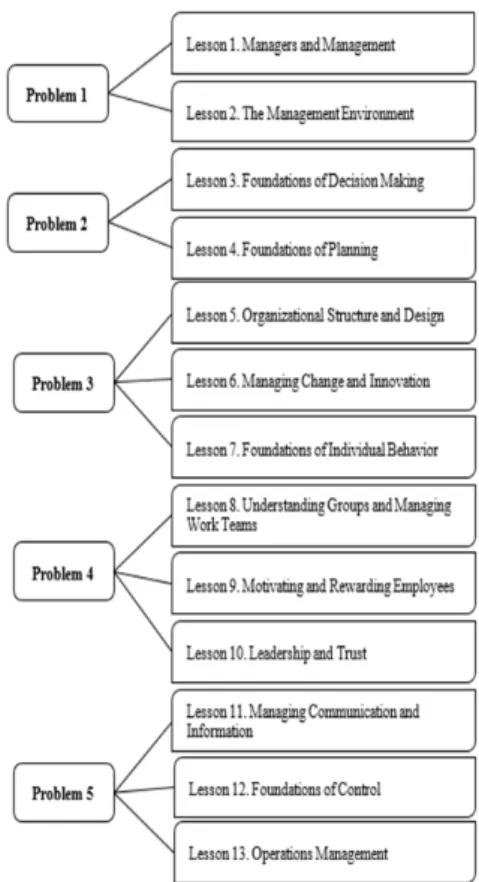
(1) Select the core objectives and content Core objectives and content of BPBL for Management subject in Mongolian Universities can be selected. In the process of solving a given problem, learning objectives should be achieved [14]. In this study, learning contents and the suitable BPBL problem is designed [14]. It is shown in (fig.3)

(2) To plan associated learning content and practical context

Learner-centered learning is actuated in educational

Fig. 3. The Problems of BPBL and Relative Lessons

scene all around the world. On the other hand, teaching methods used in Mongolian universities are mostly teacher centered and passive.

(3) Draft the Problem

To define and introduce the BPBL problem which suited Mongolian learners. The method for distributing a problem falls under three closely related teaching techniques: case studies, role-plays, and simulations.

Regardless of which technique is used, the heart of the method remains the same: a real-world problem.

(4) Identify the learner characteristics

In Mongolia there have been the traditional way of thinking that teacher is the best, other than parents and education is very important since long time ago.

Teachers are the most idolized person and without

seeing their faces students can’t learn independently.

(5)

(5) Find the problem

In BPBL problems are provided through a variety of forms such as of video, simulation, role-playing, and simulation computer. This also evaluates the students based on their understanding of contents and terminologies.

(6) Setting up the roles and situation

The role of instructor and learners of BPBL are unfamiliar in Mongolia. Encourage the learners based on the real situations of Mongolian students to attend the learning even when they are solving problem poorly and continue with a flexible mindset to fit the actual learning environment.

(7) Create the problem

While the core problems will vary among disciplines, there are some characteristics of good PBL problems that transcend fields (2001, Duch, Groh, and Allen). The problem must motivate students to seek out a deeper understanding of concepts. The problem should require students to make reasoned decisions and to defend them. The problem should incorporate the content objectives in such a way as to connect it to previous courses/knowledge. If used for a group project, the problem needs a level of complexity to ensure that the students must work together to solve it.

If used for a multistage project, the initial steps of the problem should be open-ended and engaging to draw students into the problem. Problem designed that learners can check in learning tasks. All of the information needed to solve the problem is given into the problem definition and do research for the problem solving. An example of a problem for a management class is provided below:

Example: You are a professor of management at University for 10 years. You have to make lesson plan and instruction easy to understand. The contents of the lesson plan require a Managers and Management, The Management Environment, Foundations of Decision Making, Foundations of

Planning, Organizational Structure and Design, Managing Change and Innovation, Foundations of Individual Behavior, Understanding Groups and Managing Work Teams, Motivating and Rewarding Employees, Leadership and Trust, Managing Communication and Information, Foundations of Control, to present it on the dates outlined below, The presentation should be carried out within 20 minutes.

Date of Announcement: 0000 Announcement: 0000

3. Conclusion

This study designed the procedures for employing BPBL and provides guidelines of defining problems for learning content of the subject. BPBL provides high satisfaction because of reasons such as more acquired skills, more independent study and collaboration, more flexibility and more opportunities. The good problem designing is summarized as selecting the core learning objectives and content, designing practical context related to learning content, drafting problem, identify the learner characteristics, finding problems, establishing the role and situation and designing problem. The learning content that is composed of 13 chapters and 5 designed problems for BPBL. An online environment, Google Classroom is introduced in this paper as a possible environment to facilitate BPBL.

Develop students' problem-solving skill based on increasing opportunities for the development of collective intelligence [15]. In Google Classroom, multimedia contents provided by search sites and information that are necessary for classes are produced as multimedia contents. The instructional design of BPBL at the Mongolia is a worthwhile research topic.

This research will be helpful for tending the Mongolian

specialists required by society based on information

and communication technology.

(6)

References

[1] Narangerel Jachin, Tsuyoshi Usagawa, “Potential Impact of Blended Learning on Teacher Education in Mongolia,” Scientific Research Publishing, vol. 8 no. 9, July 2017.

[2] Roisin Donnelly “Blended Problem-based Learning for Teacher Education: Lessons Learnt,” Journal of Learning, Media and Technology, vol. 31, no. 2, 2006.

DOI: https://doi.org/10.1080/17439880600756621 [3] Oyunsuren Buriad, “A study on Learning Environment

and Design for Cyber Education in Mongolia,”

Sangmyung University, pp 17-22, 2013.

[4] Bayarmaa Natsagdorj, Keunsoo Lee, “Instructional Study Design of the Application of BPBL in Engineering College in Mongolia”, Journal of KAIS, vol. 17, no.

12, pp. 504-510, 2016.

DOI: https://doi.org/10.5762/KAIS.2017.18.1.530 [5] “A Study on the Effects of Applying PBL in Class

Design,” 2011.

[6] Keun soo Lee, “A study on Problem Design for PBL in Creative Engineering Design Subject,” Journal of KAIS, vol. 8, no. 6, pp. 5. 2012.

DOI: https://doi.org/10.5762/KAIS.2014.15.8.5242 [7] Weiss R. E, "Designing problems to promote high-order

thinking. In D. Knowlton and D. Sharp (Ed.), Problem-Based Learning in the Information Age" pp.

25-31 CA: Jossey- Bass Publishers, 2003.

[8] Park Yang Mi, “The Effects after Appling PBL (Problem-Based Learning) On-off Line in Design Class”

pp. 128, 2014.

[9] Jordan Catapano, “Technology in the Classroom: A Look at Google Classroom”

http://www.teachhub.com/technology-classroom-look-goo gle-classroom

[10] Meghan Bogardus Cortez, “Google Classroom:

Exploring the Benefits for Teachers,”

https://edtechmagazine.com/k12/article/2017/06/google-cl assroom-exploring-benefits-teachers

[11] Amanda Graham, Debra Peters, “Google Classroom Basics,”

http://hesperiausd.org/Schools/Middle/HJH/pearson/teach ers/pdf/HowToGoogleClassroomBasics.pdf

[12] Y. S. Cho, H. J. Lee, E. J. Baek, H. H. Lim, A study on the procedure of Problem- Based Learning, The Journal of Curriculum Studies, vol. 21, no. 3, pp.

215-242, 2003.

DOI: http://dx.doi.org/10.15708/kscs.21.3.200309.001 [13] Nachamma Sockalingam, “Designing Problems for

Problem-based Learning,” https://www.facultyfocus.com, 2011.

[14] Stephen P. Robbins, "Fundamentals of management", Pearson Education Canada 2013.

[15] Keun soo Lee, “A study on Problem Design for PBL in Creative Engineering Design Subject,” Journal of KAIS, vol. 8, no. 6, pp. 5, 2012.

DOI: https://doi.org/10.5762/KAIS.2014.15.8.5242 [16] Sun-Young Kim, Soo-Jin Kim, Effects of Learning Style

on Self-Directed Readiness of Student in Problem-Based Learning, Asia-pacific Journal of Multimedia Services Convergent with Art, Humanities, and Sociology, vol. 6, no. 4, pp. 261-270, Apr. 2016.

DOI: http://dx.doi.org/10.14257/AJMAHS.2016.04.28 [17] Soo-Jin Kim, Hee-Kyeung Kang, The Effect of Tutor's

Expertise and Teaching Experience on Learners' Satisfaction in the Problem-Based Learning, Asia-pacific Journal of Multimedia Services Convergent with Art, Humanities, and Sociology, vol. 6, no. 7, pp. 279-290, July 2016.

DOI: http://dx.doi.org/10.14257/AJMAHS.2016.07.40 [18] Hye Jin Kim, Effects of PBL Applied to a Teaching

Training Course on Cognitive, Affective, and Social Features of Pre-service Teachers, Asia-pacific Journal of Multimedia Services Convergent with Art, Humanities, and Sociology, vol. 6, no. 11, pp. 181-190, Nov. 2016.

DOI: http://dx.doi.org/10.14257/AJMAHS.2016.11.40

Natsagdorj Bayarmaa [Regular member]

•Feb. 2015 : Mongolian Educational Univer,. Dept. of Economy, M.A

•Sep. 2012 ~ Jun. 2015: Dornod Univer., Professor

•Mar. 2015 ~ current: Hankyong National Univer., Department of Computer Science & Engineering (Computer system Institute) Studying at Doctor's course

<Research interests>

PBL, educational engineering, engineering design, Accounting, Economy, and Marketing

Keunsoo Lee [Regular member]

•Feb. 1988: Soongsil Univ., Dept.

of Computer Science, M.S

•Aug. 1993: Soongsil Univ.,Dept.

of Computer Science, Ph.D

•Feb. 1989 ~ current: Hankyong National University., Dept. of Computer Science & Engineering (Computer system Institute), Professor

<Research interests>

Computer Vision, Image Processing, Fuzzy Theory, Motion

Understanding, Video Retrieval. Ubiquitous computing,

PBL, educational engineering, and engineering design

수치

Fig.  1. procedures  design  for  BPBL
Fig.  2. The  procedure's  design  problem  for  BPBL

참조

관련 문서

The purpose of this study is to investigate the effect of project-based and problem-based convergent learning on the creative personality of EFL (English as a foreign language)

Abstract This study was convergence study conducted to examine the effects of problem-based learning(PBL) on self-directed learning ability, problem solving

A Study on the Possibility of Applying Blended Learning to Design Education -Focused on the survey of learners’ satisfaction-.. A Study on Method for Learning

학습자중심 학습에서 주로 활용되고 있는 교수학습법 은 문제중심학습(Problem Based Learning), 플립러닝 (Flipped Learning), 액션러닝(Action Learning), 사례 중심학습(Case

“Problem-based learning meets case-based reasoning in the middle-school science classroom: Putting learning by design into practice”, Journal of the Learning

The purpose of this study was to develop practical problem based teaching-learning plans and to verify its effect on middle school students' self efficacy, ego

The purpose of the study is to provide educational implications for more effective Problem-based learning(PBL) by investigating students' learning types based

Purpose: This study aimed at developing the problem-based learning packages on the respiratory and cardiac system of an adult- health nursing course, and to examine the effect of