라즈베리파이를 이용한 얼굴검출 및 인식 시스템 개발
김강철*ㆍHai-tong Wei**
Development of a Face Detection and Recognition System Using a RaspberryPi
Kang-Chul Kim*ㆍHai-tong Wei**
요 약
사물인터넷이 4차 산업혁명을 주도할 새로운 기술로 각광받고 있으며, 이미 많은 기술과 제품들이 발표되어 인간의 삶의 질을 높이는 데 많은 기여를 하고 있다. 본 논문에서는 건물의 엘리베이터 등에서 얼굴 검출 및 얼굴 인식에 사용할 수 있는 시스템을 개발한다. 얼굴 검출 시스템은 하르 직렬 분류기를 사용하며, 얼굴 인식 시스템에는 수행 시간을 줄이기 위하여 본 논문에서 파이썬 언어로 구현된 주성분 분석(PCA)이 얼굴 인식을 위한 고유 얼굴(eigenface) 계산에 사용된다. 데이터베이스에 저장된 얼굴과 얼굴 검출 시스템의 결과로부터 얼굴을 인식하기 위하여 SVM 또는 유크리디안 측정이 사용된다. 제안된 시스템은 OpenCV를 사용하여 라즈 베리파이 3에 구현된다. 본 논문에서 구현된 주성분 프로그램의 성능을 구하기 위하여 기존의 주성분 프로그 램과 비교하여 얼굴 인식율과 수행시간을 비교하였다. 성능 평가를 위하여 ORL 얼굴 데이터베이스에서 40명 의 얼굴에 대하여 각각 10 개의 이미지를 이용하여 학습에 200, 테스트에 200개의 이미지를 사용하였다. 본 논 문에서 제안된 PCA와 유클리디안 측정을 이용한 경우 약 93%, SVM의 경우 약 96% 이상의 얼굴 인식률을 얻었다. 그러나 수행시간은 본 논문에서 구현된 PCA를 사용할 경우 약 0.11초, 기존 PCA의 경우 약 1.1초로 약 1/10로 수행 시간을 줄일 수 있었다. 그러므로 본 논문에서 개발된 시스템은 실시간 결과가 필요한 보안 시스템, 엘리베이터 모니터링 시스템 등에 적용할 수 있을 것으로 기대된다.
ABSTRACT
IoT is a new emerging technology to lead the 4th industry renovation and has been widely used in industry and home to increase the quality of human being. In this paper, IoT based face detection and recognition system for a smart elevator is developed. Haar cascade classifier is used in a face detection system and a proposed PCA algorithm written in Python in the face recognition system is implemented to reduce the execution time and calculates the eigenfaces. SVM or Euclidean metric is used to recognize the faces detected in the face detection system. The proposed system runs on RaspberryPi 3. 200 sample images in ORL face database are used for training and 200 samples for testing. The simulation results show that the recognition rate is over 93% for PP+EU and over 96% for PP+SVM. The execution times of the proposed PCA and the conventional PCA are 0.11sec and 1.1sec respectively, so the proposed PCA is much faster than the conventional one. The proposed system can be suitable for an elevator monitoring system, real time home security system, etc.
키워드
IoT, Face Detection, Face Recognition, Eigenface, OpenCV, RaspberryPi 사물 인터넷, 얼굴 검출, 얼굴 인식, 고유 얼굴, OpenCV, 라즈베리파이
* 전남대학교 전기전자통신컴퓨터공학부 ([email protected])
** 교신저자 : 전남대학교 대학원 컴퓨터공학과 ㆍ접 수 일 : 2017. 09. 02
ㆍ수정완료일 : 2017. 09. 25 ㆍ게재확정일 : 2017. 10. 18
ㆍReceived : Sep 02, 2017, Revised : Sep 25, 2017, Accepted : Oct 18, 2017 ㆍCorresponding Author : Wei Hai-Tong
Dept. of Computer Engineering, Graduate School, Chonnam National University, Email :loveweihaitong@fox mail.com
http://dx.doi.org/10.13067/JKIECS.2017.12.5.859
Ⅰ. Introduction
IoT is a new emerging and most import technology for 4th industrial renovation and has been widely used in position based system, smart car, home network and security system, monitoring systems for water, gas and power in a smart city, and so on. In the era of world wide web people are in the center of network, but in the IoT a smart devices are in the center of network[1-3].
Many open source hardware platforms are announced for IoT implementation such as Arduino, Beaglebone black, Cubieboard, Galileo, Artik, RaspberryPi. RaspberryPi is a building blocks of a generic SBC(single-board computer) based IoT device and is a low-cost mini-computer with the physical size of a credit card. RaspberryPi runs various flavors of Linux and can perform almost all tasks that a normal desktop computer can do[4]. In addition, RaspberryPi also allows interfacing sensors and actuators through the general purpose I/O pins. And it supports Python out of the box[5].
An elevator is the most important riding tool in a building. If the elevator is more intelligent, it will bring more conveniences to the people. High-tech face recognition technology will bring revolutionary changes to make the elevator of buildings intelligent and convenient. RaspberryPi 3 can be used in a smart elevator monitoring system that automatically takes passengers to the floor of the building which they want to go[6].
In this paper, IoT based face detection and recognition system for a smart elevator, which shows the floor of the building that passengers live in is developed using OpenCV[7-8]. Haar cascade classifier is used a face detection system and in the face recognition system a proposed PCA algorithm written in Python is implemented to reduce the execution time on RaspberryPi 3 so that the passengers don’t feel bored in an elevator.
We propose four types of the face detection and
recognition system using the proposed PCA and conventional PCA supported in OpenCV with SVM and Euclidean metric for matching. To get performance evaluation of the proposed system, we train and test the system with 200 sample images for training and 200 sample images for testing in ORL face database. The time consumption of two PCAs are calculated.
This paper is organized as follows. Section Ⅱ explains the proposed PCA algorithm, and the face detection and recognition system is presented in section Ⅲ. Section Ⅳ shows the simulation results with four models and conclusions are described in section Ⅴ.
Ⅱ. The Proposed Principal Component Analysis(PCA)
Many algorithms have been developed to recognize objects and they extract information looking around some features or inside[9-10]. The extracted information or algorithms are called descriptor because they describe the features. So good descriptor is required to extract many useful features. PCA is well known as very effective descriptor for face recognition and can reduce D-dimensional feature vectors into d-dimensional vectors(D>d) with the least information loss[11].
PCA is a statistical procedure that uses an orthogonal transformation to convert a set of observations of possibly correlated variables into a set of values of linearly uncorrelated variables called principal components[12]. The number of principal components is less than or equal to the smaller of the number of original variables or the number of observations. This transformation is defined in such a way that the first principal component has the largest possible variance, and each succeeding component in turn has the highest variance possible under the constraint that it is
orthogonal to the preceding components. The resulting vectors are an uncorrelated orthogonal basis set. PCA is sensitive to the relative scaling of the original variables.
In this paper we develop a new PCA instead of the PCA supported in OpenCV. Fig. 1 shows the pseudo code of the proposed PCA.
# Pseudo code for PCA
step 1: Process the local face library step 2: Calculate the mean
step 3: Subtract the mean from data matrix step 4: Compute the covariance matrix
step 5: Find the eigenvalues and eigenvectors of the covariance matrix
step 6: Sort the eigenvalues from largest to smallest step 7: Take the top N eigenvectors
step 8: Transform the data into the new space created by the top N eigenvectors
step 9: Get the Eigenfaces dataset matrix
Fig. 1 Pseudo code for the proposed PCA
In the first step, the system reads all the images in the local face library and saves them in a matrix. we create the matrix A(m,n=i×j) to save the image data, where the number of images, the number of pixel in an image, image length and width are m, n, i and j respectively. Each row of the matrix represents all the pixel information of an image and each column represents a dimension. In other words, dimension reduction represents the image with fewer columns. After processing the image of the local face library, the system displays all the images in a matrix called data. The dimension of data is m × n where n = i × j.
The second step is to calculate the average of each dimension in the data matrix and we can obtain the mean face.
The third step is to subtract the mean of the corresponding column from each column of the data matrix, so that mean of the data from each column is zero.
In the fourth step, the covariance matrix represents the relationship between the different random variables, so it is to find the relationship between any two pixels in the image. If the covariance of two random variables is positive or negative, it indicates that there is a correlation between the two variables. If it is zero, the two variables are not relevant. By calculating the covariance matrix, we can obtain the relationship between the different pixels. The formula for calculating the covariance matrix in OpenCV is as follows, where mean_matrix is the result of the third step.
cov =mean_matrix.T x mean_matrix
Because the covariance matrix is a real symmetric matrix in the fifth step, we can find all the eigenvalues and eigenvectors, which have n eigenvalues and eigenvectors.
The principal component is the eigenvectors with the largest eigenvalues. So in the sixth and seventh steps, we need to sort the eigenvectors according to the eigenvalues from large to small and then select different number of eigenvectors by the precision requirement. In our system, the dimension of the matrix is 92×112=10304 and the chosen eigenvectors are much smaller than n. In order to achieve the accuracy of the recognition rate, we only select 50 eigenvectors.
The principal component we choose is actually the projection matrix in eighth step.
Finally, we can get the eigenfaces dataset matrix and the data of test images under the eigenvectors.
Ⅲ. The Face Detection and Recognition System Structure
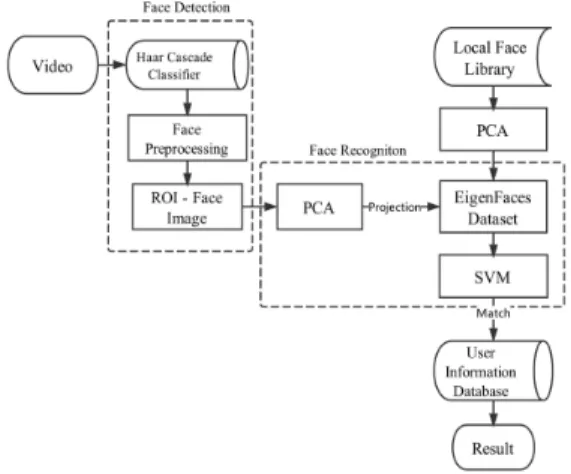
The proposed system consists of a face detection and face recognition as shown in Fig. 2.
The face detection system captures the faces of visitors in an elevator. Face detection part
contains facial detection using Haar classifier and image preprocessing aimed at Region of Interest(ROI)[13]. A histogram equalization is used to preprocess the face image. The histogram is a point operation that changes the grayscale value of the image by point, maximizing the number of pixels in each gray scale, making the histogram balanced. Histogram equalization allows the input image to be converted to an output image with the same number of pixels on each gray scale.
Fig. 2 Block diagram of the proposed system
The proposed PCA is applied to get the Eigenfaces dataset from the images. Next, we use one of Euclidean metric and Support Vector Machine(SVM) for matching[11].
Ⅳ. Simulation Results
We implement 4 types of a face detection and recognition system with two PCAs(the proposed PCA in section Ⅱ and conventional PCA provided in OpenCV) and two matching algorithms(SVM and Euclidean metric). PP+EU is the proposed PCA+
Euclidean, OP+EU is OpenCV PCA + Euclidean, PP+SVM is the proposed PCA + SVM, and OP+SVM is OpenCV PCA + SVM.
The ORL(Olivetti Research Laboratory) Database of Faces contains a set of face images used in the context of a face recognition project[14]. There are ten different images of each of 40 distinct subjects.
For some subjects, the images were taken at different times, varying the lighting, facial expressions. All the images were taken against a dark homogeneous background with the subjects in an upright, frontal position.
In order to get the performance of each system, the following 3 steps are carried out: 1) Use ORL face database as a training and test data sample. 2) Select randomly the 5 faces of each person in the database as training samples and the rest of 5 faces as test samples. So there are a total of 200 training samples and 200 test samples. 3) All 200 test samples are all recognized, this process is called a random test. Then we observe whether the 200 test samples are accurately identified. This experimental process is done 50 times for every 4 systems.
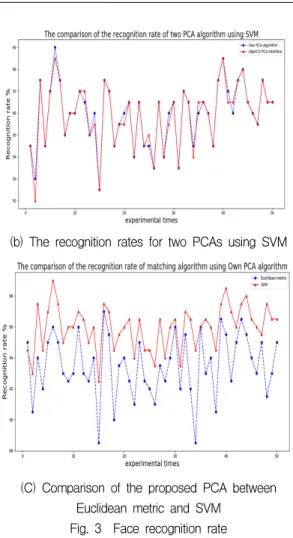
Fig. 3 shows the face recognition rates of 4 systems for every experiment. As shown in Fig. 3 (a), PE+EU and OP+EU get almost same results of around 94% and PP+SVM and OP+SVM in Fig.3 (b) show almost same results of around 96%, and they have same trends as well. And Fig. 3 (c) says that the proposed PCA with SVM(PP+SVM) has better face recognition rate than the proposed PCA with Euclidean metric(PP+EU).
(a) The recognition rates for two PCAs using Euclidean metric
(b) The recognition rates for two PCAs using SVM
(C) Comparison of the proposed PCA between Euclidean metric and SVM
Fig. 3 Face recognition rate
Table 1 shows the average recognition rates, where ARR is the average recognition rate. PP+EU has a little higher rate of 0.4% than OP+EU and PP+SVM has higher result of 0.13% than OP+SVM.
These results mean that the proposed PCA is a little better than the conventional PCA for the face recognition.
Table 1. Recognition rate
Type PP+EU OP+EU PP+SVM OP+SVM
ARR 93.99 % 93.57 % 96.23 % 96.10 %
Table 2 show the average time consumption in PCA, where ATC is the average time consumption.
PP has 0.11s, and conventional OP has 1.11s on RaspberryPI 3. The proposed PCA can reduce it by removing the complex interfaces to connect to other functions and data type conversion time. Therefore our proposed PCA is more suitable to real time system or embedded systems that need faster execution time.
Table 2. Time consumption of PCA
PCA type PP OP
ATC(s) 0.110 1.110
Ⅴ. Conclusion
We implement a new PCA written in python that can run on RaspberryPi 3 for a smart elevator and design 4 types of face detection and recognition system.
The ORL database which contains 400 images is used to get the face recognition rate. The simulation results say that the proposed PCA in this paper is better than the conventional PCA in OpenCV, and the combination of the proposed PCA and SVM has the best performance. The execution times for two PCAs are 0.11s and 1.11s and this shows the proposed PCA is 10 times faster than the conventional PCA. Therefore our proposed PCA is more suitable in application field such as real time system or embedded systems that need faster execution time.
References
[1] S. Ray, A. Raychowdhury, and Y. Jin, “The Changing Computing Paradigm With Internet of Things: A Tutorial Introduction,” IEEE Design Test, vol. 33, issue 2, 2016, pp. 76-96.
[2] A. Al-Fuqaha, M. Guizani, M. Mohamadi, M.
Aledhari, and M. Ayyash, “Internet of Things:
A Survey on Enabling Technologies,
Protocols, and Applications,” IEEE Communication Surveys & Tutors, vol. 17, no.
4, 2015, pp. 2347-2376.
[3] M. Palattella, M. Dohler, A. Grieco, G. Rizzo, J. Torsner, T. Engel, and L. Ladid, “Internet of Things in the 5G Era: Enablers, Architecture, and Business Models,” IEEE J.
on Selected Areas In Communications, vol. 34, no. 3, Mar. 2016, pp. 510-527.
[4] K. Kim, D. Wang, S. Han, “Home Security System Based on IoT”, J. of the Korea institute of electronic communication sciences, vol. 12, no.
1, Feb. 2017, pp.147-154.
[5] A. Bahga, V. Madisetti, Internet of things: A Hands-On Approach, San Bernardino, Arshdeep Bahga & Vijay Madsett, 2014.
[6] E. Upton and G. Halfsacree, Raspberry Pi User Guide, West Sussex, Wiley, 2014.
[7] G. Bradski and A.Kaehler, Learning OpenCV:
Computer Vision with the OpenCV Library, Sebastopol, O'Reilly Media, 2008.
[8] J. Zhu, J. Chong, K. Kim, “The Recognition and Distance Estimation of a Golf Ball using a WebCam”, J. of the Korea institute of electronic communication sciences, vol. 8, no. 12, Dec. 2013, pp.147-154.
[9] I. Oh, Computer Vision, Seoul, HANBIT Academy, 2014.
[10] R. C. Gonzalez, Digital image processing, NewJersey, Pearson. 2010.
[11] L. I. Smith, A tutoral on principal component analysis, New York, Cornell University, 2002.
[12] P. Viola and M. J. Jones, “Robust real-time face detection,” Int. J. of Computer Vision, vol.
57, no. 2, 2004, pp. 137-154.
[13] K. Subramanian, “Face recognition using eigenface and support vector machine,” Int. J.
of Innovative Research in Computer and Communication Engineering, vol. 2, issue 7, 2014, pp. 4974-4980.
[14] F. Purnomo, D. Suhartono, M. Shodig, “Face Recognition using Gabor Wavelet and Non-Negative Matrix Factorization“, SAI Intelligent Systems Conf., London, Nov. 2015, pp.788 – 792.
저자소개
김강철(Kang-Chul Kim) 1981년 서강대학교 전자공학과 학사
1983년 서강대학교 전자공학과 석사
1996년 경상대학교 전자공학과 박사
현재 전남대학교 전기전자통신컴퓨터공학부 교수
※ 관심분야 : 임베디드시스템, NoC, IoT
Pattern Recognition
Hai-tong Wei 2016년 8월 ~ Beijing Institute of Petrochemical Technology University, communication engineering 졸업(공학사) 2016년 9월 ~ 전남대학교 대학원 컴퓨터학과 석사과정
※ 관심분야 : IoT, Computer Vision, Image Processing