기업의 CSV활동 인식이 비정규직 근로자의 직무만족에 미치는 영향 : 조직몰입의 매개효과와 자기효능감의 조절효과를 중심으로
The Effect of Perception of Creating Shared Value (CSV) Activity on Job Satisfaction of Non-permanent (Part-time) Employees: Analysis of the Mediating
Effect of Organizational Commitment and the Moderating Effect of Self-Efficacy
민희경, 유태섭, 오상진 서울과학종합대학원
Heekyung-Jo Min([email protected]), Tae-Seob Yoo([email protected]), Sang-Jin Oh([email protected])
요약
본 연구는 기업에 근무하는 비정규직(시간제) 근로자를 대상으로 기업의 CSV 활동에 대한 인식이 조직 몰입과 직무만족에 미치는 영향을 분석함으로써 기업의 CSV활동의 중요성에 대한 시사점을 제시하는데 그 목적이 있다. 본 연구의 설문 조사는 국내 대기업에서 시간제 근로자로 근무하고 있는 구성원을 대상으 로 실시하였고, 회수된 설문지 중 총 559부가 사용되었으며, 통계분석 방법은 SPSS 25.0 통계패키지를 사 용하였다. 연구결과 기업의 CSV활동에 대한 인식은 직무만족에 정(+)의 영향을 미쳤다. 특히, CSV활동 인식과 조직몰입, 그리고 조직몰입과 직무만족의 관계에서도 각각 정(+)의 영향을 미치는 것으로 나타났고, 조직몰입의 매개효과와 자기효능감의 조절효과 역시 각각 정(+)의 영향을 미치는 것으로 나타났다. 본 연구 가 함의하는 바는 기업의 CSV활동에 대한 인식이 중요하게 작용하는 바, 향후 기업에서는 다양한 영역에 서 CSV활동을 진행하고, 비 정규직 조직 구성원이 적극적으로 참여하는 제도와 조직문화를 조성하는 것이 필요하다는 결과를 보이고 있다.
■ 중심어 :∣CSV활동 인식∣직무만족∣조직몰입∣자기효능감∣
Abstract
This research examines the effect of perception of creating shared value (CSV) activity on the organizational commitment and job satisfaction of non-permanent (part-time) employees in order to understand the importance of CSV. In order to accomplish this study, 559 questionnaires were used for final analysis. SPSS 25.0 was used for statistical analysis. The analysis revealed that perception of corporate CSV activity had a positive effect on job satisfaction of non-permanent(part-time) employees. In particular, it had a positive effect on the relationships between the perception of CSV activity and organizational commitment, as well as organizational commitment and job satisfaction. The mediating effect of organizational commitment and the moderating effect of self-efficacy also had a positive effect. The implication of this study is that the perception of corporate CSV activity plays a crucial role in the current service landscape.
Therefore, it is recommended that companies conduct a range of CSV activities and create an inclusive system and organizational culture that encourages active participation of non-permanent employees.
■ keyword :∣CSV Perception∣Job Satisfaction∣Organizational Commitment∣Self-efficacy∣
접수일자 : 2018년 04월 30일 수정일자 : 2018년 05월 23일
심사완료일 : 2018년 05월 23일
교신저자 : 오상진, e-mail : [email protected]
I. Introduction
Service industries in Korea have seen remarkable growth in recent years. The number of employees working in non-permanent (part-time) positions has increased dramatically as a result. According to the 2017 Economically Active Population Survey published by Statistics Korea, the number of non-permanent (part-time) employees reached 4.76 million, which accounts for 40.3% of the total working population[1].
Other service sectors, including retail, are reported to have a larger percentage of non-permanent (part-time) workers. For example, a large retail company in Korea was hiring 6,800 part-time workers out of 10,000 employees, which makes up 68% of its total staff. Another media service company operating movie theatres was filling 70% of its workforce with part-time staff. A Korean newspaper recently surveyed non-permanent (part-time) employees, and reported that approximately 65% of those surveyed were working at the current workplace for less than 6 months. This reflects the reality of the short average tenure of non-permanent (part-time) workers in Korea. This phenomenon is now an emerging problem for service companies as they have to assume the responsibility of continuously hiring and training new employees[2-4].
In service industries, companies and their services are evaluated according to workers' attitudes towards customers and these evaluations have a direct impact on companies' business performance. In this circumstance, another big issue in this field is that non-permanent (part-time) workers make up a majority of the key employees who deal directly with customers. Therefore these workers not only should obtain a good understanding of their responsibilities within a short time, but also become personally motivated. It is important for them to have a positive
attitude towards the company they work for in order for them to deal with customers with patience.
Therefore, it is critical to identify factors influencing non-permanent (part-time) workers' organizational commitment and job satisfaction to ensure that they feel satisfied with their job and align their goals with the companies' goals. Further, it is a priority to investigate the relationship between various organizational effectiveness variables to improve corporate performance[5-7]. Unfortunately, a majority of available studies have principally investigated permanent workers. In the Korean working climate, permanent and non-permanent (part-time) workers are treated very differently, and therefore there is a considerable gap in employees' emotions towards their companies and jobs. Therefore, it is not very appropriate to apply findings of studies of permanent workers on non-permanent ones. In addition, various policy efforts for non-permanent (part-time) workers have arisen as a key labor issue to address during the current administration. Scholars suggest that setting focus on the millennial generation and finding ways to motivate them will help resolve the problem as the generation that was born between the 1980s and the 2000s, makes up the great majority of non-permanent (part-time) workers in the service sectors[8][9]. The World Economic Forum reported in 2015 that the millennial generation is highly interested in the local communities and societies that they belong to. The Harvard Business Review has argued that companies should communicate their visions on social responsibility to the millennial generation as an effective measure to increase productivity. Corporate social philanthropy is largely classified into Corporate Social Responsibility (CSR) and Creating Shared Value (CSV) and a number of scholars argue that there is a significant difference between these two concepts[10], pointed out that though CSR is a type
of essential marketing strategy for companies to form a positive reputation and to fulfil the duty of sharing benefits with society, this concept has now reached a dead-end because it has become more of a tool for corporations to stage a show. Porter and Kramer[11]
argued that CSR programs are principally focused on corporate reputation and are related to corporate projects to a limited extent. As it is hard to maintain such programs in the long term, CSV has become a new alternative, which allows a form of management that harmonizes economic and social values. To summarize, corporate CSV activities successfully appeal to the millennial generation who are highly interested in societies and local communities to which they belong.
The present study has the following objectives.
First, to empirically test the effect of perception of Creating Shared Value (CSV) activities on non-permanent (part-time) workers' organizational commitment and job satisfaction. Second, to empirically demonstrate the mediating effect of organizational commitment and the moderating effect of self-efficacy on the relationship between non-permanent (part-time) workers' perception of the company's CSV activities and job satisfaction. Finally, based on the findings, this study ultimately aims to suggest practical implications of CSV activities and organizational effectiveness to business managers who strive to increase productivity in response to the transition of employment forms and increased number of non-permanent (part-time) workers.
II. Theoretical Background
1. Perception of CSV activities
The It is necessary to examine the concept of Shared Value in CSV prior to the discussing
perception of CSV activities. Porter and Kramer[11]
held the view that shared value is not a matter of social responsibility, philanthropy, or sustainability, but rather a new way to achieve economic success.
They defined it as a policy and management strategy to strengthen the competitiveness of a company and to develop the economic and social conditions of a society where it belongs. Therefore, CSV has its focus on strengthening and expanding the links between social and economic growth. Porter and Kramer[12]
defined CSV activity as a concept of mutual coexistence of companies and local communities and suggested the following three methods for CSV activities. The first method is a way to redesign products and market. It is the development of products satisfying the unmet needs of customers and markets where suitable products are yet to be supplied. Through this activity, companies can achieve increased profit and market share, and can improve profitability. Value creation is its key objective in social terms, such as reduction of carbon emission and improved education. The second method is redefinition of value chain. Shared value can be created in the factors making up a value chain, such as energy consumption, downsizing logistics, resource exploitation, procurement, shipping, employee productivity, and location. The third method is enabling the development of community clusters.
With this approach, shared value can be created in establishing a social infrastructure with cooperating partners, which is the success factor of a company.
Scholars have continued to study the differences between CSR and CSV. Moon and Lee[10] explained that though CSR started from a positive approach to return corporate benefits gained from society back to where it came from and an essential marketing activity, in terms of corporate reputation, by a responsible company fulfilling its social duties.
However, they pointed out that CSR has become more of an obligation, which companies showcase for formality reasons. Now there is an emerging discussion on new alternatives to overcome the limitations of CSR. Porter and Kramer[11] considered CSV as a concept overcoming SCR as the former induces investment in the local community where a company is based. They stressed that CSR programs are primarily tuned to the matter of reputation, thus they are associated with corporate projects inevitably to a limited degree. This makes it hard for companies to continuously run such programs in the long term.
On the other hand, CSV activity is an indispensable factor in a company's pursuit of corporate profits and economic status. It mobilizes available resources and expertise aiming to create economic value through the creation of social value. Moore[13] clarified the difference between the two concepts indicating that CSR is an activity fundamentally distinctive from a company, whereas CSV is used to integrate the social and environmental impact to the company and to transform the integration into economic value, which is useful for corporate entities.
Porter and Kramer[11] argued that CSV is a concept that goes beyond CSR as the former induces investment in the local community where the company is based. While the existing literature tends to consider CSV as proactive and CSR as reactive, Meconnen and Dufwa[14] studied three exemplary companies known for successful CSV activities, Nestle, Pfizer, and Gekas and claimed that there is no difference between CSV and CSR. Past studies considered these companies to have successfully implemented CSV. As previously discussed, CSV is a concept that surpasses the one-way SCR, which companies unilaterally offer to society. It is emerging as an alternative strategy that embraces and promotes both social and corporate economic values.
Moon and Lee[10] studied employees working at 10 deluxe hotels in Seoul. They demonstrated that the hotels' CSV had a significant impact on organizational cohesiveness and organizational loyalty. They also showed that organizational loyalty mediated CSV and organizational cohesiveness. Kim and Park[15]
surveyed employees of an exhibition- convention center and found that the CSV activity of the exhibition-convention center had a positive effect on all the three variables: corporate identification, corporate reputation, and brand attitude. Yu and Heo[16] investigated CSV authenticity and authenticity and argued that consumers' perception of CSV authenticity is crucial for forming a positive attitude in consumers toward a company. In other words, the perception of CSV authenticity induces consumers to positively evaluate the company. This helps the company to realize both corporate and social values through CSV at the same time. They predicted that the perception can influence long-term CSV outcomes. Park and Lee[17] examined the case of CJ Hellovision's CSV activity as a case of increasing corporate sustainability through CSV based on the FSG guide for CSV[18]. According to this guide, the key factors for CSV comprise four stages of vision, strategy, delivery, and performance and 10 other components. The authors of this study closely observed a social problem. As an effort to tackle the challenge, they suggested that the company integrate its existing competence and new technological capacity to optimize products and services capable of addressing the problem. This business strategy will help the company create a new market and launch new products and services, leading inevitably to increased sales[10][15][17][18]. They demonstrated that increasing social benefits in local communities, particularly for socially vulnerable groups, such as the visually impaired, elderly people living alone,
ultimately has a positive effect on sales. This finding corresponds to one of the three CSV achievement strategies suggested by [11] "Reconstruction of products and market: developing products satisfying the unmet needs of customers and markets without suitable products." Kim, Kim, and Kim[19] surveyed individuals who had used delivery services and demonstrated that the authenticity of Senior Parcel Delivery Service companies had a significant effect on customers' trust. Meconnen and Dufwa[14]
investigated the difference in the effects of CSV and CSR on corporate sustainability and claimed that there is no difference in the effects of these two factors. Park and Park[20] studied cases of healthcare facilities and suggested employee training for enterprise CSV. They emphasized the importance of sharing the organizational vision and management philosophy with employees from the CSV perspective through a gradual training program. They further stressed the importance of designing and implementing projects from the CSV perspective.
They suggested that, to this end, CSV activities should be realized in conjunction with a system of human resources and training. Lee and Lee[21]
typified CSV strategies and investigated practical strategies. He demonstrated that CSV expands and stimulates the health factors of corporate ecology, including productivity, stability, and scalability, having a positive effect on the health of business ecology. He classified CSV into 4 types (market-economy, technology-economy, market- society, and technology-society) as shown in the figure and drew the following proposition for CSV implementation. First, market-based CSV strategies set different social problems according to the nature of each market. Second, it is fundamental to utilize diverse competencies of companies to increase the competitiveness of partners, which will ultimately
reinforce the productivity and stability of business ecology. Third, for a successful implementation of CSV strategy, market-based CSV strategies should take a bottom-up approach, and technology-based CSV strategies a top-down approach. Finally, it is suggested that CSV strategies are implemented to improve the health of the business ecology. Lim[22]
surveyed hotel employees and demonstrated that CSV and employees' organizational loyalty were significantly positively correlated and that employees' identification with the organization partially positively moderated the relationship between hotel CSV and employees' organizational loyalty. In brief, her study empirically proved that hotels' support intention for partner companies and employees' loyalty to their hotels were highly closely associated with each other when employees strongly identified with their organization. Ghasemi, Nazemi, and Hajirahimian[23]
conducted a case study of an Iranian steel company and investigated the process of CSR evolving into CSV through strategic CSR activities. Kang, Park, and Moon[24] classified companies into stupid corporation, selfish corporation, good corporation, and smart corporation taking the two concepts of CSV corporate interest and social interest into account and suggested that companies should become smart corporations through CSV.
2. Job Satisfaction
Locke and Dunnette[25] defined job satisfaction as joy or a positive emotional state felt from jobs or an evaluation of job experience. Price and Mueller[26], Lee, Nam, and Kwon[6] viewed that job satisfaction is a positive emotional state, which members of an organization feel about their employment and work at an organization. Im[27] explained job satisfaction as an attitude of members towards their job and more importantly towards their organization. He stressed
that the reason why job satisfaction is extensively researched in business management is because it is very closely associated with organizational performance.
Job satisfaction is related to employee's turnover, absence, and organizational citizenship behaviour, which influence organizational performance. He further pointed out that organizational members' experience of high job-related satisfaction contributes to increased organizational performance through a process of synchronizing organizational goals and their own goals. In other words, factors influencing job satisfaction are important and studies identified that public service motivation, work autonomy, and HR system had a significant effect on the dependent variable of job satisfaction[5]. Studies of job satisfaction were conducted across a range of fields.
For example, Kim and Hwang[28] demonstrated that job satisfaction had a significant effect on employees' intention to change jobs. The present study aims to investigate the effect of organizational members' perception of CSV activity on job satisfaction.
Relatively few researches has been done on the correlation between CSV and job satisfaction. Hwang, Lee, and Jang[29] studied whether CSV authenticity had a positive effect on employees' job satisfaction through CSV projects. They observed that CSV authenticity had a positive effect on business activities, having a positive influence on employee's perception of practical authenticity. They reported that it ultimately had a positive effect on employees' job satisfaction.
3. Organizational Commitment
Organizational commitment is understood as emotional commitment or loyalty, including acceptance of organizational goals and values, attachment to the organization, and the will to be loyal and contribute to the organization[30]. Porter,
Steers, Mowday, and Boulian[31] defined organizational commitment as the degree of identifying oneself with the organization within the entity and of participating in organizational affairs. Meyer and Allen[32]
classified organizational commitment into 3 aspects of affective commitment, continuance commitment, and normative commitment. Affective commitment refers to emotional attachment to an organization and identification with and commitment to it. This is a type of commitment in which the individual wants to stay with the organization as their values match[33].
Precedents of affective commitment include personality, organizational structure, and work experience.
Affective commitment is a sincere behavior. It may be an expression of the individual's genuine personality or may result from a challenging and responsible performance or a good work atmosphere. Employees with a strong sense of affective commitment consider that their employment was maintained because they wanted it to[30]. Continuance commitment is defined as the perception of costs of leaving an organization[32]. It is an attitude to stay with the organization because it is much better for one to stay there than moving to another organization, or because one does not have any other option. In essence, it is a fundamentally transactional commitment based on economic reasons, and means a commitment to stay in an organization for rewards awarded by it[30].
Precedents of continuance commitment include the availability of alternative options. Employees remaining in an organization based on continuance commitment maintain their employment out of their needs[32]. Finally, normative commitment is a commitment materialized by the responsibility to maintain the employment. This sense of responsibility may originate from the fact that the individual internalized the normative pressure, which had been formed before he entered the organization (for
example, family tradition or cultural socialization), or from the organizational socialization formed after joining the organization. On the other hand, normative commitment may also occur when the organization provides rewards (for example, scholarship) or important costs related to employment (for example, costs for job training). This kind of costs imposes a sense of responsibility on employees to commit to the organization until they pay off the debts. Members with high normative commitment maintain the employment because they ought to stay[34].
The representative result variables of organizational commitment are organizational behavior variables, including turnover intention, performance, absenteeism, and organizational citizenship behavior[32]. A number of studies reported that increased organizational commitment increases productivity, job satisfaction, and improved performance, and reduces turnover and absenteeism[6][7][30][32][35]. Cherian, Alkhatib, and Aggarwal [36] surveyed nurses working at hospitals based in Dubai and demonstrated that nurses' organizational commitment and job satisfaction are significantly correlated with each other. The level of nurses' general job satisfaction was considerably correlated with their affective commitment and total organizational commitment. Essentially, they demonstrated that nurses' total organizational commitment is substantially correlated with their external job satisfaction and total job satisfaction.
4. Self-efficacy
Self-efficacy was developed based on Social Cognitive Theory[37] and is defined as an individual's personal beliefs in his own ability in successfully performing specific tasks in a given situation and in realizing motivation, perceived resources, and a set of actions[38]. Luthans and Youssef[39] introduced 5 characteristics of people with self-efficacy: they
autonomously set a high level of objectives and choose challenging tasks; they enjoy and tackle all forms of challenges without fear; they motivate themselves; they ceaselessly exert efforts to accomplish their goals; and finally, they persevere and overcome hardships faced during their work.
Stajkovic and Luthans[40] conducted a meta-analysis of 114 existing studies of self-efficacy and demonstrated that self-efficacy and job performance are positively correlated with each other. An organization with members having high self-efficacy showed a high level of organizational efficacy and a high organizational efficacy had a positive effect on increasing organizational effectiveness. Kim and Hwang[28] reported that self-efficacy had a negative effect on turnover intention.
Ⅲ. Research Method
1. Research Hypothesis
1.1 Perception of CSV activity and job satisfaction Jang[41] demonstrated that companies can secure moral authenticity through CSV authenticity in terms of promoting the social value and it ensures practical authenticity in terms of pursuing business value. He claimed that the authenticity in pursuing business value has an impact on employees' job satisfaction.
He explained that CSV can increase corporate performance through activities seeking business value. The employee's perception of practical authenticity of CSV helps them realize that their work ultimately contribute to their company's interests through CSV. Thus, it has a significant effect on their job satisfaction. On the other hand, there was no significant effect on job satisfaction with respect to the other pillar of CSV: seeking social value. Lee, Yi, and Lee[42] demonstrated that a positive attitude
toward CSV in employees performing CSV projects, such as marketing, had a positive effect on CSV job commitment. Although, there are not many studies available concerning the effect of non-permanent (part-time) employees' perception of CSV on their job satisfaction, because CSV has evolved from CSR [43] the following hypothesis is developed in reference to existing studies of the effect of CSR on job satisfaction.
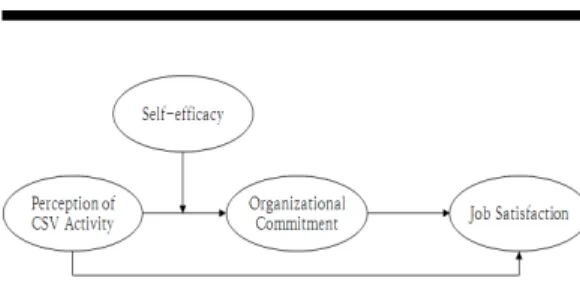
H1. Perception of corporate CSV activity has a positive effect on non-permanent (part-time) workers' job satisfaction.
1.2 Perception of CSV activity and job satisfaction Moon and Lee[10] demonstrated that CSV activity has a highly significant effect on organizational cohesiveness through an empirical analysis.
Organizational cohesiveness is a variable positively correlated with organizational commitment and it is predictable that perception of CSV activity will also have a significant effect on organizational commitment[44][45]. On the other hand, Amarsaikhan[46] demonstrated that CSR is positively correlated with organizational commitment[47] and argued that perceived CSR has a significant effect on members' organizational commitment through organizational trust and identity. CSR and CSV are commonly classified as kinds of social philanthropy through which companies fulfill their social responsibility. Thus, it is predictable that perception of CSV activity and organizational commitment will be likely positively correlated with each other.
Lim[22] demonstrated that CSV activity has a positive effect on employees' organizational loyalty.
In reference to this, it is likely that organizational loyalty is a type of job attitude positively correlated with organizational commitment and the level of
organizational commitment can be predicted accordingly[7]. Based on the literature review, the following hypothesis was established.
H2. Perception that corporate CSV activity has a positive effect on non-permanent (part-time) workers' organizational commitment.
1.3 Organizational commitment and job satisfaction Organizational commitment is an inclination to stay with the current organization. It demonstrates an individual's relative identification with and involvement in the organization, and the sense of belonging, commitment, and attachment to the organization[48]. Inanc and Ozdilek[49] studied university faculties and demonstrated that affective commitment and normative commitment - two sub-types of organizational commitment - are positively correlated with job satisfaction, but continuance commitment was negatively associated.
Kim and Park[50] studied temporary(non- permanent) hotel workers, and observed that organizational commitment had a positive influence on their job satisfaction. Byun and Ko[51] surveyed hotel employees and showed that organizational commitment had a positive effect on workers' job satisfaction. Lee, Jin, and Ju[52] observed similar results in their study of public hospital nurses. Based on the theoretical implications of past studies, the following hypothesis was established.
H3. Non-permanent (part-time) workers' organizational commitment has a positive effect on job satisfaction.
1.4 Mediating effect of organizational commitment There are only few studies available that investigate the mediating effect of organizational
commitment in the relationship between perception of CSV activity and job satisfaction of non-permanent employees. Nonetheless, because CSV has evolved from CSR, thus referring to existing studies analyzing the effect of organizational commitment on the relationship between CSR and job satisfaction, we can draw clues about the role of organizational commitment in the relationship between perception of CSV and job satisfaction. Hyeon[53] demonstrated that organizational commitment mediated the effect of corporate CSR activity on job satisfaction. Azim[54]
also elucidated the mediating role of organizational commitment in the relationship between perception of CSR and job commitment. Job commitment is a job attitude variable, which has a positive effect on job satisfaction[55][56]. Therefore, it is predicted that organizational commitment will likely mediate the relationship between job satisfaction and CSV, which is an extension of CSR. Based on the results and implications of existing studies, the following hypothesis was established.
H4. Non-permanent (part-time) workers' Organizational commitment has a mediating effect between perception of corporate CSV activity and job satisfaction.
1.5 Moderating effect of self-efficacy
Self-efficacy is defined as one's beliefs or conviction in one's ability and competence[57]. There are not many studies available on the moderating effect of self-efficacy among the existing body of research on the relationship between organizational members' perception of CSV activity and job attitude.
Instead, only a handful of studies on consumers are found[58]. This is probably because CSV is a relatively new concept. Self-efficacy is defined as a judgment on one's own ability to perform certain
tasks, namely, to organize and execute actions required for job performance by selectively employing behavioral, cognitive, and emotional resources needed for successful job performance[57]. It is also closely associated with how confident one is about the given situation and how well one handles the task[59].
Individuals with high self-efficacy are characterized by their attitude to actively engage in difficult tasks and to try to make contributions. Therefore, the effect of perception of CSV activity on members' organizational commitment will vary depending on the degree of their self-efficacy. That is, CSV activity is pursuing corporate and social interests at the same time. These two are generally conflicting concepts and it may be perceived as an unachievable challenge to realize both the interests simultaneously. When it comes to such CSV activities, therefore, organization members with high self-efficacy will likely perceive difficult CSV activities as an opportunity and respond with activism to the organizational policy, showing a high organizational commitment. Conversely, those with low self-efficacy will likely behave in the opposite manner[60]. In several past studies looking into the moderating effect of self-efficacy over the process in which precedents of organizational commitment take effect, subordinates' self-efficacy was proven to have a moderating effect in the process in which leadership influenced organizational commitment[61];
in which LMX influenced organizational commitment[35]; and in which midlife crisis influenced organizational commitment[62]. The below hypothesis was established based on the existing studies of the moderating effect of self-efficacy.
H5. Non-permanent (part-time) workers' self-efficacy has a positive moderating effect between perception of corporate CSV activity and organizational commitment.
Fig. 1. Conceptual Model of the Present Study
2. Definition and measurement of variables
The variables used in this study model are perception of CSV activity, job satisfaction, organizational commitment, and self-efficacy. All variables were evaluated on a 5-point Likert scale (1= strongly disagree, 2 = disagree, 3 = neutral, 4 = agree, and 5 = strongly agree).
2.1 Perception of CSV activity
Perception of CSV activity here was defined as non-permanent (part-time) workers' general perception of their company's CSV activity. This perception includes the perception of CSV activity and that of the degree of CSV activity. In order to measure perception of CSV activity, 9 questions from existing studies Yang and Yang[63], Jang[41] were used based on the study of Maignan and Ferrell[64], taking into account the characteristics of non-permanent (part-time) workers. The reliability and validity of this study were confirmed. Representative survey questions include "I am well aware of my company's CSV activity' and 'my company's CSV activity starts from the interest in social problems and aims to address them.' The reliability of perception of CSV activity was high, recording Chronbach's Alpha .885.
2.2 Organizational commitment
Organizational commitment is defined as having affection and responsibility for the organization, fulfilling one's duty, and a sense of identity with the organization. 5 questions from several existing
studies[4][6][7] based on the tool developed by Meyer and Allen[32] were used to measure non-permanent (part-time) workers' organizational commitment in this study. The questions include "I am proud that I am an employee of my company" and "I know how my job contributes to the development of my company as a whole." The reliability of organizational commitment was Chronbach's Alpha .717.
2.3 Job satisfaction
Job satisfaction here is defined as employees' positive emotional state felt after accomplishing a task. 5 questions used in preceding studies[28][44], which were reconstructed by Williams and Anderson[65] based on the JDI (Job Description Index) developed by Smith[66] were adopted to measure job satisfaction and its validity and reliability were tested. The questionnaire of the present study comprises five areas of work, superiors, salary, promotion, and colleagues. Representative questions include "my superior properly fulfils the supervising function" and "my colleagues have a sense of responsibility for their work." The reliability of job satisfaction was Chronbach's Alpha .734.
2.4 Self-efficacy
Self-efficacy here is defined as the degree of confidence to successfully perform given tasks based on one's strong will and firm beliefs in one's ability.
As for the evaluation tool, 4 questions were adopted from an existing study by Lee, Cho, and Oh[67]
based on the self-efficacy scale (NGSE) developed by Chen, Gully, and Eden[68] which best corresponds to our study objectives. Representative questions include
"I can accomplish goals once I set them" and "I do not feel anxious about my own ability." The self-efficacy scale demonstrated quite a high reliability of Chronbach's Alpha .796.
Ⅳ. Research Method
1. Results of empirical analysis
1.1 Study subjectsFor subject sampling, members of a big domestic company working as non-permanent employees were surveyed. Data were collected from October 18 to November 3, 2017 for about 20 days. 600 copies of the questionnaire were distributed through their companies' human resources department. A total of 582 copies (97%) were retrieved and 559 copies were used for final analysis, excluding 23 with missing answers. [Table 1] shows the demographic characteristics of survey respondents.
Variable N % Variable N %
Gender Male 123 22.0
Work Period (Months)
1 to 3 103 18.4
Female 436 78.0 4 to 6 154 27.5
Age
20 to 25 455 81.5 7 to 12 162 29.0 26 to 30 96 17.2 13 to 36 126 22.5 More than 31 8 1.3 More Than 37 14 2.5
Working Hours per week
Less Than 6 125 36.7
Education Level
Junior
college 351 62.8 7 to 12 36 10.6
Bachelor's
Degree 204 36.5 13 to 20 22 6.5
Graduate
School 3 0.5 21 to 30 113 33.1
Other 1 0.2 More Than 31 45 13.2
Total 559 100 Total 559 100
Table 1. Demographic Data for the Participants
1.2 Reliability and validity test
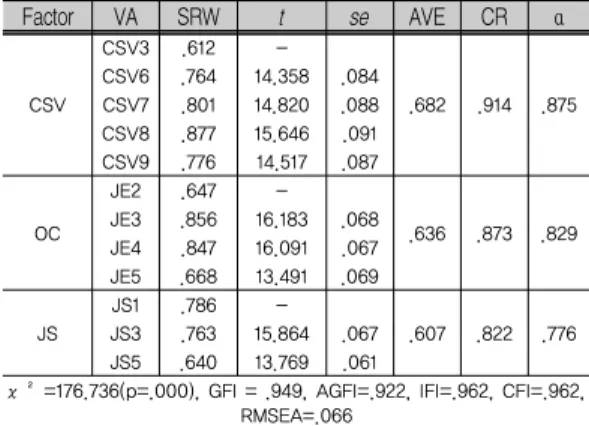
In order to keep continuity of the study cronbach's alpha number was counted by SPSS 25.0 and AMOS 25.0 program. As a result of reliability shown at Perception of CSV activity (cronbach α=.875), Organizational commitment (cronbach α=.829) and Job satisfaction (cronbach α=.776) are turned out to have cronbach's alpha 0.7 higher reliability than other variations.
According to the CFA analysis of the measurement model, the goodness of fit indices showed that χ² (p) was 176.736 (0.00), which did not meet the acceptable level. However, the other goodness of fit indices showed that CFI = 0.962, IFI = 0.962, GFI = 0.949 were thus higher 0.9 and AGFI = 0.933 was thus higher than 0.85; thereby fulfilling the acceptable criteria for the goodness of fit and RMSEA = 0.066, i.e., close to 0.05 indicating that the goodness of fit of this measurement model was acceptable.
Moreover, the standardized regression coefficients were generally appropriate, and because the CR value was more than 0.7, and the AVE value was more than 0.5, convergent validity was considered optimal [Table 2].
Factor VA SRW t se AVE CR α
CSV
CSV3 .612 -
.682 .914 .875 CSV6 .764 14.358 .084
CSV7 .801 14.820 .088 CSV8 .877 15.646 .091 CSV9 .776 14.517 .087
OC
JE2 .647 -
.636 .873 .829 JE3 .856 16.183 .068
JE4 .847 16.091 .067 JE5 .668 13.491 .069
JS
JS1 .786 -
.607 .822 .776 JS3 .763 15.864 .067
JS5 .640 13.769 .061
χ²=176.736(p=.000), GFI = .949, AGFI=.922, IFI=.962, CFI=.962, RMSEA=.066
CSV:Perception of CSV activity,SE:Self-efficacy OC:Organizational Commitment, JS:Job Satisfaction Table. 2 Confirmatory Factor Analysis
1.3 Correlation analysis
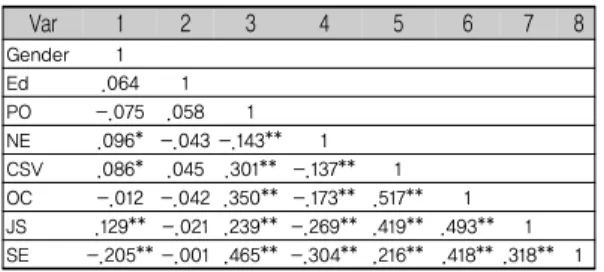
Prior to testing the hypotheses, the correlation between the variables included in the study model was examined. The control variables, gender and education, did not show any noticeable correlation with other variables. However, negative inclination and positive inclination were negatively and positively correlated with most of the variables. The rest of the major variables had a strong positive correlation.
1.4 Common method bias
In this research, in order to decrease the risk of serious error due to same measurement used within the survey[70], common method bias was examined through survey processes and statistical methods.
Firstly, in the survey process, the possibility of the answerer being able to predict the correlation between questions was decreased by randomly placing questions, and the survey itself maintained conciseness, relevance, clarity, specificity and objectivity. In addition, Harman's single factor test was conducted as a statistical test. Harman's single factor test is the most general method of testing for common method bias, and conducts non-rotational factorial analysis on all variables, and thus examining the variance of the factor that has the strongest explanation power out of those that have a value higher than 1. The result of the test showed that the explanation power of the first factor was 35.473%, which was less than half of the total explanation power, which confirmed the absence of common method bias.
Var 1 2 3 4 5 6 7 8
Gender 1
Ed .064 1
PO -.075 .058 1
NE .096* -.043 -.143** 1
CSV .086* .045 .301** -.137** 1
OC -.012 -.042 .350** -.173** .517** 1 JS .129** -.021 .239** -.269** .419** .493** 1 SE -.205** -.001 .465** -.304** .216** .418** .318** 1 p <0.05 *, p < 0.01 **,Spearman
Ed:Eduacation Level, PO:Positive Inclination, NO:Negative Inclination, CSV:Perception of CSV activity,SE:Self-efficacy OC:Organizational Commitment, JS:Job Satisfaction Table. 3 Correlation Analysis
1.5 Test of research hypothesis
Multiple regression analysis was conducted to test the hypotheses of perception of CSV activity, organizational commitment, job satisfaction, and
self-efficacy used in this study. Three stage regression analysis and Sobel Test were conducted as posttest to test the mediating effect of perception of CSV activity and job satisfaction. Hierarchical regression analysis was conducted to test the moderating effect of perception of CSV activity and organizational commitment. The results are as follows.
As for Hypothesis 1 "Perception of corporate CSV activity has a positive effect on non-permanent (part-time) workers' job satisfaction.", perception of CSV activity (β=.350, p=.00) had a significant positive effect on job satisfaction as shown in [Table 4]. The test of F value showed that the regression model was significant (F=33.767, p < .01). The independent variable perception of CSV activity had R²=.234 (adj R²=.227), which means 23.4% of explanatory power for job satisfaction. VIF value was smaller than 10, thus there was no multi-linearity between independent variables. The Durbin-Watson (1.738) value was close to 2, thus there was no autocorrelation. To summarize, job satisfaction became higher as perception of corporate CSV activity (B=.369) in non-permanent (part-time) employees increased.
Thus, Hypothesis 1 was adopted.
Job Satisfaction
B SE β t
Constant 2.527 .271
Gender .198 .065 .116 3.068**
Education Level -.093 .053 -.065 -1.744 Positive Inclination .132 .050 .105 2.655**
Negative Inclination -.210 .040 -.201 -5.274**
Perception of CSV .369 .045 .350 8.853**
R² = 0.234, adj R² = 0.227, F = 33.767** (p < .01) Durbin-Watson = 1.738
p <0.05 *, p < 0.01 **
Table 4. Perception of CSV activity and job satisfaction
Organizational Commitment
B SE β t
Constant 1.123 .248
Gender -.004 .059 -.002 -.61
Education Level -.107 .049 -.078 -2.196*
Positive Inclination .291 .046 .239 6.397**
Negative Inclination -.047 .036 -.046 -1.284 Perception of CSV .473 .041 .432 11.565**
R² = 0.317, adj R² = 0.311, F = 51.396** (p < .01) Durbin-Watson = 1.731
p <0.05 *, p < 0.01 **
Table 5. Perception of CSV activity and job satisfaction
As for Hypothesis 2. "Perception of corporate CSV activity has a positive effect on non-permanent (part-time) workers' organizational commitment," perception of CSV activity (β=.432, p=.00) had a significant positive effect on organizational commitment as shown in [Table 5]. The F value test (F=51.396, p<.01) indicated that the regression model was significant.
The independent variable perception of CSV activity had R²=.317 (adj R²=.311), 31.7% of explanatory power for organizational commitment. VIF was smaller than 10, thus there was no multilinearity between independent variables. The Durbin-Watson value (1.731) was close to 2, thus there was no autocorrelation. In particular, non-permanent (part-time) workers' positive inclination had a significant positive effect on organizational commitment, whereas negative inclination did not. Therefore, organizational commitment of non-permanent (part-time) employees grew when the perception of their company's CSV activity (B=.473) became higher. Thus, Hypothesis 2 was adopted.
Job Satisfaction
B SE β t
Constant 2.430 .258
Gender .228 .062 .133 3.672**
Education Level -.039 .051 -.028 -.765
Positive Inclination .060 .049 .048 1.225 Negative Inclination -.207 .038 -.198 -5.417**
Organizational Commitment .453 .040 .439 11.273**
R² = 0.289, adj R² = 0.282, F = 44.902** (p < .01) Durbin-Watson = 1.790
p <0.05 *, p < 0.01 **
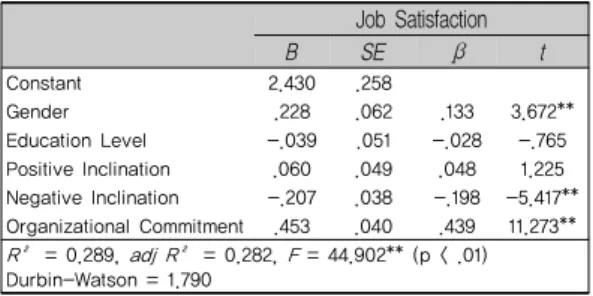
Table 6. Organizational commitment and job satisfaction
The analysis of Hypothesis 3, "Non-permanent (part-time) workers' organizational commitment has a positive effect on job satisfaction," Indicated that organizational commitment (β=.439, p=.00) had a significant positive effect on job satisfaction as shown in [Table 6]. The F value test (F=44.902, p<.01) confirmed that the regression model used was significant and the independent variable organizational commitment had R²=.289 (adj R²=.282), namely 28.9%
of explanatory power for job satisfaction. VIF value was smaller than 10. Thus, there was no multilinearity between the independent variables.
Durbin-Watson (1.790) test was also close to 2 and it was confirmed that there was no autocorrelation. To summarize, non-permanent (part-time) workers' job satisfaction increased as their organizational commitment (B=.453) became higher. Therefore, Hypothesis 3 was adopted.
Three stage hierarchical regression was conducted to test the mediating effect.
The analysis showed that Hypothesis 4
"Non-permanent (part-time) workers' organizational commitment has a mediating effect between perception of corporate CSV activity and job satisfaction." was significant as shown in Table 6.
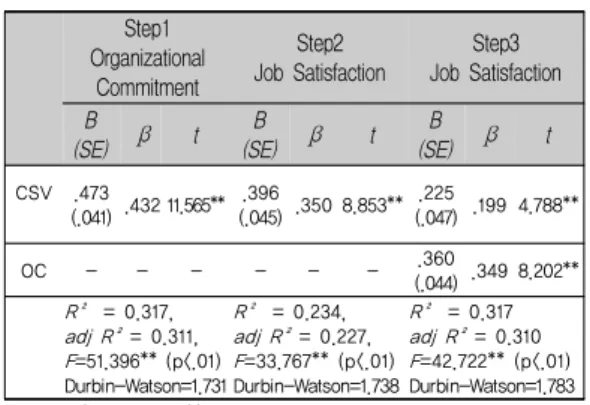
First, the F value was 51.396 in the stage 1 regression model. P (.000) value was smaller than the significance level .01. Thus, it was significant. The explanatory power was quite high accounting for R²=.317 and β=.432. Therefore, the independent variable perception of CSV activity had a significant positive relationship with the mediator organizational commitment.
In the two-stage regression model, F value was 33.767. p(.000) was smaller than the significance level .01, thus the result was significant. The explanatory power was quite high recording R²=.234 and β=.350.
Therefore, the independent variable perception of
CSV activity was significantly positively correlated with the dependent variable job satisfaction.
Finally, the effect of the independent and mediating variables on the dependent variable was analyzed with the three-stage regression model. The F value was 42.722, and p(.000) was smaller than the significance level .01. Therefore, the result was significant. The explanatory power was quite high (R²=.317). The standardized regression coefficient β was .350 in the two-stage model and .199 in the three-stage model. The latter was smaller than the former, thus it was confirmed that the mediator organizational commitment mediates the relationship between the independent variable perception of CSV activity and the dependent variable job satisfaction.
A posttest Sobel Test was additionally conducted to verify whether the indirect effect through organizational commitment was significant. This is a method to directly test whether the size of the indirect (mediating) effect of an independent variable influencing dependent variables through a mediator is significant. Sobel Test uses a standardized regression coefficient beta and a standard error for the unstandardized beta of the first and third stages. If the Z value resulting from the test is greater or smaller than 1.96, the mediating effect is judged significant[71].
B=.473 and SE=.041 of the first stage, and B=.360 and SE=.044 of the third stage were tested, and Z=6.6738 p<.01. The Z value was greater than 1.96, thus the indirect effect of organizational commitment mediating the relationship between perception of CSV activity and job satisfaction was statistically significant. These results demonstrate that organizational commitment mediates the relationship between perception of CSV and job satisfaction.
Therefore, hypothesis 4 was adopted.
Step1 Organizational
Commitment
Step2 Job Satisfaction
Step3 Job Satisfaction B
(SE) β t B
(SE) β t B
(SE) β t
CSV .473
(.041).432 11.565** .396
(.045) .350 8.853** .225
(.047) .199 4.788**
OC - - - - - - .360
(.044) .349 8.202**
R² = 0.317, adj R²= 0.311, F=51.396** (p<.01) Durbin-Watson=1.731
R² = 0.234, adj R²= 0.227, F=33.767** (p<.01) Durbin-Watson=1.738
R² = 0.317 adj R²= 0.310 F=42.722** (p<.01) Durbin-Watson=1.783 p <0.05 *, p < 0.01 **, OC:Organizational Commitment
Table 7. Mediating effect of Organizational Commitment on perception of CSV and Job Satisfaction
Hierarchical regression analysis was conducted to test the hypotheses of this study. This analysis method is one of the most useful methods to test effects of interactions. It takes the order of introduction into account considering the cause and effect of variables[76]. The regression was conducted through a total of 3 stages. Independent variable, moderating variable, and interaction term for the independent and moderating variables were introduced to the three-stage hierarchical regression analysis.
The two-stage regression equation is formed by introducing independent and moderating variables.
The additional third stage is added as the interaction term of independent and moderating variables is added to the two-stage regression equation R². This method compares the R² (△ R²) values of these three stages, verifies whether the values are statistically significant, and judges the moderating effect. Even if no multilinearity occurs in the process of introducing the interaction term, a multilinear pattern may appear when multiplying the independent variable by the moderating variable. The Mean Centering technique was applied in order to address this problem[72].
The analysis of hypothesis 5 "Non-permanent (part-time) workers' self-efficacy has a positive
moderating effect between perception of corporate CSV activity and organizational commitment,"
produced significant results as shown in [Table 8].
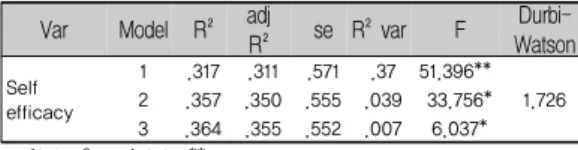
F=51.396, p(.001) in the first stage; F=33.756, p(.000) in the second, and F=6.037, p(.014) in the third. The F values were all smaller than the significance level .05, thus the results were significant. The R² variance increased from .317, .039, to .007 consecutively along with the stages. Therefore, it was judged that non-permanent (part-time) employee's self-efficacy has a moderating effect on the relationship between perception of CSV activity and organizational commitment.
The explanatory power of the independent variable, non-permanent (part-time) workers' perception of corporate CSV activity, and the interaction term of self-efficacy for organizational commitment was quite high (36.4%). The Durbin-Watson value (1.726) was close to 2, thus there was no autocorrelation problem.
Therefore, hypothesis 5 was adopted.
Var Model R² adj
R² se R² var F Durbi- Watson Self
efficacy
1 .317 .311 .571 .37 51.396**
1.726 2 .357 .350 .555 .039 33.756*
3 .364 .355 .552 .007 6.037*
p <0.05 *, p < 0.01 **
Table 8. Moderating effect of self-efficacy on perception of corporate CSV activity and organizational commitment.
Step1 Step2 Step3
B β t B β t B β t
Constant Gender Ed PO NE CSV
2.753 -.004 -.107 .291 -.047
.473 -.002 -.078 .239 -.046 .432
-.061 -2.196*
6.397**
-1.284 11.565**
2.865 .067 -.098
.172 .007 .441
.041 -.017
.141 .007 .403
1.147 -2.076*
3.534**
.196 10.996**
2.909 .062 -.103 .162 .006 .418
.038 -.075
.132 .006 .381
1.064 -2.184*
3.317**
.165 10.166**
SE - - - .251 .242 5.810** .246 .237 5.693**
CSV*SE .133 .088 2.457*
R² = 0.317, adj R²= 0.311, F=51.396** (p<.01)
R² = 0.357, adj R²= 0.350, F=50.933** (p<.01)
R² = 0.364 adj R²= 0.355 F=44.969* (p<.01) Durbin-Watson=1.726
p <0.05 *, p < 0.01 **, SE:Self-efficacy
Table 9. Moderating effect of perception of corporate CSV activity and organizational commitment on self-efficacy
Ⅴ. Conclusion and suggestions
The research question of the present study starts from 'what effect does non-permanent (part-time) employee's perception of CSV activity in an organization have on their job satisfaction?' We empirically investigated the correlation between the variables and the findings are summarized as below.
First, non-permanent (part-time) employees' perception of CSV activity had a positive effect on job satisfaction. This means that employees' increased perception of CSV activity further enhances job satisfaction. In other words, employees' job satisfaction increases when they positively perceive their companies pursuing corporate interest activity and CSR activity at the same time. Conversely, job satisfaction decreases if they see it negatively. It can be understood that, once employees perceived that their job performance contributes both to CSR, which is the social demand of our times and to their companies' interest, their job satisfaction increases.
This corresponds to the finding of an existing study that companies' CSR activity increased employees' job satisfaction[73]. According to the Herzberg's two-factor theory on job satisfaction, motivation is one of the causes of job satisfaction and the internal conditions of the job itself are the components of motivation[74]. The value, meaning, and importance of employees' work motivate them and increase job satisfaction in return. Therefore, if employees understand that what they are doing for their job does not intrinsically go towards solely pursuing the corporate interests of their companies at the expense of social value and if it is possible to enhance their perception that CSV is an activity of pursuing corporate interest and social value at the same time, employees' job satisfaction will be improved.
Second, it was found that non-permanent
(part-time) employees' perception of CSV activity had a positive effect on organizational commitment.
This is understood as employees' increased perception of CSV activity enhances organizational commitment. When employees positively perceive the simultaneous pursuit of corporate interest and social responsibility activities by their companies, their organizational commitment grows, and it decreases when they perceive it negatively. Considering the fact that non-permanent employees generally have a weaker organizational commitment than permanent counterparts[4], CSV activity may be a solution to increase non-permanent employees' organizational commitment. Peterson[75] demonstrated that the perception of corporate citizenship and organizational commitment were more closely correlated with each other among employees who perceived SCR important. He showed that the moral norms of corporate citizenship were the stronger predictors of organizational commitment than economic and legal norms. In addition, CSR improves the corporate image, which in turn increases employees' organizational commitment[73]. The reason that perception of CSV activity increases organizational commitment is because employees feel ethically satisfied with the fact that their company fulfils social responsibilities and the society views the company positively.
Third, non-permanent (part-time) employees' organizational commitment had a positive effect on job satisfaction. This supports the finding of existing studies[30][36] that increased organizational commitment enhances job satisfaction. This is to say, employees with high organizational commitment have a higher level of job satisfaction even among non-permanent employees. In order to increase the performance of non-permanent (part-time) employees, the precedent job satisfaction should be
primarily enhanced. This suggests that it is important for companies to establish measures to increase organizational commitment. As the test result of hypothesis 2 shows, improving perception of CSV activity can be a good strategy to increase non-permanent (part-time) workers' organizational commitment.
Fourth, the study verified that non-permanent (part-time) employee's organizational commitment positively mediates the relationship between perception of corporate CSV activity and job satisfaction. When non-permanent (part-time) employees' organizational commitment is higher, their perception of CSV activity has a greater effect on their job satisfaction. This finding suggests that companies shall devise appropriate measures to promote their organizational commitment through CSV in order to increase their job satisfaction and performance. Among the three components of organizational commitment - affective commitment, continuance commitment, and normative commitment [32], non-permanent (part-time) employees' organizational commitment is particularly likely to be continuance commitment. This means that they can leave the organization at any moment as soon as they come up with a better job with better working conditions. Offering better conditions than the other company certainly has a limitation. Therefore, it is crucial to promote non-permanent (part-time) employees' affective commitment and normative commitment to increase their organizational commitment. As previously discussed, affective commitment is developed as employees wish to stay with the organization when their and their organization's values correspond with each other[33].
Therefore, companies should learn the values of new employees and establish an effective system to help existing employees identify with the values of the
company.
Finally, non-permanent (part-time) employees' self-efficacy had a positive moderating effect on the relationship between perception of CSV activity and organizational commitment. This suggests that the perception of CSV of employees with higher self-efficacy has a greater effect on their organizational commitment. It is thus recommended for companies to establish measures to hire employees with stronger self-efficacy and strengthen existing employees' self-efficacy. Bandura[57]
suggested performance accomplishment, vicarious experience, verbal persuasion, and emotional arousal as four sources of self-efficacy. The experience of performance accomplishment is a self-achieved success and increases self-efficacy. Companies shall assign tasks corresponding to the competencies of non-permanent (part-time) employees to help them experience success and gradually escalate the levels of tasks over time to increase their self-efficacy.
Vicarious experience is a kind of modelling and one comes to increase self-efficacy through the experience of witnessing others' success, strengthening the belief in one's own success. A system, such as mentoring service or OJT, will provide more opportunities for vicarious experiences. Verbal persuasion is a placebo effect experienced through others' direct compliments and recognition. Clear expressions, recognition, and compliments on desirable outcomes given by non-permanent (part-time) employees' superiors increases their self-efficacy. Conversely, expressions hurting their drive may reduce their self-efficacy.
Many companies' recent efforts to prevent verbal violence at workplaces are a good approach to maintain and improve employees' self-efficacy. In particular, it is crucial to prevent expression that non-permanent (part-time) employees may find discriminative. Individuals experience emotional
arousal in stress situations, which induce anxiety or loss of confidence. Those with low self-efficacy can easily put the blame on themselves, whereas those with high self-efficacy likely will not associate it with their ability. Companies shall provide an environment and system that help employees maintain the first three sources of self-efficacy in possible stress situations.
Our study's empirical results have following values.
First, the majority of studies of domestic companies' CSV activity are theoretical or case studies. On the contrary, our study is valuable as it takes an empirical approach and elucidates the effect of corporate CSV activity. Also, if previous research is conducted on permanent employees who are directly or indirectly experiencing CSV activities[10][15][16], our study is valuable as we studied non-permanent (part-time) employees whereas the majority of past studies mainly surveyed permanent workers.
Second, the existing body of CSV activity studies mainly focus on external corporate factors, such as corporate image, preference, and reputation improvement in terms of corporate performance and marketing. Our study investigated workers and shed light on the effect of corporate CSV activity on employee's job satisfaction and organizational commitment.
However, our study has the following limitations.
We surveyed employees of two organizations.
Therefore, it is hard to generalize our findings. Future studies should include employees from a larger number of companies. Our subjects were also limited to non-permanent (part-time) workers. It would be beneficial to include both permanent and non-permanent (part-time) workers and compare the differences of the two groups in the future. In addition, organizational commitment was used as a