감성지능이 조직 구성원의 Job Crafting에 미치는 영향 : 자기효능감의 매개효과와 경력성장기회의 조절효과 중심으로
The Impact of Employees' Emotional Intelligence on Job Crafting: Focus on Mediating Effect of Self-efficacy and Moderating Effect of Career Growth
Opportunities
이지혜
*
, 조동성**
, 오상진*
서울과학종합대학원
*
, 장강경영대학원**
Ji-Hye Lee([email protected])
*
, Dong-Sung Cho([email protected])**
, Sang-Jin Oh([email protected])*
요약
본 연구는 기업에 근무하는 조직구성원을 대상으로 감성지능이 Job Crafting에 미치는 영향을 분석함으 로써 감성지능의 중요성에 대한 시사점을 제시하는데 그 목적이 있다. 특히, 감성지능과 Job Crafting의 관계에서 자기효능감의 매개효과와 경력성장기회의 조절효과를 실증적으로 검증하였다. 본 연구의 설문 조 사는 국내기업 조직 구성원을 대상으로 실시하였고 회수된 설문지 중 총 341부가 사용되었으며, 통계분석 방법은 SPSS 24.0와 AMOS 24.0 통계 패키지를 사용하였다. 연구결과 감성지능은 그들의 Job Crafting에 정(+)의 영향을 미쳤다. 특히, 감성지능과 자기효능감, 그리고 Job Crafting와의 관계에서 각각 정(+)의 영 향을 미치는 것으로 나타났고, 자기효능감의 매개효과도 입증 되었다. 또한 자기효능감과 Job Crafting의 관계에서 경력성장기회가 조절효과를 갖는 것으로 나타났다. 본 연구가 함의하는 바는 조직구성원의 직무 태도와 행동을 변화시키기 위해서는 감성지능을 높여 주는게 중요한 바, 다양한 프로그램 개발과 자율성의 기반으로 한 조직문화 조성, 그리고 지속적인 경력성장기회 제공이 필요하다는 결과를 보이고 있다.
■ 중심어 :∣감성지능∣Job Crafting∣자기효능감∣경력성장기회∣
Abstract
The purpose of this study is to suggest importance of emotional intelligence by studying effects between emotional intelligence and job crafting; the research was conducted among employees working for organizations. Especially this empirical study proves mediating effect of self-efficacy, and moderating effect of career growth opportunities in relationship between emotional intelligence and job crafting. The survey was conducted for employees; 341 answers were used from total population and were analyzed by SPSS 24.0 and AMOS 24.0 statistics package. The study concludes that emotional intelligence has positive influence (+) on job crafting of employee. Positive influence was found in the relationship between emotional intelligence and self-efficacy, and job crafting as well. The study also proves mediating effect of self-efficacy. Moreover it is likely that career growth opportunities have moderating effect in the relationship between self-efficacy and job crafting. The study implies that improving emotional intelligence is important to change attitude/behavior of employees on job. The study also implies that corporations need to provide career growth opportunities, to develop various programs, and to create friendly working environment.
■ keyword :∣Emotional Intelligence∣Job Crafting∣Self-efficacy∣Career Growth Opportunities∣
접수일자 : 2017년 04월 24일 수정일자 : 2017년 05월 03일
심사완료일 : 2017년 05월 08일
교신저자 : 조동성, e-mail : [email protected]
I. Introduction
Recently global business environment has been confronted with radical change and severe competition. As the world has entered the fourth Industrial Revolution earnestly it is getting harder to predict alteration and its speed, and besides the world is facing the danger of low-rate economic growth from deteriorated business environment and high unemployment rate. Therefore it is crucial issue for corporations to adopt strategies for competitiveness and achievement of performance along with recruitment and management of workers having core competencies.
Employment structure and job competency of corporations are expected to have drastic changes since emergence of AI (artificial intelligence) and robots; to cope with these changes emotional intelligence of employees influencing on organizational effectiveness has been considered important[1-4]. Moreover, corporations performance is influenced by effectiveness of job performance and emotional intelligence of employees, and employees' motivation and cooperation with others have effect on conducting its job directly[1][5-8]. Accordingly, it is necessary to study the correlation between emotional intelligence of employees and job performance which improves efficiency of job performance.
Goleman (1988) emphasized the importance of emotional intelligence related to group performance;
he proved that emotional intelligence influenced on not only personal physical and mental health, but also on career outcomes. A person with high emotional intelligence can have/exercise various control strategies and control stress and anxiety to outcome performance[9].
Wrzesniewski and Dutton[10] defined job crafting as the activity modifying and changing style of job
performance. Recently various studies found out that job crafting is the antecedents of job involvement and is the positive component to improve job satisfaction, organizational commitment, and job effectiveness [11][12]. Despite the fact that job crafting has practical influence, there are little studies on components influencing job crafting.
Self-efficacy is defined as the belief on personal ability of problem solving, which is seen as motivation of active change of job performance style [13][14]. Self-efficacy theory is the most important cognitive concept of subjective control among various approaches over motivation as a personal characteristics influencing human behavior[15][16].
Otherwise career growth opportunities as a job characteristics has become an important issue deciding how employee behaves against organization [17][18]. Under the recent changing employ environment career growth opportunities has emerged as an crucial issue that determines how employee assume an attitude toward an organization and can be a factor influencing job crafting particularly.
The purpose of this study is: first, we examine how employees' emotional intelligence can affect job crafting, especially mediating effect of self-efficacy considered as personal motivation; second, we seek to systemic model of moderating effect of career growth opportunities, which is job characteristics in relationship between emotional intelligence and job crafting; third based on the result of the evaluation we suggest actual application and effect of emotional intelligence of employees on job crafting.
II. Theoretical Background 1. Emotional Intelligence
The concept of emotional intelligence is suggested
by Thorndike in 'Social Intelligence' in 1920.
Thorndike divided intelligence into three sections, and conceptualized one of them as social intelligence defined as the ability to understand and to manage human behavior in relationship with others[19].
Following Thorndike, Gardner[20] suggested multiple intelligence theory including social intelligence as one of seven intelligence areas. According to Gardner, social intelligence is comprised of a person's interpersonal intelligence and intrapersonal intelligence. Intrapersonal intelligence relates to deal with oneself, and is the ability to identify and reflect on one's feelings and moods. In contrast, interpersonal intelligence relates to one's intelligence in dealing with others and is the ability to pay attention to the mood and feelings of others and to maintain human relationships[21].
Salovey and Mayer[4] who used the earliest the term 'Emotional Intelligence' propose a fundamental concept of emotional intelligence is the ability to deal with emotions. They defined emotional intelligence is the ability to monitor feelings and emotions of oneself and others'; to use emotional information to think and to behave; and to make balance emotional information.
Later Mayer and Salovey[22] developed original concept and suggest the model of four branches composed sixteen factors: recognition and expression of emotion, promotion of thinking by emotion, usage of emotional information, and emotional control.
Goleman[23] who popularized emotional intelligence newly modified concept of Salovey and Mayer in practical way. According to Goleman[19] emotional intelligence involves motivation to a person in desperate situation, make a person protect himself by controlling impulse and delaying satisfaction, arouse to sympathize with others and to keep hope; it includes concepts of motivations such as delaying satisfaction, minimized impulses, passion, and patience. Furthermore Goleman [24] conceptualized
'Emotional Competence' implying personal character and emotional trait in emotional intelligence and differentiate personal competence from social competence. Personal competence is the ability to understand emotion of oneself including self-awareness, self-regulation, and motivation whereas social competence is consisted of social skill and empathy understanding emotion of others.
Boyatzis, Goleman and Rhee[25] revised emotional intelligence with four subordinate areas after reconsidering concept of competence. They divide competences into ability and target; sub-dimensions of ability are awareness and regulation; and sub-dimensions of target are self and others.
Combination of these four area (self/others, awareness/regulation) creates four sub-dimensions of emotional intelligence, which are self-awareness, self-management, social awareness, and relationship management.
Based on the study of Mayer and Salovey[22], Wong and Law[7] simplified existing complex scale of emotional intelligence into four areas: self-emotion appraisal, others' emotion appraisal, use of emotion, and regulation of emotion. Wong and Law[7] define emotional intelligence the ability to understand and express one's feeling, to perceive and empathize others' feeling, to regulate emotion in the self appropriately, to facilitate emotions to achieve goals.
Most of studies about emotional intelligence are based on four areas suggested by Wong and Law[7], and they have influence various field such as creativity, trust, organizational effectiveness, innovative behavior, job satisfaction, job performance, and LMX[1][3][14][26]. This study will be conducted based on concept of emotional intelligence and four areas(self-emotion appraisal, others' emotion appraisal, use of emotion, regulation of emotion) suggested by Wong and Law[7].
2. Job Crafting
Job crafting is defined as the self-initiated changes that employees make in their own job demands and job resources to attain and/or optimize their personal work[27]. Wrzesniewski and Dutton[10] introduce concept of job crafting with broader definition: the change of physical, cognitive, relational, spontaneous that people show in their job; Ghitulescu[11]
determines that as the belief of people their job and relationship with others are valuable to conceptualize and to achieve their goals. Lyons[28] asserts that as spontaneous and autonomous change on personal job area; Tims and Bakker[29] describes this in JD-R model defining change process of job demands and job resources into person's own standard. In general job crafting can be defined as active behavior of employees pursuing change related to their job[30-32].
Job crafting can be divided into three sections depending on changing objects (job crafting, relational crafting, and cognitive crafting), which means it is to change achievement area by expanding range and by changing performance style. Also relational crafting is to change work relationship into correlation relationship among employees[10][33][34].
However, there are different views seeing job crafting as individual job redesign in bottom-up style not current top-down style[34][29]. Tims, Bakker and Derks[27] divide job crafting scale into four dimensions, which are increasing structural job resource, increasing social job resource, decreasing hindering job demands, and increasing challenging job demands. These views are based on JD-R model (job demand-resource model) by Bakker and Demerouti [35] increasing structural job resource is personal behavior studying new area to improve his work capability. Also, decreasing hindering job demands are to keep emotional room by reducing hindrance
factors (stress, work overload, role ambiguity) in work. Increasing challenging job demands is personal behavior to carry out challenging goal not by reward but by personal interest.
Current studies related to job crafting are about personal recognition, which are self-efficacy, organizational commitment, job engagement, immersion in change, and innovative behavior [2][36-40]. But it is hard to find practical analyses of job crafting model. Therefore, this study will examine personal definition of job and practical behavior of reconstruction by change of job crafting, relational crafting, cognitive crafting based on job characteristics of employees following the model suggested by Ghitulescu[11], Wrzesniewski and Dutton[10].
3. Self-Efficacy
Self-efficacy means the degree of personal belief on own capability to achieve goals and work[41].
Self-efficacy is known as important factor to change human behavior[42] and important variation to explain motivation effects especially[43]. Wood, Mento, and Iocke[44] define self-efficacy as personal evaluation on own ability to fulfill work based on trust of capability; Hong[13] defines it as trust on own capability to solve certain problems by himself.
Self-efficacy is deeply related to self-confidence to react certain situation and self-evaluation on control management of problem or expected result. In other words, a person with strong self-efficacy is more likely to have trust on own ability to achieve goal of performance even in difficult situation. Therefore, self-efficacy has influence on people to choose certain activities, degree of passion, and period of maintaining work in difficult situation[45].
People with strong self-efficacy are likely to recognize performance positive and to improve job
satisfaction with less stress[46]. Lee[47] sees self-efficacy as meaningful factor on achievement behavior. According to Lee, self-efficacy plays a role to perform in specific situations, which decide level of performance or skill by personal expectation or evaluation on own capability. Hong[13] points out people with strong self-efficacy have positive, future-oriented view in their lives. Thus, strong self-efficacy makes a person choose challenging and specific goals whereas week self-efficacy makes a person choose limited and familiar situation.
Bandura[48] sees Determinants of self-efficacy into four sections (enactive mastery experience, vicarious experience, verbal persuasion, physiological and affective states) and explains that enactive mastery experience is the most effective and powerful factor.
Thus, the most important factor to improve self-efficacy is to have various experiences on work and have strong positive belief through enactive mastery experience. The components of self-efficacy are self-confidence, self-monitoring, self-judgment showing degree of trust on own capability, Self-regulated efficacy which is expectation to perform self-reactive sell, and task difficulty preference process to choose challenging task to control[49].
This study will use self-regulated efficacy among self-efficacy components based on consideration the relationship between emotional intelligence and four areas (self-emotion appraisal, others' emotion appraisal, use of emotion, and regulation of emotion).
4. Career Growth Opportunities
Career growth opportunities is the expectation of employees that they can have useful result to their career success through job performance such as promotion or reward[50]. Recently employees of corporations change their job to find more stable
work environment or seek various activities to improve their career, which can be opportunity to improve it by job performance, career management, and job rotation provided by their workplace[18][51].
As traditional concept of career has been changed to protean career which main actor is a person, the concept of career by employees has been dramatically changed. But there are few studies on career growth opportunities, and the change concept on result has been made while suggestion of various concepts is little.
Unfortunately, there are still few studies even though career growth opportunities are considered as main factor explaining how change of personal career concept can affect corporations. Chay and Aryee[52]
says that career growth opportunities can be a tool to keep stability of employment to employees; Weng and other scholars[51] also see that system improving personal ability will increase attachment of employees against corporations. Lee and Jeon[17] see that career growth opportunities is known as tool to guarantee employment and career achievement of employees, and can be a tool to evaluate how current corporation and job be developed. Other preceding researches like Bakker and Demerouti[35] see career growth opportunities as one of job resources provided by corporations; and career growth opportunities decreases job burnout, increases career commitment, and has positive relationship with organizational commitment, job commitment and has negative relationship with turnover intention[17][18][51].
Ⅲ. Research Method
1. Research Model
Researches about emotional intelligence have been conducted in many different fields. However most of
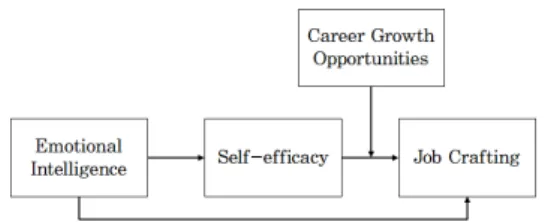
researches are focused on effect on organizational effectiveness based on emotional intelligence and emotional leadership[1][3][5][6][9][14]. Thus this study will do research on how employees will affect active behavior to pursue changes in their jobs based on previous theoretical consideration. Also this study creates research model to practically figure out correlation with recognition of employees on career growth opportunities provided by corporation as it is introduced at [Fig. 1].
Fig. 1. Conceptual Model of the Present Study
2. Research Hypothesis
2.1 Emotional Intelligence and Self-efficacy Many studies figured out that emotional intelligence has positive effect on employees such as happiness, self-efficacy, job satisfaction, organizational commitment, and organizational effectiveness and decrease negative feelings[4][6][7][9]. Preceding researches about influence of emotional intelligence on self-efficacy and job stress on nurses show that all components of emotional intelligence has meaningful effect on self-efficacy[53].
Kang, Park, and Moon[54] proved valid relationship based on analysis on moderating effect of self-efficacy in terms of influence of emotional intelligence on team effectiveness; Jin and Shin[55]
says emotional intelligence of salespersons has positive effect on self-efficacy and improves job performance. According to study of Jung and Cho[14]
organizations highly understand emotional intelligence has positive effect of self-efficacy of employees, and
especially hotel employees get more influence from emotional competence in the process of their emotional labor with customers. This shows that emotional intelligence can be understood the same with self-efficacy in terms of it is the ability to check himself and others feelings, to differentiate them, and to behave based on emotional information. It is important since trust of own capability to control problems or expected result is crucial to understand emotion and feelings of others and himself[4][15].
Therefore this study expects the result of the relationship between emotional intelligence and self-efficacy:
H1. Emotional Intelligence is positively related to Self-efficacy.
2.2 Self-efficacy and Job Crafting
There are few preceding researches directly on this issue but Campbell and Hackett[56] argues that self-efficacy has deeply related to personal performance, which a person with strong self-efficacy is more likely to focus on activities related to his job. After Bandura[15] suggested self-efficacy theory, organization researchers applied this theory to various areas of organization; they argued that a person with strong self-efficacy has more trust on his ability, can control negative effects in his life, and overcome well when he experienced failures in terms of social-cognitive concept.
According to Bandura[15] self-efficacy is the trust on personal ability to carry out job successfully in specific performance. Therefore, in case a person has strong self-efficacy, he will put more effort to achieve goal he set, and will have positive effect on performance directly. Also, self-efficacy can be affected by personal successful experience, persuasion from other's emotion or language, personal emotional condition, and indirect learning from others; and it can
be defined the positive attitude against unexpected problems or setting new goals in job[57]. This shows that job crafting can have positive effect on self-efficacy in terms of employees can actively pursue changes. Based on theories above this study expects the result of the relationship between self-efficacy and job crafting:
H2. Self-efficacy is positively related to Job Crafting.
2.3 Emotional Intelligence and Job Crafting Job crafting can be affected by various components such as job demands, job resources, proactive dispositions, proactive personality, job autonomy, relationship, leadership, team cohesiveness, and team diversity[12][29][32][58]. Moreover, breaking out from the effectiveness of relationship and early concept, there are many studies on emotional intelligence on organizational activities; it turns out that emotional intelligence can manage crisis and has positive effect on job attitudes such as job satisfaction, and organizational commitment[7][59].
In terms of a person and organizational effectiveness, emotional intelligence has influence on job satisfaction, job commitment, turnover intention, creativity & innovation, organizational citizenship behaviors, job performance, team work, quality of service, and so on[7][60]. Kozlowski and Ilgen[61]
argues that emotional intelligence can affect recruit and retention of employees, human resource development, team work, health, innovation, production, effectiveness, commitment of customers, and increase of employee's commitment.
There are little preceding researches on the relationship with emotional intelligence and job crafting. However, will of employees to conceptualize his work, to have relationship with others to achieve goals, and to be proud of his work, and to change behavior has deeply related to four factors of
emotional intelligence(self-emotion appraisal, others' emotion appraisal, use of emotion, regulation of emotion). Based on these facts, this study expects the relationship between emotional intelligence and job crafting:
H3. Emotional Intelligence of employees is positively related to Job Crafting.
H4. Self-efficacy partially mediates Emotional Intelligence and Job Crafting
2.4 Moderating Effect of Career Growth Opportunities Recently employees put lots of effort to improve personal career to have stable employment[51][52].
However, as employment environment has been changed, there are many researches about career growth opportunities under the idea that improving career development to maintain continuity of employment is more valuable result. This can be understood the same with job crafting in terms of evaluating how current corporations and job can be useful to improve personal career.
Based on current preceding researches about career growth opportunities, Nouri and Parker[18] say that career growth opportunities make employees think positively toward organization, improve organizational commitment and decrease turnover intention. Chay and Aryee[52] studied that career growth opportunities increase job involvement and organizational commitment while decrease turnover intention, which is the same in study of Weng[51].
Lee and Jeon[17] claim that career growth opportunities have positive effect on job engagement as well as improving organizational commitment and decreasing turnover intention especially personal career commitment decreases organizational commitment while increasing turnover intention[52], this is because people seek other organization to help personal career once they think current organization
cannot help to improve their career[51]. Park[58] says it is because job characteristics has influence on job crafting and once they think they have autonomy and chance to learn new skills, and have responsibilities on their job they have more opportunity to make decision[10].
Bakker, Tims and Derks[27] proved that personal characteristics of proactive dispositions have positive influence on job crafting in their group research.
Tims, Bakker, and Derks[62] say that job demands, which is job characteristics, and job resources have influence on job crafting in their research on chemical factory workers. Shin[32] says, in the research on hotel workers, active personality, job autonomy, relationship with others have positive effect on job crafting; Park[58] says, in the research on employees of major corporation, job characteristics and authentic leadership of leaders, team cohesiveness, and team diversity have influence on job crafting.
Based on these researches, job crafting, which can be defined that employees put effort to perform job in a way that he wants, can increase by career growth opportunities provided by organizations. Therefore, this study expects the relationship between self-efficacy and career growth opportunities, and job crafting:
H5. Self-efficacy and Job Crafting relationship is moderated by recognition of Career Growth Opportunities of employee.
3. Definition and measurement of Variations
To prove influence of emotional intelligence of employee on job crafting and mediating effect of self-efficacy and that of career growth opportunities among the relationship with variations, systemic created survey was used. Questions of survey were reorganized current one based on pre-conducted research, and it was measured with Likert 5-point scale. Below definitions is that of each variation:3.1 Emotional Intelligence
Emotional intelligence is defined as 'the ability to recognize and to differentiate his and other's feelings and emotion, which is used to decide his thoughts and behavior. "Based on measurement created by Wong and Law[7], Jung and Cho[14], Ko and Oh[3], there are total 16 questions from four sub-dimensions used in various researches: 4 questions from self-emotion appraisal, 4 questions from others' emotion appraisal, 4 questions from use of emotion, and 4 questions from regulation of emotion. Examples of the questionnaire are: "I understand my own feelings well."(self-emotion appraisal), "I understand the feelings of people around me."(others' emotion appraisal). Cronbach's alpha of emotional intelligence scale shows high reliability .909.
3.2 Job Crafting
Job crafting is the attitude or behavior of a person to carry out job in a way he wants to make, and JCQ(job crafting questionnaire) created by Slemp and Vella-Brodrick[34] was used as measurement, which was used in many researches like[32][63][64]. There are 16 questions from three components in total: 5 questions from task crafting, 5 questions from cognitive crafting, and 5 questions from relational crafting. Examples of the questionnaire are: "I try a new way of doing things to improve my work."(Task crafting), "I try to get along well with customers, bosses and co-workers at work." (cognitive crafting).
Cronbach's alpha of job crafting scale shows high reliability .942.
3.3 Self-Efficacy
Self-efficacy is defined as the trust on personal ability of problem solving, which is seen as motivation of active change of job performance style.
Self-efficacy scale (NGSE) created by Chen, Gully,
and Eden[65] was used as measurement, which has used 4 questions of self-regulated efficacy from questions used by[14]. Examples of the questionnaire are: "I think I have the ability to overcome difficult situations." Cronbach's alpha of self-efficacy scale shows high reliability .930.
3.4 Career Growth Opportunities
Career growth opportunities is the expectation of employees that they can have useful result to their career success through job performance, and was measured by four questions used by Lee and Jeon[17]
translated from Nouri and Parker[18] research.
Examples of the questionnaire are: "My job is useful to achieve my career objectives." Cronbach's alpha of the scale shows high reliability .930.
Ⅳ. Practical Analysis
1. Participants and Procedures
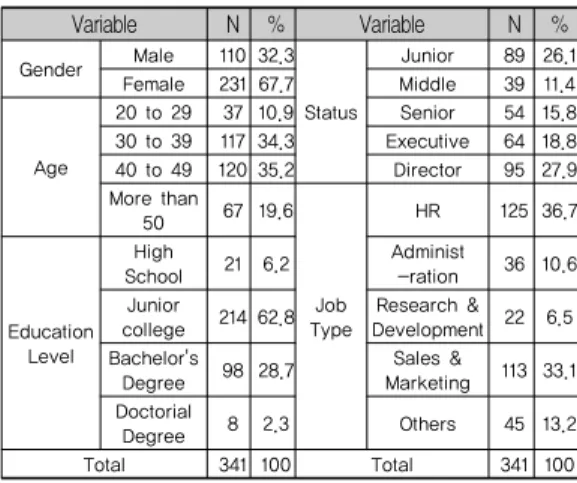
Research model suggested by this study was conducted for employee in Korea for practical analysis. The research was conducted for three weeks from February 1st to 19th in 2017. The 500 survey was distributed online, 368 of them was returned (73.6%), and 341 of them was analyzed (except 27 survey having inadequate answers including double missing value). Demographic characteristics of respondents are shown at [Table 1].
2. Verifying Reliability and Validity
In order to keep continuity of the study cronbach's alpha number was counted by SPSS 24.0 and AMOS 24.0 program. As a result of reliability shown at self-emotion appraisal (cronbach α=.839), others' emotion appraisal (cronbach α=.819), use of emotion (cronbach α=.832), regulation of emotion (cronbach α
=.844) in emotional intelligence are shown; task crafting (cronbach α=.823), relational crafting (cronbach α=.779), cognitive crafting (cronbach α
=.854) in job crafting are shown; self-efficacy (cronbach α=.796), career growth opportunities (cronbach α=.904) are turned out to have cronbach's alpha 0.7 higher reliability than other variations.
Variable N % Variable N %
Gender Male 110 32.3 Status
Junior 89 26.1
Female 231 67.7 Middle 39 11.4
Age
20 to 29 37 10.9 Senior 54 15.8
30 to 39 117 34.3 Executive 64 18.8 40 to 49 120 35.2 Director 95 27.9 More than
50 67 19.6
Job Type
HR 125 36.7
Education Level
High
School 21 6.2 Administ
-ration 36 10.6 Junior
college 214 62.8 Research &
Development 22 6.5 Bachelor's
Degree 98 28.7 Sales &
Marketing 113 33.1 Doctorial
Degree 8 2.3 Others 45 13.2
Total 341 100 Total 341 100
Table 1. Demographic Data for the Participants
According to the CFA analysis of the measurement model, the goodness of fit indices showed that χ² (p) was 476.257 (0.00), which did not meet the acceptable level. However, the other goodness of fit indices showed that CFI = 0.956, IFI = 0.956, GFI = 0.909 were thus higher 0.9 and AGFI = 0.879 was thus higher than 0.85; thereby fulfilling the acceptable criteria for the goodness of fit and RMSEA = 0.044, i.e., close to 0.05 indicating that the goodness of fit of this measurement model was acceptable.
Moreover, the standardized regression coefficients were generally appropriate, and because the CR value was more than 0.7, and the AVE value was more than 0.5, convergent validity was considered optimal [Table 2].
Factor VA SRW t se AVE CR
αSEA
SEA1 .716 -
.761 .927 .839 SEA2 .723 15.716 .073
SEA3 .829 12.673 .110 SEA4 .683 11.203 .105
OEA
OEA1 .753 -
.787 .917 .819 OEA2 .858 14.430 .077
OEA3 .768 13.507 .086
UE UE3 .736 -
.843 .913 .832 UE4 1.007 10.396 .123
RE
RE1 .706 -
.741 .919 .844 RE2 .750 12.576 .092
RE3 .796 13.258 .077 RE4 .796 13.256 .085
TC TC2 .813 -
.780 .876 .823 TC3 .789 12.963 .074
RC
RC3 .642 -
.568 .798 .779 RC4 .706 9.142 .100
RC5 .660 8.903 .078
CC
CC1 .685 -
.712 .907 .854 CC3 .636 10.558 .114
CC4 .856 13.479 .090 CC5 .816 13.096 .089
CGO CGO1 .725 -
.723 .838 .904 CGO4 .837 12.026 .105
SE
SE1 .796 -
.778 .913 .796 SE2 .801 13.624 .072
SE3 .667 11.678 .069
χ²=476.257(p=.000), GFI = .909, AGFI=.879, IFI=.956, CFI=.956, RMSEA=.044
SEA: Self-Emotion Appraisal, OEA: Others' Emotion Appraisal, UE: Use of Emotion, RE: Regulation of Emotion, TC: Task Crafting, RC: Relational Crafting, CC: Cognitive Crafting, CGO: Career Growth Opportunities, SE: Self-Efficacy, SRW: Standardized Regression Coefficients, α : Cronbach's Alpha
Table. 2 Confirmatory Factor Analysis
3. Correlations of the Study Variables
Correlations among variations in research model shows that gender which is control variable is not meaningful to other variation, and educational level has meaningful positive effect with status. Especially educational level has weak correlations with emotional intelligence as well as status has weak correlations with emotional intelligence. Correlations among emotional intelligence, self-efficacy, job crafting, and career growth opportunities are mostly positive relationship statistically.Variable 1 2 3 4 5 6 7
Gender 1
Education
Level -.038 1
Status -.168** .518** 1
Emotional Intelli- gence
-.059 .105 .107** 1 Self
efficacy -.030 .199** .184** .438** 1 Job
Crafting -.040 .173** .238** .527** .436** 1 Career
Growth Opportu- nities
-.062 .190** .218** .394** .385** .522** 1
p <0.05 *, p < 0.01 **
Table. 3 Correlation Analysis
4. Common Method Bias
This study use common method and found common method bias by using statistical check method and resource collecting process to reduce error lowering validity of the research. First, in resource collecting process, variations of survey was organized randomly in order to lower possibility that respondents can predict correlations among questions; simplification, clarification, correlation, specification, and objectiveness of survey questions are maintained.
Second, Harman's single factor test was taken for statistical check method. Factor analysis was conducted for variations used for find common method bias and confirmed that variation having the most high explanation among variations, which eigen value is higher than 1. As a result, there was no error common method bias as the first factor explanation was 29.273%, a half lower than total explanation.
5. Verification of Hypothesis
In order to verify hypotheses about emotional intelligence, job crafting, self-efficacy, career growth opportunities, multiple regression analysis was conducted to each hypotheses.
Self-efficacy
B SE β t
Constant 1.766 .234
Gender .022 .050 .022 .446
Education Level .083 .043 .104 1.921
Status .021 .015 .079 1.424
Emotional
Intelligence .517 .055 .451 9.431**
R² = 0.241, adj R² = 0.232, F = 26.687** (p < .01) Durbin-Watson = 1.916
p <0.05 *, p < 0.01 **
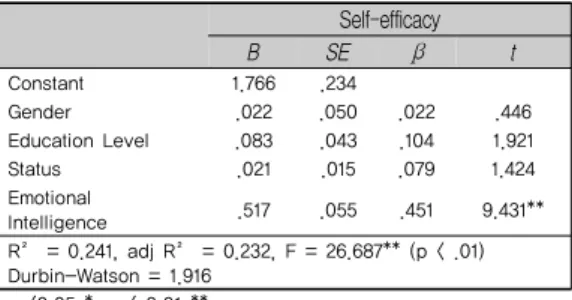
Table 4. Effect of Emotional Intelligence on Self-efficacy
Hypothesis 1 "Emotional Intelligence is positively related to Self-efficacy." It turns out emotional intelligence(β=.451, p=. 000) has valid positive effect on self-efficacy as [Table 4] shows. Regression model was valid through F value verification (F=26.687, p < .01), Emotional intelligence which as independent variable has 24.1%(adj R²=0.232) of explanation to explain self-efficacy. It turns out there is no multicollinearity among independent variable as VIF value is less than 10, and there is no auto-correlation problem as Durbin-Watson(1.916) value was close to 2. Therefore, the higher emotional intelligence (B=.517) of employees has the higher self-efficacy.
Job Crafting
B SE β t
Constant 1.782 .213
Gender .010 .049 .009 .194
Education Level .004 .043 .005 .093
Status .034 .015 .130 2.331*
Self-efficacy .435 .048 .443 9.092**
R² = 0.233, adj R² = 0.224, F = 25.525** (p < .01) Durbin-Watson = 1.725
p <0.05 *, p < 0.01 **
Table 5. Effect of Self-efficacy on Job Crafting
Hypothesis 2 "Self-efficacy is positively related to Job Crafting." It turns out self-efficacy(β = .443, p=.
000) has valid positive effect on job crafting as [Table 5] shows. Regression model was valid through F
value verification (F=25.525, p < .01), self-efficacy which as independent variable has 23.3%(adj R²=0.224) of explanation to explain job crafting. It turns out there is no multicollinearity among independent variable as VIF value is less than 10, and there is no auto-correlation problem as Durbin-Watson(1.725) value was close to 2.
Therefore, the higher self-efficacy of employees (B=.435) of employees has the higher job crafting.
Job Crafting
B SE
βt
Constant 1.118 .212
Gender .034 .045 .033 .741
Education Level .022 .039 .028 .564
Status .039 .013 .148 2.906**
Emotional
Intelligence .624 .050 .555 12.527**
R² = 0.249, adj R² = 0.341, F = 44.949** (p < .01) Durbin-Watson = 1.781
p <0.05 *, p < 0.01 **
Table 6. Effect of Emotional Intelligence on Job Crafting
Hypothesis 3 "Emotional Intelligence of employee is positively related to Job Crafting." It turns out emotional intelligence(β = .555, p=. 000) has valid positive effect on job crafting as [Table 6] shows.
Regression model was valid through F value verification (F=44.949, p < .01), emotional intelligence which as independent variable has 34.9%(adj R²=
0.341) of explanation to explain job crafting. It turns out there is no multicollinearity among independent variable as VIF value is less than 10, and there is no auto-correlation problem as Durbin-Watson(1.781) value was close to 2. Therefore, the higher self-efficacy of employees (B=.624) of employees has the higher job crafting.
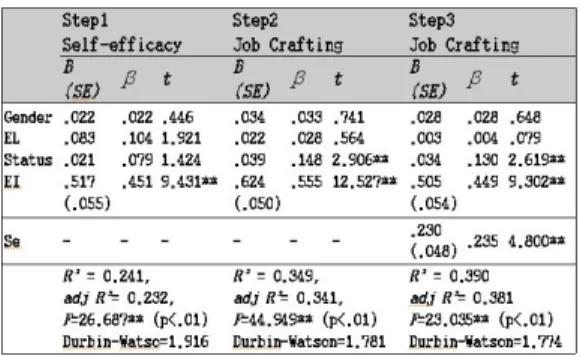
The result of analysis to verify mediating effect of self-efficacy in the relationship between emotional intelligence and job crafting is shown in [Table 7].
Verification of mediating effect through was used
through the third step regression analysis[43]. The verification of mediating effect of this study was also followed by this method.
Table 7. Mediating Effect of Self-efficacy
EL : Education Level, EI : Emotional Intelligence, Se : Self-efficacy, p <0.05 *, p < 0.01 **
Hypothesis 4. "Self-efficacy partially mediates Emotional Intelligence and Job Crafting" Through the first step regression model, it turns out F value was valid with 26.687, p(.000) lower than .01. Explanation R² = 0.241 was fairly high, and β=.451 shows that emotional intelligence which is independent variable has valid positive relationship with self-efficacy which as mediator variable. The second regression model shows that F value was valid with 44.949, p(.000) lower than .01. Explanation R²=0.555 was fairly high, and β=.451 shows that emotional intelligence which is independent variable has valid positive relationship with job crafting which is dependent variable.
Lastly, in the third regression model which examined correlations among independent, dependent, and mediator variable, F value was valid with 23.035, p(.000) lower than 0.01. R²=0.390 shows high explanation as well. Also β value which is standardized regression coefficient was .555 on the second step, and was .449 on the third step; the third was lower than the second, which means self-efficacy (mediator variable) has mediating effect between emotional intelligence (independent variable)
and job crafting (dependent variable). Also Durbin-Watson showing auto-correlations between two variations was close to 2, which means no auto-correlations; there is also no multicollinearity as all variations VIF value was lower than 10.
Next, sobel test was conducted to verify indirect effectiveness of self-efficacy. This verification is to verify validity of mediating effect of independent variable on dependent variable through mediator variable.
Sobel test use non-standardized standard order, and the first and third step regression coefficient; if the result value Z is higher than 1.96 or lower than -1.96, there is valid mediating effect[43]. B = .517, SE = .055 of the first step, B = .505, SE = .054 of the third step shows Z=6.630, p < .01. Thus, Z is higher than 1.96 the indirect effectiveness of self-efficacy on the correlation between emotional intelligence and job crafting is valid. The result shows that self-efficacy has mediating effect in the relationship between emotional intelligence and job crafting.
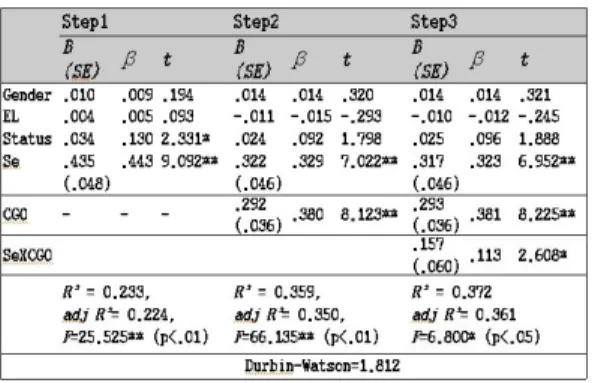
To verify moderating effect of career growth opportunities in the relationship between self-efficacy and job crafting is shown at [Table 8]. This study use hierarchical regression analysis to verify hypothesis.
Hierarchical regression analysis is useful tool to verify interaction effect considering a causal relationship of variations[66]. It was conducted in three steps, correlations among independent variable, moderator variable, independent variable, and moderator variable was put in three steps hierarchical regression analysis. To verify validity and moderating effect the second step regression R² was compared to the step 3 R² (△ R²), which correlations between independent variable and moderator variable was added. Also in the step adding correlations, independent variable was multiplied by moderator variable, even though multicollinearity was not happened, to reduce the risk of multicollinearity by
using mean centering method[67].
Table 8. Moderating Effect of Career Growth Opportunities
EL : Education Level, CGO : Career Growth Opportunities, Se : Self-efficacy, p <0.05 *, p < 0.01 **
Hypothesis 5 "Self-efficacy and Job Crafting relationship is moderated by recognition of Career Growth Opportunities of employee." As a result the first step was F=25.525, p(.000), the second step was F=66.135, p(.000), and the third step was F=6.800, p(.01), which turns out to be valid as it was lower than .05. Also the value of R²was increased each steps (.233, .359, .372), which turns out career growth opportunities has moderating effect in the relationship between self-efficacy and career growth opportunities. Self-efficacy (independent variable), career growth opportunities, and explanation of correlations between self-efficacy and career growth opportunities was 23%, Durbin-Watson(1.812) was close to 2, which turns out to be no auto-correlations problem.
Ⅴ. Conclusion and Proposal
This study is to verify impact of emotional intelligence of employee on job crafting, along with mediating effect of self-efficacy and moderating effect of career growth opportunities. The results of
the study are explained below.
First, the higher emotional intelligence of employee shows the higher self-efficacy. according to preceding research, emotional intelligence has positive influence on various organizational effectiveness such as happiness, self-efficacy, job satisfaction, organizational commitment, team effectiveness, and job performance[7][9][14][54][64].
It is because components emotional intelligence are from the ability to check himself and others feelings, to differentiate them, and to behave based on emotional information[4][7]. Therefore, improving emotional intelligence of employees is not only improving self-efficacy, but also positively affect organizational effectiveness.
Second, self-efficacy of employee has positive effect on job crafting. This shows that self-efficacy is deeply related to personal performance and supports argument of Campbell and Hackett[56] that higher self-efficacy can help people concentrate on their jobs and performance. Self-efficacy is defined as the belief on personal ability of problem solving, which appear as motivation of active change of job performance style and attitude to react unexpected problems or setting new goals in jobs[15][57]. Therefore a person with strong self-efficacy is active to job crafting.
Third, the higher emotional intelligence of employee reveals the higher job crafting. According to preceding research job crafting is effected by job demands, proactive dispositions, positive personality, relationship with others, and leadership[32][58][68].
Also emotional intelligence has influence on organizational effectiveness such as job satisfaction, organizational citizenship behaviors, job performance, creativity, and innovation[5][7][59]. Thus four areas of emotional intelligence (self-emotion appraisal, others' emotion appraisal, use of emotion, regulation of emotion) can affect job attitudes or behavior.
Therefore emotional intelligence can affect positively on job crafting.
Fourth, self-efficacy of employees has mediating effect in the relationship between emotional intelligence and job crafting. As preceding research shows in the relationship between emotional intelligence and self-efficacy has mediating effect based on many researches[53][54]. Also dependent variable of most of researches is organizational effectiveness. Therefore it is likely to have higher emotional intelligence can change personal behavior with strong trust and self-confidence.
Fifth, recognition of career growth opportunities of employees in the relationship between self-efficacy and job crafting has moderating effect. There are many researches were conducted saying career growth opportunities is opposite from career commitment improving turnover intention. Especially unstable employment in changing management environment has negative effect by leaking capable workers. Therefore career growth opportunities is considered as important to improve job crafting by changing job and improving job involvement and performance[17][18][51][52]. Thus career growth opportunities provided by organizations can improve job crafting correlating with self-efficacy.
Based on results of the study there are theoretical and practical suggestion. First, researches about emotional intelligence were conducted widely related to organizational effectiveness of employees. Specially global management environment change and their performance is dependent on effectiveness along with motivation and cooperation with others. Change of employment brings unstable employment rate which decrease job involvement and increase turnover intention, which has negative result in organizational performance. But existing researches do not limit just explaining the relationship of organizational
effectiveness. There is a difference that emotional intelligence relates to job crafting based on changes in attitude or behavior. Especially, this study has theoretical contribution to explain that organizations should have career growth opportunities system, not only to improve emotional intelligence, for organizational effectiveness. Second, this study suggests the solution to reduce turnover intention of high-quality employees, which is huge issue lately, and to improve job involvement by providing career growth opportunities and improving emotional intelligence. This means organizations need to develop programs and system for emotional intelligence and career growth opportunities. Also this study provides insights on developing organization culture with autonomy and leadership to improve emotional intelligence.
Despite theoretical and practical contribution there are still limits in this study. First, it is hard to generalize the result as the study was conducted for employees of domestic corporations. Therefore, there should be more research on different fields, and corporations in the future. Second, the study was personal level to figure out recognition of variations of employees. As relationship with leaders and employees is important, the study on effect of leadership and culture in organization is needed.
Third, the study was conducted for employees of corporations where turnover intention is usually high.
Therefore the research for government officials where turnover intention is fairly low should be conducted in the future.
참 고 문 헌
[1] S. S. Choi and Y. J. Kown, "A Study for The Effects of Leader's Emotional Intelligence,
Creativity, Trust, and Group Cohesiveness on The Group Effectiveness and Innovation Action : Focus on Hotel Employees in Seoul," Journal of Tourism&Leisure Research, Vol.24, No.7, pp.95-113, 2012.
[2] L. Hang, "Effects of IT workers' Emotional Intelligence and Job Crafting on Job Satisfaction and Job Performance," e-Business Research, Vol.17, No.5, pp.117-135, 2016.
[3] S. H. Ko and S. M. Oh, "The Effect of Emotional Intelligence on LMX, TMX and Innovative Behavior among flight attendants," Korean Journal of Tourism Research, Vol.31, No.7, pp.129-147, 2016.
[4] P. Salovey and J. D. Mayer, "Emotional intelligence," Imagination, cognition and personality, Vol.9, No.3, pp.185-211, 1990.
[5] H. Y. Kim and J. Y. Ko, "The Effects of Emotional Intelligence on Job performance of the Hotel F&B," Korean Journal of Hospitality
& Tourism, Vol.23, No.1, pp.181-198, 2014.
[6] H. Y. Park, "A Study on the Effects of Emotional Intelligence on Organizational Commitment, Customer Orientation and Turnover Intention in Global e-Business Environment," The e-Business Studies, Vol.17, No.1, pp.3-30, 2016.
[7] C. S. Wong and K. S. Law, "The effects of leader and follower emotional intelligence on performance and attitude: An exploratory study," The Leadership Quarterly, Vol.13, No.3, pp.243-274, 2002.
[8] J. Zhou and J. M. George, "Awakening employee creativity: The role of leader emotional intelligence," The Leadership Quarterly, Vol.14, No.4-5, pp.545-568, 2003.
[9] Z. Ivcevic, M. A. Brackett, and J. D. Mayer,
"Emotional intelligence and emotional creativity,"
Journal of Personality, Vol.75, No.2, pp.199-236,
2007.
[10] A. Wrzesniewski and J. E. Dutton, "Crafting a job: Revisioning employees as active crafters of their work," Academy of Management Review, Vol.26, No.2, pp.179-201, 2001.
[11] B. Ghitulescu, Job crafting and social embedde
dness at work, Unpublished doctoral dissertation,
University of Pittsburgh, 2006.[12] M. Tims, A. B. Bakker, and D. Derks, "The impact of job crafting on job demands, job resources, and well-being," Journal of Occupa -tional Health Psychology, Vol.18, No.2, p.230, 2013.
[13] H. K. Hong, K. Y. Chung, and W. H. Kim,
"Effects of Self-efficacy on Job Embeddedness, Innovation Behaviors, and Organizational Citizenship Behavior: The Moderating Effect Worked Mainly in the Form," Journal of The Korea Ccontents Association, Vol.12, No.5, pp.415-430, 2012.
[14] E. J. Jung and K. H. Cho, "The Effects of Emotional leadership upon Self-efficacy:
Focusing on moderating effects of Emotional intelligence," Tourism Research, Vol.40, No.1, pp.81-103, 2015.
[15] A. Bandura, Self-efficacy: The exercise of
control, New York: Freeman, 1997.
[16] C. Eric and M. Xiaofang, "The Influence of Individual Factors, Supervision and Work Environment on Creative Self-Efficacy,"
Creativity & Innovation Management, Vol.19, No.3, pp.233-247, 2010.
[17] J. H. Lee and J. H. Jeon, "The Impact of Employability on Organizational Commitment and Turnover Intention Mediated by Career Growth Opportunities," Journal of Human Resource Management Research, Vol.23, No.1, pp.47-67, 2016.
[18] H. Nouri and R. J. Parker, "Career growth
opportunities and employee turnover intentions in public accounting firms," The British Accounting Review, Vol.45, No.2, pp.138-148, 2013.
[19] D. Goleman, Emotional intelligence, Bantam, 2006.
[20] H. Gardner, Intelligence reframed: Multiple
intelligences for the 21st century, Basic books,
1999.[21] H. Gardner, Frames of mind: The theory of
multiple intelligences, Basic books, 2011.
[22] J. D. Mayer and P. Salovey, "Emotional intelligence and the construction and regulation of feelings," Applied and preventive psychology, Vol.4, No.3, pp.197-208, 1995.
[23] D. P. Goleman, Emotional intelligence: Why it
can matter more than IQ for character, health and lifelong achievement, New York: Bantam
Books, 1995.[24] D. Goleman, Working with emotional intelligence, Bantam, 1998.
[25] R. E. Boyatzis, D. Goleman, and K. Rhee,
"Clustering competence in emotional intelligence:
Insights from the Emotional Competence Inventory (ECI)," Handbook of emotional intelligence, Vol.99, No.6, pp.343-362, 2000.
[26] H. K. You and S. P. Kim, "A Study On The Relationship Between Emotional Intelligence, Job Stress, Job Satisfaction And Job Performance,"
Journal of Human Resource Management Research, Vol.15, No.4, pp.127-146, 2008.
[27] M. Tims, A. B. Bakker, and D. Derks,
"Development and validation of the job crafting scale," Journal of Vocational Behavior, Vol.80, No.1, pp.173-186, 2012.
[28] P. Lyons, "The crafting of jobs and individual differences," Journal of Business and Psychology, Vol.23, No.1-2, pp.25-36, 2008.
[29] M. Tims and A. B. Bakker, “Job crafting:
Towards a new model of individual job redesign,” SA Journal of Industrial Psychology, Vol.36, No.2, pp.1-9, 2010.
[30] C. Leana, E. Appelbaum, and I. Shevchuk,
"Work process and quality of care in early childhood education: The role of job crafting,"
Academy of Management Journal, Vol.52, No.6, pp.1169-1192, 2009.
[31] F. P. Morgeson and S. E. Humphrey, "Job and team design: Toward a more integrative conceptualization of work design," Research in personnel and human resources management Emerald Group Publishing Limited, pp.39-91, 2008.
[32] I. Y. Shin, "Main and Interaction Effects of Determinants in Individual, Job, and Relational Aspects on Job Crafting," Corporation Management Reaserach, Vol.63, pp.107-125, 2015.
[33] B. E. Ghitulescu,
Shaping tasks and relationships at work: Examining the antecedents and consequences of employee job crafting, University of Pittsburgh, 2007.
[34] G. R. Slemp and D. A. Vella-Brodrick, "The Job Crafting Questionnaire: A new scale to measure the extent to which employees engage in job crafting," International Journal of Wellbeing, Vol.3, No.2, 2013.
[35] A. B. Bakker and E. Demerouti, "The job demands-resources model: State of the art,"
Journal of managerial psychology, Vol.22, No.3, pp.309-328, 2007.
[36] A. Battistelli, F. Montani, C. Odoardi, C.
Vandenberghe, and P. Picci, "Employees' concerns about change and commitment to change among Italian organizations: the moderating role of innovative work behavior,"
The International Journal of Human Resource Management, Vol.25, No.7, pp.951-978, 2014.
[37] Z. X. Chen and S. Aryee, "Delegation and employee work outcomes: An examination of the cultural context of mediating processes in China," Academy of Management Journal, Vol.50, No.1, pp.226-238, 2007.
[38] H. S. Kim and J. K. Tak, "The Effect of Leader Empowering Behavior on Work Engagement : The Mediating Role of Job Crafting and Moderating Effects of Core-Self Evaluation and Person-Job Fit," The Korean Journal of Industrial and Organizational Psychology, Vol.28, No.2, pp.275-299, 2015.
[39] T. W. Ng and L. Lucianetti, "Goal striving, idiosyncratic deals, and job behavior," Journal of Organizational Behavior, Vol.37, No.1, pp.41-60, 2016.
[40] M. B. Tims, A. Bakker, and D. Derks, "Daily job crafting and the self-efficacy-performance relationship," Journal of managerial psychology, Vol.29, No.5, pp.490-507, 2014.
[41] A. Bandura, "Self-efficacy: toward a unifying theory of behavioral change," Psychological review, Vol.84, No.2, p.191, 1977.
[42] N. R. Han and A. K. Choi, "A Study on the Development and Validation of a Secretary Self-efficacy Scale," Journal of Secretarial Studies, Vol.20, No.2, pp.31-58, 2011.
[43] R. M. Baron and D. A. Kenny, "The moderator-mediator variable distinction in social psychological research: Conceptual, strategic, and statistical considerations," Journal of personality and social psychology, Vol.51, No.6, p.1173, 1986.
[44] R. E. Wood, A. J. Mento, and E. A. locke,
"Task Complexity as a Moderator of Goal Effects: A Meta-Analysis," Journal of Applied Psychology, Vol.72, No.3, pp.416-425, 1987.
[45] J. E. Maddux and J. Lewis, “Self-efficacy and adjustment Self-efficacy, adaptation, and adjustment,” Springer, pp.37-68, 1995.
[46] Y. S. Park, K. L. Lee, J. Y. Ahn, and S. H. Lee,
"A study of worker's stress symptoms and coping related variables: Focusing on emotional support, self-efficacy, job-satisfaction and job –performance," The Korean Journal of Culture and Social Issues, Vol.21, No.3, pp.317-338, 2015.
[47] S. J. Lee, "The Effect of Flow on Learning and Self-efficacy on College Adaptation and Academic Achievement in Undergraduate Students,"
Korean Journal of Educational Psychology, Vol.25, No.2, pp.235-253, 2011.
[48] A. Bandura, "Self-efficacy mechanism in human agency," American psychologist, Vol.37, No.2, p.122, 1982.
[49] A. Bandura, "The explanatory and predictive scope of self-efficacy theory," Journal of social and clinical psychology, Vol.4, No.3, pp.359-373, 1986.
[50] A. G. Bedeian, E. R. Kemery, and A. B.
Pizzolatto, "Career commitment and expected utility of present job as predictors of turnover intentions and turnover behavior," Journal of Vocational Behavior, Vol.39, No.3, pp.331-343, 1991.
[51] Q. Weng, J. C. McElroy, P. C. Morrow, and R.
Liu, "The relationship between career growth and organizational commitment," Journal of Vocational Behavior, Vol.77, No.3, pp.391-400, 2010.
[52] Y. W. Chay and S. Aryee, "Potential moderating influence of career growth opportunities on careerist orientation and work attitudes: Evidence of the protean career era in Singapore," Journal of Organizational Behavior, pp.613-623, 1999.
[53] K. H. Lee and J. S. Song, "The Effect of Emotional Intelligence on Self-Efficacy and Job Stress of Nurses Mediating Role of Self-Efficacy,"
Journal of Korean Academy of Nursing Administration, Vol.16, No.1, pp.17-25, 2010.
[54] D. Kang, K. Park, and J. Moon, "Emotional Intelligence and Team Effectiveness: The Moderating Role of Self-efficacy," Korean Journal of Resources Development, Vol.18, No.2, pp.59-80, 2015.
[55] X. Jin and H. C. Shin, "Relationships between Emotional Intelligence and Job Performance of Sales Representatives : Mediating Effects of Self-efficacy and Moderating Effects of Person-supervisor Fit," Journal of the Korea Contents Association, Vol.16, No.10, pp.350-363, 2016.
[56] N. K. Campbell and G. Hackett, "The effects of mathematics task performance on math self-efficacy and task interest," Journal of Vocational Behavior, Vol.28, No.2, pp.149-162, 1986.
[57] J. J. Kim and K. K. Par, "A Study on Determinants of Feedback Acceptance & its Consequences in Multi-Source Feedback System", Korean Management Review, Vol.37, No.4, pp.661-689, 2008.
[58] H. K. Park, The hierarchical linear relationship
among job crafting, individual and team level variables of employees in large corporations.
(Domestic Doctorial Degrees), Seoul national university, Seoul, 2015.
[59] D. L. Joseph, J. Jin, D. A. Newman, and E. H.
O'Boyle, Why does self-reported emotional
intelligence predict job performance ? A meta-analytic investigation of mixed EI:
American Psychological Association, 2015.
[60] D. L. Joseph and D. A. Newman, Emotional
intelligence: an integrative meta-analysis and cascading model,
American Psychological Association, 2010.[61] S. W. Kozlowski and D. R. Ilgen, "Enhancing the effectiveness of work groups and teams,"
Psychological science in the public interest, Vol.7, No.3, pp.77-124, 2006.
[62] M. Tims, A. B. Bakker, and D. Derks, “Job crafting and job performance: A longitudinal study," European Journal of Work and Organizational Psychology, Vol.24, No.6, pp.914-928, 2015.
[63] H. S. Kim and J. K. Tak, "The Effect of Leader Empowering Behavior on Work Engagement : The Mediating Role of Job Crafting and Moderating Effects of Core-Self Evaluation and Person-Job Fit," The Korean Journal of Industrial and Organizational Psychology, Vol.28, No.2, pp.275-299, 2015.
[64] S. Y. Kim, S. H. Bae, H. G. Kim, and S. I. Ahn,
"The Effect of Job Crafting Behavior on Innovative Behavior: Focused on Mediating Effect of Work Engagement," Korean Journal of Resources Development, Vol.23, No.5, pp.1-26, 2016.
[65] G. Chen, S. M. Gully, and D. Eden, "Validation of a new general self-efficacy scale," Organiza -tional Research Methods, Vol.4, No.1, pp.62-83, 2001.
[66] J. Cohen and P. Cohen, Applied multiple
regression/correlation analysis for the behavior
–al sciences, Hillsdale, NJ: Erlbaum, 1983.[67] L. S. Aiken, S. G. West, and R. R. Reno,
Multiple regression: Testing and interpreting interactions: Sage, 1991.
[68] M. Tims, A. B. Bakker, D. Derks, and W. van Rhenen, "Job crafting at the team and individual level: Implications for work engagement and performance," Group & Organization Management, Vol.38, No.4, pp.427-454, 2013.
저 자 소 개
이 지 혜(Ji-Hye Lee) 정회원
▪2002년 2월 : 가천대학교 관현악 과 바이올린전공학사
▪2007년 2월 : 가천대학교 교육대 학원 음악교육 석사
▪2015년 ~ 현재 : 서울과학종합 대학원대학교 박사과정
<관심분야> : 감성지능, 창의력, 메커니즘, 전략
조 동 성(Dong-Sung Cho) 정회원
▪1977년 2월 : 하버드대학교 경영 대학원 경영학박사
▪2016년 ~ 현재 : 장강경영대학 원 전략담당 전임교수
<관심분야> : 전략, 메커니즘, 감성지능, 창조경영
오 상 진(Sang-Jin Oh) 정회원
▪2009년 9월 : 중앙대학교 GHRD 석사
▪2016년 2월 : 경희대학교 국제경 영학 박사
▪2016년 ~ 현재 : 서울과학종합 대학원대학교 기업교육 MBA/PhD 주임교수
<관심분야> : 창의력, 리더십, HRD, 전략, 메커니즘, 감성지능, Job Crafting