• 검색 결과가 없습니다.

Surgical Treatment of Blunt Traumatic Cardiac Rupture - Two Case Reports -

N/A
N/A
Protected

Academic year: 2021

Share "Surgical Treatment of Blunt Traumatic Cardiac Rupture - Two Case Reports -"

Copied!
4
0
0

로드 중.... (전체 텍스트 보기)

전체 글

(1)

─ 5 ─ elSSN 2287-1683

plSSN 1738-8767

Journal of Trauma and Injury Vol. 27, No. 1, March, 2014

� Case Report � [ J Trauma Inj 2014;27:5-8 ]

� Address for Correspondence : Pil Won Seo, M.D.

Department of Thoracic & Cardiovascular Surgery, Dankook University College of Medicine, Dankook University Hospital, 16-5 Anseo-dong, Cheonan-si, Chungcheongnam-do, Korea

Tel : 82-41-550-6269, Fax : 82-41-550-0524, E-mail : [email protected]

Submitted : September 30, 2013 Revised : November 5, 2013 Accepted : April 9, 2014

I. Introduction

Blunt traumatic cardiac rupture is a relatively uncommon injury and usually associated with a high mortality rate. It could be arisen from motor vehicle accidents, falls from height, and crush injuries.

Diagnosis of blunt traumatic cardiac rupture is sometimes difficult, especially in stable patients.

Echocardiography is a safe and quick diagnostic tool for hemodynamically unstable patients. Once cardiac rupture is suspected, early surgical exploration and

mechanical cardiopulmonary support should be con- sidered. Here in, we reported two cases of success- fully recovered from blunt traumatic cardiac rupture through early surgical exploration and application of ECMO.

II. Case Report

1. Case 1

A 36 years old male patient had fallen down from

둔상성 외상에 의한 심장파열에 대한 수술적 치험
단국대학교 의과대학 단국대학교병원 흉부외과학교실 노태욱, 서필원

- Abstract -

Surgical Treatment of Blunt Traumatic Cardiac Rupture - Two Case Reports -

Tae Ook Noh, M.D., Pil Won Seo, M.D.

Department of Thoracic & Cardiovascular Surgery, Dankook University, College of Medicine, Cheonan, Korea

Although blunt traumatic cardiac rupture is an uncommon injury, it can be associated with a high mortality rate. Two cases of cardiac rupture in blunt trauma patients are described herein. In those cases, applications of mechanical support devices such as ECMO (extracorporeal membrane oxygenation) and early surgery for explo- ration under cardiopulmonary bypass may be helpful for treating blunt chest trauma patients.

Key Words: Blunt trauma, Cardiac rupture

(2)

─ 6 ─

- Journal of Trauma and Injury Vol. 27, No. 1 -

4th floor and was transferred to our hospital from local clinic due to suspicious hemopericardium. On arrival at the emergency room, he was stupor in mental state with blood pressure of 140/60 mmHg and a pulse rate of 78 beats per minute. He had no any significant changes and evidence of external trauma to the extremity. And his abdomen was soft without distension. Chest X-ray showed left hemo- thorax and mediastinal widening. We inserted chest tube in the left pleural cavity and drained about 1000cc of fresh blood. In echocardiography, large amount of hemopericardium was seen, so pericar- diocentesis was done and drained 200 cc of fresh blood. During these procedures, he was hemody- namically stable. We performed chest CT scan and found multiple fractures of the ribs, left hemotho- rax. But there was no definite injury of great vessel or cardiac chamber. After that, the patient’ s condi- tion started deteriorating. Pulse rate was 40 beats per minute and systolic blood pressure was 60 mmHg. He fell into cardiac arrest and we started resuscitation. He recovered from cardiac arrest in 10 minutes. We kept the pericardiocentesis catheter in negative pressure, and then applied ECMO through right femoral artery and vein. We confirmed that he had no traumatic cerebral hemorrhage at brain CT in local clinic. Blunt traumatic cardiac rupture was suspected, and we decided surgical exploration. At the operation, contusional pericardium came out and then we explored the whole cardiac chamber.

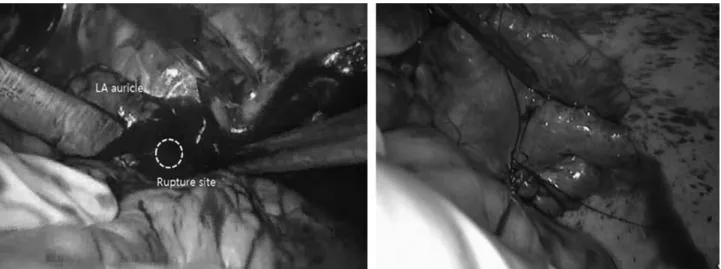
Bleeding point was noted at left atrial wall below

appendage (Fig. 1). The rupture site was difficult to repair under the beating heart because it was locat- ed at posterior aspect of heart. We repaired it under cardiopulmonary bypass. The postoperative course was uneventful and the patient was discharged without any complication.

2. Case 2

A 71 year-old male patient was admitted to emer- gency room after driver’ s traffic accident. He crashed his anterior chest wall to the steering wheel. He was diagnosed with hypertension and diabetes in past years. He was conscious with stable vital signs. Chest X-ray showed neither rib fracture nor hemop- neumothorax in both pleural cavities. But mediastinal contour was widened on chest x-ray. Chest CT revealed large amount of pericardial effusion.

Pericardiocentesis was attempted but failed due to his obese body. We planned the operation for pericar- diostomy under general anesthesia. After the pericar- diostomy, large amount of fresh blood gushed out, so we decided to perform sternotomy for exploration.

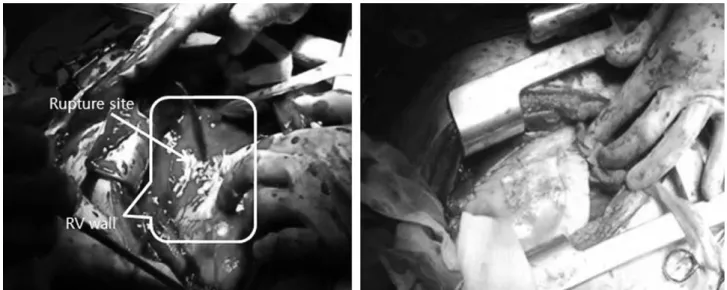
Pericardium was intact but massive bleeding was noted in the pericardial cavity. The active bleeding was found at RV anterior wall and direct primary suture was done with the finger compression on the rupture site (Fig. 2). There was no bleeding after applying hemostatic agent, and we ended the opera- tion without any complication. He recovered unevent- fully and then discharged without any problems.

Fig. 1. A 36 years old man with blunt chest trauma because of falling down from the 4

th

floors had hemopericardium. It was originat-

ed in LA wall below auricle and treated by direct repair under cardiopulmonary bypass.

(3)

III. Discussion

Traumatic cardiac injury is classified into two types by injury mechanism. One is penetrating injury, the other is blunt injury. Blunt cardiac trau- ma varies from clinically insignificant contusion to cardiac rupture. It is usually associated with vehic- ular accidents, falls from height and crush injuries.(1) Most cardiac rupture patients are already dead on hospital arrival. Patients who are success- fully arrived at emergency room, have an overall mortality rate of 89%.(2)

Blunt traumatic cardiac rupture shows various clinical symptoms, mild chest discomfort, dyspnea and shock. A blunt traumatic cardiac rupture patient with head or abdomen trauma has no typical symptoms in some cases.(3) A cardiac rupture mechanism due to blunt chest trauma are direct transmission of intrathoracic pressure, hydraulic effect, decelerating force, myocardial necrosis by contusion, and penetration from broken rib and sternum fragment.(4)

Clinical diagnosis of blunt traumatic cardiac rup- ture is sometimes difficult so suspicion is an impor- tant point in diagnosing traumatic patient with tamponade physiology, hemodynamic instability.(5) The diagnosis of traumatic cardiac injury is presence of hemopericardium through the echocardiography.

Hemopericardium could be worsened and turned into

cardiac tamponade. Therefore definite diagnosis is needed in suspicious cardiac injury related to chest trauma even though the vital sign is stable.

Immediate pericardiocentesis for draining of the hemorrhage is important. When the vital sign is unstable despite of the sufficient drainage, we should suspect the significant coexisting injury and consider the mechanical support like ECMO. Like as case 1, when he fell into cardiac arrest, it is surely necessary to apply the ECMO.

The surgical treatment of traumatic cardiac injury must be executed on condition that the cardiopul- monary bypass is ready to use immediately. And the recommended incision is median sternotomy when another injury is absent, because it can be easily extended for laparotomy, and is suitable for car- diopulmonary bypass.(6)

Furthermore, when the operation cannot be car- ried out because of the unstable vital sign in delayed cases, application of the ECMO which can make the vital sign adequately stable for performing operation should be initially considered, and we think such strategy may decrease the mortality of the blunt cardiac injury.

REFERENCES

01) Tanoue K, Sata N, Moriyama Y, Miyahara K. Rupture of the left atrial ‘basal’ appendage due to blunt trauma in an elderly

─ 7 ─

Tae Ook Noh, et al.: Surgical Treatment of Blunt Traumatic Cardiac Rupture - Two Case Reports -

Fig. 2. A 71 years old man with blunt chest trauma due to motor vehicle accident had active bleeding after opening of the pericardi-

um. Blood gushed out from RV anterior wall and the rupture was repaired it treated by direct suture and sealed up surgical

hemostatic materials.

(4)

patient. Eur J Cardiothorac Surg. 2008; 34: 1118-9.

02) Teixeira PG, Inaba K, Oncel D, et al. Blunt cardiac rupture: a 5-year NTDB analysis. J Trauma. 2009; 67: 788-91.

03) Kim HY KM, Park JH, Chei CS, Hwang SW. Cardiac Injury due to Thoracic Trauma. Korean J Thorac Cardiovasc Surg.

2007; 40: 831-6.

04) Hirai S, Hamanaka Y, Mitsui N, Isaka M, Kobayashi T.

Successful emergency repair of blunt right atrial rupture after

a traffic accident. Ann Thorac Cardiovasc Surg. 2002; 8: 228-30.

05) Pucci MJ, Warrington C, Lindenbaum GA, Kaulback KR, Jenoff JS, Martin ND. Nonoperative management of blunt traumatic cardiac rupture: considerations of a novel approach.

Ann Thorac Surg. 2012; 94: 1341-3.

06) Nan YY, Lu MS, Liu KS, et al. Blunt traumatic cardiac rup- ture: therapeutic options and outcomes. Injury. 2009; 40: 938- 45.

─ 8 ─

- Journal of Trauma and Injury Vol. 27, No. 1 -

수치

Fig. 1. A 36 years old man with blunt chest trauma because of falling down from the 4 th floors had hemopericardium
Fig. 2. A 71 years old man with blunt chest trauma due to motor vehicle accident had active bleeding after opening of the pericardi- pericardi-um

참조

관련 문서