• 검색 결과가 없습니다.

Experiences of Video-assisted Thoracic Surgery in Trauma

N/A
N/A
Protected

Academic year: 2021

Share "Experiences of Video-assisted Thoracic Surgery in Trauma"

Copied!
4
0
0

로드 중.... (전체 텍스트 보기)

전체 글

(1)

Received: May 10, 2017 Revised: July 7, 2017 Accepted: July 8, 2017 JOURNAL OF

TRAUMA AND INJURY

ORIGINAL ARTICLE

J Trauma Inj 2017;30(3):87-90 http://doi.org/10.20408/jti.2017.30.3.87

Correspondence to Hyun Min Cho, M.D., Ph.D.

Division of Trauma and Surgical Critical Care, Department of Thoracic and Cardio- vascular Surgery, Pusan National Universi- ty Hospital, 179 Gudeok-ro, Seo-gu, Busan 49241, Korea

Tel: +82-51-240-7369 Fax: +82-51-240-7719 E-mail: [email protected]

http://www.jtraumainj.org eISSN 2287-1683

pISSN 1738-8767

Copyright © 2017 The Korean Society of Trauma

This is an Open Access article distributed under the terms of the Creative Commons Attribution Non-Commercial License (http://creativecommons.org/licenses/by-nc/4.0/) which permits unrestricted noncommercial use, distribution, and reproduction in any medium, provided the original work is properly cited.

Experiences of Video-assisted Thoracic Surgery in Trauma

Dongsub Noh, M.D.

1,2

, Chan-kyu Lee, M.D.

1

, Jung Joo Hwang, M.D., Ph.D.

1,2

, Hyun Min Cho, M.D., Ph.D.

1

1

Department of Trauma and Surgical Critical Care, Pusan National University Hospital, Busan, Korea

2
Department of Thoracic and Cardiovascular Surgery, Eulji University Hospital, Daejeon, Korea

Purpose: Nowadays, Video-Assisted Thoracic Surgery (VATS) is widely used for its benefits, low post-operative pain, excellent anesthetic result and complete visualization of intrathoracic organs. Despite of these advantages, VATS has not yet been widely used in trauma patients. In this study, we aimed to investigate the usefulness of VATS in the chest trauma area.

Methods: From January 2016 to December 2016, 203 patients underwent surgical treat- ment for chest trauma. Their medical records were analyzed retrospectively.

Results: Eleven patients underwent thoracic surgery by VATS. Six patients were unsta- ble vital sign in the emergency room. Two patients underwent emergency surgery and the rest patients underwent planned surgery. The common surgeries were VATS hema- toma evacuation and wedge resection. There was no conversion to thoracotomy. The surgery proceeded without any problems for all patients.

Conclusions: VATS would be an effective diagnostic and therapeutic modality in chest trauma patients. It can be applied to retained hemothorax, persistent pneumothorax, suspicious diaphragm injury and even coagulation of bleeder.

Keywords: Thoracic injuries; Video-assisted thoracic surgery

INTRODUCTION

The technique of thoracoscopy was first described by Jacobeus in 1910, who used a

cystoscope to examine the pleural space [1]. Although thoracosopy was initially per-

formed for diagnostic purpose, it evolved later into a therapeutic procedure [2]. The

(2)

88 http://doi.org/10.20408/jti.2017.30.3.87

Journal of Trauma and Injury Volume 30, Number 3, September 2017

development of endoscopic instruments, particularly endoscopic staplers, enabled surgeons to perform major operations using minimally invasive techniques [2]. Now- adays, Video-Assisted Thoracic Surgery (VATS) is applied to simple lung wedge resection, pulmonary lobectomy, pulmonary segmentectomy and even atrial septal defect closure [3,4].

VATS provides low post-operative pain, excellent aes- thetic result, complete visualization of intrathoracic organs including diaphragm, pericardium, mediastinum, and prevents extensive surgery and its complications [5-7].

Despite of these advantages, VATS has not yet been widely used in trauma patients [5]. We therefore aimed to inves- tigate the usefulness of VATS in the trauma area.

METHODS

From January 2016 to December 2016, 203 patients un- derwent surgical treatment for chest trauma at Pusan Na- tional University Hospital, Trauma Center. We exclude the surgical treatment through traditional thoracotomy.

All the patients who underwent VATS from beginning were enrolled in this retrospective study. All medical re- cords and operative notes of these patients were reviewed.

Descriptive statistics were expressed as mean±standard deviation unless otherwise specified.

Operative technique

The operation was performed under general anesthe- sia with a double lumen endotracheal intubation. The patients were positioned supine or lateral decubitus ac- cording to patient’s condition. The video equipment was 5-mm 30-degree or 10-mm 30-degree scope (Karl Storz, Tuttingen, Germany). The chest tube drainage site was always used to introduce the first thoraco-port. The num- ber and the site of ports were determined by operative findings. When operating on a single port, the surgery was performed by extending the first thoraco-port incision by 3-4 cm, without rib spreading.

RESULTS

Eleven patients underwent thoracic surgery by VATS.

Table 1 summarizes the demographic data. The average age was 48.18±16.46. Ten patients were injured by blunt trauma and one patient was injured by penetrating trau- ma. Most of the associated injured areas were part of the extremities. The average Injury Severity Score (ISS) was 19.55±10.63. Six patients showed unstable vital signs in the emergency room. Two patients were put into emer- gency surgery and the others underwent planned surgery.

In these two patients, surgical indication was continuous bleeding from chest drain but the vital sign of these pa- tients were stable. The average operation time of VATS was 106.10±58.67 min.

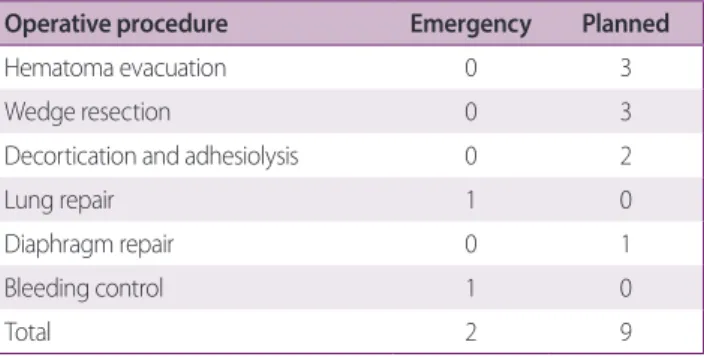
The most common surgery was hematoma evacuation (Table 2). Most surgeries were performed through a three port (Table 3). There was no conversion into thoracoto-

Table 2. Operative procedures of video-assisted thoracic surgery Operative procedure Emergency Planned

Hematoma evacuation 0 3

Wedge resection 0 3

Decortication and adhesiolysis 0 2

Lung repair 1 0

Diaphragm repair 0 1

Bleeding control 1 0

Total 2 9

Values are presented as number.

Table 1. Patients characteristics

Variables Patients (N =11)

Age (year) 48.18±16.46

Sex (M:F) 6:5

Injury mechanism (blunt : penetration) 10:1 Associated injury

Brain 2

Abdomen 1

Extremity 4

Injury severity score 19.55±10.63

Hemodynamic unstable at emergency room 6 Emergency video-assisted thoracic surgery 2

Operation time (min) 106.10±58.67

Values are presented as mean±deviation or number.

(3)

89

http://www.jtraumainj.org Dongsub Noh, et al. Video-assisted Thoracic Surgery in Trauma

my. The surgery proceeded without any problems for all patients and there were no complications and deaths.

DISCUSSION

We successfully performed the VATS procedure for 11 patients who had chest trauma. And there was no con- version into conventional thoracotomy, nor was there morbidity or mortality. Two cases of VATS were per- formed on an emergency basis, and the rest were carried out in planned surgeries. In these two patients, surgical indication was continuous bleeding from chest drain but the vital sign of these patients were stable, and we could find bleeders in computed tomography (CT) scan.

In hemodynamically stable patients, VATS provides ac- curate assessment of intra-thoracic organ injuries and can be utilized to manage them definitely and effectively [5]. Additionally, VATS for chest trauma would be ap- plicable for bleeding that persists even after drainage of the thoracic cavity, when there were no findings in the diagnostic images that would indicate injury to the great vessels [5]. Penetrating chest trauma which met some criteria could be treated through emergency VATS [8].

However, the usefulness of emergency VATS has not yet been identified [5,6]. Usually the conditions like hemo- dynamic instability, profound shock, major hemorrhage and uncontrolled air-leakage requires thoracotomy for satisfactory outcome [9]. Thoracotomy seems to be more appropriate for unstable vital sign. However, if surgical technique or surgical instruments are improved, VATS can be applied to unstable vital sign.

VATS can provide complete visualization of intra- thoracic organs including diaphragm, pericardium and mediastinum [5-7]. Therefore, VATS was mainly used for evacuation of retained hemothorax, wedge resection of

lung, decortication of empyema and repair of diaphragm [5,6,10,11]. Our results were similar to the previous re- ports: operative procedures included evacuation of clotted hemothorax (3 cases), wedge resection (3 cases), adhesi- olysis and decortication (2 cases), hemostasis of intratho- racic bleeders (1 case), repair of diaphragm (1 case) and suture repair of the lacerated lung (1 case). We planned most of the surgeries, if possible, by taking CT preopera- tively. CT is generally considered as an initial diagnostic method to evaluate the injured organs.

We preferred to use single or two-port access, by ex- tending the chest drainage site. Thoracotomy incision, by itself, may cause a prolonged recovery and severe morbidity even in patients with mild intrathoracic injury [6,11]. Minimally invasive surgery was considered to be beneficial in trauma patients, especially in multiple severe traumas. So, we performed the VATS through the chest drainage site for the minimally invasive surgery. VATS shortened duration of chest tube drainage and length of hospital stay, ultimately lowered costs in patients with re- tained traumatic hemothoraces [12]. Patients who under- went VATS had less pain, early recovery and superior rate of return to normal life than those who underwent con- ventional thoraocotomy [6]. We attempted to perform VATS using a single port or two ports, which would be beneficial to trauma patients. We believe that the smaller invasiveness leads to the better outcome of the trauma patient.

CONCLUSION

VATS would be an effective diagnostic and therapeutic modality in chest trauma patients. It can be applied to retained hemothorax, persistent pneumothorax and sus- picious diaphragm injury. Even coagulation of bleeder by VATS may be possible to apply if reliable bleeder is found on CT scan with stable vital sign. However, a careful clinical assessment and a reliable diagnostic imaging are required before performing VATS on a chest trauma pa- tient. And it is necessary to add further study by increas- ing the case of a VATS.

Table 3. The numbers of the thoraco-port

Thoraco-port Numbers

Single port 3

Two ports 3

Three ports 5

Total 11

(4)

90 http://doi.org/10.20408/jti.2017.30.3.87

Journal of Trauma and Injury Volume 30, Number 3, September 2017

REFERENCES

1. Jacobaeus HC. The practical importance of thoracoscopy in surgery of the chest. Surg Gynecol Obstet 1922;34:289-96 2. Gabal A, Alghorori M. Role of emergency VATS in blunt chest

trauma patients. J Cardiothoracic Surg 2013;8(Suppl 1):O73.

3. Gonzales-Rivas D, Mendez L, Delgado M, Fieira E, Fernandez R, de la Torre M. Uniportal video-assisted thoracoscopic anatomic segmentectomy. J Thorac Dis 2013;5(Suppl 3):S234-45.

4. Sabate Rotes A, Burkhart HM, Suri RM, Grogan M, Taggart NW, Li Z, et al. Minimally invasive video-assisted surgical clo- sure of atrial septal defects: a safe approach. World J Pediatr Congenital Heart Surg 2014;5:527-33.

5. Manlulu AV, Lee TW, Thung KH, Wong R, Yim AP. Current indications and results of VATS in the evaluation and manage- ment of hemodynamically stable thoracic injuries. Eur J Car- diothorac Surg 2004;25:1048-53.

6. Ben-Nun A, Orlovsky M, Best LA. Video-assisted thoracoscopic surgery in the treatment of chest trauma: long-term benefit.

Ann Thorac Surg 2007;83:383-7.

7. Khammash M, El Rabee F. Penetrating chest trauma in North of Jordan: a prospective study. The Internet Journal of Thoracic and Cardiovascular Surgery 2006;8:1.

8. Taniguchi Y, Nakamura H, Haruki T, Fujioka S, Adachi Y, Miwa K, et al. Video-assisted thoracic surgery (VATS) for stabbing thoracic injury. Yonago Acta Medica 2008;51:73-6.

9. Mattox KL. Indications for thoracotomy: deciding to operate.

Surg Clin North Am 1989;69:47-58.

10. Potaris K, Mihos P, Gakidis I. Role of video-assisted thoracic surgery in the evaluation and management of thoracic injuries.

Interact Cardiovasc Thorac Surg 2005;4:292-4.

11. Liu DW, Liu HP, Lin PJ, Chang CH. Video-assisted thoracic sur- gery in treatment of chest trauma. J Trauma 1997;42:670-4.

12. Meyer DM, Jessen ME, Wait MA, Estrera AS. Early evacuation of traumatic retained hemothoraces using thoracoscopy: a pro- spective, randomized trial. Ann Thorac Surg 1997;64:1396-400.

Discussion 1400-1.

수치

Table 2. Operative procedures of video-assisted thoracic surgery Operative procedure Emergency Planned
Table 3. The numbers of the thoraco-port

참조

관련 문서

It considers the energy use of the different components that are involved in the distribution and viewing of video content: data centres and content delivery networks

1 John Owen, Justification by Faith Alone, in The Works of John Owen, ed. John Bolt, trans. Scott Clark, "Do This and Live: Christ's Active Obedience as the

Pathology, Internal Medicine, Neuroscience, Psychiatry, Pediatrics, Dermatology, Surgery, Thoracic and Cardiovascular Surgery, Neurosurgery, Orthopedic Surgery,

In addition, the expression of REDD1 was increased when Huh7 cells were treated with PA, and overexpression of REDD1 affected cell survival and lipid

The purpose of this study was to evaluate the effect of these substances on bone regeneration by applying these materials to bone defects after cyst

This showed that the surgical outcome was successfulin 269 patients (98.89%),butthe revision surgery due to surgicalrelapse was performed in three patients.Of 152 patients

Using this leap motion, a surgeon can perform the virtual shoulder arthroscopic surgery skillfully and reduce mistakes in surgery.. The simulation using leap motion shows

The median concentrations of FDP were significantly elevated ( p= 0.02) and the median concentrations of fibronogen were decreased ( p= 0.021) in abnormal bleeding patients