모바일 가상화기반 클라우드 자원관리를 지원하는 효율적 방법
강용호, 장창복*, 이완직, 허석렬, 김주만
부산대학교 IT응용공학과 (주)알투소프트*
Efficient Method to Support Mobile Virtualization-based Cloud Resource Management
Yongho Kang, Changbok Jang * , Wanjik Lee, Seokyeol Heo, Jooman Kim
Dept. of Applied IT and Engineering, Pusan National University Director of Institute, R2SOFT LTD
*요 약 최근 다양한 클라우드 서비스가 데스크탑 및 서버 컴퓨터 뿐만 아니라 모바일 장치에 적용되었다
.
또한 스마트폰 사용자들이 급속히 증가는 클라우드 서비스
,
게임,
은행업무 및 모바일 사무실과 같은 다양한 서비스를 즐기 면서 클라우드 환경에서의IT
자원의 효율적 관리 방안이 요구되었다.
본 논문에서는 모바일 장치들 간에 상호 이용 가능한 물리 장치인CPU,
메모리 및 저장장치들을 가상화 하고,
가상화 기반의 클라우드 환경에서 물리적 자원의 효율적 사용방법을 제시한다.
제안된 기술은 모바일 단말기의 서비스 활용시에 클라우드 접속을 통한 가상화 기반의 자원 관리가 효율적임을 증명하였고,
또한 처리과정의 실시간성을 보장하였다.
주제어 : Disk Cache, Micro-Kernel, I/O Performance, Parallel Processing
Abstract Recently, various cloud service has been being provided on mobile devices as well as desktop pc and server computer. Also, Smartphone users are very rapidly increasing, and they are using it for enjoying various services(cloud service, game, banking service, mobile office, etc.). So, research to utilize resources on mobile device has been conducted. In this paper, We have suggested efficient method of cloud resource management by using information of available physical resources(CPU, memory, storage, etc.) between mobile devices, and information of physical resource in mobile device. Suggested technology is possible to guarantee real-time process and efficiently manage resources.
Key Words : Mobile Virtualization, Mobile Cloud Computing, Cloud Resource Management
Received 2 January 2014, Revised 7 February 2014 Accepted 20 February 2014
Corresponding Author: Jooman Kim(Pusan National University) Email: [email protected]
Ⓒ The Society of Digital Policy & Management. All rights reserved. This is an open-access article distributed under the terms of the Creative Commons Attribution Non-Commercial License (http://creativecommons.otg/licenses/by-nc/3.0), which permits unrestricted non-commercial use, distribution, and reproduction in any medium, provided the original work is properly cited.
ISSN: 1738-1916
1. Introduction
The market of mobile recently has been evolving rapidly and cloud computing is spreading into mobile as
well. That is why mobile cloud computing is becoming
a new issue today. Cloud computing is the environment
that provides virtualized IT resources as a service by
using wireless Internet technology. In cloud computing,
a user lends IT resources as(software, storage, server, network)needed, uses them, get a support of real-time scalability according to service load, and pays as he/she goes[1].
Especially the cloud computing environment distributes IT resources and allocates according to user’s request, so there should be a study on technology that manages these resources and deals with effectively[2,3].
Mobile cloud computing creates a new chance for IT industry because it allows the superiority and economic of cloud computing to meet the mobility and convenience of mobile and draws a synergy effect for both.
Recently, Mobile device(Smartphone, Tablet PC, etc) does not only perform the role of communication medium such as phone calls, but also has similar performance of latest PC computer, and provide a various services. So, it has being conducted that research about using mobile virtualization on the mobile devices to provide a variety of services, or to enhance mobile security recently.
Therefore, the future mobile virtualization system will be able to provide resources to user in their mobile devices. Thus, if cloud resource is requested by the user or mobile application, how to provide mobile device’s cloud resource to user will be need. So We have suggested management technique of cloud resource that efficiently can handle them by using information of available physical resources(CPU, memory, storage, etc.) between mobile devices , and information of physical resource in mobile device
2. Related Works
Mobile devices are increasingly becoming an essential part of human life as the most effective and convenient communication tools not bounded by time and place. Mobile users accumulate rich experience of
various services from mobile applications, which run on the devices and/or on remote servers via wireless networks. The rapid progress of mobile computing becomes a powerful trend in the development of IT technology as well as commerce and industry fields[4].
However, the mobile devices are facing many challenges in their resources (e.g., battery life, storage, and bandwidth) and communications (e.g., mobility and security) [5]. The limited resources significantly impede the improvement of service qualities. Cloud computing has been widely recognized as the current generation’s computing infrastructure. Cloud Computing offers some advantages by allowing users to use infrastructure (e.g., servers, networks, and storages), platforms (e.g., middleware services and operating systems), and softwares (e.g., application programs provided by cloud providers (e.g., Google, Amazon, and Salesforce) at low cost. In addition, Cloud Computing enables users to elastically utilize resources in an on-demand fashion. As a result, mobile applications can be rapidly provisioned and released with the minimal management efforts or service provider’s interactions. With the explosion of mobile applications and the support of Cloud Computing for a variety of services for mobile users, mobile cloud computing is introduced as an integration of cloud computing into the mobile environment. Mobile cloud computing brings new types of services and facilities for mobile users to take full advantages of cloud computing[6].
Like the above, as mobile cloud computing is being introduced, research on how to efficiently use the resources of mobile devices is actively carried out.
Especially, rapid growth of the demand for
computational power by scientific, business and
web-applications has led to the creation of large-scale
data centers consuming enormous amounts of electrical
power. Anton Beloglazov proposes an energy efficient
resource management system for virtualized Cloud data
centers that reduces operational costs and provides
required Quality of Service (QoS). Energy savings are achieved by continuous consolidation of VMs according to current utilization of resources, virtual network topologies established between VMs and thermal state of computing nodes. They present first results of simulation-driven evaluation of heuristics for dynamic reallocation of VMs using live migration according to current requirements for CPU performance[7]. Also, to protect the processed data, security services are performed in the cloud. In general, they can classify cloud security services in two categories: Critical Security service and Normal Security service. Critical Security service provides strong security protection such as using longer key size, strict security access policies, isolations for protecting data, and so on. The Critical Security service usually occupies more cloud computing resources, however it generates more rewards to the cloud provider since the Critical Security service users need to pay more for using the Critical Security service. With the increase of the number of Critical Security and Normal Security service users, it is important to allocate the cloud resource to maximize the system rewards with the considerations of the cloud resource consumption and incomes generated from cloud users. To address this issue, they propose a Security Service Admission Model (SSAM) based on Semi-Markov Decision Process to model the system reward for the cloud provider. [8]. ThinkAir is a framework that makes it simple for developers to migrate their smartphone applications to the cloud. ThinkAir exploits the concept of smartphone virtualization in the cloud and provides method-level computation offloading. it focuses on the elasticity and scalability of the cloud and enhances the power of mobile cloud computing by parallelizing method execution using multiple virtual machine (VM) images.
They implement ThinkAir and evaluate it with a range of benchmarks starting from simple micro-benchmarks to more complex applications[9].
Research on provisioning methods is also actively conducted to efficiently manage resources in cloud computing system.
Dornemann, T. suggested a solution that automatically schedules workflow steps to underutilized hosts and provides new hosts using Cloud computing infrastructures in peak-load situations is presented [10]
3. System Architecture
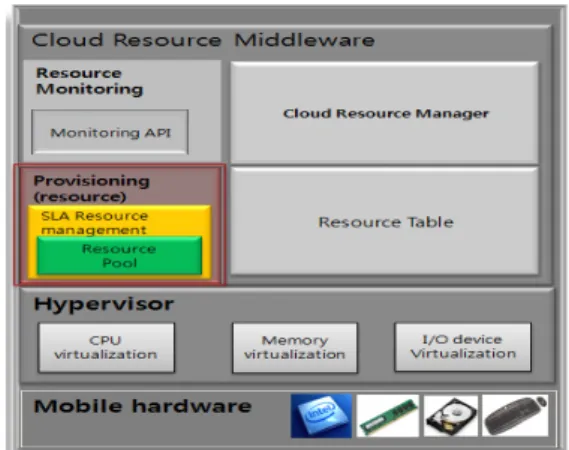
Fig. 1 show the architecture of cloud resource management system which I suggested based on mobile virtualization. Suggested system consists of Hypervisor which virtualizes physical resources of the mobile device and Cloud resource middleware which manages the each resource in mobile device. Cloud Resource Manager contains algorithm which uses the physical resources of the mobile devices(CPU, Memory, Storage). Resource Table contains current use information of resources in mobile devices
[Fig. 1] Cloud resource management system
In the Fig. 1, Cloud Resource Manager consists of
cloud resource process module, resource selection
module. Cloud resource process module receives(or
sends) a result of cloud resource process which was
requested by each mobile device When user(or system
itself) requests the cloud resources, cloud resource middleware select the best resource among the available physical resources. To this selection, it uses the information of resource table (Table 1).
In the example of table 1, device No field is a name of a mobile device which can be currently connect to the network, RL(Resource_location) field is a maximum number and information of the available resources.
The core of my suggestion is that can find both the device which has a lot of available resources and the information of available resources by using only one value(RL). The algorithm to search for what available resources within the device, to retrieve the device which has a current maximum number of available resources is as follows.
<Table 1> Resource Table Device No. RL(Resource location)
D1 6
D2 11
D3 4
D4 15
Provision of a mobile device to dynamically configure the physical resources that are part of the algorithm is implemented, Resource Pool that were associated with the current mobile devices and other devices using the resources that contain information part.
The provisioning module handles the provisioning process modules, SLA-based resource management module. Provisioning module gathers information of device which was connected with mobile devices according to the given time interval. SLA-based resource management module selects devices which own the resource dynamically was configured based on the collected devices and resource information. The system can use the information of resource pool such as Fig. 3 to this selection.
3.1 Searching the device
As shown table, each device(D1~D4) has the resources(R1, R2, R3, R4). And if the resources are being used, the value of R1, R2, R3, R4 set 0, or if not in use, the value set 1. Thus, in the above table, R2, R3 resources is available resources in the device D1, and R1, R4 is currently in use. Based on this information, the value of RL is calculated by converting binary(0110) to decimal(6). Each value(R1, R2, R3, R4) of D1 can be sequence list(0, 1, 1, 0), and it can be value of binary(0110) by converting tasks. So, the value converted to decimal number which has a value of 6.
This calculated value of RL is stored in the Resource Table. Based on the RL value of these resources, the most currently available devices is device(D4) that have the greatest value of RL(RL=15). So, cloud resource middleware will request physical resources to the device(D4).
<Table 2> Resource Table in mobile device Device R1 R2 R3 R4 RL
(Resource_location)
D1 0 1 1 0 6
D2 1 0 1 1 11
D3 0 1 0 0 4
D4 1 1 1 1 15
3.2 Location information
Based on RL values, you can search for current available resources. As these operations were performed through regularization methods and repetitive tasks, it has the algorithm of simple form as follow.
Step 1: Rk = RL-2
n-1operation is performed. n means the total number of resources that the device has. Currently, as devices have R1, R2, R3, R4, so the value of n is 4. k refers to the number of each resource.
k is increased by 1 from1.
Step 2: Rk> = 0 : this operation examines whether
Rk is greater than 0 or equal to 0. If the return value
is true, that the resources are available, otherwise it is not possible to use the resources.
Step 3: If the return value is true, the calculated Rk value was stored in RL(RL=Rk) to use in the next step the formula. If it is not true, the current value of RL is used. In order to proceed to the next step, the value of n is decremented by 1, and k value is incremented by 1.
Step 4 : Repeat the above steps.
Therefore, according to the example of Table 2, the available resources in device D1
Step 1: By the formula Rk = RL - 2n-1 (k = 1, n
= 4), R1 = 6 - 23 = 6 - 8 = -2. Therefore,
Step 2: Rk >= 0: the value of R1 is false. It means the resource is now in use. After this, according to Step 3, the return value of R1 is false and the value of RL becomes 6 which is the current value. In order to proceed to the next step, the value of k is incremented from 1 to 2, the value of n is decremented from 4 to 3.
Until the current calculation, the resource of R1 is in use and the value of R1 is 6, k =2, n=3.
Based on these values, if the calculation is repeated one more time from Step 1,
Step 1: R2 = 6 - 22 = 6 - 4 = 2,
Step 2: the condition R2 >= 0 is satisfied and true.
Therefore, the resource of R2 is identified available.
Step 3: Because R2 is true, the value of R2 is stored in RL. Therefore, when the current step is completed, the each RL value is 2, k =3, n = 2.
If the above process is repeated until n = 0, in the case of D1, the available resources become R2 and R3.
Like this, with the methods suggested in this report, based on the value of RL, we can acquire the device which has the most available resources and the resource number of each available resource.
3.3 Provisioning Method
In the example of Table 3, D1, D2, D3, and D4 mean device names, and the numbers in the fields mean the
resource use frequency of each device respectively.
With the basis of D1 on the first line, the usage frequencies of each device D2, D3, and D4 are 3, 2, and 1. The device D2 used the resources of D1, D3, and D4 for 4 times, 4 times, and 1 time respectively. The device D3 used the resources in the device D1, D3, and D4 for 2 times, 6 times, and 5 times respectively.
<Table 3> Resource Pool Information
D1 D2 D3 D4
D1 3 2 1
D2 4 4 1
D3 2 6 5
D4 3 2 1