• 검색 결과가 없습니다.

Effect of Endophytic Bacterium Inoculation on Total Polyphenol and Flavonoid Contents of Tartary Buckwheat Sprouts

N/A
N/A
Protected

Academic year: 2021

Share "Effect of Endophytic Bacterium Inoculation on Total Polyphenol and Flavonoid Contents of Tartary Buckwheat Sprouts"

Copied!
7
0
0

로드 중.... (전체 텍스트 보기)

전체 글

(1)

Effect of Endophytic Bacterium Inoculation on Total Polyphenol and Flavonoid Contents of Tartary Buckwheat Sprouts

Xoxiong Briatia 1 , Md Obyedul Kalam Azad 2 , Chartchai Khanongnuch 3 , Sun Hee Woo 4 , and Cheol Ho Park 2,†

ABSTRACT The effects of endophytic microbial inoculation and temperature on the phenolic content of tartary buckwheat (TP) sprouts were investigated. TP seeds were inoculated with Herbaspirillum spp. at concentrations (%v/v) of 0 (control), 10, 20, and 40% at 20, 25, and 30ºC in a growth chamber for seven days. It was observed that the phenolic content (PC) including flavonoid, rutin, and tanin increased with an increase in inoculant rate at 20ºC, whereas the PC content increased with an increase in temperature regardless of the inoculant rate. Therefore, it is suggested that increasing the inoculant rate is effective at achieving higher phenolic contents when plants are grown at lower temperatures.

Keywords : endophytic bacterium, seed inoculants, tartary buckwheat, total phenol, total flavonoid, tanin

DOI : https://doi.org/10.7740/kjcs.2018.63.1.057

Original Research Article

ⓒ 본 학회지의 저작권은 한국작물학회지에 있으며, 이의 무단전재나 복제를 금합니다.

This is an Open-Access article distributed under the terms of the Creative Commons Attribution Non-Commercial License (http://creativecommons.org/licenses/by-nc/3.0) which permits unrestricted non-commercial use, distribution, and reproduction in any medium, provided the original work is properly cited.

1)

Department of Food Science and Technology, Faculty of Agriculture and Forest Resources, Souphanouvong University, Luang Prabang 06300, Lao PDR

2)

Department of Bio Health Technology, College of Biomedical Science, Kangwon National University, Chuncheon 24341, Korea

3)

Division of Biotechnology, Faculty of Agro-Industry, Chiang Mai University 50200, Thailand

4)

Department of Crop Science, Chungbuk National University, Cheong-ju 28644, Korea

Corresponding author: Cheol Ho Park; (Phone) +82-33-259-5642; (E-mail) [email protected]

<Received 10 November, 2017; Revised 29 January, 2018; Accepted 1 February, 2018>

Buckwheat (Fagopyrum spp.) is an annual plant belongs to Polygonacae family. Fagopyrum spp. consists of at least 18 species distribution in the world wide (Ohnishi, 1995).

However, only Common buckwheat (Fagopyrum esculentum Moench) and Tartary buckwheat (Fagopyrum tatarucum L.

Gaertn.) are of economically important and contain higher nutritional value. This plant contain proteins, carbohydrates, lipids, fibers, vitamins, amino acids and minerals as their basic components. Moreover, buckwheat grains has no gluten, so they are safe for people with celiac disease (Halbrecq et al., 2005; Skerritt, 1986). Tartary buckwheat has higher rutin content than common buckwheat (Kitabayashi et al., 1995a, b). Many people have interest in utilizing of Tartary buckwheat grains and sprouts because of their nutritional and pharmaceutical values. Nowadays, fresh and dried Tartary buckwheat sprouts are attracting a lot of attention from pharmaceutical and food companies, and are applied in the prevention of obesity and diabetes (Lee et al., 2006; Lin et al., 2008). Tartary buckwheat sprouts contents phenolic

compounds significantly higher during sprouting stage than matured stage (Sharma et al., 2012; Kim et al., 2008). Rutin including quercetin and catechin is the main polyphenol present in buckwheat (Park et al., 2005).

Tannins is a polyphenolic compound which is proven as antioxidant and possesses a chemo-protective potential found in plant food (Saxena et al., 2013). Gadzo et al. (2010) reported that light exposed leaves had higher concentration of tannins in Tartary buckwheat. On the other hand, the tannin contents significantly increased in the sprouting Tartary buckwheat compared to grains (Lee et al., 2004).

Endophytes are microorganisms that colonize living internal

tissues of plants without causing any harm to their host. All

types of microorganisms (fungi, bacteria and actinomycetes)

have been discovered as endophytes. Studies have revealed

the ubiquity of these microbes, with an estimate of at least

one million species of endophytic microorganisms residing

in plants with protect their hosts from infectious agents and

adverse conditions by secreting bioactive secondary metabolites

(2)

Fig. 1. Colony formation (left), Gram staining (middle) and cell morphology (right) of Herbaspirillum rubrisubalbicans.

(Hyde & Soytong, 2008; Strobel, 2003). Moreover, there is enormous potential for exploiting these endophytes for medi- cinal, agricultural and industrial uses (Aly et al., 2010).

Therefore, the aim of this study was to investigate the secondary metabolites content of Tartary buckwheat sprouts inoculated with endophytic bacterium Herbaspirillum rubri- subalbicanse isolate at different temperature.

MATERIALS AND METHODS

Endophytic bacterium Herbaspirillum rubrisubalbicans was isolated from Tartary buckwheat stem at the Laboratory of Applied Microbiology, Department of Biology, Faculty of Science, Chiang Mai University, Thailand. The taxonomic studies of the bacteria isolate was determined as described in Bergy’s manual of systematic bacteriology. Gram staining was performed after 24 h of bacteria cultivation at 37°C on nutrient agar media. Endospore formation was assessed with spore-staining method using malachite green (Schaeffer

& Fulton, 1993). Colony formation was assessed by spread plate technique on nutrient agar media. The biochemical test including oxidase test, catalase test, methyl red test, Voges-Proskauer test and citrate test were performed according with the method described by MacFaddin (2000). The growth of endophytic bacterium Herbaspirillum rubrisubalbicans was evaluated by using nutrient broth (NB) and nutrient agar (NA) media (Atlas, 2010). Endophytic bacterium cultivation was conducted at 37°C on 150 rpm rotary shaker. Sample was taken every 1h and measured at 600 nm by spectrophotometer.

Viable cell was determined by the spread plate method on nutrient agar (NA) media and all plates were incubated at 37°C for 24h. Colony formation was counted and the value was expressed as cfu/ml of sample.

A single colony was selected and inoculated into NB

medium, then incubated at 37°C for 8-10 h under shaking conditions. Exponentially growing cells were harvested by centrifugation at 6000 rpm for 20 min, and re-suspended in sterilized normal saline (0.85% NaCl) solutions to obtain the final cell densities of 10

8

cfu/ml. The inoculums were prepared with the proper diluents by using sterile distilled water to obtain a final concentration of 10, 20 and 40%

(v/v), respectively. Tartary buckwheat seeds were surface- sterilized with 2.5% (v/v) sodium hypochlorite for 3 min, and rinsed thoroughly in sterile distilled water for 4 times with 1 min duration. Seeds were soaked in liquid suspension of endophytic bacterium (10

8

cfu/ml) by separating each treatment for 0, 4, 8 and 12 h, at 30°C (Fig. 1).

Seven days-old Tartary buckwheat sprouts obtained from endophytic bacterium-treated seeds were harvested, cleaned and dried in hot air oven at temperature of 50°C for 24h.

The dried samples were ground in a mortar and pestle into powder. The powdered samples (2.0 g) sprouts were taken and 100 ml of 80% methanol was added to each and incubated overnight in a shaker followed by filtration using filter paper No.2. The extract was dried using a rotatory evaporator (Eyela N-100, Japan) at a temperature of 40°C.

The extracts were vacuum freeze dried to remove the re- maining moisture. The extracts were stored in a refrigerator at -20°C for further analysis.

Chemicals and reagents

The following reagents were used: Folin-Ciocalteu’s phenol

reagent (Fluka), Folin-Denis reagent (Fluka), Gallic acid

(Sigma-Aldrich), Tannic acid (Fluka), Sodium carbonate

(Fisher), Aluminum nitrate nanohydrate (ACS reagent, Sigma-

Aldrich), Potassium acetate (Fisher), Methanol (AR, ACI

Labscan), Ethanol 95% (AR, ACI Labscan), Deionized water

(Thermoscientific), Rutin (Sigma-Aldrich), Quercetin (Sigma-

(3)

Aldrich), Methanol (HPLC grade), Formic acid (Reagent grade, Sigma-Aldrich). 2, 2-Diphenyl-1-picrylhydrazyl (DPPH) (Sigma-Aldrich), Ferric chloride (Fluka), Ferrozine [Iron (II) chloride (FeCl

2

)] (Fisher), Potassium ferricyanide (III) (RANKEM), Trichloroacetic acid (ACS reagent, Sigma- Aldrich), Ferric chloride (Fluka), disodium hydrogen phosphate Anhydrous (RANKEM), Sodium dihydrogen phosphate An- hydrous (UNIVAR).

Determination of total polyphenol and flavonoids content

Total polyphenol (TP) content was determined by the Folin-Ciocalteu assay method as described by Eom et al.

(2008) with slight modifications. Briefly, an aliquot of 200 μl was added to a test tube containing 200 μl of phenol reagent (1 M). The volume was increased by adding 1.8 ml of distilled deionized water (DDW). Further 400 μl of Na

2

CO

3

(10%, w/v) was added and adjusted final volume to 4 ml by adding DDW. The absorbance was measured at 725 nm. The TP content was expressed as mg of Gallic acid equivalents (GAE) per gram of dried sample.

Total flavonoid (TF) content was determined according to the method described by Eom et al. (2008) with slight modification. Briefly, an aliquot of 0.5 ml was mixed with 0.1 ml of aluminum nitrate (10%, w/v) and 0.1 ml of potassium acetate (1 M). Thereafter, 3.3 ml of 80% methanol was added to make the total volume 4 ml. The mixture was vortexed and incubated for 40 min and the absorbance was measured at 415 nm. Quercetin was used as a standard and the value of TF content was expressed as mg of quercetin equivalent (QE) per gram of dried sample.

Determination of total tannin content

Total tannin content was determined by Folin-Denis method (Saxena et al., 2013). 1 ml of extract was mixed with 7.5 ml of standard solution of tannic acid (10-50 µg/ml). Then 0.5 ml of Folin-Denis reagent and 1 ml of Na

2

CO

3

(10%, w/v) solutions were added. The volume was made up to 10 ml with distilled deionized water. The absorbance was measured at 700 nm in spectrophotometer. Total tannins content was expressed as mg of tannic acid equivalent (TAE) per gram of extract.

Determination of rutin and quercetin content by HPLC The quantitative estimation of rutin and quercetin were performed by HPLC (Agilent 1100 Series, HPLC Value System, Germany). The analysis was performed according to the procedure reported by Rangkadilok et al. (2005) and Zvezdanovic et al. (2012). The HPLC instrument and operating conditions for rutin and quercetin was as follows: injection volume 10 µl, flow rate 1.0 ml/ min, UV detector 270 nm and Zorbax C

18

ABS (150 × 4.6 ㎜. i.d., 5 µm) reversed phased column with two mobile phase (A): Formic acid (0.4%) and (B): Methanol (100%).

Statistical analysis

Statistical analysis of all tests were carried out using Statistix software version 8.0. FL. Data was analyzed with ANOVA and Least significant difference (LSD) test at P ≤ 0.05 level was used to separate the means when the ANOVA F-test indicated a significant effect of the treatments.

RESULTS AND DISCUSSION

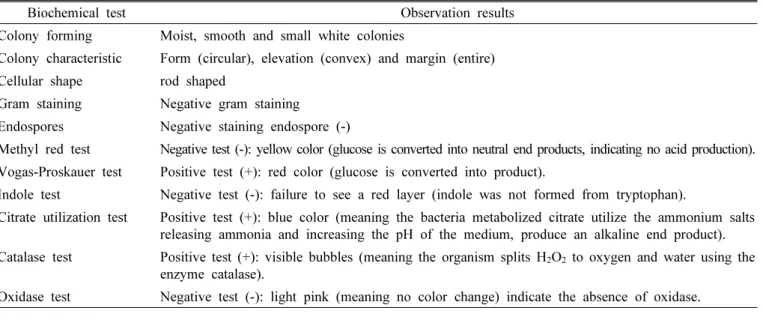
Identification and growth of endophytic bacterium The morphological characteristics and biochemical test of Herbaspirillum rubrisubalbicans were shown in Fig. 1 and Table 1. Cells of H. rubrisubalbicans exhibited gram-negative staining and negative staining endospore. For biochemical tests, negative test in methyl red test, indole test and oxidase test, while the positive test occurred with Vogas-Prokauer test, citrate utilization test and catalase test. However, the morphological characteristics, they generally have a circular form, convex elevation, entire margin and rode shape (Table 1). Colony formation with a small moist white colony and smooth with rode shapes was found in NB medium (Fig.

1). The optimal condition for H. rubrisubalbicans growth was performed using nutrient broth and nutrient agar medium.

It is reported that endophytes have beneficial effects on plant

growth, improvement of plant resistance to environmental

stress and enhance N

2

fixation (Spiering et al., 2006; Briatia

et al., 2016). The exponential growth phases was 8-10h of

incubation with a cell density 10

8

cfu/ml, moreover, viable

cell was more than 300 cfu/ml after 48h of incubation times

(data not shown).

(4)

Table 1. Biochemical test for endophytic bacterium Herbaspirillum rubrisubalbicans isolate.

Biochemical test Observation results

Colony forming Moist, smooth and small white colonies

Colony characteristic Form (circular), elevation (convex) and margin (entire) Cellular shape rod shaped

Gram staining Negative gram staining Endospores Negative staining endospore (-)

Methyl red test Negative test (-): yellow color (glucose is converted into neutral end products, indicating no acid production).

Vogas-Proskauer test Positive test (+): red color (glucose is converted into product).

Indole test Negative test (-): failure to see a red layer (indole was not formed from tryptophan).

Citrate utilization test Positive test (+): blue color (meaning the bacteria metabolized citrate utilize the ammonium salts releasing ammonia and increasing the pH of the medium, produce an alkaline end product).

Catalase test Positive test (+): visible bubbles (meaning the organism splits H

2

O

2

to oxygen and water using the enzyme catalase).

Oxidase test Negative test (-): light pink (meaning no color change) indicate the absence of oxidase.

Table 2. Total polyphenol content of tartary buckwheat sprouts (mg/g dw).

Inoculants (% v/v)

Sprouts growth temperature

20°C 25°C 30°C

Control 38.13 ± 0.51c 47.99 ± 0.06b 42.67 ± 0.13b 10% 42.31 ± 1.29b 50.54 ± 0.19a 44.13 ± 0.51a 20% 42.99 ± 0.19b 50.31 ± 0.13a 44.90 ± 0.32a 40% 45.35 ± 0.45a 44.13 ± 0.26c 43.31 ± 1.41b The results are expressed as means ± SD (n=3). Values with the same letter in columns are not significantly different at P < 0.05.

Table 3. Total flavonoid content of tartary buckwheat sprouts (mg/g dw).

Inoculants (% v/v)

Sprouts growth temperature

20°C 25°C 30°C

Control 77.15 ± 1.08c 93.78 ± 0.92b 74.11 ± 0.46c 10% 91.00 ± 0.31b 96.93 ± 1.08a 84.87 ± 0.31a 20% 92.04 ± 1.23b 98.67 ± 1.08a 80.96 ± 0.46ab 40% 99.17 ± 1.54a 86.28 ± 0.77c 77.15 ± 0.46b The results are expressed as means ± SD (n=3). Values with the same letter in columns are not significantly different at P < 0.05.

Phenolic compound and flavonoid content

It is shown that seed inoculation significantly increased total polyphenol (TP) and flavonoid content of Tartary buckwheat sprouts compared to control at 20°C growth temperature.

However, increasing temperature enhanced TP content at lower inoculant rate (Table 2). Generally, temperature has an enormous positive effect to accumulation of secondary metabolites in plant (Shiow and Zheng, 2001). However, Chen et al. (2010) reported that plant inoculated with S.

cinereus had the highest total polyphenols content of tea leaves. Aquaculture buckwheat sprouts significantly enriched total polyphenolics content higher than that of solid-phase cultured to 13% (Peng et al., 2009).

The content of total flavonoid of sprouts was high in order, 40% > 20% > 10% > control at 20°C, however, the order

is different where 10% and 20% inoculation has same trends for flavonoid content at 25 and 30°C (Table 3). From these results it is commercially economic to consider lower growth temperature regarding inoculation ratio. Tao et al. (2004) shown that Tartary buckwheat production by application of microbial inoculants (Bacillus megaterium) effectively increased flavonoids content. Furthermore, they suggested that Streptomyces strain could be adopted in the production of Tartary buckwheat sprout to get better quality buckwheat tea.

Randhir et al. (2008) found lower phenolic content in buckwheat seedling when grown under high temperature. Li et al. (2010) reported that after treated Tartary buckwheat by endophyte strains N

3

, the content of flavonoids reached 4.59%

and the production of flavonoids was 15.3% higher than the

control.

(5)

Table 4. Total tannins content of tartary buckwheat sprouts (mg/g dw).

Inoculants (% v/v)

Sprouts growth temperature

20°C 25°C 30°C

Control 23.80 ± 0.57c 27.35 ± 0.21b 24.05 ± 0.35b 10% 26.45 ± 0.35b 30.10 ± 0.14a 25.40 ± 0.14a 20% 26.65 ± 0.07b 29.56 ± 0.07a 25.50 ± 0.28a 40% 28.30 ± 0.42a 25.05 ± 0.07c 24.88 ± 0.14ab The results are expressed as means ± SD (n=3). Values with the same letter in columns are not significantly different at P < 0.05.

Table 5. Rutin and quercetin contents of tartary buckwheat sprouts (mg/g dw).

Contents (mg/g dw)

Inoculants (% v/v)

Sprouts growth temperature

20°C 25°C 30°C

Rutin Control 54.52 ± 1.63d 56.77 ± 0.97b 62.06 ± 0.41b

10% 62.72 ± 1.59b 62.68 ± 2.02a 64.31 ± 1.15a

20% 58.56 ± 1.32c 62.11 ± 1.75a 65.91 ± 0.37a

40% 67.06 ± 1.13a 57.40 ± 0.37b 61.32 ± 1.72b

Quercetin Control 0.66 ± 0.05c 0.66 ± 0.13b 1.07 ± 0.09c

10% 0.78 ± 0.03a 0.88 ± 0.03a 1.18 ± 0.12b

20% 0.73 ± 0.02ab 0.84 ± 0.06a 1.41 ± 0.07a

40% 0.71 ± 0.01b 0.81 ± 0.03ab 1.15 ± 0.07b

The results are expressed as means ± SD (n=3). Values with the same letter in columns are not significantly different at P < 0.05.

Total tannin content

Results of total tannin content is presented in Table 4. At 20°C growth temperature total tannin content significantly increased when the inoculation rate was 40%. However tannin content increased with increasing temperature regardless inoculant rate. Buckwheat sprout is known as a rich source of tannin (Kreft et al., 2002). Previous report explored that tannin content highly affected by Bradyrhizobium inoculation in cowpea seeds (Musa et al., 2011). Elsheikh (2001) also demonstrated that Rhizobium inoculation of legumes seed significantly increased tannin content. However, higher tannin content was achieved in 25°C temperature in our study.

Similar results were obtained by Wu et al. (2016), they found higher tannin content of sorghum grain when grown under high temperature. In the same way Trifoli leaf was accumulated higher condensed tannin when grown in high temperature (Lees et al., 1994).

Rutin and quercetin content

It is observed that rutin content was highest at 40%

inoculation rate at 20°C temperature, however, quercetin content was increased at 20% inoculation rate at 30°C temperature (Table 5). The chemical structure shows that rutin has sugar moiety in their ring, on the other hand, quercetin form without this moiety. High temperature may destructed the sugar moiety from rutin therefore, rutin converted to quercetin therefore enhanced quercetin was achieved. Report showed that seed inoculation with microbes (Streptomyces jingyangesis) significantly increased rutin content in tartary buckwheat (Tao et al., 2004). Similar results were obtained by Singh et al. (2016) in rutin content from rice.

They observed that seed inoculation with Bacillus subtilis greatly increased rutin and other phenolic content from rice seed.

The enriched phenolic compounds can be the reason for

the enhanced biofilm formation which has been implicated

to play a key role in efficient root colonization. Exerting

chemical from microbes in plant root zone might have

beneficial effects on plant secondary metabolites. Study

showed that effective microbial colonization in Arabidopsis

thaliana roots was triggered by certain plant polysaccharides

(Beauregard et al., 2013). Similarly, in another study L-malic

acid (MA) secreted from roots of A. thaliana and recruited

the beneficial rhizobacterium B. subtilis thus accelerate to

accumulates plant secondary metabolites.

(6)

CONCLUSION

It is observed from our findings that inoculation rate is depended upon plant growth environment. Higher inoculant rate is effective when sprouts are grown at lower temperature.

Inoculated plant grown under elevated temperature is giving same output as low temperature dose. As therefore, it might be suggested that Tartary buckwheat inoculated with Herbaspirillum spp should be grown under lower temperature in order to get higher secondary metabolites.

ACKNOWLEDGEMENTS

This research was supported by 2016 research grants (No.

520160146) from Kangwon National University, Korea.

REFERENCES

Aly, A. H., A. Debbab, J. Kjer, and P. Proksch. 2010. Fungal endophytes from higher plant: a prolific source of phyto- chemicals and other bioactive natural products. Fungal Diversity. 41 : 1-16.

Akanksha, S., A. R. Gupta, and R. Pandey. 2016. Rice Seed Priming with Picomolar Rutin Enhances Rhizospheric Bacillus subtilis CIM Colonization and Plant Growth. PLoS One v.11 (1): PMC4711789: DOI:10.1371/journal.pone.0146013.

Atlas, R. M. 2010. Handbook of Microbiological Media.4

th

ed.

CRC Press Inc, Florida.

Beauregard, P. B., Y. Chai, H. Vlamakis, R. Losick, and R.

Kolter. 2013. Bacillus subtilis biofilm induction by plant polysaccharides. Proc. Nat. Acad. Sci. 110 : 1621-1630.

Elsheikh, E. A. E. 2001. Effect of inoculation with Rhizobium on the seed chemical and physical properties of legumes.

Aspects applied Biol. 63 : 151-163.

Eom, S. H., H. J. Park, C. W. Jin, D. O. Kim, D. W. Seo, Y. H. Jeong, and D. H. Cho. 2008. Changes in antioxidant activity with temperature and time in Chrysanthemum indicum L. (Gamguk) tea during elution processes in hot water. Food Sci. Biotech. 17 : 408-412.

Briatia, X., M. H. Lee, S. K. Hong, I. J. Sung, K. J. Chang, B. J. Park, and C. H. Park. 2012. Local Adaptability of Buckwheat Species in Luang Prabang Region, Lao P. D.

R. Korean J. Plant Res. 25(3) : 357-362.

Chen, Y. S., B. L. Liu, and Y. N. Chang. 2010. Bioactivities and sensory evaluation of Pu-erh teas made from three tea leaves in an improved pile fermentation process. J. Biosci.

Bioeng. 109(6) : 557-563.

Chan, E. W. C., Y. Y. Lim, S. K. Wong, K. K. Lim, S. P.

Tan, F. S. Lianto, and M.Y. Yong. 2009. Effect of different drying methods on the antioxidant properties of leaves and tea of ginger species. Food Chemistry. 113 : 166-172.

Gadzo, D., M. Djikic, T. Gavric, and P. Strekelj. 2010. Com- parison of tannin concentration in young plants of common and Tartary buckwheat. Acta agriculturae Slovenica. 95(1) : 75-78.

Hyde, K. D. and K. Soytong. 2008. The fungal endophyte dilemma. Fungal Divers. 33 : 163-173.

Halbrecq, B., P. Romedenne, and J. F. Ledent. 2005. Evolution of flowering ripening and seed set in buckwheat (Fagopyrum esculentum Moench): quantitative analysis. Europ. J. Agronomy.

23 : 209-224.

Kim, S. J., I. S. M. Zaidul, T. Suzuki, Y. Mukasa, N.

Hashimoto, S. Takigawa, T. Noda, M. E. Chie, and H.

Yamauchi. 2008. Comparison of phenolic compositions between Common and Tartary buckwheat (Fagopyrum) sprouts. Food Chemistry. 110 : 814-820.

Kitabayashi, H., A. Ujihara, T. Hirose, and M. Minami. 1995a.

Varietal differences and heritability for rutin content in common buckwheat, Fagopyrum esculentum Moench. Breeding Science. 45 : 75-79.

Kitabayashi, H., A. Ujihara, T. Hirose, and M. Minami. 1995b.

On the genotypic differences for rutin content in Tartary buckwheat, Fagopyrum tataricum Gaertn. Breeding Science.

45 : 189-194.

Kim, Y. S. and J. G. Kim. 2001. Studies on the rutin content and fatty acid composition of buckwheat sprout. The proceeding of the 8

th

ISB : 561-563.

Kreft, I., N. Fabjan, and K. Yasumoto. 2006. Rutin contents in buckwheat (Fagopyrum esculentum Moench) food materials and products. Food Chemistry. 98 : 508-521.

Lee, H. S., C. H. Park, B. J. Park, S. M. Kwon, K. J. Chang, and S. L. Kim. 2006. Rutin, catechin derivatives, and chemical components of Tartary buckwheat (Fagopyrum tataricum Gaertn.) sprouts. Korean J. Crop Sci. 51(S) : 277-282.

Lin, L. Y., C. C. Peng, Y. L. Yang, and R.Y. Peng. 2008.

Optimization of bioactive compounds in buckwheat sprouts and their effect on blood cholesterol in hamsters. J. Agric.

Food Chemistry. 56(4) : 1216-1223.

Lee, M. H., J. U. Lee, and T. H. Lee. 2004. Germination of buckwheat grains: Effects in minerals, rutin, tannins and colour. Proc. Int. Symposium on Buckwheat. Prague : 50-54.

Lees, G. L., C. F. Hinks, and N. H. Suttill. 1994. Effect of high temperature on condensed tannin accumulation in leaf tissues of big Trefoil. J. Sci. Food Agric. 65(4) : 415-421.

Li, X. Y., H. D. Huang, R. Y. Zhen, and G. J. Niu. 2010.

Identification of endophyte from Tartary buckwheat and its influence on synthesis of flavonoids (Abstract). Sci. Tech.

Food Industry. S517-518.

Musa, E. M., E. A. E. Elsheikh, I. A. M. H., Ahmed, and E.

E. Babiker. 2011. Effect of intercropping, Bradyrhizobium

(7)

inoculation and N, P fertilizers on yields, physical and chemical quality of cowpea seeds. Front. Agric. China. 5(4) : 543-551.

Ohnishi, O. 1995. Discovery of new Fagopyrum species and its implication for the studies of evolution of Fagopyrum and of the origin of cultivated buckwheat. pp.175-190, Current Advances in Buckwheat Research. Vol. IIII. Proc. 6

th

ISB., Shinshu. 24-29.

Park, C. H., Y. B. Kim, Y. S. Choi, K. Heo, S. L. Kim, K.

C. Lee, K. J. Chang, and H. B. Lee. 2000. Rutin content in food products processed from groats, leaves, and flowers of buckwheat. Fagopyrum. 17 : 63-66.

Park, B. J., S. M. Kwon, J. I. Park, K. J. Chang, and C. H.

Park. 2005. Phenolic compounds in common and Tartary buckwheat. Korean J. Crop Sci. 50(S) : 175-180.

Peng, C. C., K. C. Chen, Y. L. Yang, L. Y. Lin, and R. Y.

Peng. 2009. Aqua-culture improved buckwheat sprouts with more abundant precious nutrients and hypolipidemic activity.

Int. J. Food Sci. Nutri. 60(S1) : 232-245.

Rangkadilok, N., L. Worasuttayangkurn, R. Bennett, and J.

Satayavivad. 2005. Identification and quantification of phenolic compounds in Longan (Euphoria longana Lam.) fruit. J.

Agric. Food Chem. 53(5) : 1387-1392.

Randhir, R., Y. I. Kwon, and K. Shetty. 2008. Effect of thermal processing on phenolics, antioxidant activity and health- relevant functionality of select grain sprouts and seedlings.

Inno. Food Sci.Eng. Tech. 9 : 355-364.

Saxena, V., G. Mishra, A. Saxena, and K. K. R. Vishwakarma.

2013. A comparative study on quantitative estimation of tannins in Terminalia chebula, Terminalia belerica, Terminalia arjuna and Saraca indica using spectrophotometer. Asian.

J. Pharm Clin. Res. 6(3) : 148-149.

Shiow, Y. W. and W. Zheng. 2001. Effect of Plant Growth Temperature on Antioxidant Capacity in Strawberry. J. Agric.

Food Chem. 49(10) : 4977-4982.

Sharma, P., A. Kumar, G. Anup Gurung, W. J. Cheng, S. R.

Ho, and D. H. Cho. 2012. Phenolic contents, antioxidant and α-glucosidase inhibition properties of Nepalese strain buckwheat vegetables. African J.Biotech. 11(1) : 184-190.

Spiering, M. J., D. H. Greer, and J. Schmid. 2006. Effects of the fungal endophyte, Neotyphodiumlolii, on net photosynthesis and growth rates of perennial ryegrass (Loliumperenne) are independent of in planta endophyte concentration. Annals of Botany. 98 : 379-387.

Strobel, G. A. 2003. Endophytes as source of bioactive products.

Microbes and Infection 5 : 535-544.

Skerritt, J. H. 1986. Molecular comparison of alcohol-soluble wheat and buckwheat proteins. Cereal Chemistry. 63 : 365-369.

Tao, Y. P., Q. L. Shi, X. X. Zhang, and Y. N. Zhou. 2004.

Inoculation effect on growth and flavonoids content of Tartary buckwheat in field experiment. Proceeding of the 9

th

ISB, Prague. 116-123.

Wu, G., S. K. Johnson, J. F., Bornman, S. J. Bennett, V., Singh, A. Simic, and Z. Fang. 2016. Effect of genotype and growth temperature on the contents of tannin, phytate and Invitro iron availability of Sorghum grain. PLoS ONE 11(2) : e0148712. doi:10.1371/journal.pone.0148712.

Zvezdanovic, J. B., J. S. Stanojevic, D. Z. Markovic, and D. J.

Cvetkovic. 2012. Irreversible UV-induced quercetin and rutin

degradation in solution studied by UV spectrophotometry

and HPLC chromatography. J. Serb. Chem. Soc. 77(3) :

297-312.

수치

Fig. 1. Colony formation (left), Gram staining (middle) and cell morphology (right) of Herbaspirillum rubrisubalbicans.
Table 1. Biochemical test for endophytic bacterium Herbaspirillum rubrisubalbicans isolate.
Table 5. Rutin and quercetin contents of tartary buckwheat sprouts (mg/g dw).

참조

관련 문서