• 검색 결과가 없습니다.

Assuming the Role of a Racist and an Egalitarian Both Decreases Spontaneous Discriminatory Behavior

N/A
N/A
Protected

Academic year: 2021

Share "Assuming the Role of a Racist and an Egalitarian Both Decreases Spontaneous Discriminatory Behavior"

Copied!
6
0
0

로드 중.... (전체 텍스트 보기)

전체 글

(1)

Vol.18, No.2, pp.31-36, 2015

http://dx.doi.org/10.14695/KJSOS.2015.18.2.31

* This work was supported by the National Research Foundation of Korea Grant funded by the Korean Government (NRF-2013S1A5A8022987).

†Corresponding author:Sang Hee Park (Department of Psychology, Chungbuk National University) Phone:82-43-261-2192.

Email:[email protected].

Assuming the Role of a Racist and an Egalitarian Both Decreases Spontaneous Discriminatory Behavior

Yeong Ock Park․Hyeon Jeong Kim․Sang Hee Park†

Department of Psychology, Chungbuk National University

Abstract

This study employed the first-person shooter task(FPST: Correll, Park, Judd, & Wittenbrink, 2002) paradigm to examine racial bias toward Blacks in a population unrelated to the Black-White racial context. We tested whether having Korean participants play the role of a White police officer portrayed as nonracist (vs. racist) would attenuate the bias to shoot Black suspects. Participants were told that they would perform a police simulation task as a White police officer, who was described as racist or nonracist, or was presented without a description. They then performed the FPST. Although nonracist description lowered shooter bias, racist description weakened it even more, contrary to our prediction. The latter result is interpreted as due to activation of an egalitarian goal after reading about racism-related description, especially as the description was about someone who was to be incorporated to the self. Supporting this interpretation, a mediation analysis involving Racist and Control conditions revealed that the racist description was associated with stronger perception of the officer’s racial bias, which in turn was correlated with weaker shooter bias.

Key words: Racial Bias, Automaticity, Prejudice, Stereotype, Identity

(2)

1. Introduction

In the current world with ever-increasing intergroup mingling, being egalitarian towards people of different ethnic and cultural background is a crucial virtue for everyone. But studies show that it is difficult to think, feel about, and treat others without bias (e.g., Devine, 1989; Greenwald & Banaji, 1995). A plethora of effort have been made by researchers to find ways to decrease intergroup bias (for a recent review, see Lai et al., 2014).

The current study tests one possible strategy, using First-Person Shooter Task (FPST; Correll, Park, Judd, &

Wittenbrink, 2002) to observe changes in bias.

FPST is a useful paradigmto examineunintended racist behavior toward the Black people. In this task, participants assume the role of a police officer and make quick judgments to shoot or not shoot suspects who vary in terms of armed status (on which participants' response should be contingent) as well as race (on which it should not). Past research has consistently found (e.g., Correll et al., 2007) that participants shootBlack targets faster and more readily than White targets (shooter bias), mostly with U.S. participants, either White or Black.

The present study adopted the FPST in a population not involved in the Black-White racial tension (South Koreans), to examine the role of one's perceptions about others’ biases in their own discriminatory behavior. People may have assumptions about others’ (including police officers’) racial attitudes, which can manifest in spontaneous behavior when schemasof those others are activated. According to Wheeler, DeMarree, and Petty’s (2007) Active Self account, a person’sexplicit and implicit self-concept can change in response to external inputs. For example, exemplars or stereotypes of different social groups (such as different racial groups) can influence aspects of the self that are temporarily salient, which in turn may guide one’s self perceptions and behavior even when one does not belong to the group (see also Bargh, Chen, & Burrows, 1996; DeMarree, Wheeler, & Petty, 2005). In previous research,Park and Kim (2015) had

participants imagine themselves as a Black or a White police officerbefore and while performing FPST,and found that playing the Black police officer’s roleattenuates shooter bias.One interpretation of this result is that because people typically would assume a Black (vs. White) police officer to be less biased against other Black people, when the racial category of Blacks are activated, people would show weaker discriminatory behavior toward Black targets.

In the current study, we extended Park and Kim (2015) by testing whether playing the role of a nonracist (vs.

racist) White police officer would yield a similar effect.If it was differences in assumed racial bias of Black/White police officers that caused disparity in shooter bias in the abovementioned study, we reasoned that more direct manipulation of knowledge about race-related attitudes of the same police officer would similarly influence the bias in the behavior done in the officer’s shoes. We manipulated how a White police officer was portrayed (racist, nonracist, or no description) and then administered FPST, having participants play the role of that police officer. In line with Active Self Account (Wheeler, DeMarree, & Petty, 2007), we made the following predictions: 1) Participants in the control condition would show shooter bias replicating previous studies; while 2) those playing the role of a racist police officer would exhibit even stronger bias; and 3) those playing a nonracist police officer’s role would show less or no bias.

2. Method

Two hundred and49 undergraduate students at a Korean university participated for partial course credit (120 women; M

age

= 21.65). Participants were asked to decide whether to shoot on-screen targetsusingSpace bar (shoot),and Tab key (not shoot).

After 8 practice trials, participants were randomly

assigned to one of three conditions. Some of them were

presented with a picture of a White male officer and a

portrayal of the officer’s behavior: In one ("Racist")

(3)

Condition Control Racist Non-racist

Target object Armed Unarmed Armed Unarmed Armed Unarmed

Target race

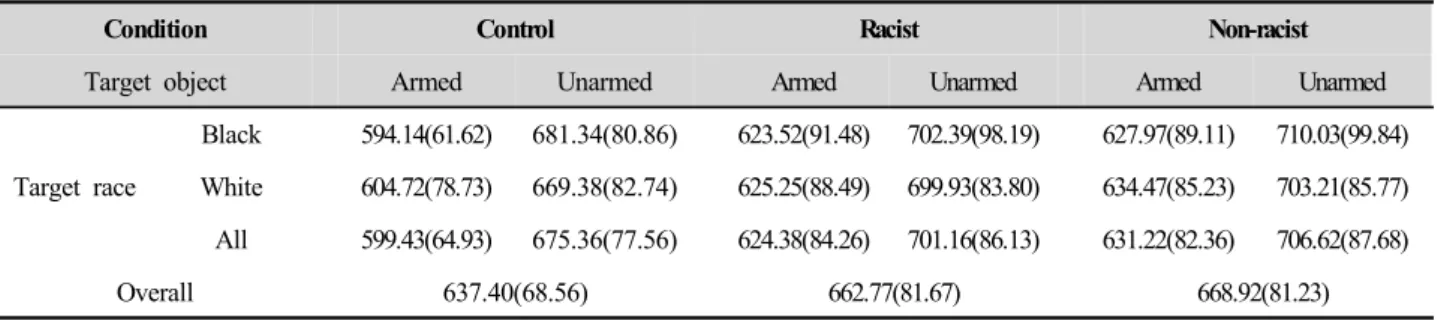
Black 594.14(61.62) 681.34(80.86) 623.52(91.48) 702.39(98.19) 627.97(89.11) 710.03(99.84) White 604.72(78.73) 669.38(82.74) 625.25(88.49) 699.93(83.80) 634.47(85.23) 703.21(85.77)

All 599.43(64.93) 675.36(77.56) 624.38(84.26) 701.16(86.13) 631.22(82.36) 706.62(87.68)

Overall 637.40(68.56) 662.77(81.67) 668.92(81.23)

Table1. Means (standard deviations) of reaction time (ms) condition, the officer took an aggressive measure against a Black homicide suspect; in another ("Nonracist") condition, he refrained from aggressive methods and verbally persuaded the suspect to turn himself in.Lastly in the Control condition, only the officer’s image was given.All participants imagined being the officer for one minute.

Amodified FPST with 48 trials was then administered.

The officer'shands and upper armsweresuperimposed on the task screen, so that participants were reminded of his race.Unlike in the original FPST, no response window was given. This was to examine behavioral racial bias mostly in terms of response latency, rather than errors (see Correll et al., 2002).Shooter bias can be examined both in terms of response latency as well as error rates.

However, we explicitly decided not to set a response timeout, with the intention of having shooter bias be concentrated on response latency instead of error rates.

As expected, participants overall made very few errors (less than 2.4% of all trials); accordingly, we focused on response latencies in our analysis.

Participants then completed two self-report measures:

Perceived bias of the police officer they played("How racially biased do you think is the police officer whose role you just played?", "How much antipathy do you think the police officer whose role you justplayed have towards Black people?"; Cronbach’s α = .85) andeffort to control prejudice("How much did you try to control your racial prejudice while doing this experiment?, "How much did you try not to act like a racist?"; Cronbach’s α = .91),each with two items on 7-point Likert scales. Finally, participantsanswered a demographics questionnaireand were fully debriefed.

3. Results

3.1. Shooter bias as a function of Condition

Table 1 presents means and standard deviations of raw reaction time in all combinations. To test the main hypothesis, reaction timesin FPST (log-transformed) were analyzed with mixed-model ANOVA (Target Race * Target Object * Condition). If there was shooter bias, it would be revealed by a significant Target Race * Target Object interaction (i.e., response time as determined both by the race of the target as well as the object he holds).

First, there was a significant but theoretically uninteresting main effect of Target Object, F(1, 246) = 749.57, p < .001, η

2

= .75,soparticipants were quicker to respond to armed targets. A Target Race * Target Object interaction was observed, F(1, 246) = 7.78, p = .006, η

2

=

.03, indicating overall shooter bias.

Our main interest was the Target Race * Target

Object * Condition 3-way interaction, in other words,

whether shooter bias differed across conditions. This was

not significant, F(2, 246) = 1.33, p = .27, η

2

= .01; however,

the three conditions showed different patterns when

examined separately (Figure 1). Consistent with our first

prediction, shooter bias was observed in the Control

condition, F(1, 86) = 8.94, p = .004, η

2

= .10;in contrast,

shooter bias was not significantin the Nonracist condition,

F(1, 81) = 2.21, p = .14, η

2

= .03,supporting our third

prediction. Contrary to our secondprediction, however,

bias was even smaller and almost nonexistent in the

Racist condition, F(1, 82) = .15, p = .70, η

2

< .01. This

last finding suggests that the goal to control one's biased

(4)

Figure 1. Reaction Time in FPST (ms)

Note.p values are forshooter bias effects (i.e., Target Race by Target Object interaction effects). Error
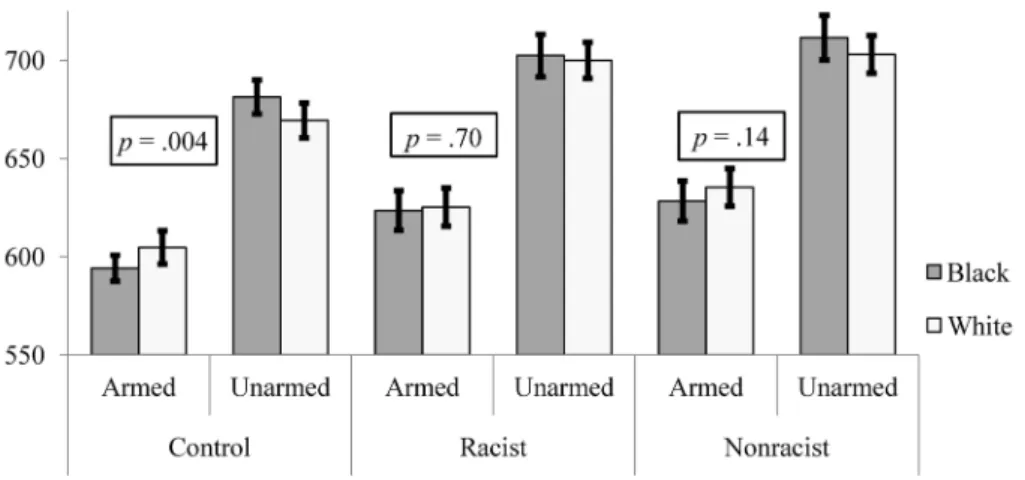
bars indicate +/-1 SE.

responses (Devine, Plant, Amodio, Harmon-Jones, &

Vance, 2002)may have been invoked after reading about racist behavior by the police officer they were to play the role of.

3.2. Condition-shooter bias relation as mediated by perceived bias

We examined self-report data to explore the possibilitythat participants who thought of the police officer as more prejudicedtried harder to control their responses. Perceived bias of the police officer was negatively correlated with shooter bias (calculated from log-transformed RT mean differences), r = -.18, p = .005:The more racist the police officer was perceived to be, the weaker was the shooter bias.

We ran a mediation analysis with Condition (Control vs. Racist) as the IV, perceived bias as the mediator, and shooter bias as the DV using bootstrapping procedure with SPSS PROCESS macro (Hayes, 2013). The mediation effect was significant, B = - .007, with 95%

confidence interval of [-.0159, -.0007]: Description of the police officer as racist resulted in stronger perception of bias of the officer, which in turn was associated with relatively weaker bias in the FPST. This overall pattern is also consistent with the interpretation that participants in the Racist condition may have been more strongly

motivated to control their racial bias:Participants in the Racist condition reported the highest degree of effort to control their prejudice during FPST, followed by those in the Nonracist condition, F(2, 246) = 3.95, p = .02.

However, effortful control was uncorrelated with shooter bias, r = -.07, ns,suggesting that reduction in shooter bias in the experimental conditions may not have been caused by explicit control of bias(Glaser &

Knowles, 2008; Park, Glaser, & Knowles, 2008).In contrast, when another mediation analysis comparing Control versus Nonracist conditions was run, the mediation effect by perceived bias turned out to be not significant, B = .003, with 95% confidence interval of [-.0012, .0090]; this result indicates that the difference in shooter bias between Control and Nonracist conditions cannot be explained by implicit controlling of bias.

3.3. Condition main effect on RT

Going back to the examination of response time in

FPST, there was also an interesting main effect of

Condition, F(2, 246) = 3.89, p = .02, η

2

= .03. No other

main or interaction effects were significant. Tukey’s LSD

post-hoc analyses of this Condition main effect revealed

that overall, responses in Nonracist condition were

significantly slower than in Control condition, with

(5)

Racist condition falling in between and not significantly different from these two condition(see Table 1). This raises the possibility that participants in the Nonracist condition (and in the Racist condition, to a lesser degree) may have engaged in more effortful control of their behavioral bias compared to participants in the Control condition. However, average response time was not correlated with either perceived bias or effortful control, both |r|s < .06, ps > .38. It may be that participants who made slower responses were not cognizant of their own control; alternatively, slower responses may not imply more (and more successful) control. Supporting this latter interpretation, those who made slower responses actually made more biased responses: average response time was positively correlated with shooter bias, r = .13, p = .04.

Thus, although inconclusive, the data indicates that slower responses does not necessarily mean (successful) effortful control.

4. Discussion

Our hypothesis that a Nonracist description of the police officer before FPST would attenuate shooter bias was supported. However, the Racist description showed a surprising, even stronger bias-decreasing effect. The findings seem to indicate that playing the part of an egalitarian police officer made participants behave in a way consistent with such an image, but having to take the perspective of an intolerant, prejudiced person may have led to a contrast, not assimilation, effect of the police officer description. Participants in the Racist condition may have been motivated to compensate for the police officer's discriminatory behavior instead of acting along with it. In support of this interpretation, perceived bias of the police officer negatively mediated the effect of Racist description on shooter bias.

An alternative explanation of non-significant shooter bias in that condition is that participants may have empathized with the abused Black suspect and takenhis

perspectiveinstead, which has been shown to be an effective strategy to reduce bias (Galinsky & Moskowitz, 2000). The current data is inconclusive as to the exact mechanism, so this warrants a future investigation.

Another interesting result was the lack of correlation between participants' self-reported efforts to control bias and their actual shooterbias, which suggests that the egalitarian goal may have worked only implicitly.

Relatedly, participants were slower to respond in the racist condition than in the other two conditions, but response latency was not correlated with either self-reported measures of perceived bias or effortful control, and was correlated positively with shooter bias.

This indicates that, at least, shooter responses did not translate to better responses.

There are some limitations to our study. Demand effect may have been at work, so that participants may have attempted to control their bias after reading the racist/nonracist description. However, shooter task taps relatively spontaneous responses; therefore we suspect that effortful control is unlikely, and manipulation of verbal instructions does not necessarily mean its effect is conscious in nature (see Correll et al., 2007, Study 1 for a similar effect of verbal description on FPST performance).

In addition, the null correlations between self-reported effort and bias indicates that while participants who were presented with the police officer description may have been more explicitly motivated, such increased motivation did not lead to more successful management of bias.

Another limitation is that we didnot check for participants’

attention while reading the descriptions; therefore, there is a possibility that smaller bias in the Racist condition than in the Control condition may reflect a deficient understanding of instructions.

The above flaws notwithstanding, the findings of our

study indicate that providing an egalitarian model that

people can follow as well as presenting an aversive case

acting in a racist way can both promote egalitarian

motivation– the former by priming people to act in

accordance with the provided model, and the latter by

(6)

© 2015 (by) the authors. This open access article is distributed under the terms and conditions of the Creative Commons Attribution license (http://creativecommons.org/licenses/by/3.0), which permits unrestricted use, distribution, and reproduction in any medium, provided that the original work is properly cited.

inducing people to unconsciously repudiate the discriminating behavior. In future research, motivational nature of prejudice control should be further investigated.

For example, how would we separate the nonconscious goal to control prejudice from its conscious counterpart?

And is the egalitarian goal activation purely implicit? In conclusion, this study indicates that opposite portrayals of someone whose role is to be played may, paradoxically, affect one’s behavioral racial bias in the samedirection.

REFERENCES

Bargh, J. A., Chen, M., & Burrows, L. (1996). Automaticity of social behavior: Direct effects of trait construct and stereotype priming on action. Journal of Personality and Social Psychology, 71(2), 230-244.

Correll, J., Park, B., Judd, C. M., & Wittenbrink, B.

(2002). The police officer’s dilemma: Using ethnicity to disambiguate potentially threatening individuals. Journal of Personality and Social Psychology, 83(6), 1314–1329.

Correll, J., Park, B., Judd, C. M., Wittenbrink, B., Sadler, M. S., & Keesee, T. (2007). Across the thin blue line: Police officers and racial bias in the decision to shoot. Journal of Personality and Social Psychology, 92(6), 1006–1023.

DeMarree, K. G., Wheeler, S. C., & Petty, R. E.

(2005). Priming a new identity: Self-monitoring moderates the effects of nonself primes on self-judgments and behavior. Journal of Personality and Social Psychology, 89(5),657–671.

Devine, P. G. (1989). Stereotypes and prejudice: Their automatic and controlled components. Journal of Personality and Social Psychology, 56(1), 5–18.

Devine, P. G., Plant, E. A., Amodio, D. M., Harmon-Jones, E., & Vance, S. L. (2002). The

regulation of explicit and implicit race bias: The role of motivations to respond without prejudice.

Journal of Personality and Social Psychology, 82(5), 835–848.

Galinsky, A. D., & Moskowitz, G. B. (2000). Perspective- taking: Decreasing stereotype expression, stereotype accessibility, and in-group favoritism. Journal of Personality and Social Psychology, 78(4), 708–724.

Glaser, J., & Knowles, E. D. (2008). Implicit motivation to control prejudice. Journal of Experimental Social Psychology, 44(1), 164–172.

Greenwald, A. G., & Banaji, M. R. (1995). Implicit social cognition: Attitudes, self-esteem, and stereotypes. Psychological Review, 102(1), 4–27.

Lai, C. K., Marini, M., Lehr, S. A., Cerruti, C., Shin, J.-E. L., Joy-Gaba, J. A., Nosek, B. A. (2014).

Reducing implicit racial preferences: I. A comparative investigation of 17 interventions.

Journal of Experimental Psychology: General, 143(4), 1765–1785.

Park, S. H., Glaser, J., & Knowles, E. D. (2008).

Implicit motivation to control prejudice moderates the effect of cognitive depletion on unintended discrimination. Social Cognition, 26(4),401–419.

Park, S. H., & Kim, H. J. (2015). Assumed race moderates spontaneous racial bias in a computer-based police simulation. Asian Journal of Social Psychology.

Wheeler, S. C., DeMarree, K. G., & Petty, R. E.

(2007). Understanding the role of the self in prime-to-behavior effects: The Active-Self account.

Personality and Social Psychology Review, 11(3), 234–261.

Received: 2015.01.19

Revised: 2015.04.22

Accepted: 2015.05.08

수치

Table 1 presents means and standard deviations of raw  reaction time in all combinations
Figure 1. Reaction Time in FPST (ms)

참조

관련 문서

It plays a central role in degradation of short-lived and regulatory proteins important in a variety of basic cellular processes, including regulation of the cell

1 John Owen, Justification by Faith Alone, in The Works of John Owen, ed. John Bolt, trans. Scott Clark, &#34;Do This and Live: Christ's Active Obedience as the

As a result of the study, it was confirmed that only human resource competency had a positive(+) effect on the intercompany cooperation method of IT SMEs,

The study conducted a study of literature and research, and in literature, the study of cosmetic behavior, nail behavior, self esteem, and

Although Korea has been playing a leading role in the development of fusion power generation and Korea is playing a leading role in the world stage,

The study photgraphs of male dentist dressed in formal attire (A) white coat1. The study photgraphs of female dentist dressed in formal attire (A)

In this paper, it was examined whether there is a possibility that the medical institution might be mistaken as a specialized hospital designated by the Ministry of Health

출처 : IAEA 발표 자료(Comprehensive inspection exercise at bulk handling facilities, “U-235 Enrichment measurements by gamma-ray spectroscopy”) 13.  Uranium