DOI https://doi.org/10.9725/kts.2020.36.1.1
A Review on Transfer Process of Two-dimensional Materials
Chan Kim
1,4, Min-Ah Yoon
1,4, Bongkyun Jang
5, Jae-Hyun Kim
3,6and Kwang-Seop Kim
2,5†1
Ph.D. Student, Dept. of Nano-Mechatronics, University of Science and Technology (UST)
2
Associate Professor, Dept. of Nano-Mechatronics, University of Science and Technology (UST)
3
Professor, Dept. of Nano-Mechatronics, University of Science and Technology (UST)
4
Researcher, Nano-Convergence Mechanical System Research Division, Korea Institute of Machinery & Materials (KIMM)
5
Senior Researcher, Nano-Convergence Mechanical System Research Division, Korea Institute of Machinery & Materials (KIMM)
6
Principal Researcher, Nano-Convergence Mechanical System Research Division, Korea Institute of Machinery
& Materials (KIMM)
(Received December 2, 2019; Revised February 7, 2020; Accepted February 7, 2020)
Abstract − Large-area two-dimensional (2D) materials synthesized by chemical vapor deposition on donor substrates are promising functional materials for conductors, semiconductors, and insulators in flexible and transparent devices. In most cases, 2D materials should be transferred from a donor substrate to a target sub- strate; however, 2D materials are prone to damage during the transfer process. The damages to 2D materials during transfer are caused by contamination, tearing, and chemical doping. For the commercialization of 2D materials, a damage-free, large-area, and productive transfer process is needed. However, a transfer process that meets all three requirements has yet to be developed. In this paper, we review the recent progress in the development of transfer processes for 2D materials, and discuss the principles, advantages, and limitations of each process. The future prospects of transfer processes are also discussed. To simplify the discussion, the transfer processes are classified into four categories: wet transfer, dry transfer, mechanical transfer, and electro- chemical transfer. Finally, the “roll-to-roll” and “roll-to-plate” dry transfer process is proposed as the most promising method for the commercialization of 2D materials. Moreover, for successful dry transfer of 2D materials, it is necessary to clearly understand the adhesion properties, viscoelastic behaviors, and mechanical deformation of the transfer film used as a medium in the transfer process.
Keywords − 2D materials, transfer process, chemical-vapor deposition
1. Introduction
Since monolayer graphene was isolated from bulk graphite using a scotch tape and showed the excellent electrical properties, researches on the 2-dimensional (2D) materials have been much attention as a functional material for next generation flexible electronics[1-3]. Recently, large-area (4-inch wafer size or greater) 2D materials
with atomic thickness such as graphene (Gr), molybdenum disulfide (MoS
2), and hexagonal boron nitride (h-BN) are synthesized on a donor substrate using a chemical vapor deposition (CVD) method, and the large-area 2D materials have been utilized as a conductor, semiconductor, and insulator of flexible electronics[4-10].
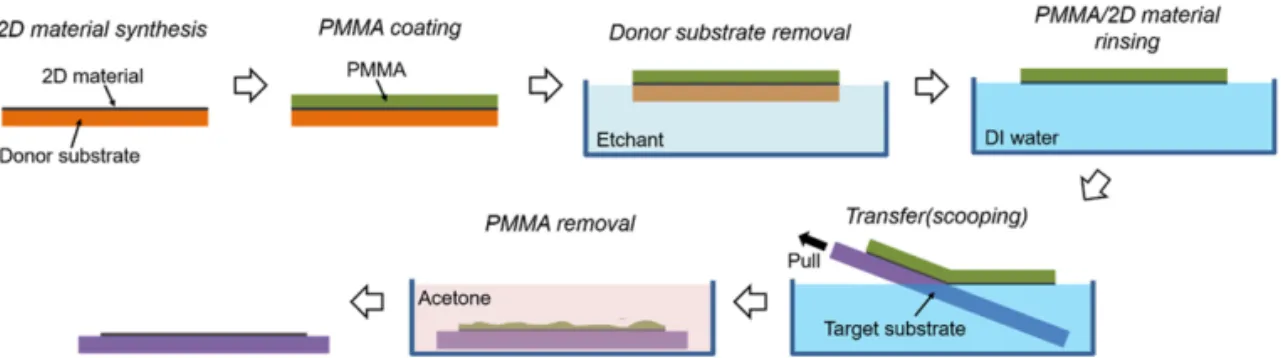
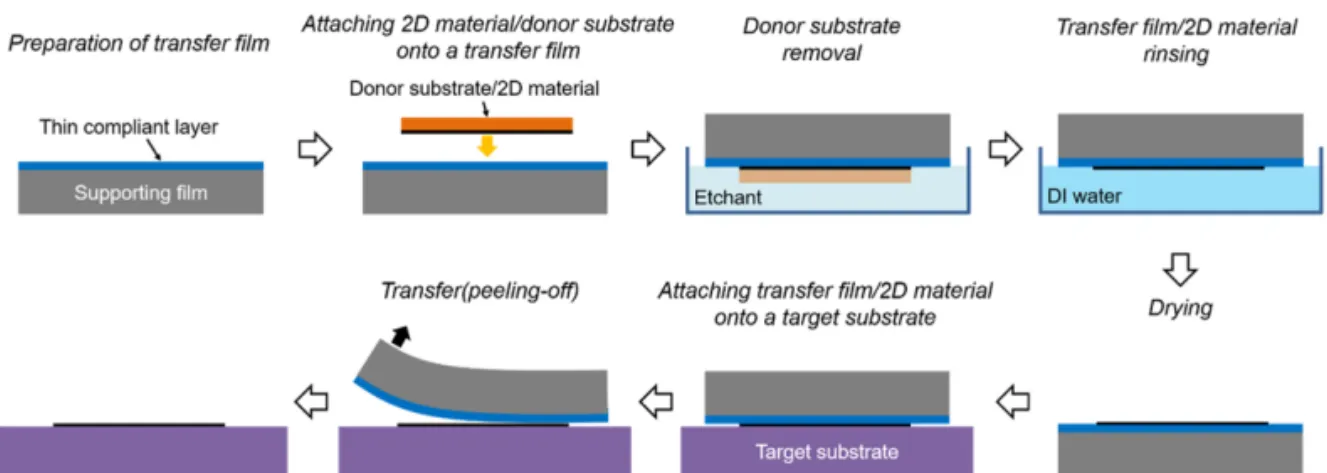
In order to utilize the large-area 2D materials for flexible electronic devices, a “transfer process” is required to move the 2D material from the donor substrate to a target substrate. The most common transfer process is wet transfer and dry transfer[11,12]. Wet and dry transfer is generally distinguished depending on the environment
†