http://dx.doi.org/10.7236/JIWIT.2012.12.2.61
JIWIT 2012-2-8
시간 정보를 이용한 확장성 있는 하이브리드 Recommender 시스템
Scalable Hybrid Recommender System with Temporal Information
Farman Ullah, Ghulam Sarwar, 김재우 * , 문경덕 ** , 김진태 ** , 이성창 ***
Farman Ullah, Ghulam Sarwar, Jae-Woo Kim, Kyeong-Deok Moon, Jin-Tae Kim, Sung-Chang Lee
요 약 최근 디지털 컨텐츠와 컨텐츠 사용자의 기하 급수적인 증가와 함께
recommender
시스템이 주목을 받으며 많은 응용 프로그램에 적용되고 있는 가운데, recommender
시스템의 확장성과 대체적으로 이와 반비례하는 정확성 이 이슈가 되고 있다.
본 논문에서는recommender
시스템 모델 중 하이브리드 모델의 매트릭스를 제거하고 아이템의 특성을 정하기 위해 클러스터링 기술을 사용한Scalable Hybrid Recommender System
을 제안한다.
제안된 모델은recommender
시스템의 확장성과 정확성을 향상시키기 위해서 아이템에 대한 사용자의 평가 정보, demographic
정보 와 구체적인 시간 정보를 사용한다. Reduction
기술 사용을 통해Item-feature
매트릭스의 사이즈를 축소하고,
사용자demographic
정보를 사용하여temporal aware hybrid user model
을 만든 후,
비슷한 정보를 가진 사용자간 클러스터링 을 통해,
가장 유사한 정보를 가진 사용자들을 추출하여,
사용자간 정보를 비교함으로써 사용자가 원하는 아이템의 특성을 예상하고 사용자에게N
개의 아이템을 추천함으로써,
기존의recommender
시스템보다 더욱 향상된 결과를 도 출해 낼 수 있는 알고리즘을 제시하였다.
Abstract Recommender Systems have gained much popularity among researchers and is applied in a number of applications. The exponential growth of users and products poses some key challenges for recommender systems.
Recommender Systems mostly suffer from scalability and accuracy. The accuracy of Recommender system is somehow inversely proportional to its scalability. In this paper we proposed a Context Aware Hybrid Recommender System using matrix reduction for Hybrid model and clustering technique for predication of item features. In our approach we used user item-feature rating, User Demographic information and context information i.e. specific time and day to improve scalability and accuracy. Our Algorithm produce better results because we reduce the dimension of items features matrix by using different reduction techniques and use user demographic information, construct context aware hybrid user model, cluster the similar user offline, find the nearest neighbors, predict the item features and recommend the Top N- items.
Key Words : Item features rating, User Demographic information, Contextual information, Matrix Reduction Techniques, k-means clustering Algorithm.
*준회원, 한국항공대학교 통신공학과
**준회원, 한국전자통신연구원 그린컴퓨팅연구부
***정회원, 한국항공대학교 항공전자 및 정보통신공학부(교신저자) 접수일자 2012.4.4, 수정일자 2012.4.12
게재확정일자 2012.4.13
Received: 4 April, 2012, Revised: 12 April, 2012 Accepted: 13 April, 2012
***Corresponding Author: [email protected]
Dept. of Information and Communication Engineering, Korea Aerospace University, Korea
Ⅰ. INTRODUCTION
User Preference and Recommendation Systems have gained much popularity and are widely used in E – Commerce, Automatic IPTV content recommendation, Media sharing, Net Surfing and web service selection etc. Choosing among a number of items is challenging job for a user. Advancement in Technology and growing density of contents and users demands recommender system to make an accurate recommendation in user bearable time. Most of recommender systems use Collaborative filtering [1, 2, 3]
that work on the idea that similar users have similar preferences. Collaborative filtering can be divided into two types, memory-based [4] and model-based [5] .
In this paper, we used two different matrix reduction techniques i.e. Singular Value Decomposition and Relative Feature Rating in specific time and day to reduce the dimension of items feature rating matrix.
Then we construct Temporal Aware Hybrid User Model from the reduced matrix and User Demographic information. We applied K-means Clustering Algorithm
[6] on the Hybrid Model, in order to cluster the similar users offline. Do neighbors selections from the cluster to which user belong to reduce online processing time.
The final recommendation is based on the contextual information, neighbors set and rating matrix. Keeping temporal information in term of Day, Time improves the accuracy of the system. We predict the item features and select the Top N-items from the rating of the neighbors set.
The paper is organized as follow: Section-II briefly describe about the matrix reduction techniques and its calculation. Section-III describe the Temporal Aware Hybrid Recommender System, Section-IV Temporal Hybrid User Model, Section-V clustering technique, Section-VI is about neighbor selection and predication of item features & item selection, Section-VII is about our simulation and results and the last section about conclusions and future work.
Ⅱ. MATRIX REDUCTION TECHNIQUES
In order to improve the scalability of recommender system we reduce the size of the items features rating matrix. We use two different techniques to reduce the matrix. Using the statistical measure of Mean Absolute Error (MAE), due to less MAE we recommend relative feature rate for reduction of matrix as shown from Fig. 1.
1. Relative Feature Rating
In Relative Feature Rating Technique we find the relative mean of each feature by using the item feature rating that user rate at specific time and day. The related concepts and definition we used are as under:- Definition 1 Total Feature Rating: the sum of ratings R that user ‘i’ grades for all the item attributes at a specific time and day, which is expressed as TFR(i,t,d).
Here Ti stands for the set composed of items have been graded by user i.
Definition 2 Feature Rating: the sum of ratings that user i grades for the feature k in that time and day, which is expressed as FR(i,k,t,d).
Definition 3 Relative Feature Rating: relative feature rating that user i grades for feature k, expressed as RFR, is defined as the ratio of Feature Rating FR(i,k,t,d) and Total Feature Rating TFR(i,t,d).
Since the relative is normally a value less than one, so
we use is "α" a constant factor in our algorithm. In our
algorithm we use seven days a week and four time
ranges in each day. In order to understand above
mentioned concepts we consider five different movies
that are rated by three users at four time ranges at Day
표 1. 사용자에 의해 평가된 영화/아이템 특성표
Table 1. Movies/Items features rating by user at time Ti and day Di
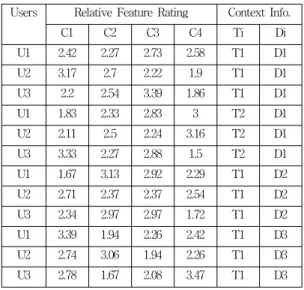
d1-d7. The Table.1 shows the data we use for understanding of above concepts. Table.2 shows the reduced matrix after applying the Equation.1, 2 and 3.
표 2. 사용자를 위한 RFR
Table 2. RFR for users at time Ti and day Di Users Relative Feature Rating Context Info.
C1 C2 C3 C4 Ti Di
U1 2.42 2.27 2.73 2.58 T1 D1 U2 3.17 2.7 2.22 1.9 T1 D1 U3 2.2 2.54 3.39 1.86 T1 D1 U1 1.83 2.33 2.83 3 T2 D1 U2 2.11 2.5 2.24 3.16 T2 D1 U3 3.33 2.27 2.88 1.5 T2 D1 U1 1.67 3.13 2.92 2.29 T1 D2 U2 2.71 2.37 2.37 2.54 T1 D2 U3 2.34 2.97 2.97 1.72 T1 D2 U1 3.39 1.94 2.26 2.42 T1 D3 U2 2.74 3.06 1.94 2.26 T1 D3 U3 2.78 1.67 2.08 3.47 T1 D3
2. Singular Value Decomposition
Singular Value Decomposition (SVD), is a matrix factorization technique [7,8] that decomposes a single matrix into three different matrices.
If M is a matrix of m x n, then U is m x m an unitary matrix, Σ is an m×n rectangular diagonal matrix, and V* (the conjugate transpose of V) is n×n an unitary matrix. The diagonal entries Σi,i of Σ are known as the singular values of M [8] .
We apply the SVD in order to find the singular value
for each feature rated by a user at specific time and
day. We normalize the singular values matrix by
dividing it the maximum singular value and multiply it
by a constant, so the mean value in RFR and SVD is
2.5 in our algorithm. So we find the Mean absolute
error of both reduction methods by using different
number of users that rate the movies at specific time
and day as shown in Fig. 1.
20 40 60 80 100 120 140 160 180 200
0 0.005 0.01 0.015 0.02 0.025 0.03 0.035 0.04 0.045
No of User that Grades for movies
Mean Absolute Error
Singular Value Decomposition Method Relative Feature Rating
그림 1. RFR과 SVD를 사용한 매트릭스 축소 Fig. 1. Matrix reduction using RFR and SVD
III. Scalable hybrid recommender system with temporal information
As the number of users and items are growing exponentially, so it becomes difficult for recommender system to make an accurate recommendation in user bearable time. Some Conventional Recommender system uses only item rating for recommendation [9] , some improved recommender system uses attribute rating [10] and demographic similarity [11] . The conventional recommender system does not consider any temporal information that whether user a like the item at that specific time or not, it find the similarity of item with all database, which reduce the scalability and increase the recommendation time.
The Workflow of our algorithm i.e. scalable hybrid recommender system with temporal information is shown in Fig.2. In our algorithm we use the temporal information that is four time ranges per day and seven days a week. We use the rating and demographic information in order to predict the feature value if a user have not assigned to any attribute in order to eliminate the sparsity problem. When we dense the rating matrix, we apply the matrix reduction technique i.e. Relative Feature Rating in order to reduce the dimension of the rating matrix. We construct the
temporal aware hybrid model by using the relative feature rating matrix, user demographic information and context information i.e. time and day. We apply the k-means clustering algorithm to temporal aware hybrid user model in order to cluster the similar users. The process from feature rating to clustering the similar users is offline. We find the target user belong to which cluster, then similarity with users and select the Top N- similar neighbors. Using the similar neighbor we predict the item features and recommend the Top N-similar items.
그림 2. 시간 정보를 이용한 Scalable Hybrid Recommender 시스템의 워크플로우
Fig. 2. Workflow of Scalable Hybrid Recommender system with temporal information
IV. Temporal aware hybrid User model
We construct the temporal aware hybrid user model
offline by using relative feature rating matrix, user
demographic information and temporal information. We
have considered four demographic features of each
user. The temporal aware hybrid user model is a three
dimensional matrix as shown in Table III. The temporal
aware hybrid user model has the following advantages:-
Ø The temporal aware hybrid user model has a reduced dimension as compared to the items feature rating matrix, so it reduces the computational complexity.
Ø We apply the clustering technique on this model offline to cluster the similar users so that the system recommends an accurate item with user bearable time.
표 3. 상황 인식 하이브리드 사용자 모델
Table 3. Context aware hybrid user model
User
Relative Features Rating
User Demographic Features
Context Info.
RFR1 ... RFRp D1 . Dq Ti Di
U1 H11 ... H1p H1(p+1) . H1(p+q) T1 D1
... ... ... ... ... . ...
Um H1m ... Hmp Hm(p+1) . Hm(p+q) T1 D1
U1 H11 ... H1p H1(p+1) . H1(p+q) T2 D1
... ... ... ... ... . ... ..
Um H1m ... Hmp Hm(p+1) . Hm(p+q) T2 D1
.. .. .. .. ... . .. .. ..
Um H1m ... Hmp Hm(p+1) . Hm(p+q) T4 T7
V. Clustering of Simmilar users
Clustering means to divide the items into similar groups based on some similarities. Cluster analysis could be divided into hierarchical clustering and non-hierarchical clustering techniques. Examples of hierarchical techniques are single linkage, complete linkage, average linkage, median, and Ward.
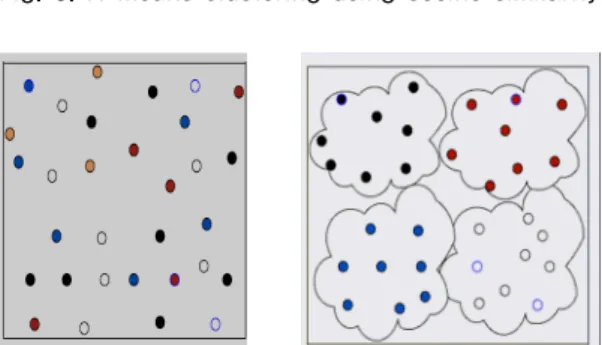
Non-hierarchical techniques include k-means, adaptive k-means, k-medoids, and fuzzy clustering [12, 13] . A good clustering algorithm is one who produces groups with non-overlapping. We apply the k-means clustering technique to temporal aware hybrid user model to group the similar users into k-groups. In our algorithm we use the cosine similarity in order to group the similar users. The algorithm is explained in Fig.3 and Fig.4.
그림 3. Cosine similarity를 이용한 K-means 클러스터 링
Fig. 3. K-means clustering using cosine similarity
그림 4. 그룹 내 유사한 정보를 가진 사용자 클러스터링 Fig. 4. Clustering similar users in a group
VI. Neighbors selection and item features predication and item selection
The process in our algorithm from items feature rating to clustering similar users in a group is offline, which improve the performance of recommender system. We find the Top N-similar users in a group/cluster at a specific time and day not in a whole database of items or hybrid model. We find the minimum absolute error (MAE) using Eq.5 of target user with the centroid of each group.
We select the cluster that having minimum MAE
with the target user and using relative cosine similarity
Eq. 6 to find the Top N most similar user in that group
at that specific time and day.
Where Haktd and Hbktd are the relative interest score for feature k in time ‘t’ and day ‘d’ for target user a and user b from cluster. Hatd and Hbtd is the average rating of User a and b in time ‘t’ and day ‘d’
respectively.
1. Items Feature Predications and Item Selection Based on Similar Users After obtaining the similar users from a cluster with the target user, we predicate the target user feature rating by using Eq.7.
Where P(a,j,t,d) is the predicted rating that user a grades for feature j at time t, and U is the nearest neighbor set of user "a" calculated at that time and day.
Rijtd is rating of neighbor i for the content j in that time and day. Ratd is the rating to user a in time t and day d. After obtaining the predicated item features, we select the Top N- most similar items from the similar neighbor set we selected for feature predication.
VII. Simulation and Results
Currently no such movies or items database we find that has rating at specific time and day. So we build our own database having 1000 movies rated by 200 users at four time ranges per day and seven days a week. Each movie has four feature rating and user has four demographic information. We compare our algorithm with Collaborative Filtering using Hybrid User Model [14] , we consider the 1000 movies database for the Collaborative Filtering using Hybrid User Model also.
We use 80% of the data as a training data and 20%
for testing. Many statistical measuring can be used, but we use the mean absolute error of Eq.5 and
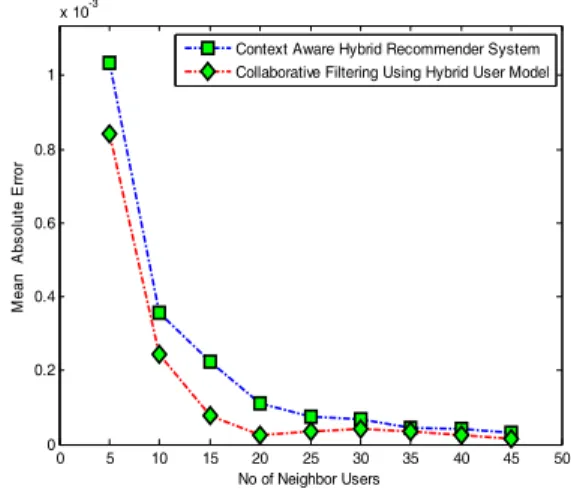
performance i.e. recommendation time. Fig.5 shows that there is a little difference in mean absolute error; the collaborative filtering using hybrid user model has less error as compared to our algorithm, because we consider a cluster of users not the whole users matrix.
But there is a tremendous difference in the recommendation time as shown in Fig.6.
0 5 10 15 20 25 30 35 40 45 50
0 0.2 0.4 0.6 0.8 1
x 10-3
No of Neighbor Users
Mean Absolute Error
Context Aware Hybrid Recommender System Collaborative Filtering Using Hybrid User Model
그림 5. 예상 오류 : 하이브리드 사용자 모델과 시간정보를 사 용한 확장성 있는 하이브리드 사용자 모델을 사용한 Collaborative 필터링
Fig. 5. Predication error : Collaboratice filtering using hybrid user model and Scalable Hybrid Recommender System with Temporal Information
0 5 10 15 20 25 30 35 40 45 50
0 0.02 0.04 0.06 0.08 0.1 0.12
No of Neighbor Users
R ec om m endat io n T im e (S ec ond)
Context Aware Hybrid Recommender System Collaborative Filtering Using Hybrid User Model
그림 6. 추천 시간
Fig. 6. Recommendation time
VIII. CONCLUSION AND FUTURE WORK
The traditional recommender systems do not consider the context, so due to increasing the items and users it becomes difficult to recommend an accurate item with user bearable time. Our algorithm solves the problem of sparsity, scalability and cold start issues.
We apply our algorithm for recommendation of movies, but it can be used anywhere for recommendation.
We have considered only the time and day as context information, but we will improve our recommender system by adding further context information and user demographic information. We are also working by adding the device information for N screen service architecture.
참 고 문 헌
[1] Herlocker, J., Konstan, J., Borchers, A., and Riedl, J. (1999). An Algorithmic Framework for Performing Collaborative Filtering. In Proceedings of ACMSIGIR’99. ACMpress.
[2] Konstan, J., Miller, B., Maltz, D., Herlocker, J.,Gordon, L., and Riedl, J. (1997). GroupLens:A pplying Collaborative Filtering to Usenet News.
Communications of the ACM, 40(3), pp. 77-87.
[3] Resnick, P., Iacovou, N., Suchak, M., Bergstrom, P., and Riedl, J. (1994). GroupLens:A n Open Architecturefor Collaborative Filtering of Netnews.
In ProceedingsofCSCW’94,ChapelHill,NC.
[4] Shardanand, U., & Maes, P. (1995). Social information filtering: Algorithms for automating
‘Word of Mouth’. In proceedings of the conference on human factors in computing systems,
[5] Shahabi, C., Banaei-Kashani, F. Chen, Y., &
Mcleod, D. (2001). Yoda: accurate and scalable web-based recommendation systems, In the preceeding of the sixth international conference on cooperative information systems (coopIS
2001), Trento Italy.
[6] Badrul M. Sarwar, George Karypis, Joseph Konstan, John Ried: Recommender Systems for Large-Scale E-Commerce: Scalable Neighborhood Formation using Clustering, the fifth international Conference on Computer and Information Technology ICCIT 2002.
[7] http://www.cs.wits.ac.za/~michael/SVDTut.pdf [8] http://en.wikipedia.org/wiki/Singular_value_
decomposition
[9] “PuWANG”, “HongWu YE” A Personalized Recommendation Algorithm combining Slope One Scheme and User Based Collaborative Filtering, 2009 International Conference on Industrial and Information Systems
[10] “HengSong Tan”, “HongWu Ye” A Collaborative Filtering Algorithm Based on Item Classification, 2009 Pacific-Asia Conference on Circuits and Communications and System
[11] “YaE Dai”, “Hong Wu Ye”, Personalized Recommendation Algorithm using User Demographic Information, Second International Workshop on Knowledge Discovery and Data Mining.
[12] “Oyelede, O. J”, “Oladipupo, O. O”, “ Obagbuwa.
I. C”, Application of k-Means Clustering algorithm for prediction of Students’ Academics Performane, International Journal of Computer Science and Information Security, Vol. 7, N0. 1, 2010
[13] “Dong-Moon Kim”, “Kun-su Kim”, “Kyo-Hyun
Park”, ” Jee-Hyong Lee”, ” Keon Myung Lee”, A
Music Recommendation System with a Dynami
K-means Clusting Algorithm, Sixth Internation
Conference on Machine Learning and Applications
[14] “Qain Wang”, “Xianhu Yuan”, “Min Sun”,
Collaborative Filtering Recommendation Algorithm
based on Hybrid User Model, 2010 Seventh
International Conference on Fuzzy Systems and
Knowledge Discovery.
※ This work was supported by the Industrial Strategic technology development program(10039202, Development of SmartTV Device Collaborated Open Middleware and Remote User Interface Technology for N-Screen Service) funded by the Ministry of Knowledge Economy(MKE,Korea)"