*Corresponding author: Kye Man Cho Phone: +82-55-751-3272; Fax: +82-55-751-3279;
E-mail: [email protected]
Korean J Environ Agric. 2016;35(1):62-71. English Online ISSN: 2233-4173
Published online 2016 March 28. http://dx.doi.org/10.5338/KJEA.2016.35.1.11 Print ISSN: 1225-3537
Comparison of Isoflavone Contents and Antioxidant Effect in Cheonggukjang with Black Soybean Cultivars by Bacillus
subtilis CSY191
Md. Azizul Haque
1, Chung Eun Hwang
1, Hee Yul Lee
1, Min Ju Ahn
1, Eui-Cheol Sin
1,
Sang Hae Nam
1, Ok Soo Joo
1, Hyun Joon Kim
2, Shin-Woo Lee
3, Yun-Geun Kim
4, Keon Hee Ko
4, Young-Min Goo
4and Kye Man Cho
1*1
Department of Food Science, College of Bioscience, Gyeongnam National University of Science and Technology, Jinju 52725, Korea
2
Department of Anatomy and Convergence Medical Science, Graduate School of Medicine, Gyeongsang National University, Jinju 52828, Korea
3
Department of Agronomy & Medicinal Plant Resources, College of Bioscience, Gyeongnam National University of Science and Technology, Jinju 52725, Korea
4
Department of Research and Development, Sancheong Oriental Medicinal Herb Institute, Sanchung 52215, Korea
Received: 11 April 2015 / Revised: 10 November 2015 / Accepted: 27 March 2016 Copyright ⓒ 2016 The Korean Society of Environmental Agriculture
This is an Open-Access article distributed under the terms of the Creative Commons Attribution Non-Commercial License (http://creativecommons.org/licenses/by-nc/3.0) which permits unrestricted non-commercial use, distribution, and reproduction in any medium, provided the original work is properly cited.
ORCID
Md. Azizul Haque
http://orcid.org/0000-0002-9788-0766 Kye Man Cho
http://orcid.org/0000-0002-5928-0532
62
Abstract
BACKGROUND: Soybeans are the rich sources of isoflavones. To date, the changes of isoflavone contents in various black soybeans cheonggukjang during fermentation by Bacillus subtilis CSY191 has not been investigated.
METHODS AND RESULTS: This study investigated the changes of total phenolic and isoflavone contents and antioxidant effects during cheonggukjang fermentation made with four black soybean (BS) cultivars including Cheongja, Cheongja#3, Geomjeong#5, and Ilpumgeomjeong with a potential probiotic Bacillus subtilis CSY191. The total phenolic contents, isoflavone-malonylglycoside and -aglycone contents, and antioxidant activity were increased
in cheonggukjang at 48 h fermentation, while the content of isoflavone-glycosides was decreased during cheonggukjang fermentation. In particular, the Cheongja#3 soybean fermented at 37℃ for 48 h displayed the highest antioxidant activities, compared to those of the other BS cultivars tested. Also, the highest levels of total phenolic, daidzein, glycitein, and genistein were present at concentrations of 17.28 mg/g, 283.7 g/g, 39.9 g/g, and 13.2 g/g at the end of Cheongja#3 soybean fermentation.
CONCLUSION: The results from this study suggested that the enhanced antioxidant activity of cheonggukjang of BS might be related to increased levels of total phenolic, isoflavon-aglycone, and malonyl-glycoside contents achieved during fermentation. Furthermore, fermented Cheongja#3 soybean showed the highest levels of enhanced antioxidant activities than the other BS cultivars.
Key words: Antioxidant, Bacillus subtilis CSY191, Black soybean, Cheonggukjang, Isoflavone
Research Article Open Access
Introduction
In general, soybeans [ Glycine max (L.) Merril] have been consumed as an important protein source to complement grain protein in Asian countries. However, they are also enriched with isoflavones, anthocyanins, saponins, lipids, and oligosaccharides (Kim et al ., 2011). The several soy-foods, such as cheonggukjang , doenjang , douche , temphe , and tofu , are being prepared from soybeans through fermentation process.
Among several soybean varieties, black soybean (BS) is increasingly sought after in food and medicinal industries because of their various beneficial effects (Lee et al ., 2012). The beneficial properties of BS are due to the many phytochemicals present in the crop, including isoflavone, flavanol, flavan-3-ol, anthocyanin, and saponin (Lee et al ., 2012; Lee et al ., 2014). BS is very much popular in Korea and are used to prepare several different traditional fermented foods, including meju (soybean cake), cheonggukjang (soybean cook), kanjang (soybean sauce), and doenjang (soybean paste). In particular, cheonggukjang is manufactured in a traditional way in homes using different types of processes, depending on the region: thus its physicochemical and functional properties vary due to differences in soybeans, microorganisms, and fermentation time (Nam et al ., 2012).
In raw soybeans, isoflavones are present in four chemical forms: malonylglycosides (70-80%), acetylglycosides (5%), glycosides (25%), and aglycones (2%) (Lee et al ., 2011). Isoflavones conjugated glycoside are converted to aglycones under acidic or alkaline conditions or by the action of -glycosidase. Importantly, the aglycone forms show greater potential for absorption in the intestine than the glycoside forms (da Silva et al ., 2011).
Thus, incorporation of β-glycosidase has attempted to increase the content of isoflavone- aglycones in cheonggukjang in several studies (Yang et al ., 2006;
Cho et al ., 2011). Moreover, some studies reports that total phenolic and isoflavone-aglycone contents increased, depending on whether antioxidant activities increased after cheonggukjang fermentation (Cho et al ., 2009; Hu et al ., 2010). Recently, we reported that the total phenolic and isoflavone- aglycone contents were enhanced during cheonggukjang fermentation made with two wild varieties of black soybeans (Hwang et al ., 2013) and brown soybean (Shin et al ., 2014) using a potential probiotic Bacillus subtilis CSY191 (Cho et al ., 2009; Cho et al ., 2011).
In this study, the antioxidant activities in cheonggukjang made with four BS cultivars including Cheongja , Cheongja #3, Geomjeong #5, and Ilpumgeomjeong by the potential probiotic B. subtilis CSY191 were investigated. Moreover, the possibility of antioxidant enhancing effect during cheonggukjang fermentation made with BS cultivars that may be related to the total phenolic contents and isoflavone compositions of this product were also investigated.
Materials and methods
Black soybeans, microorganism, and chemicals Four BS cultivars, including Cheongja , Cheongja #3, Geomjeong #5, and Ilpumgeomjeong , were harvested in 2012 and were procured from the National Institute of Crop Science (NICS) of the Rural Development Administration (RDA) in Miryang, Korea. The collected BS samples were packaged in labeled vacuum pouches to prevent their degradation.
The potential probiotic Bacillus subtilis CSY191 previously isolated from Korean traditional soybean paste ( doenjang ), were used as the starter organism (Cho et al ., 2011). The twelve standard isoflavones were purchased as described previously (Hwang et al ., 2014). Glacial acetic acid, Folin-Cicalteu phenol reagent, 2,2-diphenyl-1-picrylhydrazyl (DPPH), 2,2-azinobis (3-ethyl-benzothiazoline-6-sulfonic acid) diammonium salt (ABTS), potassium persulfate, ferric chloride, sodium acetate, 2,4,6-tripyridyl-s-triazine (TPTZ), were purchased from Sigma-Aldrich Chemical Co. (St.
Louis, MO, USA). HPLC-grade H
2O, methanol, and acetonitrile were purchased from Fisher Scientific Korea ltd. (Gangnam-gu, Seoul, Korea). All other reagents were of analytical grade.
Cheonggukjang preparation
Approximately 1,000 g of BS from each cultivar were separately washed and soaked with 2.5 volume tap water at 25±2℃ for 12 h, and steamed for 15 min at 121±1℃. The steamed HBS were left to stand for 1 h at 40±2℃ to cool down. After that, cooked BS were inoculated with 5.0% (w/w) strain CSY191 (7.65 log cfu/mL) and fermented for 48 h at 37±2℃ in an incubator and sampled at 0 and 48 h. The method was adapted as previously described (Hwang et al ., 2013).
Viable cell number, pH, and β-glucosidase activity
One gram of Cheonggukjang was mixed with 9
mL of 0.85% NaCl solution and the diluted
Table 1. Change of viable cell, pH, and β-glucosidase activity during four black soybean cultivars with
cheonggukjang
fermentation byB. subtilis
CSY191Soybean cultivars Samples Contents1)
Viable cell numbers (log cfu/g) pH β-Glucosidase activity (Unit/g)
Cheongja
UFBS2) 4.83±0.17b 6.57±0.12b 3.91±0.1b
FBS3) 11.74±0.63a 8.39±0.10a 18.8±0.18a
Cheongja
#3 UFBS 4.81±0.22b 6.63±0.12b 3.94±0.12bFBS 11.47±0.53a 8.48±0.15a 20.5±0.2a
Geomjeong
#5 UFBS 4.92±0.19b 6.54±0.15b 4.01±0.13bFBS 11.58±0.51a 8.51±0.16a 21.1±0.25a
Ilpumgeomjeong
UFBS 4.95±0.17b 6.61±0.13b 3.98±0.12b
FBS 11.62±0.58a 8.42±0.16a 19.2±0.22a
1)Values indicate the mean’s of three replications (
n
=3). Means with different lowercase letters (a and b) indicate significant differences of fermentation times by Tukey’s multiple range test (p
<0.05).2)Unfermented black soybeans
3)Fermented black soybeans at 37℃ for 48 h.
suspension (0.1 portions) was spread on a TSA plate.
The plate was incubated at 37±1℃ for 48 h and after which colony counts were carried out. A 10 g portion of the cheonggukjang of BS samples was dissolved in 90 mL of distilled water at room temperature for 12 h and was filtered through Whatman No. 4 filter paper (Whatman International, Ltd., Maidstone, England).
The residue pH was measured by pH meter (MP 200, UK). Moreover, the β-glucosidase activity of the Cheonggukjang crude extract was measured as previously described (Hwang et al ., 2013).
Isoflavone extraction and analysis
The four BS Cheonggukjang samples isoflavone were extracted and analyzed by HPLC according to previously described method (Hwang et al ., 2013).
Total phenolic contents (TPCs)
A method based on gallic acid equivalents (GAE) was used to quantify the TPCs of 50% methanol extract of four BS Cheonggukjang samples according to Cho et al . (2009).
Diphenyl picrylhydrazyl (DPPH) radical scavenging activity
The 50% methanol extracts of BS Cheonggukjang (0.2 mL) were prepared and mixed with 0.8 mL of 1.5×10
-4mM DPPH methanolic solution. The mixture was vortexed vigorously and allowed to stand for 30 min at room temperature in the dark. The absorbance of the mixture at 517 nm was determined using a spectrophotometer. The scavenging activity was expressed
as a percentage using the following formula: DPPH radical scavenging activity (%) = (1-absorbance of sample/absorbance of control)×100. The DPPH radical scavenging activity of Cheonggukjang extracts was carried out according to Kim et al . (2013) that was adapted from Cho et al . (2011).
ABTS radical scavenging activity
ABTS
+was dissolved in methanol to a finial concentration of 7 mM. This radical cation was produced by reacting the ABTS
+stock solution with 2.45 mM potassium persulfate (final concentration) and by leaving the mixture for 12-16 h until the reaction was complete and the absorbance was stable.
The ABTS+ stock solution was diluted in ethanol to an absorbance of 0.7±0.02 at 734 nm. After adding 0.9 ml of the diluted ABTS
+solution to 0.1 mL of the sample and mixing them, the absorbance was taken 3 min later. The ABTS radical scavenging activity (%) of four cultivars of Cheonggukjang extracts was expressed as a percentage using the following formula: ABTS radical scavenging activity (%) = (1-absorbance of sample / absorbance of control)×100 (Kim et al ., 2014).
Ferric reducing/antioxidant power assays
1.5 mL of working ferric reducing/antioxidant power (FRAP) reagent pre-warmed to 37℃ was mixed with 50 μL of the test samples and standards.
After vortexing, the mixture absorbance was read at
593 nm against a reagent blank. The assay was
conducted at 37℃ for 15 min. The FRAP assay was
conducted according to Choi et al . (2012).
Fig. 1. Change of total phenolic contents during
cheonggukjang
fermentation with four black soybean cultivars byB. subtilis
CSY191. UFBS, unfermented black soybeans; and FBS, fermented black soybeans at 37℃ for 48 h. All values are means of determinations in three independent experiments. Means with different lowercase letters (a, b, c, d, and e) indicate significant differences of fermentation times by Tukey’s multiple range test (p
<0.05).
Statistical analysis
Data were expressed as the means SD (standard deviation) of three replicates. The results were subjected to analysis of variance followed by the Tukey's multiple range tests at p <0.05 using the SAS program (Version 9, USA).
Results and discussion
Viable cell numbers, pH, and β-glucosidase activity during black soybean fermentation
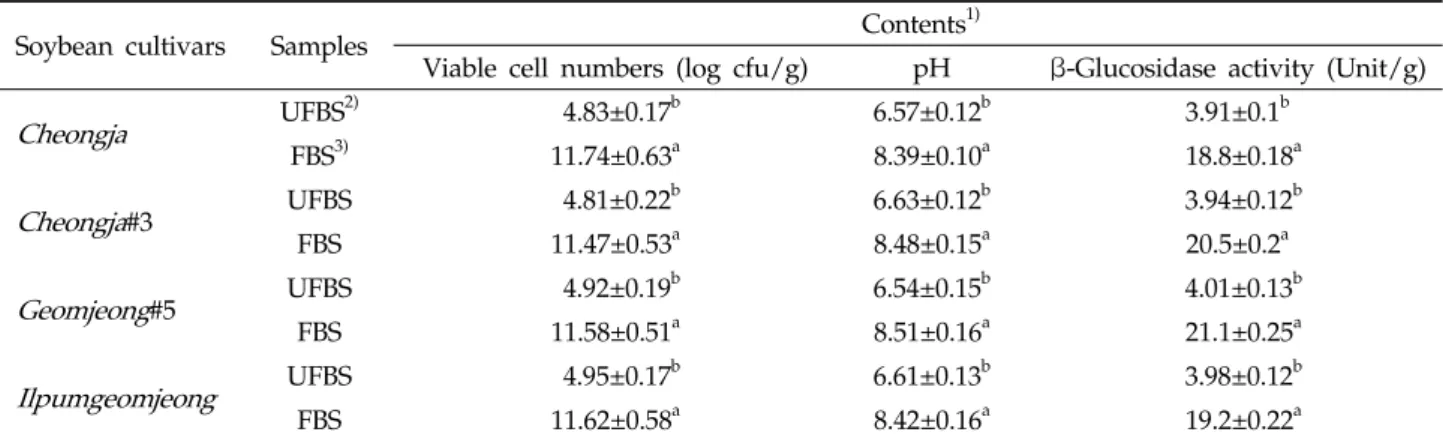
The viable cell numbers, pH, and β-glycosidase activities in each cheonggukjang made with four BS cultivars were increased during fermentation (Table 1).
As the results, the bacterial cell numbers in fermented cheonggukjang made with BS of Cheongja , Cheongja #3, Geomjeong #5, and Ilpumgeomjeong cultivar were increased to 2.43-, 2.38-, 2.35-, and 2.35-fold, respectively. In addition, the β-glucosidase activities in cheonggukjang made with BS of Cheongja , Cheongja #3, Geomjeong #5, and Ilpumgeomjeong cultivars were increased to 4.8-, 5.2-, 5.26-, and 4.82-fold by the end of fermentation (48 h), respectively. In fact, the pH of fermented cheonggukjang made with BS from all four cultivars was raised approximately to 8.39 to 8.51. The viable cell numbers and β-glycosidase activities were markedly increased during cheonggukjang fermentation in previous studies (Yang et al ., 2006;
Cho et al ., 2011; Hwang et al ., 2013; Shin et al ., 2014),
which is a very good agreement with the current study.
Changes of total phenolic and isoflavone contents during BS fermentation
The change in the TPCs in cheonggukjang made with BS of Cheongja , Cheongja #3, Geomjeong #5, and Ilpumgeomjeong cultivars is shown in Fig. 1. The TPCs in each fermented cheonggukjang made with BS from all cultivars were increased than that of the unfermented BS. In particular, the TPCs in fermented cheonggukjang made with BS were increased to 1.53-, 1.3-, 1.43-, and 1.31-folds by the end of fermentation (48 h) for the Cheongja , Cheongja #3, Geomjeong #5, and Ilpumgeomjeong cultivars, respectively (Fig. 1).
Phenolics are usually found in conjugated forms through hydroxyl groups with sugars and glycosides in plant materials (Juan & Chou, 2010). Catalyzing the release of the total phenolic contents from the BS during fermentation may thus lead to an increase in the content of those compounds, as shown in Fig. 1.
Our previous study reported that the TPCs in fermented cheonggukjang made with brown soybean ( Galmi ) and wild BS cultivars ( Seoritae and Seomoktae ) were increased in amount with potential probiotic Bacillus subtilis CSY191 by the end of fermentation (Hwang et al ., 2013; Shin et al ., 2014). These results suggested that Bacillus subtilis CSY191 is a strong potential candidate strain for the biotransformation of soybean biopolymers into beneficial phenolics during cheonggukjang fermentation made with wild or breeding soybean seeds. Meanwhile, some studies reported that the total phenolic content increased during soybean fermentation in foods, such as cheonggukjang and natto (Cho et al ., 2009; Cho et al ., 2011; Shon et al ., 2007).
In the case of chenoggukjang made with BS of
Cheongja cultivar, the isoflavone-malonylglycoside
and-aglycone contents increased throughout fermentation
to approximately 1.24- and 1.85-fold relative to their
starting amounts (23.1% and 6.8%, respectively), but
the isoflavone-glycoside contents decreased from 70.1
to 58.7% at the end of fermentation. Similarly, the
levels of isoflavone-malonylglycoside and -aglycone in
the chenoggukjang made with BS of Cheongja #3,
Geomjeong #5, and Ilpumgeomjeong cultivars increased
throughout fermentation to approximately 1.47- and
2.52-fold, 1.02- and 2.48-fold, and 1.27- and 1.72-fold
relative to their starting amounts (20.4 and 7.5%, 32.9
Fig. 2. Change of isoflavone β-glucoside, -malonyl- β -glucoside, and -aglycones and total isoflavones contents during
cheonggukjang
fermentation with four black soybean cultivars byB. subtilis
CSY191. UFBS, unfermented black soybeans; and FBS, fermented black soybeans at 37℃ for 48 h.Table 2. Distributions of isoflavone contents in
cheonggukjang
made of four black soybean cultivars by theB. subtilis
CSY191Soybean
Cultivars Samples
Isoflavone contents1) (μg/g)
Glycosides Malonylglycosides Acetylglycosides Aglycones
Total Daidzin Glycitin Genistin Daidzin Glycitin Genistin Daidzin Glycitin Genistin Daidzein Glycitein Genistein
Cheongja UFBS2) 243.2±8.6b 187.0±7.1b 421.2±13.1c 65.5±3.1d 45.6±1.6c 169.1±4.2 nd4) nd nd 39.9±1.5d 42.7±1.9ab tr5) 1214.1d FBS3) 189.9±5.1c 173.8±6.8b 302.0±10.2d 80.0±4.8bc 71.1±2.5b 175.0±5.6ab nd nd nd 114.7±3.2bc 27.9±1.6bc tr 1134.4d
Cheongja#3 UFBS 432.9±12.7a 254.6±9.3a 737.5±15.8a 108.4±6.1b 58.3±2.1ab 236.1±5.3 nd nd nd 96.5±2.7c 51.4±2.7a nd 1975.5a FBS 258.7±7.3b 233.1±6.1ab 416.9±11.4c 133.1±6.6ab 116.9±3.4a 285.7±8.7 nd nd nd 283.7±4.1a 39.9±2.4b 13.2±1.3a 1781.2b
Geomjeong#5 UFBS 267.5±7.8b 155.4±5.2bc 475.6±13.2b 124.0±5.3ab 53.6±1.8ab 297.3±9.2 nd nd nd 29.1±1.2d 39.6±2.5b tr 1442.1d FBS 235.5±7.5b 146.9±4.5c 400.1±10.1c 131.8±4.0ab 64.0±1.8b 284.4±8.8 nd nd nd 126.3±3.5b 33.1±1.8b 10.2±1.1b 1432.3c
Ilpumgeomjeong UFBS 384.7±10.4a 277.3±7.1a 493.0±12.8b 154.6±4.5a 67.3±2.3b 261.7±6.8 nd nd nd 42.4±1.1d 45.7±2.1ab tr 1726.7b FBS 237.3±9.0b 267.4±6.4a 286.2±8.8d 166.4±4.7a 105.2±2.6a 252.5±5.2 nd nd nd 127.9±2.5b 21.4±1.8c 3.3±.05c 1467.5c
1) Values indicate the mean’s of three replications (n=3). Means with different lowercase letters (a, b, c, and d) indicate significant differences of fermentation times by Tukey’s multiple range test (p<0.05).
2) Unfermented black soybeans.
3) Fermented black soybeans at 37℃ for 48 h.
4) nd, not detected.
5) tr, trace <0.002 μg/g.
and 8.8%, and 28.0 and 5.1%), but the isoflavone- glycoside contents decreased from 72.1 to 51.0%, 62.3 to 54.6%, and 66.9 to 55.5%, respectively, at the end of the fermentation (Fig. 2). In particular, daidzin of the glycoside type decreased from 432.9 μg/g to 258.7 μg/g and the corresponding daidzein of the aglycone type increased from 96.5 μg/g to 283.7 μg/g in chenoggukjang made with BS of Cheongja #3 cultivar at the end of fermentation (Table 2). In fact, the total amount of isoflavone was higher in unfermented and fermented ( chenoggukjang ) BS of Cheongja #3 cultivar than those of the other BS cultivars examined.
However, it is apparently shown that the isoflavone- glycosides decreased, while the isoflavone-aglycones
increased during cheonggukjang fermentation made
with all the four BS cultivars (Fig. 3A-H). These
results suggested that the glycoside type isoflavone
content daidzin, glycitin, and genistin concentrations
were decreased in chenoggukjang made with all BS
cultivars, while the aglycones type isoflavone content
daidzein, glycitein, and genistein concentrations were
increased at the end of fermentation. In addition, the
malonylglycosides concentrations were also increased
in the fermentation of BS chenoggukjang than that of
the unfermented BS. The content and composition of
these isoflavones vary in soybean foods depending on
the soybean varieties and processing techniques used,
such as fermentation. It has been reported that the
isoflavone levels in soybean-containing foods, such as
tofu , douchi , and cheonggukjang , decrease depending
on the processing conditions (Yang et al ., 2006; Cho et
al ., 20011; Coward et al ., 1998; Prabhakaran et al .,
2006). Jang et al . (2006) reported that the total
isoflavone content in raw soybeans was 2.87 μg/g,
which decreased by approximately 50% during
cooking prior to cheonggukjang fermentation. In a
related study, Yang et al . (2006) reported that the total
isoflavone content decreased from 1,055 μg/g (0 h) to
870 μg/g (36 h) during cheonggukjang fermentation
by B. subtilis . Meanwhile, Cho et al . (2011) reported
that the total isoflavone contents in cheonggukjang
fermentation decreased approximately 64% from an
initial 2923.21 μg/g to 1051.59 μg/g after 60 h of
fermentation. Hwang et al . (2013) reported that the
total isoflavone content in cheonggukjang made with
wild soybeans was decreased by 13.15% and 8.3% for
Fig. 3. Typical HPLC chromatograms of isoflavones. HPLC chromatogram of isoflavone extract in
cheonggukjang
made with black soybean of (A)Cheongja
cultivar according to fermentation period (0 h), (B)Cheongja
cultivar according to fermentation period (48 h), (C)Cheongja
#3 cultivar according to fermentation period (0 h), (D)Cheongja
#3 cultivar according to fermentation period (48 h), (E)Geomjeong
#5 cultivar according to fermentation period (0 h), (F)Geomjeong
#5 cultivar according to fermentation period (48 h), (G)Ilpumgeomjeong
cultivar according to fermentation period (0 h), and (H)Ilpumgeomjeong
cultivar according to fermentation period (48 h). 1, diadzin; 2, glycitin; 3, genistin;4, malonyldaidzin; 5, malonyl glycitin; 6, malonyl genistin; 7, daidzein; 8, glycitein; and 9, genistein.
Fig. 4. Change of diphenyl picrylhydrazyl (DPPH) radical scavenging activity during
cheonggukjang
fermentation with four black soybean cultivars byB. subtilis
CSY191.UFBS, unfermented black soybeans; and FBS, fermented black soybeans at 37℃ for 48 h. All values are means of determinations in three independent experiments. Means with different lowercase letters (a, b, c, and d) indicate significant differences of fermentation times by Tukey’s multiple range test (
p
<0.05).Fig. 5. Change of ABTS radical scavenging activity during
cheonggukjang
fermentation with black soybean cultivars byB. subtilis
CSY191. UFBS, unfermented black soybeans; and FBS, fermented black soybeans at 37°C for 48 h. All values are means of determinations in three independent experiments. Means with different lowercase letters (a, b, c, and d) indicate significant differences of fermentation times by Tukey’s multiple range test (p
<0.05).
the Seoritae and Seomoktae cultivars using Bacillus subtilis CSY191. In this study, the total isoflavone content decreased by approximately 6.6, 9.84, 0.7, and 15.1% after fermentation processing in BS of Cheongja , Cheongja #3, Geomjeong #5, and Ilpumgeomjeong cultivars at the end of fermentation (48 h), respectively (Table 2).
In general, most isoflavones in soybean are present in glycoside form, and they are converted into aglycones during fermentation by microbial β -glycosidase activity (Velioglu et al ., 1998; Yang et al ., 2006; Cho et al ., 2011). It is important to note that the levels of isoflavone-aglycones and the β-glycosidase activity increased and isoflavone-glycosides decreased during cheonggukjang fermentation by the potential probiotic B. subtilis CS90 (Cho et al ., 2011; Hwang et al ., 2013). In this study, we found that the starter potential probiotics B. subtilis CSY191 had the effect of increasing the β-glycosidase activity, and the algycone contents increased at the end of fermentation. In contrast, Yang et al . (2006) reported that the addition of B. subtilis had no effect on β-glycosidase activity, and the aglycone contents did not increase during cheonggukjang fermentation.
Change of antioxidant activities during Black Soybean fermentation
To examine the hydrogen donating activity, the DPPH radical scavenging activity of the unfermented black soybean (UFBS) and fermented black soybean
(FBS) were tested. As the result, the DPPH radical scavenging activities of chenoggukjang made with different BS cultivars were increased about to 1.4-, 1.3-, 1.3-, and 1.25-folds at the end of fermentation, respectively (Fig. 4). This result suggested that the hydrogen donating activities of BS were increased after chenoggukjang fermentation. Importantly, the chenoggukjang made with BS of Cheongja #3 cultivars has shown the greater DPPH radical scavenging activity (78.3%) than those of the chenoggukjang made with other BS cultivars in this study.
Moreover, to determine the hydrogen-donating antioxidants and chain-breaking antioxidants, the ABTS radical scavenging ability of chenoggukjang made with UFBS and FBS were tested. The levels of ABTS radical scavenging activity in chenoggukjang of Cheongja , Cheongja #3, Geomjeong #5, and Ilpumgeomjeong was increased about to 1.35-, 1.25-, 1.27-, and 1.22- folds at 48 h of fermentation (Fig. 5). However, like DPPH radical scavenging activity, the chenoggukjang of Cheongja #3 has shown the greater ABTS radical scavenging activity (80.64%) than those of the other chenoggukjang examined in this study.
The FRAP assay directly measure the total
antioxidant power of plant extracts. Thus, we further
determine the antioxidant activity of the unfermented
and FBSs. In fact, the chenoggukjang of Cheongja ,
Cheongja #3, Geomjeong #5, and Ilpumgeomjeong , the
values resulting from the FRAP assay of the
Fig. 6. Change of ferric reducing/antioxidant power value during