ORIGINAL ARTICLE
Screening of the Physiological Activity of Solvent Extracts of Paulownia coreana Bark and Antioxidative Effect of the Extracts on an Edible Oil
Nam Gull Lee, Kap Seop Jeong
*Department of Food Science & Nutrition, Tongmyong University, Busan 608-711, Korea
Abstract
Paulownia coreana is a medicinal, edible and industrial plant with the largest leaf, and is native to Korea. We evaluated the reducing power activities, 1,1-diphenyl-2-picrylhydrazyl (DPPH) radical scavenging activities (RSAs), nitrite scavenging activities (NSAs) and 2,2-azino-bis-(3-ethylbenzothiazoline-6-sulfonic acid) (ABTS) cation RSAs by solvent extraction of P.
coreana bark by using 50℃ hot water and 25℃ methanol. The antioxidative effect of P. coreana bark extract on corn seed oil was evaluated using the Rancimat test. The extraction yields on dry weight basis with 15 folds of hot water and methanol were 23.88% and 5.30%, respectively; further the flavonoid content in the hot water extract was over 2.5 times more than that in the methanol extract. The DPPH RSA of the methanol extract was substantially higher than that of the water extract, whereas the NSA of the water extract was higher than that of the methanol extract at pH 1.2. The ABTS RSAs of the two extracts were almost the same as that of ascorbic acid and 2,6-ditertiarybutyl hydroxytoluene. The two extracts of P. coreana bark in this study were found to slightly improve the oxidation stability of corn seed oil.
Key words : Paulownia coreana bark, Physiological activity, Oxidation stability, Rancimat test, Solvent extraction
1. Introduction
1)Paulownia coreana is a native Korean plant with the leaves larger than that of any other plant in the country. It has been used for making conventional wood furniture, in landscape architecture, as insecticide agents, and in traditional Korean medicines and home remedies (Kim et al., 2011).
Recently, it was discovered that the fruits of P.
coreana contain eleostearic acid, fatty oil, flaovonoids and alkaloids, and that the constituents of syringin, paulownin and eleostearic acid are present in the stems and roots. These components contribute to the diverse medicinal uses of P. coreana (Park et al.,
1991).
In the study by Chung et al. (2008) on industrial furniture materials, a limonene component was detected during analysis on the antifungal activity of a P. coreana-wood storage box, and significant activity levels of 92.6% and 99.9% were shown with the addition of eugenol and anethole, respectively.
Recent studies on P. coreana leaves indicate that the extract has the potential to inhibit- microbial activity of six food spoilage microorganisms, including Bacillus cereus (Lee and Shin, 1991), superoxide anion radical scavenging activities(RSAs), and anti- inflammatory activity (Kim et al., 2006).
Chloroform and ethylacetate extracts from the
Received 28 August, 2013; Revised 16 September, 2013;
Accepted 21 Ocotober, 2013
*Corresponding author : Kap Seop Jeong, Department of Food Science & Nutrition, Tongmyong University, Busan 608-711, Korea Phone: +82-51-629-1713
E-mail: [email protected]
ⓒ The Korean Environmental Sciences Society. All rights reserved.
This is an Open-Access article distributed under the terms of the Creative Commons Attribution Non-Commercial License (http://
creativecommons.org/licenses/by-nc/3.0) which permits unrestricted non-commercial use, distribution, and reproduction in any medium, provided the original work is properly cited.
flowers of P. coreana exhibited significant cytotoxic activity against human tumor cell lines (Oh et al., 2000), and four components, including paulowin and sesamin, have been isolated from a methanol extract of P. coreana stems (Park et al., 1991). Si et al.
(2006) isolated and established the structures of caffeic acid as that of a phenolic acid and naringenin, kaempferol, apigenin, luteolin and quercetin as that of a flavonoid compound. They also identified 1,1-diphenyl-2-picrylhydrazy (DPPH) radical scavenging effects from the fruits of P. coreana.
With respect to the antioxidative activities of P.
coreana fruits extracts, Jun et al. (2001) measured the activities of methanol, ethanol, and water soluble extracts, and Zima et al. (2010) isolated several flavones and measured their antiradical and cytoprotective activities through DPPH and 2,2-azino-bis-(3- ethylbenzothiazoline-6-sulfonic acid) (ABTS) assays.
Cho et al. (2012) isolated geranylated flavonoid and showed that the methanol extract had potent inhibitory activity against cholinesterase. Kim et al. (2011) isolated phenylpropanoid glycoside and five phenolic compounds through bioassay-guided fractionation of 70%-acetone extract from P. coreana seeds and showed that its aldose reductase effect has considerable therapeutic potential, against diabetic complications.
Despite all the above, only few studies have shown RSA such as nitrite scavenging activity (NSA) and ABTS RSA, particularly studies on Rancimat tests by using P. coreana extracts.
In this study, we evaluated several physiological activities, including reducing power activity, DPPH RSA, nitrite scavenging activity, and ABTS cation RSA of water and ethanol extracts of P. coreana bark under different extraction conditions and also assessed the antioxidative effect of the extracts on edible corn seed oil by using the Rancimat test.
2. Experimental
2.1. Chemicals and preparation of the extract DPPH was purchased from Sigma-Aldrich (St. Louis, USA). Folin Ciocalteu phenol reagent, trichloroacetic acid (TCA), ascorbic acid (AA), 2,6-ditertiarybutyl hydroxytoluene (BHT), and ferric chloride was purchased from Junsei (Tokyo, Japan); ABTS was purchased from Fulka (Steinheim, Germany). All other reagents used were of analytical grade. The bark of naturally grown P. coreana was removed from the plant, washed using distilled water, cut into pieces of approximately 3 cm, and dried at 70℃ for 48 h. Twenty grams of the dried bark fragments were extracted in a flask shaker containing 300 mL of the extraction solvent at 25℃ (methanol) and 50℃
(water) for 3 h. The extracts were vacuum-filtered using GF/C filter paper and kept in a refrigerator until further analysis.
2.2. Determination of total polyphenol and flavonoid contents
The total polyphenol content in the P. coreana bark extracts was determined using the Folin Denis method (Kim et al., 2004) with a slight modification.
Three milliliters of each extract was mixed with 3 mL Folin Ciocalteu reagent and shaken by using a vortex mixer for 1 min. After exactly 3 min, 3 mL of 10%
sodium carbonate solution was added and the mixtures were allowed to stand at room temperature for 1 h.
The absorbances at 720 nm were measured, and the total polyphenol content was calculated from a calibration curve by using gallic acid as the standard.
The total polyphenol content is expressed as mg
gallic acid/100 g dry samples. The total flavonoid
content was evaluated using the colorimetric method
described by Liu et al. (2002), with a slight
modification. Sodium hydroxide solution (1 N) was
mixed with 1 mL each of the extracts and 10 mL
diethylene glycol, and incubated at 37℃ for 60 min.
The absorbances were measured at 420 nm and the total flavonoid content was calculated with respect to the standard curve of naringin and was expressed as a naringin equivalent, as naringin mg/100 g dry samples.
2.3. Reducing power activity
The reducing power of the extracts were evaluated according to the methods of Yildirim et al. (2001) with a slight modification. One milliliter of each extract was mixed with 2.5 mL of 0.2 M sodium phosphate buffer (pH 6.0) and 2.5 mL of 1%
potassium ferricyanide. The mixtures were incubated at 50℃ for 30 min. After terminating the reaction by adding 2.5 mL of 10% TCA solution, the mixtures were centrifuged at 3000 rpm for 10 min. Two mL of the upper layer solution was pipetted, and mixed with 2 mL of distilled water and 0.4 mL of 0.1% of ferric chloride. The absorbances were measured at 700 nm.
The increased absorbance indicated increased reducing power activity. Ascorbic acid and BHT were used as positive controls.
2.4. DPPH RSA
Free radical scavenging activity of P. coreana bark extract on DPPH was determined by using the modification method from the method of Burda and Oleszek (2001). One milliliter of 0.5 mM DPPH ethanolic solution and 2 mL of ethanol were added to 2 mL each of the extracts and mixed well. The mixture was left to stand for 30 min at room temperature in the dark. The absorbance was measured at 517 nm. The absorbances of the reference sample prepared with ethanol instead of extract and the blank with 1 mL ethanol instead of DPPH solution were measured. The RSA was calculated as the percentage of DPPH decoloration by using the following equation described by Burda and Oleszek (2001): RSA (%) = 100 × ([1 - abs of sample]/abs of reference). Ascorbic acid and BHT were used as positive controls.
2.5. Nitrite scavenging activity
NSA of the P. coreana bark extracts was measured using UV-visible spectrophotometer at a wavelength of 520 nm, according to the methods of Kato et al.
(1987) and Kang et al. (1996). Mixtures of 1 mL extract and 1 mL of 1 mM sodium nitrite solution were made up to 10 mL by using 0.2 M citric acid buffer solution adjusted to pH 1.2, 4.0 and 6.0 with 0.1 N hydrochloric acid. Each solution was incubated at 37℃ for 1 h and pipetted by 1 mL for further analysis. Then, 5 mL of 2% acetic acid and 0.4 mL of Griess reagent was added to each 1 mL pipetted solution, and the mixtures were allowed to stand for 15 min at room temperature. Finally, the residual nitrite content was measured at 520 nm. Griess reagent was prepared using 1% sulfanilic acid and 1% naphthylamine in 30% acetic acid immediately before use. The NSA were calculated using the following equation: NSA (%) = (1 - [A – C]/B ) × 100, where, A is absorbance of the reaction mixture containing the sample extract, B is the absorbance of nitrite solution, and C is the absorbance of the sample extracts (sample blank: a blank was prepared by adding 0.4 mL of distilled water instead of the Griess reagent).
2.6. ABTS RSA
The ABTS RSA was measured using the methods
of Re et al. (1999) and Shon et al. (2008) with some
modifications. The ABTS radical cation was generated
with the addition of an equal dosage of 7 mM ABTS
solution to 2.45 mM potassium persulfate solution,
after which the mixture was allowed to stand for 24
hr in darkness at room temperature. Mixtures of 3 mL
ABTS radical cation solution diluted with distilled
water and 2.4 mL of extract were allowed to react at
room temperature for 7 min. The ABTS RSA at
absorbance 734 nm, was calculated using the following
equation: ABTS RSA (%) = ([B – A]/B ) × 100,
where A and B were the absorbances of the extract
and blank, respectively.
2.7. Rancimat test
The antioxdative effect of the extracts on corn seed oil oxidation was evaluated by an accelerated automated test by using the Rancimat apparatus (Fig. 1) model 743 (Metrohm Co., Switzerland). In the Rancimat method, oxidation was induced by bubbling a stream of the charcoal-filtered and dried air at the rate of 20 L/h into 3 g of oil samples in reaction vessel (Garcia-Moreno et al., 2013; Sarin et al., 2009). The vessel was placed in an electric heating block set at a constant temperature of 120℃. Effluent air containing volatile organic acids from the oil samples were collected in a measuring vessel with 60 mL of distilled water. The conductivity of the water was continuously recorded and the induction period was automatically determined by the apparatus. The Rancimat induction period was expressed as resistance time in hours for the oil to oxidize. The experiment was performed thrice, and the data were the means of the three experiments.
Fig. 1. Principles of measurement in the Rancimat test method.
3. Results and discussion
3.1. Physicochemical properties of extracts The color of the extract when using 50℃ hot water was dark brown and that when using methanol at 25℃
was light green. The extraction yields expressed as the ratio of solid content of the extract to dry basis
weight were 23.88% with hot water and 5.30% with methanol. This difference may because variations in the compositions and contents of the extracted components with the extraction solvent and temperature.
The pH of the hot water extract was weakly acidic, 5.51 (5.74 with methanol): the specific gravity was 1.0069 (0.7890 with methanol) and sugar content was 2.0 °Bx (0.0 with methanol). The Hunter’s color values L, a, and b were 39.59, 7.73, and 19.36 for the hot water extract and 39.61, 7.68, and 19.36 for the methanol extract, whereas the values of powdered samples were L = 39.59, a = 7.70, and b = 19.38 by using the control plates of L = 97.21, a = 0.23, and b
= 1.73. In the proximate composition analysis, moisture, crude lipid, crude protein, and ash contents of powdered samples were 5.29%, 1.89%, 4.03%, and 4.71%.
3.2. Total polyphenol and flavonoid contents Phenolic compounds and flavonoids exist widely in plants. Vegetables and fruits are bioactive substances and have been reported to have free radical scavenging and antioxidant activities (Park et al., 2010). It is well known that phenolic compounds in plants are viewed as powerful in vitro antioxidants because of their ability to donate hydrogen or electrons, redox properties, and ability to form stable radical intermediates by adsorption and neutralization of free radicals, as well as quenching of singlet and triplet oxygen, and the decomposition of peroxides (Hong et al., 2009).
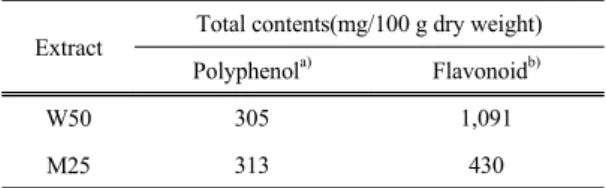
Table 1. Total polyphenol and flavonoid contents of Paulownia coreana bark extracts under different extraction conditions (W50: water extract at 50℃; M25:
methanol extract at 25℃)
Extract Total contents(mg/100 g dry weight) Polyphenola) Flavonoidb)
W50 305 1,091
M25 313 430
a) gallic acid equivalent, b) naringin equivalent
Reducing powera) DPPH radical scavenging activity(%)
50℃ Hot water 25℃ Methanol 50℃ Hot water 25℃ Methanol
Extract 1.3225 1.3373 32.51 87.22
AA 2.2442 1.9030 96.26 96.67
BHT 1.5854 1.2937 90.91 91.21
a) absorbance values
Table 2. Comparison of the reducing power and 1,1-diphenyl- 2-picrylhydrazyl (DPPH) radical scavenging activity of Paulownia coreana bark extract with ascorbic acid (AA) and 2,6-ditertiarybutyl hydroxytoluene (BHT)
In this study, the total polyphenol contents were 305 and 313 mg/100 g dry weight and flavonoid contents were 1091 and 430 mg/100 g dry weight in the 50℃ hot water and 25℃ methanol extracts, respectively (Table 1).
Polyphenol and flavonoid contents were expressed as gallic acid and naringin equivalents, respectively.
3.3. Reducing power
The reducing power of a compound is associated with antioxidant activity: a positive correlation is observed between the antioxidant activity and reducing power (Park et al., 2010). The reducing power associated with the presence of reductones, which act as the primary and secondary antioxidants, occurs by breaking the free radical chain through the donation of a hydrogen atom (Hu et al., 2009). Table 2 shows the reducing power of P. coreana bark hot water extract compared with that of AA and BHT positive controls. Under the same dosages, the reducing power of the extract was 70.3% of that of AA and nearly similar to that of BHT in terms of the absorbance. Thus, the reducing power may serve as a significant indicator of potential antioxidant activity, and the significant antioxidant activity of the extract is anticipated to be closely related to the reducing power (Park et al., 2010).
3.4. DPPH RSA
Free radicals are known to be one of the most significant causes of oxidative damage to biological molecules in the human body. The free radical
compound DPPH has been used extensively to evaluate free radical scavenging activity of antioxidants (Hu et al., 2009). The absorbance of DPPH solution is decreased by the formation of non-radical diamagnetic molecules and DPPH-H by accepting an electron or hydrogen radical from the proton-donating substance (Hong et al., 2009). In this study, the DPPH RSAs are shown in Table 2 with those of AA and BHT as positive controls. The RSA of the extract obtained using 50℃ hot water was 32.51%, whereas those of AA and BHT using the same contents as the solid content of P. coreana bark hot water extract were 96.26% and 90.91%, respectively. However, the RSA of the 25℃ methanol extract was 87.22%, whereas the RSAs of AA and BHT using the same contents as the solid content of P. coreana bark methanol extract were 96.67% and 91.21%, respectively.
3.5. Nitrite scavenging activity
Nitrite containing -NO
2radical is known to react with secondary amines to form nitrosamine, which converts to diazoalkane in the human body and can increase the risk of cancer by alkylation of nucleic acids, proteins or intracellular components (Lee et al., 2008). However, anticancer components in plants and vegetables restrain nitrosamine formation, suppress the nitrification of phenolic component, and contribute to anticancer effect.
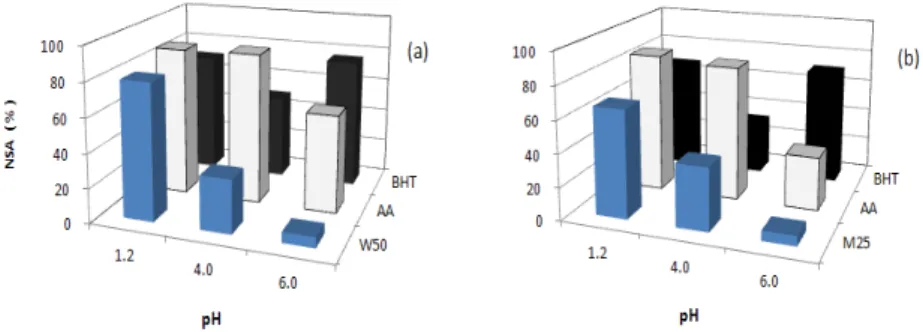
The nitrite scavenging effects of hot water and
methanol extracts of P. coreana bark under pH 1.2,
4.0, and 6.0 are shown in Figure 2. The nitrite
scavenging effects of the extracts showed high nitrite
Fig. 2. Nitrite scavenging activity of Paulownia coreana extracts; (a) 50℃ water extract and (b) 25℃ methanol extract.
removal ability at pH 1.2, which is the average pH in animal stomachs; further as the pH increased from 1.2, 4.0 and 6.0, the nitrite removal ability decreased in the hot water extract: 79.46%, 31.02% and 6.13%, respectively. In the methanol extract, as the pH increased from 1.2, 4.0 and 6.0, the nitrite removal ability decreased at 65.79%, 38.08% and 6.06%, respectively. Thus P. coreana bark extracts reduce the formation of nitrosamine, which is carcinogen.
3.6. ABTS RSA
The ABTS cation RSA is one of the extensive properties of the antioxidant activity of biological material (Hong et al., 2009). The ABTS free radical is eliminated by any antioxidant component in the extract with the reaction of ABTS and potassium persulfate, and the ABTS free radical showed bleached coloration (Ryu, 2011).
Figure 3 shows a comparison of the ABTS RSA of P. coreana bark extract with that of AA and BHT.
The ABTS RSAs of the hot water and methanol extracts were 99.01% and 96.89%, respectively, whereas those of AA and BHT with equal dosages were 99.88% and 96.07%, respectively. We found that the soluble solid content in the water extract (15.92 mg/mL) was 4.5 times more than that in the methanol extract (3.53 mg/mL), the DPPH RSA of the water extract was lower than that of the methanol extract, and the NSA of the water extract was higher
than that of the methanol extract at pH 1.2, but the ABTS RSAs of the two extracts were shown to be almost equal. RSAs are generally considered strong in the presence of high total polyphenol and flavonoid contents. However Wang et al. (1998) determined that some compounds showing ABTS RSA did not show DPPH RSA. In our study, the extraction yields and flavonoid contents in 25℃
methanol extract were lower than that in 50℃ water extract. Although the DPPH RSA of the methanol extract was higher than those of the water extract, the ABTS RSA of the methanol extract was lower than those of the water extract. Moreover, the ABTS RSAs of the two extracts showed to be almost equivalent values with those of AA and BHT.
Fig. 3. Comparison of 2,2-azino-bis-(3-ethylbenzothiazoline-6- sulfonic acid (ABTS) radical scavenging activity of Paulownia coreana bark extract with ascorbic acid (AA) and 2, 6-ditertiarybutyl hydroxytoluene (BHT).
Fig. 4. Oxidation stability measurements of corn seed oil treated with Paulownia coreana bark extract, ascorbic acid (AA) and 2, 6-ditertiarybutyl hydroxytoluene (BHT); (a) induction period and (b) antioxdant index.