• 검색 결과가 없습니다.

First Report of Take-All on Turfgrass Caused by Gaeumannomyces graminis Var. Graminis in Korea

N/A
N/A
Protected

Academic year: 2021

Share "First Report of Take-All on Turfgrass Caused by Gaeumannomyces graminis Var. Graminis in Korea"

Copied!
2
0
0

로드 중.... (전체 텍스트 보기)

전체 글

(1)

Asian J. Turfgrass Sci. 26(1):72~73, 2012 Print ISSN 1229-3253

Disease Report Open Access

72

The Turfgrass Society of Korea Asian Journal of Turfgrass Science

First Report of Take-All on Turfgrass Caused by Gaeumannomyces graminis Var. Graminis in Korea

Jaeyul Cha

1

, Jung-Han Lee

1

, Jeong Ho Kim

2

, Gyu Yul Shim

2

, Eunji Bae

3

, and Youn-Sig Kwak

1

*

1

Department of Applied Biology and Institute of Agricultural & Life Science, Gyeongsang National University, Jinju 660-701, Korea

2

Korea Turfgrass Research Institute, Seongnam 463-840, Korea

3

Southern Forest Research Center, Korea Forestry Research Institute, Jinju 660-300, Korea

Gaeumannomyces graminis Arx & Olivier comprises four varieties: G. graminis var. tritici (Ggt), var. avenae (Gga), var. maydis (Ggm) and var. graminis (Ggg), and all cause similar diseases on different crops or grasses. Ggt causes take-all of wheat, barley. Gga attacks oats. Ggm causes take- all of maize. Ggg causes dieback of Bermuda grass and sheath blight of rice (Freeman and Ward, 2004). Gga, Ggm and Ggt produce a simple, unlobed hyphopodium, but Ggg develops a lobed hyphopodium, as a key characteristic for identification of the pathogen (Freeman and Ward, 2004).

Take-all disease of turfgrass is caused by G. gramins var.

graminis, the fungus belongs to Magnaporthaceae. First report of the disease was on St. Augstengrass in 1991 in US, the pathogen has been known to successfully infect and cause disease on other turfgrasses (Krausz, 2005).

Symptoms of the disease generally appear in late spring or early summer. The disease has been reported in worldwide (Hill et al., 1999) but not in Korea. In June 2011, we observed severe disease patches at a golf course (turfgrass;

Zoysia sp.) in Giheung, Gyeonggi province (Fig. 1A). The patch was suspected as turfgrass take-all, based on the symptoms. The infected stolons and roots had typical black lesions (Fig. 1B) and yellowish foliage and brown symptoms were observed on the edge of the patch. The infected roots and stolons were washed for 2 hr running tap water and then surface-sterilized by immersion in a solution of 1% silver nitrate for 1 min, followed by rinsing twice in distilled water. Excess water was removed by filter paper then roots were cut into pieces and placed on R-PDA (Kwak et al., 2009). Dark-pigmented fungi were isolated from the roots and the stolons of the infected plants. The ITS sequences were deposited in GenBank (Accession No.

*Corresponding author ; Tel: +82-55-772-1922 E-mail : [email protected]

Received : Jan. 04, 2012, Revised : Jan. 24, 2012, Accepted : Feb.

02, 2012

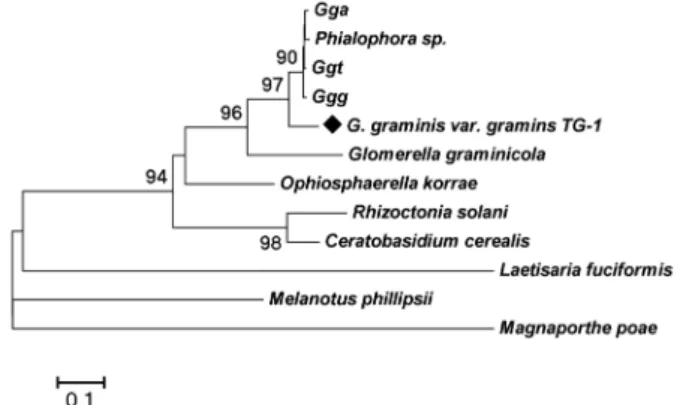
Fig. 2. Phylogenetic tree of Gaeumannomyces spp. based on rDNA ITS sequences. Multiple sequence alignment performed using ClustalW2. A neighbor-joining algorithm was used to generate the phylogenetic tree. The tree was constructed using the original data set and 1000 bootstrap data sets. indicated the present isolate.

Fig. 1. (A) Severs take-all patch symptoms on Zoysiagrass. (B)

Typical black lesion symptom on the stolon. (C) Hyphopodia

on turfgrass coleoptiles by isolates G. graminis var. graminis

TG-1. Bars indicate 20 µm. (D) Take-all symptom was

produced isolates of G. graminis var. graminis TG-1.

(2)

Turfgrass Take-All Disease Caused by Gaeumannomyces graminis var. graminis in Korea 73

JQ303334). The fungi were identified as G. graminis var.

graminis based on ITS-rDNA sequences and the phylogenetic tree (Fig. 2), avenacinase-like gene PCR reaction (data not shown) (Rachdawong et al., 2002) and morphological characteristics, such as lobed hypopodia on coleoptiles of turfgrass (Fig. 1C). On PDA media, the optimal temperature for the pathogen hyphal growth was 20

o

C (3.85 mm ±1 per day) (data not shown). The barely kernel inoculums (1%, v/v) of the pathogen successfully produced the take-all symptom on Zoysiagrass (Fig. 1D). To our knowledge, this is the first report of take-all disease in turfgrass and the causal pathogen, G. graminis var. graminis, in Korea.

References

Hill, W. J., Heckman, J. R., Clarke, B. B., and J.A. Murphy. 1999.

Take-all patch suppression in creeping bentgrass with manga-

nese and copper. HortScience 34:891-892.

Krausz, J. P. 2005. Take-all root rot of turfgrass. Texas AgriLife Extension Service.

Kwak, Y.-S., Bakker, P. A. H. M., Glandorf, D. C. M., Rice, J. T., Paulitz, T. C., and D. M. Weller. 2009. Diversity, virulence, and 2,4-diacetylphloroglucinol sensitivity of Gaeumannomyces graminis var. tritici isolates from Washington State. Phytopa- thology 99:472-479.

Rachdawong, S., Cramer, C. L., Grabau, E. A., Stromberg, V. K., Lacy, G. H., and E. L. Stromberg. 2002. Gaeumannomyces graminis vars. avenae, graminis, and tritici identified using PCR amplification of avenacinaselike genes. Plant Dis.

86:652-660.

Freeman, J., and E. Ward. 2004. Gaeumannomyces graminis, the

take-all fungus and its relatives. Mol. Plant Pathol. 5:235-252.

수치

Fig. 1. (A) Severs take-all patch symptoms on Zoysiagrass. (B) Typical black lesion symptom on the stolon

참조

관련 문서

First, analyzing the difference of enjoyment factor based on demographic attributes of elderly sport for all program’s participant and by its gender, the

○ Furthermore along with obtaining fundamental data on power network system in Korea and related-data on demand, supply, transmission of Russia and North

In addition, loss compensation does not take precedence over compensation liability based on other laws or liabilities incurred by the person who caused the

A phylogenetic tree obtained by the neighbor-joining method revealed that five sequence (SMS-1, 2, 5, 6, 7) from the squirrel monkey and three sequences (NM6-4, 5, 9) from

• Using the method of superposition, the separate M/EI diagrams for the redundant reaction B y and the load P are shown in Fig...

First of all, it is necessary to set Korea's status and role in the denuclearization peace process on the Korean Peninsula as the core party, not the mediator, considering the

In view of the essential relevance of mission in history (and not only in the history of religion), on the one hand, and in theology (and not only in missiology),

Based on experience in some OECD countries, Korea could reform its existing energy tax system more environmentally-friendly including the introduction of a carbon tax,