Abstract
The purpose of this research is to identify the relation be- tween the Korean wave and Korean cosmetics export. Instead of using UN COMTRADE data as with other researches on the similar studies, this paper adopts Google Trends query index with keyword ‘Korean drama’as a proxy variable for cultural trade. With controlling export determining factors such as GDPs of import and export countries, distance, R&D, and FTA, this paper examines whether the Korean wave represented by Google Trends contributes to the explosive increase of Korean cosmetics export in the recent years. Moreover, this study also investigates the possible effects of the Korean wave on export that could vary according to the different trade groups by classi- fying import countries into two groups: 74 countries worldwide and 9 ASEAN member countries. The results reveal that the Korean wave indeed leads to cosmetics export to ASEAN coun- tries but show weak relation with cosmetics export to worldwide.
Keywords: Korean wave, Cosmetics, Cultural proximity, Google Trends, Gravity model.
JEL Classification Codes: F14, F10, D10.
1. Introduction
Many of research questions raised in the last two decades on international trade flows have centered on the trade costs derived from the territorial borders. The famous research by McCallum (1995) on Canada-US regional trade patterns trig- gered a flood of studies in search of the true magnitude of the border effect. Obstfeld and Rogoff (2000) include the home bias in trade as one of the six puzzles in international macroeconomics. Disdier and Head (2008) examined 1467 dis- tance effects estimated in 103 papers and found that, on aver- age, 10% increase in distance lowers bilateral trade by about
* Deputy Director. [KOTRA New Delhi #2, 12th Floor, DLF Cyber Terraces, Building 5-A, DLF Cyber City, Phase-lll, Gurgaon-122002, Haryana, India. Tel: (+91 124) 462-8500, Fax: (+91 124) 462-8501 E-mail: [email protected]]
9%. Transportation costs for long distance, tariffs, and other non-tariff barriers can explain part of the reasons why the na- tional border still matters.
As Grossman (1998) speculates, however, the reason why distance matters so much might also be due to the lack of fa- miliarity or cultural difference. Many researchers adopting the gravity model include common languages (Boisso & Ferrantino, 1997; Melitz, 2008), colonial experience (Rose, 2000;
Eichengreen & Irwin, 1998), and ethnic ties (Rauch & Trindade, 2002; Combes, Lafourcade, & Mayer, 2005; Wagner, Head, &
Ries, 2002) as proxies for cultural ties between the trading partners. The border effect is not restricted to trade in manufac- tured goods. Miroudot, Sauvage and Shepherd (2013) find that trade costs in services are much higher than those in a goods sector. Their research data also suggest that trade costs in manufactured goods have fallen considerably over the last dec- ade, but they have remained essentially stable in services markets. Blum and Goldfarb (2006) show that physical distance reduces trade even in online products and services that should be free of trade costs.
In line with the above reasons, a few of recent studies focus on the trade diffusion effects of the popularity of Korean cultural contents such as TV dramas and music (Park & Choe, 2009;
Kim & Ahn, 2012). The remarkable success of Korean cultural industry is especially evident in Asian countries. According to the data from Korea Creative Content Agency (KOCCA), during the 8-year period between 2005 and 2013, the value of Korean music export increased more than 10 times from 22 million dol- lars to 227 million dollars. Among the total music export value in 2013, 97.4% went to Asian countries such as Japan, China and South East Asian countries. The situation of the Korean ex- port of broadcasting contents is not much different. During the same 8-year period the value of Korean export of TV contents increased from 121 million dollars to 309 million dollars and 73% of the total export of TV contents in 2013 went to Asian countries.
The advantage of adopting trade in cultural goods as a proxy for cultural links between trading partners is that, while other cultural factors such as common language, colonial experience, and ethnic ties are time invariant, cultural trade changes within a short period of time. Thus, the dynamic nature of trade pat- terns can be captured with the use of the cultural trade as a proxy variable for cultural ties between trading partners. George Print ISSN: 2288-4637 / Online ISSN 2288-4645
doi: 10.13106/jafeb.2015.vol2.no4.13.
Does the Rise of the Korean Wave Lead to Cosmetics Export?
2)
Young-Seaon Park*
[Received: June 15, 2015 Revised: September 30, 2015 Accepted: October 15, 2015]
and Becker (1977) challenge the traditional assumption of the stability of tastes and preferences through case studies of ad- diction, habitual behavior, advertising and fashions. In accord- ance with the above reasoning it is also possible to assume that frequent exposure to foreign cultural contents can shift do- mestic consumers’ buying behavior (Rauch & Trindade, 2009;
Bala & Van Long, 2005; Park, 2014). There are ample cases of media reports and publications in Korea claiming that the Korean wave greatly contributed to the Korean export in partic- ular and to the Korean economy in general. However, most of such reports are based either on pure speculations or on the anecdotal researches which lacks rigorous analysis.
This paper attempts to study the trade creation effects of the Korean wave, with special consideration of the Korean cos- metics export. The Korean cosmetics industry is chosen be- cause of the remarkable performance of the industry in the midst of the economic recession in recent years. Also, cos- metics can be categorized as partially substituted products and so their consumption is closely connected not only to the prod- uct price and quality but also to the images the products impart.
One of the possible reasons why Korean cultural contents have become so popular in Asian countries may be due to the at- tractive faces of Korean entertainers. Since the concept of beau- ty can be shared in the specific regions, the rise of the Korean wave might explain the explosive export increase of Korean cosmetics to Asian countries in the recent years.
Whereas most of the researches on trade creation effects of the Korea wave (i.e., Park & Choe, 2009; Kim & Ahn, 2012) use United Nations COMTRADE data for both manufactured and cultural goods, this paper adopts data extracted from Google Trends search queries as a proxy measure for trade in cultural goods. As the Internet is widely used for the consumption of audio-visual products, trade of manufactured cultural goods such as CDs, magnetic tapes, and cinematographic film may fail to represent the true scale of cultural trade.
Choi and Varian (2012) demonstrate that Google Trends can help in predicting the present. Google Trends search queries have recently been used to estimate the current level of dis- ease activities such as ‘influenza’, ‘bird flu’ and ‘swine flu’ in the countries (Ginsberg et al., 2009; Eysenbach, 2006). Askitas and Zimmermann (2009) demonstrate strong correlations between keyword searches and unemployment rates using monthly German data. As the Internet searching activities become part of daily lives around the world, analyzing search key word quer- ies may also reveal each person’s cultural affinity to a certain country.
The paper proceeds as follows: The next section describes the dynamic growth of the Korean cosmetics industry. The third section proposes a gravity model approach for empirical analysis with data description. The fourth section provides the estimation results. The fifth section considers the implications of the results and concludes.
2. Korean Cosmetics Industry
Korean cosmetics industry enjoys fast growth thanks to heightened health interests among the population and increasing investment in the cosmetics production. According to the data from Korea Health Industry Development Institute (KHIDI) shown in Table 1, Korean domestic production of cosmetics reached 7280 million dollars in 2013 from 4049 million dollars in 2009 with an average annual growth of 16.0%, far outpacing the average Korean GDP growth rate of 3.2% in the same period.
The remarkable aspect of the industry is that whereas most of other industries were severely affected by the financial crisis and recorded no growth at all in 2009, Korean cosmetics mar- ket grew by as high as 11.8% in the same year.
<Table 1> The Market Size of the Korean Cosmetics Industry (Unit: US$ million, %) 2009 2010 2011 2012 2013 YoY CAGR
(2009~2013) Market
Size 4,336 5,456 5,947 6,231 6,962 11.7 12.8 Production 4,049 5,202 5,763 6,321 7,280 15.1 16.0 Export 416 597 805 1,067 1,290 20.8 32.9
Import 702 851 989 978 972 -0.1 8.9
Trade
Balance -286 -254 -184 89 318 Source: Korea Health Industry Development Institute
* YoY stands for year over year and CAGR stands for compound annual growth rate.
Source: Korea Health Industry Development Institute
<Figure 1> Korean Export of Cosmetics (Unit: US$ thousand)
The export performance of the Korean cosmetics industry in
the recent years is also noteworthy. According to the data from
Korea Health Industry Development Institute (KHIDI), the value
of Korean cosmetics export during 11 year periods (2002 –
2013) increased more than 10 times from 123 million dollars to 1,289 million dollars and, as shown in Figure 1, the export val- ue of Korean cosmetics in 2012 outpaced the import value for the first time.
The major export destinations of Korean cosmetics are Asian countries such as China, Hong Kong, Japan, Taiwan and South East Asian countries. Figure 2 shows that the top 10 export destination countries occupy 90% of the total Korean cosmetics export and among them only The United States and The Russian Federation are not Asian countries. Among the South East Asian countries Thailand, Singapore, and Malaysia are in- cluded in the top 10 export destinations.
There might be several explanations why Korean cosmetics are highly preferred among Asian people rather than people in the other part of the world. Firstly, Korean companies’ efforts on satisfying domestic consumers paid off not only in the domestic market but also in the overseas market. Korean women are very conscious of the skin care and so the majority of the prod- uct development of cosmetics companies thereby focuses on skin care products. Biotechnology takes an increasingly im- portant role in protecting skin from aging. Korea’s number one cosmetics manufacturer, Amore Pacific Corp, established a bio- science R&D center in 2011 and LG Household and Health Care, the number two cosmetics company, formed a technology partnership with a renowned women’s hospital, Cha Medical Center, on stem cell research (Kang, 2012). Taking into account the Korean women’s special interest in ingredients of the cos- metics, Korean companies have also developed skin care prod- ucts made of such natural, organic and herbal medical in- gredients as green tea, ginseng, sacred lotus root, and bamboo extract. Sulhwasoo, an exceedingly successful brand by Amore Pacific Corp, is noted for its fragrance of ginseng and the use of many traditional medicinal herbs and roots. The kin interests in clean and fair skin are not an exclusive property of Korean women but are shared among Asian women. For example, the Japanese brand Shiseido also created a herb-infused face cream developed especially for Chinese skin (Alexander, 2011).
Source: Korea Health Industry Development Institute
<Figure 2> Korean Export of Cosmetics per Country as of 2013
Secondly, Asian women also share a similar concept of beauty and skin color. In Korea ‘whitening’ skin product is popu- lar because white skin is synonymous with beauty. The descrip- tion of a woman’s skin as ‘Jade white’has been a common ex- pression for praising her beauty in both Korea and China. There are poems from Tang Dynasty in China that described women as ‘Jade white’ and ‘creamy tinted’ (Alexander, 2011). According to the study by Li et al. (2008), contemporary meanings of whiteness in Asia are influenced by Western ideologies as well as traditional Asian values and beliefs. They concluded that skin whitening and lightening products not only promise to fulfill the desire for white and fair skin as a route to higher status, but al- so empower women to control their own bodies and alter nature.
Thirdly, since the advertisement and product brand image are critical aspects of the cosmetics industry, star marketing method of the Korean companies is thought to have greatly contributed to the success of Korean cosmetics in the Asian countries. For example, Laneige, one of the renowned cosmetics brands of Amore Pacific Corp, made a contract for product advertisement with an actress Song Hye-Kyo in 2008. The actress achieved stardom in Asia for her appearances in successful TV dramas such as ‘Autumn in My Heart’ and ‘Full House’ and also fre- quently appeared in Chinese movies. Also, the number four player in the Korean cosmetics market, The Face Shop, be- came highly successful partly due to the signing of the actor Bae Yong-joon of the popular TV drama ‘Winter Sonata’ as an endorser.
3. Empirical Strategy and Data 3.1 Empirical Strategy
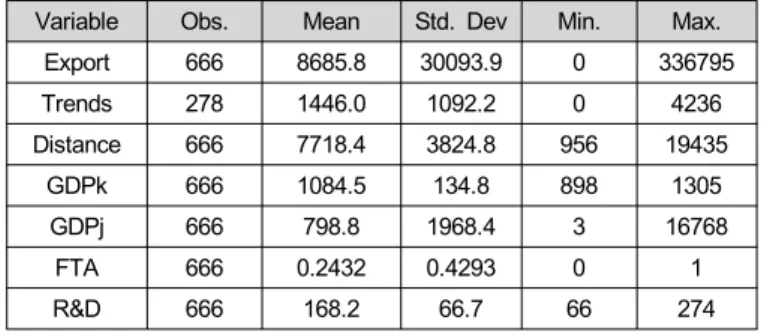
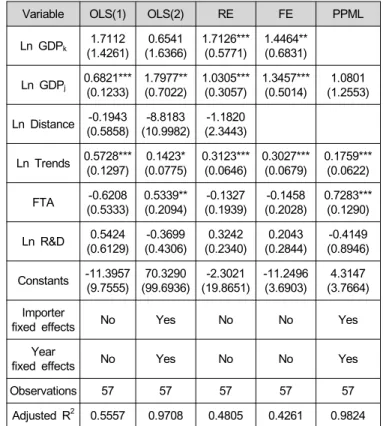
This paper adopts the gravity model for the empirical analysis of the impact of the Korean wave on the export of the Korean cosmetics utilizing the export panel data from 2005 to 2013.
The gravity model has been widely used for analyzing the pat- tern of international trade because it has produced some of the clearest and most robust findings in economics (Leamer &
Levinsohn, 1995). Even though the gravity model has been used for bilateral trade data since Tinbergen (1962), it became truly popularized in empirical work after the concept of multi- lateral resistance (Anderson & Van Wincoop, 2001) was in- troduced and fixed effects revolution (Feenstra, 2004; Redding &
Venables, 2004) started to capture the multilateral resistance terms. The combination of its consistency with theory and easy implementation leads to rapid adoption of the model in empirical work (Head & Mayer, 2014).
With the inclusion of multilateral resistance, Anderson and Van Wincoop (2001) derive the following theoretically founded gravity equation of international trade:
1
i j ij
i j
j i
w
x y y y
τ
−σΠ
⎛ ⎞
⎜ ⎟
⎝ Ρ⎠
=
where xij denotes exports from country i to j, yi and yj are
GDPs of each country, ijis the gross bilateral trade cost, τ σ > 1 is the elasticity of substitution, and i and j represent country Π Ρ i’s outward and country j’s inward multilateral resistance varia- bles, respectively.
As shown by Shepherd (2013), taking the natural logarithms of all variables, the above equation can be transformed as fol- lows:
log (1
l
)[log ] lo
o g log log log
g log
log log
ij
i i i
ij i j
ij ij ij ij
j j j
C Y
F Y
F
X C F F
Dist Cultur Y
e FTA
σ τ
τ
= + + + −
= +
= −
=
+
− Π
= − Ρ
The first term, C, is equal to world GDP but for estimation purposes it can be a coefficient because it is constant across all exporters and importers. The next term, Fi, is shorthand for a full set of exporter fixed effects. Taking the same approach, Fj is a full set of importer fixed effects. log ij is the sum of cost τ variables such as distance, cultural proximity, and FTAs be- tween country i and country j.
To analyze the impact of the Korean wave on the export of the Korean cosmetics, adopting and modifying the above equa- tions, this paper estimates the following econometric model:
0 1 2 3 4 5
6ln
n
&
kjt kt jt l jt kjt
kt t kj
j
j t
lnX lnGDP lnGDP lnDistk Tr FTA
R D
β β β β β
endsβ
β γ δ ε
= + + + + +
+ + + +