
Exploring Preservice teachers' Understandings about Scientific Literacy embedded in Science Camp at Science Center
12
0
0
전체 글
(2) 2. Young-Shin Park. tices about the envisioned scientific inquiry (Capps, Crawford, & Constas, 2013; NRC, 2000; Park, 2008; 2010). Many researchers point out that the teachers’ understandings about science (scientific inquiry in this study) influence their practices of teaching in the classroom which in turn influence students’ achievement for science learning (NRC, 1996; Gess-Newsome & Lederman, 1989; Richardson, 1996). In addition, when preservice teachers are considered to start to develop teaching careers for teacher profession, it is very critical for preservice teachers to be prepared to teach scientific inquiry. Preservice teachers are also reported that they feel dissonance between theory and practice in teaching science; therefore, it is very careful for preservice teachers to be prepared and exposed to the real context of teaching to decrease their conflict from the gap between theory and practice (Beyer & Davis, 2008; Cavallo & Saunders, 2002; Park, 2008). Real contexts including field experience with students’ interaction, are very essential factors for preservice to reflect on their understandings and practices on science teaching (Bardford & Dana, 1998; Park, 2008; Zeichner, 2002). Preservice teachers can bring theory and practice into closer alignment when they are exposed to large doses of ‘reality’ in the classroom at schools or field at outdoors. Preservice teachers can form new understandings about scientific inquiry or change their understandings to be connected into their practices of scientific inquiry teaching through clinical reflection on theory and practice to be more professional in teaching (Cronin-Jones, 1992; Park, 2008; Roehrig & Luft, 2008). However, schools are not the only way for improving science literacy. Perhaps, scientific literacy could be strengthened in more informal context such as leisure setting. Learning science in informal setting has some difference from that in formal learning. The science museum can be the representative of informal setting for science learning. The number of science museums (science center included) in Korea as well as other countries is increasing and with this comes the demand for engaging and even entertaining educational. programming recently. To meet its demand, science museums depend on volunteers to serve as educators like docents of objects and exhibits in museums. If science educators at museum are eager to use docents effectively, it is critical for science educators to understand what docents needs to be prepared and developed it to meet the goal of informal setting of science education. At this time, if we assign preservice teachers into science museum for field experience during their practicum period, we can solve two problems; that is, we do not have to worry about limitation of fieldwork experience and science museums can have more qualified ‘explainers’ for visitors or campers learning science. Existing within the larger context of museums, they are free-choice settings within the overall goal of exciting, engaging and educating the public on aspects of science (Falk, 2001). Science museum can provide chances for learning, although learning occurs in unstructured and non-sequential way. For the most science learning at science center, it is critical for docents or explainer (who are defined as 'educator' or 'interpreter' at science center) to be equipped with appropriate knowledge and practices which guides students/ visitors to be exposed to the authentic environment where they experience scientific literacy (Park & Lee, 2011; 2012; Cox-Petersen, Marsh, & Melbar, 2003; Grenier, 2009). In this study, the researchers implemented one preservice internship program in one science museum in Taiwan and 20 preservice teachers participated in this program to see how their understandings and practices of scientific literacy had been changed or developed. The research-questions are as follows; (1) how much do preservice teachers understand about scientific literacy? (2) how much do preservice teachers understand the nature of science? (3) Which one do preservice teachers prefer to experience scientific literacy, formal settings (schools) or informal settings (science museum)? (4) Do preservice teachers experience scientific literacy during science camp activities? The first three questions are asking participants' theories and the last question is checking their practices in the real context at science camp..
(3) Exploring Preservice teachers’ Understandings about Scientific Literacy embedded in Science Camp at Science Center. Ⅱ. METHODOLOGY 1. Information about research site Nine preservice teachers from Korea participated in international science survival camp designed and offered by National science and technology museum (NSTM) in Taiwan and Korean preservice science teachers paired with another 11 Taiwanese preservice teachers and they spent one month for informal (or non-formal) education. Each group consisted of one Korean and one Taiwanese preservice teacher with 10 campers at upper elementary level and there were 9 groups for survival science camp at NSTM. Survival science camp focused on cooperative learning among the members to carry out the given activities, during which campers need to solve the problem with the help from preservice teachers. Nine Korean preservice teachers’ background consisted of four different science education fields (physics, chemistry, biology and earth science) and another 11 Taiwanese interns’ background consisted of natural science or engineering field. All interns (preservice teachers here) and campers communicated Taiwanese or English and they experienced the survival camp guided by three researchers from Korea (one researcher) and Taiwan (2 researchers). The researchers in this study designed science camp, implemented it, and developed instruments (survey and questionnaire) for data collection. Science camp program consisted of 7 different small activities for 4 day-long period and that program was repeated every week for one month, therefore, 20 preservice teachers worked at NSTM for indoor and outdoor activities for one month. 2. The development of science survival camp program This study aimed at promoting preservice teachers’ understandings of scientific literacy, which is defined operationally with 4 different abilities: scientific knowledge (contents-on), abilities of inquiry, one is procedural (hands-on) and the other thinking (minds-on), at-. 3. titude toward science, and the understandings of STS (science- Technology-Society) relationship (hearts-on). To achieve this goal, researchers developed survival science camps program including 7 small activities with the emphasis of scientific literacy. For example, one activity of science camp program was designed by the following guiding questions and under the title of 'making fire’ in the activity of wild cooking. A. Share the value of fire in our lives with the following questions; “Why do we need fire in our lives?” this is for checking students’ valuing fires on their lives [the nature of science or STS relationship understandings] B. Check what we knew about ‘fire’, this is for checking students’ prior knowledge or misconception with the following guiding questions; “Did you have any experience of making fire? [science concept] C. Plan what we want to know-we collect more data to know ‘fire’ better with the following guiding questions; “What are the elements of combustion?” [interest/motivation toward science] D. Learn inquiry procedural skills-teach students how to make fire and practice this experiment in groups [experimentation] E. Provide alternative contexts-where fire can be interpreted differently, which means ‘positive’ and ‘negative’ impact on our lives in two ways, where we can expect two groups of students to debate each other through promoting their abilities of scientific thinking skills, finally [argumentation] F. Share how they felt about this program-what was successful and unsuccessful episode [reflection on the program]. →. →. →. →. →. →. By doing this activity, campers with the help by preservice teachers in a group would experience the aspects of scientific literacy and the researchers explored how they formed or changed their understandings about scientific literacy. Small activities' titles are, ‘Morse’, ‘river crossing’, water collection’, ‘snare’, ‘stretcher’, ‘boomerang’, and 'wild cooking’..
(4) 4. Young-Shin Park. i. 7 items for scientific literacy (checking understandings about scientific literacy in contents-on, hands-on, minds-on, hearts-on)_SL survey Scientific literacy 1 2 3 4 5 6 7. Learn Learn Learn Learn Learn Learn Learn. (SL); It is important for students to. science concept for daily life procedural inquiry skill necessary for experimentation to test scientific thinking skill necessary for argumentation attitude about science (motivation, curiosity, fun) the value of science: science is useful in our life how science impacts on society or vice versa the nature of science. ii. 15 items for the nature of science (checking understandings about the nature of science such as science is tentative)_NOS survey Nature of science 1 2 3 4 5 6 7 8 9 10 11 12 13 14 15. (NOS). Science can be changeable Science is the product of human being. Science is objective Science is subjective Science is impacting on society positively Science is inferred one. Science must start from observation Science is creative Science is imaginative Science is socially and culturally embedded Scientific theory can be changed into scientific law Scientific law has exception Scientific theory has exception Science is empirically-based Science is always true. 3. Instruments Instruments for data collection included the followings A. Questionnaire evaluating science camp for 20 preservice teachers B. Questionnaire checking what 45 campers learned. objective Contents-on Hands-on Minds-on Hearts-on Hearts-on Hearts-on Hearts-on. C. Surveys for 20 preservice teachers: The survey consisted of 4 categories with smaller items to check preservice teachers’ scientific literacy (the total item number is 85). We also checked preservice teachers’ understandings about scientific literacy from other 7 different small inquiry activities, which released if participants could experience the aspects of scientific literacy from each activity designed by the research team. 7 different items of the aspects of scientific literacy in survey were checked in 7 different activities.. 4. Data Collection and Analysis For data collection, surveys mentioned in the above was carried out before and after the second science survival camp (after two weeks since camp started) and preservice teachers of Korean and Taiwanese at universities filled out the surveys. Before the camp, the researchers explained what scientific literacy is and what objectives need to be met through scientific literacy. All surveys were written in their own language and the researchers guided participants if there was any question about surveys which were filled out. iii. 7 items learning science at schools and another 7 at science center (checking which setting of science learning provides more chance to experience the aspect of scientific literacy) In schools/at science center 1 2 3 4 5 6 7. Students Students Students Students Students Students Students. can can can can can can can. learn science concept learn scientific inquiry skill (procedural skill in experiments) learn scientific inquiry skill (scientific thinking skill in argumentation) learn the value of science learn attitude about science learn the nature of science Learn how science impact on/can be impacted by society or technology (vice versa).
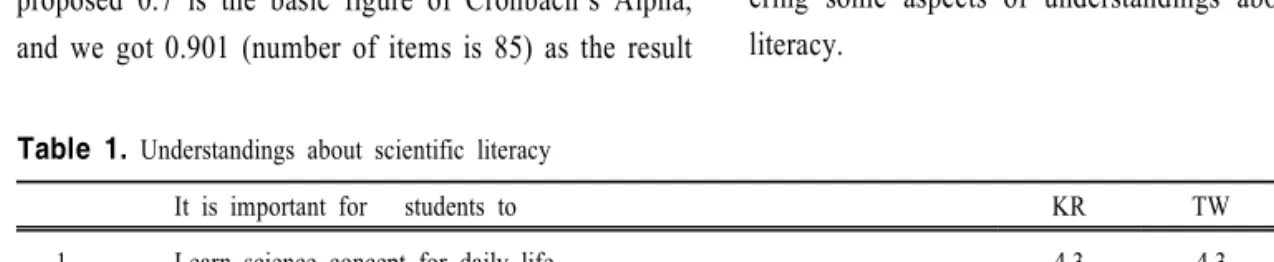
(5) 5. Exploring Preservice teachers’ Understandings about Scientific Literacy embedded in Science Camp at Science Center. within about half an hour. In addition, questionnaire with two questions asking general impression about science camp were run right after surveys. 36 items (exploring general perception about scientific literacy as well as nature of science) were checked before the camp and 85 items (checking if every activity was met in terms of scientific literacy) after the camp. In addition to this, campers of 45 students at upper elementary and lower middle school level responded the simple survey asking the followings; (1) what was the most impression and its reason, (2) what science concept you learned, (3) what was your favorite activity and its reason, (4) what activity you disliked and reason. For data analysis, all items in surveys produced the average (out of 5 likert scale), illustrating how well preservice teachers understood scientific literacy as well as nature of science. Preservice teachers’ preference for science learning at school and science center was also evaluated by comparing average and descriptive statistics. Other preservice teachers’ responses in evaluating science camp program were coded into categories and we used those responses for triangulation purpose to construct the validity and reliability in data analysis.. Ⅲ. RESULTS The total of 20 preservice teachers participated in this study; 9 Korean and 11 Taiwanese preservice teachers at college level responded surveys before and after the camp lasting one month. As Nunnally (1978) proposed 0.7 is the basic figure of Cronbach’s Alpha, and we got 0.901 (number of items is 85) as the result. of this survey which means that this instrument is adaptable.. 1. Preservice teachers’ understandings about scientific literacy The scores of preservice teachers’ understandings about scientific literacy during science camp offered by science center as indoor and outdoor activities were recorded as moderate ones above the average (3 is the average out of 5 likert scales), meaning that preservice teachers participating in this study held good enough understandings about scientific literacy [Table 1], learning science concept (4.3 point), learning inquiry skills for experimentation (4.1) and for argumentation (4.2), experiencing attitude toward science (4.6) as well as its value, finally understanding the relationship among science, technology, and society. The best understood aspect of scientific literacy is that students need to learn attitude about science such as science is fun (not knowledge delivery only), kids feel curiosity, and they are motivated to learn science. Preservice teachers believed that science camp which was not regular activity in the classroom must be organized to provide much fun and curiosity basically as outdoor activity. Participants also responded that they used to be fascinated by live animals and detail equipment whenever they visited science museum when young, therefore, fun and curiosity are the very basic component to be included in the activities in informal setting of science center. The following excerpts were from preservice teachers’ questionnaire responses covering some aspects of understandings about scientific literacy.. Table 1. Understandings about scientific literacy It is important for 1 2 3 4 5 6. Learn Learn Learn Learn Learn Learn. students to. science concept for daily life procedural inquiry skill necessary for experimentation to test scientific thinking skill necessary for argumentation attitude about science (motivation, curiosity, fun) the value of science: science is useful in our life how science impacts on society or vice versa. KR: Korean preservice teachers TW: Taiwanese preservice teachers AVE: average. KR. TW. AVE. 4.3 4.2 4.0 4.8 4.4 4.2. 4.3 4.0 4.3 4.3 4.3 4.1. 4.3 4.1 4.2 4.6 4.4 4.2.
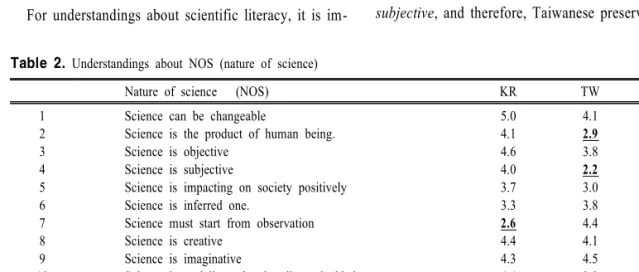
(6) 6. Young-Shin Park. I am fascinated with scientific facilities and I am curious about everything, including earth science stuffs there. So I want to learn more about them whenever I visit science center [curiosity]. In 2008, I was 17 years old. I visited the museum of natural disaster in Osaka. It was the first science museum I visited. The museum was built without concrete and covered by glasses and it was full of stuffs which looked technical ones such as tsunami, earthquake, hurricanes, radiation and pollution. It was awesome memory [fun]. I remember that there have a lot of hands-on stuffs which able to provide actual experience things [experimentation] The impression about science center was that I could see insects and had lots of fun. I used to come to science museum every week and I learn much science knowledge [science concept] After visiting science center, I dreamed to be scientist [the value of science]. 2. Preservice teachers’ understandings about nature of science For understandings about scientific literacy, it is im-. portant for participants to understand the nature of science which is connected to the value of science. The results of survey about preservice teachers’ understandings about the nature of science were recoded as follows [Table 2]. 13 items about nature of science were scored above the average (3 out of 5 likert scale) and two items, the scores of # 11 (the relationship between theory and law) and # 15 (always true) were below the average, releasing that preservice teachers in this study showed more scientific view of nature of science than naïve one. For scientific view, scientific theory is not changed into scientific law or vice versa and science is not always true (Lederman, 1999). Therefore, we can interpret that preservice teachers participating in this study hold scientific view of nature of science generally. What is interesting, however, is that there is difference in participants’ view between Korean and Taiwan. For example, #2, science is the product of human being, is perceived more scientifically by Korean participants in the way of social construction for developing scientific knowledge. Whereas, Taiwanese participants more believed that scientific knowledge is formed through empirical-based experimentation more than social process of constructing knowledge. This naïve view of #2 can also impact on view of #4, science is subjective, and therefore, Taiwanese preservice teachers. Table 2. Understandings about NOS (nature of science) Nature of science 1 2 3 4 5 6 7 8 9 10 11 12 13 14 15. (NOS). Science can be changeable Science is the product of human being. Science is objective Science is subjective Science is impacting on society positively Science is inferred one. Science must start from observation Science is creative Science is imaginative Science is socially and culturally embedded Scientific theory can be changed into scientific law Scientific law has exception Scientific theory has exception Science is empirically-based Science is always true. KR: Korean preservice teachers TW: Taiwanese preservice teachers AVE: average. KR. TW. AVE. 5.0 4.1 4.6 4.0 3.7 3.3 2.6 4.4 4.3 4.4 2.0 3.2 4.4 4.6 2.3. 4.1 2.9 3.8 2.2 3.0 3.8 4.4 4.1 4.5 3.9 3.8 3.8 4.3 3.4 1.8. 4.5 3.5 4.2 3.1 3.3 3.5 3.5 4.3 4.4 4.2 2.9 3.5 4.4 4.0 2.1.
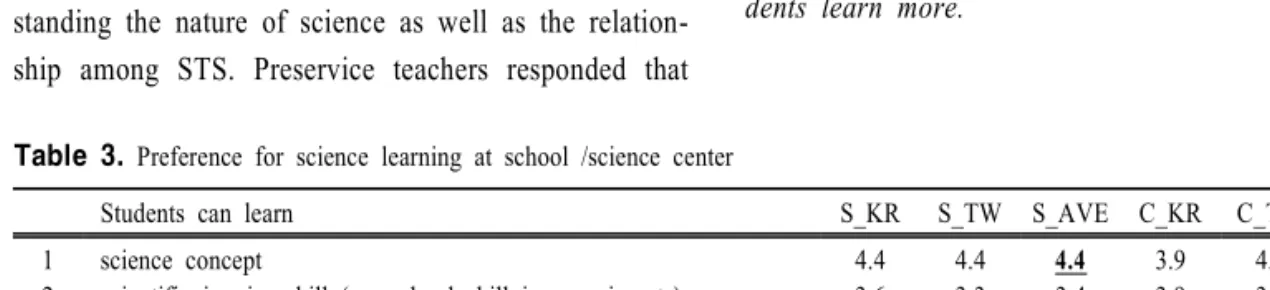
(7) 7. Exploring Preservice teachers’ Understandings about Scientific Literacy embedded in Science Camp at Science Center. can hold naïve view that science is not subjective. This view, science is not subjective and science is not the product of human being, is also related to #7, science must start from observation, which is again releasing naïve view of nature of science. Overall, we can say that preservice teachers in this study showed appropriate scientific view about nature of science with the above average scores (3 point) in all items (but # 11 and # 15 scores must be below the average (3 point) to be scientific view, so all items are scientific views about nature of science). However, there were a few items where Taiwanese preservice teachers hold more naïve views about nature of science than Korean preservice teachers, which could be resulted from different cultural factor, educational system, or researcher’s bias in this study. Even though participants in this study seemed to hold scientific view of nature of science, this interpretation does not imply that participants’ practices during science camp were aligned with their scientific views of nature of science.. 3. The settings of science learning for Preservice teachers to prefer On the basis of explored views about scientific literacy and nature of science by preservice teachers in this study, we also asked participants which setting of science learning could provide more chances for scientific literacy, which consisted of learning science concept, learning inquiry skills related to experimentation as well as argumentation, experiencing the attitude about science as well as the value of science, and understanding the nature of science as well as the relationship among STS. Preservice teachers responded that. only science concept can be learned (# 1) easily and effectively at schools but the others, learning inquiry skills about experimentation (#2) as well as about argumentation (#3), experiencing the attitude about science (#4) and the value of science (#5), and understandings about the nature of science(#6) and the relationship of STS (#7) can be more achieved easily and effectively at science centers rather than at schools [Table 3]. When we used the descriptive statistics about science learning at schools or at science center, there was significance by 95 % confidence (p<0.05) in #3 (p~ 0.038), #4 (p~0.011), #5 (p~0.001), and #7 (p~0.013). On the basis of data, we can interpret that at least preservice teachers prefer science centers for science learning to classroom at school for scientific literacy. More responses from questionnaires by participants supported why preservice teachers prefer informal setting of science learning, science center, as follows. In schools, the way teachers teach knowledge makes me feel bored. But here [science center], the practical operation and participation are highly emphasized, so I feel interested in it. Generally, I think they tend to be the same. The only difference is that more complex & unique experiments can be done in the science center. It is not flexible at school compared with the science center. If school teachers can add experiments into classes, it will not only attract students’ attention but also students learn more.. Table 3. Preference for science learning at school /science center Students can learn 1 2 3 4 5 6 7. science concept scientific inquiry skill (procedural skill in experiments) scientific inquiry skill (scientific thinking skill in argumentation) the value of science attitude about science the nature of science the relationship among STS. S_KR. S_TW. S_AVE. C_KR. 4.4 3.6 3.3 3.6 3.9 3.3 3.6. 4.4 3.3 3.2 3.2 3.2 3.3 3.4. 4.4 3.4 3.3 3.4 3.5 3.3 3.5. 3.9 3.9 3.3 4.1 3.9 3.2 4.0. S: Schools C: Science Center KR: Korean preservice teachers TW: Taiwanese preservice teachers AVE: average. C_TW C_AVE 4.0 3.9 3.9 3.8 4.4 3.7 4.3. 3.9 3.9 3.6 4.0 4.2 3.4 4.1.
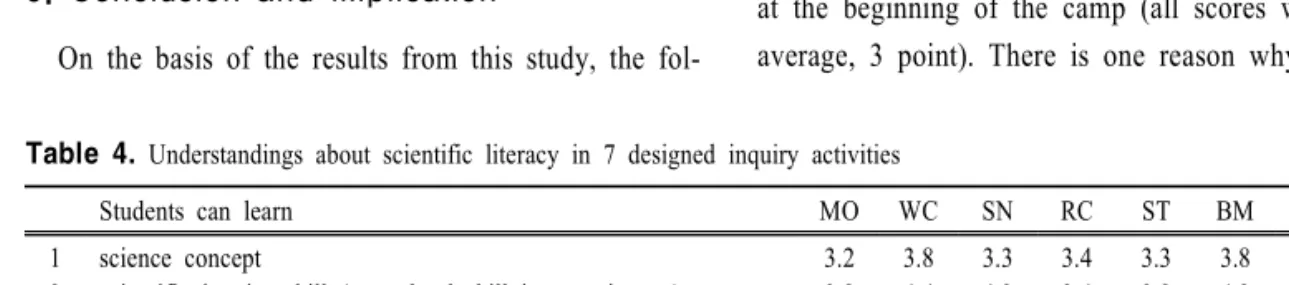
(8) 8. Young-Shin Park. For science center, the lively teaching let students learn by doing themselves. In other words, only do it by myself that I can know the versatility and reversibility. For students, they learn faster by playing games because it is a vivid and lively learning style. What kids learn from schools is limited; they can practice what they had learned here. Students will find out their interest and motivation of learning science from games. Learning from experience left no pressure. It's free to learn things in camp, and I can also learn things that are different from books. Overall, preservice teachers feel that science center as informal setting for science learning provide more opportunities where students/campers can experience more aspects of scientific literacy than schools do. In questionnaire, preservice teachers added that kids or visitors at science centers as informal setting can have more freedom to learn what they want to learn without pressure, they can have more fun in doing activities, they can do real inquiry from finding problems to solving it, they can experience the miracle of nature, they can do what they cannot do at schools, and they can feel more comfortable in learning because all learning is connected to their prior experience. Participants, however, agreed that science concepts can be easily achieved at schools better than at science centers, which implies that well-balanced science learning between formal and informal settings is necessary for scientific literacy.. 4. Evaluation on 7 science camp activities for scientific literacy The researchers designed 7 different camp activities where campers could experience some aspects of scientific literacy. Science camp consisted of indoor and outdoor activities related to science. Indoor activities included chocolate activity (making chocolate with the use of boiler), and sonic science (making sound with different materials). Outdoor activities included the fol-. lowings; (1) Morse, (2) Water collection, (3) Snare, (4) River crossing, (5) Stretcher, (6) Boomerang, and (7) Wild cooking. More description about each activity is provided with the photo below. All outdoor activities were designed to embed the aspects of scientific literacy and preservice teachers participating in this study got the scores above the average in all aspects of scientific literacy, even though there were 4 independent items scored below the average in River crossing activity (2.8 out of 5 at both thinking skill for argumentation and the value of science), Snare (2.9 at attitude about science), and Stretcher (2.9 at attitude about science). We can interpret that preservice teachers experienced all aspect of scientific literacy across all activities designed by the research team in some degrees. More than anything else, there had been many hands-on activities during 7 small programs so the # 2 aspect of scientific literacy was ranked as the highest (4.0 out of 5.0) out of 7 aspects. In 45 campers’ questionnaire, River Crossing activity was ranked as the most impressive one out of all activities (51%, 21/41 responses) with the reasons of fun and challenge. All campers who attended the science camp responded that 'fun' during science was the most important factor for them to do science (42%, 19/45 campers) and 'curiosity' was the second most important (29%, 13/45). Campers responded that they learned science concepts most in filtering water from Water Collection (30%, 30/100 responses; multiple responses allowed), the second most in rope ladder from River Crossing (18%, 18/100), and the third most in making fire from Wild Cooking (17%, 17/100). The list of science concepts what campers learned during science survival camp was as follows; capillarity, resonance, filter, tension, gravity, torque, evaporation, respiration, and centripetal force. The list of what campers thought was the most helpful for their daily life was water filter (27%, 11/41 response), scientific wild cooking (22%, 9/41), high ropes adventures (15%, 6/41), signal for survival with the use of Morse (15%, 6/41), and so on. The reasons why 7 different activities were helpful included that campers learned the ability.
(9) Exploring Preservice teachers’ Understandings about Scientific Literacy embedded in Science Camp at Science Center. 9. Main activities for science camp offered by science center as outdoor activity. Morse: Campers developed the record with the principle of Morse of different notes of sound.. Water Collection: Campers observed water vapor by covering the plants with plastic bag. Campers also fined the dirty water into clear one by passing it through towel or layered soils.. Snare: Campers developed the trap to catch small birds or animals with the use of long bamboo stick, chopstick, rubber band and string. Collaboration among members is necessary. River Crossing: Assistants helped campers to make ropes which are strong for people to use in crossing the river, going upstream or downstream. Stretcher: In emergency, campers with the help from assistants could made the stretcher using the materials found around the camp site. Stretcher is proved to be strong enough to hold one adult and to be handled easily.. Boomerang: Campers made boomerang to hunt small bird or animals with the use of board, hard papers. Campers learned science principle of how to work boomerang with the rubber band and wood stick.. Wild Cooking: Campers tried to make the fire for cooking. They also used bamboo to cook the rice and noodle. They need to collaborate in cooking with different responsibilities in each group..
(10) 10. Young-Shin Park. to solve the problem in bad situation (24%, 10/41 responses), experienced the fun (17%, 7/41), learned useful skills for daily life (32%, 13/41), learned how to overcome challenging (7%, 3/41), learned something new (15%, 6/41), and learned how to enjoy the nature (5%, 2/41). Overall, on the basis of results from surveys and questionnaire from preservice teachers and campers, we can conclude that all participants experienced some aspects of scientific literacy such as learning science concepts (e.g. gravity, water vapor, and so on), learning inquiry skills of experimentation (e.g. making water filters) and of argumentation (e.g. discussing good and bad of fire in our life), and experiencing attitude about science (e.g. fun) and the value of science (e.g. using science knowledge to survive), and understanding the nature of science (e.g. collaborating in a group for social construction) and the relationship among STS (e.g. using towels for filtering water in daily life). Preservice teachers evaluated science camp internship program very positively in that they learned how to communicate with campers, how to use science concept in daily life, how to take care of campers in bad environment, how to manage time to do activity, how to respond to people from different culture, how to motivate kids for learning, and so on. However, environment factors such as hot weather (July is the temperature highest month in Taiwan) and undeveloped English skills were the limitations to impede this internship from being successful.. 5. Conclusion and Implication On the basis of the results from this study, the fol-. lowing conclusion with implication can be made. First, science centers can be used for teaching scientific literacy. That is, informal setting for science learning such as science center can be considered as the very context where preservice teachers and campers could promote their understandings about scientific literacy envisioned in the Standards (1996; 2000). Preservice teachers participating in this study preferred science centers as informal settings to schools as formal ones for the purpose of experiencing the aspects of scientific literacy. In addition, preservice teachers as well as campers who attended science camp designed by the research team for science centers’ use showed some evidences that they had more chances of experiencing scientific literacy at science centers and they preferred science centers to schools for those purposes. Therefore, it is more ideal for the current science education curriculum developers/policy makers as well as runners (like teachers and principals) to include both type of science learning at science center as well as schools. Second, preservice teachers need to be trained to have the stronger connection between theory from campus-based and practices from field-based and to be prepared to be more appropriate ‘practitioner’ in the real teaching context. In this study, preservice teachers displayed moderate understandings about scientific literacy, nature of science and preference to science centers with certain reasons at the beginning of the camp (all scores were above 4 point), but they seemed not to have experienced scientific literacy much as expected at the beginning of the camp (all scores were around average, 3 point). There is one reason why preservice. Table 4. Understandings about scientific literacy in 7 designed inquiry activities. 1 2 3 4 5 6 7. Students can learn. MO. WC. SN. RC. ST. BM. WD. AVE. science concept scientific inquiry skill (procedural skill in experiments) scientific inquiry skill (scientific thinking skill in argumentation) the value of science attitude about science the nature of science the relationship among STS. 3.2 3.8 3.0 3.2 3.0 3.2 3.6. 3.8 4.4 3.9 3.4 3.3 3.5 3.6. 3.3 4.3 3.2 3.2 2.9 3.3 4.1. 3.4 3.4 2.8 2.8 3.0 3.4 3.2. 3.3 3.8 3.6 3.3 2.9 3.3 3.4. 3.8 4.2 3.7 3.4 3.5 3.7 3.0. 3.7 4.3 3.5 3.5 3.5 3.6 3.8. 3.5 4.0 3.4 3.3 3.2 3.4 3.5. MO: Morse WC: Water collection SN: Snare RC: River crossing ST: Stretcher BM: Boomerang WD: Wild cooking.
(11) Exploring Preservice teachers’ Understandings about Scientific Literacy embedded in Science Camp at Science Center. teachers could not experience scientific literacy much as expected; the researchers should have explained how theories of scientific literacy could be applied into practices of teaching and learning science during science camp. Preservice teachers did not fully understand how to motivate campers to develop argumentation within the given situation. Preservice teachers ‘know’ what scientific literacy is but they seemed not to ‘understand’ scientific literacy. In addition, preservice teachers showed moderate understandings about nature of science, but their practices of implementing nature of science was not observed nor detected in questionnaires. Teacher’s preparation program at college levels need to develop the effective and efficient curriculum where preservice teachers could experience scientific literacy and nature of science theoretically and practically in the contexts of informal as well as formal settings of science learning. Since preservice teachers who attended this internship program indicated that they prefer science museum to schools for experiencing scientific literacy, practicum of field experience at science museum as informal setting of science learning can be recommended as one of solutions to equip preservice teachers with stronger theories about scientific literacy connected to its practices (Folk & Dierking, 2004). Third, informal educators at science centers need to be also expertise in developing programs for equipping visitors/students to be literate scientifically. All participants in this study experienced the aspects of scientific literacy in some degrees but not successfully as expected. Even though there was communication among researchers about how to develop activities with the guideline of scientific literacy, the researchers did not guarantee the content validity of activities. For the future study, researchers should construct content validity of activities with the aim of embedding the aspects of scientific literacy by discussing and modifying it with other consultants so that all researchers can have all agreement in implementing activities designed by them. The validated activities and trained preservice teachers as docents in science museum can be the best vehicle so that campers can experience all aspects of scientific. 11. literacy which is the goal of science education.. REFERENCES Beyer, C. J., & Davis, E. A. (2008). Supporting preservice elementary teachers' critique and adaptation of science curriculum materials using two types of educative supports, Paper presented at the annual meeting of the National Association for Research in Science Teaching, Baltimore, MD Bradford, C. S., & Dana, T. M. (1998). Changes in prospective science teachers' conceptions and practices during field experiences, Paper presented at the annual meeting of the National Association for Research in Science Teaching, San Diego, CA. Bransford, J. D., Brown, A. L., & Cocking, R. R. (Eds.) (1999). How People Learn: Brain, Mind, Experience, and School. Washington, DC: National Academy Press. Cavallo, A. M., Miller, R. B., & Saunders, G. (2002). Motivation and affect toward learning science among preservice elementary school teachers: Implications for classroom teaching, Journal of Elementary Science Education, 14(2), 25-38. Cox-Petersen, A. M., Marsh, D. D., & Melbar, L.M. (2003). Investigation of guided school tours, student learning, and science reform recommendations at a museum of natural history. Journal of Research in Science Teaching, 40(2), 200-218. Cronin-Jones, L. (1992). The influence of methods instruction on the beliefs of preservice elementary and secondary science teachers: Preliminary comparative analysis, School Science and Mathematics, 92(1), 14-22. Falk, J. H. (Ed.). (2001). Free-choice science education: How we learn science outside of school. New York: Teachers College Press Folk, J. J., & Dierking, L. D. (2002). Looking through the glass: reflections of identity in conversations at a history museum. In Ge.Leinhardt, K. Crowley, & K. Knutson (Eds.).Learning conversations in museums. Mahwah, NJ. Lawrence Erlbaum. Gess-Newsome, J., & Lederman, N. G. (1990). The preservice microteaching course and science teachers’ instructional decisions: A qualitative analysis. Journal of Research in Science Education, 27(8), 717-726. Grenier, R. S. (2009). The role of learning in the development of expertise in museum docents. Adult Education Quarterly, 59(2), 142-157. Lederman, N. G. (1999). Teachers’ understandings of the nature of science and classroom practice: Factors that facilitate or impede the relationship. Journal of Research in Science Teaching, 36(8), 916-929. National Research Council. (1996). National Science Education standards. Washington, DC: National Academy Press..
(12) 12. Young-Shin Park. National Research Council (2000). Inquiry and the national science education standards: A guide for teaching and learning. National Research Council, Washington, Washington, DC: National Academy Press. Park, Y-S., & Flick, L. (2004). Student opportunities to develop scientific argumentation in the context of scientific inquiry: A review of literature. Journal of Korean Science Society, 25(3), 194-204. Park, Y-S. (2006). Theoretical study on the opportunity of scientific argumentation for implementing authentic scientific inquiry. Journal of Korean Science Society, 27(4), 401-415 Park, Y-S. (2008). Preservice teachers’ beliefs about teaching and learning science through field experience. Journal of the Society for the International Gifted in Science, 2(1), 53-69. Park, Y-S. (2010). Secondary beginning teachers’ view of scientific inquiry: With the view of hands-on, mindson, and hearts-on. Journal of Korean Science Society, 31(7), 798-812.. Park, Y-S, & Lee, J-H. (2011). Analyzing the status quo of docent training program and searching its development direction in science museum of Korea. Journal of Korean Earth Science Society, 32(7), 881-901. Park, Y-S, & Lee, J-H. (2012). The study of docent system improvement for revitalization of science museum. Journal of Korean Earth Science Society, 33(2), 200215. Richardson, V. (1996). The role of attitudes and beliefs in learning to teach. Handbook of research on teacher nd education (2 ed.), New York: Macmillan Library Reference, USA. Roehrig. G. H., & Luft, J. A. (2008). Exploring the first year of teaching in secondary science classrooms, Paper presented at the annual meeting of the National Association for Researching Science Teaching, Baltimore, MD. Zeichner, K., 2002, Beyond traditional structures of student teaching, Teacher Education Quarterly, 29(2), 59-64..
(13)
수치
관련 문서
