• 검색 결과가 없습니다.

Blood samples were drawn at 17 points during 48 hours after administration and plasma OTC concen- trations were measured by using HPLC.

N/A
N/A
Protected

Academic year: 2022

Share "Blood samples were drawn at 17 points during 48 hours after administration and plasma OTC concen- trations were measured by using HPLC."

Copied!
6
0
0

로드 중.... (전체 텍스트 보기)

전체 글

(1)

J O U R N A L O F

Veterinary Science

ABSTRACT

5)

Oxytetracycline (OTC) has been used for over 40 years in veterinary medical field. Various forms of oxytetracycline preparations have been marketed, but little information is available on the bio- equivalence of OTC preparations. This study was conducted to evaluate the bioequivalence of two OTC powder preparations available in Korea.

Fourteen rabbits were randomly allocated into two groups. During the first period, a dose (200 mg/kg) of reference product was orally administered to the rabbits in Group A and test product to those in Group B. After 7-day washout period the reterence and test products were given in group B and A, respectively.

Blood samples were drawn at 17 points during 48 hours after administration and plasma OTC concen- trations were measured by using HPLC.

The solution concentrations of OTC dissolved from two products were not significantly different in the dissolution test. The mean area under the curve (AUC

0-∞

) and peak plasma concentration (C

max

) values for test and reference OTCs were 7.22 ± 3.90 and 11.04 ± 7.37 μg·h/ml, 1.11 ± 0.65 and 1.85 ± 1.15 μ g/ml, respectively. The realtive bioavailability and C

max

of test product to those of reference product was 65.4% and 60.0%, respectively. The ranges of AUC and C

max

of test drug compared to those of reference drug under 90% confidence limits were 27 ∼ 104% and 28

∼ 91.5%, respectively.

The results of statistical analysis indicate that the two pivotal pharmacokinetic parameters, AUC and C

max

of test product are not within the 20% of those of the reference, suggesting that the test OTC is not bioequivalent to the reference OTC.

Key word : oxytetracycline, pharmacokinetics, bioequi-

*Corresponding author : Pan Dong Ryu

College of Veterinary Medicine, Seoul National University, 103 Seodundong, Kwonsunku, Suwon, 441-744

E-mail: [email protected]

# Current address : Laboratory of Neuroendocrinology, The Baabraham Institute Cambridge, UK, CB2 4AT.

valence, AUC, Cmax

Introduction

Bioequivalence is defined as statistically equivalent bioavailability between two products at the same molar dose of the therapeutic moiety under similar experimental conditions. Two products are said to be bioequivalent if they are pharmaceutical equivalents or pharmaceutical alternatives and if their rate and extent of absorption do not show a significant difference statistically. In case of bioavailability, it is defined as the rate and extent to which an active drug ingredient is absorbed and becomes available at the site of drug action [27, 31]. A comparative bioavailability study is usually referred to as the comparison of bioavailabilities of different formulations of the products. In veterinary medical field, the demand for review systems of bioequivalence on drug approval process has been increasing [12].

Oxytetracyline is a broad-spectrum antibiotic with bac- teriostatic activity for many gram-positive and gram- negative bacteria, including some anaerobes, rickettsiae, chlamydiae, and mycoplasmas [8, 22]. It has been available for human and veterinary medical use for more than 40 years. In pharmacokinetics, 60∼80% of oxytetracycline is absorbed in the gut, and the absorption occurs mainly in the upper small intestine. The food inhibits the enteric absorption of OTC [8, 19]. In the blood, 40∼80% of various tetracylclines is protein-bound [10, 25]. The drug is distributed widely to tissues and body fluids except for the cerebrospinal fluid, where concentrations are low. The absorbed oxytetracycline is excreted mainly in bile and urine [6, 10].

Oxytetracycline is one of major antibiotics currently used in Korea for pig, cow, and chicken. More than 140 oxytetracycline preparations which are commercially available and its market volume was about 400,000 kg in 1998. More than 90% of them is the powder form. However, little information is available on the bioequivalence of these oxytetracyclines [28].

In this study, we compared two pivotal pharmacokinetic properties of parameters; area under the plasma concentration- time curve (AUC) and (C

max

), to evaluate the bioequivalence of two commercially available OTC HCl powder preparations labeled effective for the treatment of bacterial infections

Lack of bioequivalence of two oxytetracycline formulations in the rabbit

W. Chong, Y.J. Kim, S.D. Kim, S.K. Han

#

and P.D. Ryu

*

Department of Pharmacology, College of Veterinary Medicine and School of Agricultural Biotechnolog, Seoul National

University, Suwon, 441-744, Korea

(2)

and 60 g per kg. Working OTC solutions of both products contained 33.33 mg per ml of distilled water.

Dissolution test

The reference and the test product were dissolved in distilled water at nominal concentration of 10 ㎍/㎖, and the OTC HCl concentrations in the solutions were compared with that of standard OTC HCl purchased from Sigma Co.

(St. Louis, USA). The level of OTC HCl in the solutions were determined after two hours from dissolution time by HPLC with a UV detector as described below.

Animals

Fourteen healthy male New Zealand white rabbits of 1.5 to 2.3 kg were used in this study. They were purchased from Sam-Yuk Experimental Animal Breeding Center (Osan, Kunggi-do, Korea). The rabbits were stabilized for two weeks and fed a pellet diet for rabbits (Purina Korea Co.) with water ad libitum. Each rabbit was fasted the night before the experiment.

Study Design

According to the randomized two-period crossover design, the 14 rabbits were randomly divided into two groups (group A and group B, 7 animals per group). Group A was given an oral dose (200 mg OTC / kg body weight, 6.0 ml solution) of the reference product, and blood samples (0.5 ml) were drawn up 17 times at 0.5, 1.0, 1.5, 2.0, 2.5, 3.0, 3.5, 4.0, 5.0, 6.0, 8.0, 10.0, 12.0, 16.0, 24.0, 36.0, 48.0 hours after administration. The blood sample was drawn into 1 ml of heparinized syringes, and then stored in the ependorff tube. Plasma were taken by centrifugation at 10,000 rpm for 10 minutes and stored in the deep freezer until assayed.

Group B was administered with the same dose of the test product as for the Group A, and the blood samples were taken with the same time schedule as with that for Group A to compare its pharmacokinetic responses with those of the reference drug formulation. After washout period of 7 days, The rabbits in Group B were administered with the reference product and those in Group A with the test product. The duration of washout period was set based on the reported half lives of OTC of 2 to 12 hours [5]. All the procedures at the second period study including the dosage and the time intervals of blood drawn were identical with those of first period study.

column used was Symmetry C18 column (Waters, Messa- chusetts, USA), and scanned by an ultraviolet detector at 357 nm. The temperature of the column was maintained at 44℃. The mobile phase was the PBS (pH 6.5) / acetonitrile (860/140) solution, where PBS contained 0.05 M potassium phosphate and 0.01 M EDTA [1]. Triethylamine was added at 30 mM. Oxytetracycline standard stock solution (1000μ g/ml) was prepared from standard OTC and diluted serially 0.1, 0.2, 0.5, 1.0, 1.5, and 3.0 ㎍/㎖ in plasma. Each solution was injected into HPLC and the standard curve was made using the area under the peak. The standard curve of oxytetracycline in plasma which was linear at the OTC concentrations of 0.2 ∼ 3 μg/ml (R = 0.99851; CV = 0.04).

The limit of quantification for OTC was 0.1 μg/ml.

Pharmacokinetic analysis

The total area under the concentration-time curve (AUC) was calculated by using the linear trapezoidal rules- extrapolation method for each subject, and then the mean of AUC was calculated. Peak plasma concentration (C

max

) and the time to the peak (T

max

) were directly obtained from the plasma concentration vs. time curve of each subject.

Apparent elimination rate constant (b) was obtained by curve fitting of the equation (1) described below to the concentration-time data of each subject. The apparent half-life (t

1/2

) was obtained from the relation, t

1/2

= 0.693/b.

The following equation is used for the calculation of parameters based on one compartment model.

Y= kㆍ(a/(a-b))ㆍ(e

-bㆍt

- e

-aㆍt

) + Y

0

··· (1) Where 'k' is a constant representing F · Dose / Vd, and F, Dose and Vd are bioavailability, amount of drug administered and volume of distribution of the drug, respectively. Parameter 'a' is the initial absorption rate constant and 'b' is an apparent elimination rate constant.

Parameters Y and Y

0

are measured and background plasma levels of oxytetracycline HCl formulation.

Statistical analysis

Equivalence of the two oxytetracycline preparations was evaluated according to the guidelines of KFDA(Korean Food and Drug Administration)1998-86 and US FDA (United States of America, Food and Drug Administration) [29].

Statistical variance on the pharmacokinetic parameters

such as AUC and C

max

were assessed by ANOVA and

(3)

unpaired student t-test with 90% confidence limit.

Noncentrality (λ) was calculated by the following equation:

λ = (X

R

ㆍ0.2) / (s

2

/n)

1/2

··· (2),

where 's

2

' is estimated population variance found in ANOVA table as mean square for error factor and 'n' is the number of samples per group. The power of the test (1-β) was obtained from the table for noncentral distributions and powers of the tests. Here, β means type II error. The least significant difference (Δ) was calculated from the following equation:

Δ = ((s

2

/n)

1/2

ㆍλ

(α, 0.8, 2(n-1))

/ X

R

··· (3),

where α means type I error, 0.8 is the minimum power of the test required by KFDA guideline and X

R

, is the mean of reference drug parameter. Lower and upper 90%

confident intervals were found by the following formulas based onthe Student‘s t-distribution.

(X

T

- X

R

)ㆍt

(2(n-1), α/2)

ㆍ(s

2

/n)

1/2

··· (4)

Bioequivalence with respect to a specific variable was concluded at α of 0.05 or 0.1 if the mean value and the range of 90% confidence intervals of the test product parameter were within the range of 80% to 120% of the

reference product parameter for the untransformed parameters. In addition, KFDA guideline also recommends that the power of the test should be larger than 0.8 and the least significant difference from the mean of refence drug should be less than 20%.

Result

Dissolution test

The OTC concentrations of standard, reference, and test drug products, adjusted to 10 ㎍/㎖, were measured as 184.5

± 3.9, 202.1 ± 10.7, and 200.2 ± 8.8 (n = 3), respectively.

None of these are significantly different from the others, indicating that two OTC preparations contained correct amount OTC that can be dissolved in aqueous environment.

Pharmacokinetics

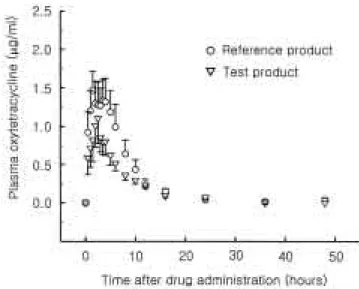
Figs. 1 and 2 illustrate mean plasma concentration-time profiles of two OTC products during the first and second periods, respectively. Plasma OTC was detected as early as 15 minutes and gradually increased and reached its peak at 2.5 hour on both products in Period 1, but 1.5 hours on reference product and 2.5 hours on test product in Period 2.

Then plasma OTC declined below the lower limits of quantification (LOQ) level at 12 hours on both products in the first period and at 16 hour on both products in the second period, respectively.

These plasma concentration-time profiles of OTC had typical shapes of plasma concentration-time profile for oral dose. The plasma concentrations of the reference product Fig. 1. Mean concentration-time profiles of oxytetracycline in

rabbit plasma after oral administration of a single dose of 200 mg/kg with reference and test products during the first period. Each symbol and bar represent the mean plasma concentration and standard error obtained from 7 rabbits.

The plasma levels of reference drug were shown higher than those of the test drug during the whole study period.

Fig. 2. Mean concentration-time profiles of oxytetracycline in

rabbit plasma after oral administration of a single dose of

200 mg/kg with reference and test products during the

second period. Each symbol and bar represent the mean

plasma concentration and standard error obtained from 7

rabbits. The plasma levels of reference drug were also higher

than those of the test drug during the whole study period.

(4)

2.77 ± 1.48 hours. The test to reference products ratios of AUC, C

max

, and T

max

were 65.4 %, 60.0 %, and 109.2%, respectively.

Statistical analysis

In general, the bioequivalence of two drug products were evaluated by comparing AUC and C

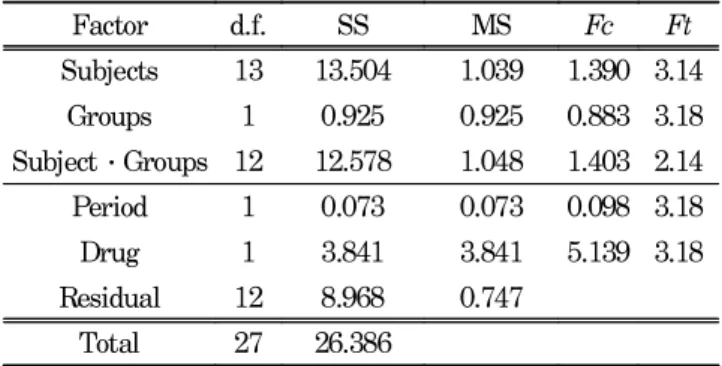
max

values. On the ANOVA test for AUC as shown in Table 1, all factors of variation sources were within the acceptance limits with 90

% confidence limit which means there are no significant difference between factors. In case of C

max

, all variances also were within the acceptance limits except the drug factor as shown in Table 2. The results of ANOVA for AUC and C

max

values did not show any significant difference in variances between two groups as well as two test periods which means that the cross-over test was successful. The power of our test was 0.241 and 0.289 for AUC and C

max

, and the minimum detection difference was 57.2% and 46.5% for AUC and C

max

, respectively, indicating that the experimental design is to be improved to obtain the criteria for proper test of bioequivalence.

The mean AUC ratio of test product to reference product was 0.654 and the 90% confidence interval range was 27 - 104% of the reference. The mean C

max

ratio was 0.60 with the 90% confidence interval ranges of 28 - 91.5%. Thus, the 90% confidence interval test of both AUC and C

max

were not within the acceptable bioequivalence range (80-120% of the reference), indicating that two OTC products are not equivalent.

Table 1. Analysis of variance for AUC

Factor d.f. SS MS Fc Ft

Subjects 13 382.310 29.408 0.734 3.14

Groups 1 1.201 1.201 0.038 3.18

Subject·Groups 12 381.109 31.759 0.793 2.14 Period 1 41.140 41.140 1.027 3.18 Drug 1 102.300 102.300 2.553 3.18 Residual 12 480.820 40.068

Total 27 1006.561

※ d.f.: degree of freedom, SS: sum of squares, MS: mean square, Fc: calculated F value, Ft: F value from table.

Total 27 26.386

※ d.f.: degree of freedom, SS: sum of squares, MS: mean square, Fc: calculated F value, Ft: F value from table.

Discussion

Our results showed that the differences in the ratios of mean values of two OTC powder products were not less than 20% in AUC and Cmax, and the 90% confidence intervals of both parameters for test products were not within 20% of the reference product. Therefore, we conclude that two OTC products are likely to be pharmacologically different in rabbits. The dicrepancy in these pharmackinetic parameters between two OTC products is the topic of further study in the future.

The fact that the power of the test was below the required limit (0.8 or larger) in our experiments, suggest that the number of rabbits per group should be larger for more reliable determination. In general, since the value of power of test is affected by variations of observations, the larger number of subjects would increase the power of test.

However, it is not uncommon that many drugs showed a rather large deviation on the concentration in blood, especially in antibiotics [3]. Also this decision rule, at least 80% power for detection and a 20% difference of the reference average, has been criticized by many researchers because it is based on the wrong point hypothesis rather than the correct interval hypothesis [21]. Therefore, the better criteria in determining the power of the test in bioequvalence study are under active discussion and more systemized study is needed in the future.

The pharmacokinetic parameters of OTC for species varies a lot, indicating all pharmacokinetic responses are dependent on the species and there is considerable deviation among the values of pharmacokinetic parameters. In case of rabbit, we got the half-life as 2.05 ±1.07 hours for reference product and 2.77 ±1.48 hours for test product, whereas the half life of OTC measured at other study was 1.32 hours [14]. In general, the half-life values obtained after IV administration of OTC is more accurate. Furthermore, the half-life of a drug can be prolonged when the absorption rate is much slower than the elimination rate [11].

Therefore, this discrepancy in the half-life is not surprising

since the administration route was different each other (PO

(5)

vs IV). Our results did not indicate that two OTC products in the rabbit are bioequivalent. Our results also indicate that information indicates that more definite bioequivalence should be conducted in the target species to confirm the bioequivalence of OTC because there is large species- dependent variation among the values of pharmacokinetic parameters to extrapolate this result to the target species.

Conclusion

To evaluate bioequivalence of two oral OTC preparations currently available in Korea, we compared the degree of dissolution and pivotal pharmacokinetic parameters of two OTC products in rabbits. The results indicate that, although the degrees of dissolution are not significantly different, the biological effects of two OTC preparations are not equivalent in the living body, at least in the rabbits. The results further suggest that the drugs used in veterinary medicine should be re-evaluated in terms of bioequivalce to assure the expected therpeutic efficasy as well as to reduce the resiudes of veterinary drugs in food animals.

Reference

1. Antonio Marzo and Lorenzo Dal Bo., Chro- matography as an analytical tool for selected antibiotic classes : a reappraisal addressed to pharmacokinetic applications, J. Chromato., 1998, 812, 1734.

2. Baggot J.D., Powers J.E., Powers J.D., Kowalski J.J, and Kerr K.M., Phramacokinetics and dosage of oxytetracycline in dogs, Res. Vet. Sci., 1978, 24(1), 77-81.

3. Bertram G Katzung., Basic & clinical pharmacology. 6th ed. lange medical book. 695-697, 1995.

4. Black W.D., Ferguson H.W., Byrne P., and Claxton M.J., Pharmacokinetic and tissue distribution study of oxytetracycline in rainbow trout following bolus intravenous administration, J. Vet. Pharmacol. Therap., 1991, 14(4), 351-358.

5. Doi A.M., Stoskopf M.K. and Lewbart G.A., Pharmacokinetics of oxytetracycline in the red pacu (Colossoma brachypomum) following different routes of administration. J. vet. pharmacol. therap., 1998, 21, 364-368.

6. Engelund A, Terp P. and Trolle-Lassen C., Renal excretion of tetracycline., Acta. Pharmacol. Toxocol., 1956, 12, 227-239.

7. Horspool L.J., and Mckellar Q.A., Disposition of oxytetracycline in horses, ponies and donkeys after intravenous administration, Equine Vet. J., 1990, 22(4), 284-285.

8. Huber W.G., Tetracyclines, Vet. Pharm. and Ther., pp 813-821 6th ed, Ames, Iowa State University Press, IA:

813-821, 1988.

9. John R. Walsh., Determination of tetracyclines in

bovine and porcine muscle by high-performance liquid chromatography using solid-phase extraction, J.

Chromato., 1992, 596, 211-216.

10. Kaplan S.A., Yuceoglu A.M. and Strauss J., Renal clearance and plasma protein binding of oxytetracylcine in man. J. Appl. Physiol., 1960, 15, 106-108.

11. Malcolm Rowland and Thomas N. Tozer., Clinical pharmacokinetics: Concepts and Applications. Philadelphia, Lea & Febiger. 19-41, 1989.

12. Martinez M.N., Riviere J.E., Review of the 1993 veterinary drug bioequivalence workshop, J. vet. pharmacol.

therap., 1994, 17, 85-119.

13. McCorthy D.O., Kluger M.J. and Vander A.J., The role of fever in appetite suppression after endotoxin administration, Am. J. Clin. Nutr., 1984, 40, 310-318.

14. McElroy D.E., Ravis W.R., and Clark C.H., Pharmacokinetics of oxytetracycline hydrochloride in rabbits, Am. J. Vet. Res., 1987, 48(8), 1261-1263.

15. Mekjer L.A., Ceyssens G.F., deJong W.T., and de Greve B.I.J.A.C., Correlation between tissue and plasma concentrations of oxytetracycline in veal calves, J. Toxicol. Environ. Health, 1993, 40, 35-45.

16. Mevius D.J., Nouws J.F.M., Breukink J.J., Vree T.B., Driessens F., and Verkaik R., Comparative pharmacokinetics, bioavailability and renal clearance of five parenteral oxytetacycline-20 % formulations in dairy cows. Vet. Qaurterly, 1986, 8(4), 285-294.

17. Nouws J.F.M., Irritation, bioavailability, and residue aspects of ten oxytetracycline formulations administered intramuscularly, Vet. Quarterly, 1984, 6(2), 80-84.

18. Nouws J.F.M., Breukink H.J., Binkhorst G.J., Lohuis J., van Lith P., Mevius D.J., and Vree T.B., Comparative pharmacokinetics and bioavailability of eight parenteral oxytetracycline-10% formulations in dairy cows, 1985, Vet. Quarterly, 7(4), 306-314.

19. Pijpers A., Schoevers E.J. van Gogh H., van Leengoed L.A.M.G., Visser I.J.R., van Miert A.S.J.

P.A.M., and Verheijden J.H.M., The influence of disease on feed and water consumption and on phar- macokinetics of orally administered oxytetracycline in pigs. J. Vet. Pharmacol. Therap. 1991, 13, 320-326 20. Pilloud M., Pharmacokinetics, plasma protein binding

and dosage of oxytetracycline in cattle and horsed, Res.

Vet. Sci., 1973, 15, 224-230.

21. Shien-Chung Chow and Jen-pei Liu, Recent statistical developments in bioequivalence trials: a review of the FDA guidance. Drug Infor. J., 1994, 28, 851-864.

22. Spinelli J. S. and Enos L. R., Introduction to prevention and treatment of infectious disease. CV Mosby Co., St Louis, Mo: 29-54, 1978.

23. Toutain P.L. and Paynaud J.P., Pharmacokinetics of

oxytetracycline in young cattle : Comparison of conventional

vs Long-acting formulations, Am. J. Vet. Res., 1983,

44(7), 1203-1209.

(6)

329-352, 1988.

27. Bioequivalence guideline (Final), Center for Veterinary Medicine, FDA, USA, 1996.

standard two-treatment crossover design. Center for

Drug Evaluation and Research, FDA, USA, 1992.

수치

Fig. 2. Mean concentration-time profiles of oxytetracycline in rabbit plasma after oral administration of a single dose of 200 mg/kg with reference and test products during the second period
Table 1. Analysis of variance for AUC

참조

관련 문서

Coadministration of naringenin increased the absorption rate constant (Ka), the area under the plasma concentration-time curve (AUC) and peak concentration (C max

Finally, after analyzing the differences according to training period, there were significant differences in positive and negative guidance of guiding behavior

In the analysis of the dose constraint of nuclear medical radiation workers using chi-square test statistics, the dose constraint at (the time of) the highest

Mean arterial plasma concentration-time profiles of 4-hydroxytamoxifen after an oral administration of tamoxifen (10 mg/kg) to rats in the presence or absence

Pharmacokinetic parameters were determined following an oral administration of nateglinide (30 mg/kg) to rabbits in the presence and absence of calcium channel blockers

Mortality and clinical signs in SD rats about single oral administration after 3 weeks with callus extract ..... Hematological values in SD rats administered orally

(A-E) Overexpression of HOXC6 induce the downregulation of FOXN2. HEK293 cells were transfected with HONC6 overexpression vector for 48 hours prior isolation

R.M.S and Frequency Domain of the measured signals in time domain were obtained to compare vibration levels, and frequency characteristics of signals were