• 검색 결과가 없습니다.

Correlation between Proximal Abdominal Aortic Stiffness Measured by Ultrasound and Brachial-Ankle Pulse Wave Velocity

N/A
N/A
Protected

Academic year: 2022

Share "Correlation between Proximal Abdominal Aortic Stiffness Measured by Ultrasound and Brachial-Ankle Pulse Wave Velocity"

Copied!
9
0
0

로드 중.... (전체 텍스트 보기)

전체 글

(1)

Korean Circulation Journal

Introduction

Aortic stiffness is known to be associated with cardiovascular outcomes. Pulse wave velocity (PWV) is one of the best ways to mea-

Print ISSN 1738-5520 • On-line ISSN 1738-5555

Correlation between Proximal Abdominal Aortic Stiffness

Measured by Ultrasound and Brachial-Ankle Pulse Wave Velocity

Young-Hyo Lim, MD 1 , Rentsendorj Enkhdorj, MD 2 , Bae Keun Kim, MD 1 , Soon Gil Kim, MD 1 , Jeong Hyun Kim, MD 1 , and Jinho Shin, MD 1

1

Division of Cardiology, Department of Internal Medicine, Hanyang University College of Medicine, Seoul, Korea

2
Department of General Surgery, Shatin Central Hospital, Ulaanbaatar, Mongolia

Background and Objectives: The proximal portion of the abdominal aorta (AA) is characterized by minimal arteriosclerosis compared with other aortic segments. To assess the clinical usefulness of this characteristic, the correlation between ultrasonographically measured proximal AA stiffness and brachial-ankle pulse wave velocity (baPWV) was examined.

Subjects and Methods: 285 subjects were analyzed, half with hypertension and half with normal blood pressure. Proximal AA was ex- amined using ultrasonography; strain, distensibility, elastic modulus, and the stiffness index were determined. After adjustment for age, gender, body mass index (BMI), systolic blood pressure (SBP), and heart rate, the relationships between baPWV and all these parameters were tested.

Results: The mean age of the study subjects was 58.1±12.8 years and the mean BMI was 24.3±3.8 kg/cm

2

. 58.9% of the subjects were female. 42.8% were hypertensive subjects. Among the hypertensive subjects, 56.0% were taking antihypertensive medication. Adjusted partial correlation coefficients for the relationship between baPWV with strain, distensibility, elastic modulus, and the stiffness index of the proximal AA were -0.203 (p=0.01), -0.121 (p=0.129), 0.304 (p=0.0001), and 0.299 (p=0.0001), respectively, in normotensive subjects. In the multivariate analyses, such correlations were observed mainly in the normotensive group, whereas there was no association among hyper- tensive subjects regardless of antihypertensive medication status.

Conclusion: baPWV is moderately correlated with the stiffness parameters for the proximal AA, mainly in normotensive subjects. (Korean Circ J 2013;43:391-399)

KEY WORDS: Abdominal aorta; Arteriosclerosis; Blood pressure; Elastic modulus; Pulse wave velocity.

Received: March 14, 2013 Revision Received: May 27, 2013 Accepted: June 12, 2013

Correspondence: Jinho Shin, MD, Division of Cardiology, Department of In- ternal Medicine, Hanyang University College of Medicine, 17 Heangdang- dong, Seongdong-gu, Seoul 133-792, Korea

Tel: 82-2-2290-8308, Fax: 82-2-2299-0278 E-mail: [email protected]

• The authors have no financial conflicts of interest.

This is an Open Access article distributed under the terms of the Creative Commons Attribution Non-Commercial License (http://creativecommons.

org/licenses/by-nc/3.0) which permits unrestricted non-commercial use, distribution, and reproduction in any medium, provided the original work is properly cited.

sure aortic stiffness. Aortic stiffness measured by PWV is regarded as one of the prognostic markers of cardiovascular diseases.

1)

In addition, aortic stiffness can also be assessed by analyzing strain in various parts of the aorta.

2-5)

This can be measured directly using ul- trasound or magnetic resonance imaging,

2)

which are familiar tools in clinical practice. In general, the abdominal aorta (AA) is more sus- ceptible to increased stiffness due to degenerative changes or aging than the more proximal or ascending parts, because the elastic fiber composition and the susceptibility to ischemic damage from ath- erosclerosis differ.

6)7)

In a recent necropsy study of Korean subjects, the proximal por-

tion of the AA was found to display minimal atherosclerosis com-

pared to other segments such as the ascending or proximal parts or

the distal part of the AA.

8)

This observation suggests that an examin-

ation of the proximal part of the AA may be more useful for the mea-

surement of aortic stiffness, because any structural changes, such as

(2)

severe atherosclerosis or aneurysmal changes, can make it difficult to measure the strain.

Carotid-femoral PWV (cfPWV) is the standard measure of aortic stiffness. However, from a practical point of view, cfPWV has some limitations, such as requiring a long time for measurement, examin- er variability, and inconvenience of exposing the femoral site.

9)

Prac- tically, brachial-ankle PWV (baPWV), on the other hand, does not re- quire exposure of the femoral site and is a more feasible measure of aortic stiffness than cfPWV. baPWV is a measure of the pulse wave propagation velocity from the point of the aorta where the pulse wave arrives during the time period of the same pulse wave travel to the brachial artery to the ankle. Although baPWV is also affected by the characteristics of the peripheral arteries and the inferior mea- sure of the aortic stiffness compared to cfPWV, baPWV has been validated mainly by comparison with cfPWV, with which it shows a moderate correlation.

10)

Hence, at least in part, baPWV can reflect the characteristics of the aorta. Moreover, the validity of baPWV as a marker for cardiovascular diseases has been reported in popula- tion studies.

11)

To investigate the usefulness of measurement of proximal AA distensibility, we examined the relationship between the stiffness parameters for the proximal AA and baPWV as the par- tial measure of aortic stiffness.

Subjects and Methods

Data were prospectively collected from 290 consecutive patients (selected from an initial cohort of 396) who underwent echocar- diography after fasting, in hypertension clinics at the Hanyang Uni- versity Medical Center, Seoul, Korea from February 1st to May 31st, 2009. During the study period, 114 cases were referred from a he- alth promotion center and local clinic for an evaluation of atypical chest symptoms, palpitation, electrocardiographic changes without symptoms, and abnormal blood pressure or laboratory findings.

Clinical exclusion criteria were the refusal to provide informed consent, incomplete clinical data, patients with exposure to nico- tine smoking or drinking coffee one hour before the study, and pa- tients with significant skin diseases, joint deformity, renal insuffici- ency (estimated glomerular filtration rate <60 mL/min), atrial fibrill- ation, valvular heart disease, and unstable coronary artery disease.

Echocardiographic exclusion criteria were moderate or severe val- vular dysfunction, systolic dysfunction characterized by an ejection fraction below 55% as indicated by M-mode measurement, regional wall motion abnormality, moderate or large pericardial effusion, car- diomyopathy, aortic aneurysm, right side heart failure, or pulmonary hypertension. Patients with an ankle-brachial index less than 0.95 were also excluded from the study.

Clinical information was collected via interviews with the partici-

pants and from medical records. Body mass index (BMI) was calcu- lated as weight in kg/(height in meters)

2

and blood pressure was measured according to current guidelines. Blood chemistry data on fasting blood glucose, lipid profiles, creatinine, and hemoglobin were collected from patient medical records. Only current smokers were defined as smokers. Hypertensive patients were defined as those with systolic blood pressure (SBP) ≥140 mm Hg, diastolic blood pres- sure (DBP) ≥90 mm Hg, or those taking antihypertensive medica- tions. Patients with diabetes mellitus were defined as those with fa- sting blood glucose >126 mg/dL, HbA1C >6.5%, or those taking anti- diabetic medications or insulin.

Dyslipidemia was defined as total cholesterol ≥240 mg/dL, low density lipoprotein-cholesterol (LDL-C) ≥160 mg/dL, high density lipoprotein-cholesterol <40 mg/dL in males and <50 mg/dL in females, or triglyceride ≥150 mg/dL. A history of ischemic heart disease and/or cerebrovascular accident was determined through interviews.

Measurement of abdominal aortic stiffness

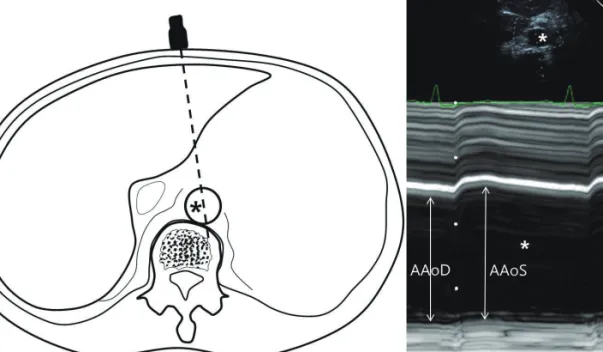
The proximal AA was examined at the epigastrium for changes in diameter during the cardiac cycle using an echocardiography ma- chine (iE33, Philips®). Unlike the ascending aorta, the posterolateral wall motion of the proximal AA is limited by the spine, so that most of the wall excursion during a cardiac cycle is observed in the ante- rior wall. By targeting the spine and the diaphragm and tilting the projection slightly to the right side, proximal AA wall excursions were recorded just below the diaphragm, in the suprarenal portion of the AA (Fig. 1).

All participants were examined by a single examiner, and aortic dimensions were measured by a single individual in an off-line pro- cedure using Infinity® DICOM Software (Infinity Inc., Korea). The minimal diastolic proximal AA diameter (AAoD) was measured at the time of QRS onset, and the maximal systolic proximal AA diameter (AAoS) was measured at the time of peak T wave in the electrocardio- graphy recording from the trailing edge of the anterior wall to the leading edge of the posterior wall, over three cycles. Intra-observer Pearson correlation coefficients for repeated measurements of aor- tic dimensions in 30 subjects were 0.89 and 0.87, respectively, for di- astolic and systolic diameters.

A preliminary study to calculate the Pearson correlation coeffici- ent between proximal AA strain and aortic strain measured on the ascending aorta at a level 3 cm distal to the aortic annulus reveal- ed a coefficient of 0.322 (p=0.018, n=50).

The stiffness parameters for the proximal AA were calculated as fol- lows:

1) AA strain (%)=(AAoS-AAoD)/AAoD×100

12)

2) AA distensibility (mm Hg

-1

×10

-3

)=Δaortic luminal area/pulse

pressure

(3)

=π×[(AAoS/2)

2

-(AAoD/2)

2

]/[(π×AAoD/2)

2

×pulse pressure]

13)

3) Elastic modulus (also known as Peterson’s modulus)=(SBP- DBP)/[(AAoS-AAoD)/AAoD]×100

14)

4) Aortic stiffness index=Ln(SBP/DBP)/[(AAoS-AAoD)/AAoD]

15-18)

Measurement of brachial-ankle pulse wave velocity

Brachial-ankle pulse wave velocity was measured upon the com- pletion of echocardiography after five minutes of rest in the supine position using a VP-2000

TM

(Colin Co. Ltd., Komaki, Japan), as de- scribed in a previous study.

19)

The mean values of the right and left baPWV were used for statistical analysis. All measurements were performed by a single examiner. For 17 subjects in the repeated measurement, Cronbach alpha was 0.978 and the repeatability co- efficient was 186.4 cm/sec.

Heart-carotid PWV (hcPWV), heart-femoral PWV (hfPWV), and cfPWV were also measured to allow for an assessment of the cor- relation between baPWV and those particular parameters. Measu- rements were performed on the left side using an applanation to- nometry probe.

20)21)

The Pearson correlation coefficients for the re- lationship of baPWV with hcPWV, hfPWV, and cfPWV were 0.580 (p<0.001), 0.423 (p<0.05), and 0.577 (p<0.001), respectively.

The study protocol was reviewed and approved by the Institution- al Review Board of the Hanyang University Medical Center in Seoul, and each participant provided informed consent.

Statistical analysis

The sample size was calculated from the expected Pearson cor-

relation coefficients for the relationship of age with proximal AA strain and baPWV of 0.5 and 0.3. A two-tailed difference between the two correlation coefficients was expected to be detected at the level of alpha=0.05, with a value for 1-beta of 0.9.

22)

The sample size was 279 when the correlation coefficient between proximal AA strain and baPWV was 0.3.

For the analysis of the correlation between baPWV and the stiff- ness parameters for the proximal AA partial correlation coefficients, adjusted for age, gender, and SBP, were calculated for all subjects, normotensive/hypertensive patients, and treated/untreated patients (with antihypertensive medication). Partial correlation coefficients according to gender were generated by adjusting for age and SBP.

Multiple regression analyses were performed to separately exa- mine the factors influencing each proximal AA stiffness parameter.

To test the main hypothesis, the parameters for the stiffness param- eters for the proximal AA were set as the dependent variables in each multiple linear regression model. baPWV was set as an independent variable along with other independent variables, such as age, gender, BMI, SBP, heart rate, total cholesterol, and fasting blood glucose.

baPWV values adjusted for age, gender, BMI, SBP, and heart rate were compared according to the quartiles of each proximal AA stiffness parameter using analysis of variance and general linear models. A p<0.05 was regarded as statistically significant.

All statistical analysis was performed using Statistical Package for the Social Sciences (SPSS) software package 15th edition (SPSS Inc., Chicago, IL, USA), and data are expressed as mean±standard deviation.

Fig. 1. Measurement of abdominal aortic strain. A sector probe was placed at the epigastrium targeting the spine, which typically shows a prominent an-

terior wall excursion and a relatively fixed posterior wall. *Abdominal aorta abutting spine posteriorly. AAoD: minimal diastolic abdominal aortic dimension

at the onset of the QRS wave, AAoS: maximal systolic abdominal aortic dimension.

(4)

Results

General characteristics of the study subjects

The mean age of the study subjects was 58.1±12.8 years and the mean BMI was 24.3±3.8 kg/cm

2

. 58.9% of the subjects were female.

Hypertension was noted in 122 subjects (42.8%). The proportion of current smokers was 13.6% (32 males and 7 females). Frequencies of essential hypertension, dyslipidemia, and diabetes were 49.5%, 58.9%, and 14.7%, respectively. Histories of coronary artery disease and stroke were observed in 10.5% and 2.4% of the subjects, re- spectively.

Table 1 shows the general characteristics of the subjects and com- pares these characteristics between males and females. As can be seen in the table, on average, females had higher pulse pressure, total cholesterol level, and LDL level than the male subjects.

Table 2 shows the comparison between hypertensive and nor- motensive subjects and between hypertensive subjects according to antihypertensive medication status. SBP in hypertensive subjects was the highest in untreated hypertensive at 137.7±18.8, whereas the control rate of hypertension was 61/132 (46.2%). Among the hypertensive patients, 56.0% (74/122) were taking antihypertensive

medication. baPWV was also higher in hypertensive subjects. As shown in Table 2, the proportion of ischemic heart disease in treated hypertension subjects was higher than among normotensive or un- treated subjects.

Stiffness parameters for the proximal AA

As shown in Table 1, the parameters related to pulse pressure, i.e.

distensibility, elastic modulus, and stiffness index, were significantly more affected among females than among males, even though baP- WV was not significantly different between genders. Parameters for proximal AA stiffness were different among the normotensive, untreated hypertensive, and treated hypertensive groups. They were worst among untreated hypertensive subjects (Table 2).

Correlation between brachial-ankle pulse wave velocity and stiffness parameters for the proximal AA

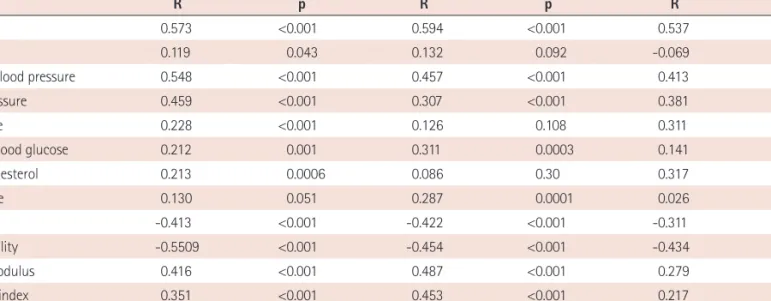
In a simple correlation analyses, the Pearson correlation coeffici- ents for the relationship between baPWV and age, SBP, pulse pres- sure, heart rate, fasting blood glucose, total cholesterol, and creati- nine were significantly positive (Table 3). The parameters of proximal AA stiffness were significantly correlated with baPWV in both nor- Table 1. General characteristics of the study subjects and comparison between genders

Overall (n=285) Male (n=117) Female (n=168) p

Age (years) 58.1±12.8 56.6±13.9 59.1±12.0 0.102

Height (cm) 159.7±9.5 168.2±6.6 153.9±6.3 <0.0001

Body weight (kg) 62.2±11.2 68.8±10.2 57.5±9.3 <0.0001

Body mass index (kg/m

2

) 24.3±3.8 24.3±3.6 24.3±3.9 0.952

Systolic blood pressure (mm Hg) 127.7±18.5 126.7±15.2 128.4±20.5 0.467

Diastolic blood pressure (mm Hg) 77.4±10.9 78.8±11.1 76.4±10.6 0.067

Pulse pressure (mm Hg) 50.2±12.7 47.8±10.1 51.9±14.0 0.005

Heart rate (beats per minute) 67.2±11.6 65.8±11.0 68.1±12.0 0.111

Total cholesterol (mg/dL) 198.0±39.4 187.1±34.6 205.3±40.8 0.0003

Fasting blood glucose (mg/dL) 104.6±29.3 105.4±27.5 104.1±30.6 0.734

Creatinine (mg/dL) 0.92±0.22 1.07±0.22 0.81±0.13 <0.0001

Triglyceride (mg/dL) 154.1±94.0 159.7±103.1 149.7±86.3 0.434

HDL-C (mg/dL) 46.6±11.5 43.8±11.3 48.8±11.2 0.0013

LDL-C (mg/dL) 112.3±35.3 103.5±31.7 119.1±36.6 0.0012

Mean baPWV (cm/s) 1556.8±321.9 1526.1±300.4 1578.2±335.3 0.179

Aortic dimension (cm) 3.06±0.36 3.22±0.35 2.94±0.33 <0.0001

Systolic AA dimension (cm) 2.20±0.32 2.29±0.32 2.14±0.31 0.0002

Diastolic AA dimension (cm) 2.02±0.32 2.09±0.33 1.97±0.31 0.004

AA strain (%) 9.13±4.08 9.82±4.17 8.65±3.96 0.0182

AA distensibility (mm Hg

-1

×10

-3

) 4.15±2.29 4.59±2.37 3.84±2.1 0.0066

AA elastic modulus 7.40±6.33 6.48±6.16 8.03±6.39 0.0428

AA stiffness index 7.29±6.05 6.40±5.91 7.91±6.09 0.0395

p from Student t-tests to compare genders. HDL-C: high density lipoprotein-cholesterol, LDL-C: low density lipoprotein-cholesterol, AA: abdominal aortic,

baPWV: brachial-ankle pulse wave velocity

(5)

motensive and hypertensive subjects (Fig. 2).

In partial correlation analyses, after adjustments for age, gender, SBP, BMI, and heart rate, baPWV was consistently significantly cor- related with strain, elastic modulus, and stiffness index in all sub- jects and in normotensive subjects (Table 4). When additionally ad- justed for antihypertensive medication status, there was no sig- nificant correlation between baPWV and the stiffness parameters for the proximal AA.

Multiple regression analyses for the stiffness parameters of the proximal AA

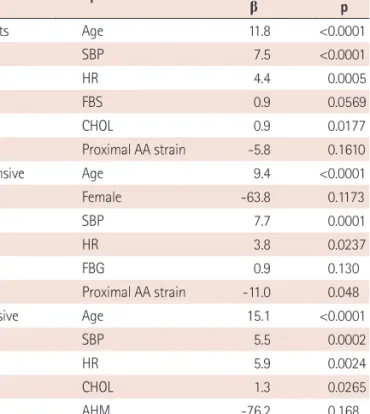
In the multiple regression analyses, baPWV was independently associated with the strain of the proximal AA or strain only among normotensive subjects, as shown in Table 5. Not antihypertensive medication status itself, but the level of blood pressure and heart rate, was associated with baPWV in the multiple linear regression model, including abdominal aortic strain.

Comparison of brachial-ankle pulse wave velocity between the quartiles of the stiffness parameters of proximal AA

After adjustments for age, gender, BMI, SBP, and heart rate, baP- WV was significantly higher among the lower quartiles of distensibi- lity in the normotensive group (Q1, 1539±36 cm/sec; Q2, 1426±32 cm/sec; Q3, 1406±32 cm/sec; Q4, 1425±35 cm/sec, p for linear trend=0.0419). The baPWV among normotensive subjects was sig- nificantly higher with increasing quartiles of elastic modulus (Q1, 1428±35 cm/sec; Q2, 1404±31 cm/sec; Q3, 1426±32 cm/sec; Q4, 1539±36 cm/sec, p for linear trend=0.0489) (Fig. 3A). For the hyper- tensive group, with additional adjustments for antihypertensive me- dication status, baPWV was not significantly different among the quartile groups (Fig. 3B).

Discussion

The main finding of this study is that baPWV has a moderate Table 2. Comparison of the general characteristics of normotensive and hypertensive subjects

Normotensive (n=163) Untreated hypertensive (n=48) Treated hypertensive (n=74) p

Age (years) 56.4±13.6 57.2±13.4 62.4±9.4 0.003

Female (%) 58.2 66.6 55.4 0.45

Height (cm) 160.3±8.8 159.2±10.5 158.8±10.4 0.51

Body weight (kg) 60.8±10.7 64.0±12.5 63.9±11.1 0.06

BMI (kg/m

2

) 23.6±3.7 25.1±4.1 25.3±3.3 0.002

Systolic BP (mm Hg) 118.2±10.9 151.5±12.5 133.3±19.0 <0.001

Diastolic BP (mm Hg) 72.7±8.0 89.1±9.5 80.2±10.6 <0.001

Pulse pressure (mm Hg) 45.4±9.3 62.3±11.0 53.1±14.3 <0.001

Pulse rate (bpm) 66.3±11.4 68.6±9.0 68.1±13.4 0.347

Total cholesterol (mg/dL) 195.1±37.8 206.2±38.0 199.4±43.2 0.278

FBG (mg/dL) 105.2±32.1 101.7±20.4 105.1±28.0 0.814

Creatinine (mg/dL) 0.92±0.19 0.92±0.27 0.91±0.24 0.976

Triglyceride (mg/dL) 140.1±90.9 153.3±77.9 181.5±101.7 0.015

HDL-C (mg/dL) 47.9±11.5 49.9±13.2 42.6±9.5 0.0025

Mean baPWV (cm/s) 1445.8±280.7 1764.6±322.6 1666.4±305.3 <0.001

Aortic diameter (cm) 3.00±0.38 3.04±0.33 3.18±0.31 0.0023

Systolic AA (cm) 2.15±0.30 2.22±0.35 2.29±0.35 0.0068

Diastolic AA (cm) 1.96±0.30 2.06±0.33 2.12±0.34 0.0016

AA strain (%) 9.82±4.23 8.07±3.70 8.28±3.72 0.004

AA distensibility (mm Hg

-1

×10

-3

) 6.04±4.55 2.79±1.35 3.51±1.80 <0.001

AA elastic modulus 6.04±4.55 10.04±8.41 8.73±7.42 <0.001

AA stiffness index 6.44±4.74 8.68±7.92 8.30±7.01 0.0211

Ischemic heart disease (%) 5.5 8.3 25.6 0.006

History of stroke (%) 1.2 2.0 5.4 0.719

Diabetes mellitus (%) 12.7 10.4 21.6 0.554

p from Student t-tests or chi-square tests to compare groups. HDL-C: high density lipoprotein-cholesterol, AA: abdominal aortic, baPWV: brachial-ankle

pulse wave velocity

(6)

crude correlation with the stiffness parameters for proximal AA.

However, when adjusted for age, sex, SBP, heart rate, and BMI, such correlations were observed only among normotensive subjects. The

antihypertensive medication status does not appear to be associated with baPWV in the multiple linear regression model, including ab- dominal aortic strain. Such a finding suggests that, in hypertensive

Table 3. Pearson correlation coefficients for the relationships between mean baPWV and proximal AA stiffness parameter

All subjects (n=285) Normotensive (n=163) Hypertensive (n=122)

R p R p R p

Age 0.573 <0.001 0.594 <0.001 0.537 <0.0001

BMI 0.119 0.043 0.132 0.092 -0.069 0.449

Systolic blood pressure 0.548 <0.001 0.457 <0.001 0.413 <0.0001

Pulse pressure 0.459 <0.001 0.307 <0.001 0.381 <0.0001

Heart rate 0.228 <0.001 0.126 0.108 0.311 0.0005

Fasting blood glucose 0.212 0.001 0.311 0.0003 0.141 0.154

Total cholesterol 0.213 0.0006 0.086 0.30 0.317 0.0007

Creatinine 0.130 0.051 0.287 0.0001 0.026 0.795

Strain -0.413 <0.001 -0.422 <0.001 -0.311 0.0005

Distensibility -0.5509 <0.001 -0.454 <0.001 -0.434 <0.0001

Elastic modulus 0.416 <0.001 0.487 <0.001 0.279 0.002

Stiffness index 0.351 <0.001 0.453 <0.001 0.217 0.016

baPWV: brachial-ankle pulse wave velocity, AA: abdominal aortic, BMI: body mass index

Fig. 2. Scatter plots for the correlation between proximal abdominal aortic strain and mean brachial-ankle pulse wave velocity according to hypertension status. The correlation was higher in normotensive subjects than in hypertensive subjects.

20

15

10

5

Mean brachial ankle pulse wave velocity (cm/sec)

Ab do m in al a or tic s tr ai n (% )

1000 1500 2000 2500

15

10

5

Mean brachial ankle pulse wave velocity (cm/sec)

Ab do m in al a or tic s tr ai n (% )

1000 1500 2000 2500

R=-0.422, p<0.0001 R=-0.312, p=0.0005

Table 4. Partial correlation coefficients for the relationships between mean baPWV and proximal AA stiffness parameters

All subjects (n=285) Normotensive (n=163) Hypertensive (n=122)

R p* R p* R p

Pulse pressure -0.107 0.072 -0.080 0.315 -0.180 0.056

Strain -0.110 0.062 -0.203 0.010 0.019 0.837

Distensibility -0.059 0.320 -0.121 0.129 0.053 0.576

Elastic modulus 0.097 0.109 0.304 0.0001 -0.079 0.405

Stiffness index 0.096 0.114 0.299 0.0001 -0.085 0.576

*p adjusted for age, gender, systolic blood pressure, body mass index, and heart rate,

p adjusted additionally for antihypertensive medication status. baP- WV: brachial-ankle pulse wave velocity, AA: abdominal aortic

Normotension (n=163) Hypertension (n=122)

(7)

subjects, not antihypertensive medication itself, but other factors, (such as age, SBP, and heart rate), may be more involved in the re- lationship between baPWV and proximal AA strain than for normo- tensive subjects. The relationship between baPWV and proximal AA stiffness parameters seemed to be linear only in the normotensive

group. The lack of any significant association between baPWV and proximal AA stiffness parameters in the hypertension group may be due to the effect of antihypertensive medication on blood pres- sure and heart rate. The role of the different classes of antihyperten- sive medication could not be demonstrated in the present study.

Similar results were observed in a previous study, which showed that baPWV might have some limitations in predicting arterial stiff- ness in hypertensive patients with a history of cardiovascular dis- ease.

23)

However, some authors suggest that baPWV can predict ear- ly arteriosclerotic changes.

24)

In addition, compared to the augment- ation index, baPWV is reported to be useful among elderly patients, and some studies have shown that baPWV can predict aortic calci- fication.

4)25)

The non-significant correlations between baPWV and proximal AA stiffness in the hypertensive group, regardless of antihypertensive medication status, can be explained by findings from previous stu- dies. The stiffness parameters of the proximal AA do not have a lin- ear relationship with age; a plateau can be observed in old age.

26)27)

It was reported that aortic distensibility and elastic modulus are more useful indicators in normal young subjects than among hyperten- sive and elderly subjects.

28)

baPWV was reported to underestimate aortic stiffness in hypertensive patients with coronary artery disease or target organ damage, as these subjects have lower femoral-an- kle PWV.

23)

In this study, we unexpectedly found that the stiffness parame- ters of the proximal AA were more affected in female subjects (Table 1 and 5). The higher pulse pressure in females is likely to be the rea- son for those differences. It is known that pulse pressure tends to be higher in females than males after the age of 50.

29)

In addition, Table 5. Multiple linear regression analysis of factors associated with baPWV

Group baPWV

β p

All subjects Age 11.8 <0.0001

SBP 7.5 <0.0001

HR 4.4 0.0005

FBS 0.9 0.0569

CHOL 0.9 0.0177

Proximal AA strain -5.8 0.1610

Normotensive Age 9.4 <0.0001

Female -63.8 0.1173

SBP 7.7 0.0001

HR 3.8 0.0237

FBG 0.9 0.130

Proximal AA strain -11.0 0.048

Hypertensive Age 15.1 <0.0001

SBP 5.5 0.0002

HR 5.9 0.0024

CHOL 1.3 0.0265

AHM -76.2 0.168

Proximal AA strain -2.0 0.756-

baPWV: brachial-ankle pulse wave velocity, SBP: systolic blood pressure, HR: heart rate, FBS: fasting blood sugar, CHOL: total cholesterol, AA: abdomi- nal aorta

1600 1550 1500 1450 1400 1350 1300

1760 1740 1720 1700 1680 1660 1640 1620

Hypertensive group Normotensive group

ba PW V (c m /s ec ) ba PW V (c m /s ec )

Strain Distensibility Elastic modulus Stiffness index Strain Distensibility Elastic modulus Stiffness index

p for linear trend

0.98 0.65 0.68

p for linear trend

0.068 0.0419 0.0489 0.085 0.48

Q1 Q2 Q3 Q4 Q1 Q2 Q3 Q4

A   B  

Fig. 3. baPWV according to the quartiles of the stiffness parameters of the proximal AA. A: least square means adjusted for age, gender, systolic blood

pressure, heart rate, and body mass index according to the quartile groups of the stiffness parameters of the proximal AA in normotensive subjects. B: least

square means additionally adjusted for antihypertensive medication status, according to the quartile groups of the stiffness parameters of the proximal AA

in hypertensive subjects. There was no difference observed in baPWV between the quartiles of the stiffness parameters of the proximal AA in the hyperten-

sive group. baPWV: brachial-ankle pulse wave velocity, AA: abdominal aorta.

(8)

we found that diastolic aortic dimensions were significantly lower among female subjects, which is consistent with a previous study suggesting that aortic arch diameter in the diastole was lower in fe- males than in males (2.56±0.31 mm vs. 2.88±0.35 mm).

30)

Although the smaller aortic size could not explain the pulse pressure difference completely, these differences between genders point to some gen- der-related differences in mechanical properties in response to aor- tic pressure changes, or a gender-related mismatch between ven- tricular function and aortic function.

30)

Furthermore, females had higher total cholesterol and LDL, consistent with a previous study performed in the general population and one of patients with famil- ial hypercholesterolemia.

16)31)

Finally, there may be a difference in left ventricular function, which may affect proximal AA distensibility, as found in a previous study.

32)

Clinical Implications

Ultrasonography is a readily accessible clinical tool for examining proximal AA when combined with an examination of the heart or intra-abdominal organs. The worst quartiles of proximal AA stiff- ness in normotensive subjects had greatly increased baPWV values.

The application of a conventional ultrasound examination of the proximal AA may be helpful in identifying normotensive subjects with arterial stiffness, but its potential application for hypertensive subjects is not supported by the findings of the present study. How- ever, the proportion of subjects with ischemic heart disease history was about a quarter in the treated hypertension group, because, in our study, the subjects were recruited from a hypertension clinic af- filiated with a cardiology division. Consequently, any generalized ap- plication of the negative findings among hypertensive subjects may be limited.

Limitations of the study

There are some limitations of this study. Firstly, all subjects were examined after fasting. Thus, the usefulness of measuring proximal AA stiffness in fed subjects was not demonstrated. Additionally, cfP- WV, which is more accurate than baPWV, was not used in this study because, during preliminary testing, baPWV was found to be superi- or in terms of both technical feasibility and general use in actual cli- nical practice. Using a VP-2000 device, hfPWV would be a far more accurate indicator of aortic stiffness than baPWV if a femoral ar- tery probe can be applied. The correlation between PWV and abdo- minal aortic strain would have been improved had cfPWV been ad- opted. The result cannot be applied to cfPWV. The results of the study demonstrating the effects of antihypertensive medication on aortic strain in the multiple regression analysis should be interpreted with caution, because each of the classes of antihypertensive drugs were not considered. In the present study, the sample size was too

small to examine the effects of antihypertensive drug classes in the treated subjects. Further studies are warranted in this area of investigation.

References

1. Laurent S, Boutouyrie P, Asmar R, et al. Aortic stiffness is an indepen- dent predictor of all-cause and cardiovascular mortality in hyperten- sive patients. Hypertension 2001;37:1236-41.

2. Kolipaka A, Woodrum D, Araoz PA, Ehman RL. MR elastography of the in vivo abdominal aorta: a feasibility study for comparing aortic stiff- ness between hypertensives and normotensives. J Magn Reson Imag- ing 2012;35:582-6.

3. Kim MJ, Lee SY, Kim YB, Kil HR. Click here to read click here to read clinical significance of the mechanical properties of the abdominal aorta in Kawasaki disease. Korean J Pediatr 2008;51:1012-7.

4. Nakamura U, Iwase M, Nohara S, Kanai H, Ichikawa K, Iida M. Useful- ness of brachial-ankle pulse wave velocity measurement: correlation with abdominal aortic calcification. Hypertens Res 2003;26:163-7.

5. Okubo M, Ino T, Takahashi K, Kishiro M, Akimoto K, Yamashiro Y. Age dependency of stiffness of the abdominal aorta and the mechanical properties of the aorta in Kawasaki disease in children. Pediatr Cardi- ol 2001;22:198-203.

6. Haskett D, Johnson G, Zhou A, Utzinger U, Vande Geest J. Microstruc- tural and biomechanical alterations of the human aorta as a function of age and location. Biomech Model Mechanobiol 2010;9:725-36.

7. Ahlgren AR, Hansen F, Sonesson B, Länne T. Stiffness and diameter of the common carotid artery and abdominal aorta in women. Ultraso- und Med Biol 1997;23:983-8.

8. Seo JS, Lee SY, Kim HD. Quantitative analysis of aortic atherosclerosis in Korean female: a necropsy study. J Korean Med Sci 2007;22:536-45.

9. Zakai NA, Katz R, Jenny NS, et al. Inflammation and hemostasis bio- markers and cardiovascular risk in the elderly: the Cardiovascular He- alth Study. J Thromb Haemost 2007;5:1128-35.

10. Kaibe M, Ohishi M, Komai N, et al. Arterial stiffness index: a new evalu- ation for arterial stiffness in elderly patients with essential hyperten- sion. Geriatr Gerontol Int 2002;2:199-205.

11. Giannattasio C, Capra A, Facchetti R, et al. Relationship between arterial distensibility and coronary atherosclerosis in angina patients. J Hyper- tens 2007;25:593-8.

12. Gur M, Yilmaz R, Demirbag R, et al. Relationship between myocardial performance index and aortic distensibility in patients with essential hypertension. Int J Clin Pract 2008;62:138-42.

13. Dernellis J, Panaretou M. Aortic stiffness is an independent predictor of progression to hypertension in nonhypertensive subjects. Hyper- tension 2005;45:426-31.

14. Gosling RG, Budge MM. Terminology for describing the elastic behav- ior of arteries. Hypertension 2003;41:1180-2.

15. Kawasaki T, Sasayama S, Yagi S, Asakawa T, Hirai T. Non-invasive assess- ment of the age related changes in stiffness of major branches of the human arteries. Cardiovasc Res 1987;21:678-87.

16. Pitsavos C, Toutouzas K, Dernellis J, et al. Aortic stiffness in young pa-

tients with heterozygous familial hypercholesterolemia. Am Heart J

(9)

1998;135:604-8.

17. Stefanadis C, Stratos C, Boudoulas H, Kourouklis C, Toutouzas P. Dis- tensibility of the ascending aorta: comparison of invasive and non- invasive techniques in healthy men and in men with coronary artery disease. Eur Heart J 1990;11:990-6.

18. Pannier BM, Avolio AP, Hoeks A, Mancia G, Takazawa K. Methods and devices for measuring arterial compliance in humans. Am J Hypertens 2002;15:743-53.

19. Shin J, Lee J, Lim HK, Lee BH, Kim MK, Choi BY. The relationship be- tween the pulse wave velocity (PWV) and the left ventricular geometry:

a Community-Based Cross-Sectional Study. Korean Circ J 2005;35:

683-9.

20. Erdogan D, Gullu H, Caliskan M, et al. The influence of circadian blood pressure changes on aortic distensibility and left ventricular diastolic function in hypertensive individuals. Int J Cardiovasc Imaging 2006;

22:157-65.

21. Lee YS, Kim KS, Hyun DW, et al. The change of arterial stiffness accord- ing to dialysis in patients with end-stage renal disease. Korean Circ J 2004;34:865-73.

22. Faul F, Erdfelder E, Buchner A, Lang AG. Statistical power analyses us- ing G*Power 3.1: tests for correlation and regression analyses. Behav Res Methods 2009;41:1149-60.

23. Ito N, Ohishi M, Takagi T, et al. Clinical usefulness and limitations of brachial-ankle pulse wave velocity in the evaluation of cardiovascular complications in hypertensive patients. Hypertens Res 2006;29:989- 95.

24. Hung CS, Lin JW, Hsu CN, et al. Using brachial-ankle pulse wave veloc- ity to associate arterial stiffness with cardiovascular risks. Nutr Metab

Cardiovasc Dis 2009;19:241-6.

25. Li B, Gao H, Li X, Liu Y, Wang M. Correlation between brachial-ankle pulse wave velocity and arterial compliance and cardiovascular risk factors in elderly patients with arteriosclerosis. Hypertens Res 2006;

29:309-14.

26. Redheuil A, Yu WC, Wu CO, et al. Reduced ascending aortic strain and distensibility: earliest manifestations of vascular aging in humans. Hy- pertension 2010;55:319-26.

27. Tsamis A, Rachev A, Stergiopulos N. A constituent-based model of age- related changes in conduit arteries. Am J Physiol Heart Circ Physiol 2011;301:H1286-301.

28. Lehmann ED, Gosling RG, Parker JR, deSilva T, Taylor MG. A blood pres- sure independent index of aortic distensibility. Br J Radiol 1993;66:

126-31.

29. Regnault V, Thomas F, Safar ME, et al. Sex difference in cardiovascular risk: role of pulse pressure amplification. J Am Coll Cardiol 2012;59:

1771-7.

30. Dart AM, Kingwell BA, Gatzka CD, et al. Smaller aortic dimensions do not fully account for the greater pulse pressure in elderly female hy- pertensives. Hypertension 2008;51:1129-34.

31. Mokhtari A, Bellinetto-Ford L, Melander O, Nilsson PM. Determinants of increasing pulse pressure during 23 years’ follow-up as a marker of arterial stiffness and vascular ageing. Blood Press 2008;17:291-7.

32. Giannattasio C, Achilli F, Failla M, et al. Radial, carotid and aortic dis-

tensibility in congestive heart failure: effects of high-dose angiotensin-

converting enzyme inhibitor or low-dose association with angioten-

sin type 1 receptor blockade. J Am Coll Cardiol 2002;39:1275-82.

수치

Fig. 1. Measurement of abdominal aortic strain. A sector probe was placed at the epigastrium targeting the spine, which typically shows a prominent an- an-terior wall excursion and a relatively fixed posan-terior wall
Table 1 shows the general characteristics of the subjects and com- com-pares these characteristics between males and females
Table 3. Pearson correlation coefficients for the relationships between mean baPWV and proximal AA stiffness parameter
Fig. 3. baPWV according to the quartiles of the stiffness parameters of the proximal AA

참조

관련 문서