Acculturation, meal frequency, eating-out, and body weight in Korean Americans
Soo-Kyung Lee §
Department of Food and Nutrition, Inha University, 253 YongHyun-dong, Nam-gu, Incheon 402-751, Korea
Received October 2, 2008, Revised November 24, 2008, Accepted November 27, 2008
Abstract
Consuming regular meals has been studied in relation to better health, while higher regularity of eating-out has been linked to obesity. This study examined whether acculturation was associated with regularity of meals, eating-out, and overweight in Korean Americans. Pre-tested questionnaires were mailed to a U.S. national sample with Korean American surnames, and 55% of the deliverable sample responded, producing 356 usable questionnaires.
Acculturation was measured using a two-culture matrix model and Gordon’s theoretical work, and showed there were three distinct groups (acculturated, bicultural, and traditional). Only 36% reported that they regularly ate three meals a day. Breakfast was the least frequent meal of the day with 43% reporting eating breakfast everyday. More than half (58%) reported that they usually eat out or get take-out food at least once a week. After controlling for age, sex, income, education, and working status, higher acculturation was related to greater regularity of eating-out, but not meal regularity. A total of 28% of men and 6% of women were overweight (BMI>25), and there were significant and positive relationships between body weight status and acculturation in men but not women. However, no significant relationships between frequency of meals and eating-out and overweight status were present. This study did not find significant relationships of meal regularity and eating-out with body weight, however, given the positive relationship between acculturation and eating-out among the subjects and the well-established relationship between eating-out and obesity, nutrition education about skipping meals and eating-for Korean Americans may be useful to prevent such relationships from developing.
Key Words: Acculturation, meal-regularity, eating-out, obesity, Korean Americans
Introduction 12)
Obesity is a growing problem in the United States (Flegal et al., 1998; Kuczmarski et al., 1994; Mokdad et al., 2001; Ogden et al., 2006). Among many determinants of obesity, frequency of meals, snacking, and eating-out have attracted research and practical interests because of their direct applicability to everyday life.
Fabry and co-workers reported that eating small frequent meals (nibbling) was strongly associated with lower body weight than eating large few meals (gorging) (Fabry et al., 1964, 1966; Hejda
& Fabry, 1964). But, the inverse relationship between meal frequency and body weight has not been consistently found in recent other studies in population studies (Charzewska et al., 1981; Dreon et al., 1988; Edelstein et al., 1992; Metzner et al., 1977; Summerbell, 1996). Nibbling did not produce better results in weight loss than gorging in clinical studies, when the amount of total energy was restricted (Finkelstein & Fryer, 1971). Bellisle et al. (1997) concluded in their review paper that nibbling does not have energy metabolic advantages in terms of energy utilization over gorging.
It has also been hypothesized that eating frequent meals may result in higher amount of energy than eating infrequent meals, however, data on this hypothesis is relatively limited. Kant (1995)
reported that energy intake was positively associated with meal frequency in the National Health and Nutrition Examination and Survey I Epidemiologic Follow-up Study. However, energy intake levels in the dataset were below the predicted minimal energy needs (1.4 * BMR) (Goldberg et al., 1991). With limited data availability and imprecision of dietary assessment methods, it is not clear if more frequent meals result in higher energy intakes.
Snacking has been discussed in relation to obesity in similar ways to meal frequency has. Snacking has sometime been studied in the context of meal frequency, because definitions of meals or snacking have not been fully established (Gatenby, 1997).
Booth (1988) proposed that snacking in addition to meals may lead to higher energy intake. High-fat, high-sugar and high- energy foods are often associated with snacking, possibly resulting in consuming “empty calories (Drummond et al., 1996).” Studies on whether frequent meals or snacking leads to higher energy consumption reported mixed results (Kirk, 2000; Lioret et al., 2008).
Eating-out is one of the significant phenomna in the industrialized and modernized society (Finklestein, 1989). In the U.S., about half of the food expenditures of adults are spent eating away from home (Blisard et al., 2002; Clausen, 2000).
In the U.K., eating-out became much more commonplace at the
§
Corresponding Author: Soo-Kyung Lee, Tel. 82-32-860-8121, Fax. 82-32-862-8120, Email. [email protected]
end of the twentieth century (Warde & Martens, 2000). Eating- out is thought to be associated with obesity because foods eaten away home tend to be in larger portion size and higher fat and energy content (Ma et al., 2003; Young & Nestle, 2002). If and how frequent eating-out is related to body weight, however, has not been fully studied.
Frequency of meals, snacking, and eating-out are determined by many factors. Culture is an important determinant because it dictates how one carries out daily life. Immigrants and their children provide unique information on relationships among meal frequency, snacking, eating-out, and body weight, because people acculturate in different speed and patterns. Acculturation refers to a process of overall adaptation on both individual and group levels, including cultural, psychological, social, economic, and political aspects (Berry, 1997). Since current international migration flows from undeveloped or developing countries to developed countries, immigrants and their children may be in different stages of showing changes from industrialization and modernization.
This study examined whether acculturation was associated with meal frequency, snacking, and eating-out and whether meal frequency, snacking and eating-out were related to weight status using Korean Americans as an example. Specifically, we hypothesized that: 1) higher acculturation is related to lower meal frequency, more frequent snacking, and more frequent eating-out and 2) lower meal frequency, more frequent snacking, and more frequent eating-out are associated with higher prevalence of overweight.
Subjects and Methods
Data for this study were collected by a cross-sectional mail survey of a national sample of Korean Americans in the continental U.S. University Institutional Review Board (IRB) approval was obtained prior to the study.
Sample
Adult (17 years old or older) Korean Americans were randomly sampled from U.S. telephone book white pages. Korean surnames were used to target ethnicity and the listing was screened to make sure that only people with Korean surnames were included.
The sample was stratified by four variables: 1) region (Northeastern, Midwestern, Southern, and Western following the National Health and Nutrition Examination and Survey (U.S.
Department of Health and Human Services. 1981)), 2) urban-rural area (Standard Metropolitan Statistical Area (SMSA) and non-SMSA), 3) age as a proxy for generation (under 35 years and over 35 years), and 4) gender (male and female).
Data collection procedure
The pre-tested questionnaire was mailed to a total of 1113 people with Korean surnames in the continental U.S., following
the Total Design Method of Dillman (1978). A personally addressed cover letter in both English and Korean explaining the purpose of the study was sent along with two questionnaires (in English and Korean). Non-respondents received reminder postcards followed by second and third mailings.
Out of the 1113 questionnaires mailed out, 259 (33%) were returned as undeliverable. Of the 854 deliverable questionnaires, 470 (55% of the total deliverable sample) responded, with 105 who responded that they were not Korean Americans and two who refused to participate. After careful screening, 16 questionnaires were determined to be unusable. This analysis used a total of 347 questionnaires, which was 42% of the total deliverable sample. The respondents did not show significantly different patterns from the sampling list distribution by region, area, or gender.
Measures
There are no widely accepted acculturation scales for Korean Americans. In this study, a bidimensional model (Berry, 1997) provided a framework and Gordon’s seven dimensions (Gordon, 1964) were used to identify variables to measure overall acculturation in Korean Americans. Each dimension was independently measured in two axes: relation to American society and retention of Korean ethnic society. Cluster analysis on acculturation resulted in three distinct groups: acculturated, bicultural, and traditional (Lee et al., 2000; 2003).
Acculturated Korean Americans were either born in the U.S.
or immigrated to the U.S. when they were very young. Generally, they were most comfortable with American society compared to the other acculturation groups. They tended to have high English fluency and low Korean fluency. The largest, traditional group was situated on the opposite end from the acculturated group. They came to the U.S. during their late 20s or early 30s.
They were more likely to have limited English proficiency and felt most comfortable with Korean culture and environments. The bicultural group appeared to be in between the acculturated and the traditional group, however, it was notable that the bicultural group had a wider social network and social participation with American mainstream than the acculturated group. More detailed information on acculturation scale and acculturation groups can be found elsewhere (Lee et al., 2000).
Frequency of meal was estimated by asking how often respondents eat breakfast, lunch, and dinner. Response categories were never, once a week or less, 2~3 times a week, 4~6 times a week, and everyday. Response categories were re-coded because of low frequencies in some of the categories. “Never”
and “once a week or less” category for regularity of lunch were
combined together, leaving “once a week or less,” “2~3 times
a week,” “4~6 times a week,” and “everyday.” Response
categories for regularity of dinner were re-coded into three
response categories with the first three categories (“never,” “once
a week or less,” and “2~3 times a week”) collapsed. Frequency
Table 1. Descriptive Characteristics of Respondents
Male (201) Female (146) Total (347)
Acculturation N (%) N (%) N (%)
Traditional 100 (49.8) 81 (55.5) 181 (52.1)
Bicultural 73 (36.3) 41 (28.1) 114 (32.9)
Acculturated 28 (13.9) 24 (16.4) 52 (15.0)
Socioeconomic Status
Non-SMSA 58 (28.2) 29 (19.6) 87 (24.6)
Age (age, Mean ± SD) 43.2 ± 14.1 37.4 ± 12.7 40.7 ± 13.8 Education (years, Mean ± SD) 16.1 ± 3.1 15.0 ± 3.2 15.6 ± 3.2 Income (mean of 1~6 ± SD) 3.7 ± 1.6 3.5 ± 1.8 3.6 ± 1.7
Working*** 151 (73.3) 68 (46.0) 219 (61.9)
Unmarried 46 (22.3) 45 (30.4) 91 (25.7)
Weight Status***
Average BMI (mean ± SD) 23.99 ± 2.96 21.72 ± 3.08 23.03 ± 3.21 Underweight (BMI<18.5) 4 (1.9) 13 (8.8) 17 (4.8) Normal weight (18.5~25) 141 (68.5) 123 (83.1) 264 (76.6) Overweight (25~30) 54 (26.2) 9 (6.1) 63 (17.8) Obese (BMI>30) 7 (3.4) 3 (2.0) 10 (2.8)
* p<0.05; *** p<0.001: Significantly different by sex
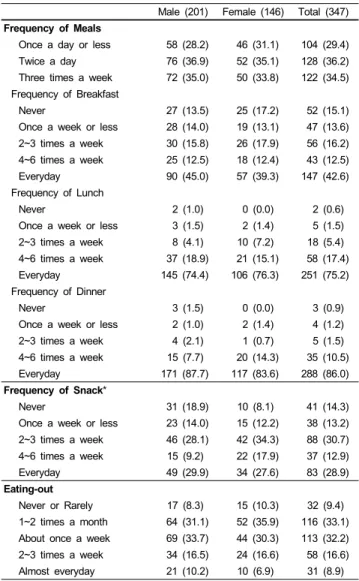
Table 2. Frequency of Meals, Snacking, and Eating-out N (%) Male (201) Female (146) Total (347) Frequency of Meals
Once a day or less 58 (28.2) 46 (31.1) 104 (29.4)
Twice a day 76 (36.9) 52 (35.1) 128 (36.2)
Three times a week 72 (35.0) 50 (33.8) 122 (34.5) Frequency of Breakfast
Never 27 (13.5) 25 (17.2) 52 (15.1)
Once a week or less 28 (14.0) 19 (13.1) 47 (13.6) 2~3 times a week 30 (15.8) 26 (17.9) 56 (16.2) 4~6 times a week 25 (12.5) 18 (12.4) 43 (12.5)
Everyday 90 (45.0) 57 (39.3) 147 (42.6)
Frequency of Lunch
Never 2 (1.0) 0 (0.0) 2 (0.6)
Once a week or less 3 (1.5) 2 (1.4) 5 (1.5)
2~3 times a week 8 (4.1) 10 (7.2) 18 (5.4)
4~6 times a week 37 (18.9) 21 (15.1) 58 (17.4)
Everyday 145 (74.4) 106 (76.3) 251 (75.2)
Frequency of Dinner
Never 3 (1.5) 0 (0.0) 3 (0.9)
Once a week or less 2 (1.0) 2 (1.4) 4 (1.2)
2~3 times a week 4 (2.1) 1 (0.7) 5 (1.5)
4~6 times a week 15 (7.7) 20 (14.3) 35 (10.5)
Everyday 171 (87.7) 117 (83.6) 288 (86.0)
Frequency of Snack*
Never 31 (18.9) 10 (8.1) 41 (14.3)
Once a week or less 23 (14.0) 15 (12.2) 38 (13.2) 2~3 times a week 46 (28.1) 42 (34.3) 88 (30.7) 4~6 times a week 15 (9.2) 22 (17.9) 37 (12.9)
Everyday 49 (29.9) 34 (27.6) 83 (28.9)
Eating-out
Never or Rarely 17 (8.3) 15 (10.3) 32 (9.4)
1~2 times a month 64 (31.1) 52 (35.9) 116 (33.1) About once a week 69 (33.7) 44 (30.3) 113 (32.2) 2~3 times a week 34 (16.5) 24 (16.6) 58 (16.6)
Almost everyday 21 (10.2) 10 (6.9) 31 (8.9)
* p<0.05: Significantly different by sex
of snacking was also asked using the same response categories.
With responses for frequency of breakfast, lunch, and dinner, a new variable (daily frequency of meals) was created.
Respondents who reported eating each meal everyday were given a score of 1 for each meal, while others received a score of 0. Combining the scores for three meals produced a value for frequency of meals, ranging from 0 to 3; a value of 0 would mean a respondent did not have regularly established meal frequency, while a value of 3 would mean a respondent had a regularly established meal frequency of three. There were few respondents with a value of 0, therefore, they were combined with those with a value of 1.
Eating-out behaviors was determined by asking how often respondents eat out or take out from restaurants: never or rarely, 1~2 times a month, about once a week, 2~3 times a week, and almost everyday.
Weight status was determined by calculating Body Mass Index (BMI) with self-reported height and weight. BMI is a good indicator of adiposity and self reported height and weight have adequate validity for population studies (Bowman & DeLucia, 1992). Respondents were grouped by BMI into four groups:
underweight (BMI<18.5), normal weight (18.5≤BMI<25), overweight (25≤BMI<30), and obese (BMI≤30) (WHO, 1998).
In multiple logistic regressions, overweight individuals (BMI≤
25) were compared to non-overweight individuals.
Control variables included sex, age, size of place of residence, education, income, working status, and marital status. Women were used as a reference category. Size of place of residence was divided into SMSA (0) vs non-SMSA (1) according to zip code of residence. Education was total years of formal education obtained in the U.S. or Korea. Income was measured as combined family income before tax, using nine categories. Income categories were re-coded to six categories because of low frequency in some of the categories. Working status was collapsed into two categories: currently working (1) and not working (0). Married people were treated as a reference category and all other categories were collapsed into unmarried.
Analysis
All analyses were performed separately for men and women.
Chi-squares and analysis of variance with Scheffé test were used to examine bivariate relationships. Logistic regression (proportional odds model) was applied to simultaneously investigate the relationships of all study variables in multi-variable models.
Results
Descriptive information about the variables is presented in
Table 1. About half of the sample’s acculturation status was
traditional, a third was bicultural and a sixth could be classified
as acculturated. Men and women were similar in acculturation.
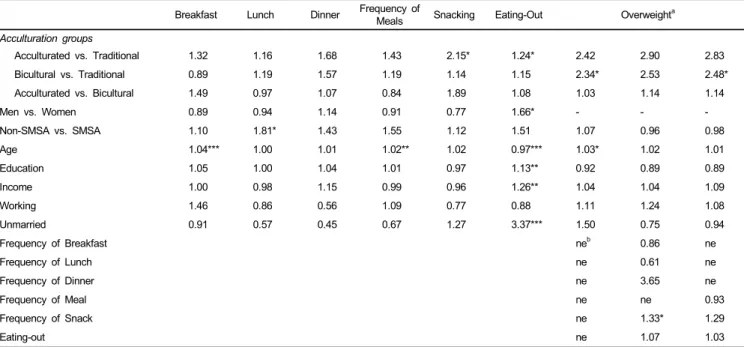
Table 3. Relationships among acculturation, frequency of meals, eating-out, and weight status. (OR) Breakfast Lunch Dinner Frequency of
Meals Snacking Eating-Out Overweight
aAcculturation groups
Acculturated vs. Traditional 1.32 1.16 1.68 1.43 2.15* 1.24* 2.42 2.90 2.83
Bicultural vs. Traditional 0.89 1.19 1.57 1.19 1.14 1.15 2.34* 2.53 2.48*
Acculturated vs. Bicultural 1.49 0.97 1.07 0.84 1.89 1.08 1.03 1.14 1.14
Men vs. Women 0.89 0.94 1.14 0.91 0.77 1.66* - - -
Non-SMSA vs. SMSA 1.10 1.81* 1.43 1.55 1.12 1.51 1.07 0.96 0.98
Age 1.04*** 1.00 1.01 1.02** 1.02 0.97*** 1.03* 1.02 1.01
Education 1.05 1.00 1.04 1.01 0.97 1.13** 0.92 0.89 0.89
Income 1.00 0.98 1.15 0.99 0.96 1.26** 1.04 1.04 1.09
Working 1.46 0.86 0.56 1.09 0.77 0.88 1.11 1.24 1.08
Unmarried 0.91 0.57 0.45 0.67 1.27 3.37*** 1.50 0.75 0.94
Frequency of Breakfast ne
b0.86 ne
Frequency of Lunch ne 0.61 ne
Frequency of Dinner ne 3.65 ne
Frequency of Meal ne ne 0.93
Frequency of Snack ne 1.33* 1.29
Eating-out ne 1.07 1.03
a
Only men were included in this analysis because of the small number of overweight women.; Three different models were created for the overweight variable.
b