JESK
http://jesk.or.kr eISSN:2093-8462Suggestion of Risk Assessment Models for Cardiovascular Disease in the Workplace
Eui Rak Choi, Byung Yong Jeong
Department of Industrial and Management Engineering, Hansung University, Seoul, 136-792
Corresponding Author Byung Yong Jeong
Department of Industrial and Management Engineering, Hansung University, Seoul, 136-792 Mobile : +82-10-3391-4127 Email : [email protected]
Received : March 06, 2014 Revised : April 29, 2014 Accepted : July 22, 2014
Objective: The purpose of this study is to identify the incidence risk of cardiovascular disease (CVD) in the workplace, and to suggest the prediction models for level of CVD incidence risk.
Background: CVD can be caused by various factors related to personal habits such as diet and exercise, or genetics. However it can also be caused and aggravated by work, making the elimination of such risk factors at work crucial disease (KOSHA, 2013).
Method: The distribution of CVD risk assessment levels of 162 workers was compared with the acquired medical examination data to discuss the necessity of assigning additional risk factors. Two alternative risk assessment models were given to enhance the accuracy of the evaluation; adjusting risk scores given in the KOSHA GUIDE H- 1-2013 (alternative 1) and building a matrix of KOSHA GUIDE H-1-2013 and risk assessment results based on work condition levels (alternative 2). To verify the suggested models, medical examination results of 12 workers approved of convalescence were referred to.
Results: The second alternative showed more relevance between the results and workers approved of convalescence in predicting the risk group when applied to actual heath examination data from the approved workers. The power of description of the new method for determining the risk of CVD incidence, 83.3%, is higher than that of KOSHA GUIDE H-1-2013, 25%.
Conclusion: Results of this study imply that more approved workers had been from unmanaged normal groups than managed risk groups, raising the importance of CVD management.
Application: The new prediction model considering working time and shift work developed in this study is expected to be a fundamental data for risk analysis and management of CVD in the workplace.
Keywords: Cardiovascular disease, Risk assessment, Shift work, Work time
Copyright@2014 by Ergonomics Society of Korea. All right reserved.
○cc This is an open-access article distributed under the terms of the Creative Commons Attribution Non-Commercial License (http://
creativecommons.org/licenses/by-nc/3.0/), which permits unrestricted non-commercial use, distribution, and reproduction in any medium, provided the original work is properly cited.
1. Introduction
The cardiovascular disease (CVD) is the leading cause of death. and a major reason for compensation claims among workers. CVD refers to cerebrovascular disease (brain dysfunctions related to damage or blockage of the blood vessels in the brain) and cardiovascular disorders (cardiac disorder and angiosis). These diseases have different origins in the body but are grouped together because they require similar measures
due to common causes, risk and aggravating factors (WHO/ISH, 2003).
Cardiovascular risk assessment is a method to predict the possibility of disease occurrence based on risk factors in life style and physical condition. WHO/ISH (2003) guideline states that for prevention of cardiovascular disease, hypertension should be managed as well as complex factors such as smoking, diabetes, hyperlipidemia and obesity.
CVD can be caused and aggravated by work, making the elimination of such risk factors at work crucial disease (KOSHA, 2013).
When CVD is known to be caused by work-related factors, it is referred to as work-related CVD. The KOSHA (Korea Occupational Safety and Health Agency) revised KOSHA GUIDE H-1-2013, the risk assessment and post-management guidelines for CVD in the workplace. The KOSHA GUIDE H-1-2013 is based on the 2003 World Health Organization/International Society of Hypertension guideline (WHO/ISH, 2003). The assessment is classified based on the blood pressure, number of possessed risk factors, target organ damage, or complexion (KOSHA, 2013), and encourages the combination of risk assessment results with work properties to provide work-related measures. The goal of this assessment is to evaluate the risks for prevention and for deciding upon the requirements of the employee/r and assigned doctor’s role in post-management. In order to effectively prevent the CVD, employers should practice risk assessment. For healthy employees without aggravating factors, assessment should be done once every two years and once a year for healthy employees that have potentially dangerous habits. The risk group is classified into 3 categories according to the possibility of CVD occurrence; low, medium, high (KOSHA, 2013).
This study examines the CVD risk factors of KOSHA GUIDE H-1-2013 using medical examination data and aims to provide a revised method of assessment for management level evaluation including additional risk factors.
2. Method
2.1 Analyzing result of risk assessment according to the work conditions
This study evaluated results of medical examinations of 162 workers from 3 companies in the manufacturing, service, and electrical industry on CVD risks based on the KOSHA GUIDE H-1-2013 criteria. Table 1 displays the work styles of the 162 subjects in the study, according to work-type. Based on the KOSHA Guide CVD risk evaluations, the medical examination data is analyzed to assess working hours and shift types as risk factors.
2.2 Suggesting risk assessment models
In this study, the suitability of KOSHA GUIDE H-1-2013 verified while suggestions are made for better evaluation of CVD risk Table 1. Subjects (n=162) by industry type and working condition
Industry type Subjects by shift work
Total
Normal work Shift work
A. Manufacturing Company 30 30 30
B. Service Company 19 19 19
C. Electrical Company 32 32 32
Total 81 81 162
factors. The suggestions include 1) adjusting risk scores in the KOSHA GUIDE, 2) building a risk grade matrix with KOSHA GUIDE H-1-2013 evaluation results using work condition levels.
2.3 Verifying suitability for suggested models
To verify the suggested models, medical examination results of 12 subjects approved of convalescence during 2009 to 2013 due to CVD were referred to. The medical examinations were done prior to the approval. Seven out of 12 subjects were diagnosed with cardiovascular disorder and 5 with cerebrovascular disease. The average age of the 12 subjects was 45.5 years old and consisted of 11 men and 1 woman.
3. Results
3.1 Risk assessment results by work conditions 3.1.1 Effect of shift work
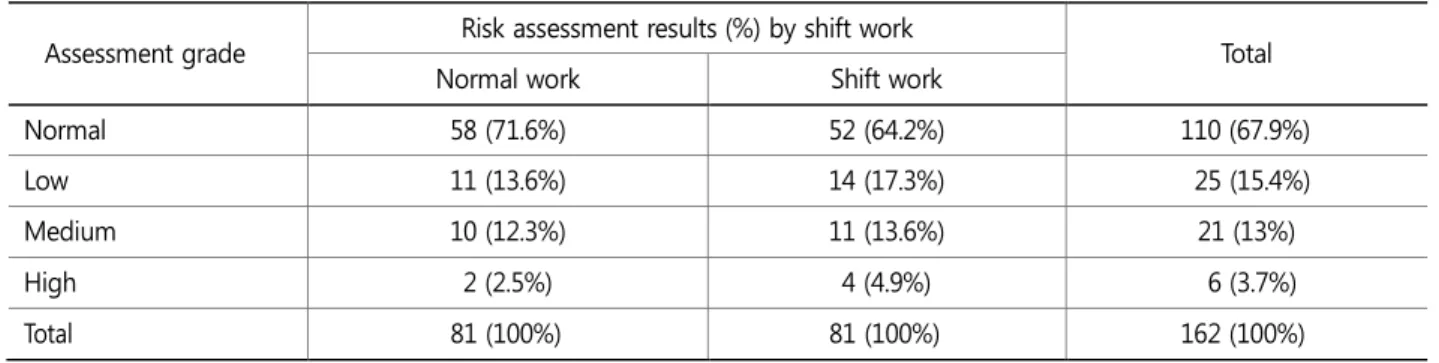
Medical examination results of 81 workers with shifts and 81 without shifts working in 3 companies in the manufacturing, service and electrical industry were compared with KOSHA GUIDE H-1-2013 in Table 2. Results showed difference between normal and shift workers, verified by the Chi-square test of independence (p<0.001). Table 2 illustrates the higher rate of risk groups for shifts, despite having similar working environments.
3.1.2 Effect of work time
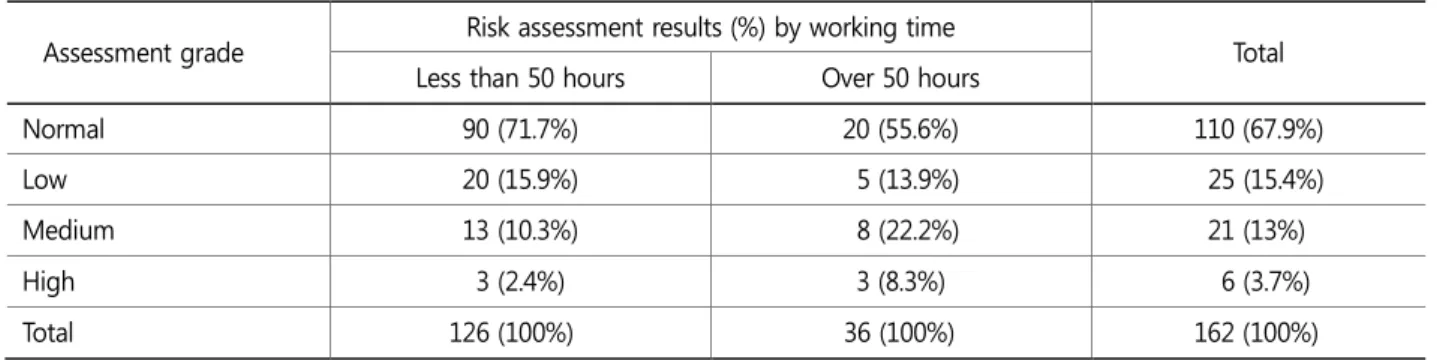
The risk assessment results of the 162 workers in 3 companies by working time are shown in Table 3, while it is revised based on 50 hours of work per week in Table 4. The Chi-square test of independence on the data in Table 4 showed difference in distribution of risk assessment between workers with less than 50 hours and over 50 hours of work at 10% level of significance (p=0.077). In addition, risk group rates were higher for those exceeding 50 hours of work per week (Table 4).
Table 2. Risk assessment results of 162 workers by shift work
Assessment grade Risk assessment results (%) by shift work
Total
Normal work Shift work
Normal 58 (71.6%) 52 (64.2%) 110 (67.9%)
Low 11 (13.6%) 14 (17.3%) 25 (15.4%)
Medium 10 (12.3%) 11 (13.6%) 21 (13%)
High 2 (2.5%) 4 (4.9%) 6 (3.7%)
Total 81 (100%) 81 (100%) 162 (100%)
3.2 Revised suggestions for KOSHA GUIDE H-1-2013 3.2.1 Alternative 1: Add risk factors
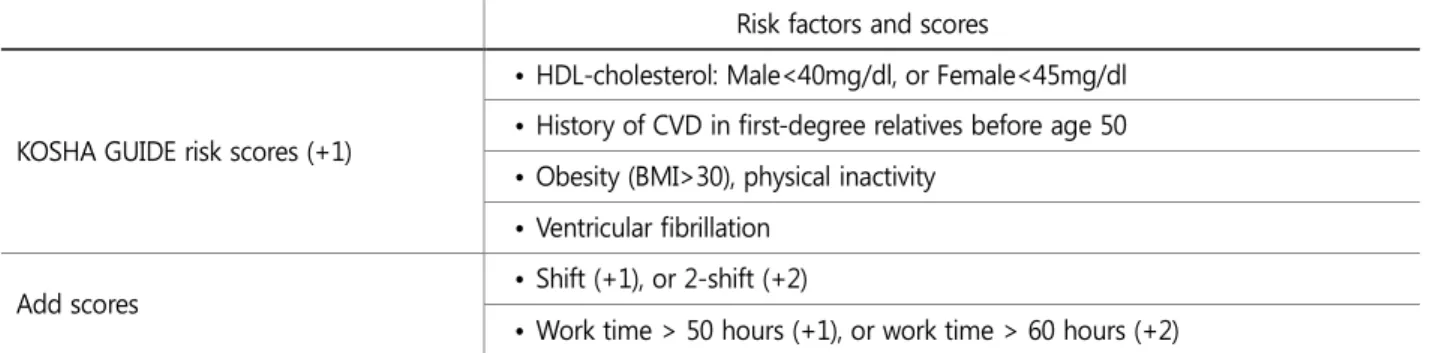
The first alternative is to add risk factors such as work time and shift in the KOSHA GUIDE H-1-2013. Table 5 displays the risk scores and additional scores for work time and shift type. Additional scores will be given +1 for shifts (+2 for double shifts), +1 for over 50 hours of work per week (+2 for over 60 hours). The total risk score will be calculated as a sum of the KOSHA GUIDE GUIDE H-1-2013 risk scores (number of relevant risk factors from the list) and the additional scores.
Table 6 includes higher normal rates in addition to the KOSHA GUIDE H-1-2013 classifications. This grading table enables the evaluation from normal to moderate risk level for subjects with normal blood pressure, based on the risk scores.
Table 3. Risk assessment results of 162 workers by working time (hours per week) Assessment grade Risk assessment results (%) by working time
Total Less than 44 hours 44~50 hours 50~60 hours Over 60 hours
Normal 66 (71.7%) 24 (70.6%) 20 (57.1%) - 110 (67.9%)
Low 12 (13%) 8 (23.5%) 4 (11.4%) 1 (100%) 25 (15.4%)
Medium 11 (12%) 2 (5.9%) 8 (22.9%) - 21 (13%)
High 3 (3.3%) - 3 (8.6%) - 6 (3.7%)
Total 92 (100%) 34 (100%) 35 (100%) 1 (100%) 162 (100%)
Table 4. Risk assessment results of 162 workers by working time (hours per week) Assessment grade Risk assessment results (%) by working time
Total Less than 50 hours Over 50 hours
Normal 90 (71.7%) 20 (55.6%) 110 (67.9%)
Low 20 (15.9%) 5 (13.9%) 25 (15.4%)
Medium 13 (10.3%) 8 (22.2%) 21 (13%)
High 3 (2.4%) 3 (8.3%) 6 (3.7%)
Total 126 (100%) 36 (100%) 162 (100%)
Table 5. Alternative 1: Risk factors and scores
Risk factors and scores
KOSHA GUIDE risk scores (+1)
• Levels of systolic and diastolic blood pressure (Grade 1-3)
• Age (Male > 55years, or female > 65years)
• Smoking
• Total cholesterol>240mg/dl, or LDL-cholesterol>160mg/dl
3.2.2 Alternative 2: Add stratification of work conditions
The second alternative is a two-step evaluation method involving the assessment of work condition and combining the results with KOSHA GUIDE H-1-2013 risk assessment results. A matrix based on risk assessment theory is applied in each step for grading.
Table 7 is the stratification of work conditions combining work time and shift type. Fifty or sixty hours of work and triple or double shifts determine the work condition levels.
Table 8 combines the results from work condition evaluation and KOSHA GUIDE H-1-2013 risk assessment for management Table 5. Alternative 1: Risk factors and scores (Continued)
Risk factors and scores
KOSHA GUIDE risk scores (+1)
• HDL-cholesterol: Male<40mg/dl, or Female<45mg/dl
• History of CVD in first-degree relatives before age 50
• Obesity (BMI>30), physical inactivity
• Ventricular fibrillation
Add scores • Shift (+1), or 2-shift (+2)
• Work time > 50 hours (+1), or work time > 60 hours (+2)
Table 6. Stratification of risk to quantify prognosis
Other risk factors and disease history
Blood pressure (mmHg) Normal
(SBP 135-139 or DBP 85-89)
Grade 1 (SBP 140-159 or
DBP 90-99)
Grade 2 (SBP 160-179 or
DBP 100-109)
Grade 3 (SBP >180 or
DBP >110)
Ⅰ
No other risk factors Normal Low Medium High
Ⅱ
1-2 risk factors Low Medium Medium High
Ⅲ
3 or more risk factors, or TOD, or ACC Medium High High High
SBP, systolic blood pressure; DBP, diastolic blood pressure; TOD, target-organ damage; ACC, associated clinical conditions.
Table 7. Stratification of work conditions
Shift type Work time (hrs/week)
~50 50~60 60~
Normal I I II
3-shift I II III
2-shift II III IV
grades. The risk management grade is classified into normal, low, medium and high. This can be interpreted for management of CVD prevention.
3.2.3 Verification for alternatives
To compare the alternatives with the current KOSHA GUIDE H-1-2013 method, medical examination data of 12 shift workers that were approved convalescence of CVD during 2009 to 2013 were analyzed. The medical examinations were done prior to the approval.
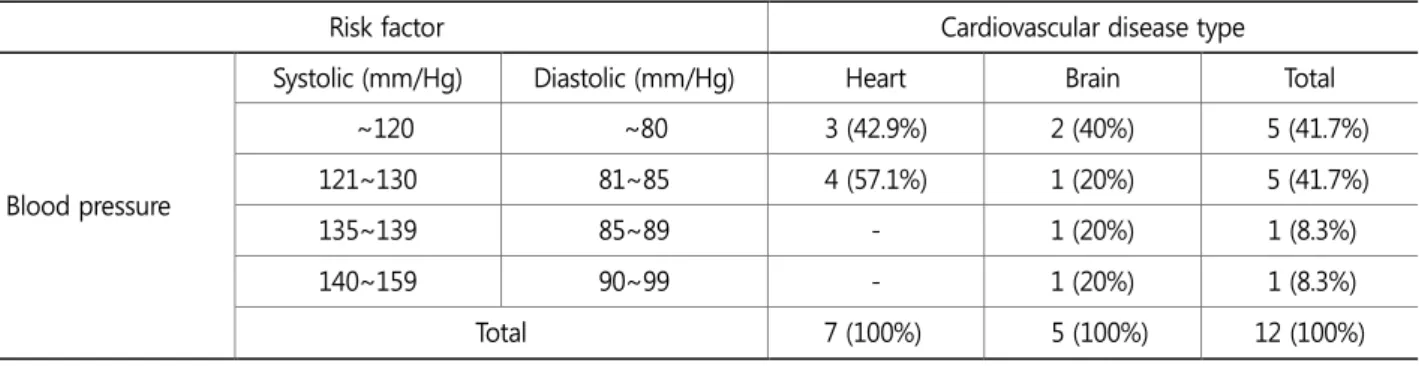
In Table 9, 100% of workers approved of cardiovascular disorder and 80% approved of cerebrovascular disease appeared to have ideal (systolic: -120, diastolic: -80), normal (systolic: 120-130, diastolic: 81-85) or high normal (systolic: 135-139, diastolic:
85-89) blood pressure levels (unit: mm/Hg). 91.7% of the total subjects had normal blood pressure in the examinations and 58.3% showed no relevance in the risk factor assessment. This means that many of the approved workers are evaluated as normal by the risk factor assessment. Therefore, results imply that more approved workers had been from unmanaged normal groups than managed risk groups, raising the importance of CVD management.
Table 10 displays the results of applying the alternatives 1 and 2 in evaluating risk factors for the 12 workers approved with cardiovascular diseases. It indicates that the rate of being included in the risk group is lowest when following the KOSHA GUIDE H-1-2013 and highest for alternative 2. Thus, alternative 2 best reflects the medical examination results and work conditions of the approved workers.
Table 8. Revised risk management grade
Work condition grade KOSHA Guide H-1-2013 risk grade
Normal Low Medium High
I Normal Low Medium High
II Low Medium High High
III Medium High High High
IV High High High High
Table 9. Distribution of 12 approved subjects by risk factors and cerebrovascular disease types
Risk factor Cardiovascular disease type
Blood pressure
Systolic (mm/Hg) Diastolic (mm/Hg) Heart Brain Total
~120 ~80 3 (42.9%) 2 (40%) 5 (41.7%)
121~130 81~85 4 (57.1%) 1 (20%) 5 (41.7%)
135~139 85~89 - 1 (20%) 1 (8.3%)
140~159 90~99 - 1 (20%) 1 (8.3%)
Total 7 (100%) 5 (100%) 12 (100%)
4. Discussion and Conclusion
In this study, the distribution of CVD risk assessment levels of work shift and work time following the KOSHA GUIDE H-1-2013 was compared with the acquired medical examination data to discuss the necessity of additional risk factors. Based on this comparison, two alternatives were given to enhance the accuracy of the evaluation; adjusting risk scores given in the KOSHA GUIDE H-1-2013 (alternative 1) and building a matrix of KOSHA GUIDE H-1-2013 and risk assessment results based on work condition levels (alternative 2). The second alternative showed more relevance between the results and workers approved of convalescence in predicting the risk group when applied to actual heath examination data from the approved workers. Also, many of the approved workers are evaluated as normal by the risk factor assessment of KOSHA GUIDE H-1-2013. Results imply that more approved workers had been from unmanaged normal groups than managed risk groups, raising the importance of CVD management in the workplace.
Worker safety and health laws are being established or medical examination data are being utilized for prevention (Cho and Jeong, 2013; Pyo and Jeong, 2010; Jeon and Jeong, 2013), along with data of approved convalescence (Kim et al., 2012; Yoo et al., 2011) and approaches in risk assessment (Jeong et al., 2012; Shin, 2013) in work places. In particular, researches on the effects of work time (ILO, 1990; Kim et al., 2012; Yoo et al., 2011) or shift work (Folkard, 2005; Jeon and Jeong, 2010; Jung et al., 2007; Kim et al., 2006; Park, 2012, Seo et al., 2003) on CVD have shown influence.
This study shines light on work time and shift type as risk factors having significance as management considerations for the prevention of CVD in the workplace. In this study, the evaluation was based on data from a limited 12 of convalescence-approved workers and the work type and hours were not retrieved on a sufficient number of samples. In order to make changes in the risk assessment guideline, further study is required for verifying risk factors with actual patients. However, this study was able to consider the previously neglected work time and shift factors in the CVD KOSHA GUIDE H-1-2013, providing alternatives for Table 9. Distribution of 12 approved subjects by risk factors and cerebrovascular disease types (Continued)
Risk factor Cardiovascular disease type
Risk factor score
0 4 (57.1%) 3 (60%) 7 (58.3%)
1 2 (28.6%) 2 (40%) 4 (33.3%)
2 1 (14.3%) - 1 (8.3%)
Total 7 (100%) 5 (100%) 12 (100%)
Table 10. Comparison of risk assessment methods using 12 approved subjects
Assessment grade Risk assessment methods
KOSHA GUIDE H-1-2013 Alternative 1 Alternative 2
Normal 9 (75%) 7 (58.3%) 2 (16.7%)
Low 1 (8.3%) 1 (8.3%) 1 (8.3%)
Medium 2 (16.7%) 2 (16.7%) 4 (33.3%)
High - 2 (16.7%) 5 (41.7%)
Total 12 (100%) 12 (100%) 12 (100%)
efficient management of employers with more challenging tasks from long hours of work and many shifts. Also, the risk levels suggested in this study is more a method of prevention rather than evaluation of convalescence-approved workers. Thus, further investigation is required for its application. Moreover, limits in comprehensive consideration of other CDV aggravating factors related to job stress, such as changes in workload or the external environment, signals for further need of study.
Acknowledgements
This research was financially supported by Hansung University.
References
Cho, K.S. and Jeong, B.Y., Lead Exposure Indices, Workloads, and Environmental Factors in Battery Manufacturing Workplace, Journal of the Ergonomics Society of Korea, 32(3), 259-266, 2013. doi:10.5143/JESK.2013.32.3.259
Folkard, S., Lombardi, D. and Tucker, P.T., Shift work: safety, sleepiness and sleep, Industrial Health, 43(1), 20-23, 2005.
ILO, R178-Night Work Recommendation, 1990 (No. 178), ILO, 1990.
http://www.ilo.org/dyn/normlex/en/f?p=1000:12020:0::NO::: (retrieved July 11, 2014).
Jeong, B.Y., Kim, W.J. and Jeong, Y.S., Risk Assessment in the Shipbuilding Industry Present and the Future, Journal of the Ergonomics Society of Korea, 31(1), 143-149, 2012. doi:10.5143/JESK.2012.31.1.143
Jeon, I.S. and Jeong, B.Y., Effect of Job Rotation on Job Satisfaction, Occupational Safety and Health, Journal of the Ergonomics Society of Korea, 32(5), 429-435, 2013. doi:10.5143/JESK.2013.32.5.429
Jeon, I.S. and Jeong, B.Y., A Study on the Job Rotation Types of Assembly Workers in a Motor Company, Journal of the Ergonomics Society of Korea, 29(6), 951-957, 2010. doi:10.5143/JESK.2010.29.6.951
Jung, Y.J., Sa, E.J., Kim, M.N., Lee, D.U., Park, K.H. and Sung, N.J., Alteration of Circadian Diurnal Rhythms of Cardiovascular Parameters by Night Shift Work in 3 Shift Nurses, Korean Journal of Family Medicine, 28(3), 187-194, 2007.
Kim, D.H., Yoon, Y.S. and Lee, Y.H., A Heuristic Approach to the Shift-scheduling Considering the Balance of Work-load in Nuclear Power Plants, Journal of the Ergonomics Society of Korea, 25(4), 1-7, 2006. doi:10.5143/JESK.2006.25.4.001
Kim, I.S., Ryu, S.C., Kim, Y.H. and Kwon, Y.J., Influencing Factors in Approving Cerebrovascular and CVDas Work-Related Disease of Workers' in Manufacturing Sectors, Annals of Occupational and Environmental Medicine, 24 (2), 158-166, 2012.
Kim, E.Y. and Hwang, S.Y., Incidence Risk of Cardiocerebrovascular Disease, Preventive Knowledge, Stage of Change and Health Behavior among Male Bus Drivers, Korean Journal of Adult Nursing, 23(4), 321-331, 2011.
KOSHA, KOSHA GUIDE H-1-2013 Risk Assessment and Post-Management Guidelines for Cardiovascular Disease in the Workplace, 2013.
Park, T.J., The Relationship between Shift Work and Work-related Injuries among Korean Workers, Annals of Occupational and Environmental Medicine, 24(1), 52-60, 2012.
Pyo, Y. and Jeong, B.Y., Correlation Analysis between Safety and Health Indices in a Shipbuilding Industry, Journal of the Ergonomics Society of Korea, 29(6), 897-905, 2010. doi:10.5143/JESK.2010.29.6.897
Seo, Y.J., Park, Y.M., Moon, S.K. et al., Problems of Working Hours and Shift Work Systems, and Proposed Methods for Their Improvement, Journal of the Ergonomics Society of Korea, 22(3), 13-26, 2003. doi:10.5143/JESK.2003.22.3.013
Shin, I.J., Comparative Study on the Institutional Framework of Risk Assessment between German, UK and Korea, Japan in Asian Countries, Journal of the Korean of Safety, 28(1), 151-157, 2013.
Ryu, S.C., Kim, I.S., Lee, J.H. et al., Factors for Approving Cerebrovascular Disorders and Cardiovascular Diseases as Work-related Diseases in Chronically Overworked Workers, Annals of Occupational and Environmental Medicine, 23(4), 379-386, 2011.
World Health Organisation, International Society of Hypertension Writing Group, 2003 World Health Organization (WHO)/
International Society of Hypertension (ISH) statement on management of hypertension, Journal of Hypertension, 21(11), 1983-1992, 2003.
Author listings
Eui Rak Choi: [email protected]
Highest degree: MS, Department of Industrial & Management Engineering, Hansung University Position title: Ergonomist, KOSHA
Areas of interest: Ergonomics, Safety and Health Management
Byung Yong Jeong: [email protected]
Highest degree: PhD, Department of Industrial Engineering, KAIST
Position title: Professor, Department of Industrial and Management Engineering, Hansung University Areas of interest: Ergonomics, Safety and Health Management, UX, UD