Blast Resistant Genes Distribution and Resistance Reaction to Blast in Korean Landraces of Rice (Oryza sativa L.)
Jae Young Song
1, Gi-An Lee
1, Yu-Mi Choi
1, Sukyeung Lee
1, Kwang Beom Lee
1, Chang-Hyu Bae
2, Yeonju Jung
1, Do-Yoon Hyun
1, Hong-Jae Park
1and Myung-Chul Lee
1*
1
National Agrobiodiversity Center, NAAS, RDA, Jeonju 560-500, Korea
2
Deparment of Bioresources Science, Sunchon National University, Suncheon 540-742, Korea
Abstract - Rice blast (Magnaporthe oryza B.) is one of the most important diseases in rice that causing great yield losses
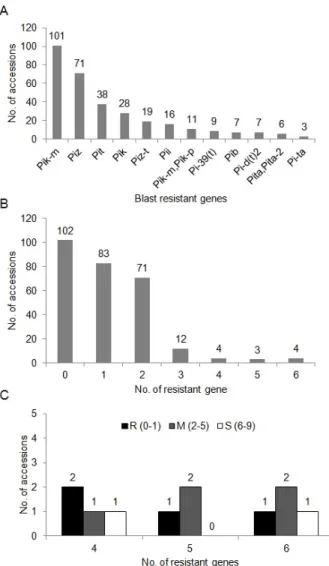
every year around the world. It is important to screen valuable genetic resources for improving blast resistance. This study was conducted to identify the blast resistance in 279 Korean rice landraces using blast nursery tests and isolate inoculum screening. The results showed that 11 landrace accessions found to be resistant to rice blast in blast nursery and inoculation screening tests and the degree of lesions in most accessions showed that they were susceptible to reactions. In order to find the distribution of blast resistant genes, a molecular survey was conducted to identify the presence of major blast resistance (R) gene in 279 Korean landraces. The results revealed that their frequency distribution was Pik-m (36.2%), Piz (25.4%), Pit (13.6%), and Pik (10%). Besides, the frequency distribution of Piz-t, Pii, Pik-m/Pik-p, Pi-39(t), Pib, Pi-d(t)2, Pita/Pita-2 and Pi-ta genes were identified as less than 10%. The results did not consist with the reactions against blast diseases between genotypes and phenotypic part of the nursery tests and isolate inoculation. For concluding these results, we used genome-wide SSR markers that have closely been located with resistance genes. The PCoA analysis showed that the landrace accessions formed largely two distinct groups according to their degree of blast resistance. By comparing genetic diversities using polymorphic information contents (PIC) value among the resistant, total and susceptible landraces, we found that PIC values decreased in four SSR markers and increased in six markers in the resistant accessions, which showed contrary to total and susceptible groups. These regions might be linked to resistance alleles. In this study, we evaluated the degree of blast resistance and the information about the distribution of rice blast resistant genes in Korean rice landraces.
This study might be the basis for association analysis of blast resistance in rice.
Key words -
Rice landraces, Blast, M. grisea, Molecular marker*Corresponding author. E-mail : [email protected]
Introduction
Rice (Oryza sativa L.) is one of the important staple food crops in the world and maintaining stable rice production is extremely important to feed the constantly growing human population (Maclean et al., 2002; Sasaki and Burr, 2000).
Manipulation of the disease resistant in rice is an important objective in all rice-breeding programs, because the production is constantly affected by several major diseases, such as bacterial blight, blast, sheath blight, and tungro. Among these diseases, rice blast disease caused by the ascomycete fungus Magnaporthe oryzae (Couch and Kohn, 2002), as the leading cause of yield loss of rice worldwide is the most devastating
fungal disease on cultivated rice as well as other species of the Poaceae (Zeigler et al., 1994; Talbot and Foster, 2001; Talbot, 2003). For the control of blast diseases, the breeding of resistant varieties is an effective approach to reduce the use of pesticides and minimized rice losses due to this disease.
However, the breakdown of blast resistance frequently occurs due to the rapid change in the blast pathogenic races after new developed cultivar release, with the exception of the some elite cultivar. It is indicated that the genetic control of blast resistance is complex due to major and minor genes with complementary or additive effects, as well as their environment interactions (Yamanaka and Yamaguchi, 1987; Yaegashi, 1994; Han et al., 2001). The ideal approach for blast control is probably to develop durable resistance cultivars accumulating several resistance (R) genes against highly variable pathogen
Original Research Article
(Bonman et al., 1986; Hittalmani et al., 2000).
Genetic studies of resistance to rice blast began by establishing the differential system for races of the blast in the early 1960s. Since then, the inheritance of resistance has been extensively studied, and over 70 major R genes have now been reported (Chen et al., 2005; Ballini et al., 2008; Koide et al., 2009). During the last few years, considerable progress has been made to understand molecular mechanisms of M.
grisea infection to rice plants and rice blast R genes [Pit, Pib, Piz, Pik, Pik-m/Pik-p, Pita/Pita-2 (Hayashi et al., 2006), Piz-t (Hayashi et al., 2004; Zhou et al., 2006), Pi-d(t)2 (Chen et al., 2004), Pii (Jeon et al., 2003), Pik-m (Zhai et al., 2011), Pi39 (Liu et al., 2007), Pita (Jia et al., 2002 and Jia et al., 2004), Pi9 (Qu et al., 2006), Pid2 (Chen et al., 2006), Pi2 (Zhou et al., 2006), Pi36 (Liu et al., 2007), Pi37 (Lin et al., 2007), Pi5 (Lee et al., 2009) and Pi3 (Shang et al., 2009)] have been identified and characterized via map-based cloning or chromo- some walking. Due to map-based cloning marker system and the integration of high-density molecular linkage map with genome sequence information of rice, marker-assisted selection (MAS) in molecular marker technology may provide new solutions for identifying and pyramiding valuable gene to improve the blast disease resistance in rice. Some studies have been reported that introductions of the major resistant genes into the rice varieties are correlated to the blast disease resistance of rice (Cho et al., 1996; Jeung et al., 2007; Suh et al., 2009) using molecular marker that reported blast resistant (R) gene marker or known as well-characterized resistant gene markers. According to the widely genome research progresses, specific gene marker identified in accordance with the characteristics serve as a valuable tool for assessment of genetic variability and information offering for high blast resistance among rice landraces germplasm.
According to Harlan (1975), landraces are the balanced resources in equilibrium with both the environment and pathogens and are genetically dynamic. Rice landraces have been domesticated for a long time in a specific region and accordingly were adapted to their natural and cultural environ- ment. The landraces has a long term co-evolution between the resources and rice blast pathogen, and the distribution of resistance genes and rice blast was closely related (Li et al., 2012). Landrace could be used for breeding program in that it
conserves useful alleles adapted to specific environment.
Variation in landraces can be used to complement and is helpful for broadening the crop gene pool (Kobayashi et al., 2006).
For these reasons, rice landraces has been valued as genetic variation sources of many agronomic traits and may have great potential for breeding of cultivated rice (Villa et al., 2006).
Korean landraces have been continuously maintained by farmers within different agricultural areas as well as their local environments. Therefore, this study was conducted to get the blast resistance degree of rice landraces germplasm in blast pathogenicity of field and in vitro tests and to investigate the distribution of blast resistant genes in Korean landraces. The present study reports on the screening and evaluation of rice germplasm for sources of resistance against rice blast disease.
Materials and Methods
Evaluation of blast resistance by field nursery test and in vitro inoculation
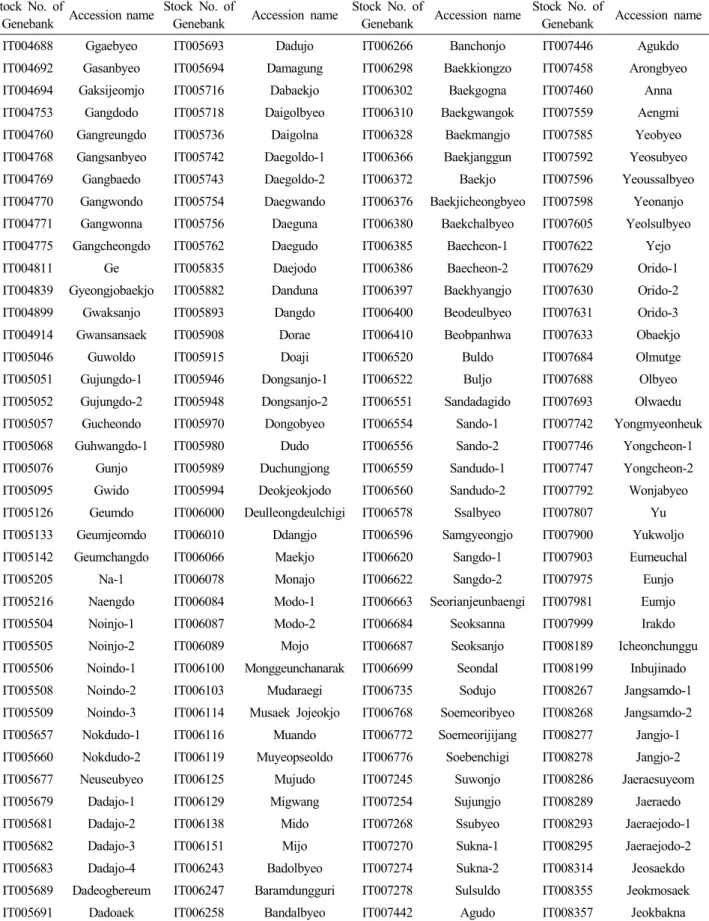
The plant materials used in this study were 279 Korean rice landraces (Table 1), which have been conserved in the RDA Genbank (http:// genebank.rda.go.kr.). These rice germplasm were evaluated for seedling reaction under field nursery test, which was replicated two times at experimental field of Cheolwon, in Korea from 2010 to 2011. Each accession was planted in one row of 50 ㎝ long and 15 ㎝ apart, with cv.
mixture of three cultivars (Chugwangbyeo, Odaebyeo, and Yeomyeongbyeo) as a susceptible check from each side of the bed and alternatively after the ten rows of each tested entry. Plants were left for natural leaf blast infection and scored 30-45 days after sowing.
M. grisea isolates collected in Korea was used for pathogenic
test in this study. The 31 isolates of M. grisea have been
conserved in the National Institute of Crop Science (NICS)
and these isolates are genetically stable and routinely used for
studies in Korea (Ahn et al., 2000; Goh et al., 2013). Pathogen
inoculation and blast response evaluation of the 279 landraces
were carried out at the NICS, Rural Development Administration,
in Korea. At the seedling stage, the inoculums suspension of
ca. 5 × 10
4conidia/㎖ was sprayed onto rice leaves in a
controlled chamber. Inoculated seedlings were moved to the
greenhouse after 3 days incubation in saturated humidity
Table 1. List of Korean rice landraces used in this study
Stock No. ofGenebank Accession name Stock No. of
Genebank Accession name Stock No. of
Genebank Accession name Stock No. of
Genebank Accession name IT004688 Ggaebyeo IT005693 Dadujo IT006266 Banchonjo IT007446 Agukdo IT004692 Gasanbyeo IT005694 Damagung IT006298 Baekkiongzo IT007458 Arongbyeo IT004694 Gaksijeomjo IT005716 Dabaekjo IT006302 Baekgogna IT007460 Anna IT004753 Gangdodo IT005718 Daigolbyeo IT006310 Baekgwangok IT007559 Aengmi IT004760 Gangreungdo IT005736 Daigolna IT006328 Baekmangjo IT007585 Yeobyeo IT004768 Gangsanbyeo IT005742 Daegoldo-1 IT006366 Baekjanggun IT007592 Yeosubyeo IT004769 Gangbaedo IT005743 Daegoldo-2 IT006372 Baekjo IT007596 Yeoussalbyeo IT004770 Gangwondo IT005754 Daegwando IT006376 Baekjicheongbyeo IT007598 Yeonanjo IT004771 Gangwonna IT005756 Daeguna IT006380 Baekchalbyeo IT007605 Yeolsulbyeo IT004775 Gangcheongdo IT005762 Daegudo IT006385 Baecheon-1 IT007622 Yejo
IT004811 Ge IT005835 Daejodo IT006386 Baecheon-2 IT007629 Orido-1
IT004839 Gyeongjobaekjo IT005882 Danduna IT006397 Baekhyangjo IT007630 Orido-2 IT004899 Gwaksanjo IT005893 Dangdo IT006400 Beodeulbyeo IT007631 Orido-3 IT004914 Gwansansaek IT005908 Dorae IT006410 Beobpanhwa IT007633 Obaekjo
IT005046 Guwoldo IT005915 Doaji IT006520 Buldo IT007684 Olmutge
IT005051 Gujungdo-1 IT005946 Dongsanjo-1 IT006522 Buljo IT007688 Olbyeo IT005052 Gujungdo-2 IT005948 Dongsanjo-2 IT006551 Sandadagido IT007693 Olwaedu IT005057 Gucheondo IT005970 Dongobyeo IT006554 Sando-1 IT007742 Yongmyeonheuk IT005068 Guhwangdo-1 IT005980 Dudo IT006556 Sando-2 IT007746 Yongcheon-1 IT005076 Gunjo IT005989 Duchungjong IT006559 Sandudo-1 IT007747 Yongcheon-2 IT005095 Gwido IT005994 Deokjeokjodo IT006560 Sandudo-2 IT007792 Wonjabyeo IT005126 Geumdo IT006000 Deulleongdeulchigi IT006578 Ssalbyeo IT007807 Yu IT005133 Geumjeomdo IT006010 Ddangjo IT006596 Samgyeongjo IT007900 Yukwoljo IT005142 Geumchangdo IT006066 Maekjo IT006620 Sangdo-1 IT007903 Eumeuchal
IT005205 Na-1 IT006078 Monajo IT006622 Sangdo-2 IT007975 Eunjo
IT005216 Naengdo IT006084 Modo-1 IT006663 Seorianjeunbaengi IT007981 Eumjo IT005504 Noinjo-1 IT006087 Modo-2 IT006684 Seoksanna IT007999 Irakdo IT005505 Noinjo-2 IT006089 Mojo IT006687 Seoksanjo IT008189 Icheonchunggu IT005506 Noindo-1 IT006100 Monggeunchanarak IT006699 Seondal IT008199 Inbujinado IT005508 Noindo-2 IT006103 Mudaraegi IT006735 Sodujo IT008267 Jangsamdo-1 IT005509 Noindo-3 IT006114 Musaek Jojeokjo IT006768 Soemeoribyeo IT008268 Jangsamdo-2 IT005657 Nokdudo-1 IT006116 Muando IT006772 Soemeorijijang IT008277 Jangjo-1 IT005660 Nokdudo-2 IT006119 Muyeopseoldo IT006776 Soebenchigi IT008278 Jangjo-2 IT005677 Neuseubyeo IT006125 Mujudo IT007245 Suwonjo IT008286 Jaeraesuyeom IT005679 Dadajo-1 IT006129 Migwang IT007254 Sujungjo IT008289 Jaeraedo IT005681 Dadajo-2 IT006138 Mido IT007268 Ssubyeo IT008293 Jaeraejodo-1 IT005682 Dadajo-3 IT006151 Mijo IT007270 Sukna-1 IT008295 Jaeraejodo-2 IT005683 Dadajo-4 IT006243 Badolbyeo IT007274 Sukna-2 IT008314 Jeosaekdo IT005689 Dadeogbereum IT006247 Baramdungguri IT007278 Sulsuldo IT008355 Jeokmosaek IT005691 Dadoaek IT006258 Bandalbyeo IT007442 Agudo IT008357 Jeokbakna
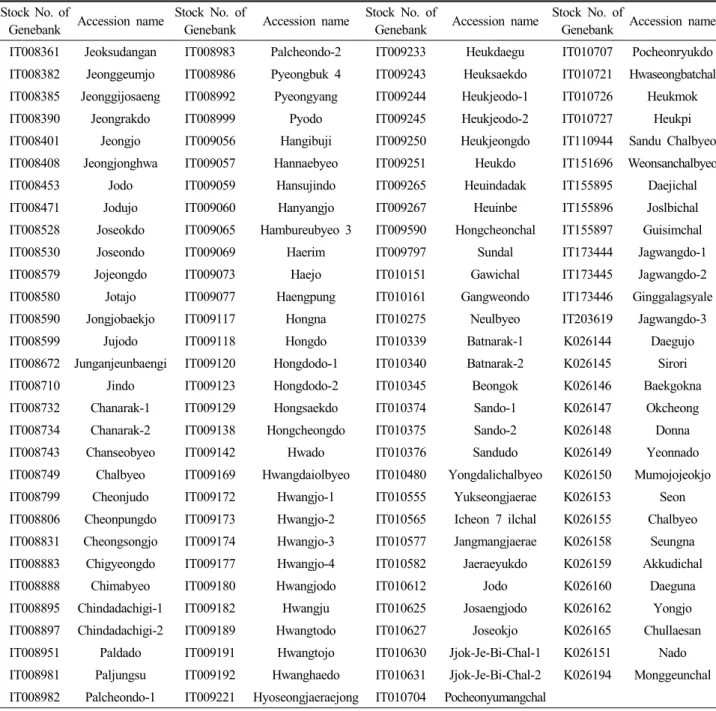
Table 1. Continued
Stock No. ofGenebank Accession name Stock No. of
Genebank Accession name Stock No. of
Genebank Accession name Stock No. of
Genebank Accession name IT008361 Jeoksudangan IT008983 Palcheondo-2 IT009233 Heukdaegu IT010707 Pocheonryukdo IT008382 Jeonggeumjo IT008986 Pyeongbuk 4 IT009243 Heuksaekdo IT010721 Hwaseongbatchal IT008385 Jeonggijosaeng IT008992 Pyeongyang IT009244 Heukjeodo-1 IT010726 Heukmok IT008390 Jeongrakdo IT008999 Pyodo IT009245 Heukjeodo-2 IT010727 Heukpi IT008401 Jeongjo IT009056 Hangibuji IT009250 Heukjeongdo IT110944 Sandu Chalbyeo IT008408 Jeongjonghwa IT009057 Hannaebyeo IT009251 Heukdo IT151696 Weonsanchalbyeo IT008453 Jodo IT009059 Hansujindo IT009265 Heuindadak IT155895 Daejichal IT008471 Jodujo IT009060 Hanyangjo IT009267 Heuinbe IT155896 Joslbichal IT008528 Joseokdo IT009065 Hambureubyeo 3 IT009590 Hongcheonchal IT155897 Guisimchal IT008530 Joseondo IT009069 Haerim IT009797 Sundal IT173444 Jagwangdo-1 IT008579 Jojeongdo IT009073 Haejo IT010151 Gawichal IT173445 Jagwangdo-2 IT008580 Jotajo IT009077 Haengpung IT010161 Gangweondo IT173446 Ginggalagsyale IT008590 Jongjobaekjo IT009117 Hongna IT010275 Neulbyeo IT203619 Jagwangdo-3
IT008599 Jujodo IT009118 Hongdo IT010339 Batnarak-1 K026144 Daegujo
IT008672 Junganjeunbaengi IT009120 Hongdodo-1 IT010340 Batnarak-2 K026145 Sirori IT008710 Jindo IT009123 Hongdodo-2 IT010345 Beongok K026146 Baekgokna IT008732 Chanarak-1 IT009129 Hongsaekdo IT010374 Sando-1 K026147 Okcheong IT008734 Chanarak-2 IT009138 Hongcheongdo IT010375 Sando-2 K026148 Donna IT008743 Chanseobyeo IT009142 Hwado IT010376 Sandudo K026149 Yeonnado IT008749 Chalbyeo IT009169 Hwangdaiolbyeo IT010480 Yongdalichalbyeo K026150 Mumojojeokjo IT008799 Cheonjudo IT009172 Hwangjo-1 IT010555 Yukseongjaerae K026153 Seon IT008806 Cheonpungdo IT009173 Hwangjo-2 IT010565 Icheon 7 ilchal K026155 Chalbyeo IT008831 Cheongsongjo IT009174 Hwangjo-3 IT010577 Jangmangjaerae K026158 Seungna IT008883 Chigyeongdo IT009177 Hwangjo-4 IT010582 Jaeraeyukdo K026159 Akkudichal
IT008888 Chimabyeo IT009180 Hwangjodo IT010612 Jodo K026160 Daeguna
IT008895 Chindadachigi-1 IT009182 Hwangju IT010625 Josaengjodo K026162 Yongjo IT008897 Chindadachigi-2 IT009189 Hwangtodo IT010627 Joseokjo K026165 Chullaesan IT008951 Paldado IT009191 Hwangtojo IT010630 Jjok-Je-Bi-Chal-1 K026151 Nado IT008981 Paljungsu IT009192 Hwanghaedo IT010631 Jjok-Je-Bi-Chal-2 K026194 Monggeunchal IT008982 Palcheondo-1 IT009221 Hyoseongjaeraejong IT010704 Pocheonyumangchal
chamber. Blast disease incidence was evaluated in two weeks after inoculation according to Ahn et al. (2000). The incidence of blast disease in blast nursery test was scored from 0 (no lesions) to 9 (necrosis of all leaves and sheaths) following Standard Evaluation System (SES, IRRI, 2002). Accessions were assigned to the resistance (R) group in score 0-3, moderate resistance in 4-6 and susceptible in 7-9, respectively. The reproducible accessions of R and S group were selected to analyze the blast resistance gene distribution. The isolate
inoculation screening were assigned to resistance in score 0-2, moderate resistance in 3, and susceptible in 4-5, respec- tively.
DNA extraction and Marker analysis
Genomic DNA as extracted from two weeks old fresh leaf
tissue according to modified CTAB method as previously
described by Kump and Javornik (1996). The DNA concentra-
tion was determined using a UV–Vis spectrophotometer
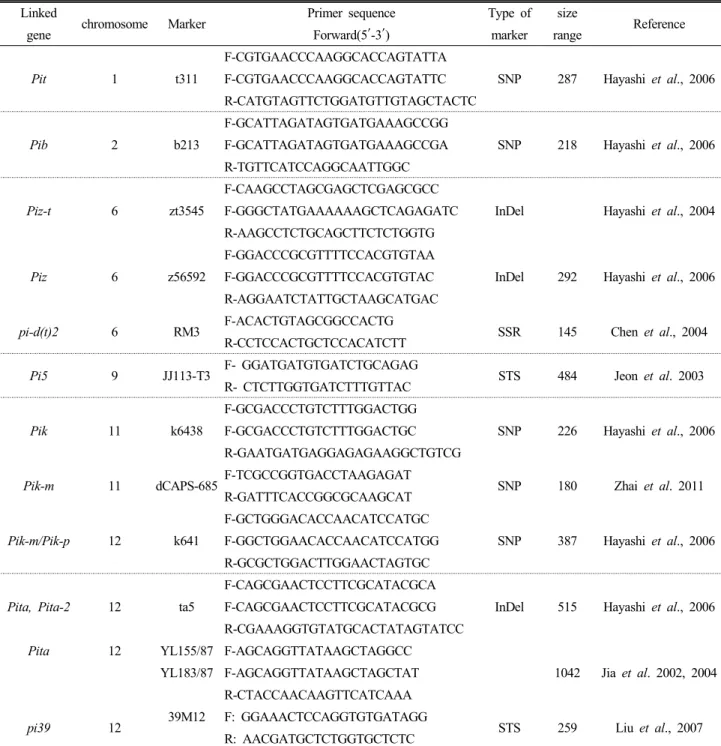
Table 2. Gene specific primers used for the amplification of rice blast resistance genes
Linkedchromosome Marker Primer sequence Type of size
Reference
gene Forward(5′-3′) marker range
Pit 1 t311
F-CGTGAACCCAAGGCACCAGTATTA
SNP 287 Hayashi et al., 2006 F-CGTGAACCCAAGGCACCAGTATTC
R-CATGTAGTTCTGGATGTTGTAGCTACTC
Pib 2 b213
F-GCATTAGATAGTGATGAAAGCCGG
SNP 218 Hayashi et al., 2006 F-GCATTAGATAGTGATGAAAGCCGA
R-TGTTCATCCAGGCAATTGGC
Piz-t 6 zt3545
F-CAAGCCTAGCGAGCTCGAGCGCC
InDel Hayashi et al., 2004 F-GGGCTATGAAAAAAGCTCAGAGATC
R-AAGCCTCTGCAGCTTCTCTGGTG
Piz 6 z56592
F-GGACCCGCGTTTTCCACGTGTAA
InDel 292 Hayashi et al., 2006 F-GGACCCGCGTTTTCCACGTGTAC
R-AGGAATCTATTGCTAAGCATGAC
pi-d(t)2 6 RM3 F-ACACTGTAGCGGCCACTG
SSR 145 Chen et al., 2004 R-CCTCCACTGCTCCACATCTT
Pi5 9 JJ113-T3 F- GGATGATGTGATCTGCAGAG
STS 484 Jeon et al. 2003 R- CTCTTGGTGATCTTTGTTAC
Pik 11 k6438
F-GCGACCCTGTCTTTGGACTGG
SNP 226 Hayashi et al., 2006 F-GCGACCCTGTCTTTGGACTGC
R-GAATGATGAGGAGAGAAGGCTGTCG
Pik-m 11 dCAPS-685 F-TCGCCGGTGACCTAAGAGAT
SNP 180 Zhai et al. 2011 R-GATTTCACCGGCGCAAGCAT
Pik-m/Pik-p 12 k641
F-GCTGGGACACCAACATCCATGC
SNP 387 Hayashi et al., 2006 F-GGCTGGAACACCAACATCCATGG
R-GCGCTGGACTTGGAACTAGTGC
Pita, Pita-2 12 ta5
F-CAGCGAACTCCTTCGCATACGCA
InDel 515 Hayashi et al., 2006 F-CAGCGAACTCCTTCGCATACGCG
R-CGAAAGGTGTATGCACTATAGTATCC Pita 12 YL155/87 F-AGCAGGTTATAAGCTAGGCC
1042 Jia et al. 2002, 2004 YL183/87 F-AGCAGGTTATAAGCTAGCTAT
R-CTACCAACAAGTTCATCAAA
pi39 12 39M12 F: GGAAACTCCAGGTGTGATAGG
STS 259 Liu et al., 2007 R: AACGATGCTCTGGTGCTCTC
(ND-1000; NanoDrop, Wilmington, DE, USA). The DNA solution was then diluted to a working concentration with distilled water and stored at -20℃ until use. Polymerase chain reaction (PCR) was performed using the gene specific primers described as blast resistant and susceptible genes, which are listed in Table 2. Ten ng of genomic DNA was used in a 20 ㎕ PCR reaction containing 2 ㎕ of the specific primer
pairs (10 pmol/ul), 2.0 ㎕ of 10 x PCR buffer, 1.6 ㎕ of dNTP (2.5 mM), and 0.2 ㎕ of Taq polymerase (5 unit/㎕; Promega.
USA). The reaction mixture was subjected to the following
conditions: initial denaturation at 94℃ for 3 min, followed by
35 cycles of denaturation at 94℃ for 30 s, annealing at 50-5
5℃ for 45 s and extension at 72℃ for 45 s and final extension
at 72℃ for 10 min. PCR was carried out in PTC-220
Table 3. Distribution patterns of blast resistant genes in 11 resistant cultivars selected on blast nursery test and isolate inoculation
IT/Tem. Accession Name
Pit Pib Piz-t Piz Pik Pik-m Pik-m,
Pik-p
Pita,
Pita-2 Pi-ta Pi39 Pi-d(t)2 Pii t311 b213 zt3545 z56592 K6438 dCAPS-
685 K641 ta5 YL 155
YL
183 39M12 39M22 RM3 JJ113-T3
Rz Sy R S R S R S R S R R S R S R S R R R R
IT006538 Saducho + - + - - + - + - + + + - - + - + + + - -
IT009118 Hongdo + - + - - + - + - + + - + - + - + + + - -
IT009221 Hyosung-
jaerae + - + - - + - + - + - - + + - + - + + + -
IT010345 Beonkok + - - + - + - + - + - - + - + - + - - - -
IT010480 Yongdali-
chalbyeo + - - + - + - + - + - - + - + - + - - - -
IT010555 Yukseong-
jaerae + - - + - + - + - + - - + - + - + - - - -
IT010565 Icheon7ilcha + - - + + - - + - + - - + - + - + - - - -
IT010577 Jangmang-
jaerae + - - + - + - + - + - - + - + - + - - - -
IT010721 Hwaseong-
batchal + - - + - + - + - + - - + - + - + - - - -
IT010726 Hweukmok + - - + - + - + - + - - + - + - + - - - -
K026194 Mongkeun-
chalbyeo + - - + + + - + - + - + - - - + + - -
+: Positive response, -: negative response
zblast resistance specific primers
yblast susceptible specific primers
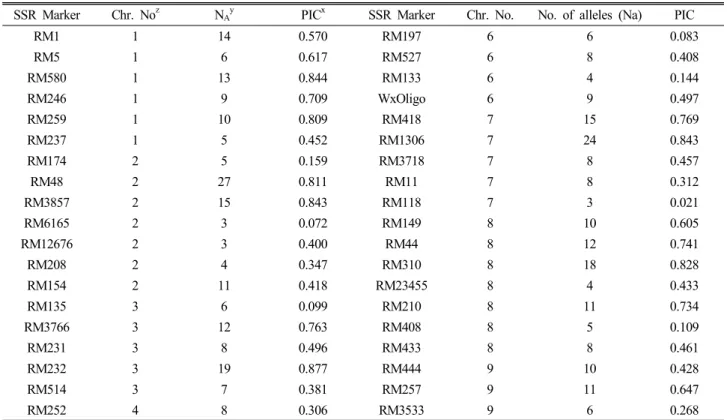
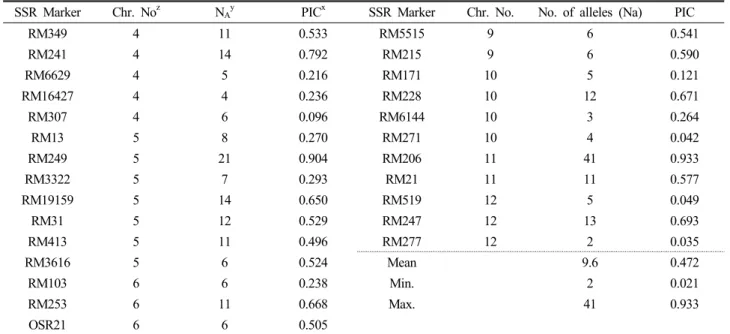
Table 4. Chromosomal localization, number of detected alleles and polymorphism information content (PIC) obtained through 64 SSR marker analyses
SSR Marker Chr. Noz NAy PICx SSR Marker Chr. No. No. of alleles (Na) PIC
RM1 1 14 0.570 RM197 6 6 0.083
RM5 1 6 0.617 RM527 6 8 0.408
RM580 1 13 0.844 RM133 6 4 0.144
RM246 1 9 0.709 WxOligo 6 9 0.497
RM259 1 10 0.809 RM418 7 15 0.769
RM237 1 5 0.452 RM1306 7 24 0.843
RM174 2 5 0.159 RM3718 7 8 0.457
RM48 2 27 0.811 RM11 7 8 0.312
RM3857 2 15 0.843 RM118 7 3 0.021
RM6165 2 3 0.072 RM149 8 10 0.605
RM12676 2 3 0.400 RM44 8 12 0.741
RM208 2 4 0.347 RM310 8 18 0.828
RM154 2 11 0.418 RM23455 8 4 0.433
RM135 3 6 0.099 RM210 8 11 0.734
RM3766 3 12 0.763 RM408 8 5 0.109
RM231 3 8 0.496 RM433 8 8 0.461
RM232 3 19 0.877 RM444 9 10 0.428
RM514 3 7 0.381 RM257 9 11 0.647
RM252 4 8 0.306 RM3533 9 6 0.268
Table 4. Continued
SSR Marker Chr. Noz NAy PICx SSR Marker Chr. No. No. of alleles (Na) PIC
RM349 4 11 0.533 RM5515 9 6 0.541
RM241 4 14 0.792 RM215 9 6 0.590
RM6629 4 5 0.216 RM171 10 5 0.121
RM16427 4 4 0.236 RM228 10 12 0.671
RM307 4 6 0.096 RM6144 10 3 0.264
RM13 5 8 0.270 RM271 10 4 0.042
RM249 5 21 0.904 RM206 11 41 0.933
RM3322 5 7 0.293 RM21 11 11 0.577
RM19159 5 14 0.650 RM519 12 5 0.049
RM31 5 12 0.529 RM247 12 13 0.693
RM413 5 11 0.496 RM277 12 2 0.035
RM3616 5 6 0.524 Mean 9.6 0.472
RM103 6 6 0.238 Min. 2 0.021
RM253 6 11 0.668 Max. 41 0.933
OSR21 6 6 0.505
zChromosome Number.
yNumber of alleles.
xPolymorphic information content.