가중표준편차를 이용한 비대칭 모집단에 대한 다변량 공정능력지수
장영순
1
․배도선2†
1
LG CNS 컨설팅 부문 /2
한국과학기술원 산업공학과Multivariate Process Capability Indices for Skewed Populations with Weighted Standard Deviations
Young Soon Chang
1
․Do Sun Bai2
1
LG CNS Co., Ltd. Consulting SSU, Seoul, 100-7682
Department of Industrial Engineering, Korea Advanced Institute of Science and Technology, Daejon, 305-701 This paper proposes multivariate process capability indices (PCIs) for skewed populations usingT
2 and modified process region approaches. The proposed methods are based on the multivariate version of a weighted standard deviation method which adjusts the variance-covariance matrix of quality characteristics and approximates the probability density function using several multivariate normal distributions with the adjusted variance-covariance matrix. Performance of the proposed PCIs is investigated using Monte Carlo simulation, and finite sample properties of the estimators are studied by means of relative bias and mean square error.Keywords: process capability index, skewed population, weighted standard deviation, T
2 approach, modified process region approach†Corresponding author : Professor Do Sun Bai, Department of Industrial Engineering, Korea Advanced Institute of Science and Technology, Daejon, Korea, 305-701, Fax : 82-42-869-3110, e-mail : [email protected]
Received November 2002; revision received February 2003; accepted February 2003.
1. Introduction
Process capability analysis is an important and integral part of the statistical process control activities for the continuous improvement of quality and productivity.
The capability of a process is frequently measured by a process capability index (PCI) which is designed to provide a common and easily understood language for quantifying its performance with a single-number summary, and is a dimensionless function of process parameters and specifications.
C
p andC
pk are widely used PCIs based on univariate quality measurements.However, capability analyses involving more than one quality characteristics are sometimes of interest, and
multivariate statistical techniques can be used to analyze several quality characteristics simultaneously.
A difficulty of defining multivariate PCIs is that there is no consensus on the methodology for assessing capability, which arises since the multivariate relationship among the quality characteristics may or may not be reflected in the engineering specifications.
In general, the upper specification limit (
USL
) and the lower specification limit (LSL
) may be given for each quality characteristic and these specification ranges, taken together, form a rectangle or hypercube.A multivariate PCI should compare the shapes, locations, sizes, and orientations arising from the statistical distribution with those from the engineering specifications, which can lead to very different defini- tions of capability in the multivariate domain.
Several multivariate PCIs have been proposed.
Hubele et al. (1991) proposed a multivariate capability vector which consists of three components, a ratio of area or volumes, a relative location of the process and specification centers, and a relative location of maximum and minimum of the probability contour and the specification limits. Taam et al. (1993) proposed
MC
pm which is the ratio of specification region to a scaled 99.73 percent process region. Karl etal. (1994) considered geometric dimensioning and
tolerancing which is a set of standards to describe the physical features and their specified tolerances. Wang and Chen (1998-99) suggested to use principal components analysis. For more detailed reviews, see Kotz and Lovelace (1998) and Wang et al. (2000).These methods, however, are confined to the case of multivariate normal populations. In practice, the nor- mality assumption is usually difficult to justify and is often not appropriate. For example, the measurements from chemical processes, filling processes, and semi- conductor processes are often skewed. Recently, Polansky (2001) proposed a nonparametric approach based on a kernel estimate of an integral of a multi- variate density. This procedure can do without the nor- mality assumption, but may be somewhat complicated for practitioners and may need a large amount of data to perform well. Therefore, it is necessary to develop a multivariate PCI for skewed populations which is simple and performs reasonably well even with a small data set.
This paper proposes methods of constructing simple multivariate PCIs for skewed populations based on the multivariate version of a 'weighted standard deviation (WSD) method of Chang and Bai (2002). This method adjusts the variance-covariance matrix in accordance to the degree of skewness of the distribution by using different factors in computing the deviations above and below the process mean and approximates the probability density function (PDF) using several multi- variate normal distributions with adjusted variance- covariance matrix.
This paper is organized as follows: Section 2 reviews the WSD method. Section 3 proposes two multivariate WSD PCIs using
T
2 and modified process region (Hubele et al. (1991)) approaches. TheT
2 approach uses Hotelling'sT
2 statistic to reduce the dimension of quality characteristics, and the process region approach defines the PCI as the ratio of the volume of engineering tolerance region to the volume of modi- fied process region. The performance of the proposed PCIs is investigated in Section 4, and the finite sample properties are studied in Section 5.2. W eighted Standard Deviation(W SD) M ethod
Chang and Bai (2001) and Chang et al. (2002) propos- ed a WSD method to construct univariate control charts and PCIs for skewed populations, respectively.
The WSD method is based on the idea that standard deviation
σ
X can be divided into upper and lower deviations,σ
WU andσ
WL, which represent the degree of the dispersions of the upper and lower sides from meanμ
X, respectively. WSDsσ
WU andσ
WL are obtained asσ
WU= P
Xσ
X andσ
WL= ( 1 - P
X) σ
X, whereP
X= Pr { X≤μ
X}
. An asymmetric PDF can be approximated with two normal PDFs with the same meanμ
X but different standard deviations2σ
WU and2σ
WL. Details can be found in Chang and Bai (2001).Chang and Bai (2002) suggested a multivariate WSD method and constructed a WSD
T
2 control chart for skewed populations. The multivariate WSD method adjusts the variance-covariance matrix with WSDs of each quality characteristic. However, we should not tamper with the correlation matrix since it represents the dependent structure of quality characteristics and a multivariate control chart must reflect this dependency. If the variance-covariance matrix is adjusted and the correlation matrix is maintained, the scale of the conventional control region is adjusted in accordance with skewness but the direction is maintained.< Figure 1> depicts the iso-PDF contours of the original distribution, bivariate normal distribution, and approximated distribution by the WSD method with two quality characteristics,
X
andY
. For simplicity, the correlation ofX
andY
is set to zero. < Figure 1(a)> describes the iso-PDF contours of the original bivariate distribution, which show that the distribution of( X,Y )
is skewed. < Figure 1(b)> shows that the iso-PDF contour of the bivariate normal distribution is very different from that of original distribution and the rate of incorrect decisions will be large if the standard method based on the normality assumption is used.< Figure 1(c)> represents the concept of a multivariate version of the WSD method. Similarly to the univariate case, the original bivariate PDF can be approximated with four segments each from four bivariate normal PDFs which are obtained with the combination of normal PDFs derived from marginal PDFs of
X
andY
. < Figure 1(c)> shows that the iso-PDF contour of the original skewed distribution is approximated with four parts each from the iso-PDF contour of the derived bivariate normal distributions,①, ②, ③, and ④. It is similar to the iso-PDF contour of the original PDF, and we can see that the WSD method can effectively approximate the PDF of a bivariate skewed distribution.
µY
µX
marginal PDF of Y
marginal PDF of X
(a) iso-PDF contours of skewed distribution
iso-PDF contour of bivariate normal distribution incorrect decision
(b) iso-PDF contour of normal distribution
(,1) MVN µ Σ
① MVN µ Σ(,2)
②
(, 3) MVN µ Σ
③
(,4) MVN µ Σ
④
approximated iso-PDF contour
① ②
③
④
(c) iso-PDF contour approximated with WSD method MVN(μ, Σ): multivariate normal distribution with
mean vector μ and variance-covariance matrix Σ
Figure 1. Iso-PDF contours and concept of
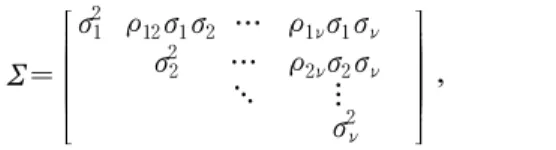
multivariate WSD Method.Assume that
ν
-variate random vectorX = ( X
1,…,
X
ν)
T is distributed with mean vectorμ = (μ
1,…,μ
ν)
T and variance-covariance matrixΣ = ꀎ
ꀚ
︳ ︳
︳ ︳
︳ ︳
︳ ︳
︳ ︳
ꀏ
ꀛ
︳ ︳
︳ ︳
︳ ︳
︳ ︳
︳ ︳ σ
2 1ρ
12σ
1σ
2… ρ
1νσ
1σ
νσ
2 2… ρ
2νσ
2σ
ν⋱ ⋯
σ
2ν, (1)
where ‘
T
’ denotes the transpose of a vector or matrix,σ
j is the standard deviation ofX
j, andρ
ij is the correlation coefficient ofX
i andX
j. For the approximation such as < Figure 1(c)>, the variance- covariance matrix should be adjusted as follows:
Σ
W= W Σ W =
ꀎ
ꀚ
︳ ︳
︳ ︳
︳ ︳
︳ ︳
︳ ︳
ꀏ
ꀛ
︳ ︳
︳ ︳
︳ ︳
︳ ︳
︳ ︳ ( σ
W1)
2ρ
12σ
W1σ
W2… ρ
1νσ
W1σ
W ν( σ
W2)
2… ρ
2νσ
W2σ
Wν⋱ ⋯ ( σ
Wν)
2, (2)
where
W = diag { W
1,…,W
ν}
,W
j= { 2P 2( 1 - P
j,
j), otherwise , if X
j> μ
j,
(3)σ
Wj= W
jσ
j, andP
j= Pr { X
j≤μ
j}
. IfX
j is greater thanμ
j, the PDF related toX
j is modified by adjusting thej
th row and column of the variance- covariance matrix using upper deviation2P
jσ
j in place ofσ
j. Otherwise, thej
th row and column of the variance-covariance matrix is adjusted using lower deviation2( 1 - P
j) σ
j. Note that correlation matrixρ = { ρ
ij}
does not change after the variance-covariance matrix is adjusted. This WSD method approximates the original PDF with segments from2
ν multivariate normal distributions. < Figure 1(c)> is obtained with four bivariate normal distributions with the same mean vectorμ = (μ
X,μ
Y)
T but different variance-covariance matrices as follows:Σ
1= [ ρ
XY⋅2( 1 - P { 2( 1 - P
XX)σ ) σ
XX⋅2P }
2 Yσ
Yρ
XY⋅2( 1 - P { 2P
Yσ
X)σ
Y}
X2⋅2P
Yσ
Y]
,Σ
2= [ ρ
XY⋅2P {2P
XXσ σ
XX⋅2P }
2 Yσ
Yρ
XY⋅2P {2P
XYσ σ
XY⋅2P }
2 Yσ
Y]
,Σ3=
[
ρXY⋅2( 1 - P{ 2( 1 - PX)σXX⋅2( 1 - P)σX}2 Y)σYρXY⋅2( 1 - P{ 2( 1 - PX)σXY⋅2( 1 - P)σY}2 Y)σY]
,Σ
4= [ ρ
XY⋅2P {2P
Xσ
X⋅2(1-P
Xσ
X}
2 Y)σ
Yρ
XY⋅2P {2(1-P
Xσ
X⋅2(1-P
Y)σ
Y}
2 Y)σ
Y]
.Since the WSD method approximates the PDF of the original distribution using normal distributions, the standard statistical methods based on the normality
assumption can be used with the approximated distri- bution.
3. Multivariate PCIs Based on the WSD Method
3.1 T
2Approach
We now propose multivariate
T
2 WSD PCIs. TheT
2 statistic is often used in multivariate control charts. The univariateC
pk is defined as the ratio of the distance of the specification limits from the process mean to the actual process spread3σ
X:
C
pk= min { USL -μ 3σ
X X, LSL -μ 3σ
X X}
= min { USL 3
Z, LSL 3
Z} ,
(4)where
USL
Z andLSL
Z are the standardized dis- tances from the mean to the upper and lower specifi- cation limits, respectively, and the number 3 means the 99.865th percentile of the standard normal distribution which is the same asχ
20.0027(1)
. Therefore, formula (4) can be extended to the multivariate case as follows:C
pk;T2= min { L χ
T20.00271ρ
- 1(ν) L
1,…, L χ
T220.0027νρ
- 1(ν) L
2ν}
= min { χ
20.0027L
T2(ν)
,1,…, χ
2L
0.0027T2,2(ν)
ν} ,
(5)where
L
i is the coordinates of edgei
among2
ν edges of the hypercube made by standardized specification limitsUSL
Zk
=( USL
k- μ
k)/σ
k andLSL
Zk= ( LSL
k- μ
k)/σ
k,k = 1,2,…,ν
. The order of edges is meaningless, but we assume thatL
1= (USL
Z1,…,USL
Zν)
T andL
2ν=(LSL
Z1,…, LSL
Zν)
T. For example, ifν=2
,L
1= (USL
Z1
, USL
Z2)
T andL
4= (LSL
Z1
,LSL
Z2)
T, andL
2=
( USL
Z1,LSL
Z2)
T andL
3= (LSL
Z1
,USL
Z2)
T orL
2= (LSL
Z1,USL
Z2)
T andL
3= ( USL
Z1
,LSL
Z2)
T. If all the correlation coefficients are positive, onlyL
1 andL
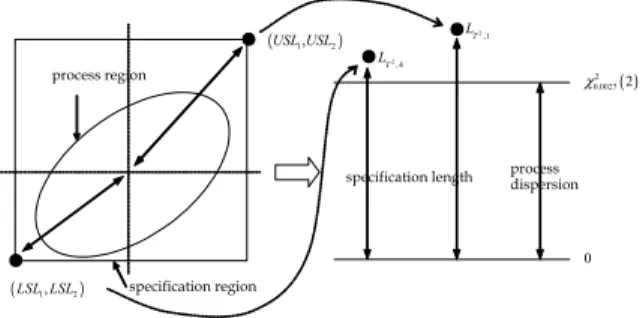
2ν can be considered since they have the shortest distances from the mean. < Figure 2 >describes the
T
2 approach for a bivariate distribution with a positive correlation, and shows thatC
pk;T2 is the ratio the standardized specification lengthsL
T2,1and
L
T2,4 to the process dispersionχ
20.0027(2)
.specification region process region
● (USL USL1, 2)
● (LSL LSL1, 2)
( )
2 0.00272 χ
0
●
●
specification length process dispersion
2,1
LT 2,4
LT
Figure 2. Concept of T
2 approach.When the distribution is skewed, the WSD method can be applied, so that formula (5) can be extended to
C
WSDpk;T2= min { L χ
W120.0027Tρ
- 1(ν) L
W1,…, L χ
W220.0027Tνρ
- 1(ν) L
W2ν}
= min { χ
20.0027L
WT2(ν)
,1,…, χ
2L
0.0027WT2,2(ν)
ν} , (6)
where the
k
th component ofL
Wi isUSL
ZWk
=(USL
k- μ
k)/σ
Wk orLSL
ZWk
= ( LSL
k- μ
k)/σ
Wk,k = 1,2,…,ν
.3.2 Modified Process Region Approach
Hubele et al. (1991) proposed a 'modified process region approach' which defines a multivariate PCI as the ratio of the volume of engineering tolerance region to the volume of modified process region. < Figure 3 >illustrates the concept of the method. The modified process region can be obtained by drawing the smallest rectangle around the elliptical probability contour. The edges of the rectangle are defined as the upper and lower process limits,
UPL
i andLPL
i,i = 1,…,ν
, determined by solving the system of equations of first derivatives, with respect toX
i, of the quadratic form( X - μ )
TΣ
- 1( X - μ ) = χ
20.0027(ν )
.The solutions to the equation provide the upper and lower limits as follows:
UPL
i= μ
i+ χ
20.0027( ν )⋅det( Σ
- 1i) det( Σ
- 1) ,
(7)
LPL
i= μ
i- χ
20.0027( ν )⋅det( Σ
- 1i) det( Σ
- 1) ,
where
det(⋅)
is the determinant of a matrix andΣ
i is the matrix obtained fromΣ
by deleting rowi
and columni
. The approach defines the multivariate PCIC
p;M asTable 1. Data for the example
i 1 2 3 4 5 6 7 8 9 10 11 12 13
X
i1143 200 160 181 148 178 162 215 161 141 175 187 187 X
i234.3 57.0 47.5 53.4 47.8 51.5 45.9 59.1 48.4 47.3 57.3 58.5 58.2
i 14 15 16 17 18 19 20 21 22 23 24 25
X
i1186 172 182 177 204 178 196 160 183 179 194 181 X
i257.0 49.4 57.2 50.6 55.1 50.9 57.9 45.5 53.9 51.2 57.5 55.6
C
p;M= [
i = 1∏
ν( UPL USL
ii- LSL -LPL
ii)]
1/ν. (8)If the process mean and specification midpoint are incorporated in the PCI and the specification limits are standardized,
C
pk;M can be defined asC
pk;M= [
i = 1∏
νmin { UPL USL
ZZii, LPL LSL
ZZii}]
1/ν, (9)where
UPL
Zi= χ
20.0027(ν) ⋅det( ρ
- 1i) det( ρ
- 1) ,
LPL
Zi= - χ
20.0027(ν) ⋅det( ρ
- 1i)
det( ρ
- 1) =- UPL
Zi.
(10)
process region
specification region modified process region
Figure 3. concept of modified process region
approach.When the distribution is skewed, the WSD method can be applied.
USL
WZi and
LSL
WZi replace
USL
Zi
and
LSL
Zi in formula (10), respectively, and hence
C
WSDpk;M is defined asC
WSDpk;M= [
i = 1∏
νmin { USL UPL
WZZii, LSL LPL
WZZii}]
1/ν. (11)3.3 Estimation of Parameters
To use PCIs in practice, the parameters must be estimated. If a random sample of size
n
is obtained,μ
andΣ
can be estimated by the sample meanX = 1 n ∑
n i = 1
X
iand the sample variance-covariance matrix
S = 1 n - 1 ∑
n
i = 1
( X
i- X )( X
i- X )
T,respectively. The correlation coefficient of
j
th andk
th random variablesρ
jk can be estimated byˆ ρ
jk
= S
ijS
jjS
kk,
where
S
jkis the (j,k
)th element ofS
.P
j can be estimated by the number of observations less than or equal to the sample mean ofj
th quality characteristicX
j asˆ P
j
= 1 n ∑
n
i = 1
I( X
j- X
ij)
,where
I(x)=1
ifx≥0
orI(x)=0
otherwise.3.4 An Illustrative Example
We illustrate the use of the proposed WSD PCIs with the bivariate process data in Sultan (1986) dealing with 25 observations of the Brinell hardness (
X
1) and the tensile strength (X
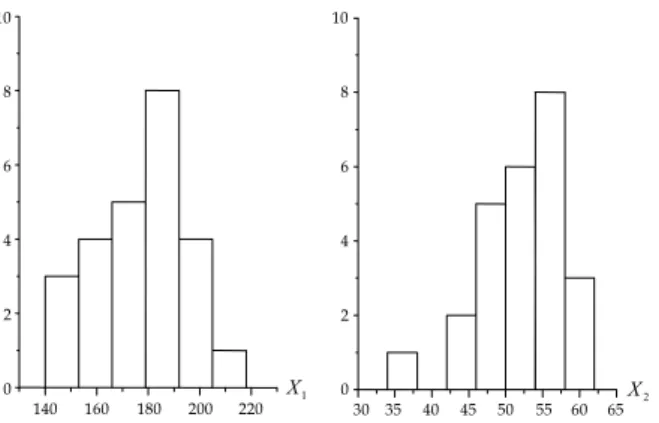
2) of a process.These data were also used by Chan et al. (1988), Chen (1994), and Wang and Chen (1998-99). < Table 1 >
presents the data, and < Figure 4 > depicts the histograms of
X
1 andX
2 and shows that the marginal distributions ofX
1 andX
2 are slightly skewed to the left. The specification limits forX
1 andX
2 were set at (112.7, 2451.3) and (32.7, 73.3), respectively.140 160 180 200 220 0
2 4 6 8 10
X
130 35 40 45 50 55 60 65
0 2 4 6 8 10
X
2Figure 4. Histograms of data in <table 1>.
From the data,
X
1= 177.2
,X
2= 52.32
,ˆ σ
1=
18.38
,ˆ σ
2= 5.80
,ˆ ρ
12= 0.80
,ˆ P
1= 0.40
, andˆ P
2
=0.48
. We can obtainLSL
Z1
= ( LSL
1- X
1)/ σ ˆ
1= ( 112.7 - 17 7.2)/18.38 =- 3.51
,USL
Z1
= 3.49
,LSL
Z2
=- 3.38
,USL
Z2
= 3.62
,LSL
WZ1
= LSL
Z1/2( 1 - P ˆ
1
)
=- 2.93
,USL
WZ1
= 4.36
,LSL
WZ2
=- 3.25
,USL
WZ2
= 3.77
. Also,L
T2, 1= L
T1ρ
- 1L
1= [ -3.51 - 3.38 ]
[
0.8 1 0.8 1
][- 3.51 - 3.38
]= 13.57
,L
T2, 4= L
T4ρ
- 1L
4= [ 3.49 3.62 ]
[
0.8 1 0.8 1
][3.49 3.62
]= 14.08
,L
WT2, 1= L
W1Tρ
- 1L
1= [ - 2.93 - 3.25 ]
[
0.8 1 0.8 1
][- 2.93 - 3.25
]= 10.87
,L
WT2, 4= L
W4Tρ
- 1L
4= [ 4.36 3.77 ]
[
0.8 1 0.8 1
][4.36 3.77
]= 19.23
,UPL
Zi= χ
20.0027(2) ⋅det( ρ
- 1i) det( ρ
- 1)
= 11.83⋅2.78
2.78 = 3.44
and
LPL
Zi
=- UPL
Zi=- 3.44
fori = 1,2
. Then the estimated PCIs are:The
T
2 approach ―ˆ C
pk;T2
= min { χ
20.0027L
T2, 1(2) , χ
20.0027L
T2, 4(2) }
= min
{13.57 11.83 , 14.08 11.83
}
= min { 1.07 , 1.09 } = 1.07
ˆ C
WSDpk;T2
= min { χ
20.0027L
WT2, 1(2) , χ
20.0027L
WT2(2)
, 4}
= min
{10.87 11.83 , 19.23 11.83
}
= min { 0.96 , 1.27 } = 0.96
The modified process region approach ―
ˆ C
pk;M
= [
i = 1∏
2min { UPL USL
ZZii, LPL LSL
ZZii}]
1/2
= [ min { 3.49 3.44 , - 3.51 - 3.44 } ⋅
min { 3.62 3.44 , - 3.38 - 3.44 }]
1/2
= [ 1.01⋅0.98]
1/2= 0.99
ˆ C
WSDpk;M
= [
i = 1∏
2min { USL UPL
WZZii, LSL LPL
WZZii}]
1/2
= [ min { 4.36 3.44 , - 2.93 - 3.44 } ⋅
min { 3.77 3.44 , - 3.25 - 3.44 }]
1/2
= [ 0.85⋅0.94]
1/2= 0.89 ˆ C
WSDpk;T2 and
ˆ C
WSDpk;M are smaller thanˆ C
pk;T2 andˆ C
pk;M, respectively, and this shows that the process is less satisfactory than
ˆ C
pk;T2 andˆ C
pk;M indicate.4. Performance of the W SD PCIs
The performances of the proposed PCIs are studied when the distribution is multivariate normal, multivariate lognormal, Hougaard's bivariate Weibull, or Cheriyan and Ramabhadran's bivariate gamma. See Kotz et al. (2000) for detailed discussions on theses distributions. For all cases, it is assumed that
USL
i= 3
andLSL
i=- 3
, and the distribution is shifted and scaled to produce the same value ofμ
i= 0
andσ
i= 1
,i = 1,…,ν
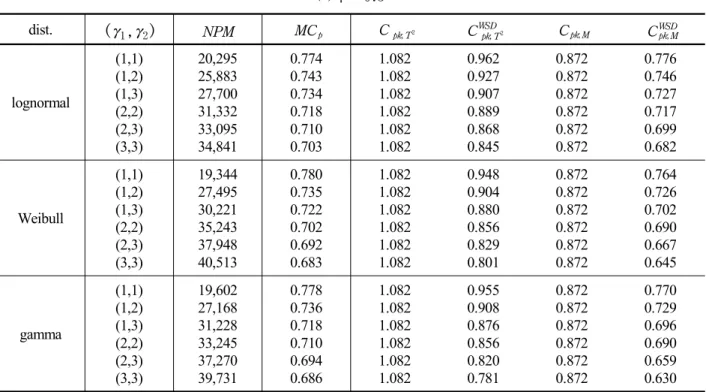
.< Tables 2 > gives
C
pk;T2, andC
pk;M as the sample sizen
increases when the distribution is bivariate normal and the correlation coefficientρ
is nonnegative.It also gives nonconforming proportion per million (
NPM
) andMC
p.MC
p is calculated by-(1/3)Φ
- 1( ( NPM/2) ×10
- 6)
sinceNPM×10
- 6= 2Φ( - 3 C
p)
Table 2. NPM
,MC
p,C
pk;T2 andC
pk;M for bivariate normal distributionsρ NPM MC
pn = 50 n = 100 n = 200 n = ∞
C
pk;T2C
pk;MC
pk;T2C
pk;MC
pk;T2C
pk;MC
pk;T2C
pk;M0.0 0.1 0.2 0.3 0.4 0.5 0.6 0.7 0.8 0.9
5,392 5,389 5,377 5,352 5,308 5,236 5,120 4,940 4,655 4,179
0.928 0.928 0.928 0.928 0.929 0.931 0.933 0.937 0.943 0.955
1.233 1.174 1.123 1.077 1.036 1.000 0.969 0.938 0.911 0.885
0.850 0.850 0.850 0.851 0.850 0.851 0.852 0.851 0.852 0.851
1.227 1.168 1.118 1.073 1.032 0.998 0.964 0.935 0.909 0.882
0.855 0.854 0.855 0.854 0.854 0.855 0.854 0.855 0.856 0.854
1.226 1.168 1.118 1.073 1.033 0.997 0.965 0.936 0.909 0.885
0.859 0.859 0.859 0.859 0.859 0.859 0.859 0.859 0.859 0.859
1.234 1.176 1.126 1.082 1.043 1.007 0.975 0.946 0.919 0.895
0.872 0.872 0.872 0.872 0.872 0.872 0.872 0.872 0.872 0.872 n = ∞ : parameters-known case
Table 3. NPM
,MC
p,C
pk;T2,C
WSDpk;T2,C
pk;M andC
WSDpk;M for bivariate distributions (parameters known)(a) ρ = 0.3
dist. (γ
1,γ
2) NPM MC
pC
pk;T2C
WSDpk;T2C
pk;MC
WSDpk;Mlognormal
(1,1) (1,2) (1,3) (2,2) (2,3) (3,3)
20,295 25,883 27,700 31,332 33,095 34,841
0.774 0.743 0.734 0.718 0.710 0.703
1.082 1.082 1.082 1.082 1.082 1.082
0.962 0.927 0.907 0.889 0.868 0.845
0.872 0.872 0.872 0.872 0.872 0.872
0.776 0.746 0.727 0.717 0.699 0.682
Weibull
(1,1) (1,2) (1,3) (2,2) (2,3) (3,3)
19,344 27,495 30,221 35,243 37,948 40,513
0.780 0.735 0.722 0.702 0.692 0.683
1.082 1.082 1.082 1.082 1.082 1.082
0.948 0.904 0.880 0.856 0.829 0.801
0.872 0.872 0.872 0.872 0.872 0.872
0.764 0.726 0.702 0.690 0.667 0.645
gamma
(1,1) (1,2) (1,3) (2,2) (2,3) (3,3)
19,602 27,168 31,228 33,245 37,270 39,731
0.778 0.736 0.718 0.710 0.694 0.686
1.082 1.082 1.082 1.082 1.082 1.082
0.955 0.908 0.876 0.856 0.820 0.781
0.872 0.872 0.872 0.872 0.872 0.872
0.770 0.729 0.696 0.690 0.659 0.630
under the normality assumption, whereΦ(⋅)
is thecumulative standard normal distribution function. If the value of PCI is close to that of
MC
p orMC
pk, the PCI can be considered to describe the process capa- bility very well in terms of nonconforming proportion.The Table shows that:
i) If the parameters are known (
n = ∞
),MC
p slightly increases as the correlation coefficientρ
increases butC
pk;T2 decreases andC
pk;M does not change. Also,C
pk;T2 overestimates the process capability when the correlation is low andunderestimates it when the correlation is high, and
C
pk;M underestimates it for all ranges of correlation. For highly correlated normal popu- lations,C
pk;T2 performs better thanC
pk;M, and vise versa.ii) If the parameters are unknown (
n = 50,100,200
), the biases ofˆ C
pk;T2 andˆ C
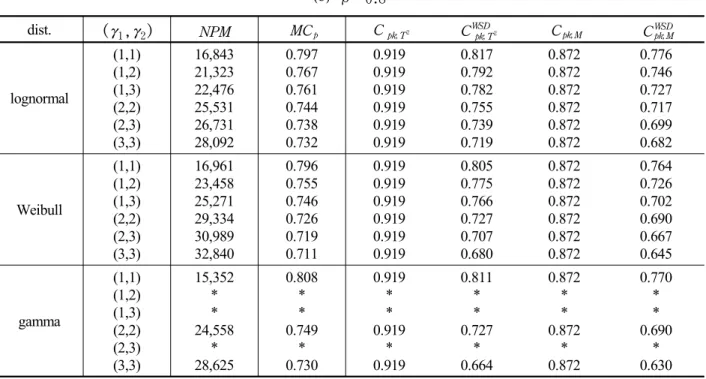
pk;M are negative.< Table 3 > and < Table 4 > give
C
pk;T2,C
WSDpk;T2,C
pk;M, andC
WSDpk;M for bivariate lognormal, Weibull, and gamma distributions with correlationρ = 0.3
or(b) ρ = 0.8
dist. (γ
1,γ
2) NPM MC
pC
pk;T2C
WSDpk;T2C
pk;MC
WSDpk;Mlognormal
(1,1) (1,2) (1,3) (2,2) (2,3) (3,3)
16,843 21,323 22,476 25,531 26,731 28,092
0.797 0.767 0.761 0.744 0.738 0.732
0.919 0.919 0.919 0.919 0.919 0.919
0.817 0.792 0.782 0.755 0.739 0.719
0.872 0.872 0.872 0.872 0.872 0.872
0.776 0.746 0.727 0.717 0.699 0.682
Weibull
(1,1) (1,2) (1,3) (2,2) (2,3) (3,3)
16,961 23,458 25,271 29,334 30,989 32,840
0.796 0.755 0.746 0.726 0.719 0.711
0.919 0.919 0.919 0.919 0.919 0.919
0.805 0.775 0.766 0.727 0.707 0.680
0.872 0.872 0.872 0.872 0.872 0.872
0.764 0.726 0.702 0.690 0.667 0.645
gamma
(1,1) (1,2) (1,3) (2,2) (2,3) (3,3)
15,352
*
* 24,558
* 28,625
0.808
*
* 0.749
* 0.730
0.919
*
* 0.919
* 0.919
0.811
*
* 0.727
* 0.664
0.872
*
* 0.872
* 0.872
0.770
*
* 0.690
* 0.630
*: not applicable
Table 4. C
pk;T2,C
WSDpk;T2,C
pk;M andC
WSDpk;M for bivariate distributions(parameters unknown)(a) ρ = 0.3
dist. (γ
1,γ
2) n = 50 n = 100 n = 200
C
pk;T2C
WSDpk;T2C
pk;MC
WSDpk;MC
pk;T2C
WSDpk;T2C
pk;MC
WSDpk;MC
pk;T2C
WSDpk;T2C
pk;MC
WSDpk;Mlognormal (1,1) (1,2) (1,3) (2,2) (2,3) (3,3)
1.095 1.111 1.143 1.313 1.160 1.187
1.026 1.011 1.019 0.998 1.001 1.007
0.860 0.869 0.888 0.882 0.898 0.914
0.794 0.778 0.777 0.765 0.762 0.758
1.082 1.093 1.111 1.106 1.119 1.138
0.995 0.973 0.968 0.948 0.939 0.935
0.860 0.867 0.876 0.874 0.881 0.892
0.788 0.766 0.756 0.744 0.733 0.725
1.077 1.083 1.091 1.090 1.097 1.108
0.980 0.950 0.936 0.920 0.904 0.892
0.861 0.865 0.868 0.868 0.873 0.878
0.783 0.756 0.741 0.731 0.716 0.704
Weibull
(1,1) (1,2) (1,3) (2,2) (2,3) (3,3)
1.085 1.108 1.141 1.127 1.158 1.193
1.002 0.982 0.984 0.953 0.953 0.958
0.856 0.870 0.886 0.880 0.897 0.918
0.782 0.760 0.751 0.735 0.726 0.722
1.076 1.089 1.102 1.101 1.118 1.135
0.975 0.942 0.927 0.906 0.893 0.881
0.857 0.863 0.871 0.871 0.880 0.891
0.775 0.743 0.725 0.713 0.698 0.685
1.074 1.080 1.090 1.086 1.096 1.105
0.960 0.922 0.905 0.880 0.862 0.841
0.859 0.863 0.869 0.866 0.872 0.877
0.769 0.735 0.716 0.701 0.683 0.665
gamma
(1,1) (1,2) (1,3) (2,2) (2,3) (3,3)
1.091 1.115 1.152 1.135 1.174 1.211
1.103 0.992 0.987 0.960 0.954 0.943
0.858 0.869 0.887 0.881 0.901 0.920
0.788 0.762 0.744 0.737 0.722 0.705
1.079 1.092 1.111 1.106 1.119 1.141
0.984 0.950 0.930 0.909 0.882 0.861
0.858 0.864 0.874 0.872 0.877 0.890
0.780 0.747 0.722 0.714 0.687 0.667
1.076 1.082 1.094 1.089 1.098 1.109
0.970 0.928 0.905 0.883 0.854 0.822
0.860 0.863 0.869 0.867 0.872 0.877
0.776 0.737 0.710 0.702 0.675 0.649 ρ = 0.8
and various skewnesses (γ
1, γ
2).NPM
andMC
p are also given in < Table 3 >. The tables show that:i) When the parameters are known,
MC
p decreasesas skewness increases and
C
WSDpk;T2 andC
WSDpk;M reflect such a phenomenon, i.e., they decrease as skewness becomes large whereasC
pk;T2 andC
pk;M remain constant; <Table 3>(b) ρ = 0.8
dist. (γ
1,γ
2) n = 50 n = 100 n = 200
C
pk;T2C
WSDpk;T2C
pk;MC
WSDpk;MC
pk;T2C
WSDpk;T2C
pk;MC
WSDpk;MC
pk;T2C
WSDpk;T2C
pk;MC
WSDpk;Mlognormal (1,1) (1,2) (1,3) (2,2) (2,3) (3,3)
0.928 0.950 0.983 0.968 0.997 1.026
0.879 0.878 0.888 0.870 0.877 0.888
0.862 0.874 0.889 0.887 0.902 0.923
0.797 0.784 0.780 0.772 0.769 0.771
0.916 0.932 0.948 0.941 0.959 0.973
0.850 0.840 0.836 0.816 0.814 0.809
0.860 0.869 0.875 0.875 0.886 0.896
0.788 0.769 0.756 0.746 0.738 0.731
0.913 0.921 0.932 0.928 0.938 0.948
0.834 0.815 0.811 0.788 0.780 0.769
0.861 0.865 0.871 0.870 0.877 0.883
0.783 0.757 0.744 0.733 0.721 0.709
Weibull
(1,1) (1,2) (1,3) (2,2) (2,3) (3,3)
0.923 0.947 0.995 0.968 1.007 1.032
0.866 0.857 0.870 0.839 0.848 0.847
0.858 0.870 0.891 0.883 0.903 0.922
0.785 0.761 0.757 0.740 0.736 0.728
0.914 0.928 0.951 0.939 0.956 0.975
0.836 0.817 0.815 0.783 0.774 0.766
0.858 0.865 0.876 0.872 0.881 0.894
0.776 0.746 0.732 0.716 0.700 0.688
0.912 0.918 0.931 0.925 0.937 0.944
0.821 0.794 0.791 0.755 0.744 0.724
0.861 0.863 0.870 0.867 0.875 0.879
0.770 0.735 0.717 0.702 0.686 0.667
gamma
(1,1) (1,2) (1,3) (2,2) (2,3) (3,3)
0.924
*
* 0.960
* 1.009
0.868
*
* 0.820
* 0.791
0.861
*
* 0.886
* 0.922
0.793
*
* 0.742
* 0.709
0.915
*
* 0.931
* 0.959
0.841
*
* 0.771
* 0.727
0.859
*
* 0.871
* 0.891
0.783
*
* 0.715
* 0.669
0.913
*
* 0.921
* 0.938
0.827
*
* 0.750
* 0.698
0.861
*
* 0.867
* 0.879
0.778
*
* 0.702
* 0.651
Table 5. NPM
,MC
p,C
pk;T2,
C
WSDpk;T2,
C
pk;M andC
WSDpk;M for 4-variate lognormal distributions (parameters known)case ( γ
1,γ
2,γ
3,γ
4) NPM MC
pC
pk;T2C
WSDpk;T2C
pk;MC
WSDpk;M1
(1.0,0.5,1.0,0.5) (1.5,1.0,1.0,1.5) (1.5,1.5,2.5,2.5) (0.5,2.5,2.0,1.5)
15,916 24,016 27,417 22,865
0.804 0.752 0.735 0.759
1.128 1.128 1.128 1.128
1.030 0.980 0.933 0.973
0.744 0.744 0.744 0.744
0.680 0.647 0.614 0.633
2
(1.0,0.5,1.0,0.5) (1.5,1.0,1.0,1.5) (1.5,1.5,2.5,2.5) (0.5,2.5,2.0,1.5)
13,352 19,631 22,308 19,230
0.825 0.778 0.762 0.780
0.865 0.865 0.865 0.865
0.810 0.754 0.712 0.755
0.744 0.744 0.744 0.744
0.680 0.647 0.614 0.633
ii) When the parameters are unknown,C
pk;T2 andC
pk;M increase as skewness becomes large, whereasC
WSDpk;T2 andC
WSDpk;M decrease in most cases. All PCIs are overestimated especially when the sample size is small; < Table 4 >iii)
C
WSDpk;M is closer toMC
p in < Table 3(a)>, andC
WSDpk;T2 is closer toMC
p in < Table 3(b)> except for( γ
1,γ
2) = ( 1,2)
. Also, < Table 4 > and addi- tional extensive study we have conducted indi- cate thatC
WSDpk;T2 is closer toMC
p for highly correlated populations as sample size becomes large, and vise versa. This shows that theT
2 approach is superior to the modified process region approach for highly correlated populationsin most cases, and vise versa.
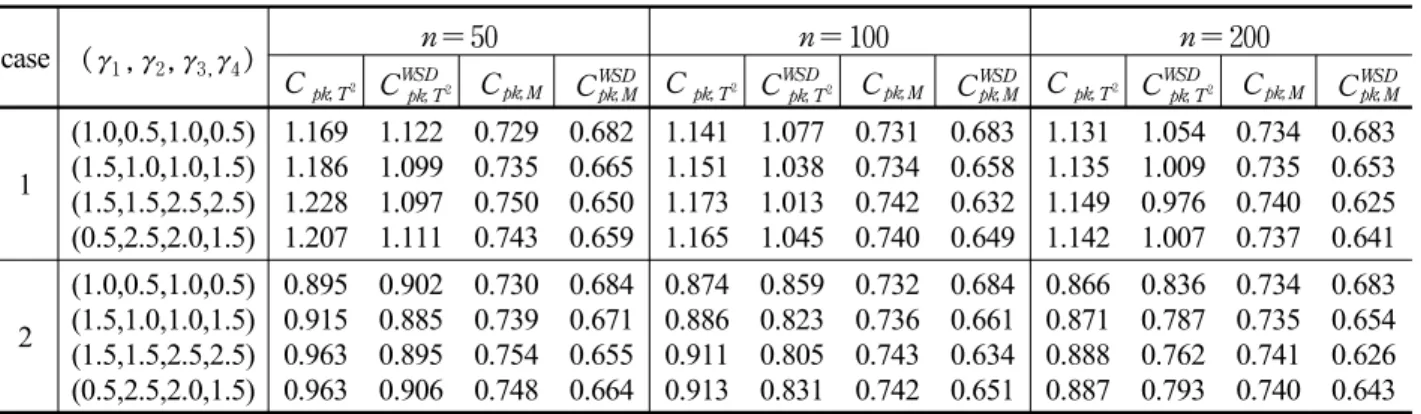
< Table 5 > and < Table 6 > present PCIs for two 4-variate lognormal distributions, where case 1 uses
ρ
1 describing low positive correlations (ρ
ij< 0.5
) and case 2 usesρ
2 containing high correlations (ρ
ij≥0.5
) as follows:ρ
1= ꀎ
ꀚ
︳ ︳
︳ ︳
︳ ︳
︳ ︳
ꀏ
ꀛ
︳ ︳
︳ ︳
︳ ︳
︳ ︳ 1 0.2 0.3 0.1
1 0.2 0.4 1 0.3 1
,
ρ
2= ꀎ
ꀚ
︳ ︳
︳ ︳
︳ ︳
︳ ︳
ꀏ
ꀛ
︳ ︳
︳ ︳
︳ ︳
︳ ︳ 1 0.8 0.6 0.7
1 0.8 0.5 1 0.6 1
.