DOI 10.17480/psk.2017.61.3.158
밀싹 추출물의 ERK와 Akt 인산화를 경유한 인간 모유두세포 증식 촉진효과
박설아* · 인명희** · 우원홍*** · 문연자**#
*원광대학교 일반대학원 뷰티디자인과, **원광대학교 한의학전문대학원 한약자원개발학과,
***원광대학교 한의과대학 해부학교실
(Received February 10, 2016; Revised June 22, 2017; Accepted June 26, 2017)
Wheat Sprout Extract Stimulates Cell Proliferation via Phosphorylation of ERK and Akt in Human Dermal Papilla Cells
Seol-a Park*, Myoung-hee In**, Won-hong Woo***, and Yeun-ja Mun*#
*Dept. of Beauty Design Graduate School, Wonkwang University
**Department of Herbal Resources, Professional Graduate School of Korean Medicine, Wonkwang University
***Department of Anatomy, College of Korean Medicine, Wonkwang University
Abstract — We investigated the effect of Wheat Sprout MeOH extract (WSM) on cell proliferation, and analyzed the molec- ular mechanism in human hair dermal papilla cells (HHDPCs). After exposure to WSM in HHDPCs, cell proliferation was increased compared with minoxidil-treated cells. Treatment with WSM led to phosphorylation of extracellular signal-related kinase (ERK) and Akt. Moreover, WSM-mediated increase of cell proliferation was attenuated by PD98059, ERK inhibitor, and LY294002, Akt inhibitor. These results suggest that WSM induced cell proliferation in HHDPCs through activation of ERK and Akt.
Keywords Wheat Sprout, HHDPCs, Cell Proliferation, ERK, Akt
모발은 모낭에서 생성되며, 모낭은 성장기(anagen phase), 퇴 화기(catagen phase), 휴지기(telogen phase) 3단계로 나뉘는 모 발성장주기(hair cycle)를 반복하며 모발의 성장과 유지 및 탈락 을 조절하고 있다. 이 중 성장기는 세포분열 및 증식이 활발히 진행되어 모발을 성장시키고, 퇴화기는 apoptosis 및 모구부의 축소로 성장을 중단하는 시기이며 휴지기는 성장이 중단되고 모 낭의 길이가 1/3로 축소되어 두피에 머무르는 기간으로 하루 평 균 50~100개의 모발이 탈락된다.1)
특히 모유두세포는 모발의 성장 및 주기 조절에 핵심적인 역 할을 하고 있으며, 모낭과 모유두세포의 상호작용은 모발의 성 장에 필수적이다.2-4)또한 모유두세포에 분포하고 있는 모세혈관
은 모낭에 영양을 공급하며 성장인자(growth factor)와 저해인자 (inhibitory factor)의 조절을 통해 모낭 상피세포 및 모발의 성장 을 조절한다.5) 모발성장의 주요 메커니즘이 현재까지 확실히 밝 혀지지 않았지만 여러 가지의 사이토카인(cytokine)이나 성장 및 저해인자가 모발의 생성, 증식, 분화 및 세포 자멸사에 관여하는 것으로 조사되었고,6,7) keratinocyte growth factor(KGF), Wnt5a, transforming growth factor(TGF)β, nexin, insulin-like growth factor(IGF)-1, tumor necrosis factor(TNF)-β가 있으며 이 중 TGF-β와 TNF-β는 성장기를 단축시키고 퇴화기를 유도하 여 모발성장을 억제하는 것으로 확인되었다.8) 따라서 발모 및 탈 모와 밀접하게 연관되어 있는 모유두세포의 세포증식 유도는 성 장기 연장 및 퇴화기를 단축하여 탈모개선에 도움이 될 것으로 생각된다.2)
현재 모발의 성장을 촉진하는 약물로는 미국식품의약국(Food and Drug Administration, FDA)의 승인을 받은 minoxidil과 finasteride가 대표적이다. Minoxidil은 모유두세포의 vascular endothelial growth factor(VEGF) 유전자 발현을 증가시킴으로
#
Corresponding Author Yeun-ja Mun
Dept. of Beauty Design Graduate School, Wonkwang University 460, Iksandaero, Iksan-si, Jeollabuk-do, Korea, 54538
Tel.: 063-850-6942 Fax.: 063-850-7324 E-mail: [email protected]
Short Report
종설서 주변의 혈관신생을 유도하며, 세포증식 및 모발 형성 촉진, β- catenin 경로 활성화, 혈관 확장에 의한 영양공급 증가, K+ channel opening 효과 등을 통해 탈모를 개선하는 것으로 보고 되었다.9-12)
밀싹(Wheat Sprout)은 발아한지 6~10일 정도의 밀 마디 부위 가 생성되기 전의 어린 새싹을 말한다.14)미국의 Ann Wigmore 와 Virginia Livingston 등은 밀싹이 건강을 증진시켜 난치병을 치료한 사례를 보고하였으며,15) 10가지 이상의 비타민과 아미노 산 칼슘, 칼륨, 인, 마그네슘, 아연, 셀레늄 등이 함유되어 있다.
최근 건강 및 미용식품으로 착즙이나 분말섭취가 증가하고 있으 며, 관련 연구로는 노인성 백내장 감소,16)암세포의 성장 억제,17) 항산화,18)노화방지,19) BALB/c mice의 모발성장 효과가20)보고 되었다. 이에 본 연구는 밀싹 메탄올추출물(Wheat Sprout MeOH extract, WSM)이 모유두세포의 세포증식과 모발성장 관련 신호 전달 인자에 미치는 영향을 조사하였다.
실험재료 및 방법
시료추출 및 시약
밀싹은 농업회사법인 선덕당(원주)에서 구입하였고 밀싹 250 g 을 100% MeOH 3 l에 3일간 실온에서 추출하였다. 추출물을 거 즈로 여과한 후 회전감압농축기(EYELA, Japan)를 이용하여 32.65 g(수율 13.06%)의 시료를 얻었다. 시료는 냉동 보관하였으 며 DMSO에 녹여 실험에 사용하였다. Fetal bovine serum(FBS) 와 Dulbecco's modified Eagle medium(DMEM)은 Welgene (Gyeongsan, Korea)사 제품, phospho p44/42 MAP kinase (Thr202/Tyr204) antibody, p44/42 MAP kinase antibody, p-Akt (S473), Akt antibody는 cell signaling(Beverly, MA, USA)사 제 품, anti-Rabbit IgG HRP conjugate antibody는 Amersham Biosciences(Buckinghanshire, England)사 제품, thiazolyl blue tetrazolium bromide(MTT)와 minoxidil은 Sigma(St. Louis, MO, USA)사 제품을 사용하였다.
세포배양 및 세포 생존율 측정
사람 모유두세포(human hair dermal papilla cells, HHDPCs) 는 Scien Cell(Sandiego, CA, USA)사 에서 구입하였고, 10%
FBS, 100 units/mL penicillin 100μg/ml가 첨가된 DMEM을 사 용하여 37oC, 5% CO2 배양기에서 배양하였다.
세포생존율 측정은 Mosmann의 방법에 의하여 실시하였다.21) 모유두세포를 24 well plate에 2×10³개씩 분주하고 시료(WSM) 을 5, 10, 20, 30 μg/ml로 처리한 후 37oC, 5% CO₂하에서 48 또는 72시간 배양하였다. 배양 후 0.5 mg/ml MTT 용액을 넣어 3시간 37oC에서 반응시킨 뒤 상층액을 제거하고 형성된 formazan 을 DMSO 1 ml로 녹여 ELISA reader로 570 nm에서 흡광도를
측정하였다.
Western blot 분석
모유두세포를 10 cm 배양용기에 5×10⁵개씩 분주하여 24시간 배양한 후 시료를 농도별(10, 25 μg/ml)로 처리하고 30분간 배양 하였다. 배양 후 PBS로 세척하여 cell scraper로 수거하고, 1×
lysis buffer(1× RIPA buffer 1 ml, 1 mM PMSF, 1 μg/ml aprotinin, 1μg/ml leupeptin, 2 mM DTT)로 30분간 용해시켜 15,000 rpm에서 30분간 원심분리하여 상층액을 분리하였다.
Bradford 시약으로 단백질을 정량하고, 2× sample buffer(1 ml glycerol, 0.5 ml β-mercaptoethanol, 3 ml 10% SDS, 1.25 ml 1 M Tris-HCl, 1~2μg bromophenol blue)를 이용하여 동량으로 혼합한 후 10-12% SDS polyacrylamide gel에서 전기영동 하였 다. 분리된 단백질을 PVDF membrane으로 전이시키고 5% non- fat skim milk와 3% BSA로 blocking한 후 1,2차 항체를 부착시 켰다. 1차 antibody는 1:1000, 2차 antibody는 1:5000의 비율로 사용하였다. ECL 용액으로 발색 후 ChemiDoc(Hercules, CA, USA)을 이용하여 각 band의 사진을 촬영하였다. 양성 대조군으 로 minoxidil(10 μm)을 사용하였다.
통계처리
모든 실험은 3회 반복하여 평균±SD로 나타내었으며, Sigma Plot(San Jose, CA, USA)의 student's t-test를 이용하여 p-value 값을 계산하여 통계적 유의성 검증을 실시하였다. p<0.05인 경 우 *로 표기하였고 p<0.01인 경우 **로 표기하여 유의성을 나 타내었다.
결과 및 고찰
밀싹 추출물의 세포증식 촉진효과
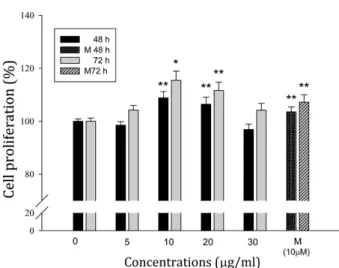
밀싹 추출물이 모유두세포의 세포증식에 미치는 영향을 확인 하기 위하여 시료를 농도별(5, 10, 20, 30 μg/ml)로 처리하고 48 시간과 72시간 후 세포생존율을 측정하였다. 각각의 농도에서 48 시간 후 세포생존율은 대조군(100%)에 비해 98.5(±1.3)%, 108.9 (±2.4)%, 106.4(±±2.7)%, 96.8(±2.1)%였으며, 72시간 후 세포 생존율은 104.3(±1.7)%, 115.5(±3.5)%, 111(±3.1)%, 104.2 (±2.6)%로 나타났다(Fig. 1). 한편 minoxidil은 48시간과 72시간 후 모유두세포의 생존율이 각각 103(±1.9)%와 107(±2.8)%였다.
따라서 48시간 후 10~20 μg/ml 농도 구간에서 모유두세포의 증 식이 촉진되고 72시간 후 세포증식의 효과는 더 높아졌다. Cho 등21)은 모유두세포의 성장 곡선 및 배양시간에 따른 모양과 형 태를 관찰한 결과 배양 3일 이후 세포 성장이 빨라졌다고 보고 하였으며, 본 결과에서도 밀싹 추출물의 모유두세포의 증식 촉 진효과는 72시간 후 더욱 증가되었다.
밀싹 추출물의 ERK 인산화 촉진효과
Extracellular signal-related kinase(ERK)는 성장인자, 호르몬,
사이토카인 등의 다양한 세포 반응을 조절하는 mitogen-activated protein kinase(MAPK)의 신호전달기전 중 하나로 알려져 있다.22) 따라서 밀싹 추출물이 모유두세포의 증식을 유도하는 신호전달기 전을 조사하기 위해 ERK 단백질 인산화에 미치는 영향을 조사 한 결과, 시료 10과 20 μg/ml 농도에서 ERK 인산화가 각각 대 조군의 약 2.6배, 3.2배 증가하였고, minoxidil은 약 3.1배 증가 되었다(Fig. 2A). 또한 시료의 ERK 인산화 촉진효과를 ERK 억 제제인 PD98059를 처리하여 확인한 결과, PD98059에 의해 밀 싹 추출물의 ERK의 인산화가 억제되었다(Fig. 2B).
밀싹 추출물의 Akt 인산화 촉진효과
Akt는 β-catenin(ser552) 및 GSK3β(ser9)를 경유하여 모유두세 포의 증식에 핵심적인 Wnt/β-catenin 신호를 조절하는 것으로 알 려져 있으며23-27), Lim 등28)은 여정실이 ERK와 Akt 인산화를 통 하여 모유두세포의 세포증식을 유도한다고 보고하였다. 따라서 밀 싹 추출물이 Akt 인산화 미치는 영향을 조사한 결과, 시료 10과 20μg/ml 농도에서 각각 2.1배, 3.2배 증가하였으며, minoxidil의 경우 1.1배 증가하였다(Fig. 3A). 또한 시료의 Akt 인산화 촉진효 과를 Akt억제제인 LY294002를 처리하여 확인한 결과, LY294002 에 의해 밀싹 추출물의 Akt의 인산화가 억제되었다(Fig. 3B).
ERK, Akt 인산화를 통한 모유두세포 증식 촉진효과
Fig. 1 − Effect of wheat sprout methanol extract (WSM) on the
cell proliferation in HHDPCs. Cells were treated with WSM (5~35 µg/ml) and minoxidil (10 µM) for 48 h or 72 h.
The proportion of survival cells was measured by MTT assay. The results are expressed as a percentage of the control in four replicate cultures. Experiments were repeated in triplicate and the results were expressed as the mean±
SD. *p<0.05, **p<0.01.
Fig. 2 − WSM induced phosphorylation of ERK in cultured HHDPCs. (A) Cells were treated with WSM (10 and 20 µg/ml) and
minoxidil (10 µM) for 30 min. The intra-cellular levels of phospho-ERK and ERK were analyzed by Western blot. (B) Cells were
pre-treated with MEK/ERK inhibitor (PD98059) for 2 h, followed by WSM (10 and 20 µg/ml) and minoxidil (10 µM) treatment for
30 min. The intra-cellular levels of phospho-ERK and ERK were analyzed by Western blot.
위의 실험 결과, 밀싹 추출물이 ERK와 Akt 인산화를 촉진하였 으므로 ERK와 Akt를 경유하여 모유두세포의 증식을 촉진하는지 확인하였다. ERK 억제제와 Akt 억제제를 1시간 전처리하고, 시 료에 72시간 배양한 후 세포생존률을 측정하였다. 실험 결과, 시
료 10과 20 μg/ml 농도에서 107.30%와 114.48%의 세포생존율이 PD98059 처리 시 92.63%와 85.95%로 감소하였다. Minoxidil의 경우에도 111.24%에서 89.64%로 세포증식이 감소되었다(Fig. 4A).
또한 시료 10과 20 μg/ml 농도에서 113%, 115%의 세포생존율이
Fig. 3 − WSM induced phosphorylation of Akt in cultured HHDPCs. (A) Cells were treated with WSM (10 and 20 µg/ml) and minoxidil
(10 µM) for 30 min. The levels of phospho-Akt and Akt were analyzed by Western blot. (B) Cells were pre-treated with PI3K/Akt inhibitor (LY294002) for 2 h, followed by WSM (10 and 20 µg/ml) and minoxidil (10 µM) treatment for 30 min. The intra-cellular levels of phospho-Akt and Akt were analyzed by Western blot.
Fig. 4 − WSM increased cell proliferation via ERK and Akt activation in HHDPCs. Cells were pre-treated with the absence or
presence of 20 µM of MEK/ERK inhibitor, PD98059, (A) and PI3K/Akt inhibitor, LY294002, (B) for 2 h, followed by WSM (10 and
20 µg/ml) and minoxidil (10 µM) treatment for 3 days. The proportion of survival cells was measured by MTT assay. The results
are expressed as a percentage of the control in four replicate cultures. Experiments were repeated in triplicate and the results were
expressed as the mean±SD. *p<0.05, **p<0.01.
LY294002 처리 시 62.8%과 71.5%로 감소하였다. Minoxidil의 경 우에도 115%에서 69%로 모유두세포의 증식이 감소되었다(Fig.
4B). 이상의 결과 밀싹 추출물은 모유두세포에서 ERK와 Akt 인 산화를 통해 세포증식을 증가시켰음을 알 수 있었다.
결 론
본 연구 결과, 밀싹 추출물은 사람 모유두세포의 증식을 촉진 하였고 ERK와 Akt 인산화를 유도하였다. 모유두세포의 증식 촉 진효과는 ERK 억제제와 Akt 억제제에 의해 감소하여 밀싹 추 출물의 세포증식 효과는 ERK와 Akt의 인산화를 경유하고 있음 을 확인하였다. 따라서 밀싹 추출물은 모발의 성장을 유도하고 탈모를 개선할 수 있는 치료제로서의 발전 가능성이 높다고 사 료된다.
감사의 말씀
이 논문은 2016학년도 원광대학교의 교비지원에 의하여 수행됨
References
1) Zhao, J., Liu LQ, Wang, Y. J., Yang, W., Geng, W. X., Wei, J., Li, L. W. and Chen, F. L. : Treatment of alopecia by transplantation of hair follicle stem cells and dermal papilla cell encapsulated in alginate gels. J Med Hypoth. 70, 1014 (2008).
2) Kwack, M. H, Ahn, J. S., Kim, M. K., Kim, J. C. and Sung, Y. K.
: Preventable effect of L-threonate, an ascorbate metabolite, on androgen-driven balding via repression of dihydrotestosterone- induced dickkopf-1 expression in human hair dermal papilla cells.
BMB Rep. 43, 688 (2010).
3) Botchkarev, V. A. and Kishimoto, J. : Molecular control of epithelial-mesenchymal interactions during hair follicle cycling. J.
Investig. Dermatol. Symp. Proc. 8, 46 (2003).
4) Stenn, K. S. and Paus, R. : Controls of hair follicle cycling. Physiol.
Rev. 81, 449 (2001).
5) Kim, J. R., Kim, J. K., Kim, Y. J., Yoon, Y. M. and An, S. K. : Research Paper : Analysis of the Gene Expression Profiling in Human Dermal Papilla Cells Stimulated by Hydrogen Peroxide. J. Kor. Soc. Cosm, 18, 110 (2012).
6) Jahoda, C. A., Horne, K. A. and Oliver, R. F. : Induction of hair growth by implantation of cultured dermal papilla cells. Nature.
311, 560 (1984).
7) Matsuzka, T. and Yoshizato, K. : Role of hair papilla cells on induction and regeneration prosess of hair follicles. Wound Repair Regen. 6, 524 (1998).
8) Itami, S., Kurata, S. and Takayasu, S. : Androgen induction of
follicular epithelial cell growth is mediated via insulin-like growth factor1 from dermal papilla cells. Biochem Biophys Res Commun. 212, 977 (1995).
9) Lee, E. J., Cho, Y. L. and Cho, K. H. : Inductive Effect for Escaping from Refractory Telogen Phase of Hair Growth Cycle by Minoxidil. J. Natural Sci. 23, 109 (2001).
10) Kwack, M. H., Kang, B. M., Kim, M. K., Kim, J. C. and Sung, Y. K. : Minoxidil activates beta-catenin pathway in human dermal papilla cells: A possible explanation for its anagen prolongation effect. J. Dermatol. Sci. 62, 154 (2011).
11) Buhl, A. E., Waldon, D. J., Baker, C. A. and Johnson, G. A. : Minoxidil sulfate is the active metabolite that stimulates hair follicles. J. Invest. Dermatol. 95, 553 (1990).
12) Kaufman, K. D., Rotonda, J., Shah, A. K. and Meehan, A. G. : Long-term treatment with finasteride 1 mg decreases the likelihood of developing further visible hair loss in men with androgenetic alopecia(male pattern hair loss). Eur. J. Dermatol.
18, 400 (2008).
13) Rastegar, H., Ashtiani, H. A., Aghaei, M., Barikbin, B. and Ehsani, A. : Herbal Extracts Induce Dermal Papilla Cell Proliferation of Human Hair Follicles. Ann Dermatol. 27, 667 (2015).
14) Kim, S. J. : Effects of Eating Wheat Sprouts and Using Cosmetics Containing Wheat Sprouts on Skin. The Graduate School of Konkuk Univ. (2015).
15) Meyerowitz, S. : Wheat grass nature's finest medicine the complete guide to using grasses to revitalize your health, The Book Publishing Company, Summertown (1999).
16) Okarter, N. : Phenolic compounds from the insoluble-bound fraction of whole grains do not have any cellular antioxidant activity. Life Sci. Med. 37, 1 (2012).
17) Calzuola, I., Giavarini, F., Sassi, P., Angelis, L. D., Gianfranceschi, G. L. and Marsili, V. : Short acidic peptides isolated from wheat sprout chromatin and involved in the control of cell proliferation: Characterization by infrared spectroscopy and mass spectrometry. Peptides 26, 2074 (2005).
18) Kulkarni, S. D., Tilak, J., Acharya, R., Rajurkar, N. S., Devasagayam, T, P. A. and Reddy, A. V. R. : Evaluation of the antioxidant activity of wheatgrass (Triticum aestivum L.) as a function of growth under different conditions. Phytother. Res.
20, 218 (2006).
19) Calzuola, I., Marsili, V. and Gianfranceschi, G. L. : Synthesis of antioxidants in wheat sprouts. J. Agric. Food Chem. 52, 5201 (2004).
20) Ryu, E. M. : Effect of Wheat Sprout Extracts on Hair Growth.
Graduate School of Chosun Univ. (2014).
21) Cho, Y. L., Lee, E. J. and Cho, K. H. : The effect of Glycine Semen nigra extract on dermal papilla(DP) cell proliferation and differentiation during anagen phase of hair cycle. J Natural
Sci. 22, 73 (2010).
22) Paul, D. R., Huang, B. W. and Tsuji, Y. : Reactive oxygen species (ROS) homeostasis and redox regulation in cellular signaling. cellular signalling. 24, 981 (2012).
23) Hedgepeth, C. M., Conrad, L., Zhang, J., Huang, H. C., Lee, V.
M. and Klein, P. S. : Activation of the Wnt signaling pathway:
a molecular mechanism for lithium action. Dev. Biol. 185, 82 (1997).
24) Hino, S., Tanji, C., Nakayama, K. I., Kikuchi, A. : Phosphorylation of beta-catenin by cyclic AMP-dependent protein kinase stabilizes beta-catenin through inhibition of its ubiquitination. Mol. Cell. Biol. 25, 9063 (2005).
25) Monick, M. M., Carter, A. B., Robeff, P. K., Flaherty, D. M., Peterson, M. W. and Hunninghake, G. W. : Lipopolysaccharide
activates Akt in human alveolar macrophages resulting in nuclear accumulation and transcriptional activity of beta- catenin. J. Immunol. 166, 4713 (2001).
26) Brudvik, K. W., Paulsen, J. E., Aandahl, E. M., Roald, B. and Taskén, K. : Protein kinase A antagonist inhibits β-catenin nuclear translocation, c-Myc and COX-2 expression and tumor promotion in Apc(Min/+) mice. Mol. Cancer. 10, 149 (2011).
27) Kang, J. I., Moon, J. S., Kim, E. J., Lee, Y. K., Koh, Y. S., Yoo, E. S., Kang, H. K. and Yim, D. S. : The Hair Growth Effects of Wheat Bran. Kor. J. Pharmacogn. 44, 384 (2013).
28) Lim, N. Y., Kim, D. S., Woo, W. H., Mun, Y. J. and Ko, K. S. : Effect of Fructus Ligustri Lucidi of H2O Extract on Cell Proliferation and Cell Signal Pathway in Human Hair Dermal Papilla Cells. J. Kor. Soc. Cosm, 17, 774 (2011).