Note
http://dx.doi.org/10.4217/OPR.2012.34.4.445 Ocean and Polar Research December 2012
홍조류 에탄올 추출물 및 다양한 용매 분획물의 라디칼 소거능
조명래 1 ·이동진 2 ·유상권 2*
1한국해양과학기술원 동해연구소
(767-813) 경상북도 울진군 죽변면 해양과학길 48
2강릉원주대학교 생명과학대학 해양식품공학과 (220-702) 강원도 강릉시 강릉대학로 120
Radical Scavenging Activity of Ethanol Extracts and Solvent Partitioned Fractions from Various Red Seaweeds
MyoungLae Cho 1 , Dong-Jin Lee 2 , and SangGuan You 2*
1East Sea Research Institute, KIOST Uljin 767-813, Korea
2Department of Marine Food Science and Technology, College of Life Sciences Gangneung-Wonju National University, Gangneung 210-702, Korea
Abstract : The EtOH extracts of red seaweeds (Symphyocladia latiuscula, Chondrus ocellatus and Carpopeltis affinis) and solvent partitioned fractions were investigated for their 2,2'-azino-bis(3-ethylbenzothiazoline-6- sulphonic acid) (ABTS) and 1,1-diphenyl-1-picrylhydrazyl (DPPH) radical scavenging effects and the total phenolic contents were correlated with ABTS and DPPH radical scavenging activities. The EtOH extracts and their solvent partitioned fractions exhibited strong ABTS and DPPH radical scavenging activities.
Among the solvent partitioned fractions obtained from n-Hexane (HX), methylenchloride (MC), ethylacetate (EA), and buthanol (BuOH), the HX fraction from C. affinis showed higher radical scavenging activities than other fractions. Total phenolic contents showed significant correlation (r
2= 0.709) with ABTS radical scavenging activity. The results of this study suggest that the strong radical scavenging activity of HX fraction from C. affinis is a promising natural antioxidant for healthcare products.
Key words : red seaweed, Carpopeltis affinis, radical scavenging effect, ABTS, DPPH
1. 서 론
인체의 산화적 스트레스에 의해 발생되는 활성산소종 [superoxide anion(O
2−), hydrogen peroxide(H
2O
2), hydroxyl 라디칼(OH) 등]은 미토콘드리아, 식세포 또는 세포질의 정상적인 대사과정 중에도 생성되며, 살아있는 생물의 세 포 신호전달에 중요한 역할을 한다(Aruoma and Cuppette 1997; Cavas and Yurdakoc 2005). 그러나, 과발현된 활성
산소종들은 생체내의 세포막, 단백질, DNA 및 효소 등을 손상시키며, 세포와 조직에 해로운 반응을 일으켜 암, 뇌 졸중, 당뇨 및 동맥경화 등의 질병을 유발한다. 또한, 활성 산소종들은 노화와 밀접한 관련이 있는 것으로 알려져 있 다(Feskanich et al. 1992; Regnstrom et al. 1992; Ames 1989; Cho et al. 2011). 따라서, 기능성 식품 및 의약품 산 업에서는 활성 산소종들을 제거하기 위하여 가격이 저렴 하면서 항산화 활성이 높은 butylated hydroxytoluene (BHT), butylated hydroxyanisole(BHA), propyl gallate (PG) 등의 합성 항산화제를 주로 사용하여 왔다. 그러나
*Corresponding author. E-mail : [email protected]
이러한 합성 항산화제들은 세포내 독성을 나타내거나, 동 물모델에서 암을 유발하는 등의 부작용을 나타내었다(Ito et al. 1986; Safer and al-Nughamish 1999). 따라서, 합성 항산화제 보다 더 안전하고 효과적인 항산화제를 천연물 에서 찾고자 하는 연구는 꾸준히 되어 왔다. 그 결과, 육상 천연물에서 tocopherol, gossypol, sesamol, oryzanol, phenolic acid, flavonoids 등과 같은 항산화 물질이 분리 되었다(Frankel et al. 1993; Giese 1996; Rice-Evans et al.
1996; Azuma et al. 1999; Rein et al. 2000). 또한, 최근 해양생물자원의 중요성에 대한 인식이 높아짐에 따라 해 양생물을 이용한 새로운 생리활성물질을 개발하고자 하는 연구도 활발히 진행되고 있다.
해양생물은 항암, 항염증, 면역증강 및 항바이러스 등의 다양한 생리활성을 갖는 물질의 함유로 새로운 의약품, 화 장품 및 기능성 식품을 개발하기 위해 꾸준히 연구 되고 있다(Kim and Wijesekara 2010). 특히 해조류에는 다당류, 비타민, 기능성 펩타이드, 각종 항산화 물질 및 필수 미네 랄 등을 다량 함유하고 있는데(Pomponi 1999; Kim and Wijesekara 2010), 갈조류 톳에서 분리된 fucoxanthin과 모자반에서 분리된 phlorotannin 및 녹조류의 가시파래에 서 분리된 pheophorbide a 등은 대표적인 항산화 물질로 잘 알려져 있다(Yan et al. 1996; Cho et al. 2011). 하지 만, 현재까지의 해조류 항산화 활성은 미역, 파래, 모자 반, 다시마, 톳 등의 국민 다소비 식용해조류에 국한되어 다양한 해조류의 항산화 활성 연구는 심도 깊게 되지 않 았다. 그 중, 홍조류는 각종 아미노산, 무기물, 페놀화합물 및 플라보노이드 등이 다량으로 함유되어 있어 항산화 활 성 및 아질산염 소거능 등을 갖고 있다(Shin et al. 2006).
본 연구에 사용한 홍조류인 참보라색우무(Symphyocladia latiuscula), 진두발(Chondrus ocellatus) 까막살(Carpopeltis affinis)은 우리나라 동해안에 널리 자생 하고 식용이 가능 하나, 거의 섭취하지 않으며, 산업적으로도 활용되지 않고 있다. 또한, 이들 홍조류의 항산화 활성에 관한 체계적인 연구도 수행되지 않았다.
따라서, 본 연구에서는 동해안에 자생하는 홍조류인 참 보라색우무, 진두발, 까막살의 에탄올 추출물 및 다양한 용매분획물의 ABTS 및 DPPH 라디칼 소거능을 측정하였 다. 또한, 총폴리페놀 함량과 ABTS, DPPH 라디칼 소거 능 및 ABTS 라디칼 소거능과 DPPH 라디칼 소거능과의 연관성을 측정하였다.
2. 재료 및 방법
재료
본 연구에 사용된 3종의 홍조류 참보라색우무(S.
latiuscula), 진두발(C. ocellatus) 및 까막살(C. affinis) 은 2010년 10월 강원도 고성군에서 채집하였다. 채집 된 해조류는 증류수로 헹구어 낸 후, 60
oC에서 건조, 마쇄 후, −20
oC에서 보관하였다. ABTS (2,2'-azino-bis (3-ethylbenzothiazoline-6-sulphonic acid)), DPPH (1,1- diphenyl-1-picrylhydrazyl), gallic acid, BHA (butylated hydroxyanisole) 등의 시약은 Sigma-Aldrich사(St. Louis, MO, USA) 에서 구입하여 사용하였다.
에탄올 추출물 및 용매 분획물의 제조
홍조류 에탄올 추출물을 제조하기 위해 50 g의 시료에 99% 에탄올 1000 ml을 첨가하여 상온에서 5시간 동안 교 반 추출을 이용하여 3회 반복 추출하였다. 99% 에탄올로 추출한 시료는 40
oC 에서 감압회전농축기로 농축 하였으 며, 30
oC 진공오븐에서 건조하였다. 획득된 에탄올 추출 물은 증류수로 현탁하여 핵산(HX), 디클로로메탄(MC), 초산에틸(EA) 및 부탄올(BuOH)을 이용하여 극성에 따라 순차적으로 분리하였으며, 최종적으로 수용액층(AQ)을 획득하였다. 획득된 각 용매 분획층은 40
oC에서 감압회전 농축기로 농축 하였으며, 30
oC 진공오븐에서 건조 후,
−20
oC 에서 보관하였다.
ABTS 라디칼 소거능
ABTS 라디칼 소거능은 Re 등(1999)의 방법을 응용하였 다. 7 mM의 ABTS와 2.45 mM의 potassium persulfate를 첨가하여 암소에서 16시간 방치한 후, 734 nm에서 흡광도 가 0.7-0.8이 되도록 증류수로 희석하였다. 희석된 ABTS 1.5 ml 와 농도별로 희석한 시료 0.5 ml를 혼합하고, 상온에 서 60분간 반응시킨 후, 734 nm에서 흡광도를 측정하였 다. ABTS 라디칼 소거능은 아래의 계산식을 사용하였다.
ABTS 라디칼 소거능(%) = [(Ac − As) / Ac] × 100 Ac: 대조군 흡광도, As: 시료군 흡광도
대조군은 시료 대신 에탄올을 첨가 하였으며, 비교를 위해 합성 항산화제인 BHA를 사용하였다
DPPH 라디칼 소거능
DPPH 라디칼 소거능은 Brand-Williams et al. (1995)
의 방법을 응용하였다. 각 시료 100 µl와 0.1 mM DPPH
100 µl를 96 well plate에 분주한 다음 실온에서 30분 동
안 반응시키고, microplate reader (EL-800, BioTek
Instruments, Winooski, VT, USA)의 515 nm에서 흡광도
를 측정하였다. DPPH 라디칼 소거능은 아래의 계산식을
사용하였다.
DPPH 라디칼 소거능(%) = [(Ac − As) / Ac] × 100 Ac: 대조군 흡광도, As: 시료군 흡광도
대조군은 시료 대신 에탄올을 첨가 하였으며, 비교를 위해 합성 항산화제인 BHA를 사용하였다
총 폴리페놀 함량 측정
총 폴리페놀 함량은 0.1 mg/ml 농도의 각 추출물 및 용 매분획물 시료 100 µl를 400 µl 증류수와 혼합하였다. 혼 합된 시료와 250 µl의 Folin-Ciocalteu reagent (1.0 N), 1.25 ml 의 12.5% sodium carbonate를 첨가하고, 상온에서 40 분간 반응시킨 후 750 nm에서 흡광도를 측정 하였다.
대조군은 시료 대신 에탄올을 첨가 하였으며, 표준물질로 Gallic acid를 이용하여 표준물질의 표준곡선으로부터 총 폴리페놀 함량(mg GAE/g sample)을 계산하였다.
통계분석
모든 실험은 3반복으로 측정하여 측정치를 평균값 ±표 준편차로 나타내었다. 실험 결과의 통계적 유의성은, one- way ANOVA test 를 실시한 후, 최소 유의차 검정(LSD)에 의해 평균간의 유의차를 95%(p < 0.05) 유의수준에서 Tukey's test 에 의해 유의성을 검정하였다. 실험의 통계 분 석은 SAS 9.3(SAS Institute Inc., Cary, NC, USA) 프로그 램을 이용하였다.
3. 결과 및 고찰
홍조류 에탄올 추출물 및 용매 분획물의 수율
홍조류 에탄올 추출물 및 용매 분획물의 수율은 Table 1 에 나타내었다. 3종의 홍조류 에탄올 추출물의 수율은 1.4-1.8%로 유사하게 나타났으며, 참보라색우무 에탄올 추출이 1.8%로 가장 높게 나타났다. 이는 기존에 Cho et al. (2010)이 보고한 4종의 녹조류 에탄올 추출물 3.5- 14.8% 보다는 낮게 나타났다. 하지만, Ganesan et al.
(2008) 이 보고한 홍조류 Euchema kappaphycus의 100%
메탄올 추출물 2.9%와 유사한 결과를 확인하였다.
한편, 홍조류 에탄올 추출물의 용매 분획물 수율은 참
보라색우무의 Hx, BuOH 및 AQ 분획물이 22.3-25.5%로 유사하게 나타났으며, EA 분획물이 5.2%로 가장 낮은 수 율을 보였다. 진두발과 까막살은 AQ 분획물이 각각 47.1, 46.0%로 가장 높게 나타났으며, 진두발의 MC 분획물 (9.7%) 과 까막살의 EA 분획물(2.7%)이 가장 낮은 수율을 보였다. 이와 유사한 결과로, Duan et al. (2006)이 보고한 홍조류 100% 메탄올 추출물의 용매 분획물은 AQ 분획물 이 36.4% 가장 높은 수율을 보였다.
ABTS 라디칼 소거능
ABTS 라디칼 소거능은 ABTS의 양이온 라디칼의 흡광 도가 항산화 활성 물질에 의해 감소되는 원리에 기초한 방법으로 potassium persulfate와 ABTS의 산화에 의해 라 디칼을 형성한 후, 각 시료에 의한 라디칼 소거활성능력을 측정함으로 각 시료의 항산화 능력을 측정할 수 있다. 홍 조류 에탄올 추출물 및 용매 분획물의 ABTS 라디칼 소거 능은 Table 2와 같다. 3종 홍조류의 에탄올 추출물은 1.1- 16.2% 로 낮은 ABTS 라디칼 소거능을 나타내었다. 그 중, 진두발 에탄올 추출물은 1.0 mg/ml 농도에서 2.0%의 ABTS 라디칼 소거능을 보이면서 3종의 홍조류 에탄올 추 출물 중 가장 낮은 ABTS 라디칼 소거능을 보였고, 참보 라색우무와 까막살에탄올 추출물은 1.0 mg/ml에서 각각 16.2, 13.6% 로 유사한 ABTS 라디칼 소거능을 보였다. 다 른 연구에 의하면, Ahn et al. (2011)은 33종의 해조류를 에탄올로 추출하여 항산화 활성을 측정하였는데, 그 중 11종의 홍조류 에탄올 추출물의 ABTS 라디칼 소거능은 9.6-19.6% 로 본 연구와 유사한 결과를 보였다.
하지만, 홍조류 에탄올 추출물의 용매 분획물은 농도에 비례하여 ABTS 라디칼 소거능을 나타내었다. 특히, 참보 라색우무와 까막살의 BuOH 분획물은 0.06 mg/ml 농도에 서는 각각 11.6, 10.4%의 낮은 ABTS 라디칼 소거능을 보 이다가 1.0 mg/ml로 농도가 높아짐에 따라 74% 이상의 높은 ABTS 라디칼 소거능을 보였으다. 또한, 까막살 Hx 분획물은 0.5 mg/ml 농도에서는 61.3%, 1.0 mg/ml 농도 에서 84.8%의 높은 ABTS 라디칼 소거능을 나타내었다.
그러나, 참보라색우무 MC 분획물은 1.0 mg/ml 농도에서 10.9% 의 ABTS 라디칼 소거능을 보이면서 참보라색우무 Table 1. Yield
1)of crude extract as % (w/w) of dried seaweed and solvent partitioned fractions as % of crude extract
from various red seaweeds
red seaweeds EtOH
2)Fractions
HX MC EA BuOH AQ
S. latiuscula 1.8 25.5 17.0 5.2 22.3 24.1
C. ocellatus 1.6 17.1 9.7 13.2 10.1 47.1
C. affinis 1.4 15.4 14.6 2.7 14.4 46.0
1)
Yield of the ethanol fraction was in wt/wt of dried seaweed, and yield of the solvent partitioned fractions was in percentage of total EtOH extract
2)
EtOH: Ethanol; HX: Hexane; MC: Methylen chloride; EA: Ethyl acetate; BuOH: Butanol; AQ: Aqueous
Table 2. ABTS radical scavenging effect of the crude extract, solvent-partitioned fractions from various red seaweeds ABTS radical scavenging effect (%)
0.06 mg/ml 0.13 mg/ml 0.25 mg/ml 0.5 mg/mL 1.0 mg/ml
S. latiuscula
EtOH
1)extract 3.8 ±0.7
bc, 2)4.9 ±0.4
d7.2 ±3.1
d10.9 ±1.0
d16.2 ±0.9
dHX fraction 5.6 ±1.4
bc8.8 ±0.3
c15.5 ±1.6
c33.6 ±3.4
b56.8 ±3.0
bMC fraction 1.6 ±1.0
c4.6 ±2.2
d6.3 ±0.7
d8.4 ±0.3
d10.9 ±0.3
dEA fraction 8.6 ±0.8
ab16.4 ±0.1
b26.0 ±0.2
b35.4 ±1.7
b53.7 ±0.7
bBuOH fraction 11.6 ±1.9
a21.3 ±1.1
a34.3 ±0.7
a54.1 ±2.5
a79.7 ±0.7
aAQ fraction 3.6 ±0.3
c6.2 ±0.1
cd12.0 ±1.8
cd21.9 ±2.7
c46.0 ±2.9
cC. ocellatus
EtOH extract 1.3 ±0.1
b2.2 ±1.6
c1.1 ±0.3
c1.1 ±0.3
d2.0 ±0.8
cHX fraction 1.4 ±0.4
b3.9 ±1.1
c9.9 ±1.9
b18.2 ±3.9
c38.4 ±0.3
bMC fraction 4.6 ±0.1
ab11.1 ±2.0
a13.7 ±0.6
ab21.9 ±2.4
bc32.7 ±1.3
bEA fraction 6.0 ±1.5
a10.9 ±0.8
a17.1 ±2.5
a30.5 ±2.5
a46.7 ±2.6
aBuOH fraction 6.3 ±0.9
a9.2 ±2.4
ab16.5 ±2.5
a30.9 ±0.1
a51.4 ±0.1
aAQ fraction 3.5 ±0.1
ab5.9 ±1.3
bc15.8 ±0.9
a27.3 ±0.9
ab45.6 ±2.4
aC. affinis
EtOH extract 1.8 ±0.4
c1.2 ±0.4
c3.9 ±1.0
c5.5 ±0.9
e13.6 ±2.5
eHX fraction 8.6 ±1.2
ab15.5 ±0.9
a33.4 ±0.2
a61.3 ±2.3
a84.8 ±1.6
aMC fraction 2.8 ±1.3
c7.6 ±0.6
b11.5 ±0.6
b20.7 ±1.3
d31.6 ±1.2
dEA fraction 4.2 ±1.9
bc8.4 ±1.6
b12.3 ±0.6
b17.1 ±2.3
d28.7 ±1.0
dBuOH fraction 10.5 ±0.5
a18.0 ±0.1
a30.7 ±3.2
a47.0 ±0.9
b74.3 ±2.8
bAQ fraction 2.5 ±1.1
c5.9 ±3.0
b14.9 ±2.6
b31.4 ±3.4
c49.0 ±3.9
cBHA 89.1 ±0.7 90.2 ±0.5 90.4 ±0.7 90.8 ±0.2 90.8 ±0.5
1)
HX fraction = Hexane fraction; MC fraction = Methylenchloride fraction; EA fraction = Ethylacetate fraction; AQ fraction = Aqueous fraction
2)
Different letters in the same column indicates significant differences among the EtOH extracts and various solvent partitioned fractions
Table 3. DPPH radical scavenging effect of the crude extract, solvent-partitioned fractions from various red seaweeds DPPH radical scavenging effect (%)
0.06 mg/ml 0.13 mg/ml 0.25 mg/ml 0.5 mg/ml 1.0 mg/ml
S. latiuscula
EtOH
1)extract 08.6 ±0.8
b, 2)11.9 ±2.5
b15.2 ±1.0
b16.6 ±2.1
d19.2 ±2.7
cdHX fraction 10.8 ±2.0
b11.4 ±1.6
b15.4 ±0.8
b23.4 ±2.3
bc28.7 ±2.6
bMC fraction 10.0 ±0.8
b10.3 ±1.6
b11.1 ±0.8
b12.9 ±1.9
c15.2 ±1.9
dEA fraction 08.9 ±0.6
b10.0 ±0.5
b13.9 ±1.2
b18.2 ±1.0
cd23.0 ±1.0
cBuOH fraction 24.8 ±1.9
a29.7 ±1.1
a31.5 ±3.0
a36.7 ±0.9
a41.5 ±2.1
aAQ fraction 09.8 ±0.8
b09.8 ±0.8
b12.5 ±3.4
b26.3 ±3.9
b30.5 ±0.2
bC. ocellatus
EtOH extract 10.4 ±2.3
a10.3 ±2.0
ab12.1 ±0.3
bc12.6 ±2.4
c13.5 ±3.2
cHX fraction 09.3 ±2.9
a09.4 ±1.2
b11.1 ±1.2
bc22.9 ±1.8
a31.4 ±0.4
aMC fraction 11.9 ±2.3
a12.8 ±1.6
a17.9 ±1.5
a22.8 ±1.9
a29.0 ±2.6
aEA fraction 11.0 ±0.9
a11.9 ±0.9
ab12.1 ±1.8
bc15.2 ±0.9
bc20.5 ±0.5
bBuOH fraction 11.6 ±1.9
a12.5 ±0.3
a14.7 ±2.5
ab16.9 ±2.3
b22.0 ±2.4
bAQ fraction 1.4 ±0.1
b06.2 ±0.9
c07.9 ±1.5
c14.6 ±1.1
bc20.2 ±1.0
bC. affinis
EtOH extract 12.7 ±1.3
a13.5 ±0.6
ab13.6 ±0.9
bc13.8 ±1.9
c14.9 ±1.8
cHX fraction 08.6 ±2.0
ab11.5 ±2.4
bc21.5 ±0.3
a34.3 ±0.3
a52.9 ±3.4
aMC fraction 08.8 ±1.0
ab09.8 ±1.5
cd14.9 ±1.5
bc17.2 ±0.6
bc28.0 ±2.8
bEA fraction 08.1 ±2.1
ab08.6 ±1.2
cd11.3 ±1.1
cd13.7 ±0.7
c15.9 ±0.6
cBuOH fraction 10.8 ±1.5
ab15.3 ±1.0
a17.1 ±0.5
b22.6 ±1.7
b30.0 ±0.7
bAQ fraction 03.1 ±0.1
c05.5 ±1.0
d06.7 ±2.5
d11.8 ±2.4
c13.6 ±2.9
cBHA 85.6 ±1.1 86.7 ±1.3 87.5 ±0.6 88.8 ±0.1 90.7 ±1.9
1)
HX fraction = Hexane fraction; MC fraction = Methylenchloride fraction; EA fraction = Ethylacetate fraction; AQ fraction = Aqueous fraction
2)
Different letters in the same column indicates significant differences among the EtOH extracts and various solvent partitioned fractions
에탄올 추출물 보다 낮은 ABTS 라디칼 소거능을 보였 다. Sachindra et al. (2010)의 연구에 의하면, 인도양에서 채집한 4종의 홍조류의 에탄올 추출물 및 용매 분획물은 8.2-32.7% 로 본 연구의 결과 보다 낮은 ABTS 라디칼 소 거능을 보였다.
DPPH 라디칼 소거능
DPPH 라디칼은 짙은 자색을 띄는 자유 라디칼로 항산 화 물질에 의한 전자 공여에 의해 지질 과산화 연쇄반응 에 관여하는 산화성 자유 라디칼의 억제 정도를 간접적으 로 측정할 수 있다. 홍조류 에탄올 추출물 및 용매 분획물 의 DPPH 라디칼 소거능은 Table 3에서 보여진다. 3종 홍 조류 참보라색우무, 진두발, 까막살의 에탄올 추출물은 8.6-19.2% 로 농도가 증가함에 따라 DPPH 라디칼 소거능 이 증가하였으나, 1.0 mg/ml 농도에서 20% 이하의 낮은 자유라디칼 소거능을 보였다. 다른 연구에 의하면, Kim et al. (2006)은 7종의 해조류 메탄올 추출물의 항산화 활성 및 총폴리페놀 함량을 측정하였는데, 그 중, 홍조류인 Porphyra tenera의 DPPH 라디칼 소거능은 32.7%로 본 연구의 결과인 19.2%보다 약간 높은 DPPH 라디칼 소거 능을 보였다.
한편, 홍조류 에탄올 추출물의 용매 분획물은 1.0 mg/
ml 농도에서 참보라색우무 MC(15.2%) 및 AQ(10.9%) 분 획물과, 까막살 AQ 분획물(13.6%)을 제외하고는 에탄올 추출물보다 높은 DPPH 라디칼 소거능을 보였다. 홍조류 에탄올 추출물의 용매 분획물 중에서는 까막살 Hx 분획 물이 1.0 mg/ml 농도에서 52.9%의 DPPH 라디칼 소거능 을 보이면서 가장 높은 자유 라디칼 소거능을 보였다. 비 교군으로 사용한 BHA는 0.06 mg/ml 농도에서 85%이상 의 높은 DPPH 라디칼 소거능을 보였다. 이러한 결과는 Ganesan et al. (2008)이 보고한 홍조류 E. kappaphycus, Gracilaria edulis 및 Acanthophora spicifera의 100% 메 탄올 추출물(5.2-11.9%, 1.0 mg/ml) 및 용매 분획물(2.3- 12.0%, 1.0 mg/ml)의 DPPH 라디칼 소거능보다 높았다.
이상의 결과에서 보듯이 3종의 홍조류는 에탄올 추출물 보다 용매분획물에서 더 높은 라디칼 소거능을 보였다. 그 이유는 홍조류에서 항산화 활성을 나타내는 폴리페놀이 에탄올 추출물 보다는 용매 분획물에 더 많이 함유 되어 있기 때문이라 예상되었다. 따라서 홍조류 에탄올 추출물 및 용매 분획물의 총폴리페놀 함량을 측정하고, 총폴리페 놀 함량과 라디칼 소거능과의 연관성을 측정하였다.
총폴리페놀 함량, 총폴리페놀 함량과 라디칼 소거능과의 연관성
홍조류 에탄올 추출물 및 용매 분획물의 총폴리페놀 함 량은 Table 4와 같다. 홍조류 에탄올 추출물의 총폴리페놀
함량은 13.1-15.0 mg/g sample로 Yuan et al. (2005)이 보 고한 Palmaria palmata 메탄올 추출물의 총폴리페놀 12.8 mg/g sample과 유사한 값을 보였다. 그러나, Ganesan et al. (2008)이 보고한 홍조류 메탄올 추출물의 총폴리페 놀 함량 1.5-3.55 mg/g sample 보다는 높았으며, Matanjun et al. (2008)이 보고한 홍조류 메탄올 추출물의 총폴리페 놀 함량 15.8-22.5 mg/g sample보다는 낮았다. 또한, 다른 해조류와 비교를 하면 Cho et al. (2010)이 보고한 파래류 에탄올 추출물의 총폴리페놀 함량 9.0-26.2 mg/g sample 보다 낮았다. 홍조류 에탄올 추출물의 용매 분획물 총폴리 페놀 함량은 참보라색우무 MC 분획물이 12.7 mg/g sample 의 값으로 가장 낮았으며, 참보라색우무 BuOH 분획물이 29.1 mg/g sample 의 값으로 가장 높았다. 또한, 참보라색 우무, 진두발, 까막살의 총폴리페놀 함량과 용매(Hx, MC, EA, BuOH 및 AQ)와의 상호 유의성은 보이지 않았다.
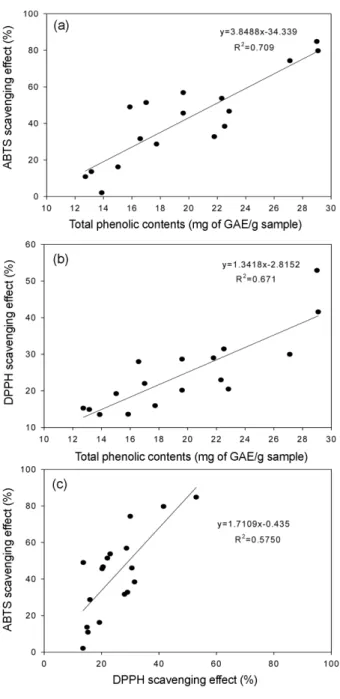
한편, 홍조류 에탄올 추출물 및 용매 분획물의 총폴리 페놀 함량과 ABTS, DPPH 라디칼 소거능 및 ABTS 라디 칼 소거능과 DPPH 라디칼 소거능과의 연관성은 Fig. 1에 나타내었다. Fig. 1(a)는 총폴리페놀 함량과 ABTS 라디칼 소거능과의 연관성을 보여주는데, 폴리페놀 함량과 라디 Table 4. Total phenolic contents of the crude extract, solvent-partitioned fractions from various red seaweeds
Total phenolic contents (mg of gallic acid equivalents/g of sample)
S. latiuscula
EtOH
1)extract 15.0 ±0.1 HX fraction 19.6 ±0.3 MC fraction 12.7 ±0.3 EA fraction 22.3 ±0.6 BuOH fraction 29.1 ±1.9 AQ fraction 16.4 ±0.7
C. ocellatus
EtOH extract 13.9 ±0.1 HX fraction 22.5 ±0.6 MC fraction 21.8 ±0.1 EA fraction 22.8 ±0.1 BuOH fraction 17.0 ±0.1 AQ fraction 19.6 ±0.1
C. affinis
EtOH extract 13.1 ±0.3 HX fraction 29.0 ±0.6 MC fraction 16.6 ±0.4 EA fraction 17.7 ±0.3 BuOH fraction 27.1 ±1.2 AQ fraction 15.9 ±0.3
1)
HX fraction = Hexane fraction; MC fraction = Methylenchloride
fraction; EA fraction = Ethylacetate fraction; AQ fraction = Aqueous
fraction
칼 소거능과의 연관성에 관한 단순회귀분석 결과 상관계 수는 0.709로 높은 연관성을 보였다. Fig. 1(b)는 총폴리페 놀 함량과 DPPH 라디칼 소거능과의 연관성을 보여주고 있는데, 상관계수는 0.671로 비교적 높은 연관성을 보였 다. 이러한 상관계수는 Cho et al. (2011)이 보고한 녹조류
Enteromorpha prolifera 에탄올 추출물 및 용매분획물의 총폴리페놀 함량과 항산화 활성과의 상관계수(0.036-0.478) 보다 높게 나타났다. 한편, Fig. 1(c)에서는 ABTS와 DPPH 라디칼 소거능과의 연관성을 보여준다. ABTS와 DPPH 라디칼 소거능과의 상관계수는 0.575로 비교적 높은 연관 성을 보였으며, 단순회귀분석을 이용한 기울기 분석에서 홍조류 에탄올 추출물 및 용매 분획물의 항산화 활성은 DPPH 라디칼 소거능 보다는 ABTS 라디칼 소거능이 더 높다는 것을 확인하였다. 본 연구 결과에서 분석된 ABTS 와 DPPH 라디칼 소거능의 상관계수(0.575)는 Ahn et al.
(2011) 이 보고한 해조류 메탄올 추출물의 ABTS와 DPPH 라디칼 소거능과의 상관계수(0.855)보다는 낮게 나타났고, reducing power와 DPPH 라디칼 소거능과의 상관계수 (0.536)와는 유사한 결과를 보였다.
이상의 연구 결과는 홍조류 에탄올 추출물의 용매 분획 물은 DPPH 라디칼 소거능 보다는 ABTS 라디칼 소거능 이 더 높다는 것을 보여주며, 특히 까막살 Hx 분획물은 DPPH 라디칼 소거능과 ABTS 라디칼 소거능을 동시에 가짐을 확인할 수 있었다. 또한, 총폴리페놀 함량과 라디 칼 소거능은 비교적 높은 연관성을 가짐을 확인하였다.
사 사
이 연구는 한국해양과학기술원(Korea Institute of Ocean Science and Technology, KIOST) 의 연구비(과제 번호:
PM56900, PE98742) 지원으로 수행되었으며, 이에 깊은 감사를 표합니다.
참고문헌