238
Korean J. Pl. Taxon.
44(4): 238-241 (2014)
http://dx.doi.org/10.11110/kjpt.2014.44.4.238
ISSN 1225-8318 Korean Journal of Plant Taxonomy
A new species of Juncus (Juncaceae): J. baekdusanensis M. Kim Kyeong Won Yun1, Hyun Jo and Muyeol Kim*
Department of Biological Sciences, Chonbuk National University, Jeonju 561-756, Korea
1
Department of Oriental Medicine Resources, Sunchon National University, Suncheon 540-742, Korea (Received 17 October 2014; Accepted 28 November 2014)
골풀속(골풀과)의 신종: 김의골풀(Juncus baekdusanensis M. Kim)
윤경원1·조 현·김무열*
전북대학교 자연과학대학 생명과학과,
1순천대학교 한약자원학과
ABSTRACT:
A new species, Juncus baekdusanensis M. Kim (Juncaceae), has been named and described from Mt.
Baekdu of the Korean peninsula. Juncus baekdusanensis shares several characters (terete leaf blades with leaf sheath auricles, between 1 and 2 flowered inflorescences, and 2 bracteoles) with its related species J. tenuis Willd. It is, how- ever, distinct from J. tenuis which have 1-flowered inflorescences, green perianth, lanceolate perianth segments, acuminate perianth apexes, small capsules, and lowland grassland habitats by having 2-flowered inflorescences, red- dish green perianth, ovate perianth segments, acute perianth apexes, large capsules, and highland swamp habitats.
Keywords:
Juncus baekdusanensis, Juncaceae, Mt. Baekdu
적 요:
백두산에서 골풀속의 신종인 김의골풀(Juncus baekdusanensis M. Kim)을 새로이 발견하여 기재하였 다. 김의골풀은 엽초를 가진 잎을 가지며 1-2개의 꽃으로 이루어진 화서를 가지고 있고 2개의 막질 소포를 가진 점에서 길골풀(J. tenuis Willd.)과 유사하다. 그러나 김의골풀은 2개의 꽃으로 이루어진 화서, 적녹색의 막질상 화피, 난형의 화피, 예두의 화피열편, 화피보다 커다란 삭과, 고지대의 늪지에서 자라는 특징이 있다.
반면에 길골풀은 1개의 꽃으로 이루어진 화서, 녹색의 강직한 화피, 장피침형의 화피, 점첨두의 화피열편, 화 피보다 작은 삭과, 저지대의 초지에서 자라는 점에서 뚜렷하게 차이를 보인다.
주요어:
김의골풀, 골풀과, 백두산
The genus Juncus L. (Juncaceae) consists of approximately 240 species and is found in temperate and cold regions (Wu and Clemants, 2000).
The genus Juncus is characterized by laterally compressed or terete leaves, bisexual flowers, 6 perianth segments, and 3-locular capsules (Wu and Clemants, 2000; Oh and Lee, 2007). Eighteen taxa of Juncus are reported from Korea (Lee, 1980; Oh and Lee, 2007). Of 18 taxa, J. effusus L. and J. krameri Fr. et Sav. are a popular occurrence in Korea, while J. maximowiczii Buchen. and
J. fauriei Lev. & Vaniot are rather rare and sporadically distributed (Lee, 1980; Kim et al,, 2012; Kim and Kim, 2013).
Mt. Baekdu (Baekdusan) is an active volcano and the highest mountain (2,744 m) on the Korean peninsula and in Manchuria (Lee, 1991; Lee et al., 2013). Mt. Baekdu contains about 1,500 species of vascular plants, of which 11 angiosperms are endemic (Kim, 2004).
In 2013, the authors first discovered Juncus baekdusanensis M.
Kim on Mt. Baekdu. It forms a large population of two thousand organisms at 1,700 m altitude on Mt. Baekdu. The species shares several characters with its related taxa J. tenuis Willd., but it can be distinguished based on its 2-flowered inflorescences, reddish green perianth, ovate perianth segments, acute perianth apexes, large capsules, and highland swamp habitats.
*Author for correspondence: [email protected] http://www.pltaxa.or.kr
Copyright © 2014 the Korean Society of Plant Taxonomists
Korean Journal of Plant Taxonomy Vol. 44 No. 4 (2014) A new species of Juncus (Juncaceae): J. baekdusanensis M. Kim 239
Juncus baekdusanensis M. Kim sp. nov. (Figs. 1-3) Korean name: Gim-ui-gol-pul 김의골풀
Plants perennial, tufed. Rhizome horizontal. Stems terete, 15- 50 cm. Leaves basal and cauline, leaf sheath auricles 1.5-4.5 mm, leaf blade terete, 7-15 cm × 0.5-1 mm. Inflorescences terminal, 7- 10 cm, 2-flowers in capitate clusters. Involucral bracts 1, leaflike, 1-5.5 cm. Bracteoles 2, ovate. Perianth segments 6, reddish green, ovate, 3.5-4.0 × 1.0-1.5 mm, margin white scarious, apex acute.
Stamens 6, filaments 2-2.4 mm, anther ca. 0.5 mm. Ovary ca.
2 mm, style ca. 0.7 mm, stigma 3-branched. Capsule ovoid, 4.0- 5.5 mm, longer than perianth. Fl. July, fr. August.
Type Locality: Mt. Baekdu.
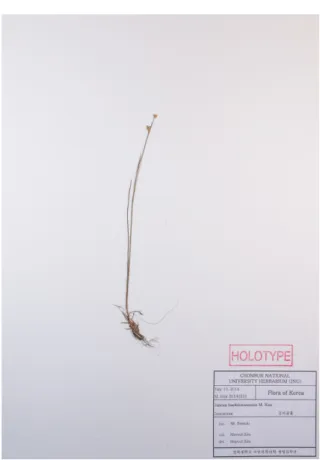
Holotype: Mt. Baekdu. July 10, 2014. M. Kim 20140321.
Herbarium of Chonbuk National University (JNU).
Isotypes: JNU, KH.
Paratypes: Mt. Baekdu. August 5, 2014. M. Kim 20140345- 20140348 JNU.
Distribution: Mt. Baekdu
Etymology: The specific epithet is derived from Mt. Baekdu (Baekdusan) where this new species is located. The Korean name, Gim-ui-gol-pul, comes from general Jwajin Kim who fought against the Japanese army in this area for Korean independence.
Habitats: The natural habitat of Juncus baekdusanensis M.
Kim was found in the highland swamps on Mt. Baekdu. This species occurs in swamps dominated by Rhynchospora alba, Andromeda polifolia, Oxycoccus microcarpus, Oxycoccus quadripetalus, Drosera rotundifolia, Scheuchzeria palustris, Parnassia palustris, and Lobelia sessilifolia.
Key to Juncus baekdusanensis and its related taxa.
1. Inflorescences pseudolateral 2. Stamens 3
3. Perianth segments unequal ··· J. effusus 골풀 3. Perianth segments equal ··· J. setchuensis 푸른갯골풀 2. Stamens 6 ··· J. haenkei 갯골풀 1. Inflorescences terminal
4. Herbs annual ··· J. bufonius 애기골풀
Fig. 1. Juncus baekdusanensis M. Kim. A. Adult plant; B. Flowers;
C. Stamens and pistil; D. Fruits; E. Seed.
Fig. 2. Photographs of Juncus baekdusanensis M. Kim at the natural habitat in Mt. Baekdu. A. Habitat; B. Adult plant; C.
Inflorescence; D. Flowers; E. Fruits; F. Seeds; G. Leaf sheath.
Korean Journal of Plant Taxonomy Vol. 44 No. 4 (2014)
240 Kyeong Won Yun, Hyun Jo and Muyeol Kim
4. Herbs perennial
5. 1- or 2-flowers in capitate clusters
6. 1-flower in capitate cluster, green perianth, lanceolate perianth segments, acuminate perianth apex, small capsule
7. Involucral bract longer than inflorescence
··· J. gracillimus 물골풀 7. Involucral bract shorter than inflorescence
··· J. tenuis 길골풀 6. 2-flowers in capitate cluster, reddish green perianth, ovate perianth segments, acute perianth apex, large capsule ··· J. baekdusanensis 김의골풀 5. Few to many flowers in capitate clusters
8. Leaf blade septate
9. Leaf blade incompletely septate, stem winged 10. Stamens 6, stems broadly winged
··· J. alatus 날개골풀 10. Stamens 3, stems narrowly winged
··· J. diastrophanthus 별날개골풀 9. Leaf blade completely septate, stem wingless
11. Stamens 6
12. Perianth segments dark brown
··· J. triceps 설령골풀
12. Perianth segments green
··· J. krameri 비녀골풀 11. Stamens 3
13. Capsule apex tapered into a short beak
··· J. wallichianus 눈비녀골풀 13. Capsule apex acute or acuminate
··· J. papillosus 청비녀골풀 8. Leaf blade not septate
14. Leaves all basal ··· J. triglumis 구름골풀 14. Leaves basal and cauline
15. Capsule 4.5-5 mm ··· J. maximowiczii 실비녀골풀 15. Capsule 3.5-3.7 mm ··· J. potaninii 백두실골풀
Fig. 3. Holotype of Juncus baekdusanensis M. Kim.Table 1. Comparison of morphological characters between Juncus baekdusanensis M. Kim and J. tenuis Willd.
Characters J. baekdusanensis J. tenuis
Habits perennial perennial
Habitat swamps grasslands
Plant height 15-50 cm 10-40 cm
Cauline leaf sheath 1.5-4.5 mm 2-4 cm Cauline leaf blade
shape terete terete
Cauline leaf blade
length 7-15 cm 4-23 cm
Inflorescences terminal terminal
Involucral bract 1-5.5 cm 4-18 cm
Flowers in capitate
cluster 2-flowers 1-flower
Bracteoles 2 2
Perianth segment
color reddish green green
Perianth segment
number 6 6
Perianth segment
apex acute acuminate
Perianth segment
shape ovate lanceolate
Perianth segment
length 3.5-4.0 mm 3.0-3.5 mm
Perianth segment
width 1.0-1.5 mm 0.7-1.0 mm
Stamens 6 6
Stigma 3-branched 3-branched
Capsule length 4.0-5.5 mm 2.0-2.5 mm
Capsule longer than
perianth
shorter than perianth
Seed length 1.2-1.4 mm 0.4-0.5 mm
Korean Journal of Plant Taxonomy Vol. 44 No. 4 (2014) A new species of Juncus (Juncaceae): J. baekdusanensis M. Kim 241