• 검색 결과가 없습니다.

Progress in the co-evaporation technologies developed for high performance REBa<sub>2</sub>Cu<sub>3</sub>O<sub>7-</sub><sub>δ</sub> films and coated conductors

N/A
N/A
Protected

Academic year: 2021

Share "Progress in the co-evaporation technologies developed for high performance REBa<sub>2</sub>Cu<sub>3</sub>O<sub>7-</sub><sub>δ</sub> films and coated conductors"

Copied!
7
0
0

로드 중.... (전체 텍스트 보기)

전체 글

(1)

Superconductivity and Cryogenics

Vol.14, No.4, (2012), pp.5~11 http://dx.doi.org/10.9714/sac.2012.14.4.005

```

Abstract— In this review article, we focus on various co-evaporation technologies developed for the fabrication of high performance REBa 2 Cu 3 O 7-δ (RE: Y and Rare earth elements, REBCO) superconducting films. Compared with other manufacturing technologies for REBCO films such as sputtering, pulsed laser deposition (PLD), metal-organic deposition (MOD), and metal organic chemical vapor deposition (MOCVD), the co-evaporation method has a strong advantage of higher deposition rate because metal sources can be used as precursor materials. After the first attempt to produce REBCO films by the co-evaporation method in 1987, various co-evaporation technologies for high performance REBCO films have been developed during last several decades. The key points of each co-evaporation technology are reviewed in this article, which enables us to have a good insight into a new high throughput process, called as a Reactive Co-Evaporation by Deposition and Reaction (RCE-DR).

Keywords: Co-evaporation technology, REBCO film, coated conductor, in-situ growth, ex-situ growth.

1. INTRODUCTION

Since the YBCO superconductor with the superconducting transition temperature (T c ) exceeding the boiling point of liquid nitrogen was first reported in March 1987 [1], various fabrication technologies for producing REBCO films have been developed by many research groups [2-14]. At the moment, sputtering [2-4], co-evaporation [5-10], PLD [11,12], MOD [13], and MOCVD [14] are available for the fabrication of high performance REBCO films. Among these technologies, the co-evaporation method has the strongest advantage that a very high rate deposition can be achieved using relatively cheap metal sources as precursor materials although it has a difficulty in an accurate control of the film composition because of a different evaporation rate of each element.

Early 1990’s, REBCO films on the flexible metal substrates, called as coated conductors (CCs), have been developed for various electric power applications [15,16].

Up to date, long-length REBCO CCs with high critical current (I c ) have been successfully fabricated by various methods [17-22]. One of the key issues for a real

commercialization of CC is to reduce its price. From this viewpoint, the co-evaporation method is very promising because, as previously mentioned, it has the advantage of high deposition rate, leading to the high throughput.

There are two different growth processes of REBCO films which are in-situ and ex-situ growth processes. Since

“in-situ” can be translated into “in position”, in-situ growth means that deposition and growth of REBCO films take place simultaneously. The PLD and MOCVD methods are the typical examples of in-situ growth of REBCO films. On the other hands, since “ex-situ” can be translated into “out of position”, ex-situ growth means that precursor films are firstly deposited on the substrates and subsequently converted into REBCO films, where samples normally move from their deposition position to another conversion position. The MOD process is a good example of ex-situ growth of REBCO films. On the basis of the co-evaporation method, however, both in-situ and ex-situ growth processes for REBCO films have been developed.

In this paper, we first explain the progress in the co-evaporation technology utilized for REBCO thin film devices. Next, we describe the progress in the co-evaporation technology for long-length REBCO CCs, and the characteristic features of REBCO CCs fabricated by various co-evaporation technologies are summarized.

Finally, we compare newly developed RCE-DR process with other processes developed for long-length REBCO CCs.

2. PROGRESS IN THE CO-EVAPORATION TECHNOLOGY FOR REBCO THIN FILM

DEVICES

Early works by the co-evaporation method were performed for the fabrication of high performance REBCO films on single crystal substrates applicable to superconducting film devices, including high-T c Josephson junctions and microwave filters [9,23]. A typical processing sequence in early works was as follows;

amorphous precursor films were deposited, and subsequently annealed at high temperature of ~ 900°C in a furnace (i.e., ex-situ post annealing) to form the YBCO phase [5-9]. For instance, IBM group [5,6] for the first time reported that YBCO thin films on sapphire (both c- and a-axis orientation) and MgO substrates (both with a <110>

Progress in the co-evaporation technologies developed for high performance REBa 2 Cu 3 O 7-δ films and coated conductors

J.W. Lee and S.I. Yoo *

Department of Materials Science and Engineering, Research Institute of Advanced Materials (RIAM), Seoul National University, Seoul 151-744, Korea

Received 15 November 2012; accepted 23 November 2012

* Corresponding author: [email protected]

(2)

and a <001> orientation) by e-beam co-evaporation.

Substrate temperature during deposition was held at

~450°C, and oxygen pressure was about 10 -3 Torr. In order to obtain high-quality YBCO films, as-deposited samples were post-annealed at the temperature region of 900 - 950°C. The highest T c,zero value was 90 K, and its critical current (J c ) value was over 1 MA/cm 2 at 4.2 K and over 0.1 MA/cm 2 at 77 K, respectively. As another example, Lathrop et al. [9] tried to produce YBCO superconducting thin films in-situ by high-pressure reactive evaporation and rapid thermal annealing. While the sample cooled in 0.65 mTorr of oxygen (deposition pressure) exhibited a poor superconductivity, they could obtain the T c,zero value of ~80 K by backfilling a deposition chamber with 1 Torr of oxygen after deposition at 700°C or by additional rapid thermal annealing at 800°C for 2 min in pure O 2 .

Since thermodynamic or kinetic information on the growth of REBCO films from amorphous films was unavailable at that time, the processing conditions were empirically determined so that it was hard to control the phase evolution from the amorphous phase to the REBCO crystalline phase during post annealing at high temperature, which might cause segregation of the secondary phases [5,6] and nucleation of randomly or a-axis oriented REBCO grains in REBCO films [6,7]. In order to overcome such barriers, in-situ growth of REBCO films at low temperature without post annealing was introduced.

During the co-evaporation process, the evaporation of each element took place in a relatively high vacuum (typically, ~ 10 -5 Torr) for retaining a suitable mean free path of each element and also for maintaining a stability of the deposition system. Unfortunately, however, this evaporation condition was generally not coincident with the growth conditions of REBCO films thermodynamically determined by many groups [24-29]. As it were, while lower oxygen pressure (PO 2 ) was preferred for the

“deposition” of each element by co-evaporation, higher PO 2 was required for the “growth” of REBCO films.

To overcome such a dilemma, a deposition chamber was specially designed to maintain the vacuum level adequate for the co-evaporation of metals including each element while a sufficient oxygen gas was simultaneously introduced to the substrate side of the deposition chamber [30-40]. With this reactive co-evaporation process, Terashima et al. [30] first reported a successful fabrication of the YBCO film. They introduced the oxygen gas to the substrate side of the deposition chamber (PO 2 ~10 -2 Torr) while a high vacuum (PO 2 ~10 -5 Torr) state was sustained near the co-evaporation unit. With the substrate temperatures of 500 - 600°C and a high deposition rate of 6 Å/s, they could obtain the T c,zero value of 90.2 K from the YBCO film. Further systematic study on the reactive co-evaporation of YBCO films was reported by Matijasevic et al. [34]. In their work, various processing variables, including oxygen pressure, composition, substrate temperature, type and orientation of substrate, total thickness of film, and cooling procedure, were studied to investigate their effects on the YBCO films. They also found that in the case of deposition at low temperature, the

c-axis lattice parameters of YBCO films were expanded in comparison with that of YBCO bulk. Even though the YBCO samples were further annealed in oxygen atmosphere at the temperature of ~500°C, the c-axis lattice parameter of YBCO film could not reach that of YBCO bulk. According to these results, they suggested that the c-axis lattice parameter of YBCO film could be expanded not only due to the oxygen contents of films, but also due to an anti-site disorder between Y and Ba. One more important point of their work was that atomic oxygen, oxygen ion or ozone gases were used instead of molecular oxygen gas. This technique was also employed by other groups [37-40] since atomic oxygen, oxygen ion or ozone gas acted as more reactive oxidizer rather than molecular oxygen gas, and hence a small amount of gas could be used for supplementing oxygen into the YBCO film to secure the stability of the deposition system.

Meanwhile, since the Ba metal is highly unstable in air and easily converted into BaCO 3 , there has been an effort for using BaF 2 as the precursor material instead of the Ba metal [10,41-44]. This method was firstly reported by Mankiewich et al. [10]. After deposition without heating the substrates, they obtained brown insulating precursor films. These precursor films were very stable so that after exposure in air for 18 h and even after immersion in de-ionized water for 5 min, they exhibited the T c,zero value of over 80 K when those had been annealed at the temperature higher than 800°C. In contrast, using the Ba metal as the precursor, only the T c,zero value of 60 K was obtainable. Later, Feenstra et al. [42] reported a systematic study for the effect of oxygen pressure on YBCO thin films by post annealing. Their post-annealing conditions include a wide PO 2 region of 8.0×10 -5 - 1 atm and also a wide temperature region of 650 - 890°C. They utilized the stability phase diagram of YBCO in order to interpret the grain alignment of YBCO films, and found that predominantly c-axis oriented YBCO films were obtainable using specific annealing conditions which could be represented as a region between two lines on the log PO 2

vs 1/T (K -1 ) diagram. The slopes of these lines were very close to that of the YBCO stability line, where the YBCO stability line indicates the upper limit conditions of its stability, and the lowest temperature in this region was about 720°C. The highest critical current density (J c ) of 2.3 MA/cm 2 (77K, self-field) was achievable from a 194 nm-thick YBCO film annealed at 835°C in PO 2 of 0.028 atm for 30 min. In their work, moisture was supplied during high temperature heat treatment for the decomposition of fluoride releasing HF gas, which is similar to the trifluoroacetate (TFA)-MOD process originally developed by Gupta et al. [13].

Solovyov et al. [43] firstly reported the properties of thick YBCO films on SrTiO 3 substrates deposited by the co-evaporation of Y-BaF 2 -Cu and followed by a subsequent ex-situ post annealing process. The high deposition rate of 10 nm/s was achieved using e-beam co-evaporation for Y and Cu and thermal evaporation for BaF 2 . From the YBCO sample with ~ 3 µm thickness, the J c

value of 1.8 × 10 5 A/cm 2 at 77 K, 1 T (H//c) was obtained.

(3)

J.W. Lee and S.I. Yoo

Fig. 1. Schematic of co-evaporation deposition system combined with an oxygen pocket heater and rotating sample holder (ref. [46]).

With a modification of annealing conditions, including temperature, oxygen pressure and partial pressure of moisture, they could obtain higher J c of 2.0 × 10 5 A/cm 2 at 77 K, 1 T (H//c) from much thicker YBCO film with ~ 5 µm thickness [44]. This process was applied to produce YBCO CCs, which will be described in section 3.

In 1993, another innovative ex-situ process enabling large area REBCO films was reported by University of Munich group [23,45-48]. They established a “rotating disk substrate holder” which could separate a co-evaporation zone from a reaction zone as shown in Fig. 1. In this figure, the co-evaporation deposition system is combined with an oxygen pocket heater and rotating sample holder. By separating the deposition zone from the reaction zone, the stability of deposition unit could be achieved. In addition, since a thin layer deposited during one cycle was immediately converted into YBCO, and segregation of the secondary phase, unavoidable in early works by ex-situ post annealing, could be suppressed. Therefore, they could successfully fabricate 4 inch diameter YBCO films with the T c,zero value over 86 K and the J c value over 2 MA/cm 2 (77K, self-field) on various substrates, including MgO, LaAlO 3 , YSZ, sapphire, Si, and GaAs [46].

The co-evaporation technologies developed for the fabrication of long-length REBCO CCs may be divided into the following three categories: 1) a BaF 2 ex-situ process [49-53], 2) a cyclic ex-situ process [54-66], and 3) a two-step ex-situ process [20-22]. All these processes are ex-situ growth of REBCO since an in-situ deposition of REBCO is limited by slow growth kinetics and thus inappropriate for fabricating long-length CCs with high throughput. While both the BaF 2 and the cyclic ex-situ processes are originally from the co-evaporation technologies developed for REBCO thin film devices, the

two-step ex-situ process is a newly developed one through a co-work between our group and Superconductor, Nano &

Advanced Materials Corporation (SuNAM Co.). Details on each process are reviewed in this section.

The BaF 2 ex-situ process for YBCO CC had been developed mainly by the research group of Oak Ridge National Laboratory (ORNL). In 2001, Lu et al. [49] first reported 1 m-long YBCO CC with 5 µm thickness fabricated by the BaF 2 ex-situ process employing the e-beam co-evaporation of Y, BaF 2 and Cu precursors.

Although they carefully adjusted the film composition to the cation ratio of Y : Ba : Cu = 1.05 : 2.10 : 3.0 with a standard deviation of less than 2.0 %, the end-to-end transport J c was 0.1 MA/cm 2 at 77 K and the highest J c of 0.77 MA/cm 2 was achievable from a short section within the tape, indicating that their sample was inhomogeneous and thus J c might be degraded. After four years later, Feenstra et al. [51] reported high-I c YBCO CC with over 350 A/cm-width (77K, self-field) on RABiTS (rolling assisted biaxially textured substrates). In their work, a fast conversion of as-deposited precursor into YBCO film could be achieved by heating it to 780°C with the heating rate of 130°C/min in gas mixtures containing 1-2 % water vapor. With this fast heating rate process, a random nucleation of YBCO at low temperature during heating could be suppressed, resulting in the J c value of 2.3 MA/cm 2 (77K, self-field) even for 1.7 µm-thick YBCO film.

The separation idea of the deposition zone from the reaction zone in the chamber, developed by University of Munich group [23], was applied to the fabrication of YBCO and DyBCO CCs [54-57]. Since it was impossible to rotate long-length coated conductors within the deposition chamber, a small container for supplementing oxygen gas below the substrate, named as a “oxygen shuttle”, was designed. With this method, Kinder et al. [58]

produced YBCO films on MgO single crystal (1cm × 1cm size) distributed over 20 cm × 20 cm area, and found uniform T c,zero values of 83.8 - 85.0 K for their films. Based on this method, THEVA [55-57] could fabricate high performance DyBCO CCs on an ISD (inclined substrate deposition)-MgO substrate. More recently, they reported the DyBCO film having high I c value of 1018 A/cm (77K, self-field) with 5.9 µm thickness [57].

With the concept of the cyclic ex-situ process, a new batch-type facility, called as evaporation using drum in dual chamber (EDDC), was developed by KAIST and KERI groups [59-65]. This facility consisted of a dual chamber in which high oxygen pressure was set in upper part for conversion into REBCO films while low pressure was maintained in lower part for deposition of metal precursors by co-evaporation. In addition, a cylindrical holder with heating elements was located inside the chamber. For fabricating CCs by EDDC, the substrate was firstly wound to a cylindrical holder located at the drum surface, and then rotated at the temperature of ~ 700°C. At the lower chamber, each element was deposited to form an 7

3. PROGRESS IN THE CO-EVAPORATION TECHNOLOGY FOR REBCO COATED

CONDUCTORS

(4)

amorphous precursor layer in low oxygen pressure, and by rotating drum holder, the amorphous layer was converted into the REBCO phase in upper chamber which was set in high oxygen pressure. With this procedure, high-I c values of 90-130A/cm-width at 77 K were achieved from SmBCO CCs with 7.5 m long and 9 mm width [59]. Ha et al. [60]

reported the effect of composition on the superconducting properties of SmBCO CCs fabricated by the EDDC method.

With an optimal composition region of Sm : Ba : Cu = 1.0 : 1.9-2.0 : 3.2-3.4, high J c value of 2.6 MA/cm 2 at 77K was obtained. Furthermore, Kim et al. [64] introduced a shield with parallelogram open zone in the deposition system to investigate the effect of composition on superconducting properties in the same batch for SmBCO CC. They reported that the optimum nominal compositions for 800 nm-thick SmBCO films were 0.01≤x≤0.05, –0.23≤y≤–0.46 in Sm 1+x Ba 2-x Cu 3+y O 7-δ , leading to high J c value of 1.6 MA/cm 2 (77 K, self-field). More recently, SmBCO CC with very high I c of 1,530A/cm-width (77 K, self-field) could be fabricated by the EDDC process [65].

Los Alamos National Laboratory (LANL) and Superconductor Technologies Inc. (STI) groups [66] also developed a cyclic ex-situ process, called as a Reactive Co-Evaporation by Cyclic Deposition and Reaction (RCE-CDR), which was essentially identical to the EDDC process except the alteration of the batch type to the reel-to-reel type. In their works, 5.3 µm-thick YBCO film with high J c value of 1.2 MA/cm 2 (77 K, self-field) was obtainable.

Recently, a novel technology for ex-situ growth of REBCO films, called as Reactive Co-Evaporation by Deposition and Reaction (RCE-DR) process, has been developed through a co-work between our groups and SuNAM Co. [20-22]. The RCE-DR process is a two-step ex-situ process as shown in Fig. 2. In this process, an amorphous precursor film was firstly deposited on a metal substrate tape by a multi-turn reel-to-reel motion using e-beam co-evaporation at low temperature in low PO 2

(~10 -5 Torr), and subsequently converted into GdBCO crystalline films within a minute by passing the tape through a tube furnace set at high temperature (~ 850°C) in relatively higher PO 2 (~100 mTorr) as shown in Fig. 2.

While a layer-by-layer growth of REBCO took place in the cyclic ex-situ processes of both EDDC and RCE-CDR, the amorphous precursor film was rapidly converted into Gd 2 O 3 plus liquid and finally grown to the GdBCO film by

Fig. 2. Schematic of the RCE-DR process.

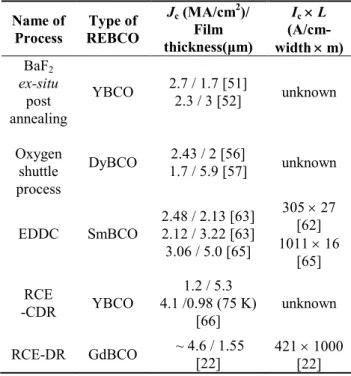
TABLE I

T HE J

C

AND I

C

× L VALUES AT 77 K FOR REBCO COATED CONDUCTORS FABRICATED BY VARIOUS CO - EVAPORATION TECHNOLOGIES . Name of

Process Type of REBCO

J c (MA/cm 2 )/

Film thickness(μm)

I c × L (A/cm- width × m) BaF 2

ex-situ post annealing

YBCO 2.7 / 1.7 [51]

2.3 / 3 [52] unknown

Oxygen shuttle process

DyBCO 2.43 / 2 [56]

1.7 / 5.9 [57] unknown

EDDC SmBCO 2.48 / 2.13 [63]

2.12 / 3.22 [63]

3.06 / 5.0 [65]

305 × 27 [62]

1011 × 16 [65]

-CDR RCE YBCO 1.2 / 5.3 4.1 /0.98 (75 K)

[66] unknown

RCE-DR GdBCO ~ 4.6 / 1.55

[22] 421 × 1000 [22]

the peritectic recombination reaction [21,67] in the RCE-DR process. Interestingly, this new process is somewhat similar to the early studies for YBCO thin films by the co-evaporation method [5-9] in the sense that as-deposited film is converted into YBCO film by ex-situ post annealing. However, while the amorphous films were annealed in high PO 2 of 760 Torr so that randomly oriented YBCO films were formed during heating in the early studies by the ex-situ co-evaporation process, highly textured GdBCO films were successfully grown at low PO 2

of ~100 mTorr by the two-step RCE-DR process [21].

The superconducting properties of REBCO CCs produced by various co-evaporation technologies are summarized in Table 1. Among these technologies, the highest throughput is achievable from the RCE-DR process since other processes like EDDC and RCE-CDR employ the cyclic deposition for precursor layers which limit the deposition rate. In addition, the high I c value (> 400

A/cm-width) could be successfully obtained from 1 km-length GdBCO CC produced by the RCE-DR process.

Therefore, one can see that the RCE-DR process is the most promising one for the commercialization of high performance REBCO CCs.

Long length CCs with high performance have been successfully fabricated by various methods such as MOD [17], MOCVD [18], PLD [19] and RCE-DR [20-22], etc.

Among these methods, the RCE-DR process exhibits the highest throughput over 360 m/h [20-22] in comparison of

4. COMPARISON OF THE RCE-DR PROCESS WITH OTHER PROCESSES DEVELOPED FOR

LONG-LENGTH REBCO COATED

CONDUCTORS

(5)

J.W. Lee and S.I. Yoo MOCVD (~180 m/h) [68], MOD (~100 m/h) [69], and

PLD (40 m/h) [19]. The throughput is defined by the processing area times the growth rate of REBCO film. If the processing area is assumed to be identical, the throughput is dependent only on the growth rates of REBCO films. Since the growth rate of REBCO films (> 100 nm/s) by the RCE-DR process is much faster than those of other methods (PLD, MOCVD < 10 nm/s, MOD

< 1 nm/s), the highest throughput can be obtained by the RCE-DR process. The reason for the highest growth rate of REBCO films by the RCE-DR process is considered to be due to a melt-textured growth of REBCO on the LaMnO 3

buffer layer [21]. However, further study is required for a better understanding of such a fast growth mechanism.

From the view point of flux pinning, the PLD method is known to be very effective for introducing the flux pinning centers because the secondary phases within the REBCO matrix can be refined into several nm size. Though not so effective as the PLD method, the MOCVD and MOD methods are also effective since the secondary phases can be refined into several tenth nm size. With the RCE-DR process, the second phases have ~100 nm size, and hence the flux pinning properties are not so good at the moment.

However, since the pinning control in the RCE-DR process is at the early stage, improvement of the flux pinning properties of REBCO films may be possible by discovering a novel route enabling further refinement of the secondary phases.

5. SUMMARY

We reviewed various co-evaporation technologies developed for high performance REBCO superconducting films. After the first attempt of co-evaporation for REBCO films in 1987, various techniques employing co-evaporation have been developed. In the early stage, the co-evaporation technology was used for the fabrication of REBCO thin film devices. Recently, however, it has been employed for the fabrication of REBCO CCs. For the fabrication of REBCO thin film devices, ex-situ post-annealing processes, including usage of BaF 2 , in-situ growth process and ex-situ conversion by multi-step growth, were developed. The BaF 2 -post annealing process and ex-situ conversion by multi-step growth were also applied for the fabrication of REBCO CCs. More recently, the new two-step process, called as the RCE-DR process, was developed. Since this process exhibits the highest throughput (> 360 m/h) due to the high growth rate of GdBCO (> 100 nm/sec), it is considered very cost-effective process for the commercialization of REBCO CCs.

REFERENCES

[1] M. K. Wu, J. R. Ashburn, C. J. Torng, P. H. Hor, R. L. Meng, L. Gao, Z. J. Huang, Y. Q. Wang, and C. W. Chu, "Superconductivity at 93K in a new mixed-phase Y-Ba-Cu-O compound system at ambient pressure, " Physical Review Letters, vol. 58, pp. 908-910, Mar. 1987.

[2] R. E. Somekh, M. G. Blamire, Z. H. Barber, K. Butler, J. H. James, G. W. Morris, E. J. Tomlinson, A. P. Schwarzenberger, W. M.

Stobbs, and J. E. Evetts, "High superconducting transition temperatures in sputter-deposited YBaCuO thin-films," Nature, vol.

326, pp. 857-859, Apr. 1987.

[3] M. Kawasaki, S. Nagata, Y. Sato, M. Funabashi, T. Hasegawa, K.

Kishio, K. Kitazawa, K. Fueki, and H. Koinuma, "High-T

c

Yb-Ba-Cu-O thin films deposited on sintered YSZ substrates by sputtering," Japanese Journal of Applied Physics Part 2-Letters, vol. 26, pp. L738-L740, May 1987.

[4] Y. Enomoto, T. Murakami, M. Suzuki, and K. Moriwaki, "Largely anisotropic superconducting critical current in epitaxially grown Ba

2

YCu

3

O

7-y

thin film," Japanese Journal of Applied Physics Part 2-Letters, vol. 26, pp. L1248-L1250, Jul. 1987.

[5] R. B. Laibowitz, R. H. Koch, P. Chaudhari, and R. J. Gambino,

"Thin superconducting oxide films," Physical Review B, vol. 35, pp.

8821-8823, Jun. 1987.

[6] P. Chaudhari, R. H. Koch, R. B. Laibowitz, T. R. McGuire, and R. J.

Gambino, "Critical-current measurements in epitaxial films of YBa

2

Cu

3

O

7-x

compound," Physical Review Letters, vol. 58, pp.

2684-2686, Jun. 1987.

[7] B. Oh, M. Naito, S. Arnason, P. Rosenthal, R. Barton, M. R.

Beasley, T. H. Geballe, R. H. Hammond, and A. Kapitulnik,

"Critical current densities and transport in superconducting YBa

2

Cu

3

O

7-δ

films made by electron-beam coevaporation," Applied Physics Letters, vol. 51, pp. 852-854, Sep. 1987.

[8] J. Kwo, T. C. Hsieh, R. M. Fleming, M. Hong, S. H. Liou, B. A.

Davidson, and L. C. Feldman, "Structural and superconducting properties of orientation-ordered Y

1

Ba

2

Cu

3

O

7-x

films prepared by molecular-beam epitaxy," Physical Review B, vol. 36, pp.

4039-4042, Sep. 1987.

[9] D. K. Lathrop, S. E. Russek, and R. A. Buhrman, "Production of YBa

2

Cu

3

O

7-y

superconducting thin-films in situ by high-pressure reactive evaporation and rapid thermal annealing," Applied Physics Letters, vol. 51, pp. 1554-1556, Nov. 1987.

[10] P. M. Mankiewich, J. H. Scofield, W. J. Skocpol, R. E. Howard, A.

H. Dayem, and E. Good, "Reproducible technique for fabrication of thin films of high transition temperature superconductors," Applied Physics Letters, vol. 51, pp. 1753-1755, Nov. 1987.

[11] D. Dijkkamp, T. Venkatesan, X. D. Wu, S. A. Shaheen, N. Jisrawi, Y. H. Minlee, W. L. McLean, and M. Croft, "Preparation of Y-Ba-Cu oxide superconductor thin films using pulsed laser evaporation from high-T

c

bulk material," Applied Physics Letters, vol. 51, pp. 619-621, Aug. 1987.

[12] X. D. Wu, D. Dijkkamp, S. B. Ogale, A. Inam, E. W. Chase, P. F.

Miceli, C. C. Chang, J. M. Tarascon, and T. Venkatesan, "Epitaxial ordering of oxide superconductor thin films on (100) SrTiO

3

prepared by pulsed laser evaporation," Applied Physics Letters, vol.

51, pp. 861-863, Sep. 1987.

[13] A. Gupta, R. Jagannathan, E. I. Cooper, E. A. Giess, J. I. Landman, and B. W. Hussey, "Superconducting oxide-films with high transition-temperature prepared from metal trifluoroacetate precursors," Applied Physics Letters, vol. 52, pp. 2077-2079, Jun.

1988.

[14] A. D. Berry, D. K. Gaskill, R. T. Holm, E. J. Cukauskas, R. Kaplan, and R. L. Henry, "Formation of high T

c

superconducting films by organometallic chemical vapor-deposition," Applied Physics Letters, vol. 52, pp. 1743-1745, May 1988.

[15] Y. Iijima, N. Tanabe, O. Kohno, and Y. Ikeno, "In plane aligned YBa

2

Cu

3

O

7-x

thin-films deposited on polycrystalline metallic substrates," Applied Physics Letters, vol. 60, pp. 769-771, Feb.

1992.

[16] X. D. Wu, S. R. Foltyn, P. Arendt, J. Townsend, C. Adams, I. H.

Campbell, P. Tiwari, Y. Coulter, and D. E. Peterson, "High current YBa

2

Cu

3

O

7-δ

thick-films on flexible nickel substrates with textured buffer layers," Applied Physics Letters, vol. 65, pp. 1961-1963, Oct.

1994.

[17] M. W. Rupich, X. P. Li, C. Thieme, S. Sathyamurthy, S. Fleshler, D.

Tucker, E. Thompson, J. Schreiber, J. Lynch, D. Buczek, K.

DeMoranville, J. Inch, P. Cedrone, and J. Slack, "Advances in second generation high temperature superconducting wire manufacturing and R&D at American Superconductor Corporation," Superconductor Science & Technology, vol. 23, Jan.

2010.

9

(6)

[18] V. Selvamanickam, Y. M. Chen, X. M. Xiong, Y. Y. Y. Xie, M.

Martchevski, A. Rar, Y. F. Qiao, R. M. Schmidt, A. Knoll, K. P.

Lenseth, and C. S. Weber, "High Performance 2G Wires: From R&D to Pilot-Scale Manufacturing," IEEE Transactions on Applied Superconductivity, vol. 19, pp. 3225-3230, Jun. 2009.

[19] H. Kutami, T. Hayashida, S. Hanyu, C. Tashita, M. Igarashi, H. Fuji, Y. Hanada, K. Kakimoto, Y. Iijima, and T. Saitoh, "Progress in research and development on long length coated conductors in Fujikura," Physica C-Superconductivity and Its Applications, vol.

469, pp. 1290-1293, Aug-Oct. 2009.

[20] S.H. Moon. “Advanced fast RCE process for REBCO coated conductor” Invited talk in 23

rd

International Symposium on Superconductivity, Nov. 1-3, 2010, Tsukuba, Japan

[21] S.I. Yoo, “The high rate conversion mechanism of GdBCO coated conductors by a new high throughput process, RCE-DR,” Invited talk in 2011 MRS spring meeting, Apr. 25-29, 2011, San Fransisco, USA.

[22] S.I. Yoo, “Recent development of GdBCO coated conductors by a new high throughput process,” Presentation in 2012 MRS spring meeting, Apr. 9-13, 2012, San Fransisco, USA.

[23] P. Berberich, W. Assmann, W. Prusseit, B. Utz, and H. Kinder,

"Large area deposition of YBa

2

Cu

3

O

7

films by thermal co-evaporation," Journal of Alloys and Compounds, vol. 195, pp.

271-274, May 1993.

[24] R. H. Hammond and R. Bormann, "Correlation between the in situ growth conditions of YBCO thin films and the thermodynamic stability criteria," Physica C, vol. 162, pp. 703-704, Dec. 1989.

[25] B. T. Ahn, V. Y. Lee, R. Beyers, T. M. Gur, and R. A. Huggins,

"Quaternary phase relations near YBa

2

Cu

3

O

6+x

at 850°C in reduced oxygen pressures," Physica C, vol. 167, pp. 529-537, May 1990.

[26] T. B. Lindemer, F. A. Washburn, C. S. Macdougall, R. Feenstra, and O. B. Cavin, "Decomposition of YBa

2

Cu

3

O

7-x

and YBa

2

Cu

4

O

8

for PO

2

≤0.1 MPa," Physica C, vol. 178, pp. 93-104, Jul. 1991.

[27] J. L. Macmanusdriscoll, J. C. Bravman, and R. B. Beyers, "Phase equilibria in the Y-Ba-Cu-O system and melt processing of ag clad Y

1

Ba

2

Cu

3

O

7-x

tapes at reduced oxygen partial pressures," Physica C, vol. 241, pp. 401-413, Jan. 1995.

[28] H. Ishizuka, Y. Idemoto, and K. Fueki, "Oxygen nonstoichiometry and high-temperature conductivity of DyBa

2

Cu

3

O

7-δ

," Physica C, vol. 195, pp. 145-156, May 1992.

[29] T. B. Lindemer, E. D. Specht, P. M. Martin, and M. L. Flitcroft,

"Nonstoichiometry, decomposition and T

c

of Nd

1+z

Ba

2-z

Cu

3

O

y

,"

Physica C, vol. 255, pp. 65-75, Dec. 1995.

[30] T. Terashima, K. Iijima, K. Yamamoto, Y. Bando, and H. Mazaki,

"Single-crystal YBa

2

Cu

3

O

7-x

thin-films by activated reactive evaporation," Japanese Journal of Applied Physics Part 2-Letters, vol. 27, pp. L91-L93, Jan. 1988.

[31] P. Berberich, J. Tate, W. Dietsche, and H. Kinder,

"Low-temperature preparation of superconducting YBa

2

Cu

3

O

7-δ

films on Si, MgO, and SrTiO

3

by thermal coevaporation," Applied Physics Letters, vol. 53, pp. 925-926, Sep. 1988.

[32] T. Terashima, Y. Bando, K. Iijima, K. Yamamoto, and K. Hirata,

"Epitaxial growth of YBa

2

Cu

3

O

7-x

thin-films on (110) SrTiO

3

single crystals by activated reactive evaporation," Applied Physics Letters, vol. 53, pp. 2232-2234, Nov. 1988.

[33] Q. Y. Ying, H. S. Kim, D. T. Shaw, and H. S. Kwok, "Nature of in situ superconducting film formation," Applied Physics Letters, vol.

55, pp. 1041-1043, Sep. 1989.

[34] V. Matijasevic, P. Rosenthal, K. Shinohara, A. F. Marshall, R. H.

Hammond, and M. R. Beasley, "Reactive coevaporation of YBaCuO superconducting films," Journal of Materials Research, vol. 6, pp. 682-698, Apr. 1991.

[35] K. Satoh, M. Yoshihara, M. Nakajima, T. Hara, H. Ishii, and T.

Yamamoto, "Characterization of Y-Ba-Cu-O thin films on metallic substrates using co-evaporation technique," Japanese Journal of Applied Physics Part 2-Letters, vol. 30, pp. L1363-L1366, Aug.

1991.

[36] F. Baudenbacher, K. Hirata, P. Berberich, H. Kinder, W. Assmann, and H. P. Lang, "Extremely smooth YBCO-films on MgO with high critical current densities," Physica C, vol. 185, pp. 2177-2178, Dec.

1991.

[37] N. Missert, R. Hammond, J. E. Mooij, V. Matijasevic, P. Rosenthal, T. H. Geballe, A. Kapitulnik, M. R. Beasley, S. S. Laderman, C. Lu,

E. Garwin, and R. Barton, "In situ growth of superconducting YBaCuO using reactive electron-beam co-evaporation," IEEE Transactions on Magnetics, vol. 25, pp. 2418-2421, Mar. 1989.

[38] D. D. Berkley, A. M. Goldman, B. R. Johnson, J. Morton, and T.

Wang, "Techniques for the growth of superconducting oxide thin-films using pure ozone vapor," Review of Scientific Instruments, vol. 60, pp. 3769-3774, Dec. 1989.

[39] W. Jo, L. S. J. Peng, W. Wang, T. Ohnishi, A. F. Marshall, R. H.

Hammond, M. R. Beasley, and E. J. Peterson, "Thermodynamic stability and kinetics of Y-Ba-Cu-O film growth at high rates in atomic and molecular oxygen," Journal of Crystal Growth, vol. 225, pp. 183-189, May 2001.

[40] T. Ohnishi, R. H. Hammond, and W. Jo, "High rate in situ YBa

2

Cu

3

O

7

film growth assisted by liquid phase," Journal of Materials Research, vol. 19, pp. 977-981, Apr. 2004.

[41] R. Feenstra, J. D. Budai, M. D. Galloway, and L. A. Boatner,

"Comparison between LaGaO

3

, LaAlO

3

, KTaO

3

, and SrTiO

3

substrates for the epitaxial-growth of YBa

2

Cu

3

O

7-x

thin films by a

“BaF

2

process”," Physica C, vol. 162, pp. 655-656, Dec. 1989.

[42] R. Feenstra, T. B. Lindemer, J. D. Budai, and M. D. Galloway,

"Effect of oxygen pressure on the synthesis of YBa

2

Cu

3

O

7-x

thin films by post-deposition annealing," Journal of Applied Physics, vol. 69, pp. 6569-6585, May 1991.

[43] V. F. Solovyov, H. J. Wiesmann, M. Suenaga, and R. Feenstra,

"Thick YBa

2

Cu

3

O

7

films by post annealing of the precursor by high rate e-beam deposition on SrTiO

3

substrates," Physica C, vol. 309, pp. 269-274, Dec. 1998.

[44] V. F. Solovyov, H. J. Wiesmann, L. J. Wu, M. Suenaga, and R.

Feenstra, "High rate deposition of 5 µm thick YBa

2

Cu

3

O

7

films using the BaF

2

ex-situ post annealing process," IEEE Transactions on Applied Superconductivity, vol. 9, pp. 1467-1470, Jun. 1999.

[45] P. Berberich, B. Utz, W. Prusseit, and H. Kinder, "Homogeneous high quality YBa

2

Cu

3

O

7

films on 3'' and 4'' substrates," Physica C, vol. 219, pp. 497-504, Jan. 1994.

[46] H. Kinder, P. Berberich, B. Utz, and W. Prusseit, "Double sided YBCO films on 4'' substrates by thermal reactive evaporation,"

IEEE Transactions on Applied Superconductivity, vol. 5, pp.

1575-1580, Jun. 1995.

[47] B. Utz, R. Semerad, M. Bauer, W. Prusseit, P. Berberich, and H.

Kinder, "Deposition of YBCO and NBCO films on areas of 9 inches in diameter," IEEE Transactions on Applied Superconductivity, vol.

7, pp. 1272-1277, Jun. 1997.

[48] M. Bauer, R. Semerad, H. Kinder, J. Wiesmann, J. Dzick, and H. C.

Freyhardt, "Large area YBCO films on polycrystalline substrates with very high critical current densities," IEEE Transactions on Applied Superconductivity, vol. 9, pp. 2244-2247, Jun. 1999.

[49] S. W. Lu, F. A. List, D. F. Lee, X. Cui, M. Paranthaman, B. W. Kang, D. M. Kroeger, A. Goyal, P. M. Martin, and R. E. Ericson, "Electron beam co-evaporation of Y-BaF

2

-Cu precursor films for YBa

2

Cu

3

O

7-y

coated conductors," Superconductor Science &

Technology, vol. 14, pp. 218-223, Apr. 2001.

[50] V. F. Solovyov, H. J. Wiesmann, L. J. Wu, Y. Zhu, and M. Suenaga,

"Ex-situ post-deposition processing for large area Y

1

Ba

2

Cu

3

O

7

films and coated tapes," IEEE Transactions on Applied Superconductivity, vol. 11, pp. 2939-2942, Mar. 2001.

[51] R. Feenstra, A. A. Gapud, F. A. List, E. D. Specht, D. K. Christen, T.

G. Holesinger, and D. A. Feldmann, "Critical currents I

c

(77 k) >

350 A/cm-width achieved in ex situ YBCO coated conductors using a faster conversion process," IEEE Transactions on Applied Superconductivity, vol. 15, pp. 2803-2807, Jun. 2005.

[52] V. F. Solovyov, H. J. Wiesmann, Q. Li, D. O. Welch, and M.

Suenaga, "Three- and four-µm-thick YBa

2

Cu

3

O

7

layers with high critical-current densities on flexible metallic substrates by the BaF

2

process," Journal of Applied Physics, vol. 99, Jan. 2006.

[53] V. F. Solovyov, H. J. Wiesmann, L. Wu, Q. Li, L. D. Cooley, M.

Suenaga, B. Maiorov, and L. Civale, "High critical currents by isotropic magnetic-flux-pinning centres in a 3 µm-thick YBa

2

Cu

3

O

7

superconducting coated conductor," Superconductor Science & Technology, vol. 20, pp. L20-L23, Apr. 2007.

[54] M. Bauer, R. Semerad, and H. Kinder, "YBCO films on metal

substrates with biaxially aligned MgO buffer layers," IEEE

Transactions on Applied Superconductivity, vol. 9, pp. 1502-1505,

Jun. 1999.

(7)

J.W. Lee and S.I. Yoo

[55] W. Prusseit, R. Nemetschek, R. Semerad, K. Numssen, R. Metzger, C. Hoffmann, A. Lumkemann, M. Bauer, and H. Kinder,

"Evaporation - the way to commercial coated conductor fabrication," Physica C-Superconductivity and Its Applications, vol.

392, pp. 801-805, Oct. 2003.

[56] W. Prusseit, R. Nemetschek, C. Hoffmann, G. Sigl, A. Lumkemann, and H. Kinder, "ISD process development for coated conductors,"

Physica C-Superconductivity and Its Applications, vol. 426, pp.

866-871, Oct. 2005.

[57] M. Durrschnabel, Z. Aabdin, M. Bauer, R. Semerad, W. Prusseit, and O. Eibl, "DyBa

2

Cu

3

O

7-x

superconducting coated conductors with critical currents exceeding 1000 A cm

-1

," Superconductor Science & Technology, vol. 25, Oct. 2012.

[58] H. Kinder, P. Berberich, W. Prusseit, S. RiederZecha, R. Semerad, and B. Utz, "YBCO film deposition on very large areas up to 20×20 cm

2

," Physica C, vol. 282, pp. 107-110, Aug. 1997.

[59] B. S. Lee, K. C. Chung, S. M. Lim, H. J. Kim, D. Youm, and C. Park,

"Fabrication of Sm

1

Ba

2

Cu

3

O

7

coated conductors using the co-evaporation method," Superconductor Science & Technology, vol. 17, pp. 580-584, Apr. 2004.

[60] H. S. Ha, H. S. Kim, J. S. Yang, Y. H. Jung, R. K. Ko, K. J. Song, D.

W. Ha, S. S. Oh, H. K. Kirn, K. K. Yoo, S. I. Yoo, C. Park, D. J.

Youm, S. H. Moon, and J. H. Joo, "Critical current density of SmBCO coated conductor on IBAD-MgO substrate fabricated by co-evaporation," Physica C-Superconductivity and Its Applications, vol. 463, pp. 493-496, Oct. 2007.

[61] H. S. Kim, H. S. Ha, T. H. Kim, J. S. Yang, R. K. Ko, K. J. Song, D.

W. Ha, N. J. Lee, S. S. Oh, D. J. Youm, and C. Park, "The deposition of Sm

1

Ba

2

Cu

3

O

7-δ

on SrTiO

3

using co-evaporation method," Physica C-Superconductivity and Its Applications, vol.

460, pp. 1361-1362, Sep. 2007.

[62] S. S. Oh, H. S. Ha, H. S. Kim, R. K. Ko, K. J. Song, D. W. Ha, T. H.

Kim, N. J. Lee, D. Youm, J. S. Yang, H. K. Kim, K. K. Yu, S. H.

Moon, K. P. Ko, and S. I. Yoo, "Development of long-length SmBCO coated conductors using a batch-type reactive

co-evaporation method," Superconductor Science & Technology, vol. 21, Mar. 2008.

[63] H. S. Ha, J. H. Lee, R. K. Ko, H. S. Kim, H. K. Kim, S. H. Moon, C.

Park, D. J. Youm, and S. S. Oh, "Thick SmBCO/IBAD-MgO Coated Conductor for High Current Carrying Power Applications,"

IEEE Transactions on Applied Superconductivity, vol. 20, pp.

1545-1548, Jun. 2010.

[64] H. S. Kim, S. S. Oh, N. J. Lee, S. H. Jang, C. H. Min, H. S. Ha, K. C.

Chung, D. J. Youm, S. H. Moon, and C. Park, "Effect of the composition on the superconducting properties of IBAD-MgO SmBCO coated conductors with superconducting film directly deposited on epi-MgO layer," Physica C-Superconductivity and Its Applications, vol. 471, pp. 932-936, Nov. 2011.

[65] H. S. Kim, S. S. Oh, S. H. Jang, C. H. Min, H. S. Ha, K. C. Chung, D. J. Youm, S. H. Moon, and C. Park, ”High performance SmBCO superconducting coated conductor on IBAD-MgO template using reactive co-evaporation method, Invited talk in Korea Superconductivity Society Meeting, Jun.29-Jul.1, 2011, Yongpyong, Korea.

[66] V. Matias, E. J. Rowley, Y. Coulter, B. Maiorov, T. Holesinger, C.

Yung, V. Glyantsev, and B. Moeckly, "YBCO films grown by reactive co-evaporation on simplified IBAD-MgO coated conductor templates," Superconductor Science & Technology, vol. 23, Jan.

2010.

[67] J.W. Lee, S. M. Choi, J. H. Lee, S. H. Moon, and S. I. Yoo, to be submitted.

[68] T. Aytug, C. Cantoni, D.K. Christen, A. Goyal, L. Heatherly, K.

Kim, M. Paranthaman, E.D. Specht, O. Polat, J.R. Thompson, Y.

Zhang, and Y. Zuev, Y. Chen, X. Xiong, Y. Xie, and V.

Selvamanickam., “Development of MOCVD-based, IBAD-2G wires”, 2008 DOE peer review, Jul. 29-31, 2008, Arlington, Virginia, USA.

[69] American superconductor, “AMSC 2G wire technology”, 2009 DOE peer review, Aug. 4-6, 2009, Alexandria, Virginia, USA.

11

수치

Fig.  1.  Schematic of co-evaporation  deposition  system  combined with an oxygen pocket heater  and rotating  sample holder (ref
Fig. 2. Schematic of the RCE-DR process.

참조

관련 문서

Second, as a result of the IPA analysis of the sub-factors of audience perception, the factors of entry route were located in the first quadrant, the

Among the five sub-content categories, only in the communication domain 'listening and speaking', the social relations domain 'living together' and the

Third, looking at the sub-factors in terms of textbooks and software by priority, they were in the order of development of textbooks and learning tools

For the gender, while training and direction, democratic direction, positive regard, and autocratic direction of leadership type sub-factors were perceived as high in

Fourth, for the sub-factors of personality traits according to weight lifters’ education, while there was a high difference in neuroticism and agreeableness

For the sub-factors of selection attributes and customer value according to screen golf course handicap, convenience, professionality, facilities, price,

The results of this study are as follows: ⑴ 4 basic directions, 16 themes, and 64 sub-themes of the vocational high school development are established, and

• Inertial sub-layer, viscosity plays a minor role. • Main turbulent