DOI: 10.3744/SNAK.2007.44.6.619
평판의 유탄성 거동에 관한 실험적 연구
Zhen Liu
*, 현 범 수
† *, 노 인 식
**한국해양대 조선해양시스템공학부* 충남대 선박해양공학과**
Experimental Study on the Fluid-structure Interaction of Flexible Plate Zhen Liu*, Beom-Soo Hyun
† * and In Sik Nho
**
Division of Naval Architecture and Ocean Systems Engineer, Korea Maritime University* Dept. of Naval Architecture and Ocean Engineeing, Chungnam National University**
Abstract
This paper presents an experimental study on deformations and force characteristics of flexible plates both in air and water. The focus is on the complicated interaction problem between the fluid and flexible structures. The displacements and forces of free oscillating plates are measured and compared with each others. The effects of several plate coefficients are investigated i.e. plate thickness, aspect ratio, plate area, plate width ratio, bending angle. For the verification of the experimental results, some of them are compared with numerical simulation and show reasonable agreements.
※Keywords: Flexible plate(유연 평판), Experimental study(실험적 연구), Dynamic characteristics (동적 특성), Plate coefficients(평판계수), Numerical simulation(수치해석)
1. INTRODUCTION
Recent progresses in watercraft design and fabrication are being made by the introduction of
접수일: 2007 년 6 월 25 일, 승인일: 2007 년 11 월 6 일 g교신저자: [email protected], 051-410-4308
new material s , leading to the screw propeller with flexible blades. The flexible propeller with composite material has significant advantages in many aspects such as less noise and cavitation inception, light weight, excellent escaping ability, and low electrical and magnetic reactions. It is particularly useful for the submarine application
where the reduction of radiation noise is a crucial factor for safety. However neither performance analysis nor design of such propeller has been successfully performed yet, mainly due to the complexity of underlying physics on fluid-structure interaction.
Early efforts focused on the interaction of simply supported flexible structures with air.
Ihara and Watanabe (1994) studied the flow field around the free end of a flexible oscillating plate by flow visualization technique. The numerically linear vibration analysis of cantilever plates partially submerged in fluid was performed by Ergin and Ugurlu (2003). Balint and Lucey (2005) investigated the instability of a flexible cantilevered plate in viscous channel flow by solving the Navier – Stokes equations for flow and the dynamics of the plate motion using finite difference method. Unfortunately, there is limited available laboratory data concentrating on the flexible plates.
The flexible rectangular plate was introduced as the simple model of propeller blades in this study. The present paper contributes extensive experimental data on the free oscillating behaviors of vertical flexible plates with various coefficients both in stationary air and water. The underlying purpose is to understand the hydrodynamics of flexible plate including its interaction with fluid, which can provide a direction for the design of flexible propeller. The lateral displacements and forces are measured using video images and 3-component load cell, respectively. The natural frequencies with various plate coefficients are obtained by Fast Fourier Transform (FFT) and compared with each other in different working fluids (air & water). The dynamic characteristics with different initial amplitudes are studied. Some experimental results are also compared with the numerical
simulation for the verification, which showed reasonable agreements.
2. EXPERIMENTAL SET-UP
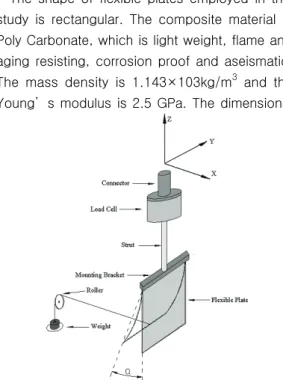
All the experiments described here are carried out in the circulating water channel at Korea Maritime University. The schematic of force and deformation testing and coordinate system is shown in Fig. 1. The bottom edge of the vertical flexible plate is set to be free; the upper end is connected with the specially-designed load cell by the Mounting Bracket and Strut. The 3- component load cell can measure forces in the x, z direction and torque against y-axis. Test jig is attached to the holder under the rail. The weight can provide a static force by a roller to the center bottom edge. The CCD camera system is placed on the side to measure the horizontal displacements of the free oscillating plate.
The shape of flexible plates employed in this study is rectangular. The composite material is Poly Carbonate, which is light weight, flame and aging resisting, corrosion proof and aseismatic.
The mass density is 1.143×10³kg/m3 and the Young’ s modulus is 2.5 GPa. The dimensional
Fig. 1 Schematics of testing and coordinates
Table 1
Dimensional details of flexible plates parameters of plates tested in the experiments are shown in Table 1. The testing cases are listed in Table 2. The static horizontal force applied in the experiments is 20N and the initial bending angles α(shown in Fig.1) are 5°, 30°, 45°, and 60°. The details of the coefficients will be described in the latter sections during the results and discussion.The free oscillation is excited by the sudden release of weights. Labview 7.0 is employed as the operating software, and the technical program is written for data acquisition and post processing. Sampling rate is 50 times/sec for each case. The resolution of CCD camera (SONY SSC-M370) are 640× 480 pixels. It can capture 30 frames per second with the maximum rate, which is accurate enough for the present experiments.
3. RESULTS AND DISCUSSION
3.1 Comparison of Deformation and Force Characteristics
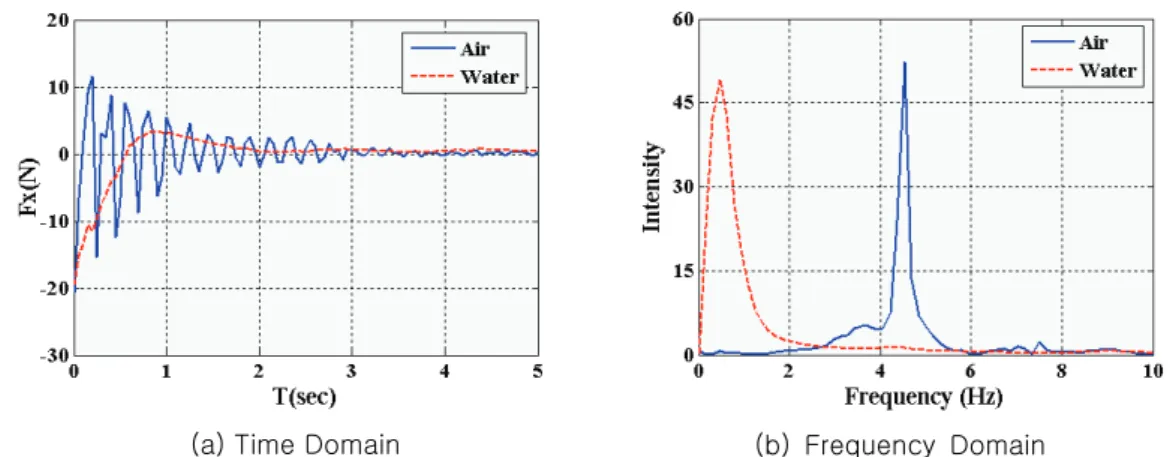
Fig. 2 (a) shows the time histories of end tip free oscillation displacements of the flexible plate ① in the air and water respectively. The oscillation in the water dies out quickly because of the high fluid damping. As seen in Fig. 3 (a), Case Working
Fluid
Tested Parameters
Serial Number 1 Air
Water
Thickness ① ② ③
Air 2
Water
Aspect
Ratio ① ④ ⑤ 3 Air
Water
Area ③ ⑥ ⑦ Air
4
Water Width Ratio ⑤ ⑦ ⑧ 5 Air
Water
Initial Bending
Angle ①
6 Air Density Ratio
⑨ ⑩
Serial Number
Thickness (mm)
Length (cm)
Width (cm)
Aspect Ratio*
①
2 33 24 1.4②
3 33 24 1.4③
5 33 24 1.4④
2 28 24 1.2⑤
2 24 24 1.0⑥
2 42 30.5 1.4⑦
2 24 17.5 1.4⑧
2 24 12 2.0⑨
2 35.5 8 4.4⑩
3 26.5 8 3.4Table 2 Test cases
(a) Time domain (b) Frequency domain
Fig. 2 Displacement of freely oscillating plate ①
free oscillation of lateral force FX shows the similar behavior to that of the displacement.
The natural frequencies in different working fluids are obtained by FFT. As shown in Fig. 2 (b), the natural frequency according to the displacement in air is 4.48Hz, and that in water is 0.47Hz. Fig. 3 (b) illustrates that the corresponding frequencies are 4.50Hz and 0.47Hz respectively due to the force time histories. It can be seen that the difference of results between the displacements and force characteristics is minor, which indicates that we can use the information of deformation for the natural frequency analysis during the free oscillation as well as the force value. Therefore, the effects of all plate coefficients on the natural frequency are investigated using the lateral force time history data.
3.2 Effects of Plate Coefficients
The testing cases 1~4 shown in Table 2 are employed to study the plate coefficients respectively. Figs. 4~8 show the effects of above plate coefficients on the natural frequencies in the different fluids. In general, it is evident that the frequencies in the water are much lower than those in the air due to the effect of added mass.
In case 1, plate thicknesses with same shape and area are tested. As shown in Fig. 4, the natural frequencies both in the air and water increase as the thickness increases, which demonstrate that the thickness i.e. stiffness of the flexible plates has obvious effect on the dynamic characteristics.
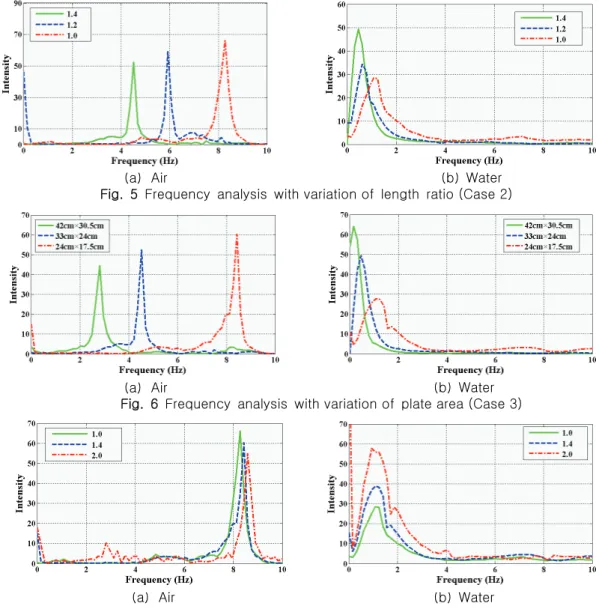
Fig. 5 shows the effect of the plate aspect ratios. The width of the plates in case 2 is same,
(a) Time Domain (b) Frequency Domain
Fig. 3 Force characteristics of freely oscillating plate ①
(a) Air (b) Water
Fig. 4 Frequency analysis with thickness variation (Case 1)
(a) Air (b) Water Fig. 5 Frequency analysis with variation of length ratio (Case 2)
(a) Air (b) Water
Fig. 6 Frequency analysis with variation of plate area (Case 3)
(a) Air (b) Water
Fig. 7 Frequency analysis with variation of width ratio (Case 4)
(a) Air (b) Water
Fig. 8 Frequency analysis with variation of initial bending angle (Case 5)
W=24cm. As the length decreases, the frequency peak values increase together with the aspect ratio decreases accordingly.
The aspect ratio of three plates in case 3 is 1.4. As shown in Fig. 6, the peak value increase along the frequency axis as the plate area decreases, and it illustrates that the effect of the plate areas on the dynamic behavior is also evident.
On the other hand, the width ratio is tested in case 4 and the length of the plates is same, L=24cm. Fig. 7 shows that natural frequencies of 3 plates with various width ratio have little difference between each other both in air and water. The width ratio has minor effects on the dynamic motion on the flexible plates. Because the behavior of plates shows basically a cantilever beam like motion and it can be considered to be a 2-dimensional problem. Even in case of behaviors in water, the 3-dimensional effect of flow seems to be not dominant.
Fig. 8 shows that the frequency responses of a flexible plate with different initial bending angles are similar. The natural frequencies of each case are nearly same and it indicates that initial bending angles have little influence on the frequency responses of the flexible plates.
Because the different bending angles induce different exciting forces, it can be deduced that the exciting forces also has minor effect on the frequency response characteristics of the flexible plates both in air and water.
From all above experimental results, it can be seen that plate thickness, plate area and aspect ratio all have effects on the dynamic characteristics, which induce different motion of flexible plates in fluid. But the responses in water are relatively lower level compared with those in air due to the high water damping effect. On the other hand, the plate width ratio and initial
bending angles have minor effects, which also provide valuable evidence and basis to the further numerical simulation.
4. COMPARISON OF NUMERICAL SIMULATION AND EXPERIMENTS
4.1 Natural Frequency Analysis
The numerical simulation using FEM is performed to compare with the results of the testing case each other both in air and water.
Recently, most of the commercial FEM analysis package has a capability of natural vibration analysis in water. MSC/NASTRAN is used in this analysis, which is known as one of the most popular commercial FEM code.
For the natural vibration analysis of structures in water, the added mass can be derived by using the boundary element formulation based on the discretization of the boundary integral equation for the fluid domain. The derived added mass matrix for the structural parts contacting the fluid is directly applicable to the equation of the motion for the finite element model of the structure. The whole equation of structure motion including the added mass term can be solved simultaneously.
The flexible plates with various thicknesses in case 1 are compared. As shown in Table 3, the experimental frequency has a reasonable agreement with the numerical results both in air and water except the case with thickness 5mm.
The results in the air show better agreements than those in the water. For the free oscillation of flexible plates, the structure damping is negligible compared with the hydrodynamic damping, especially in the large amplitude motion. The hydrodynamic damping is caused by the nonlinear viscosity of water and it can not be represented by the damping ratio which is a
Table 3
Comparison of natural frequencykind of linearized concept. And in this analysis, it is assumed that fluid domain is potential flow and the structural displacements are infinitesimal.
Therefore, in case of large displacement, the results of analysis could not predict those of experiment accurately because the oscillation period of structure depends on the magnitude of amplitude.
4.2 Density Ratio Analysis
It is noted (Balint and Lucey 2005) that the mot ion of the flexible plate, driven by a pressure field , can be modeled using classical thin plate mech anics. The plate’ s motion is driven by the press ure difference from both sides of plate, over its t wo side surfaces. Lateral displacement of the ver tical plate, w(y, t), is therefore governed by the n on-dimensionalised equation (Shin 2006):
p y C
C w t
w =− Δ
∂ + ∂
∂
∂
4 2 4 2 1
2 (1)
where y is the length from the upper end, △p demonstrates the pressure difference on the plate. And C1 and C2 are defined as:
2 2
2
1 U hL
C ρs
= β
h C L
s f
ρ
=ρ
2
where U is the character velocity and
β
2is the flexural rigidity,ρsis the plate density, and ρfisthe density of fluid. L and h are the plate length and thickness, respectively. The character velocity U is set as the maximum velocity when the plate reaches the vertical position.
The governing coefficient, density ratio is studied by both numerical and experimental method. In the experiment, the end tip displacement of flexible plates oscillating freely in the rest fluid with the various density ratios are studied to compare with the numerical simulation, which was calculated by Shin (2006) using finite difference method to solve Equation (1).
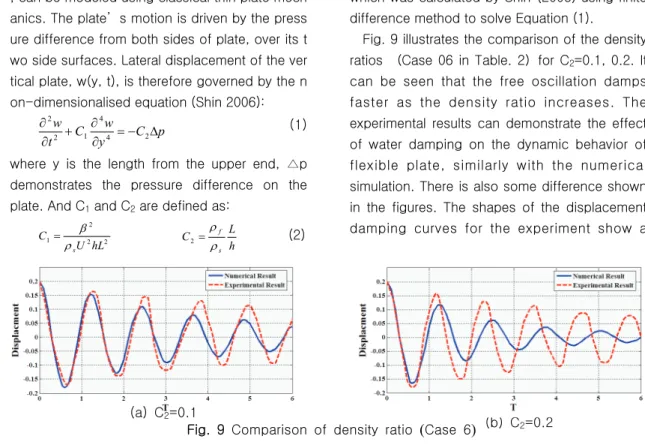
Fig. 9 illustrates the comparison of the density ratios (Case 06 in Table. 2)for C2=0.1, 0.2. It can be seen that the free oscillation damps faster as the density ratio increases. The experimental results can demonstrate the effect of water damping on the dynamic behavior of flexible plate, similarly with the numerical simulation. There is also some difference shown in the figures. The shapes of the displacement damping curves for the experiment show a
2 mm 3 mm 5 mm
Air Water Air Water Air Water
Experiment 4.53 Hz 0.47 Hz 6.25 Hz 1.09 Hz 8.28 Hz 1.89 Hz
Calculation 4.52 Hz 0.64 Hz 6.78 Hz 1.17 Hz 11.30 Hz 2.49 Hz
(2)
(a) C2=0.1
Fig. 9 Comparison of density ratio (Case 6) (b) C2=0.2
reasonable agreement with the numerical results at the beginning oscillating periods, and the differences of deflection amplitudes and damping velocities become larger as time goes on. The difference described above is more evident for C2=0.2 than that for C2=0.1. These differences are generated by the difference of the plate dynamic characteristics and the character velocity uncertainty measured in the experiment.
5. Conclusions
The experiments are performed to investigate the deformation and force characteristics of the free oscillation of flexible plates. The lateral forces and displacements with corresponding frequencies of the free oscillation flexible plates both in air and water show a good agreement.
The effects of plate thickness, plate aspect ratio and plate area on the dynamic behavior are evident. However, plate width ratio and exciting force have minor effects. All the results show the evident difference of dynamic characteristics between in the air and water and there are many unclear problems need to be investigated.
The numerical simulation of frequency analysis shows a reasonable agreement with the experimental results in the air, and there is still some difference for the natural frequency in water. The density ratio comparison illustrates its effect on the interaction of the flexible plate with the fluids. All the above conclusions demonstrate that more particular attentions need to be put on this subject to reveal the mechanics of the flexible plate hydrodynamic characteristics.
Acknowledgments
This research was supported by Underwater Vehicles Research Center of Korea (Project No:
SM-42). The authors also express our gratitude to Prof. S.M. Shin of Pukyung National University who provided much help for this paper.
References
• Balint, T.S. and Lucey, A.D., 2005, “ Instability of a Cantilevered Flexible Plate in Viscous Channel Flow,” Journal of Fluids and Structures, Vol. 20, pp. 893-912.
• Ergin, A. and Ugurlu, B., 2003. “ Linear Vibration Analysis of Cantilever Plates Partially Submerged in Fluid,” Journal of Fluids and Structures, Vol. 17, pp. 27-939.
• Ihara, A. and Watanabe, H., 1994, “ On the Flow around Flexible Plates, Oscillating with Large Amplitude,” Journal of Fluids and Structures, Vol. 8, Issue 6, pp. 601-619.
• Shin, S.M. and Kim, I.C., 2006,
“ Computations on a Fluid Damping of Oscillations of a Flexible Cantilever Using the Hybrid Cartesian/Immersed Boundary Method,” Proceedings of the Annual Autumn Meeting, SNAK, pp. 420-428.
< Zhen Liu > < 현 범 수 > < 노 인 식 >