• 검색 결과가 없습니다.

Applied Sound Frequency Monitoring in the Transformer Oil Using Fiber Optic Sagnac Interferometer

N/A
N/A
Protected

Academic year: 2021

Share "Applied Sound Frequency Monitoring in the Transformer Oil Using Fiber Optic Sagnac Interferometer"

Copied!
7
0
0

로드 중.... (전체 텍스트 보기)

전체 글

(1)

Applied Sound Frequency Monitoring in the Transformer Oil Using Fiber Optic Sagnac Interferometer

사냑형 간섭계 광섬유 센서를 이용한 변압기유 내에서의 외부 음향 주파수 모니터링

Jongkil Lee

and Seunghong Lee*

(이종길, 이승홍*)

Department of Mechanical Engineering Education, Andong National University,

*Department of Precision Mechanical Engineering, Graduate School, Andong National University (Received June 12, 2015; accepted June 22, 2015)

ABSTRACT: The fiber optic Sagnac interferometer is well established as a sensor for detection of physical perturbations such as acoustic and vibration. In this paper acoustic signals generated in the cylindrical cavity submerged in transformer oil were measured by the fiber optic sensor array in one Sagnac loop. Two different external sound frequencies, and , were applied to the sensor array simultaneously by using piezoelectric with frequency range from 5 kHz to 90 kHz. Based on the experimental results, fiber optic sensor detected harmonic series of applied sound frequency such as , ,  ,  ,     ,    . Suggested fiber optic sensor array can be applied to monitor physical quantities such as internal sound pressure and vibration due to partial discharge in the real electric transformer system.

Keywords: Fiber optic sensor, Sagnac interferometer, Acoustical measurement, Transformer oil PACS numbers: 43.58.Fm

초 록: 광섬유 사냑 간섭계는 음향 및 진동과 같은 물리적 변화량을 탐지하는 센서로 잘 개발되어 있다. 본 논문에서는 변압기유가 채워진 원통형 캐비티에 음압이 발생되었을 때 한 개의 루프내에 설치된 광섬유 배열 센서를 이용하여 음 향을 탐지하였다. 서로 다른 외부 음향 주파수   과   를 피에조 재료를 이용하여 발생시키고 주파수는 5 kHz에서 90 kHz까지로 선정하였다. 실험 결과 광섬유 센서는 하모닉 성분인   , ,  ,  ,     ,    의 주파수를 탐지하 였다. 제안된 광섬유 센서 배열은 변압기 내의 부분 방전으로 인한 음압과 진동과 같은 물리량을 모니터링 하는데 적용 할 수 있을 것으로 판단된다.

핵심용어: 광섬유센서, 사냑 간섭계, 음향 측정, 변압기유

†Corresponding author: Jongkil Lee ([email protected])

Department of Mechanical Engineering Education, Andong National University, 388 Songchun-Dong, Andong 760-749, Republic of Korea

(Tel: 82-54-820-5487, Fax: 82-54-820-7655)

I. Introduction

There are many diverse areas in system applications of fiber optic sensors. [1-5] Fiber optic interferometric sensor has many significant advantages and in many applications several of the advantages can apply. [6,7] Some of the advantages are increased sensitivity, EMI (Electro-Magnetic

Interference) immunity, large bandwidth, and geometrical versatility. [4,5] To detect external sound signals using the compliant hollow mandrel which wrapped by optical fiber, Sagnac interferometer can be fabricated and tested. [7-9] The effect of an acoustic field acting on a coil is causing a change in the optical path length of the coil, and this can be detected as a phase change in light passing through the coil. [8] Compliant hollow cylindrical mandrel has been widely used to make fiber optic acoustic sensors. [7-9]

The principle of the Sagnac interferometer is consist of

(2)

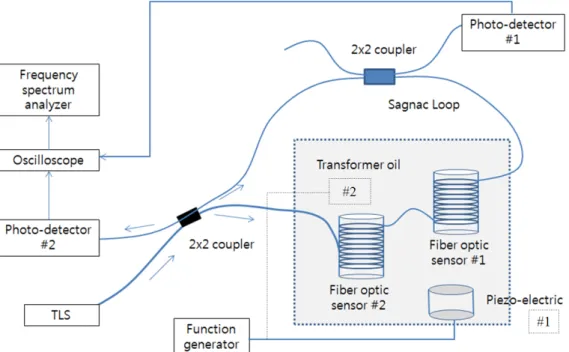
Fig. 1. Schematic diagram of the experimental setup and fiber optic sensor array in the Sagnac loop.

          , (1)

where R is the radius of closed loop,  is the angular velocity, v is the tangential velocity, λ is the wavelength, c is the speed of the light, and L is the total loop length.

In Eq.(1), the sensitivity or phase difference of the fiber optic sensor in Sagnac interferometer is proportional to the closed loop length (L). Sagnac interferometer with fiber optic sensor can be used as a diagnostic system of the electrical power equipment. Degradation and partial discharge are common causes of electrical power transformer

This paper is organized in the following arrangements.

Section II provides an experimental setup and shows fiber optic sensor array in the transformer oil. Section III presented the experimental results and discussion, and finally the concluding remarks are summarized in Section IV.

II. Experimental Setup

Experimental setup using Sagnac interferometer with two fiber optic sensors in the loop is shown in Fig. 1.

Photograph of the experimental setup is shown in Fig. 2.

TLS (Tunable Laser Source) supplied light to the Sagnac

(3)

Fig. 2. Photograph of the fiber optic sensor and piezoelectric sound generator in the transformer oil.

loop and two photo-detectors were used.

Two fiber optic sensors connected in serial were used while being submerged into transformer oil. Outside sound pressure was directly applied to the sensors using piezoelectric generator which wound optical fiber. The two sound sources were generated by function generator which controlled under different frequencies.

Generally, the performance of fiber optic acoustic, electric and magnetic field sensors are known. The fiber wrapped on a compliant hollow mandrel yields highest sensitivity. [8]

Therefore, in this experiment, optical fiber's total length of 48.6 m was wrapped on a CRP (Carbon Reinforced Plastic) hollow mandrel, as shown in Fig. 2. The distance between two sensors is 30 cm and length of the Sagnac loop is 1.7 m.

Photograph of the two fiber optic acoustic sensors and sound generator are also shown in Fig. 2.

Physical quantities of the transformer oil such as viscosity, specific weight, and sound speed are 8.5 cSt., 0.86, and 1,095 m/sec, respectively. The distance between sound generator and sensor is 10 cm each. Experiments were continued by changing applied sound frequency from 5 kHz to 90 kHz. The wavelength of the 35 kHz sound is

2.86 cm in the transformer oil.

This is a first attempt to analyze the sound frequency using two fiber optic sensors in one Sagnac loop. Because there are many electrical parts in the cylindrical transformer (described in Fig. 2), fiber optic sensors have limited space.

III. Experimental Results and Discussion

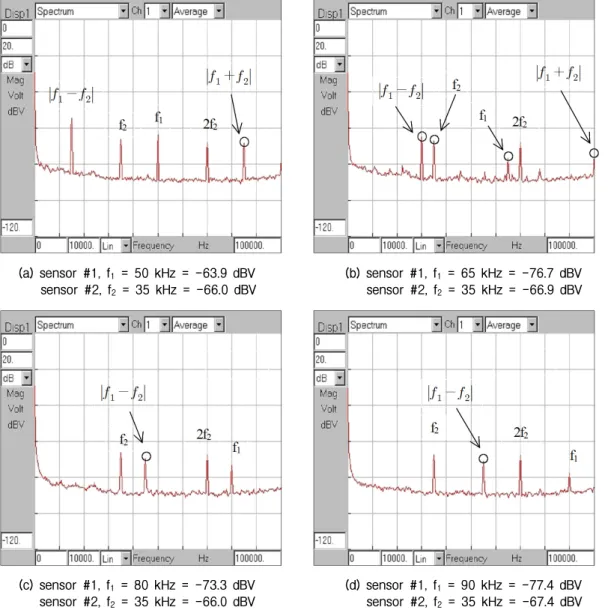
Applied sound frequency was fixed at  = 35 kHz in the fiber optic sensor #2. Under that condition, fiber optic sensor #1 was continued by changing applied sound frequency from 5 kHz to 90 kHz. Figs. 3 and 4 show detected amplitude comparison in terms of arbitrary applied sound frequencies ( ) such as 5, 10, 20, 40, 50, 65, 80, and up to 90 kHz. Most results contained harmonic frequencies of the applied sound frequency. These harmonic frequencies probably come from the shape of the circular container.

In Figs. 3 and 4, applied frequency and fixed frequency

are and , respectively. From those figures, harmonic

(4)

(a) sensor #1, f 1 = 5 kHz = -63.9 dBV

sensor # 2, f 2 = 35 kHz = -67.5 dBV (b) sensor #1, f 1 = 10 kHz = -54.8 dBV sensor #2, f 2 = 35 kHz = -66.0 dBV

(c) sensor #1, f 1 = 20 kHz = -54.9 dBV

sensor #2, f 2 = 35 kHz = -66.7 dBV (d) sensor #1, f 1 = 40 kHz = -55.8 dBV sensor #2, f 2 = 35 kHz = -67.2 dBV Fig. 3. Comparison of detected amplitudes in terms of applied sound frequency (range of 5 kHz ~ 40 kHz).

frequencies and overtones of     and   appeared mostly. In low frequency cases such as 5 kHz and 10 kHz of  , harmonic frequency of  was not observed because of their long wavelength distances (20 cm at 5 kHz compared to 10 cm at 10 kHz).

Those harmonic frequencies such as  ,  ,     ,

   were came from the shape of the container. It is known that the Sagnac interferometer is comparable to Mach-Zehnder interferometer when the signal frequency matches the length of the Sagnac loop.

The Helmholtz equation of the right circular cylindrical cavity with height (L) and radius (a) shown in Fig. 2 is

expressed as

     , (2)

where     , is circular frequency, and is wave number. In cylindrical coordinates    , the Helmholtz equation, Eq.(2), becomes [10]

 

    

     

  

   

     , (3)

where  is the pressure amplitude,    . Using boun-

(5)

(a) sensor #1, f 1 = 50 kHz = -63.9 dBV

sensor #2, f 2 = 35 kHz = -66.0 dBV (b) sensor #1, f 1 = 65 kHz = -76.7 dBV sensor #2, f 2 = 35 kHz = -66.9 dBV

(c) sensor #1, f 1 = 80 kHz = -73.3 dBV

sensor #2, f 2 = 35 kHz = -66.0 dBV (d) sensor #1, f 1 = 90 kHz = -77.4 dBV sensor #2, f 2 = 35 kHz = -67.4 dBV Fig. 4. Comparison of detected amplitudes in terms of applied sound frequency (range of 50 kHz ~ 90 kHz).

Table 1. Detected amplitude under applied frequencies.

Applied frequency (kHz), f 1

Fixed at f 2 = 35 kHz (dBV)

Amplitude (dBV) 5

10 20 25 30 40 45 50 55 60 65 70 80 85 90

-67.58 -66.09 -66.74 -65.83 -67.37 -67.28 -66.60 -66.06 -66.51 -65.77 -66.93 -66.47 -66.02 -65.65 -67.40

-63.92 -54.84 -54.96 -65.85 -64.93 -55.86 -64.14 -63.92 -75.71 -66.80 -76.71 -67.59 -73.37 -75.66 -77.41

dary conditions and separation of variables, the pressure of the    mode is expressed as [10]

      cos   ×cos   



, (4)

where         , is th Bessel function of the first kind,  and  are constant numbers. The angular frequencies are determined from [10]

           , (5)

where c is the wave speed. From Eqs. (4) and (5) it is clear

(6)

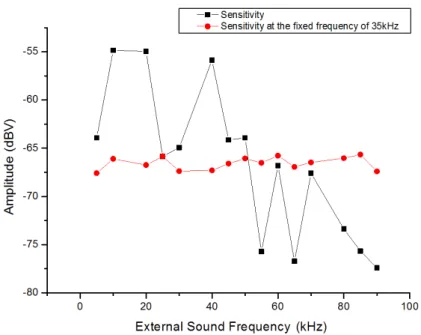
Fig. 5. Comparison of detected amplitudes (range between 5 kHz ~ 90 kHz).

that the pressure of the certain mode is function of frequency.

Detected amplitude comparison between applied sound frequency and fixed frequency is shown in Table 1 and Fig.

5. At frequency under 50 kHz, amplitude is greater than the case of fixed frequency shown in Fig. 3 (a) to (d). However, frequency above 50 kHz amplitude is lower than the case of fixed frequency, as shown in Fig. 4 (a) to (d).

From this experiment it is confirmed that fiber optic sensor using Sagnac interferometer in the transformer oil can detect harmonic series of applied sound frequency such as  ,  ,     ,    .

Because of sensor dimension (mandrel diameter and height) this experimental approach is limited to certain space. However, in real electric transformer system, suggested fiber optic sensor array can be applied to monitor physical quantities such as internal temperature, sound pressure, vibration due to partial discharge, etc. In addition, other application can be expanded to the underwater sonar system.

IV. Conclusions

This paper attempted to confirm overtones and harmonic

series in the cylindrical cavity which put in transformer oil using fiber optic Sagnac loop. Optical fiber's total length of 48.6 m was wrapped surrounding the compliant hollow mandrel (CRP) as an optical fiber sensor. Two different external sound frequencies,  and  , were applied to the sensor array simultaneously by using piezoelectric with frequency range from 5 kHz to 90 kHz. Based on the experimental results fiber optic sensor detected overtones and harmonic series of applied sound frequency such as

,  ,  ,  ,     ,    . Below 50 kHz of applied sound frequency, the sensitivity is higher than the fixed case, while above 50 kHz, the results are lower than the fixed case. In real electric transformer system, suggested fiber optic sensor array can be applied to monitor physical quantities such as internal temperature, sound pressure, and vibration due to partial discharge.

Acknowledgement

This research was supported by 2012 Special Research

Support Program of Andong National University.

(7)

References

1. J.D.C. Jones, “Fiber optic sensors,” Optica Acta. 33, 1469- 1503 (1986).

2. L.M. Lyamshev and Y. Y. Smirnov, “Fiber optic sensors (review),” Sov. Phys. Acoust. 29, 169-180 (1983).

3. R.P. De Paula, “Fiber optic sensor overview,” in Proc.

SPIE., 2-15 (1985).

4. M. Feng and H. Suzuki, “Optical fiber sensors using vibration wires,” in Proc. SPIE., 223-226 (1994).

5. C. Bryson, “Interferometric sensor system for security applications,” in Proc. SPIE., 485-488 (1994).

6. J. Lee, “Exciting frequency detection of latticed fence structure using fiber optic interferometer sensor” (in Korean), J. KSPE. 21, 142-148 (2004).

7. J. Lee, S. Kim, and J.-H. Lee, “Discharge signal detection in insulating oil using the optical fiber sagnac interferometer”

(in Korean), J. KIEE. 49, 622-626 (2000).

8. P. J. Nash and J. Keen, “Design and construction of practical optical fiber hydrophones,” in Proc. Inst. Acoust. 12, 201-212 (1990).

9. G.W. McMahon and P.G. Cielo, “Fiber optic sensitivity for different sensor configurations,” Applied Optics 18, 3720-3722 (1979).

10. L.E. Kinsler, A.R. Frey, A.B. Coppens, and J.V. Sanders, Fundamentals of Acoustics (John Wiley & Sons, New York, 2000), pp. 246-252.

Profile

▸Jongkil Lee (이 종 길)

Feb. 1984: Department of Mechanical Engineering, Pusan National University (BS) Dec. 1990: Department of Mechanical Engineering,

University of Utah (MS)

Aug. 1993: Department of Mechanical Engineering, University of Utah (Ph.D.)

Mar. 1998 ~ Present: Professor, Department of Mechanical Engineering Education, Andong National University

▸Seunghong Lee (이 승 홍)

Feb. 2010: Department of Mechanical Engineering

Education, Andong National University (BS)

Feb. 2012: Department of Precision Mechanical

Engineering, Andong National University

(MS)

수치

Fig. 1. Schematic diagram of the experimental setup and fiber optic sensor array in the Sagnac loop.
Fig. 2. Photograph of the fiber optic sensor and piezoelectric sound generator in the transformer oil
Table 1. Detected amplitude under applied frequencies.
Fig. 5. Comparison of detected amplitudes (range between 5 kHz ~ 90 kHz).

참조

관련 문서

As a results , fiber optic se nsor system has good advantages in various cases , and a1so cost effectiveness compared to conventiona1 sensor system.. KEYWORDS

Abstract: The surface mounted piezoceramic transducers and fiber optic sensor can detect signals in both symmetric and antisymmetric Lamb wave modes.. Hanning

Experimental results for the proposed fiber optic sensor are in good agreement with a theoretical analysis for BLS optical power attenuations and for three FBG

Therefore, the applicability of the Brillouin Optical Correlation Domain Analysis (BOCDA) based distributed fiber optic sensor system on the railway was evaluated in this study..

하며 구조 건전성 감시를 위해 최근 광섬유 센서 를 이용한 구조물 감시 (fiber optic sensor, FOS).. 연구가 활발히 진행되고 있다 광섬유

In this study, to measure the intensities of Cerenkov radiation induced by gamma-rays, we have fabricated the fiber-optic Cerenkov radiation sensor system using silica