JKSCI
An Examination of the Effect of Self-esteem on Aggression Among High School Students
1)
Eun-Jin Cha*
*Adjunct Professor, Dept. of Social Welfare, Honam University, Gwangju, Korea
[Abstract]
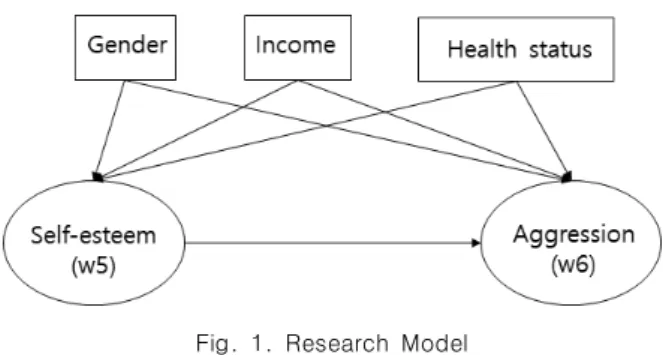
According to the ‘low self-esteem hypothesis’, low self-esteem plays a causal role in aggression among adolescents, whereas ‘threatened egotism theory’ postulates that aggression is related to a highly favorable view of the self. The primary purpose of the present study was to investigate the effect of self-esteem on aggression among adolescents. Based on the theoretical background, a research model was constructed. The present study analyzed the 5th and 6th wave data from Korea Children and Youth Panel Study (KCYPS). The results showed that self-esteem had a significant negative effect on aggression among high school students. Finally, research implications which contribute to enhancing self-esteem as well as decreasing aggression were also discussed.
▸Key words: Self-esteem, Aggression, Low self-esteem hypothesis, Threatened egotism theory, KCYPS
[요 약]
‘낮은 자아존중감 가설’에 의하면 청소년의 낮은 자아존중감이 높은 공격성의 원인으로 간주되 는 반면, ‘위협받는 자부심 이론’은 높은 자아존중감이 공격성을 불러일으키는 것으로 해석된다.
본 연구의 목적은 고등학생의 자아존중감이 공격성에 미치는 영향을 검증함으로써 자아존중감의 증진과 공격성의 감소에 기여할 수 있는 함의를 도출하는 것이다 . 이를 위해 이론적 고찰에 근거 하여 연구모형을 구축하였으며, 한국아동청소년패널조사 자료를 대상으로 구조방정식 모형을 적 용하여 검증하였다 . 연구결과, 고등학생의 자아존중감이 높을수록 공격성이 더 낮은 것으로 나타 났으며 , 따라서 낮은 자아존중감 가설이 타당한 것으로 평가되었다. 이와 같은 연구결과를 바탕으 로 고등학생의 자아존중감을 높이고 공격성을 낮출 수 있는 실천적 개입 방안을 논의하였다.
▸주제어: 자아존중감, 공격성, 낮은 자아존중감 가설, 위협받는 자부심 이론, 한국아동ㆍ청소년패널조사
∙First Author: Eun-Jin Cha, Corresponding Author: Eun-Jin Cha
*Eun-Jin Cha ([email protected]), Dept. of Social Welfare, Honam University
∙Received: 2020. 05. 27, Revised: 2020. 10. 06, Accepted: 2020. 10. 06.
Copyright ⓒ 2020 The Korea Society of Computer and Information http://www.ksci.re.kr pISSN:1598-849X | eISSN:2383-9945