간호대학생의 외모만족과 학교생활적응:
자아존중감의 매개효과와 성별의 조절효과
Appearance Satisfaction and School Adjustment in Nursing Students:
Mediating Effect of Self-esteem and Moderating Effect of Gender
박순주 을지대학교 간호대학 Soonjoo Park([email protected])
요약
본 연구는 간호대학생들의 외모만족과 학교생활적응의 관계를 조사하고 자아존중감과 성별의 매개 또는 조절효과 파악을 목적으로 하였다. 본 연구는 서술적 상관관계 연구로서 연구대상자는 D시에 소재한 간호 대학에 재학하고 있는 188명의 학생을 대상으로 하였다. 분석결과 외모만족은 학교생활적응에 직접적인 영 향을 주었고 자아존중감을 통해 간접적인 영향을 미치는 것으로 나타나 자아존중감은 외모만족과 학교생활 적응의 관계에서 부분 매개효과가 있었다. 또한 성별은 외모만족과 자아존중감 사이에서 조절효과가 있었 으나 외모만족과 학교생활적응, 자아존중감과 학교생활적응 사이에서는 조절효과가 유의하지 않았다. 그리 고 여학생이 남학생보다 외모만족이 자아존중감에 미치는 영향이 더 큰 것으로 나타났다. 이러한 결과는 간호대학생들의 학교생활적응을 증진하기 위한 전략으로 외모에 대한 긍정적 인식을 증진하고 자아존중감 의 강화가 필요함을 의미하며 여학생을 대상으로 특화된 프로그램의 필요성을 제시하고 있다.
■ 중심어 :∣외모만족∣학교생활적응∣자아존중감∣대학생∣매개효과∣
Abstract
The purpose of this study was to investigate the relationship between appearance satisfaction and school adjustment of nursing students. The role of self-esteem and gender in the relationship between appearance satisfaction and school adjustment were also examined. A descriptive correlational design was adopted and the convenience sample consisted of 188 undergraduate nursing students in D city. It was found that appearance satisfaction affected directly and indirectly through self-esteem on school adjustment. The results indicated that self-esteem had partial mediation effects in the relationship between appearance satisfaction and school adjustment. Moderation effect of gender was found only in the relationship between appearance satisfaction and self-esteem. This meant that women were affected more than men according to the level of appearance satisfaction. The results suggested that the intervention program to support nursing students to accept themselves more positively and to enhance their self-esteem will be effective to help nursing students adjust themselves more to school life. It was also indicated in this study that specialized intervention programs are needed for women.
■ keyword :∣Appearance Satisfaction∣School Adjustment∣Self-esteem∣College Student∣Mediation Effect∣
접수일자 : 2018년 05월 03일 수정일자 : 2018년 07월 02일
심사완료일 : 2018년 07월 13일
교신저자 : 박순주, e-mail : [email protected]
I. Introduction
1. Background
School adjustment is multidimensional and related to academic achievement and problematic behavior in school as well as life satisfaction of students[1][2]. It is linked to personal characteristics such as gender and health status, and influenced by relationships with parents, social support and stress[1]. As it is also known to be a predictor of academic persistence, it has become a subject of interest[1][2].
On the side where school adjustment is affected by stressors[1], it is necessary to be interested in school adjustment of nursing students. It is reported that nursing students experience a lot of stress due to the academic burden and fear of making mistakes[3].
They are also exposed to numerous stressors such as negative responses to difficulties of patients and problems with interpersonal relationships during their clinical practices in hospital settings[3]. Because these stressors have negative impacts on students' school adjustment and mental health, more attention and support should be paid to school adjustment of nursing students to improve their quality of life[1][4].
As the economic recession and the unemployment crisis continue, college students face various stressors in the preparation for employment. This is also the case for nursing students[5]. Moreover, in recent years, emphasis on physical appearance was grown, leading to lookism, which is a belief that appearance plays as a social discrimination factor like race or gender[6]. In addition, the influence of mass media and social networks in everyday life is increasing and the body image transmitted through it affects the formation of ideal body image of people[7]. The discrepancy between individual’s real body image and the body image that is obtained through the mass media causes dissatisfaction with his or her
appearance and acts as a stressor[7]. Dissatisfaction with appearance can result in psychological or physiological side effects such as low self-esteem or eating disorders[8], while affecting the quality of life too[9]. In this social environment, college students who are about to take up jobs are paying an increasing amount of attention to their appearance[10].
Consequently, dissatisfaction with appearance is often perceived as stressors to the students[5].
From the viewpoint that dissatisfaction with the body can cause stress, students' appearance can be a factor influencing school adjustment[5]. For instance, several studies[10][11] have been attempted to link these two variables and the results showed that appearance satisfaction and school adjustment were closely related to each other. This is understood to mean that the satisfaction with appearance enhances self-esteem by strengthening the positive evaluation of self and can form higher satisfaction in interpersonal relationships[10].
Self-esteem, which is the sense of value or confidence in oneself[12], is known as another variable connected to appearance satisfaction. The previous studies pointed out that self-esteem had a significant relationship with depression and was positively correlated with body satisfaction in women college students[13][14]. Furthermore, self-esteem enhances psychological stability and strengthens the adaptation to stress[15], and influenced school adjustment in adolescents[16] as well as negative thoughts[17]. Low self-esteem, however, can lead to various psychological problems such as depression, anxiety, and maladjustment of school life[13][14].
It is interesting to find that self-esteem can differ according to age or gender[8][18][19]. Several studies have shown that self-esteem had a tendency to increase until late adolescence and then decrease[18], and from late adolescence to middle age[19]. Also,
self-esteem was higher in men than women and self-esteem of Whites or Asian Americans showed gender differences, while African Americans did not[18]. However, there are few studies that explored the effects of self-esteem on appearance satisfaction or school adjustment except for some studies about adolescents[16][20]. Considering the related studies, analyzing the role of self-esteem and gender can be helpful in understanding the relationship between appearance satisfaction and school adjustment. This will also contribute to the development of effective intervention programs to improve nursing students' school adjustment.
2. Purpose of the study
The purpose of this study is to examine the relationship between appearance satisfaction and school adjustment of nursing students and to verify the effect of self-esteem and gender in the relationship between them. The specific objectives of the current study are as follows.
1) Investigating the level of nursing students' appearance satisfaction, self–esteem, and school adjustment.
2) Identifying the differences of appearance satisfaction, self-esteem, and school adjustment according to general characteristics of the subjects.
3) Testing the mediation effect of self-esteem in the relationship between appearance satisfaction and school adjustment.
4) Testing the moderation effect of gender in the relationship among appearance satisfaction, self-esteem, and school adjustment.
II. Method 1. Study design
This study adopted a descriptive correlational design to identify the relationship between appearance satisfaction and school adjustment of nursing students. Additionally, the study explored the mediation effect of self-esteem and moderation effect of gender.
2. Conceptual framework
The conceptual framework of this study is based on literature review. In previous studies, appearance satisfaction[1][2] and self-esteem[13][14] were factors influencing school adaptation. Appearance satisfaction had a direct effect on school adaptation and an indirect effect on school adjustment through self-esteem[16].
In addition, self-esteem played a partial mediator in the relationship between appearance satisfaction and school adaptation[20].
While appearance satisfaction was affected by gender[11], the previous studies showed different results; some concluded that there was no gender effect on school adjustment[16] but other study reported that men had higher school adjustment level[11]. Conflict results were also found in the effect of gender on self-esteem; Lu et al. pointed out that self-esteem was not related to gender[20] but Zuckerman et al.[18] and Bleidorn et al.[19] revealed that men had higher self-esteem. These results showed that it is necessary to explore the effect of gender.
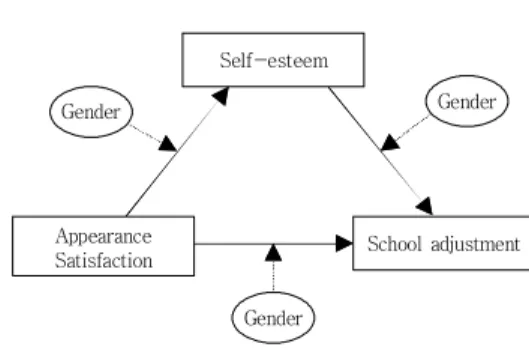
This literature review provided the conceptual foundation for this study. The study framework was developed to examine the effects of appearance satisfaction on self-esteem and school adjustment, and the effect of self-esteem on school adjustment.
The conceptual framework with three variables is depicted in [Fig. 1].
Self-esteem
Appearance
Satisfaction School adjustment
Gender
Gender Gender
Fig. 1. Conceptual framework of the current study
3. Sample
The subjects of this study were selected among the students who attended the nursing colleges in D city and understood the purpose of the study and agreed to participate in the study. Convenience sampling technique was applied to recruit participants. The required sample size was calculated using the G*power 3.1 program with medium effect size of .15, power of .95, significance level of .05, and three independent variables. The required sample size was 119 and sample size of 188 in the current study was appropriate for the analysis.
4. Measurement
4.1 Appearance satisfaction
Appearance satisfaction was measured using the scale revised by Chae[21] based on the Body Cathexis Scale developed by Secord and Jourard[22]. Appearance satisfaction is defined as the degree of feeling of satisfaction or dissatisfaction with the various parts or processes of the body[22]. Chae modified the Body Cathexis Scale, reducing it to 21 items. The scale uses a 5-point Likert scales from ‘not at all satisfied’
to ‘very satisfied’. The higher score means the higher satisfaction with appearance. Cronbach's alpha coefficient was .91 in Chae’s study[21] and .89 in the current study.
4.2 Self-esteem
Self-esteem is one’s own feeling of worthiness[23].
It was assessed using the Self-Esteem Scale (SES) which was made by Rosenberg[23] and translated by Cheon[24]. The SES was composed of 5 items of positive self-esteem and 5 items of negative self-esteem. Responses were scored on a 5-point Likert scales from ‘not at all’ to ‘strongly agree’. The higher score means the higher level of self-esteem.
Cronbach's alpha coefficient was .85 in Cheon’s study and .90 in the current study.
4.3 School adjustment
School adjustment is to set up a new culture and lifestyle through college life experiences, and to cope with the psychological, social, and personal problems facing oneself[25]. The Student Adaptation to College Questionnaire (SACQ) was used to evaluate the level of school adjustment. The SACQ was developed by Baker and Siryk[25], and translated by Hyun[26]. The SACQ consists of 67 items. Items were measured on a 9-point Likert scales from ‘not at all’ to ‘strongly agree’. The higher score means the higher level of school adjustment. Cronbach's alpha coefficient was .92 in Hyun’s study and .94 in the present study.
5. Data collection
The data was collected from May to June 2015.
Before the survey was conducted, the subjects should be provided with information about the purpose and methods of this study, rights of participants, anonymity, and confidentiality. After receiving the written consent to voluntary participation, the survey was carried out. Of the 190 respondents, two were excluded from the analysis because their responses were incomplete and average time for questionnaire completion was about 15 minutes.
6. Statistical analysis
The collected data was analyzed with multivariate regression using SPSS Win 23.0 program and SPSS PROCESS macro 3.0. The specific method of analysis is as follows.
First, general characteristics, appearance satisfaction, self-esteem and school adjustment of the subjects were calculated using descriptive statistics.
Second, independent t-test or ANOVA was applied to determine the difference of appearance satisfaction, self-esteem and school adjustment according to general characteristics.
Third, the relationship between appearance satisfaction, self-esteem, and school adjustment was measured using Pearson's correlation coefficient.
Fourth, SPSS PROCESS macro with 10,000 bootstrapping replications was adopted to analyze mediation effect of self-esteem and moderation effect of gender. It was confirmed that the sample represented the gender composition of the population before the analysis. The normality test showed that the gender variable normally distributed. In order to avoid multicollinearity problems, mean centering was
applied prior to the analysis.
Fifth, Residual analysis was performed in order to check the independence of error, the homoscedasticity, and the normality.
Sixth, the reliability of the instrument was obtained by Cronbach's alpha coefficient.
III. Results
1. General characteristics
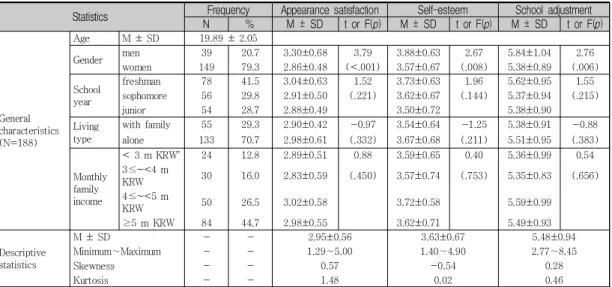
The sample consisted of 20.7% men and 79.3%
women with the mean age of 19.89±2.05 years.
Freshman was the largest group occupying 41.5%, followed by sophomore (29.8%) and junior (28.7%). Of the subjects, 70.7% students were living alone, and 29.3% were living with their families. Regarding the monthly income of family, 44.7% belonged to more than or equal to 5 million KRW group and 26.5% were included in more than 4 million KRW and less than 5 million KRW group[Table 1].
Table 1. Frequency of the subjects and mean differences of the variable by general characteristics
Statistics Frequency Appearance satisfaction Self-esteem School adjustment N % M ± SD t or F(p) M ± SD t or F(p) M ± SD t or F(p)
General characteristics (N=188)
Age M ± SD 19.89 ± 2.05
Gender men 39 20.7 3.30±0.68 3.79 3.88±0.63 2.67 5.84±1.04 2.76
women 149 79.3 2.86±0.48 (<.001) 3.57±0.67 (.008) 5.38±0.89 (.006) School
year
freshman 78 41.5 3.04±0.63 1.52 3.73±0.63 1.96 5.62±0.95 1.55
sophomore 56 29.8 2.91±0.50 (.221) 3.62±0.67 (.144) 5.37±0.94 (.215)
junior 54 28.7 2.88±0.49 3.50±0.72 5.38±0.90
Living type
with family 55 29.3 2.90±0.42 -0.97 3.54±0.64 -1.25 5.38±0.91 -0.88
alone 133 70.7 2.98±0.61 (.332) 3.67±0.68 (.211) 5.51±0.95 (.383)
Monthly family income
< 3 m KRW* 24 12.8 2.89±0.51 0.88 3.59±0.65 0.40 5.36±0.99 0.54 3≤~<4 m
KRW 30 16.0 2.83±0.59 (.450) 3.57±0.74 (.753) 5.35±0.83 (.656)
4≤~<5 m
KRW 50 26.5 3.02±0.58 3.72±0.58 5.59±0.99
≥5 m KRW 84 44.7 2.98±0.55 3.62±0.71 5.49±0.93
Descriptive statistics
M ± SD - - 2.95±0.56 3.63±0.67 5.48±0.94
Minimum∼Maximum - - 1.29∼5.00 1.40∼4.90 2.77∼8.45
Skewness - - 0.57 -0.54 0.28
Kurtosis - - 1.48 0.02 0.46
Note. m KRW = million South Korean Won
2. Appearance satisfaction, school adjustment, self-esteem
2.1 Descriptive statistics
The mean score of appearance satisfaction was 2.95±0.56 in the range of 1.29 to 5.00. The self-esteem score, which was converted into a score out of 5.00, ranged from 1.40 to 4.90, with a mean score of 3.63±0.67. The school adjustment score ranged from 2.77 to 8.45, with a mean score of 5.48±0.94. The values for skewness and kurtosis of three variables showed that the data did not violate the assumption of normality[Table 1].
2.2 Differences by general characteristics It was shown that there were differences in appearance satisfaction, self-esteem, and school adjustment according to gender. The scores of men were significantly higher than those of women in appearance satisfaction (t=3.79, p<.001), self-esteem (t=2.67, p=.008) and school adjustment (t=2.76, p=.006). There were no significant differences among the groups according to school year, living type, and family income[Table 1].
2.3 Correlation between the variables
It was found that appearance satisfaction was significantly correlated with self-esteem (p<.001) and school adjustment (p<.001). There was also a significant correlation between self-esteem and school adjustment (p<.001)[Table 2].
Table 2. Correlations between the variables
Variables ApS (p) SeE (p)
SeE .60 (<.001) 1
ScA .57 (<.001) .68 (<.001) Note. ApS = Appearance satisfaction; SeE = Self-esteem; ScA = School adjustment
3. Mediation and moderation effect
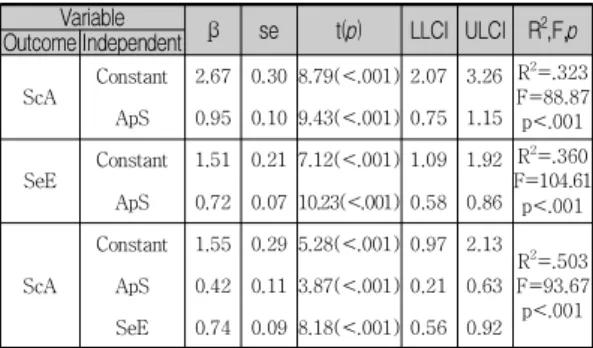
3.1 Mediation effect of self-esteemSPSS PROCESS macro Model 4 was used to analyze the mediation effects of self-esteem. This mediation model included appearance satisfaction as an independent variable, self-esteem as a mediator, and school adjustment as a dependent measure. The result showed that appearance satisfaction had a significant positive effect on self-esteem (β=.72, t=10.23, p<.001). It was also revealed that there were statistically significant effects of appearance satisfaction (β=0.42, t=3.87, p<.001) and self-esteem (β=0.74, t=8.18, p<.001) on school adjustment[Table 3].
Based on these results, it could be seen that self-esteem had partial mediation effect in the relationship between appearance satisfaction and school adjustment. The total effect on school adjustment was 0.95 (SE=.10, t=9.43, p<.001) while the direct effect was 0.42 (SE=.11, t=3.87, p<.001) and the indirect effect was 0.53 (BootSE=.08, BootCI95%=.39 to .71). This results indicated that partial mediation effect of self-esteem was significant.
Table 3. Model coefficients for mediation model Variable β se t(p) LLCI ULCI R2,F,p Outcome Independent
ScA Constant 2.67 0.30 8.79(<.001) 2.07 3.26 R2=.323 F=88.87 p<.001 ApS 0.95 0.10 9.43(<.001) 0.75 1.15
SeE
Constant 1.51 0.21 7.12(<.001) 1.09 1.92 R2=.360 F=104.61 p<.001 ApS 0.72 0.07 10.23(<.001) 0.58 0.86
ScA
Constant 1.55 0.29 5.28(<.001) 0.97 2.13 R2=.503 F=93.67 p<.001 ApS 0.42 0.11 3.87(<.001) 0.21 0.63 SeE 0.74 0.09 8.18(<.001) 0.56 0.92 Note. ApS = Appearance satisfaction; SeE = Self-esteem; ScA = School adjustment; LLCI = Lower level for 95% confidence interval;
ULCI = Upper level for 95% confidence interval
3.2 Moderation effect of gender
The moderation effect of gender was analyzed using SPSS PROCESS macro. First, mediation
analysis using Model 5 of the macro was performed to estimate indirect effect through self-esteem and conditional direct effect of appearance satisfaction on school adjustment. Next, moderation analysis using Model 7 and Model 14 of the macro was carried out to determine conditional indirect effect of appearance satisfaction on school adjustment through gender and direct effect of appearance satisfaction on school adjustment. The results showed that the moderation effect of gender was significant only in Model 7 but was not significant in Model 5 and Model 14.
Specifically, the result demonstrated significant interaction effects (β=.37, t=2.41, p=.017) of the appearance satisfaction and gender[Table 4].
Table 4. Model coefficients for moderation model Variable
β se t(p) LLCI ULCI R2,F,p Outco
me Independent
SeE
constant 3.66 0.04 90.47(<.001) 3.58 3.74 R2=.380 F=37.51 p<.001 ApS 0.77 0.08 10.08(<.001) 0.62 0.92 Gender -0.07 0.11 -.70(.484) -0.28 0.13 ApS ×
Gender 0.37 0.16 2.41(.017) 0.07 0.68
ScA
constant 2.79 0.33 8.42(<.001) 2.14 3.45 R2=.503 F=93.67 p<.001 ApS 0.42 0.11 3.87(<.001) 0.21 0.63 SeE 0.74 0.09 8.18(<.001) 0.56 0.92 Note. ApS = Appearance satisfaction; SeE = Self-esteem; ScA = School adjustment; LLCI = Lower level for 95% confidence interval;
ULCI = Upper level for 95% confidence interval
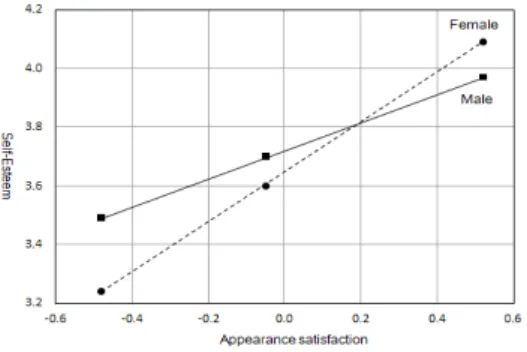
Fig. 2. Moderating effect of gender in the relationship between appearance satisfaction and self-esteem
The direct effect of appearance satisfaction on school adjustment was 0.42 (SE=.11, t=3.87, p<.001, CI95%=.21 to .63) and the indirect effect was 0.35 (BootSE=.12, BootCI95%=.16 to .62) in men, while the indirect effect was 0.63 (BootSE=.09, BootCI95%=.46 to .82) in women. The index of moderated medication was 0.28 (BootSE=.12, BootCI95%=.03 to .50)[Fig. 2].
IV. Discussion
The purpose of this study was to investigate the relationship between appearance satisfaction and school adjustment in nursing students, and to analyze the mediation effect of self-esteem and the moderation effect of gender. The result indicated that appearance satisfaction positively affected school adjustment, and self-esteem showed partial mediation effect. This relationship between the variables was similar to previous studies[16][20][27-29]. The result indicated that Korean nursing students had a similar pattern to adolescents or college students[16][20].
Their appearance satisfaction played as a factor to influence school adjustment[10][11]. This result suggests that supporting nursing students to recognize their appearance more positively can be a way to help them adapt to school life[10]. For example, supportive interventions or programs to improve the students’ appearance recognition and counsels for personality development can provide opportunities to overcome negative body images and to perceive their values.
The result that appearance satisfaction affected self-esteem could be in line with that perceived body image had an effect on quality of life[9][16][20]. There was close relationship between self-esteem and appearance satisfaction[27-29]. It could be understood that the positive perception of self-appearance
increased the individual’s overall evaluation of himself or herself, which might lead to an increase in self-esteem. As a result, higher self-esteem increased satisfaction of interpersonal relationships with other people and affected school adjustment[10][11].
Considering that self-esteem is closely related to various psychological problems such as depression, anxiety, and school maladjustment[13-15], the higher appearance satisfaction, the more likely it is to inhibit factors that have negative effects on mental health.
This could also be interpreted as giving a positive impact on school adjustment.
The moderation effect of gender in the model was found to be significant only in the relationship between the appearance satisfaction and self-esteem.
However, there were no significant moderation effects of gender between self-esteem and school adjustment, or between appearance satisfaction and school adjustment. This result indicated that the effects of appearance satisfaction on self-esteem were different between men and women[8][10][30].
Specifically, the effect of appearance satisfaction on self-esteem was higher in women than in men. This implied that the effect of appearance satisfaction on self-esteem was more sensitive in women[10].
Previous study[30] showed a similar result in that appearance satisfaction varied according to gender, and the level of appearance satisfaction of men was significantly higher than that of women. This seemed to reflect the social atmosphere that emphasized appearance more in women. It was also necessary to consider that, in women, body dissatisfaction was not changed much[31], and that there were a variety of factors that affected appearance satisfaction[32]. In addition, women tend to perceive their body image more negatively than men and feel that they are not attracted to themselves. Women are also inclined to negatively interpret their bodies more than they
actually are, resulting in low body satisfaction[8].
The perception that people should be beautiful can act as a greater pressure on women than men.
Furthermore, as the influence of internet or mass media grows in society, the evaluations of women in mass media tend to apply to appearance or physical standards more[32]. It is linked to that the stress related to appearance is more likely to be applied to women. As a result, it seems that women is more sensitive to their appearance and the change of self-esteem according to appearance satisfaction is larger than that of men[8]. Taking into the emphasis on appearance is spreading increasingly amongst men as well as women, it is likely that men will also have more interest on his appearance. Further research is necessary for better understanding the moderation effect of gender in the context of this social trends.
The moderation effect of gender could not be confirmed in the relationship between appearance satisfaction and school adjustment, and between self-esteem and school adjustment. These results are similar to the results of self-esteem being closely related to life satisfaction in both genders and across age[33]. This implies that appearance satisfaction and self-esteem directly affect school adjustment and this relationship does not differ by gender. When perceived appearance satisfaction or self-esteem is determined according to personal characteristics, it can be said that the difference in the individual is more important than the difference between men and women in school adjustment process.
The results of the current study suggest that nursing students should be more positive about their appearance and that strategies are needed to enhance their self-esteem in order to help them adapt to school life. For this purpose, it would be an effective strategy to develop and implement various intervention programs to enhance the appearance
satisfaction of nursing students. In addition, since women is prevalent in nursing students, appearance satisfaction has a greater impact on self-esteem in nursing students. Therefore, it will be more effective to develop a program specifically for women students when developing strategies to enhance their appearance satisfaction.
It is meaningful that this study analyzed the relationship among appearance satisfaction, self-esteem and school adjustment in nursing students by applying moderated mediation model. However, interpretations of the results should be taken carefully considering limitations of study such as limited survey area, gender ratio, and others. In the future, if additional research is conducted not only in the nursing major but also in other majors, it will helpful to understand the process of school adjustment and to support students’ adaptation to school life.
참 고 문 헌
[1] M. Credé and S. Niehorster, “Adjustment to college as measured by the student adaptation to college questionnaire: A quantitative review of its structure and relationships with correlates and consequences,” Educational Psychology Review, Vol.24, No.1, pp.133-165, 2012.
[2] C. Wang, Y. Xia, and W. Li, “Parenting behaviors, adolescent depressive symptoms, and problem behavior: The role of self-esteem and school adjustment difficulties among Chinese adolescents,” J. of Family Issues, Vol.37, No.4, pp.520-542, 2016.
[3] M. Pulido-Martos, J. M. Augusto-Landa, and E.
Lopez-Zafra, “Sources of stress in nursing students: A systematic review of quantitative studies,” International Nursing Review, Vol.59,
No.1, pp.15-25, 2012.
[4] R. C. F. Chui and C. K. Chan, “School Adjustment, Social Support, and Mental Health of Mainland Chinese College Students in Hong Kong,” J. of College Student Development, Vol.58, No.1, pp.88-100, 2017.
[5] M. H. Choe, J. H. Kim, and E. S. Nam, “Factors affecting job-seeking stress in nursing students,”
Korean Journal of Occupational Health Nursing, Vol.24, No.2, pp.122-131, 2015.
[6] J. Borland and A. Jeigh, “Unpacking the beauty premium: What channels does it operate through, and has it changed over time?,” Economic Record, Vol.90, No.288, pp.17-32, 2014.
[7] S. C. Want, K. Vickers, and J. Amos, “The Influence of Television Programs on Appearance Satisfaction: Making and Mitigating Social Comparisons to Friends,” Sex Roles, Vol.60, No.9-10, pp.642-655, 2009.
[8] A. Furnham, N. Badmin, and I. Sneade, “Body image dissatisfaction: Gender differences in eating attitudes, self-esteem, and reasons for exercise,”
J. of psychology, Vol.136, No.6, pp.581-596, 2002.
[9] T. F. Cash, J. A. Morrow, and J. I. Hrabosky,
“How has body image changed? A cross-sectional investigation of college women and men from 1983 to 2001,” J. of Consulting and Clinical Psychology, Vol.72, No.6, pp.1081-1089, 2004.
[10] E. J. Im, C. R. Ahn, and G. J. Lee, “School Life Adjustment in Relation to Perception and Concern Degree of Appearance in College Students,” J. of the Korean Society of Design Culture, Vol.22, No.4, pp.547-558, 2016.
[11] S. M. Song, “The influences of appearance satisfaction on school adjustment and the mediating effects of self-efficacy between them among adolescents,” J. of the Korean Society of School Health, Vol.26, No.1, pp.1-12, 2013.
[12] M. H. Kernis, Self-esteem issues and answers:
A sourcebook of current perspectives, Psychology Press, 2013.
[13] O. Kim and K. Kim, “Body weight, self-esteem, and depression in Korean female adolescents,”
Adolescence, Vol.36, No.142, pp.315-322, 2001.
[14] J. H. Nho, Y. E. Kim, and D. S. Jeong,
“Mediating Effects of Self-esteem in the Relationship between Body Image and Depression of Female University Students,” J. of the Korean Society of School Health, Vol.27, No.3, pp.196-202, 2014.
[15] M. Hosogi, A. Okada, and C. Aujii, “Importance and usefulness of evaluating self-esteem in children,” BioPsychoSocial Medicine, Vol.6, No.1, pp.9-15, 2012.
[16] J. M. Hur and J. Y. Kim, “A Research about Effects of Satisfaction Level Rural Middle School Students have about their Appearances on School Adaptability - Focusing on the Mediacy Effect of Personal Relations and Self-esteem,” Korean Journal of Youth Studies, Vol.19, No.11, pp.329-356, 2012.
[17] I. S. Caleon, M. G. L. Wui, and C. L. Chiam,
“Personal strengths and perceived teacher support as predictors of Singapore students’
academic risk status,” Educational Psychology, Vol.37, No.8, pp.983-1000, 2017.
[18] M. Zuckerman, C. Li, and J. Hall, “When men and women differ in self-esteem and when they don’t: A meta-analysis,” J. of Research in Personality, Vol.64, pp.34-51, 2016.
[19] W. Bleidorn, R. C. Arslan, and J. J. Denissen,
“Age and gender differences in self-esteem—A cross-cultural window,” J. of Personality and Social Psychology, Vol.111, No.3, pp.396-410, 2016.
[20] A. Lu, X. Hong, and Y. Yu, “Perceived physical appearance and life satisfaction: A moderated
mediation model of self-esteem and life experience of deaf and hearing adolescents,” J.
of Adolescence, Vol.39, pp.1-9, 2015.
[21] S. J. Chae, The Difference in Adolescents' Self-Respect and Self Efficiency Made by Their Satisfaction with Their Physical Appearances, Kyungpook University, Master’s thesis, 2008.
[22] P. F. Secord and S. M. Jourard, “The appraisal of body-cathexis: Body-cathexis and the self,” J of Consulting Psychology, Vol.17, No.5, p.343, 1953.
[23] M. Rosenberg, Rosenberg self-esteem scale (RSE). Acceptance and commitment therapy, Measures package 61, University of Wollongong, 1965.
[24] B. J. Cheon, “Self-Esteem: A Test of Its Measurability,” J. of Yeonsei University, Vol.11, No.1, pp.107-130, 1974.
[25] R. W. Baker and B. Siryk, Student adaptation to college questionnaire (SACQ), Western Psychological Services, 1986.
[26] J. W. Hyun and J. H. Choi, “Effect of Perfectionism and Evaluative Threat on the Performance of Task,” 1992 Conference Proceeding of Korean Psychological Association, pp.463-472, 1992.
[27] E. T. Barker and M. H. Bornstein, “Global self-esteem, appearance satisfaction, and self-reported dieting in early adolescence,” The Journal of Early Adolescence, Vol.30, No.2, pp.205-224, 2010.
[28] P. A. van den Berg, J. Mond, and M. Eisenberg,
“The link between body dissatisfaction and self-esteem in adolescents: Similarities across gender, age, weight status, race/ethnicity, and socioeconomic status,” J. of Adolescent Health, Vol.47, No.3, pp.290-296, 2010.
[29] L. Wichstrøm and T. von Soest, “Reciprocal relations between body satisfaction and
self-esteem: A large 13-year prospective study of adolescents,” J. of Adolescence, Vol.47, pp.16-27, 2016.
[30] H. R. Cho and J. M. Choi, “Relationship between body satisfaction and appearance enhancement behavior of college students,”
Korean Journal of Human Ecology, Vol.16, No.4, pp.825-835, 2007.
[31] M. Tiggemann, “Body image across the adult life span: Stability and change,” Body image, Vol.1, No.1, pp.29-41, 2004.
[32] H. K. Oh, “Phenomenological Analysis of Perception on Body Image of Female College Students,” The J. of the Korea Contents Association, Vol.14, No.3, pp.289-300, 2014.
[33] U. K. Moksnes and G. A. Espnes, “Self-esteem and life satisfaction in adolescents—gender and age as potential moderators,” Quality of Life Research, Vol.22, No.10, pp.2921-2928, 2013.
저 자 소 개
박 순 주(Soonjoo Park) 정회원
▪2001년 8월 : 연세대학교 대학원 간호학과(간호학박사)
▪2011년 3월 ~ 현재 : 을지대학교 간호학과 부교수
<관심분야> : 성인간호, 간호교육, 건강증진, 만성질환