Article http://dx.doi.org/10.14478/ace.2016.1051
미세기공 제올라이트를 이용한 국내 수종 굴참나무의 간접 촉매 열분해
김영민*⋅김범식*⋅채광석*,**⋅조태수**⋅김승도***⋅박영권*,†
*서울시립대학교 환경공학부, **국립산림과학원 바이오에너지연구센터, ***한림대학교 환경생명공학과 (2016년 5월 26일 접수, 2016년 5월 31일 심사, 2016년 6월 1일 채택)
Ex-situ Catalytic Pyrolysis of Korean Native Oak Tree over Microporous Zeolites
Young-Min Kim*, Beom-Sik Kim*, Kwang-Seok Chea*,**, Tae Su Jo**, Seungdo Kim***, and Young-Kwon Park*,†
*School of Environmental Engineering, University of Seoul, Seoul 02504, Korea
**National Institute of Forest Science, Seoul 02455, Korea
***Department of Environmental Sciences and Biotechnology, Hallym University, Chuncheon 24252, Korea (Received May 26, 2016; Revised May 31, 2016; Accepted June 1, 2016)
초 록
고정층 반응기를 이용하여 제올라이트(HZSM-5, HBeta, HY) 상에서 국내 수종 굴참나무의 간접 촉매 열분해를 수행하 였다. 고품질 바이오오일 생산 최적 조건을 도출하기 위해 시료와 촉매의 비율과 반응 온도의 영향 또한 고찰하였다.
세 종의 촉매 중에서 HZSM-5가 적절한 기공크기와 강한 산도로 인해 가장 높은 방향족 화합물 형성능을 나타내었다.
HY와 HBeta 또한 촉매능을 가졌으나, 큰 기공크기로 인해 많은 양의 코크가 형성되었다. HZSM-5 상에서 참나무의 촉매 열분해를 통해 방향족 화합물의 수율을 극대화하기 위해서는 낮은 시료/촉매비와 높은 반응 온도가 요구됨을 확인하였다.
Abstract
Ex-situ catalytic pyrolysis of a Korean native oak tree over microporous zeolites (HZSM-5, HBeta, and HY) was performed by using a fixed bed reactor. The effect of sample to catalyst ratio and reaction temperature was also investigated to optimize production conditions of high quality bio-oil. Among three catalysts, HZSM-5 showed the highest aromatic formation due to its proper pore size and strong acidity. Although HY and HBeta also showed the catalytic activity, they produced larger amounts of coke due to their larger pore size. The smaller ratio of the sample to the catalyst and higher reaction temperature were also required to maximize the yields of aromatic hydrocarbons via the catalytic pyrolysis of oak tree over HZSM-5.
Keywords: bio-oil, catalytic pyrolysis, oak tree, zeolite, aromatic hydrocarbons
1)1. Introduction
Worldwide energy security is being threatened by the fossil fuel shortage and unstable crude oil price[1-4]. Therefore, many countries are focusing on the development of alternative energy. Climate change and increased air contamination due to the intensive use of fossil fuel are also promoting the research for the renewable energy development.
Among various kinds of renewable energy, biomass is being considered as the candidate energy source which can replace the fossil fuels[6-8].
Biomass pyrolysis is one of the thermal conversion techniques which can produce valuable byproducts in forms of gas, oil, and char under non-oxygen atmosphere at medium temperature (mainly from 400 to
† Corresponding Author: University of Seoul,
School of Environmental Engineering, Seoul 02504, Korea Tel: +82-2-6490-2780 e-mail: [email protected]
pISSN: 1225-0112 eISSN: 2288-4505 @ 2016 The Korean Society of Industrial and Engineering Chemistry. All rights reserved.
600 ℃). Many researchers have investigated the fast pyrolysis of bio- mass to obtain large amounts of high quality bio-oil because bio-oil can be transported and stored easily[5,9] and used as a fuel and/or chemical feedstock[3]. However, the actual use of bio-oil produced by the thermal pyrolysis of biomass is limited due to its low quality con- taining high oxygen content[3,10,11]. Therefore, additional process for the deoxygenation is required to upgrade the quality of biomass py- rolysis oil. Various kinds of reaction such as catalytic pyrolysis of bio- mass, hydrodeoxygenation of bio-oil, catalytic co-pyrolysis of biomass with plastics or alcohols have been suggested and investigated for im- provement of the bio-oil quality[1-3,10-14]. In case of catalytic py- rolysis of biomass, various kinds of catalyst such as microporous zeo- lites (HZSM-5, HBeta, and HY) and mesoporous catalysts (Al-SBA-15, Al-MCM-41, and mesoporous MFI) were used to upgrade the bio-oil quality.
Proximate analysis (wt%)[15] Ultimate analysis (wt%)
Moisture 1.1 C 48.54
Volatiles 83.2 H 5.93
Fixed carbon 12.3 Oa 45.24
Ash 3.5 N 0.29
a By difference
Table 1. Physico-chemical Characteristics of Korean Native Oak Tree (Quercus variabilis)
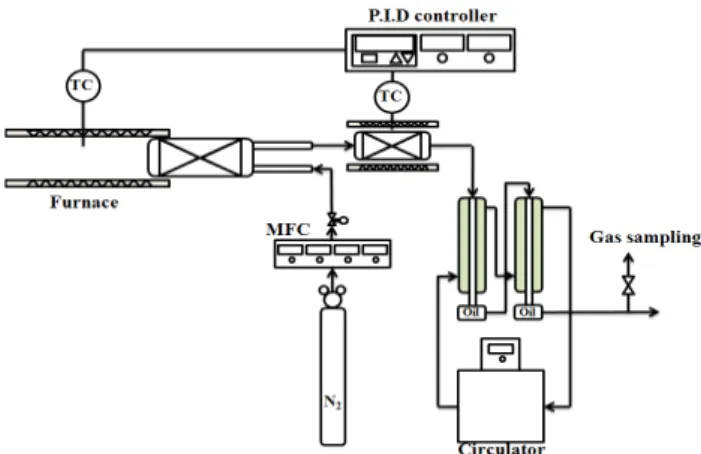
Figure 1. Schematic diagram of a fixed bed reactor system[17].
Although many researchers already reported the catalytic pyrolysis of various kinds of biomass, the catalytic pyrolysis research for Korean native wood species were rarely investigated. Recently, Kang et al.[15]
reported the catalytic pyrolysis of the Korean native oak tree over mes- oporous MFI and nanoporous materials (Al-MCM-41, Al-SBA-15, and Al2O3). They obtained the highest yields for aromatic hydrocarbons from the catalytic pyrolysis reaction over mesoporous MFI catalysts.
Although microporous zeolites are known to the effective catalysts for the catalytic pyrolysis of lignocellulosic biomass[13,16], the catalytic pyrolysis of a Korean native oak tree over microporous catalysts has never been reported, yet.
Therefore, the catalytic pyrolysis of the Korean native oak tree was investigated by applying HZSM-5, HBeta, and HY as the catalysts in this study. The effects of reaction conditions such as sample to catalyst ratio and reaction temperature on the catalytic reaction of oak tree were also investigated by reaction using a fixed-bed reactor and product anal- ysis using gas chromatography/mass spectrometry (GC/MS), GC/flame ionization detector (FID) and thermal conductivity detector (TCD).
2. Materials and Methods
2.1. Oak tree
Oriental oak tree (Quercus variabilis), obtained from Korea Forest Research Institute, was used as the biomass sample in this study. The oak tree was ground by a knife milling device, sieved to make its particle size smaller than 1 mm and dried at 80 ℃ for 6 hours. Table 1 shows the results of proximate and ultimate analyses of oak tree after air dry.
2.2. Catalysts
Three kinds of commercially available zeolite catalyst, HZSM-5 (SiO2/Al2O3 = 30), HBeta (SiO2/Al2O3 = 38), and HY (SiO2/Al2O3 = 30), were purchased from Zeolyst International. All of these catalysts were calcined at 500 ℃ under air for 5 hours. To compare the acidity of each catalyst, NH3-TPD (temperature-programmed desorption of am- monia) analysis was carried out according to the method reported in the literature[16].
2.3. Thermogravimetric (TG) analysis
To know the thermal property of oak tree, TG analysis was per- formed using a TG analyzer (Pyris Diamond, Perkin Elmer Co.). About 2 mg of sample was heated from ambient temperature to 800 ℃ at a heating rate of 20 ℃/min under 120 mL/min of nitrogen atmosphere.
2.4. Catalytic Pyrolysis
A fixed bed reactor system (Figure 1) was used for the ex-situ cata- lytic pyrolysis of oak tree in this study. This system consists of two furnaces which can perform the pyrolysis of oak tree and catalytic up- grading of its pyrolysis product vapor, respectively, in the separated reactors. The temperature of each reactor can be controlled individually. For the reactions, about 3 g of oak tree and 0.6 g of each catalyst (sample to catalyst ratio : 5 to 1, particle size of catalyst : 1.0- 1.7 mm) were positioned in the first and second reactor, respectively, and purged with 50 mL/min of nitrogen for 1 hour. Then, both furna- ces were heated up to the reaction temperatures (425, 475, or 530 ℃).
After waiting for temperature stabilization, the fast catalytic pyrolysis was initiated by pushing the first furnace to the sample position where the oak tree is located. The total reaction time was set as 1 hour to provide the enough thermal decomposition and catalytic upgrading reaction.
The product vapors emitted from the outlet of second reactor were condensed into liquid-form (product oil) at the two stage condenser system. Uncondensed gas products were also collected in the gas sam- pling bag. The collected oil and gas were analyzed by GC/MS, GC/FID/TCD and their detailed analysis conditions were shown in Table 2.
3. Results and Discussion
3.1. Characterization of catalysts
The textural properties of HZSM-5, HBeta, and HY, supplied by the manufacturer of the catalysts, are shown in Table 3. HBeta and HY have large surface areas (710 m2/g for HBeta, 780 m2/g for HY) and pore sizes (ca. 0.67 nm for HBeta, ca. 0.74 nm for HY), compared to those of HZSM-5 (405 m2/g, ca. 0.55 nm).
The acidity of each catalyst obtained by NH3-TPD analysis is shown in Figure 2. All catalysts had both weak and strong acid sites which can be monitored at around 200 and 400 ℃. Among three catalysts, HZSM-5 had the largest NH3-TPD curve area, followed in order by HBeta and HY. This indicates that HZSM-5 is the strongest catalyst among them in the aspect of the acid characteristics, followed in order by HBeta and HY.
GC/MS GC/TCD GC/FID
Target compounds Organic compounds in oil product CO, CO2, CH4 in gas product C1-C4 hydrocarbons in gas product Instrument 7890A GC, Agilent technologies/5975C
inert MSD, Agilent technologies
ACME 6000, Young Lin Instrument Co., Ltd.
ACME 6000, Young Lin Instrument Co., Ltd.
Column description
Ultra alloy-5 (30 m × 0.25 mm × 0.25 µm)
Carboxen 1000 (15 ft × 1/8 in)
HP-plot Al2O3/KCl (50 m × 0.32 mm × 8.00 µm) Injector
condition 300 ℃, split ratio 20 : 1 150 ℃, He 20 mL/min 200 ℃, split ratio 10 : 1
Oven program
40 ℃ for 4 min 40-200 ℃ at 5 ℃/min 200-320 ℃ at 10 ℃/min
320 ℃ for 10 min
35 ℃ for 5 min, 35-225 ℃ at 15 ℃/min,
225 ℃ for 10 min
40 ℃ for 5 min 40-160 ℃ at 4 ℃/min 160-200 ℃ at 2 ℃/min
200 ℃ for 40 min Detector
temperature 230 ℃ 150 ℃ 250 ℃
Table 2. Detailed Analysis Conditions of GC/TCD, GC/FID, and GC/MS
SiO2/Al2O3
(mole ratio)
BET Surface area (m2/g)
Pore size (nm)
HZSM-5 30 405 0.51 × 0.55,
0.53 × 0.56
HBeta 38 710 0.66 × 0.67
HY 30 780 0.74 × 0.74
Table 3. Physical Properties of Catalysts
Temperature (oC)
100 200 300 400 500
Intensity (a.u.)
HZSM-5 HBeta HY
Figure 2. NH3-TPD curves of catalysts.
Temperature (oC)
200 400 600 800
Residual weight (wt.%)
0 20 40 60 80 100
DTG (dX/dT)
0.0 0.1 0.2 0.3 0.4 0.5 0.6 TG DTG
#1
#2
#3
Figure 3. TG and DTG curves of oak tree.
3.2. TG analysis of oak tree
Wood pyrolysis consists of the decomposition of hemicellulose, cel- lulose and lignin which are the lignocellulosic components of woody biomass. Hemicellulose is decomposed at the lowest temperature re- gion (200-350 ℃) due to its thermally unstable structure[1,15].
Subsequently, cellulose is decomposed rapidly in the narrow temper- ature range (350-400 ℃). Meanwhile, lignin decomposition has the widest temperature region and is continued up to high temperature around 600 ℃[18]. Figure 3 shows the TG and DTG curves of an oak tree. DTG curve of oak tree had the overlapped peak, which consists of a left shoulder peak (#1) and right tailing peak (#3) on both sides of main decomposition peak (#2). Each peak can be assigned as the decomposition of hemicellulose (#1), cellulose (#2) and lignin (#3).
The overlapped peak shape of the oak tree DTG curve indicates that hemicellulose and cellulose have the overlapped decomposition temper- ature region. After the TG analysis, about 20% of solid residue re- mained in the sample cup.
3.3. Catalytic pyrolysis of oak tree
Figure 4(a) show the gas, oil, char, and coke yields obtained from the thermal and catalytic pyrolysis of oak tree at 530 ℃. The yields of char were not changed by the use of catalysts because the amount of char in the ex-situ catalytic pyrolysis reaction is concluded by the thermal pyrolysis in the first reactor. Meanwhile, the yield of oil was decreased with the increase of gas and coke yield by the catalytic up- grading of vapor-phase pyrolysis products in the second reactor. This indicates that the main catalytic reactions of pyrolysis products are re- lated to the catalytic cracking of condensable oil which produces small molecules oils, gas, and coke. Figure 4(b) shows the yields of CO,
CO2, and light hydrocarbons obtained from the ex-situ catalytic py- rolysis of an oak tree at 530 ℃. Compared to the thermal pyrolysis, the amount of CO and light hydrocarbons were greatly increased by the catalytic upgrading over all three catalysts. This indicates that de- carbonylation and dealkylation of pyrolysis products of the oak tree are major catalytic reactions during catalytic upgrading. Catalytic pyrolysis of biomass involves various kinds of catalytic reaction such as dehydration, decarbonylation, decarboxylation, dealkylation and oligomerization of the primary pyrolysis products of lignocellulosic biomass compo- nents[19]. The overall catalytic activity is also differentiated by the properties of catalyst. For example, the pore size can be the important
No. Compounds Area%
Without catalyst HZSM-5 HBeta HY
1 Acetic acid 10.81 3.02 9.93 12.79
2 2-Propanone, 1-hydroxy- 2.47 0.75 2.59 3.56
3 Furfural 4.04 1.77 4.85 6.53
4 2-Furanmethanol 1.86 N/Da N/Da N/Da
5 1,2-Cyclopentanedione 2.09 0.72 1.93 1.76
6 Phenol 0.56 2.29 2.02 2.12
7 Phenol, 2-methoxy- 1.89 1.26 2.07 2.54
8 Phenol, 2-methoxy-4-methyl- 1.90 1.34 2.42 3.09
9 1,2-Benzenediol, 3-methoxy- 1.85 1.56 2.56 2.34
10 Phenol, 4-ethyl-2-methoxy- 1.58 1.36 2.09 2.90
11 2-Methoxy-4-vinylphenol 2.06 1.05 1.41 1.15
12 Phenol, 2,6-dimethoxy- 4.38 2.95 3.77 4.09
13 Benzoic acid, 4-hydroxy-3-methoxy- 3.36 2.56 2.68 2.35
14 1,6-Anhydro-.beta.-D-glucopyranose (levoglucosan) 6.34 1.10 2.56 N/Da
15 Benzene, 1,2,3-trimethoxy-5-methyl 1.51 1.07 1.72 1.13
16 Phenol, 2,6-dimethoxy-4-(2-propenyl)- 3.54 1.34 0.64 0.47
17 Toluene N/Da 3.00 0.13 0.57
18 Xylene N/Da 12.86 2.24 2.21
19 Naphthalene N/Da 3.25 2.03 0.72
20 Naphthalene, (di)methyl N/Da 12.43 11.97 8.67
a Not Detected as a GC/MS peak.
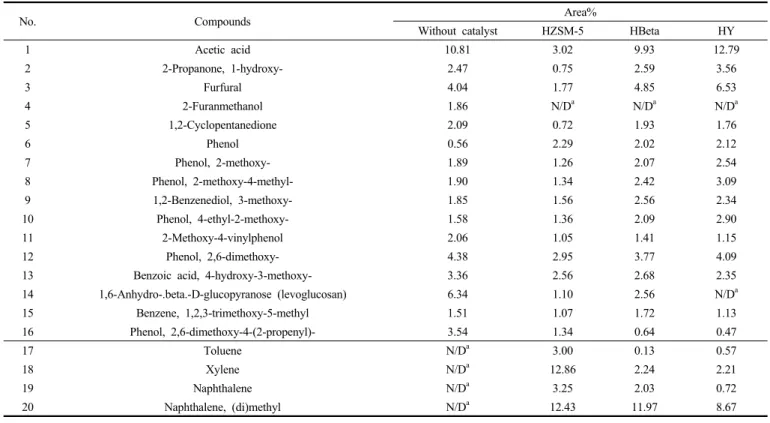
Table 4. GC/MS Peak area% of Bio-oil Produced from the Thermal and Catalytic Pyrolysis of Oak Tree over Different Catalysts at 530 ℃
(a)
(b)
Figure 4. The yields of gas, oil, and char (a) and detailed gas yields (b) obtained from the thermal and catalytic pyrolysis of oak tree at 530 ℃.
factor to enhance the selectivity for the target compounds. The amount of coke deposited in the pore of catalysts can also be different depend- ing on the pore size of catalyst. Control of coke amount is the im- portant factor on the catalytic pyrolysis because coke deposition is the main reason for the decrease of catalytic activity due to the poisoning of acid sites. As shown in Figure 4(a), their amounts deposited in each catalyst were highest on HY (30), followed by HBeta (38) and HZSM-5 (30) suggesting HBeta and HY can be deactivated faster than HZSM-5.
Fast deactivation of HBeta than HZSM-5 was also found on the ex-situ catalytic pyrolysis of other biomass reported in our previous study[20].
Table 4 shows the detailed chemical distribution of the oil obtained from the thermal and catalytic pyrolysis of oak tree over different cata- lysts at 530 ℃. In case of thermal pyrolysis, the specific pyrolyzates of lignocellulosic biomass components, such as acetic acid from hemicellulose, levoglucosan from cellulose, and phenols from lignin, were produced[6].
Most of them are the oxygen containing compounds. The amounts of oxy- gen containing compounds were decreased with the formation of aromatic hydrocarbons over all three catalysts. In case of HY, large amount of large molecular phenols such as 2,6 dimethoxy-4-(2-propenyl)-phenol were decreased from 3.54% to 0.47% and levoglucosan from 6.34% to
No. Compounds Area%
Without catalyst HZSM-5 5/1 HZSM-5 10/1
1 Acetic acid 10.81 3.02 11.42
2 2-Propanone, 1-hydroxy- 2.47 0.75 2.87
3 Furfural 4.04 1.77 3.74
4 2-Furanmethanol 1.86 N/Da N/Da
5 1,2-Cyclopentanedione 2.09 0.72 2.05
6 Phenol 0.56 2.29 1.13
7 Phenol, 2-methoxy- 1.89 1.26 1.65
8 Phenol, 2-methoxy-4-methyl- 1.90 1.34 2.31
9 1,2-Benzenediol, 3-methoxy- 1.85 1.56 4.23
10 Phenol, 4-ethyl-2-methoxy- 1.58 1.36 1.55
11 2-Methoxy-4-vinylphenol 2.06 1.05 1.45
12 Phenol, 2,6-dimethoxy- 4.38 2.95 4.07
13 Benzoic acid, 4-hydroxy-3-methoxy- 3.36 2.56 4.69
14 1,6-Anhydro-.beta.-D-glucopyranose (levoglucosan) 6.34 1.10 5.08
15 Benzene, 1,2,3-trimethoxy-5-methyl 1.51 1.07 1.40
16 Phenol, 2,6-dimethoxy-4-(2-propenyl)- 3.54 1.34 0.52
17 Toluene N/Da 3.00 0.66
18 Xylene N/Da 12.86 3.01
19 Naphthalene N/Da 3.25 0.85
20 Naphthalene, (di)methyl N/Da 12.43 4.89
a Not Detected as a GC/MS peak.
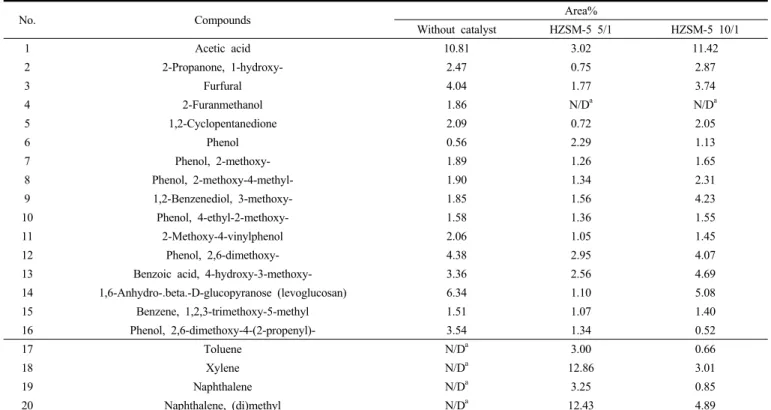
Table 5. GC/MS Peak area% of Bio-oil Produced from the Thermal and Catalytic Pyrolysis of Oak Tree over Different Amounts of HZSM-5 at 530 ℃
(a)
(b)
Figure 5. The yields of gas, oil, and char (a) and detailed gas yields (b) obtained from the thermal and catalytic pyrolysis of oak tree over different amount of HZSM-5 at 530 ℃.
0%. The high elimination of large molecular pyrolyzates over HY can be explained by the easier diffusion of reactant molecules into the large pore of HY. The catalytic reaction over HBeta produced larger amounts of aromatic hydrocarbons than HY. Stronger activity in the formation of aromatic hydrocarbons over HBeta than that over HY can be explained by the stronger acidity of HBeta than that of HY as shown in Figure 2. As expected, HZSM-5 which has the strongest acidity among three catalysts showed the highest aromatic formation.
Especially, the selectivity of xylene over HZSM-5 was quite higher than those over HY and HBeta. Higher selectivity of BTEXs over HZSM-5 can be explained by the proper pore size of HZSM-5 for the production of mono-aromatic[13,21].
To know the effect of the amount of catalyst, sample to catalyst (S/C) ratio was increased from 5/1 to 10/1 by decreasing the amount of catalyst from 0.6 g to 0.3 g for the catalytic pyrolysis of oak tree (3 g). The catalytic pyrolysis over 0.3 g of HZSM-5 showed higher
No. Compounds Area%
ZSM-5 5/1 530 ℃ ZSM-5 5/1 475 ℃ ZSM-5 5/1 425 ℃
1 Acetic acid 3.02 5.49 9.89
2 2-Propanone, 1-hydroxy- 0.75 4.05 4.16
3 Furfural 1.77 3.66 3.95
4 2-Furanmethanol N/Da N/Da N/Da
5 1,2-Cyclopentanedione 0.72 1.71 3.95
6 Phenol 2.29 1.71 0.92
7 Phenol, 2-methoxy- 1.26 2.47 3.32
8 Phenol, 2-methoxy-4-methyl- 1.34 2.07 2.90
9 1,2-Benzenediol, 3-methoxy- 1.56 1.83 1.80
10 Phenol, 4-ethyl-2-methoxy- 1.36 2.25 2.07
11 2-Methoxy-4-vinylphenol 1.05 1.71 1.68
12 Phenol, 2,6-dimethoxy- 2.95 5.09 6.4
13 Benzoic acid, 4-hydroxy-3-methoxy- 2.56 4.26 5.07
14 1,6-Anhydro-.beta.-D-glucopyranose (levoglucosan) 1.10 1.62 1.34
15 Benzene, 1,2,3-trimethoxy-5-methyl 1.07 2.54 3.18
16 Phenol, 2,6-dimethoxy-4-(2-propenyl)- 1.34 0.64 0.75
17 Toluene 3.00 1.29 0.38
18 Xylene 12.86 6.36 3.06
19 Naphthalene 3.25 2.05 1.12
20 Naphthalene, (di)methyl 12.43 8.39 4.06
a Not Detected as a GC/MS peak.
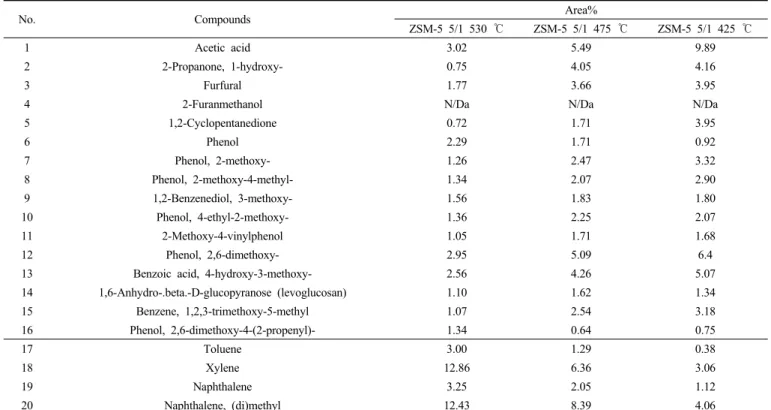
Table 6. GC/MS Peak area% of Bio-oil Produced from the Thermal and Catalytic Pyrolysis of Oak Tree over HZSM-5 at Different Reaction Temperatures
(a)
(b)
Figure 6. The yields of gas, oil, and char (a) and detailed gas yields (b) obtained from the catalytic pyrolysis of oak tree over HZSM-5 at different reaction temperatures.
yield of oil and lower yields of gas and coke than those over 0.6 g of HZSM-5 (Figure 5(a)). The yields of CO and light hydrocarbons were also smaller over 0.3 g of HZSM-5 (Figure 5(b)). The amounts of aromatic produced over 0.3 g of HZSM-5 were also quite lower than those over 0.6 mg of HZSM-5 (Table 5). These indicate that cata- lytic activity for aromatics formation is declined by decreasing the amount of HZSM-5 applied for the catalytic pyrolysis of an oak tree.
Small amount of HZSM-5 also influenced the composition of phenolic
compounds. The selectivity for mono-phenol was also decreased by ap- plying smaller amounts of HZSM-5 together with the higher selectivity for high molecular methoxy-alkyl phenols. This indicates that the de- methoxylation and dealkylation of methoxy-alkyl phenols, the im- portant catalytic pyrolysis reactions of lignin over HZSM-5, are also highly influenced by the amount of catalyst.
Reaction temperature also influenced the catalytic pyrolysis of an oak tree over HZSM-5 (Figure 6). The catalytic pyrolysis at the higher
temperature (530 ℃) produced the lower char and higher gas yields than those obtained at the lower temperature. Meanwhile, the yields of oil and coke obtained at the different reaction temperature were not so different. Interestingly, the yields for CO and light hydrocarbons were dramatically increased by increasing the reaction temperature. These phenomena explain that the reaction efficiency for catalytic upgrading of pyrolysis products over HZSM-5 is increased at the higher reaction temperature by the increase of catalytic reactions such as cracking and decarbonylation[20].
Table 6 shows the GC/MS area% of bio-oils obtained from the cata- lytic pyrolysis of an oak tree at different reaction temperatures. As ex- pected with the results shown in Figure 6, the selectivity for aromatic hydrocarbons was increased by applying the higher reaction temperature.
At the higher reaction temperature, the selectivity for methoxy-alkyl phe- nols was decreased together with the increased selectivity of mono- phenol. These results indicate that the aromatization, dealkylation, and demethoxylation reactions are promoted by increasing the reaction tem- perature[20,22].
4. Conclusions
Ex-situ catalytic pyrolysis of a Korean native oak tree over HZSM-5 was performed using a two stage fixed bed reactor. HZSM-5 showed the strongest activity for aromatic formation due to its higher acidity and proper pore size than HY and HBeta. HY having the largest pore size among the catalysts applied in this study showed the greatest cracking efficiency for large molecular pyrolysis products such as levo- glucosan and methoxyalkyl phenols due to its large pore size; however, larger amount of coke was produced. HY and HBeta produced smaller amounts of aromatics than HZSM-5 due to their lower acidity. The ar- omatic formation efficiency over HZSM-5 was also highly influenced by the sample to catalyst ratio and reaction temperature. It was con- cluded that sufficiently high temperature (530 ℃) and proper sample to catalyst ratio (5/1) have to be supplied to the catalytic pyrolysis sys- tem to increase the yields of aromatic hydrocarbons.
Acknowledgement
This subject is supported by Korea Ministry of Environment as
“Climate Change Correspondence R&D Program”. Also this work was supported by National Institute of Forest Science (FP0900-2009-02-2014).
In addition, this work was supported by the New and Renewable Energy Core Technology Program of the Korea Institute of Energy Technology Evaluation and Planning (KETEP), granted financial resource from the Ministry of Trade, Industry & Energy, Republic of Korea (No.
20143010091790).
References
1. M.-J. Jeon, J.-K. Jeon, D. J. Suh, S. H. Park, Y. J. Sa, S. H. Joo, and Y.-K. Park, Catalytic pyrolysis of biomass components over mesoporous catalysts using Py-GC/MS, Catal. Today, 204, 170-178
(2013).
2. H. J. Park, J.-K. Jeon, D. J. Suh, Y.-W. Suh, H. S. Heo, and Y.-K.
Park, Catalytic vapor cracking for improvement of bio-oil quality, Catal. Surv. Asia, 15, 161-180 (2011).
3. G. W. Huber, S. Iborra, and A. Corma, Synthesis of transportation fuels from biomass: chemistry, catalysts, and engineering, Chem.
Rev., 106, 4044-4098 (2006).
4. S. H. Park, H. J. Cho, C. Ryu, and Y.-K. Park, Removal of cop- per(II) in aqueous solution using pyrolytic biochars derived from red macroalga Porphyra tenera, J. Ind. Eng. Chem., 36, 314-319 (2016).
5. C. H. Ko, S. H. Park, J.-K. Jeon, D. J. Suh, K.-E. Jeong, and Y.-K. Park, Upgrading of biofuel by the catalytic deoxygenation of biomass, Korean J. Chem. Eng., 29, 1657-1665 (2012).
6. C. Liu, H. Wang, A. M. Karim, J. Sun, and Y. Wang, Catalytic fast pyrolysis of lignocellulosic biomass, Chem. Soc. Rev., 43, 7594-7623 (2014).
7. Y.-M. Kim, H. W. Lee, S. Kim, C. Watanabe, and Y.-K. Park, Non-isothermal pyrolysis of Citrus unshiu peel, Bioenergy Res., 8, 431-439 (2015).
8. T. U. Han, Y.-M. Kim, C. Watanabe, N. Teramae, Y.-K. Park, and S. Kim, Analytical pyrolysis properties of waste medium-density fiberboard and particle board, J. Ind. Eng. Chem., 32, 345-352 (2015).
9. T.-A. Ngo, J. Kim, and S.-S. Kim, Fast pyrolysis of palm kernel cake using a fluidized bed reactor: Design of experiment and char- acteristics of bio-oil, J. Ind. Eng. Chem., 19, 137-143 (2013).
10. H. W. Lee, S. H. Park, J.-K. Jeon, R. Ryoo, W. Kim, D. J. Suh, and Y.-K. Park, Upgrading of bio-oil derived from biomass con- stituents over hierarchical unilamellar mesoporous MFI nanosheets, Catal. Today, 232, 119-126 (2014).
11. H. S. Heo, S. G. Kim, K.-E. Jeong, J.-K. Jeon, S. H. Park, J. M.
Kim, S.-S. Kim, and Y.-K. Park, Catalytic upgrading of oil frac- tions separated from food waste leachate, Bioresour. Technol., 102, 3952-3957 (2011).
12. H. W. Lee, S. J. Choi, S. H. Park, J.-K. Jeon, S.-C. Jung, S. H.
Joo, and Y.-K. Park, Catalytic conversion of Laminaria japonica over microporous zeolites, Energy, 66, 2-6 (2014).
13. B.-S. Kim, Y.-M. Kim, H. W. Lee, J. Jae, D. H. Kim, S.-C. Jung, C. Watanabe, and Y.-K. Park, Catalytic copyrolysis of cellulose and thermoplastics over HZSM-5 and HY, ACS Sustain. Chem.
Eng., 4, 1354-1363 (2016).
14. Y.-M. Kim, J. Jae, H. W. Lee, T. U. Han, H. Lee, S. H. Park, S.
Kim, C. Watanabe, and Y.-K. Park, Ex-situ catalytic pyrolysis of citrus fruit peels over mesoporous MFI and Al-MCM-41, Energy Convers. Manage., Doi: 10.1016/j.enconman.2016.02.065.
15. H. K. Kang, I.-G. Lee, K.-H. Lee, B.-S. Kim, T. S. Jo, K.-S. Chea, S. H. Park, S.-C. Jung, and Y.-K. Park, Catalytic rapid pyrolysis of Quercus variabilis over nanoporous catalysts, J. Nanomater., 2015, 251974 (2015).
16. S. H. Jin, H. W. Lee, C. Ryu, J.-K. Jeon, and Y.-K. Park, Catalytic fast pyrolysis of Geodae-Uksae 1 over zeolites, Energy, 81, 41-46 (2015).
17. H. J. Park, H. S. Heo, J.-K. Jeon, J. Kim, R. Ryoo, K.-E. Jeong, and Y.-K. Park, Highly valuable chemicals production from cata- lytic upgrading of radiata pine sawdust-derived pyrolytic vapors over mesoporous MFI zeolites, Appl. Catal. B: Environ., 95, 365-373 (2010).
18. Y.-M. Kim, S. Kim, T. U. Han, Y.-K. Park, and C. Watanabe, Pyrolysis reaction characteristics of Korean pine (Pinus Koraiensis) nut shell, J. Anal. Appl. Pyrolysis, 110, 435-441 (2014).
19. K. Wang, K. H. Kim, and R. C. Brown, Catalytic pyrolysis of in- dividual components of lignocellulosic biomass, Green Chem., 16, 727-735 (2014).
20. B.-S. Kim, Y.-M. Kim, J. Jae, C. Watanabe, S. Kim, S.-C. Jung, S. C. Kim, and Y.-K. Park, Pyrolysis and catalytic upgrading of
Citrus unshiu peel, Bioresour. Technol., 194, 312-319 (2015).
21. J. Jae, G. A. Tompsett, A. J. Foster, K. D. Hammonda, S. M.
Auerbach, R. F. Lobo, and G. W. Huber, Investigation into the shape selectivity of zeolite catalysts for biomass conversion, J.
Catal., 279, 257-268 (2011).
22. B.-S. Kim, C. S. Jeong, J. M. Kim, S. B. Park, S. H. Park, J.-K.
Jeon, S.-C. Jung, S. C. Kim, and Y.-K. Park, Ex situ catalytic up- grading of lignocellulosic biomass components over vanadium con- tained H-MCM-41 catalysts, Catal. Today, 265, 184-191 (2016).