≫ 연구논문 ≪
석유화학공정 폐촉매에 함유된 희유금속의 유기산 침출
르민난·§이만승
목포대학교 공과대학 신소재공학과
Leaching of Rare Metals from Spent Petroleum Catalysts by Organic Acid Solution
Minh Nhan Le and §Man Seung Lee
Department of Advanced Materials Science & Engineering, Institute of Rare Metal, Mokpo National University, Chonnam 58554, Republic of Korea
요 약
석유화학공정에서 발생하는 폐촉매는 바나듐, 몰리브덴, 니켈, 코발트와 같은 희유금속을 함유하고 있다. 유기산에 의한 상기 금 속의 침출에 대해 연구하였다. 본 논문에서 사용한 유기산에 의한 금속의 침출률은 옥살산 > 타르타르산 > 구연산 > 말레산 > 오 스코브르산 순서이었다. 상기 유기산은 바나듐과 몰리브덴의 침출에 선택성이 있으며 옥살산에 의한 침출률이 가장 높았다. 옥살산 의 농도, 반응온도, 광액밀도, 교반속도를 변화시켜 옥살산에 의한 바나듐의 최적침출조건을 얻었다. 옥살산에 의한 바나듐의 침출 에 대한 속도식을 조사한 결과 Avrami식과 잘 맞았으며 활성화에너지는 8.76 kJ/mol로 물질전달에 의해 침출반응이 율속되었다.
주제어 : 석유화학폐촉매, 침출, 희유금속, 유기산
Abstract
The spent petroleum catalysts contain rare metals such as vanadium, nickel, molybdenum, and cobalt. Therefore, the leaching of these rare metals from spent petroleum catalysts by organic acid was investigated in the present study. The leaching efficiency of metals by organic acid was in the following order: oxalic acid > tartaric acid > citric acid > maleic acid > ascorbic acid.
Among the organic acids employed in this work, oxalic acid can be considered to be superior to the other acids in terms of metals leaching efficiency. The effect of several leaching conditions such as temperature, acid concentration, pulp density, stirring speed, and reaction time on the leaching of metals was investigated. Vanadium and molybdenum were selectively dissolved by oxalic acid from the spent catalysts. The leaching kinetics of vanadium by oxalic acid was also investigated. An activation energy of 8.76 kJ/mol indicated that the leaching kinetics of vanadium by oxalic acid solution was controlled by mass transfer.
Key words : Spent petroleum catalysts, Leaching, Rare metal, Organic acid
1. Introduction
In petroleum refining industries, several types of
catalysts are employed for the production of clean fuels, diesel fuels, jet fuels, and petrochemicals1). When the activity of the catalysts falls below their regeneration
· Received : October 2, 2019 · Revised : October 14, 2019 · Accepted : October 28, 2019
§Corresponding Author : Man-Seung Lee (E-mail : [email protected])
Department of Advanced Materials Science & Engineering, Mokpo National University, 1666 Yeongsan-ro, Cheonggye-myeon, Muan-gun, Chonnam 58554, Korea
ⓒThe Korean Institute of Resources Recycling. All rights reserved. This is an open-access article distributed under the terms of the Creative Commons Attribution Non-Commercial License (http://creativecommons.org/licenses/by-nc/3.0/), which permits unrestricted non-commercial use, distribution and reproduction in any medium, provided the original work is properly cited.
level, they become spent catalysts which are considered as hazardous wastes2). The spent catalysts contain some rare metals such as vanadium, molybdenum, nickel and cobalt3,4). These metals are used in many application fields5,6). Therefore, it is of importance to develop an efficient process to recover these rare metals.
Generally, the valuable metals in spent catalysts are recovered by leaching with either water after soda roasting or strong acid/base solutions3,7,8). The dis- advantages of roasting followed by leaching are high consumption of energy9). In hydrometallurgical treatments, acidic reagents are preferred to basic ones because of the high dissolution of the metals into acidic solutions.
Then, valuable metals are separated from the leaching solutions by employing solvent extraction, precipitation, or ion exchange. Some works have reported that the leaching efficiency of metals by organic acid is higher than that by inorganic acids10,11). Moreover, organic acids can selectively dissolve metal ions and be more environment-friendly than inorganic acids. For instance, citric acid is effective and selective for the dissolution of molybdenum, vanadium, and nickel from the spent hydroprocessing catalyst and their leaching efficiency ranges from 60 to 80%12). It has been reported that vanadium and molybdenum can form complexes with oxalate but the dissolution percentage of these metals by oxalic acid solution is not high13,14). The leaching efficiency of metals can be remarkably improved by either employment of ultrasonic treatment or addition of oxidizing agents11,12). Organic acids can be regarded as a potential lixiviant.
Therefore, the dissolution of rare metals from spent petroleum catalysts by organic acids has been investigated in this work. The effect of some variables such as the nature of organic acids, reaction temperature, reactant concentration, pulp density, leaching time and the stirring speed on the dissolution of metals was investigated. The leaching kinetics of vanadium was also studied by employing some kinetic models and the corresponding leaching model was reported. The present results would provide a promising process for the recovery of rare metals from the spent catalysts.
2. Experimental
Several organic acid reagents such as citric acid (99.5%), maleic acid (99%), and methane sulfonic acid (99%) were employed in this work and were purchased from Daejung Chemical & Metals Co., while ascorbic acid (99.5%), oxalic acid (99%), and tartaric acid (99.5%) were purchased from Samchun Pure Chemical Co. All the other chemicals used were of analytical grade and used without any purification.
The spent petroleum catalysts were collected from a Korean refinery. The soluble organic matters of spent catalysts were removed by washing with acetone and then the residues were dried overnight in an oven at 80oC. The structure of the spent catalysts was analyzed by XRD (X’Pert-PRO, The Netherlands) and XRF (M1MISTRAL, Germany). A muffle furnace (MF-32GH, JeioTech, Korea) was employed to pretreat the spent petroleum catalyst.
Leaching experiments were conducted with a desired concentration of reagents in a 500 mL three-neck round bottom flask. A magnetic stirrer bar in a heating mantle (WiseStir MSH-20D, Daihan Scientific Co., Korea) was used to control the leaching parameters. The solution was separated from the residue on the filter paper using vacuum filtration. The concentration of metal ions in the aqueous solution was determined by ICP-OES (Spectro Arcos, Germany).
3. Results and Discussion
3.1. Characteristics of the spent petroleum catalysts The shape of the original spent catalyst was black cylindrical, while the spent catalyst after heat treatment had a dark yellow color. The yellow particles of the spent catalysts indicate the existence of a large amount of vanadium according to the XRD data. Generally, heat treatment of spent catalysts changes their chemical composition. To verify this, the chemical composition of these materials was determined by XRF spectrometer.
The chemical properties of the spent petroleum catalysts were investigated in our earlier study15). The difference in the chemical composition of the spent catalysts before
and after calcination can be ascribed to the loss of sulfur content from the spent catalyst. In some works, the dissolution of metals during the leaching process was very low due to the presence of sulfur species in the spent catalyst14). Therefore, sulfur had been removed from the spent catalysts by calcination before the leaching experiments. The spent catalyst contains a significant amount of aluminum, molybdenum, nickel, and vanadium.
The dissolution behavior of these valuable metals in several organic acids has been discussed in the next section.
3.2. Leaching studies
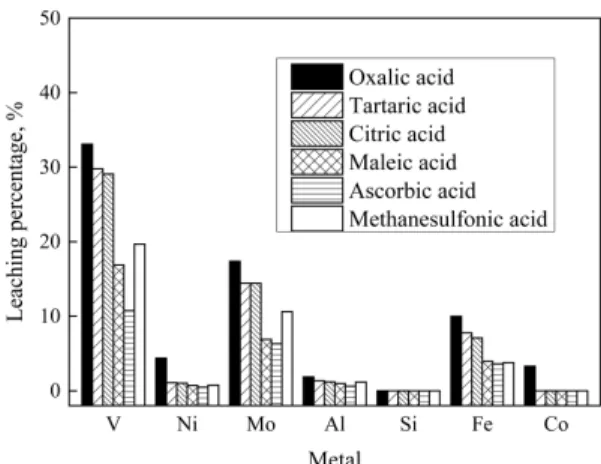
Several organic acids have been used for the leaching of metals from the spent catalyst and the results are shown in Fig. 1. The initial test conditions were temperature: 25oC, pulp density: 20 g/L, leaching time:
2 h, organic acid concentration: 1 M, and stirring speed:
500 rpm. As is seen from Fig. 1, most of organic acids can selectively dissolve vanadium and molybdenum owing to their excellent chelating properties. This behavior is in good agreement with previous works10,11,13). The difference in the leaching percentage of metals with the nature of organic acid is ascribed to the difference in the structural properties of organic acids. The leaching efficiency of metals by these organic acids was in the order: oxalic acid > tartaric acid > citric acid > maleic acid > ascorbic acid. This order agrees well with their dissociation constant16). On the other hand, the acidity of methanesulfonic acid is stronger than the other organic acids but weaker than sulfuric acid17). A strong acid like methanesulfonic acid can be expected to be more active for the leaching of the metals than other organic acids. However, our results showed the leaching efficiency of most metals by oxalic, tartaric, and citric acid was higher than that by methanesulfonic acid. It has been reported that either citric or oxalic acid is more active than sulfuric acid for the leaching of metals from the spent catalysts10,12).
Fig. 1 also indicates that oxalic acid showed the highest leaching percentage of metals among the employed organic acids. Vanadium and molybdenum were selec- tively dissolved and their leaching percentage was 33.1%
and 17.4%, respectively. Meanwhile, the leaching percentage of other metals was less than 10%. Therefore, oxalic acid was selected for further leaching experiments to investigate the effect of some factors on the dissolution behavior of metals from the spent catalyst. The aim was to find the optimal conditions for the leaching of metals from spent catalysts. Since sulfur was removed from the spent catalysts by calcination, the leaching of metals results from the dissolution of metal oxides. The dissolution reactions of metal oxides with oxalic acid can be represented as Eqs. (1) ~ (4)14). It can be said that the formation of the complexes depends on the dissociation of oxalic acid and the dissolution of metal ions. Table 1 shows the formation constants of each metal ions and oxalate. As seen in Table 1, the complex Fig. 1. Leaching percentage of metals from the spent
catalyst by organic acids. Conditions: temperature:
25oC, reaction time: 2 h, organic acid concentration:
1 M, pulp density: 20 g/L, stirring speed: 500 rpm.
Table 1. Stability constants for metal complexes of oxalic acid
Metal Complex Log K Ref.
V [VO2(C2O4)2]3– 10.2 28 Mo [Mo2O5(OH)(C2O4)2]3– 14.6 29
Ni NiC2O4 3.7 30
Co CoC2O4 3.25 28
Fe [Fe(C2O4)3]4– -2.48 31 Al Al3(OH)3(C2O4)3 -4.28 32 Si [Si(OH)3(C2O4)]– -8.5 33
formation of V(V) and Mo(VI) are much higher than that of other metals in oxalic acid solution, leading to the selective dissolution of V(V) and Mo(VI). This is in good agreement with our data results.
H2C2O4 F H+ + HC2O4– (1) HC2O4– F H+ + C2O42– (2) MOx + 2xH+ F M2x+ + xH2O (3) M2x+ + xC2O42– F M(C2O4)x (4) 3.2.1. Effect of temperature
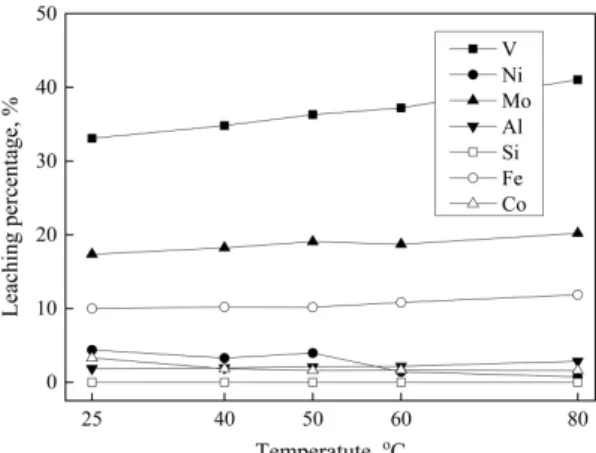
The effect of temperature on the leaching efficiency of metals by oxalic acid is shown in Fig. 2. In these experiments, the temperature was varied from 25 to 80oC, while the other conditions were fixed as oxalic acid concentration: 1 M, pulp density: 20 g/L, leaching time:
2 h, stirring speed: 500 rpm. Fig. 2 shows that the leaching percentage of vanadium increased from 33%
to 41% with the increase in temperature. The leaching efficiency of molybdenum and iron slightly increased in the temperature range and their leaching percentage fluctuated about 18.7 and 10.6%, respectively. The temperature had a negative effect on the dissolution of other metals. The leaching percentage of cobalt, nickel, aluminum, and silica was lower than 5%. It can be concluded that vanadium and molybdenum were selec- tively dissolved by oxalic acid solution. Some works
reported that oxalic acid can be decomposed to yield carbon dioxide and water at high temperature18,19). Therefore, a reaction temperature of 60oC was considered to be an optimum condition in this work. Similar results were chosen by the reported literature10,12,20).
3.2.2. Effect of oxalic acid concentration
Fig. 3 shows the influence of oxalic acid concentration on the leaching of metals from the spent petroleum catalyst. The results were obtained at the following experimental conditions: temperature, 60oC; pulp density, 20 g/L; reaction time, 2 h; stirring speed, 500 rpm. As shown in Fig. 3, the leaching percentage of vanadium after 2 h increased from 32 to 43% as acid concentration increased from 0.1 to 2 M. When oxalic acid concent- ration increased from 0.1 to 0.5 M, the leaching percent- age of iron rose to 11% and was constant with the further increase of acid concentration up to 2 M. The leaching efficiency of molybdenum, cobalt, nickel, aluminum, and silica was constant in the oxalic acid concentration range. As the concentration of organic acid increases, the concentration of hydrogen ions increases, leading to higher leaching percentage of metal ions21,22). In these experiments, except vanadium, oxalic acid concentration did not affect the leaching behavior of most metals in the spent catalysts. Besides, when acid concentrations were higher than 0.5 M, some crystalline
Fig. 2. Effect of temperature on the dissolution of metals.
Pulp density: 20 g/L; leaching time: 2 h; oxalic acid concentration: 1 M; stirring speed: 500 rpm.
Fig. 3. Effect of oxalic acid concentration on the dissolution of metals. Temperature: 60oC; pulp density: 20 g/L;
leaching time: 2 h; stirring speed: 500 rpm.
oxalic acids were observed after keeping the leaching solution for several hours. Therefore, 0.5 M oxalic acid was selected as the optimum concentration in further experiments. This result is similar to the published literature20).
3.2.3. Effect of pulp density
To investigate the effect of pulp density on the leaching efficiency of metals from the spent catalyst, the pulp density was varied from 10 to 50 g/L. The experimental conditions employed were as follows: temperature, 60oC;
oxalic acid concentration, 0.5 M; reaction time, 2 h;
stirring speed, 500 rpm. In general, an increase in the pulp density lowers the leaching efficiency of metal ions in the solution10,11). Our results agree well with these reported results. Fig. 4 shows that the leaching percentage of vanadium was decreased in the pulp density range.
Meanwhile, the leaching efficiency of molybdenum and iron slightly decreased with an increase in pulp density.
There was no change in the leaching percentage of the other metals in the range of pulp density from 10 to 30 g/L. As pulp density increased, a small increase in the leaching of cobalt, nickel, and silica was observed.
This may be due to the dense distribution of spent catalysts in the aqueous phase which facilitates the contact of the spent catalysts with oxalic acid solution. However, their leaching percentage was still low (< 10%). Since
oxalic acid could selectively dissolve vanadium and molybdenum, the pulp density of 20 g/L was suggested as the optimum condition.
3.2.4. Effect of stirring speed
The stirring speed has an important role in promoting the dispersion of spent catalysts into aqueous solution.
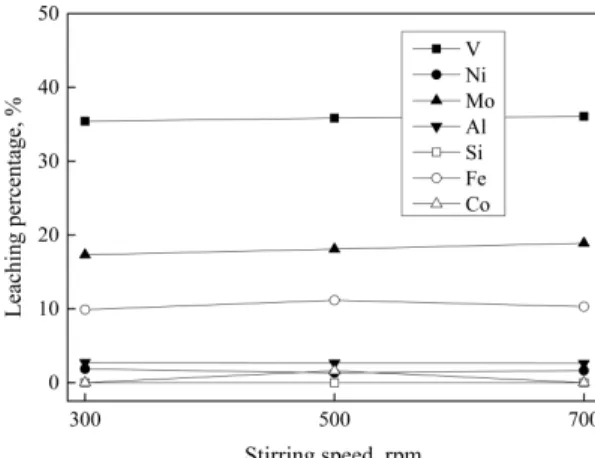
In these experiments, stirring speed was varied from 300 to 700 rpm in order to evaluate the effect on leaching efficiency. The factors such as reaction temperature, pulp density, leaching time, and oxalic acid concentration were kept constant at 60oC, 20 g/L, 2 h, and 0.5 M, respectively.
As shown in Fig. 5, an increase in stirring speed did not seem to show a significant effect on the leaching of metals from spent catalyst. The leaching percentage of all metals was almost constant at any stirring speed.
This behavior might be due to the dissolution of the metals in oxalic acid solution has reached equilibrium after 2 h leaching. To verify this, the effect of leaching time on the leaching of metals was conducted at a stirring speed of 500 rpm in further experiments.
3.2.5. Effect of leaching time
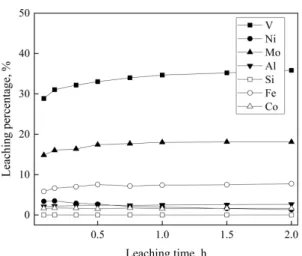
The influence of leaching time was studied up to 2 h at the following conditions: oxalic acid concentration 0.5 M, temperature 60oC, pulp density 20 g/L, stirring speed 500 rpm. It has been reported that the dissolution
Fig. 4. Effect of pulp density on the dissolution of metals.
Temperature: 60oC; leaching time: 2 h; oxalic acid concentration: 0.5 M; stirring speed: 500 rpm.
Fig. 5. Effect of stirring speed on the dissolution of metals.
Temperature: 60oC; pulp density: 20 g/L; leaching time: 2 h; oxalic acid concentration: 0.5 M.
rate of metal is generally fast in the initial stage and becomes slow in the later stage3). Our result is almost similar to that trend. As shown in Fig. 6, the leaching efficiency of vanadium was fast at the first 30 min of reaction time and was slowly increased with the increase of time up to 1.5 h. The same leaching behavior for molybdenum and iron was observed. The faster dissolution of metals at the initial stage can be ascribed to the dissolution of metal oxides in the spent catalyst. On the other hand, a decrease in leaching rate of the metals in the later stage might be ascribed to the increase in the thickness of the product layer, leading to a decrease in the mass transfer of oxalic acid solution through the product layer. Since the leaching percentage of other metals (Co, Ni, Al, and Si) was very low, the leaching time has a negligible effect on the leaching efficiency of these metals. Based on the leaching results, 2 h leaching time can be considered to be an optimum condition. This optimum leaching time is in good agreement with previous studies3,11,20).
From the leaching experiments, the following condition was selected as the most favorable condition: 60oC temperature, 0.5 M oxalic acid, 20 g/L pulp density, 2 h leaching time, and 500 rpm stirring speed. Table 2 summarizes the optimum conditions for the leaching of metals from the spent catalyst by oxalic acid solution.
Under these conditions, the highest leaching percentage of vanadium and molybdenum was 36% and 18%, respec- tively. Several works have shown that organic acids have higher leaching efficiency of valuable metals from the spent catalyst10,11,20), while adverse effects are observed14,21). The difference in the leaching behavior of the metals by organic acids might be ascribed to the leaching conditions and contents of metals in spent catalysts.
In the present work, although the leaching efficiency of vanadium by organic acids was not high, it was selectively dissolved over the other metals by oxalic acid from the spent catalysts. Further studies on improving the leaching of vanadium with organic acids are needed.
In addition, after the leaching of vanadium from spent catalysts is improved, the separation of metals in the leaching solution can be investigated by employing some processes such as solvent extraction, precipitation, and ion exchange. From there, the possibility of commer- cialization can be evaluated.
3.3. Kinetics analysis
Since the leaching time did not affect the leaching efficiency of most metals in the spent catalysts except vanadium (see Fig. 6), the leaching kinetics of vanadium was investigated. The reaction kinetics for metals in the spent catalyst are generally analyzed by employing the shrinking core model (SCM)23). Many kinetic equations listed in Table 3 have been used to describe the leaching kinetic data in solid-liquid reactions. In Table 3, the value of x is the conversion of vanadium and was calculated by Eq. (5). And t is reaction time (min), and k denotes the apparent rate constant.
Fig. 6. Effect of leaching time on the dissolution of metals.
Temperature: 60oC; pulp density: 20 g/L; oxalic acid concentration: 0.5 M; stirring speed: 500 rpm.
Table 2. A summary of the optimal conditions for the leaching of spent catalysts by oxalic acid
Parameters Optimal conditions
Temperature, oC 60
Oxalic acid concentration, M 0.5
Pulp density, g/L 20
Leaching time, h 2
Stirring speed, rpm 500
x = % vanadium extraction/100 (5) In order to find the most suitable kinetic model for the dissolution of vanadium with oxalic acid solution, the above kinetic equations were tested in the present study. The rate equations in Table 3 were tried as a function of time according to our previous experimental data15). Among the kinetic equations employed in this work, Eq. (13) is suitable for the leaching kinetics of vanadium with correlation coefficient (R2) values higher than 0.98. Eq. (13) is known as the Avrami equation which has been successfully employed to explain the leaching kinetics of metals from solid materials24,25). The parameter n in the Avrami equation can give some information on the reaction controlling step as well as reflect the nature of the leaching. The value of n near to 1 indicates that chemical reaction is the controlling step. In contrast, the reaction rate is mass transfer controlled when the value of n is less than 0.5. Within our knowledge, Eq. (13) has not been applied for leaching kinetics of vanadium by oxalic acid from the spent petroleum catalyst. Based on leaching data in our previous work, plots of Eq. (13) are depicted in Fig. 7. The
slope and intercept of the plot give the parameter n and the apparent rate constant values, respectively. Fig.
7 presents straight lines with the correlation coefficient close to 1, indicating that Eq. (13) fits the experimental data. In addition, the slope values of the lines were lower than 0.5, suggesting that the leaching of vanadium is controlled by mass transfer step. The intercepts of the lines in Fig. 7(a) can be used to determine the apparent rate constant and applied to calculate the activation energy of vanadium leaching process.
3.4. Calculation of the activation energy
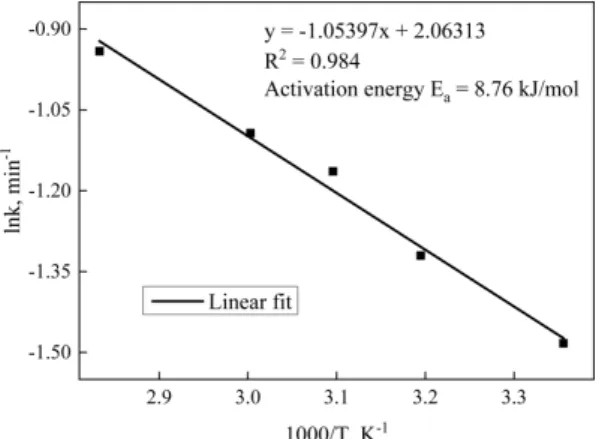
The apparent activation energy of the reaction can be calculated on the basis of the Arrhenius equation (Eq. 14).
lnk = lnA Ea/(RT) (14)
where k, A, Ea, R, and T denote the reaction rate constant (min1), the frequency factor (min1), the apparent activation energy (J/mol), the universal gas constant (8.314 J/mol·K), and reaction temperature (K), respectively.
Activation energy was obtained from the Arrhenius Table 3. Kinetic models tested in the leaching of metals from various materials
No. Kinetic equation Remark Kinetic process Ea/(kJ/mol) Ref.
(6) kt =1 (1-x)1/3 V leaching from chromium residue
intensified by NaOH in an electric field Chemical reaction control
process 10.08 34
(7) kt = 1 (1-x)1/2 V leaching from spent hydrodesulphurization catalyst by oxalic acid and H2O2
Chemical reaction at the particle
surface 30 ± 4 20
(8) kt = 1 2x/3 (1-x)2/3 V leaching from spent sulfuric acid catalyst
by H2SO4 Diffusion control process 18.44 35
(9) kt = x + (1-x)ln(1-x) V, Ni, Al leaching from spent
hydrodesulphurization catalyst by oxalic acid and H2O2
Product layer diffusion control
process - 20,36
(10) kt = (1/3)ln(1-x) + [(1-x)–1/31] V leaching from black shale by H2SO4 Interfacial transfer and diffusion
through the product layer 40.14 37 (11) kt = 1 3(1-x)+ 2(1-x) 2/3 V leaching from high chromium vanadium
slag by H2SO4 after roasting Solid product layer diffusion
and chemical reaction 14.38 26 (12) kt = (1-x)–2/3 1 Ni leaching from spent catalyst by HNO3 Mixed or intermediate-
controlled process 34.65 38
(13) ktn = -ln(1-x) V leaching from spent V2O5/TiO2 catalyst by
H2SO4 Diffusion in the solid 5.90 24
Ea: Activation energy
plot (see Fig. 8). The plot in Fig. 8 gave a straight line with a correlation coefficient value of 0.98, indicating that the applied model is suitable. The apparent activation energy calculated from the slope of the plot is 8.7 kJ/
mol. The obtained activation energy confirms that the leaching of vanadium from the spent petroleum catalyst in oxalic acid solution is controlled by mass transfer.
The low activation energy in this work is consistent with the several values reported in the literature. Namely, activation energy of 8.06 and 8.1 kJ/mol were obtained for the leaching of vanadium from high chromium slag by sulfuric acid26) and from chromium residues by alkaline medium27).
4. Conclusions
In order to investigate the leaching behavior of some rare metals from the spent petroleum catalysts, several organic acids such as oxalic acid, tartaric acid, citric acid, maleic acid, ascorbic acid, and methanesulfonic acid were employed. Among these acid solutions, oxalic acid shows the best selectivity for the dissolution of vanadium and molybdenum. Leaching parameters such as acid concentration, pulp density, temperature, stirring speed, and time were varied to optimize the leaching process. The optimum condition was found to be temperature of 60oC, oxalic acid concentration 0.5 M, pulp density of 20 g/L, stirring speed of 500 rpm, and 2 h leaching time in the range of investigated parameters.
The dissolution of metals from the spent catalyst occurred through the complex formation between metal ions and oxalate ion. Under optimum conditions, about 36%
vanadium, 18% molybdenum and 8% iron were dissolved while the leaching percentage of other metals was negligible. The kinetics of vanadium leaching was controlled by diffusion through the product layer. Among Fig. 7. Plot of ln(-ln(1-x)) vs. leaching time at various (a)
temperatures, (b) oxalic acid concentrations, and (c) pulp densities.
Fig. 8. Arrhenius plot for the activation energy of vanadium leaching by oxalic acid solution.
the several kinetic equations tested in this work, the linear equation ktn= ln(1-x) gave the best fit to our results. The activation energy of 8.76 kJ/mol for the leaching indicated that the leaching is controlled by mass transfer through product layer. Further work is necessary to increase the leaching efficiency of vanadium.
Acknowledgements
This work was supported by National Research Foundation of Korea (NRF-2018R1D1A1B07044951).
References
1. Banda, R., Nguyen, T. H., Sohn, S. H., and Lee, M. S., 2013 : Recovery of valuable metals and regeneration of acid from the leaching solution of spent HDS catalysts by solvent extraction, Hydrometallurgy, 133, pp.161-167.
2. Mishra, D., Chaudhury, G. R., Kim, D. J., and Ahn, J. G., 2010 : Recovery of metal values from spent petroleum catalyst using leaching-solvent extraction technique, Hydrometallurgy, 101(1-2), pp.35-40.
3. Barik, S. P., Park, K. H., Parhi, P. K., and Park, J. T., 2012 : Direct leaching of molybdenum and cobalt from spent hydrodesulphurization catalyst with sulphuric acid, Hydrometallurgy, 111-112(1), pp.46-51.
4. Marafi, M. and Stanislaus, A., 2008 : Spent catalyst waste management: A review. Part I-developments in hydroprocessing catalyst waste reduction and use, Resour. Conserv. Recycl., 52(6), pp.859-873.
5. Kalantar, M., Najafi, H., and Afshar, M. R., 2019 : Com- parison between vanadium and niobium effects on the mechanical properties of intercritically heat treated microalloyed cast steels, Met. Mater. Int., 25(1), pp.229- 237.
6. Huang, Y., Peng, X., Yang, Y., Wu, H., Sun, X., and Han, X., 2018 : Electroless Cu/Ni plating on graphite flake and the effects to the properties of graphite flake/Si/Al hybrid composites, Met. Mater. Int., 24(5), pp.1172- 1180.
7. Nguyen, T. T. N. and Lee, M. S., 2019 : Improvement of alumina dissolution from the mechanically activated dross using ultrasound-assisted leaching, Korean J. Met.
Mater., 57(3), pp.154-161.
8. Park, K. H., Mohapatra, D., and Reddy, B. R., 2006 : Selective recovery of molybdenum from spent HDS cat- alyst using oxidative soda ash leach/carbon adsorption method, J. Hazard. Mater., 138(2), pp.311-316.
9. Kim, S. J., Lee, J. Il., Han, K. S., Byun, S. Y., Tran, T., and Kim, M. J., 2018 : Recovery of fine aluminum hydroxide with high whiteness index from low quality bauxite using caustic roasting and water leaching, Korean J. Met. Mater., 56(1), pp.49-58.
10. Mazurek, K., 2013 : Recovery of vanadium, potassium and iron from a spent vanadium catalyst by oxalic acid solution leaching, precipitation and ion exchange pro- cesses, Hydrometallurgy, 134-135, pp.26-31.
11. Erust, C., Akcil, A., Bedelova, Z., Anarbekov, K., Baikonurova, A., and Tuncuk, A., 2016 : Recovery of vanadium from spent catalysts of sulfuric acid plant by using inorganic and organic acids: Laboratory and semi- pilot tests, Waste Manag., 49, pp.455-461.
12. Marafi, M. and Stanislaus, A., 2011 : Waste catalyst uti- lization: Extraction of valuable metals from spent hydro- processing catalysts by ultrasonic-assisted leaching with acids, Ind. Eng. Chem. Res., 50(16), pp.9495-9501.
13. Ilhan, S., Kalpakli, A. O., Kahruman, C., and Yusufoglu, I., 2013 : The use of oxalic acid as a chelating agent in the dissolution reaction of calcium molybdate, Metall.
Mater. Trans. B, 44(3), pp.495-505.
14. Marafi, M., Stanislaus, A., and Absi-Halabi, M., 1994 : Heavy oil hydrotreating catalyst rejuvenation by leaching of foulant metals with ferric nitrate-organic acid mixed reagents, Appl. Catal. B Environ., 4(1), pp.19-27.
15. Le, M. N. and Lee, M. S., 2019 : Selective dissolution of vanadium (V) from spent petroleum catalysts by oxalic acid solution. J. Min. Metall. Sect. B Metall., (under review).
16. Lide, D. R., 2007 : CRC Handbook of Chemistry and Physics, 87th ed., Taylor and Francis, Boca Raton, FL, pp.842-846.
17. Guthrie, J. P., 1978 : Hydrolysis of esters of oxy acids:
pKa values for strong acids; Brønsted relationship for attack of water at methyl; free energies of hydrolysis of esters of oxy acids; and a linear relationship between free energy of hydrolysis and pKa holding over a range of 20 pK units, Can. J. Chem., 56(17), pp.2342-2354.
18. Kakumoto, T., Saito, K., and Imamura, A., 1987 : Uni- molecular decomposition of oxalic acid, J. Phys. Chem., 91(9), pp.2366-2371.
19. Lindsay, J. G., McElcheran, D. E., and Thode, H. G., 1949 : The isotope effect in the decomposition of oxalic acid, J. Chem. Phys., 17(6), pp.589-589.
20. Szymczycha-Madeja, A., 2011 : Kinetics of Mo, Ni, V and Al leaching from a spent hydrodesulphurization cat- alyst in a solution containing oxalic acid and hydrogen peroxide, J. Hazard. Mater., 186(2-3), pp.2157-2161.
21. Mulak, W., Szymczycha, A., Leśniewicz, A., and
Żyrnicki, W., 2006 : Preliminary results of metals leach- ing from a spent hydrodesulphurization (HDS) catalyst, Physicochem. Probl. Miner. Process., 40(1), pp.69-76.
22. Lee, J. Y., Rao, S. V., Kumar, B. N., Kang, D. J., and Reddy, B. R., 2010 : Nickel recovery from spent Raneynickel catalyst through dilute sulfuric acid leach- ing and soda ash precipitation, J. Hazard. Mater., 176(1- 3), pp.1122-1125.
23. Parhi, P. K., Park, K. H., and Senanayake, G., 2013 : A kinetic study on hydrochloric acid leaching of nickel from Ni-Al2O3 spent catalyst, J. Ind. Eng. Chem., 19(2), pp.589-594.
24. Li, Q., Liu, Z., and Liu, Q., 2014 : Kinetics of vanadium leaching from a spent industrial V2O5/TiO2 catalyst by sulfuric acid, Ind. Eng. Chem. Res., 53(8), pp.2956- 2962.
25. Sokić, M. D., Marković, B., and Živković, D., 2009 : Kinetics of chalcopyrite leaching by sodium nitrate in sulphuric acid, Hydrometallurgy, 95(3), pp.273-279.
26. Gao, H., Jiang, T., Xu, Y., Wen, J., and Xue, X., 2018 : Leaching kinetics of vanadium and chromium during sulfuric acid leaching with microwave and conventional calcification-roasted high chromium vanadium slag, Miner. Process. Extr. Metall. Rev., pp.1-10.
DOI:10.1080/08827508.2018.1538985.
27. Peng, H., Liu, Z., and Tao, C., 2016 : Leaching kinetics of vanadium with electro-oxidation and H2O2 in alkaline medium, Energy and Fuels, 30(9), pp.7802-7807.
28. Martell, A. E. and Smith, R. M., 1977 : Critical Stability Constants, Vol. 3., Springer Science + Business Media, New York, pp.92-98.
29. Beltrán, A., Caturla, F., Cervilla, A., and Beltrán, J., 1981 : Mo(VI) oxalate complexes, J. Inorg. Nucl. Chem., 43, pp.3277-3282.
30. Martell, A. E. and Smith, R. M., 1982 : Critical Stability
Constants, Vol 5., Springer Science + Business Media, New York, pp.307-309.
31. Panias, D., Taxiarchou, M., Douni, I., Paspaliaris, I., and Kontopoulos, A., 2014 : Thermodynamic analysis of the reactions of iron oxides: Dissolution in oxalic acid, Can.
Metall. Q., 35, pp.363-373.
32. Sjöberg, S. and Öhman, L. O., 1985 : Equilibrium and structural studies of silicon(IV) and aluminium(III) in aqueous solution. Part 13. A potentiometric and 27Al nuclear magnetic resonance study of speciation and equi- libria in the aluminium(III)-oxalic acid-hydroxide sys- tem, J. Chem. Soc. Dalt. Trans., 12, pp.2665-2669.
33. Poulson, S. R., Drever, J. I., and Stillings, L. L., 1997 : Aqueous Si-oxalate complexing, oxalate adsorption onto quartz, and the effect of oxalate upon quartz dissolution rates, Chem. Geol., 140, pp.1-7.
34. Peng, H., Liu, Z., and Tao, C., 2015 : Selective leaching of vanadium from chromium residue intensified by elec- tric field, J. Environ. Chem. Eng., 3(2), pp.1252-1257.
35. Lozano, L. J. and Juan, D., 2001 : Leaching of vanadium from spent sulphuric acid catalysts, Miner. Eng., 14(5), pp.543-546.
36. Dickinson, C. F. and Heal, G. R., 1999 : Solid–liquid dif- fusion controlled rate equations, Thermochim. Acta, 340-341, pp.89-103.
37. Li, M., Wei, C., Qiu, S., Zhou, X., Li, C., and Deng, Z., 2010 : Kinetics of vanadium dissolution from black shale in pressure acid leaching, Hydrometallurgy, 104(2), pp.193-200.
38. Ramos-Cano, J., González-Zamarripa, G., Carrillo- Pedroza, F. R., Soria-Aguilar, M. D. J., Hurtado-Macías, A., and Cano-Vielma, A., 2016 : Kinetics and statistical analysis of nickel leaching from spent catalyst in nitric acid solution, Int. J. Miner. Process., 148, pp.41-47.
Minh Nhan Le
• 목포대학교 신소재공학과 학사
• 현재 목포대학교 신소재공학과 박사과정
이 만 승
• 현재 목포대학교 신소재공학과 교수
• 당 학회지 제11권 1호 참조